
From a self-serving, hedonistic site called “Munchies”…
http://munchies.vice.com/articles/hey-guys-we-should-chill-out-on-eating-chicken/
Written by
Kirsten Stamn
Assistant Editor
June 8, 2014
The news as of late has been pretty doom-and-gloom—downright apocalyptic, in fact. We’ve got stories flooding our inboxes and feeds filled with gruesome statistics about catastrophically rising sea levels, terrible wildfires, and devastating droughts. It’s been dominating the national conversation, not just because it’s bringing up those recurring childhood nightmares spurred on by The Day After Tomorrow, but also because it’s affecting our food supply. We’re already seeing staples like pork,beef,fish,shrimp—evenbananas andlimes—become decimated by disease or climate change, causing prices to climb. So American consumers have started to lean more heavily on an already reliable food source: chicken. Too bad our beloved poultry is facing its own issues.
Enter our old friend, bird flu (which the poultry industry really wishes we wouldn’t call it). Having previously been the subject of mass hysteria worldwide, it’s recently flown relatively under-the-radar despite being endemic in six countries around the world: Bangladesh, China, Egypt, India, Indonesia, and Vietnam. There have been multiple outbreaks in Asia this year—Japan has culled a ton of chickens thanks to an outbreak,China is sorry it infected Taiwan,South Korea’s got it, evenNorth Korea isn’t able to isolate itself from this disease—and theUS had a small scare in late April when the disease broke out in a Californian quail farm. It’s even somehow infected penguins in Antarctica. This is a disease that mutates rapidly (producingseveral strains that are fatal to humans) and alsospreads like wildfire. In fact, it’s so adaptable that many researchers havepaused in experimenting with the virus in case it triggers a pandemic. (Their worries are valid: The virus is onlyfive strains away from being tailored to preying on humans.) But not everyone has stopped. There are still those whocontinue to adapt the virus in order to study its mutation process, despite the international uproar it’s caused in the science community.
While scientists are busy playing with a ticking time bomb, the chicken industry has been busy creating the perfect conditions (i.e., overcrowded factory farms) for this virus to take off. (Reps from the USDA’s Animal and Plant Health Inspection Service did not return calls.) When an infected migratory bird somehow enters a facility—often through holes in fencing—it can set off a massive chain reaction. And humans who come in contact with infected birds—whether factory farm workers or customers—can get the disease, too: One of the reasons Asia has the most human fatalities thanks to the H5N1 virus isdue to their live poultry markets, where customers get up close and personal with their potentially infected future dinner. Mmm.
Regardless, it doesn’t look like industrialization is going to change its habits anytime soon. Chicken consumption is rising thanks to both a culturally instilled meat-heavy diet and the fact that beef and pork prices are suddenly skyrocketing. And according to David Harvey from the USDA office, it’s going to keep rising: Forecasts for 2015 indicate that Americans will be eating 39.275 billion pounds of chicken, a healthy 847 million pounds more than what we’re going to be eating in 2014. To top it off, the chicken industry is actually raising its prices because (a) demand is high now that the competition is down, and (b) to compensate for those pesky bird flu losses. Overall, the industry’s sales are down slightly, yet its margins are increasing. Let’s take a moment to process that.
I’m very happily a carnivore; I eat chicken at least once or twice a week. But right now, veggies are starting to sound pretty damn good.
 Exposing the Big Game
I rescue chickens, so I hate this article
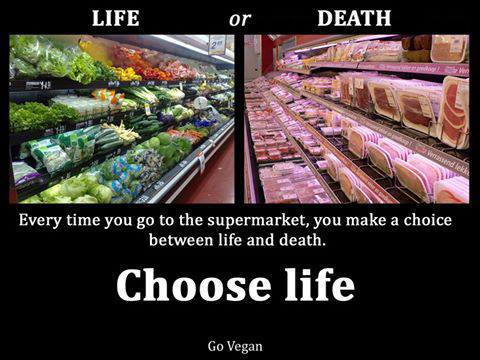
‘Every time you go to the supermarket, you make a choice between life and death. Choose life.’
I love this statement. It’s true.
Personally, I feel that if people want to eat the flesh and secretions of animals they should watch video footage of how that steak landed in cellophane and the milk in the carton. Video footage of animal slaughter should be playing on a loop above the meat & dairy section.
I agree; and if they still want to eat it, they should see a psychiatrist.