Exposing the Big Game

Forget Hunters' Feeble Rationalizations and Trust Your Gut Feelings: Making Sport of Killing Is Not Healthy Human Behavior

Exposing the Big Game

Wolf Violation Notice Delivered To Montana Governor Steve Bullock….

Nabeki's avatarHowling For Justice

wolf-howling fanpop

October 23, 2014

It’s time to start thinking outside the box concerning the decimation of America’s wolves and WWAG is certainly doing that. Trying to protect Montana and Idaho wolves, by fighting for them in federal court,  was hamstrung by the budget bill-wolf delisting rider, passed by the Democrat controlled US Senate, in 2011, which took judicial review off the table.

WWAG is demanding wolves be placed back under federal protection stating  “Montana’s wolf management policy violates the United Nations Charter for Nature, !”

“Why are these psychopaths allowed to torture animals in this country, yet 86 other countries have banned trapping?” asked WWAG member Michelle Domeier.

The group held posters showing wolves dead in both foothold traps and snares identified as legal means of killing wolves in Montana. More than 2,600 wolves had been killed since being strippedfrom federal protections, they said.

After speaking on the Capitol steps…

View original post 948 more words

The Cruelty of Wildlife Services’ Aerial Gunning

1920332_613143138754489_331154733_n

Here’s the text of a friend’s testimony to the WDFW at their wolf “management hearing:

I’m speaking on behalf of wolf protection and recovery. I’m going to cover three points tonight.

 First, perceived “conflicts” with majestic predators like wolves or cougars are just one of the COUNTLESS examples of the negative impact livestock grazing is having our state and planet. You mentioned California’s drought and fires raging in the forests of Washington, which are a direct result of livestock grazing. Climate change aside, livestock grazing continues to decimate wildlife populations at utterly astonishing rates.
My second point is that rural forested USFS land is remote and ideal for predators like wolves. Looking at the pictures of this habitat shown tonight, I was frankly shocked. This is land where I’d expect wolves should be able to live, free from harm. Where in the species recovery process are wolves expected to live and thrive if even THIS habitat is considered unacceptable for them (but appropriate for sheep grazing)?
My final point is that killing is NOT management. The fact that aerial gunning–one of the most traumatic and terrifying and cruel methods of killing–was used speaks to where I fear the department’s values lie. Further, that USDA’s WL Services–which is increasingly under scrutiny for their careless killing practices–was used to do the department’s killing speaks to the same. I call WL Services the “killing squads” because ALL they do is kill; they kill wildlife en mass and usually in exceedingly cruel ways. I’ve seen them kill first-hand, with my own eyes. This is unacceptable.
Thank you for the opportunity to speak this evening.

Wildlife Conservation & Management Funding in the U.S.

http://www.nrwm.org/wildlife-conservation-management-funding-in-the-u-s-2/

Wildlife Conservation & Management Funding in the U.S.

By Mark E. Smith and Donald A. Molde

October 2014

EXECUTIVE SUMMARY

The authors present a novel approach to help answer the question “Who really pays for wildlife in the U.S?” Using public information about budgets of various conservation, wildlife advocacy, and land management agencies and non-profit organizations, published studies and educated assumptions regarding sources of Pittman-Robertson Act and Dingle-Johnson Act federal excise monies from the sale of sporting equipment, the authors contend that approximately 95% of federal, 88% of non-profit, and 94% of total funding for wildlife conservation and management come from the non-hunting public. The authors further contend that a proper understanding and accurate public perception of this funding question is a necessary next step in furthering the current debate as to whether and how much influence the general public should have at the wildlife policy-making level, particularly within state wildlife agencies.

Read the full paper here: Smith Molde Wildlife Conservation & Management Funding in the US Oct14 FINAL

Ebola a Symptom of Ecological and Social Collapse

The global environment is collapsing and dying under the weight of inequitable over-population and ecosystem loss.

“We learn the meaning of enough and how to share or it is the end of being.” ― Dr. Glen Barry

The surging Ebola epidemic is the result of broad-based ecological and social collapse including rainforest loss, over-population, poverty and war. This preventable environmental and human tragedy demonstrates the extent to which the world has gone dramatically wrong as ecosystem collapse, inequity, grotesque injustice, religious extremism, nationalistic militarism, and resurgent authoritarianism threaten our species and planet’s very being.

Any humane person is appalled by the escalating Ebola crisis, and let’s be clear expressing these concerns regarding causation is NOT an attempt to hijack a tragedy. Things happen for a reason, and Ebola was preventable, and future catastrophes of potentially greater magnitude can be foreseen and avoided by the truth.

The single greatest truth underlying the Ebola tragedy is that humanity is systematically dismantling the ecosystems that make Earth habitable. In particular, the potential for Ebola outbreaks and threats from other emergent diseases is made worse by cutting down forests [1]. Exponentially growing human populations and consumption – be it subsistence agriculture or mining for luxury consumer items – are pushing deeper into African old-growth forests where Ebola circulated before spillover into humans.

Poverty stricken communities in West Africa are increasingly desperate, and are eating infected “bushmeat” such as bats and gorilla, bringing them into contact with infected wildlife blood. Increasingly fragmented forests, further diminished by climate change, are forcing bats to find other places to live that are often amongst human communities.

Some 90% of West Africa’s original forests have already been lost. Over half of Liberia’s old-growth forests have recently been sold for industrial logging by President Ellen Johnson Sirleaf’s post-war government. Only 4% of Sierra Leone’s forest cover remains and they are expected to totally disappear soon under the pressure of logging, agriculture, and mining.

My recently published peer-reviewed scientific research [2] on ecosystem loss and biosphere collapse indicates more natural ecosystems have been lost than the global environment can handle without collapsing. Recently published science reports that 50% of Earth’s wildlife has died (in fact been murdered) in the last 40 years [3].

Loss of natural life-giving habitats has consequences. We are each witnesses to and participants in global ecosystem collapse.

There are other major social ills which potentially foster global pandemics. Rising inequity, abject poverty, and lack of justice threaten Earth’s and humanity’s very being. These ills and global ecosystem collapse are causing increased nationalistic war, migration and rise of authoritarian corporatism. West Africa has been ravaged by war and poverty for decades, which shows little signs of abating, particularly since natural habitats for community based sustainable development are nearly gone.

War breeds disease. It is no coincidence that the 1918 flu pandemic – the last great global disease outbreak that killed an estimated 50-100 million – occurred just as the ravages of World War I were ending. Conditions after ecosystems are stripped by over-population and poverty are not that different – each providing ravaged landscapes that are prime habitat for disease organisms.

West Africa’s ecological collapse has brought people into contact with blood from infected animals causing the Ebola epidemic. Once human infection occurs, ecologically denuded, conflict ridden, over-populated, and squalid impoverished communities are ripe for a pandemic. As the Ebola virus threatens to become endemic to the region, it potentially offers a permanent base from which infections can indefinitely continue to spread globally.


Since 911 America has slashed all other spending as it militarizes, viewing all sources of conflict as resolvable by waging perma-war. Africa needs doctors and the U.S. sends the military. Both terrorism and infectious disease are best prevented by long-term investments in equitably reducing poverty and meeting human needs – including universal health-care, living wage jobs, education, family planning, and establishment of greater global medical rapid response capabilities.

We are all in this together. Our over-populated, over-consuming, inequitable human dominated Earth continues to wildly careen toward biosphere collapse as sheer sum consumption overwhelms nature. West Africa’s 2010 population of 317 million people is still growing at 2.35%, and is expected to nearly double in 25 years, even as squalor, lack of basic needs, ecosystem loss, and pestilence increase. This can never, ever be ecologically or socially sustainable, and can only end in ruin.

Equity, education, condoms, and lower taxes and other incentives to stabilize and then reduce human population are a huge part of the solution for a just, equitable, and sustainable future. Otherwise Earth will limit human numbers with Ebola and worse. It may be happening already.

We are one human family and in a globalized world no nation is an island unto itself. By failing to invest in reducing poverty and in meeting basic human needs in Africa and globally (even as we temporarily enrich ourselves by gorging upon the destruction of their natural ecosystems), we in the over-developed world ensure that much of the world is fertile ground for disease and war. There is no way to keep Ebola and other social and ecological scourges out of Europe and America if they overwhelm the rest of humanity.

Ebola is what happens when the rich ignore poverty, as well as environmental and social decline, falsely believing they are not their concern. There can be no security ever again for anybody as long as billions live in abject poverty on a couple dollars a day as a few hundred people control half of Earth’s wealth.

We learn the meaning of enough and how to share or it is the end of being.

Walmart parking lots and iPads don’t sustain or feed you. Healthy ecosystems and land do. The hairless ape with opposable thumbs – that once showed so much potential – has instead become an out of control, barbaric and ecocidal beast with barely more sentience of its environmental constraints than yeast on sugar.

Ebola is very, very serious but can be beat with public health investments, coming together and showing courage, and by dealing with underlying causes. In the short-term, it is absolutely vital that the world organizes a massive infusion of doctors and quarantined hospital beds into West Africa immediately, even as we work on the long-term solutions highlighted here.

Ultimately commitments to sustainable community development, universal health care and education, free family planning, global demilitarization, equity, and ecosystem protection and restoration are the only means to minimize the risk of emergent disease. Unless we come together now as one human family and change fast – by cutting emissions, protecting ecosystems, having fewer kids, ending war, investing in ending abject poverty, and embracing agro-ecology – we face biosphere collapse and the end of being.

A pathway exists to global ecological sustainability; yet it requires shared sacrifice and for us all to be strong, as we come together to vigorously resist all sources of ecocide. It is up to each and every one of us to commit our full being to sustaining ecology and living gently upon Earth… or our ONE SHARED BIOSPHERE collapses and being ends

I desperately hope that Ebola does not become a global pandemic killing hundreds of millions or even billions. But if it does, it is a natural response from an Earth under siege defending herself from our own ignorant yet willful actions. We have some urgent changes to make as a species, let’s get going today before it is too late.

###

[1] We Are Making Ebola Outbreaks Worse by Cutting Down Forests: Mother Jones

[2] Barry, G. (2014), “Terrestrial ecosystem loss and biosphere collapse”, Management of Environmental Quality, Vol. 25 No. 5, pp. 542-563. Read online for personal use only: http://bit.ly/MEQ_Biosphere

[3] Living Planet Index: Zoological Society of London and WWF


Support Earth through a donation to EcoInternet at http://www.climateark.org/shared/donate/

What’s to Stop Them?

I attended the Washington Department of Fish and Wildlife (WDFW) wolf hearing last week to find out how far the WDFW ultimately plans to go with wolf hunting, once wolves are inevitably removed from the state endangered species list, and when Washington residents can expect to hear that hunting groups are holding contest hunts on wolves like our neighbors in Idaho have already done.

It turns out the department wasn’t ready to come clean on their ultimate plans to implement hunting seasons on wolves (starting in Eastern Washington). They were only willing to talk about the few cases of sheep predation (a few dozen out of a flock of 1,800 animals grazing on public forest land), and the WDFW’s collusion with areal snipers from the federal Wildlife “Services” for some good old fashioned lethal removal. Here are some notes on what I was planning to say, had it been on topic:

Over the years spent living in rural Eastern Washington, I’ve gotten to know how ranchers think and feel, and what they’re capable of. For over twenty years I lived in a cabin outside the Okanogan County town of Twisp, where rancher/convicted poacher Bill White is currently under house arrest. Exploiting his then-good standing and local influence to get permission from the WDFW to gather road-killed deer, under the guise of distributing them as meat to members of the Colville tribe, he used some of the deer as bait to lure wolves from the Lookout pack to within shooting distance. He and his son are credited with killing several members of that pack—the first wolves to make it back into Washington. Their sense of entitlement was so overblown they thought they could get away with sending a blood-dripping wolf hide across the Canadian border.

On the plus side, I also have a lot of experiences with wolves themselves. As a wildlife photographer I’ve photographed them in Alaska and Canada as well as in Montana, where I lived a mile away from Yellowstone National Park. I got to know the real nature and behavior of wolves. I’d like to think that if ranchers knew the wolves the way I do, they wouldn’t be so quick to want to kill them off again. I shouldn’t have to remind folks that wolves were exterminated once already in all of the lower 48 states, except Minnesota, which had only six wolves remaining before the species was finally protected as endangered.

Although I personally believe that wolves belong to no one but themselves, to use game department jargon, wolves and other wildlife belong to everyone in the state equally—not just the squeakist-wheel ranchers and hunters. By far most of Washington’s residents want to see wolves allowed to live here and don’t agree with the department’s lethal wolf removal measures (that no doubt include plans for future wolf hunting seasons, which are currently being downplayed by the WDFW).

What’s to stop Washington from becoming just like Idaho, Montana and Wyoming in implementing reckless wolf-kill programs that eventually lead to contest hunts (as in Idaho) and the subsequent decimation of entire packs? Or year-round predator seasons that ultimately result in federal re-listing (as in Wyoming)? What guarantee do we have that Washington’s wolves will be treated any differently?

Text and Wildlife Photography ©Jim Robertson

Text and Wildlife Photography ©Jim Robertson

Dear Media: Stop Using The Term “Lone Wolf”!!!!!!

Nabeki's avatarHowling For Justice

Wolf-pup

Stop Demonizing My Brothers and Sisters

Wolves have enough problems fighting a distorted public image, without the media demonizing them on a daily basis. I’m referring to the constant use of two words – LONE WOLF! The MSM is tripping over themselves to repeat it as many times as possible. It’s driving me nuts. I think I heard it on the news tonight at least ten times. With the rise of ISIS and terrorism in general, news anchors and talking heads can’t seem to stop using this derogatory term.. It even has its own Wiki entry:

Lone wolf (terrorism) From WIKI: A lone wolf or lone-wolf fighter is someone who commits or prepares for, or is suspected of committing or preparing for, violent acts in support of some group, movement, or ideology, but who does so alone, outside of any command structure and without material assistance from any group.

A…

View original post 197 more words

Washington game managers criticized for wolf shooting

http://www.capitalpress.com/Washington/20141015/washington-game-managers-criticized-for-wolf-shooting?utm_source=Capital+Press+Newsletters&utm_campaign=3b0a939af2-Daily_Ag_Update&utm_medium=email&utm_term=0_4b7e61b049-3b0a939af2-69631657

Don Jenkins

Capital Press  October 15, 2014   

The Washington Department of Fish and Wildlife hosted a meeting in a Seattle suburb and heard the shooting of a wolf to protect sheep criticized.

LYNNWOOD, Wash. — The east-west divide over how Washington should manage conflicts between ranchers and the state’s growing population of wolves was apparent Tuesday at a meeting in this Seattle suburb.

Speaker after speaker told state Department of Fish and Wildlife officials that game managers shouldn’t have OK’d the shooting of a wolf in August to deter a pack from preying on sheep in Stevens County in northeast Washington.

A week ago at the Stevens County Fairground in Colville, game officials were accused of being slow to stop livestock predation. At the Lynnwood Convention Center, they were charged with being quick to kill wolves at the bidding of ranchers.

Denise Joines, representing a Seattle-based philanthropic conservation group, the Wilderforce Foundation, said the economic contribution of “wildlife watchers” dwarfs that of ranchers who graze their animals on public lands.

“The Department of Fish and Wildlife should focus on serving the interests, both recreational and economic, of the majority of our state’s citizens, not a small extractive industry,” she said.

A sharpshooter from a helicopter killed a breeding female in the Huckleberry Pack on Aug. 23. The department called the Lynnwood and Colville meetings to give residents a chance to vent.

Ania Pastuszewska, of Seattle, called the wolf a symbol of the American West and the August shooting “plain lazy” and an act of “cowardice.”

Hank Seipp said he drove across the state from his home in Spokane because he didn’t have a chance to speak in Colville.

He held prepared remarks laying out his belief that non-lethal means can deter attacks on livestock. Instead of referring to his paper, he turned to look at three department officials and spoke through clenched teeth.

“We, you, have to do better,” he said.

Afterward, Seipp said he was surprised by his vehemence. “My emotions got the better of me over this subject,” he said.

About 100 people came to the Lynnwood meeting and heard the department’s assistant director, Nate Pamplin, defend the shooting.

He said the Huckleberry Pack had killed 34 sheep grazing in rugged terrain. He said non-lethal efforts to protect the sheep, including patrols by state employees around the flock, didn’t stop wolves from killing and injuring livestock.

The state spent an estimated $53,000 in first tying to protect the flock and then in shooting one wolf.

Many in the audience accused game managers of failing to do enough before resorting to lethal action. The same managers were criticized in Colville for allegedly failing to take action against the wolves.

Tricia M. Cook, of Glacier, said a rancher at the Colville meeting slipped her an unfriendly note accusing her of being a “wolf lover.”

“I’ll take that accusation as a compliment,” she said.

In Lynnwood, south King County resident Bill McCorkle stood out when he applauded the shooting of the wolf.

“These guys are just trying to make a living. They are American farmers,” McCorkle said. “I’m not a wolf-hater. I don’t want to see them all dead. I just don’t want things to get out of hand.”

Washington lists the wolf on the state’s endangered species list. Game officials estimate there are 52 wolves in the state, mostly in northeast Washington.

Game officials say the population is growing rapidly and spreading. They anticipate the wolf population will recovery as soon as 2021.

“Wolves in Washington are here to stay,” Pamplin said to applause.

The department’s carnivore manager, Donny Martorello, said conflicts between wolves and livestock likely will increase.

The Huckleberry Pack caused the department the most trouble last summer.

In Ferry County, the Profanity Pack killed a cow and calf. “This is a pack we’ll have to closely monitor next year,” Pamplin said. “This will be a challenging area for 2015.”

10172782_486237174810952_1604406170771652512_n

Group demands return of federal wolf protections at Capitol protest

http://helenair.com/news/local/group-demands-return-of-federal-wolf-protections-at-capitol-today/article_f26cfaea-576b-5185-a950-0da100a42bd5.html

October 20, 2014 6:52 pm  • 

Saying that Montana’s wolf management policy violates the United Nations Charter for Nature, members of the Wolf and Wildlife Action Group delivered a “violation notice” to Gov. Steve Bullock’s office at the Capitol Monday.

Montana’s wolf policy allows for a landowner to kill up to 100 wolves, using what WWAG called cruel and barbaric methods such as aerial gunning and trapping, the violation notice said.

The policy is an attempt to exterminate the gray wolf, and WWAG demanded that wolves return to federal protection under the Endangered Species Act, said member Jeanne Rasmussen.

Bullock was not at his office at the time WWAG delivered the violation notice.

“They are being shot and trapped and gut shot, and they burn baby pups out of their dens,” Rasmussen said. “Hunters just want them eliminated.”

WWAG described itself as an “international grassroots organization” at the Capitol on behalf of 80 percent of Americans who want wolves protected.

Madison County resident Diane Nelson-Steiner spoke passionately about wolves killed near her home along the Big Hole River. She recalled an entire pack shot by government officials flying a USDA plane, and seeing the animals left to rot.

“To see those wolves killed and laying in a field is horrible,” Nelson-Steiner said. “They killed most of the Big Hole pack, and since then we’ve been overrun with elk and deer. It’s getting absolutely ridiculous with the herds getting to be overly large.”

Wolves also kept coyote numbers in check, which have increased dramatically since elimination of the wolf pack, she said.

Nelson-Steiner and her husband, Tim Steiner, brought several foothold traps they said were found illegally set on their property by trappers after wolves. They have found or heard of multiple animals caught in traps including domestic cats and dogs, an eagle, a badger and coyotes, but no wolves, Steiner said.

Yes that’s cruel and inhumane,” Steiner said while holding a trap. “Animal cruelty is against the law in all 50 states. It’s not just wolves they’re catching; it’s everything else.”

“Why are these psychopaths allowed to torture animals in this country, yet 86 other countries have banned trapping?” asked WWAG member Michelle Domeier.

The group held posters showing wolves dead in both foothold traps and snares identified as legal means of killing wolves in Montana. More than 2,600 wolves had been killed since being stripped from federal protections, they said.

After speaking on the Capitol steps, WWAG member Karen Wells delivered the violation notice to the governor’s office, which was taken by staff in Bullock’s absence.

“Montana has a highly-effective wolf management plan, developed through collaboration with stakeholders and based on scientific principles and thorough research,” said Kevin O’Brien, Bullock’s deputy chief of staff, in an email. “While some on the far left and far right may take issue with the management plan, it has resulted in healthy wolf populations in Montana.”

Within the violation notice, WAGG made the following statement:

“One Montana landowner deems a wolf a ‘problem’ wolf (and) they can legally kill it, and may ‘legally’ kill up to 100 Wolves in any cruel method, including cruel and barbaric leg hold traps and snares, poisoning, gassing and burning alive pups in their dens, stomping, clubbing, gut shooting, chasing down and shooting from the air, with no restrictions or quotas. In addition, wolf ‘hunting’ and trapping is allowed from Oct. to May.”

That statement contains several inaccuracies in reference to seasons and new regulations for landowners, said FWP spokesman Tom Palmer. Hunting and foothold traps are legal methods of take, while other methods are prohibited by hunters or trappers, he said.

Montana’s general wolf hunting season runs from Sept. 15 to March 15. The archery only season runs from Sept. 6 to Sept. 14. The trapping season runs from Dec. 15 to Feb. 28, according to regulations. Landowners can kill wolves threatening livestock or people out of season and without a permit under FWP rules.

“Most of this isn’t allowed,” he said. “Snares aren’t allowed. You can’t bait or poison them. You can’t burn them alive. Gut shooting isn’t allowed.”

Landowners also do not have special regulations allowing aerial shooting, he said.

The Fish and Wildlife Commission approved rules that allow up to 100 wolves per landowner, authorized at 25 at a time, he said. Landowners have harvested four wolves under the rules, he said, and baiting is not allowed either in hunting or trapping.

“They (wolves) have to be actively threatening you or your livestock,” Palmer said. “The chances of a landowner seeing a threat and setting out a trap immediately is almost nill.”

When told of FWP’s response, Nelson-Steiner insisted that the regulations allow landowners to use “any” means of killing wolves.

Violations of existing regulations have run rampant, and FWP and the sheriff’s office have failed to enforce state laws in her area, Nelson-Steiner said.

On the issue of international law, Bullock was in direct violation of several items within the UN’s charter, Wells said.

“We demand that these violations be corrected forthwith or these violations will be brought before the International Court of Justice,” the violation notice said.

copyrighted wolf in water

Is bushmeat behind the Ebola outbreak?

Ebola: Is bushmeat behind the outbreak?

Bushmeat

Bushmeat is believed to be the origin of the current Ebola outbreak. The first victim’s family hunted bats, which carry the virus. Could the practice of eating bushmeat, which is popular across Africa, be responsible for the current crisis?

The origin has been traced to a two-year-old child from the village of Gueckedou in south-eastern Guinea, an area where batmeat is frequently hunted and eaten.

The infant, dubbed Child Zero, died on 6 December 2013. The child’s family stated they had hunted two species of bat which carry the Ebola virus.

Bushmeat or wild animal meat covers any animal that is killed for consumption including antelopes, chimpanzees, fruit bats and rats. It can even include porcupines and snakes.

In some remote areas it is a necessary source of food – in others it has become a delicacy.

In Africa’s Congo Basin, people eat an estimated five million tonnes of bushmeat per year, according to the Centre of International Forestry Research.

Ideal hosts

But some of these animals can harbour deadly diseases. Bats carry a whole range of viruses and studies have shown that some species of fruit bats can harbour Ebola.

Via their droppings or fruit they have touched, bats can then in turn infect other non-human primates such as gorillas and chimpanzees. For them, like us, this can be deadly. Bats on the other hand can escape from it unscathed. This makes them an ideal host for the virus.

A bushmeat vendor in the Cantoments Market in Accra, selling grasscutters, bats, fish, antelope and moreCooked or smoked bushmeat is not usually harmful

Exactly how the virus “spills over” into humans is still not clear, says Prof Jonathan Ball, a virologist at the University of Nottingham. There’s often an intermediate species involved, like primates such as chimpanzees, but evidence shows people can get the virus directly from bats, he told BBC Inside Science.

But it is difficult for the virus to jump the species barrier from animals into humans, he adds. The virus first has to “somehow gain access to the cells in which it can replicate” by contact with infected blood.

Most people buy bushmeat from markets once it has already been cooked, so it is those hunting or preparing the raw meat that are at highest risk.

The current outbreak shows that, however difficult or rare it is, infection is clearly possible – though it must be remembered that each further infection, from Child Zero to today, has been caused by contact with an infected person.

Bitten and scratched

There has been talk of banning bushmeat, but that may simply drive it underground, experts have previously warned.

Hunting bushmeat is also a longstanding tradition, explains Dr Marcus Rowcliffe from the Zoological Society of London,

“It’s a meat-eating society – there’s a feeling that if you do not have meat every day, you haven’t properly eaten. Although you can get other forms of meat, there’s traditionally very little livestock production. It’s not so different from Europeans eating rabbits and deer.”

A Ghanaian vendor offers his catch known as ''bushmeat'' on route between Kumasi and Accra on 8 February 2008 Many West Africans eat bushmeat
Dried bush meat, at the Ajegunle-Ikorodu market in Lagos, Nigeria (13 August 2014) It is sold in markets across the region
Smoked bat carcasses for sale in GhanaMore than 100,000 bats are thought to be eaten in Ghana each year
In Ghana, for example, currently unaffected by the outbreak, fruit bats are widely hunted. To understand how people interact with this particular type of bushmeat, researchers surveyed nearly 600 Ghanaians about their practices relating to bats.

The study found that hunters used several different techniques to kill their prey including shooting, netting, scavenging and catapulting. All hunters reported handling live bats, which often meant they came into contact with blood and in some instances were bitten and scratched.

‘Healthy food’

These hunters are therefore the most at risk of contracting viruses present in bats, explains one of the authors, Dr Olivier Restif from the University of Cambridge.

The work also uncovered that the scale of the bat bushmeat trade in Ghana was much higher than previously thought, with more than 100,000 bats killed and sold every year.

“People who eat bat bushmeat are rarely aware of any potential risk associated with consumption. They tend to see it as healthy food,”…

More: http://www.bbc.com/news/health-29604204

Everything Wrong With Teen Hunter Kendall Jones’ New Hunting Show


By Melissa Cronin

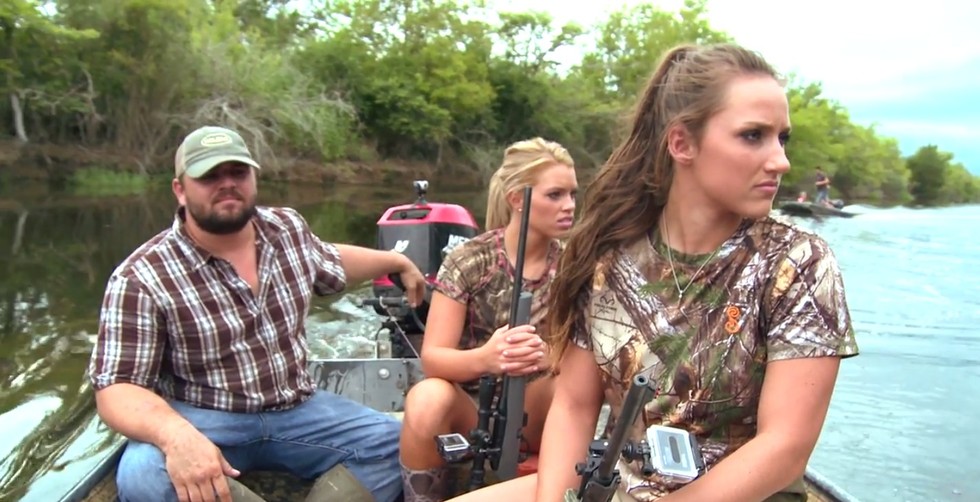
The YouTube series, titled “Game On,” features Jones and a friend setting out on hunting trips together. The first episode, a poorly-made jaunt to Lake Charles, La. for a crocodile hunt, begins with the line, from Jones’ friend Taylor Altom: “I want to shoot a gator in the face.” The pair travel through the swamp in search of alligators for a weekend with the help of a local hunter.

WARNING: Disturbing Images

  • (Kendall Jones/YouTube)The episode, which can be seen at this link, ends with Jones shooting an alligator who was caught on a baited hook in the head as her guide holds it up about six inches away from her. She’s careful to thank her Remington, a nod to the show’s sponsor.

  • (Kendall Jones/YouTube)The American alligator was taken off the U.S. Fish and Wildlife’s Endangered Species List in 1987, and is actually faring pretty well. But hunting methods like baited hooks have been criticized before as inhumane ways of killing the animals. During alligator hunts, a short wooden peg is usually attached to a line, baited with beef or roadkill and then thrown into the water or tied to a branch to lure the alligator. Because take isn’t allowed after sunset, it’s possible that alligators will have to spend the entire night on a line before they’re shot with a gun or bow and arrow.

    When Jones was attacked for hunting big game in Africa, a petition started by a Cape Town native calling on her to be banned from hunting in African states gained over 150,000 signatures. Another petition asked Facebook to remove her grisly hunting photos — which they eventually ended up doing. No word yet on whether YouTube will do the same thing.