Animal Lovers: Don’t Hesitate to Feel Your Hate

Text and Wildlife Photography ©Jim Robertson, 2014. All Rights Reserved

Text and Wildlife Photography ©Jim Robertson, 2014. All Rights Reserved

Living in Earth’s out-of-the-way places, surrounded by prime wildlife habitat (as I’ve always chosen to do), an advocate must eventually make a choice—either stand with your wildlife friends, or join in the “fun” (made increasingly more popular by repulsive “reality” shows like Duck Dynasty and so many evil others) and go around shooting everything you see.

I made my choice long ago and decided the only way to live in such a wildlife-war-torn area is to have as little to do with the people as possible. To quote Sea Shepherd’s Captain Paul Watson, referring to his native land, coastal New Brunswick, Canada (where clubbing baby seals is the local pastime), “Love the country, hate the people.”

Author Farley Mowat, another selfless Canadian animal advocate in league with Captain Watson, ultimately came around to that same sentiment in A Whale for the Killing. The 1972 book is an autobiographical account of Mowat’s moving to Newfoundland because of his love for the land and the sea, only to find himself at odds with herring fishermen who made sport of shooting at an 80-ton fin whale trapped in a lagoon by the tide. Although he had started off thinking folks around there were a quaint and pleasant lot, he grew increasingly bitter over the attitudes of so many of the locals who, in turn, resented him for “interfering” by trying to save the stranded leviathan.

Mowat wrote, “My journal notes reflect my sense of bewilderment and loss. ‘…they’re essentially good people. I know that, but what sickens me is their simple failure to resist the impulse of savagery…they seem to be just as capable of being utterly loathsome as the bastards from the cities with their high-powered rifles and telescopic sights and their mindless compulsion to slaughter everything alive, from squirrels to elephants…I admired them so much because I saw them as a natural people, living in at least some degree of harmony with the natural world. Now they seem nauseatingly anxious to renounce all that and throw themselves into the stinking quagmire of our society which has perverted everything natural within itself, and is now busy destroying everything natural outside itself. How can they be so bloody stupid? How could I have been so bloody stupid?’”

Farley Mowat ends the chapter with another line I can well relate to: “I had withdrawn my compassion from them…now I bestowed it all upon the whale.”

Having recently finished reading, Give a Boy a Gun, by Jack Olsen (author of the pro-coyote/anti-trapping book, Slaughter the Animals, Poison the Earth—an appropriate addition to his numerous other true-crime works), I’m still puzzled by that book’s similar underlying question: How could so many people be so stupid as to think so highly of Claude Dallas Jr., a killer whose crimes included poaching, trapping out of season and the shooting of two Idaho Department of Fish and Game agents? Apparently the majority of people in cattle country there think nothing of the prolonged suffering of a bobcat, coyote or trappers’ other non-human victims, and accept people at the shallowest of face-value (except game wardens out to uphold the few laws animals have on their side).

In civilized society we’ve been brought up not to hate other people. Tolerance is the buzz word and that’s supposed to go for everyone, even if they choose to kill the animals you care about. It’s not like animals are people, right? Well, that’s debatable; besides, there’s only so much tolerance to go around. I love the wilderness and the wild things who live there. But can you really love something, without at the same time, hating those who threaten its very existence?

Every morning I’m reminded how much I hate the local duck and goose hunters, for example. At first light this time of year, before I can even think about how much I love living where flocks of migratory geese spend the winter, the sound of shotgun fire rings out to remind me of those whom I hate—the ones who make sport of killing creatures more noble, magnanimous and intelligent than they could ever hope to be.

If it’s not okay to hate the people who kill your friends for sport, who can you hate? And don’t think for a second that hunters, no matter how the schmooze, don’t hate you or anyone who might be out to spoil their fun by trying to ban contest hunts, or otherwise exposing their sadism.

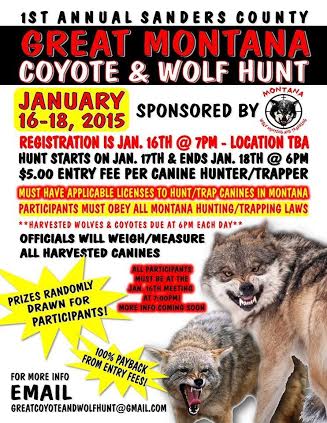
1598558_10152837672323554_7131931279073962386_oIdaho’s ongoing Predator Hunting Contest and Fur Rendezvous, organized by a group ironically calling itself “Idaho for Wildlife” (more appropriate names would either be, Idaho against Wildlife, or Extremist Idahoans for the Destruction of Wildlife) claims as part of their second mission, “To fight against all legal and legislative attempts by the animal rights and anti-gun organizations who are attempting to take away our rights and freedoms under the constitution of the United States of America.” Apparently somebody is confusing the Second Amendment with the right to kill non-human animals for sport.

Now, you may have grown up to songs with lyrics like, “Come on people now, smile on your brother, everybody get together, try to love one another right now,” or just heard phrases like, “feel the love,” “love thy neighbor” “blah, blah, blah.” Bullshit! If your neighbor is out mowing down coyotes or wolves for fun or cash prizes—or blasting into flocks of geese for sport—they need to know how deeply you hate them.

But hate is such a negative emotion; it’s not good for your chakras, or whatever they say. Well, sometimes the animals need our outrage, our lividness, our hate. It’s a war, after all, and the other side is winning, partly because we resist the urge to embrace our hatred. How can you fight a war and not feel hate for your enemy?

Yet it shouldn’t be seen as desperate words coming from some lone, animal-loving whacko. As long as the laws are on their side and they think society shares their view of animals as objects, they’ll be encouraged to keep up the killing.

In other words, “Come on people now…Everybody get together, try to hate coyote hunters right now. Right now. Right Now!

coyote contest kill

“Idaho for Wildlife” Contest hunt organizer thinks this is the year hunters will actually “catch” a wolf…

According to a new article in Newsweek, http://www.newsweek.com/wolf-hunting-event-breeds-controversy-idaho-296390  Alder “thinks this is the year hunters will actually catch a wolf.”…

The question is, how exactly does he mean “catch?” Does that mean someone thinks they can run down and actually “catch a wolf,” as in by the tail? I’ve seen how fast wolves can run. If we’re talking a fair foot race, I’d definitely put my money on them.

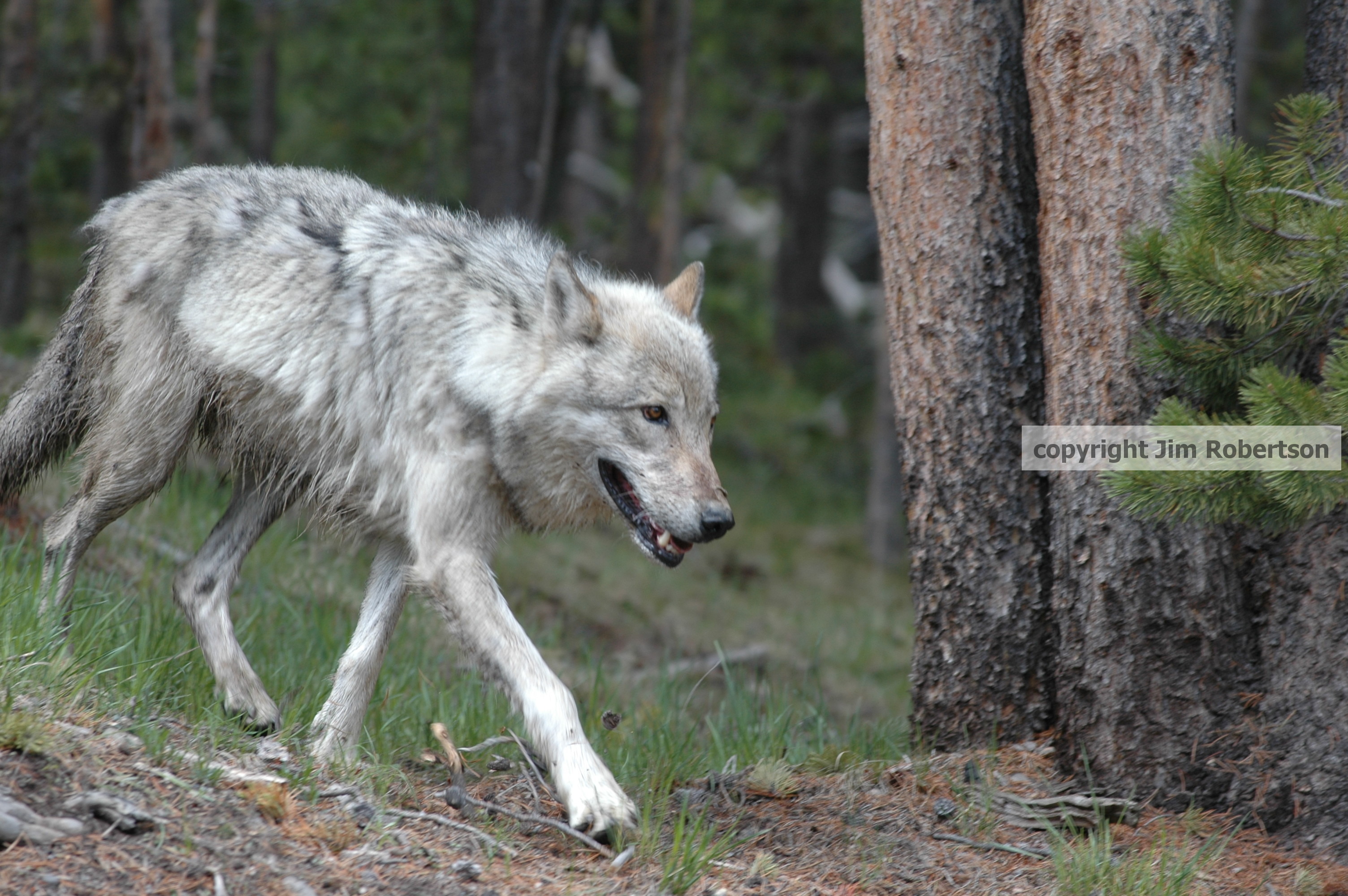
copyrighted Hayden wolf walking

Nearly 40 dead coyotes dumped near Las Cruces, NM

unnamed

http://www.abqjournal.com/519815/news/dead-coyotes-dumped-near-las-cruces.html

By
PUBLISHED: Thursday, January 1, 2015

LAS CRUCES [New Mexico] – Nearly 40 dead coyotes dumped in the desert outskirts of Las Cruces, some with wood blocks in their mouths marked with the date they were killed, are the latest sign of the excesses of coyote-killing contests, say advocates who want to see the derbies banned.

At least 10 environmental groups are hoping to push legislation this session outlawing the contests in New Mexico, much as California did last month. They say the contests, which reward participants for the largest number killed or biggest animal shot, serve no legitimate wildlife management purpose.

Supporters of the contests say coyotes are akin to varmints and identify in online forums as “predator callers,” a reference to their use of hand or electronic calling to attract coyotes.

But a co-founder of a local coyote hunting club said wholesale dumping of coyotes is “very much frowned upon.”

The hunting of coyotes is unregulated in New Mexico, and the contests are legal. There are no limits to the number of animals that may be killed.

Wildlife advocates counted some 20 such contests around New Mexico in 2014 but say the number is understated because many are not publicized.

Advocates say they are in talks with two possible sponsors of a bill to ban the contests, one Democrat and one Republican. The legislation would mirror a House bill to ban the contests that failed in the 2013 legislative session by a 38-30 vote.

California is the first state to ban wildlife-killing contests, although some states such as Colorado place limits on the number of animals that can be taken.

“The animals are not being eaten or used in any way; they are just being killed, and they are being killed for sport,” said Kevin Bixby, executive director of the Southwest Environmental Center in Las Cruces. “It disrupts natural ecosystems and undermines the ability of coyotes to provide their ecological role in maintaining healthy systems, in regulating populations of prey animals like rodents and rabbits.”

Bixby recently counted 39 coyotes strewn around creosote, broken glass and tossed cardboard boxes used for target practice near the Las Cruces airport.

The mouths of the animals were stuffed open with wood or bullets inscribed with the date they were killed – Dec. 21 – a practice used in contests. A few had been skinned, but most were tossed to rot.

New Mexico Desert Dogs holds coyote-killing contests around Las Cruces and bills itself on a Facebook page as a “hunting club for those folks that have a passion, appreciation, fondness … for coyote hunting.”

A co-founder of the club who identified himself only as Ruben said the group was not behind the dumped carcasses. He defended coyote-killing contests as “a way for people to gather and share the same culture and love for the sport” and said such dumping – instead of burying the animals or donating pelts to apprentice taxidermists – is “a shame on the hunting community.”

“It is a sport,” he said in a telephone interview. “It takes precision and skill and timing and effort to go and harvest coyotes.”

The legislation the wildlife advocacy groups are backing would ban coyote-killing contests for material gain but would not prohibit killing coyotes that threaten property, such as livestock or pets.

“They are commercial events: killing animals for the purpose of entertainment, prizes and publicity,” said Guy Dicharry of the Los Lunas-based Wildlife Conservation and Advocacy Southwest. “You’re really out there trying to win. This is not focused on predator management. It’s random.”


Wild Buffalo Roam East of the Mississippi for First Time Since 1830s

http://ecowatch.com/2014/12/31/wild-buffalo-roam-east-mississippi/?utm_source=EcoWatch+List&utm_campaign=c725c49f24-Top_News_1_2_2015&utm_medium=email&utm_term=0_49c7d43dc9-c725c49f24-85338557

When David Crites walked out of his apartment last month, he was greeted by a line of six or so bison standing shoulder to shoulder in the front yard. He sidled over to his truck, staring at the huge animals, slipped into the front seat, then closed the door and turned on the ignition. As the pickup slowly made its way down the driveway, the bison lumbered alongside.

“It was like I was in Yellowstone,” Crites says. But he wasn’t. His temporary job (which includes housing) is to remove trees and install fences in the Nachusa Grasslands of north-central Illinois—where wild bison recently set hooves down for the first time in almost 200 years.

The herd of 30 bison is part of an effort by the Nature Conservancy to restore grasslands in the Prairie State, which, perhaps ironically, has lost more than 99 percent of its former grassland. In the late 1980s, conservationists happened to be passing by the Nachusa when they heard the call of an upland sandpiper, a bird that breeds in tallgrass prairies. The Nature Conservancy then began buying farms in the area as they became available, and now it owns a total of 3,500 acres.

The group is doing its best to re-create a lost landscape, says Jeff Walk, director of science for the Nature Conservancy’s Illinois chapter. He knows the prairie won’t be exactly the same as yesteryear’s, but he and the rest of the team are trying to get as close a match as possible.

To do that, volunteers and seasonal employees like Crites (who spends the rest of his year working in data centers) erect fences, collect and sow seeds, and replicate natural growth cycles with controlled burns. So far, their work has paid off. Even on a winter day when dry brown oak leaves cling to trees, the undulating hills are colored in red, orange, and gray, a mosaic of newly planted big bluestem, Indian grass, and switchgrass.

But until October, the landscape had been missing one thing it needs in order to really thrive: grazers.

After decades of preparation, genetically pure bison (meaning they don’t have any cattle genes) arrived this fall from a preserve in Iowa. There are a few herds just like them living in reserves across the country, but this group is now the first one east of the Mississippi.

So far the experiment is working well. Aside from a roundup every fall, when the bison will get their vaccinations, these wild oxen will roam across 500 acres enclosed by a woven wire fence. Signs hung on the wire warn visitors that the bison are wild. Anyone who hops the fence could suffer the consequences (i.e. a potential horn to the buttocks, or worse, a trampling).

Within the enclosure, the bison eat the grasses and avoid the forbs, or flowering plants. This helps promote plant diversity, because without the bison noshing them down, grasses would dominate the prairie, leaving little room for rare species like the prairie violet. The nearly one-ton beasts will also help spread seeds and sculpt the soil with their hooves, something researchers will study on site.

“The other thing is poop; they’re very productive,” says Kirk Hallowell, a volunteer steward and my guide for the day. Their pies will fertilize the soil and attract insects, which will (hopefully) bring birds. If all goes well, Nachusa project director Bill Kleiman and ecologist Cody Considine will open up more land to the bison next year.

Despite the project’s success, the land will never be what it was 200 years ago. The bison each have an identification chip embedded in them, and seven of them wear GPS collars. They’ll never be able to roam wherever they want, and people will always have to manage fires on the land, raising the question of what is truly wild.

“It’s an interesting and important concept, but the answers don’t fit on bumper stickers,” says Kleiman. He argues that the bison are semi-wild, and an important part of our natural heritage. “Everyone loves bison. They’re a national symbol of what we discovered when we came to North America—that wistful longing for wide-open spaces. And they’re a symbol of it right here.”

The bison certainly feel wild when Hallowell and I step out of the open-air truck to get a closer look, nothing but knee-high grasses swaying between us. Lying on top of a hill, their shaggy hair blows with each wintery gust. The 1,900-pound bull, fondly nicknamed “Chain Breaker” because he did just that in a corral once, fixes his big brown eye on us. He gets up, hind legs first, and shakes. Other animals stand up, too, and join the viewing party.

We get back in the truck. As we start to drive away, I look back and see Chain Breaker, his horned silhouette regal against the gray sky. Looks wild enough, for now.

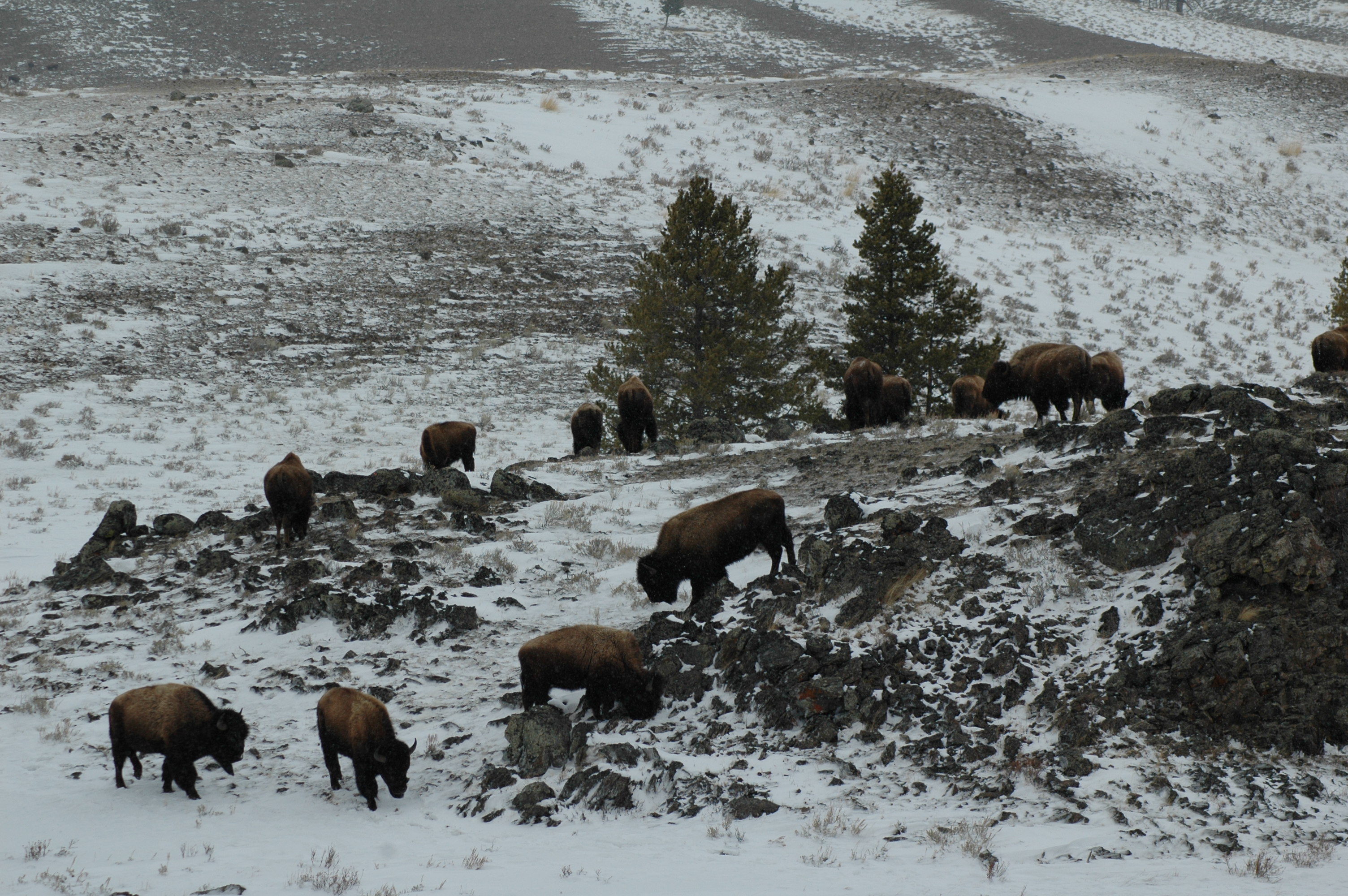
Photo Copyright Jim Robertson

Photo Copyright Jim Robertson

Wolf-Kill Derby Promoted for Salmon Area This Weekend

1598558_10152837672323554_7131931279073962386_o

Last year’s contest poster

——–

http://www.boiseweekly.com/boise/wolf-kill-derby-promoted-for-salmon-area-this-weekend/Content?oid=3376227

According to its website, Idaho for Wildlife is “dedicated to the preservation of Idaho’s wildlife.”

Save the Wolves, Ban Coyote Hunting!

One is protected by the ESA, the other can be shot on sight–anywhere, anytime!
10906075_10155034869550301_2511370178161460178_n

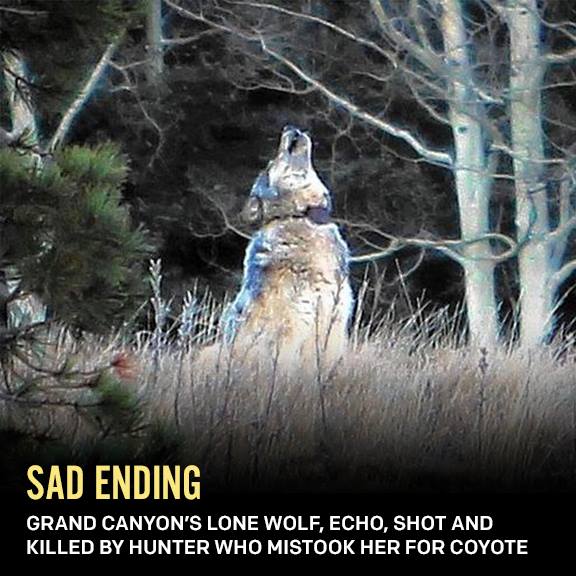
THIS NEEDS TO STOP: Echo, the beloved lone wolf who had traveled 500 miles from Wyoming to the Grand Canyon, has been shot and killed by a hunter who mistook her for a coyote. Echo’s sad ending shows why it’s critical that we keep fighting for stronger protections for wolves, grizzly bears, and other endangered wildlife [to say nothing of coyotes, who are shot on sight and hung from fences across the West].

Echo was a symbol of hope as conservationists celebrated the possible return of gray wolves to the Southwest after being wiped out for a century. Echo was probably looking for food or a mate when she was shot…

Simply Not Justifiable

From: http://www.projectcoyote.org/

You may have heard the tragic news that a coyote hunter reportedly killed the lone female gray wolf who made international headlines when she showed up just north of the Grand Canyon- the first wolf to appear in that region in decades. This devastating news is all the more reason why we need to redouble our efforts to stop the wanton wide-scale killing of predators like coyotes, foxes, wolves and bobcats. It is simply not justified in this day and age.

……………………………………..

It may be weeks before additional testing reveals whether the wolf killed in Utah is the same one, which was nicknamed Echo…

Echo was the first gray wolf seen in the Grand Canyon since the 1940s, when the last wolf there was killed as part of an extensive eradication campaign, said Chris Cline with the U.S. Fish and Wildlife Service.

Meanwhile, from: http://www.capitalpress.com/Washington/20141231/olympia-2015-wolves-water-and-taxes-top-ag-agenda

…While lawmakers are in session, the Washington Department of Fish and Wildlife is expected to update its wolf count. The census may spark talk about how to manage the animals when they are no longer listed as endangered under federal or state law, said Moses Lake Republican Judy Warnick, the incoming chairwoman of the Senate Agriculture, Water and Rural Economic Committee.

“The more they spread, the more willing people will be to have these discussions,” she said.

Kretz needled wolf advocates in 2013 with a bill proposing to relocate wolves close to Seattle. The legislation never got a hearing, but it succeeded in getting people talking, Kretz said.

This year, Kretz said he may propose regional delisting, releasing wolf-populated regions of Washington from the state’s wolf recovery plan.

Such a move would ease growing tensions between state wildlife managers and eastside counties, he said.

“I seriously hope I could get it done,” Kretz said.

He would have to find sympathetic westside Democrats. But even sympathy may not translate into votes. House Agriculture and Natural Resources Committee Chairman Brian Blake faulted the state plan for requiring wolves to be spread through the state before being considered “recovered” in any region.

“The folks in north-central Washington are being eaten out of house and home with no potential delisting in sight,” Blake, D-Aberdeen, said.

Still, Blake warned that amending the wolf-recovery plan could invite lawsuits.

“If we legislatively start pulling it apart, that, in my opinion, leaves us open to bigger problems,” he said. “I think you’re going to see potential for active management once the state population is delisted.”

The Washington Department of Fish and Wildlife estimates that won’t happen until at least 2021.

More: http://www.capitalpress.com/Washington/20141231/olympia-2015-wolves-water-and-taxes-top-ag-agenda

copyrighted Hayden wolf walking

Idaho Wolf, Coyote Derby Starts Tomorrow Morning!

January 1, 2015 at 10:12 AM | Page modified January 1, 2015 at 12:33 PM

 http://seattletimes.com/html/localnews/2025361121_idahowolfhuntxml.html

Idaho hunting derby targets wolves, coyotes

A hunting derby with $1,000 each for whoever kills the most wolves and coyotes is scheduled to start at sunrise Friday in east-central Idaho. Organizers say withdrawal of a permit to hunt on federal lands may spark greater participation.

By KEITH RIDLER

Associated Press

A hunting derby with $1,000 each for whoever kills the most wolves and coyotes is scheduled to start at sunrise Friday in east-central Idaho.

Idaho for Wildlife’s three-day Predator Hunting Contest and Fur Rendezvous is planned on private ranch land and U.S. Forest Service land around Salmon.

“I think we’re going to have a good turnout,” said Steve Alder, organizer of the contest. He didn’t have an estimate on the number of hunters though due to the remoteness of the area.

The group earlier this year received permission to include land administered by the U.S. Bureau of Land Management but the agency withdrew the permit in November following two lawsuits by environmental groups.

Losing the 3.1 million acres of BLM land cut the area for the derby in half, and also eliminated lower elevation areas likely to have more coyotes and wolves. A coalition of environmental groups, as well as Democratic U.S. Rep. Peter DeFazio of Oregon, tried but failed to get the Forest Service to revoke the permit it issued.

“The world is looking at this with a lot of dismay,” said Amy Atwood, an attorney at the Center for Biological Diversity. “We’re not going to go away and we’re going to keep fighting.”

She said the group has a litigation strategy to prevent another derby but declined to go into details.

The derby last year drew 230 people, about 100 of them hunters, who killed 21 coyotes but no wolves. Alder said the BLM’s revoking the group’s permit might have persuaded more hunters to take part this year. He said 40 hunters from outside Idaho have committed.

He said ranchers have also been contacted in advance so hunters can use that land. Also, he noted, possible wolf sightings are being tracked.

“We’ve heard some reports and we’re trying to pinpoint where those are so we can put in hunters,” he said.

Besides the $1,000 prizes, Alder said, fur buyers will also be available with the potential pay for a black wolf pelt up to $600.

“People love the black ones,” Alder said. “And the pure white. If you can find a big white pelt, that’s beautiful. That’s worth quite a bit.”

The region where the derby is planned is considered a key area for wolves that could grow in number, with some pack members dispersing to surrounding states. At least one Oregon environmental group that would like to see more wolves in that state is involved in the lawsuits against the derby for that reason.

“As we learn more about these animals, the more we’ve come to revere them,” said Atwood. “When you remove them from the landscape it upends the order of things.”

3b. Fur buyer dumps coyote in rig