A Few Words About Game Farms

Exposing the Big Game's avatarExposing the Big Game

At the end of my book is a chapter called, “A Few Words on Ethical Wildlife Photography,” wherein I examine some of the problems that arise when over-eager photographers forget that their animal subjects have needs and interests of their own that don’t always include posing for the camera. With surprising frequency, irresponsible photo-getters are gored, trampled or charged by free-roaming animals annoyed enough to feel they must defend themselves.

But no amount of disturbance could ever equal the level of abuse and exploitation suffered by an animal stuck in a zoo or game farm. Too often, the “wild” animals seen in books or magazines are actually imprisoned specimens sentenced to life in a barren pen or cage. The only time some of these pitiable creatures see the light of day is when they’re paraded out and made to pose for a client who wants to shoot them in front…

View original post 258 more words

Lessons From the Brief, Lonesome Life of Echo the Wolf

by Shelby Kinney-Lang

February 18, 2015 at 8:40
Photo from the Arrizona Game and Fish Department shows the wolf spotted on the Kaibab Plateau

Even true stories about wolves sound like fables.

Last October, an animal appearing to be a gray wolf showed up on the Kaibab Plateau in Arizona, just north of the Grand Canyon National Park. At first, no one was sure what, exactly, the “wolflike animal” was, but if, as suspected, it was a gray wolf that had migrated from the northern Rockies, it would have been the first time since the 1940s one had set foot in the Grand Canyon. Although there were once an estimated 2 million gray wolves across the continent, humans hunted and poisoned them to the point of oblivion. But thanks to federal protections under the Endangered Species Act (ESA), since the 1970s, gray wolf populations have slightly rebounded. After reintroducing 60 Canadian wolves in Yellowstone in 1995, the U.S. Fish and Wildlife Service (FWS) estimate their population is now up to about 1,500 animals across Montana, Idaho, and Wyoming.

People reported sightings of the Grand Canyon creature through November and December and heard her howls across the forest. Scientists analyzed her poop and confirmed it: she was a gray wolf from the northern Rockies, 450 miles north, first collared near Cody, WY in January 2014. The itinerant, lonesome wolf seized the imagination of the nation and then the world. In a contest for school children, she was given the nickname “Echo.”

In late December, a hunter shot and killed a wolf near Beaver, Utah, thinking it was a coyote. (The state of Utah permits bounty hunting for coyotes, $50 a head.) Federal agencies refused to say whether the dead wolf was the same one from the Grand Canyon.

That is, until last week. Genetic testing by the FWS confirms Echo was shot dead.

More: http://magazine.good.is/articles/death-of-echo-the-grand-canyon-wolf

So Much at Stake: Annual DNR 82nd Election of SOLE ADVISORY TO THE LEGISLATURE, April 13

Who the fuck traps our fellow mammals or hunts sandhill cranes these days?

dvoight09's avatarWisconsin Wildlife Ethic-Vote Our Wildlife

ALERT: DNR Annual Spring Meeting | DNR 2015 Questionnaire | Educational Help Needed | Call for Candidates |

DNR 2015 Questionnaire

The Wisconsin Department of Natural Resources (DNR) Spring Meeting is to be held state-wide on Monday, April 13. This is THE opportunity to not only complete this year’s questionnaire, but more importantly, to have a voice in what direction the DNR takes on a variety of issues. Here’s more information.

The DNR’s 2015 questionnaire can be found here. In summary, the attachment contains information regarding:
Wisconsin Conservation Congress (WCC) Delegate Elections which are to take place at 6:30 p.m. on April 13 PRIOR to the start of the DNR portion of the Annual Spring County Conservation Meeting/Hearing (instructions and delegate eligibility requirements are provided on page 3)
State-wide Electronic Balloting on Proposed Statewide Wildlife Management Rule Changes (questions 1-71 presented on pages 11-39 of the questionnaire…

View original post 934 more words

PETA Exposé Shows How a Fur Farmer Kills and Skins Mink

wikimedia commons

http://www.peta.org/blog/the-truth-about-fur-the-harsh-reality-of-mink-farming/

Written by PETA | February 18, 2015

All around the world at fur farms like this one, minks—as well as rabbits, foxes, and other animals—are crammed into barren cages and have the skin ripped off their bodies, all to make fur coats, collars, and trinkets. Fur farmers use the cheapest killing methods available, including suffocation, electrocution, poison, and gas. At this farm, minks are picked up by their sensitive tails and shoved into a box to be gassed. One mink in this video- like many animals killed for their fur- doesn’t die immediately. The farmer then tried to break his neck against the side of his crude wooden “kill box.”

The fur industry would have you believe that fashion justifies such torture, but there’s never any excuse for such barbaric treatment of animals. The farmer in this video casually described the techniques for ripping the bloody pelts off minks’ bodies, snapping the animals’ penis bones and using old pruning shears to cut off their paws.

Do you have friends or family members who still think that fur is in fashion? Remind them that in some countries, even cats and dogs are skinned alive for their fur, which is then mislabeled and sold to unsuspecting consumers in countries all over the world.

Share this video and encourage them to choose only animal-friendly clothing. Join PETA in the fight to help minks and other animals used for fur.

Factory Farm 360

http://www.all-creatures.org/articles/mdi-factory-farm-360.html

FROM

Last Chance for Animals (LCA)
February 2015

The first interactive, 360-degree video of animal life on factory farms. Brought to you by LCA’s Sam Simon Special Investigations Unit.

WATCH THE TRUTH about Pig Farms

CLICK AND DRAG ON THE VIDEO TO LOOK AROUND

  • On a factory farm, a breeding pig spends most of her life in a gestation crate too small for her to turn around in. The confinement is maddening; pigs bite on the bars until their mouths are sore and bloody.
  • After about four months, the mother is moved to a small, filthy maternity crate, where she will give birth and nurse her babies.
  • The piglets’ back teeth are cut with pliers, and their tails are clipped. The males are castrated with no anesthetic, so the meat tastes more pleasing to consumers.
  • Many piglets die of infection, or are crushed to death by their mother because her movement is so restricted. Dead piglets are gutted, and their intestines fed to mother pigs in an effort to immunize them from disease. After just weeks, the surviving piglets will be taken away and the mother re-impregnated.
  • These facilities are breeding grounds for harmful bacteria like salmonella, so pigs are given steady doses of antibiotics, spawning antibiotic-resistant germs.
  • Workers deface the pigs’ bodies with spray paint to mark their status, like whether they’re pregnant or that it’s time for them to die. Some workers have spray-painted “kill” or “die” right on animals’ backs.
  • Nearly all pork at grocery stores and restaurants in the U.S. – including bacon, ham and pork sausage – comes from these farms, where the pigs endure excruciating suffering every day of their lives.
  • You can help end this torture by choosing cruelty-free meatless options instead of pork.

WATCH THE TRUTH about Free-Range Egg Farms

CLICK AND DRAG ON THE VIDEO TO LOOK AROUND

  • This is a “free range” egg farm, but these hens are far from free. They know only concrete and metal, and beneath the grating under their feet sits piles of urine and manure.
  •  Dead hens rot among the living, spreading their disease.
  • All of these hens’ brothers were killed the day they were born, because to the egg industry, they are worthless.
  • In the U.S., no government-regulated standards exist for “free range” farms. Hens may go outside for just minutes a day. Some birds never even get outdoors, because access is blocked by the crowds.
  • The crowding and filth create a breeding ground for bacteria and parasites, making both birds and humans sick.
  • This is cruel, and it’s happening right now to hens all over the world. Help end their suffering by choosing plant-based alternatives to eggs and other animal products. Together, we can stop farm cruelty.

WATCH THE TRUTH about “Broiler” Chicken Farms

CLICK AND DRAG ON THE VIDEO TO LOOK AROUND

  • You are in a room of thousands of other “broiler” chickens, where you will spend your entire life never seeing sunlight.
  • Beneath you is a sludge of litter, urine and manure; it has so much ammonia, it’s burning your feathers off, so your chest is sore and bald.
  • You’ve been bred for constant hunger, and the lights are on all night to keep you awake and eating.
  • You’re so obese, you cannot stand (If you were a 10-year-old child, you’d weigh 500 pounds by now).
  • You probably have salmonella or another sickening bacteria, spawned from the overcrowding and filth.
  • Sound like torture? It is. And it’s reality for chickens found at nearly all stores and restaurants in the U.S.
Rescued Chicken--Pigs' Pease Sanctuary

Rescued Chicken–Pigs’ Pease Sanctuary

Experimental wolf cull in Alberta ignites scientific criticism over inhumane research

“The caribou are endangered because extensive and unabated industrial development of [obscenely omnipotent] oil, [goddamn] gas and [fucking] forestry operations has destroyed and degraded the habitat that provides life sustaining food, shelter, and security.” [NOT because of the wolf!!]

http://www.raincoast.org/2015/02/wolf-cull-ignites-critisim/

Experimental wolf cull in Alberta ignites scientific criticism over inhumane research

Scientists highlight the failure to abide by ethical standards of animal research and welfare.

3 running wolves-PCP

In a scathing commentary published today in the peer-reviewed journal, Canadian Wildlife Biology and Management, scientists from the Raincoast Conservation Foundation and the Universities of Saskatchewan and Victoria denounce the failure of researchers, government agencies, research institutions, and the scientific publishing process to abide by recognized ethical standards of animal research and welfare.

Download  the journal paper Maintaining ethical standards during conservation crises

In the November issue of the Canadian Journal of Zoology, a team of researchers described a gruesome wolf culling experiment and last-minute bid to halt the decline of the Little Smoky caribou herd in Alberta. The caribou are endangered because extensive and unabated industrial development of oil, gas and forestry operations has destroyed and degraded the habitat that provides life sustaining food, shelter, and security.

The researchers oversaw a study in which at least 733 wolves and hundreds of other animals suffered and died by methods considered inhumane by the Canadian Council of Animal Care (CCAC). The CCAC provides ethical guidelines that scientists in Canada normally comply with to ensure that animals used in research are treated humanely. Bypassing CCAC standards, managers from Alberta Environment and Sustainable Resource Development administered the killing. Cooperative university investigators assessed the outcome of the cull. Most wolves died violent deaths via aerial gunning from helicopters. Others succumbed to poisoning after ingesting baits laced with strychnine. These methods of killing do not conform to CCAC’s recognized and acceptable standards of euthanasia, owing to the extended pain and suffering they often cause.

“Expedient but inadequate emergency ‘fixes’ have been experimentally implemented to arrest the impending loss of caribou”, said co-author Dr. Ryan Brook of the University of Saskatchewan, “but no context can justify methods that impose such suffering”.

Co-author Dr. Gilbert Proulx, Director of Science at Alpha Wildlife Research & Management Ltd, agreed. “There is a need to improve checks and balances that would normally prevent the approval, execution, and publication of unethical animal research”, he said. Despite questionably modest improvements to caribou declines, the researchers advocated for the continued killing of wolves. “Such short-sighted recommendations add fuel to the fire regarding the growing controversy and scrutiny of the unethical and unscientific Alberta wolf cull”, stated Chris Genovali, Executive Director of the Raincoast Conservation Foundation.

The study also troubled co-author Dr. Chris Darimont, Hakai-Raincoast Professor at the University of Victoria and science director for the Raincoast Conservation Foundation. “Proponents of resource extraction can now announce that a ‘solution’ to the caribou crisis is in hand, enabling additional habitat destruction that harms caribou and wolves. So despite intentions otherwise, wolf control creates greater long-term harm than good to animals and ecosystems, failing a simple test of ethics.”

“In this case, the intended but very uncertain ends cannot justify the means”, said co-author Dr. Paul Paquet, senior scientist at the Raincoast Conservation Foundation and Adjunct Professor at the University of Victoria and. “Experiments that involve the intentional inhumane killing of animals violate the fundamental principles of ethical science and rightfully endanger the reputation of science and scientists, as well as the journals willing to publish them”.

Citation: Brook, Ryan, Marc. Cattet, Chris T. Darimont, Paul C. Paquet, & Gilbert Proulx. 2015. Maintaining ethical standards during conservation crises. Canadian Wildlife Biology and Management Issue 4, pages 72-79.

Available in Open Access format here or download the pdf

I Swear Because I Care so Much

Cut the crap about a harmless little F-word, there’s animals fucking dying out there.

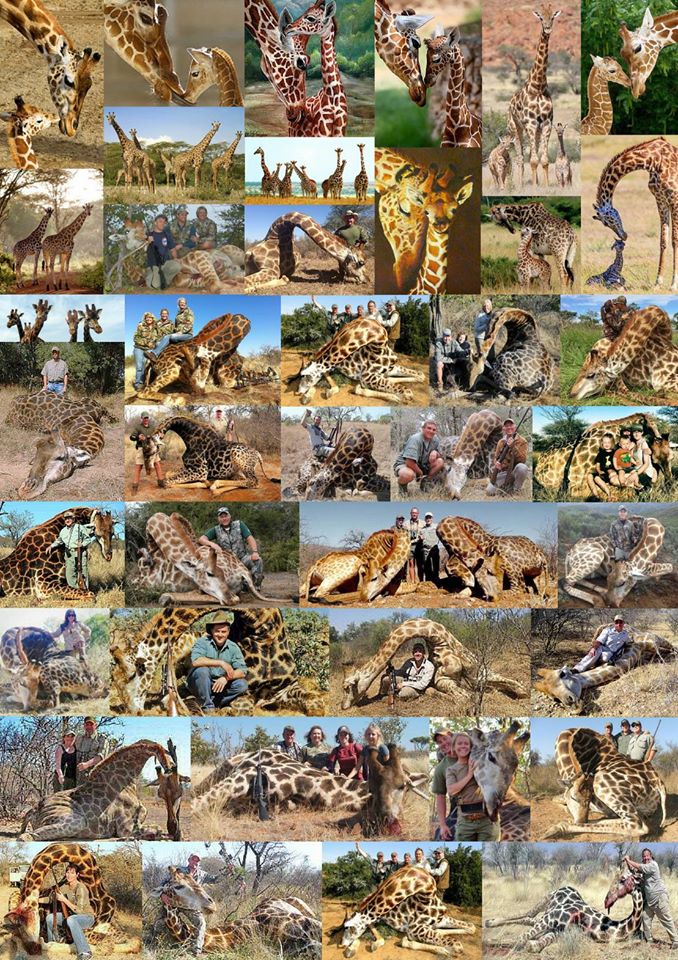
Yesterday I posted a picture someone put together of multiple murderers and their “trophy” giraffe kills. I’d thought about titling the post, “Who the Hell Hunts10557040_1609109249312078_7951148989311848842_o Giraffes for Sport and How You Can Stop Them?” But the issue made me so angry that I went with my gut reaction and titled it, “Who the Fuck Hunts Giraffes for Sport and How You Can Stop Them?” But, for that I’ve been chastised across the social media by certain readers.

Apologies to anyone reading this that’s a young kid or in some other way sheltered enough to think a word is somehow more offensive than a photo of dozens of dead giraffes and the fuckers who shot them down. Don’t get me wrong, I don’t normally go around spewing obscenities, but when some asshole is out murdering animals as harmless and miraculous as a giraffe I start to get a bit pissed off. You could say my tact goes out the fuckin’ window.

Forgive me if I can’t stay civil when addressing some shithead serial-killer-sport-hunter who wants to add a lion, rhino or giraffe to his trophy collection.

Instead of being so sensitive to swear words, perhaps some of you should save your comments for the real criminals—the murdering mother-fuckers who kill sentient beings for sport.

___________________________________________________

Please sign and share these petitions.

Rhinoceros in SA need your help before their extinction
http://www.change.org/petitions/rhinoceros-in-south-africa-need-your-help-before-their-extinction#shar

10978558_1612004402355896_3945515954454479494_n