
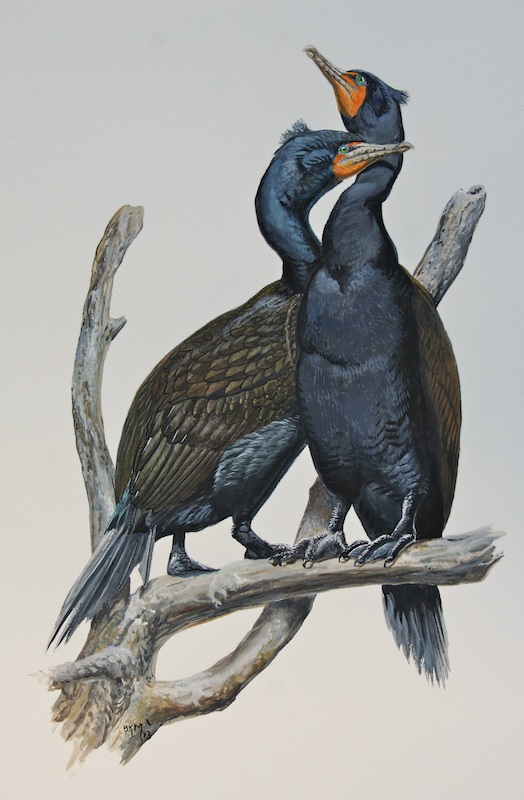
Painting Courtesy Barry Kent MacKay
http://www.oregonlive.com/environment/index.ssf/2015/02/east_sand_island_cormorant_kil.html
By The Oregonian
The U.S. Army Corps of Engineers has scaled back its plan to kill thousands of federally protected migratory birds to keep them from eating endangered juvenile salmon and steelhead at the mouth of the Columbia River.
On Friday, the corps released a final environmental impact statement detailing plans to use lethal measures to shrink the East Sand Island colony of double-crested cormorants, a long-necked black sea bird.
The revised version of a preliminary plan released last summer calls for shooting nearly 11,000 birds by the end of 2018 and pouring oil over 26,000 nests to prevent eggs from hatching. The corps’ goal is to reduce the colony by 57 percent, to about 5,600 breeding pairs.
It represents a rollback from the original plan, which called for shooting 16,000 birds to achieve the same population reduction.
The corps estimates that since 1989, the cormorant colony on East Sand Island has exploded from 100 nesting pairs to 13,000. During that time, the birds have eaten about 11 million smolts yearly, or nearly 7 percent of juvenile steelhead that pass by East Sand Island on their way to the ocean.
Plans to kill the birds were drawn up in response to a NOAA Fisheries biological opinion that recommended the corps trim the cormorant colony in order to protect endangered fish.
The changes to the plan come in response to more than 152,000 public comments on the original plan, nearly all of which expressed opposition to the killing.
Environmentalists on Friday said they aren’t satisfied, arguing the new plan still resorts to “wanton slaughter” without considering other ways to protect endangered fish.
Bob Sallinger, conservation director with the Audubon Society of Portland, argued the corps is blaming cormorants “when the primary causes for salmon declines are the dams, habitat loss and hatchery fish.” Before resorting to killing, he said, the corps should consider modifying dams to improve fish passage, improving habitat along the Columbia River, and forcing the birds off the island by reducing their habitat.
“We’re talking about killing 15 percent of the population west of the Rocky Mountains,” Sallinger said. “That level of lethal control is absolutely horrific.”
But Blaine Parker with the Columbia River Inter-Tribal Fish Commission said he was disappointed that the corps didn’t stick to the original plan. He questioned whether the revised option would make a great enough dent in the number of juvenile fish eaten by cormorants each year.
“There’s been a lot of work done to get fish passage projects at the dams,” he said. “To have all that work done, and then have those fish run into yet another obstacle once they reach saltwater, is a tremendous loss.”
The corps is still at least a couple of months away from going through with the culling. First, it must publish its plan in the federal registry and wait 30 days before issuing a record of decision. Then, it must obtain permits from U.S. Fish and Wildlife Service and hire workers to do the job.
The workers would shoot cormorants on land and in flight. The plan also calls for flooding a portion of the island to reduce nesting land for surviving birds, combined with hazing to discourage them from staying on the island.
If all goes according to plan, corps spokeswoman Diana Fredlund said, culling could begin soon after the cormorants return to East Sand Island this spring from their winter habitat in the southern United States.
Fredlund couldn’t offer further details about what a culling would entail, but said, “it’s done humanely and under all the proper veterinary approvals.”
Sallinger said if the plan receives final approval group is “prepared to use all tools at our disposal” to fight it, including a lawsuit.
 Exposing the Big Game
Good God. And the hell of it is, it isn’t going to work at all.
Nope, so why kill them?!
Why is the Army Corps of Engineers – the geniuses who so royally and completely messed up New Orleans during Hurrican Katrina with their brilliant plan – making ANY decision with regard to WILDLIFE? They are not wildlife experts. Indeed, it is hard to figure out in what area they are experts at all.
Oh, and while you’re busy developing your reputation for genius, Army Corps of Engineers, please explain by what stretch of the imagination is killing by shooting, drowning and hazing considered “humane?”
I hope Audubon sues your asses off.
I guess since they sent so many salmon down the road to extinction with their dams, they’re looking for scapegoats.
Why would they do that?
Greed? Stupidity? They think all the salmon belong to them?
A bit of all, I think. I would add arrogance to the list
Definately