
8 is enough, but 13 is definitely too many for anyone!
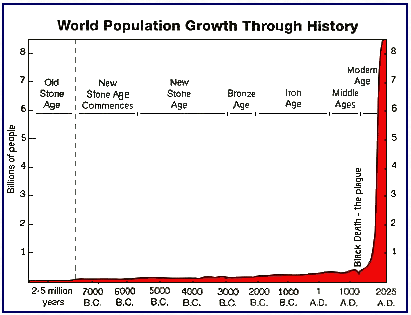
A recent article in the New York Times revisits the generalized pandemonium in the 1970s over fears of a global population explosion, due in large part to Paul R. Ehrlich’s 1968 doomsday bestseller: The Population Bomb. The article inadvertently ties Ehrlich’s apocalyptic thesis—and the widespread willingness to believe it—to the current climate change hysteria that has swept a large part of the planet.
Ehrlich sold the world the idea that mankind stood on the brink of Armageddon because there was simply no way to feed the exponentially increasing world population. The opening line set the tone for the whole book: “The battle to feed all of humanity is over.”
Being a well-credentialed scientist—as a biologist lecturing at Stanford University—Ehrlich’s trumpet call of the end times struck many as the plausible theory of an “expert.”
In the book, Ehrlich laid out the devastating future of the planet. He predicted that hundreds of millions would starve to death in the 1970s (and that 65 million of them would be Americans), that already-overpopulated India was doomed, and that odds were fair that “England will not exist in the year 2000.”
Ehrlich concludes that “sometime in the next 15 years, the end will come,” meaning “an utter breakdown of the capacity of the planet to support humanity.”
It is fascinating to compare Ehrlich’s hyperbolic forecasts with those of the recent climate workshop sponsored by the Vatican’s Pontifical Academy of Science.
“As early as 2100, there will be a non-negligible probability of irreversible and catastrophic climate impacts that may last over thousands of years, raising the existential question of whether civilization as we know it can be extended beyond this century,” the workshop concluded in its joint declaration.
The population has in fact doubled from when “The Population Bomb” was written, and yet here we are, including England and even India. People do still die of starvation in 2015, but as the Times rightly notes, shortages are often “more a function of government incompetence, corruption or civil strife than of an absolute lack of food.”
Chillingly, in his call for radical population control, Ehrlich said he would prefer “voluntary methods” but if people were unwilling to cooperate, he was ready to endorse “various forms of coercion.” To allow women have as many children as they wanted, he said, is like letting people “throw as much of their garbage into their neighbor’s backyard as they want.”
The simple fact is that the world figured out how to feed itself despite its rising numbers, and food production actually outpaced population growth. Could Ehrlich have predicted that Norman E. Borlaug, an American plant scientist, would have discovered how to breed high-yielding, disease-resistant crops that would significantly increase agricultural efficiency? Of course he couldn’t. But this may be an important lesson for today. Science, while quite good at documenting current natural phenomena, has proved completely incompetent when it comes to predicting the future—both of nature and of human ingenuity.
What would have happened had the world at large completely bought into Ehrlich’s hypothesis and altered its behavior accordingly?
China tried it by instituting a draconian one-child policy, which has now left it (through sex-selective abortions) with a horrific gender imbalance, with yearly births of some 120 boys born for every 100 girls. As a result, “30 million more men than women will reach adulthood and enter China’s mating market by 2020.”
Fortunately, The Times observes, some brave souls resisted the urge to jump on the population explosion bandwagon. One was economist Julian L. Simon, who later noted that “whatever the rate of population growth is, historically it has been that the food supply increases at least as fast, if not faster.”
Another population expert, Fred Pearce, has said that birthrates are now below long-term replacement levels nearly everywhere, a trend he analyzed in his 2010 book, “The Coming Population Crash and Our Planet’s Surprising Future.”
The New York Times observes that, as a consequence, “worrying about an overcrowded planet has fallen off the international agenda” and has now been replaced “by climate change and related concerns.”
What the Times fails to observe is the irony of its own reporting. By juxtaposing the thoroughly discredited population explosion theories of the 1970s with the (equally panicky) global warming predictions of our day, the article cannot help but make readers wonder whether a certain measure of caution is due before significantly altering human behavior to accommodate these forecasts.
 Exposing the Big Game
The world population explosion has had devastating effects on animals, ranching and sport killing (aka hunting), poaching. It has had devastating effects on climate with the increased greenhouse gases. Due to the population explosion there is increaased demand for resources, increased demands for fossil fuels, increased demand for animal farming, shrinking and pressure on wildlife habitat, disruption of balanced wildlife ecology. So, predictions of disasters due to populations explosion may be valid with the time scale skewed due to science aided increased food production but not averted. We are killing off the world’s wildlife, ranching the wilderness, polluting water, air and land.
I agree with Roger. Starvation of Americans hasn’t happened on the scale that Erlich predicted, but global devastation has occurred in many other areas. I can’t help but think increasing human densities and limited resources (and/or inequal distribution of resources) isn’t creating or fueling the increase in terrorism in the middle east. Sure looks like crowded-rat syndrome to me.
Where does it all end? Ranchers complain about threats to their livelihoods, hunters complain about having to share deer and elk, wreckreationers want access to what was once inaccessible habitat. So we accommodate them all – but as our population grows, more and more land is going to be taken for ranching, more and more elk and deer for hunters, and more and more habitat opened up to wreckreationers. It never stops. This is why protections for predators and other stressed wildlife due to our activities need to stay in place, or they will disappear forever.
ranching and farming, that should read.
I think Ehrlich just got the timing wrong (obviously predicting the future is not an exact science). Sure, we’ve made advances to help ourselves, but at what cost? Bees, fish, poisoned runoff into our rivers, drought. As usual, we only measure progress in terms of ourselves. These things will happen in time if we keep growing, and forging on blindly ahead.
Absolutely. Ehrlich had the timeline wrong and maybe some of the details, but the major premise, that the exponentially growing population would lead to disaster for the planet and all its inhabitants, was right.
The focus on the New York Times article seems reflect the ideologies of the cornucopians–those who believe the earth has limitless resources–and the cargoists–those who assert that technology will ultimately save us (from ourselves!).
Norman E. Borlaug did create/promote the breeding of specialty crops that were prolific and resistant to disease. But their yields may decrease through the years, and they usually require high concentrates of fossil fuel-based fertilizers, which presents another problem.
According the “The Green Revolution, Peace, and Humanity”–the Nobel lecture of 1970–we should not overrate the promise of those seeds:
“The term “The Green Revolution” has been used by the popular press to describe the spectacular increase in cereal-grain production during the past three years. Perhaps the term “green revolution”, as commonly used, is premature, too optimistic, or too broad in scope. Too often it seems to convey the impression of a general revolution in yields per hectare and in total production of all crops throughout vast areas comprising many countries. Sometimes it also implies that all farmers are uniformly benefited by the breakthrough in production. These implications both oversimplify and distort the facts. The only crops which have been appreciably affected up to the present time are wheat, rice, and maize. Yields of other important cereals, such as sorghums, millets, and barley, have been only slightly affected; nor has there been any appreciable increase in yield or production of the pulse or legume crops, which are essential in the diets of cereal-consuming populations.”
Keeping up with population growth also depends on what William R. Catton, Jr. (in his book “Overshoot”) calls “ghost acreage.” He refers to the food that one country must import from the actual land of another. There is also the “ghost acreage” of the ocean that more and more countries rely on. However, as the population of the countries growing the export grains grow, they will have to stop shipping to others in need, and the ocean is already being depleted of its lives for human use.
Then, of course, the diet of the burgeoning human population consists of many meat eaters, who will demand that more and more animals be born and raised and killed for food and those animals, in turn, will need increasing amounts of grain that people will not get.
The focus on population growth is usually on food production, but the Nobel Lecture has the following reminder:
” We must recognize the fact that adequate food is only the first requisite for life. For a decent and humane life we must also provide an opportunity for good education, remunerative employment, comfortable housing, good clothing, and effective and compassionate medical care. Unless we can do this, man may degenerate sooner from environmental diseases than from hunger.”
The lecture also warns those who would listen:
“Most people still fail to comprehend the magnitude and menace of the ‘Population Monster.’ The green revolution has won a temporary success in man’s war against hunger and deprivation; it has given man a breathing space. If fully implemented, the revolution can provide sufficient food for sustenance during the next three decades. But the frightening power of human reproduction must also be curbed; otherwise the success of the green revolution will be ephemeral only.”
The article joins in the criticism of China’s one-child policy. Some are horrified that it prevents human beings from having as many children as they want, and It has also resulted in a skewed sex ratio because of cultural values. The solution is for people to curtail their own numbers. We should not hold our breath for that one.
Well, maybe there is no hope. If people cling to religion, ideology, and false optimism and continue reproducing at the current rate, then whatever happens will happen. I just feel bad for the animals who will do what they always do–suffer first and most from our heedlessness.
Quotes from the Nobel Lecture 1970 http://www.nobelprize.org/nobel_prizes/peace/laureates/1970/borlaug-lecture.html
Thomas D. Williams, Ph.D.Theologian, Author, Speaker, Consultant and Wine Enthusiast. Permanent research fellow at the Center for Ethics and Culture, Notre Dame University.
And when Science fails to find a solution to stretch the Earth’s resources just a tiny bit further, Dr. Williams will lead us all in a prayer and round of of “Kumbaya My Lord” and Jesus will come back to cleanse the Earth of its pollution, give us a totally new set of species, and we’ll all have a clean fresh start, just as if we used the latest deodorant on our underarms.
Ironically, the US Population going from about 128 Million to 306 Million is not explosive growth in Earth’s time scale, but going from 51 wolves to 68 wolves in a single year in Washington State may well signal the actual start of Armageddon and the end of life as we know it. Of course, I meant to say “Our Way of Life (OWL).” OWL, of course, deserves the same respect as ranchers, loggers, and farmers give to the spotted owl.
Dr. Williams is a climate denier, obviously, and is a bit too enthusiastic about his daily communion with the blood, and his close association with his lord and savior, Lucre.
The Center for Ethics and Culture is not part of the University, but “affiliated.” I believe that means it rents office space from Notre Dame and pays a fee to get to use the U’s name and logo.
Ironically, the US Population going from about 128 Million to 306 Million is not explosive growth in Earth’s time scale, but going from 51 wolves to 68 wolves in a single year in Washington State may well signal the actual start of Armageddon” That puts it into perspective.
Not surprising that religious conservatives are against the whole idea of climate change and its consequences (unless they believe it is caused by the will of God). To believe would rock centuries of beliefs and demand changes they are not ready for.
The location of the Center for Ethics and Culture is interesting and perhaps convenient. It can seem to be a part of a prestigious university but if they say anything that doesn’t agree with Church teachings or school policies, the school can deny any relationship.
The statement from the Vatican, “Climate Change and the Common Good” (link in above article) is very interesting and says more than the Church usually does about how human behavior is impacting the earth and the other creatures we share it with.
For example, the report actually faces the issue of population and the demand for resources: “Unsustainable consumption coupled with the already record size of the human population and the use of inappropriate technologies are causally linked with the destruction of the world’s sustainability and resilience and the loss of millions of species of the organisms on which we depend directly for life, as well as the widening inequalities of wealth and income in many societies.”
While we frequently are reminded (by animal exploiters and their habitat destroyers) that the Bible gave us dominion over the earth, this report reminds us of another Biblical command, the need for human beings to be caretakers: “Considering the fact that we have found and named only a small proportion of the species of organisms that occur on earth, we will never even be directly aware of most of those that we drive and have driven to extinction. Our activities constitute a direct rejection of the Biblical injunction to care for the world by good stewardship: they not only deny benefits that we enjoy now to future generations but also seriously threaten global sustainability”
This statement by The Pontifical Academy of Sciences and the Pontifical Academy of Social Sciences is subtitled: “A Statement Of The Problem And The Demand for Transformative Solutions” and it notes that “market forces alone, bereft of ethical values, cannot solve the crises . . .” discussed.
So what’s the plan? Is the Church willing to get real and demand changes from the faithful? Will the Church itself relent on its opposition to birth control and allow family planning to deal with population growth? Will it call greed, consumption, and the destruction and suffering of the other creatures on this earth sins? Mortal sins if need be?
Will the Church demand changes in lifestyle? Will it criticize wealthy and powerful corporations who also happen to provide millions of jobs and who help fill Church coffers? Will it risk losing the “faithful” who refuse to sacrifice? We’ll have to see how far the Church will go to demand true moral reform. Will it take the risk?
More fuel for the fire: Fareed Zakaria (CNN on his show GPS) announced that Japan, Russia, and Singapore are trying to encourage people to have more children through matchmaking events, lowering the cost of weddings, and giving away free appliances. America, he tells us, will be saved because of our liberal immigration policies and the fact that many immigrant families tend to have larger families. Thus our population is climbing and for the near future we’ll be saved!
He also gave stats that indicate the US is now the biggest oil and natural gas producer, thanks to technologic progress like fracking!
Sounds more like impending doom than good news.
It definitely does!
We won’t go quietly, I guess. 😦 I love the free appliances part.
Get a refrigerator for having a baby, for Pete’s sake!? I’d rather work overtime if I needed one:)
It reminded me of getting a free toaster for opening up a bank account. 🙂
A Simple Job of Attracting Deposits