Why beef is the new SUV

The word sickening just dropped out of my mouth, involuntarily…Then I puked!

http://www.cnn.com/2015/09/29/opinions/sutter-beef-suv-cliamte-two-degrees/index.html

CNN columnist John D. Sutter is reporting on a tiny number — 2 degrees — that may have a huge effect on the future. He’d like your help. Subscribe to the “2 degrees” newsletter or follow him on Facebook, Twitter and Instagram. He’s jdsutter on Snapchat.

Lexington, Texas (CNN)This is the story of a giant pile of beef.

Well, 1.27 pounds (0.58 kilos) of brisket, to be exact.

But before I get into the business of explaining where this meat came from, and why eating this stuff has a massive, unexpected effect on climate change, I feel the need to confess something: That huge slab of brisket, which came to me by way of Snow’s BBQ, a delightful shack of a place out here in the heart of Texas beef country, easily was one of the most food-orgasm-y things I’ve tasted.

The phrase “OHMYGOD” dropped out of my mouth, involuntarily.

And I don’t eat much meat.

A colleague of mine had a better line.

“I mean, f— Al Gore, right?”

I write about climate change for a living and appreciate what the former U.S. vice president has done (or has tried to do, in his own wooden way) to raise awareness about what I consider to be one of the most critical issues facing the planet and people. But, in that moment, I had to laugh and agree with my co-worker.

Forget the climate.

This stuff was too good

Daniel Vaughn, BBQ editor at Texas Monthly, and the No.1 carnivore I know — this is a man who has developed white bumps on his tongue, apparently from failing to eat nonmeat food groups — helped me dissect the meal. Note the salt-and-pepper “bark” at the edge of the meat, the red tree rings where the smoke that cooks the beef, slowly, overnight, has left its artistic mark. The cloudlike strips of beef were so tender locals insist you peel them apart with your fingers, not a fork and knife.

Knowing the beef’s backstory only adds to the experience.

The barbecue “pitmaster” at Snow’s is 80-year-old Norma Frances Tomanetz. White hair, red apron. Everyone calls her “Tootsie.” Tootsie’s shift starts at 9 p.m. and ends the next day after about 600 pounds of beef have been served. Her recipe is simple: salt and pepper. And, in addition to working here — again, at age 80 — she also serves as a middle-school custodian, helps manage a cattle ranch and takes care of two sick family members. (They could use your prayers, by the way.)

Texas beef people are lovably tough.

You want to root for them.

But there’s “an inconvenient truth” about beef consumption, too, as I would discover on a trip through the supply chain of that meal: Beef is awful for the climate.

Don’t blame me alone for bearing the bad news. In a Facebook poll, thousands of you overwhelmingly voted for me to report on meat’s contribution to climate change as part of CNN’s Two° series. You commissioned this highly personal topic over more widely feared climate change bad guys such as coal, deforestation and car pollution.

Cattle and climate?

They’re not often used in the same sentence.

But eating beef, as I’ll explain, has come to be seen, rightly, in certain enviro circles, as the new SUV — a hopelessly selfish, American indulgence; a middle finger to the planet. It’s not the main driver of global warming — that’s burning fossil fuels for electricity, heat and transportation — but it does contribute significantly.

Globally, 14.5% of all greenhouse gas pollution can be attributed to livestock, according to the U.N. Food and Agriculture Organization, the most reputable authority on this topic. And a huge hunk of the livestock industry’s role — 65% — comes from raising beef and dairy cattle.

Take a look at how beef compares with other foods.

The world is faced with the herculean task of trying to limit warming to 2 degrees Celsius, measured as an increase of global temperature since the start of the Industrial Revolution, when humans began burning fossil fuels. That’s the point at which climate change is expected to get especially dangerous, leading to megadroughts, mass extinctions and a sea-level rise that could wipe low-lying countries off the map. That one little number — 2 degrees — is the subject of international negotiations in December in Paris, which are critical if we’re to avert catastrophe.

We’ve already warmed the atmosphere 0.8 degrees Celsius since the Industrial Revolution; and the World Bank says we’re locked in to at least 1.5 degrees Celsius of warming based on the pollution we’ve already put into the atmosphere.

It will be hard to meet the 2-degree goal no matter what; it will be impossible if livestock pollution isn’t part of the mix, said Doug Boucher, a PhD ecologist and evolutionary biologist who is director of climate research and analysis at the Union of Concerned Scientists.

“We can’t hit that goal without it,” he told me.

In Texas, as in most places, however, no one seems too worried.

“Everybody here in Central Texas goes for beef,” Tomanetz told me. “People are gonna eat what they wanna eat — what their appetites call for.”

Any vegetarians around?

None she’s knows, personally.

“They won’t eat their beef,” she said with a grin, “so somebody else will.”

70-mile meal

It wasn’t long before I wished somebody else had.

The night after I ate at Snow’s, it felt like a grapefruit was trying to climb out of my esophagus. I ate 0.61 pounds of the beef I was served, leaving 0.66 pounds of the stuff on my tray. I gave the leftovers to a guy at the hotel desk because I couldn’t stand to look at it anymore. I felt so crazy-uncomfortable, so full.

The next morning, over a decidedly small, vegetarian breakfast, I calculated the climate change pollution associated with my massive meal. I did so with the help of data from the U.S. Environmental Protection Agency and from Anne Mottet, livestock policy officer at the FAO.

Result: Nearly 29 kilograms of CO2-equivalent gases.

O'Brien Meats in Taylor, Texas, supplies high-quality beef to Snow's BBQ.

<img alt=”O'Brien Meats in Taylor, Texas, supplies high-quality beef to Snow's BBQ.” class=”media__image” src=”http://i2.cdn.turner.com/cnnnext/dam/assets/150924120934-03-two-degrees-beef-large-169.jpg”>

From the atmosphere’s perspective, that’s about the same as burning enough fuel to drive an average American car 70 miles, or 113 kilometers.

A 70-mile meal.*

That’s San Antonio to Austin, Texas.

Granted, this is a beyond-ridiculously-oversized portion of meat. And, depending on how you calculate beef’s climate footprint (Mottet, from the FAO, provided me with her organization’s estimate for beef cattle raised in feedlots in North America), you could arrive at very different results.

Regardless of the exact mileage, however, this is illustrative of an indisputable fact: Beef contributes to climate change in a substantial and outsize way.

More: http://www.cnn.com/2015/09/29/opinions/sutter-beef-suv-cliamte-two-degrees/index.html


Shell Won’t Drill in the Arctic After All

September 28, 2015

Faced with ongoing and rather clever protests, brutal conditions and mounting costs, Shell has announced that it is abandoning its efforts to cause the largest and most unstoppable oil spill in history to drill for fossil fuel in the Arctic Ocean:

Shell will now cease further exploration activity in offshore Alaska for the foreseeable future. This decision reflects both the Burger J well result, the high costs associated with the project, and the challenging and unpredictable federal regulatory environment in offshore Alaska.

The company expects to take financial charges as a result of this announcement. The balance sheet carrying value of Shell’s Alaska position is approximately $3.0 billion, with approximately a further $1.1 billion of future contractual commitments. An update will be provided with the third quarter 2015 results.

In other words, Shell blew $4.1 BILLION dollars, and has exactly diddly squat to show for it. Couldn’t have happened to a more deserving company. Even more importantly, this debacle will serve as a warning to other greedy oil companies that perhaps they should steer clear of the Arctic until they know what they hell they’re doing.

More: http://www.addictinginfo.org/2015/09/28/shell-abandons-plans-to-drill-in-the-arctic/

World’s Largest Wildlife Corridor to Be Built in California

James William Gibson, Earth Island Journal | September 27, 2015

Earlier this month an obscure Los Angeles area regional public lands agency—the Mountains Recreation and Conservation Authority—announced the first stages of a five-year plan to build one of the largest wildlife corridors in the world. The goal is to create a natural looking bridge that will allow a small cougar population in the Santa Monica Mountain National Recreation Area the chance to escape north into much larger public lands, while at the same time allowing northern mountain lions the chance to move south and help out the badly inbred and lethally infighting Santa Monica cougars.

Although a young female from the Santa Monica Mountains, P33, did successfully cross Highway 101 in March this year, her escape north is a rare event. Photo credit: Santa Monica Mountains National Recreation Area

The proposed bridge will leap over Highway 101, an eight-lane, east-west freeway in LA’s northern suburbs that sees 175,000 car trips a day. The bridge will be built at Liberty Canyon in the suburb of Agoura and when completed will be 200 feet-long and 165 feet-wide. It will be landscaped to blend in with the brushy hills and sound walls along the edge of the bridge will “mitigate traffic noise and block light in order to make the crossing more conducive to wildlife,” says the project study report. The bridge will extend beyond the 101, reaching over an access road south of the highway, necessitating the construction of a tunnel. Estimated cost of the entire project: about $57 million.

Despite the report’s dull bureaucratic language—mountain lion sex is blandly described as “the exchange of genetic material”—at its heart the proposed Liberty Canyon wildlife corridor represents an astonishing effort to reverse decades of suburban sprawl and fragmentation of the region’s surviving open spaces.

The campaign’s iconic poster boy is the famous “Hollywood lion,” also known by its wildlife ID number, “P22.” In 2012, P22 crossed two major freeways and migrated roughly 40 miles from the Santa Monica Mountains along the coast to Los Angeles’s 4300-acre Griffith Park on the city’s eastside. There he took up residence, feeding on the park’s mule deer and soon became a national celebrity of sorts.

More: http://ecowatch.com/2015/09/27/worlds-largest-wildlife-corridor-california/

Juneau hiker who freed eagle and sprung traps sued by trapper

By | September 4, 2015

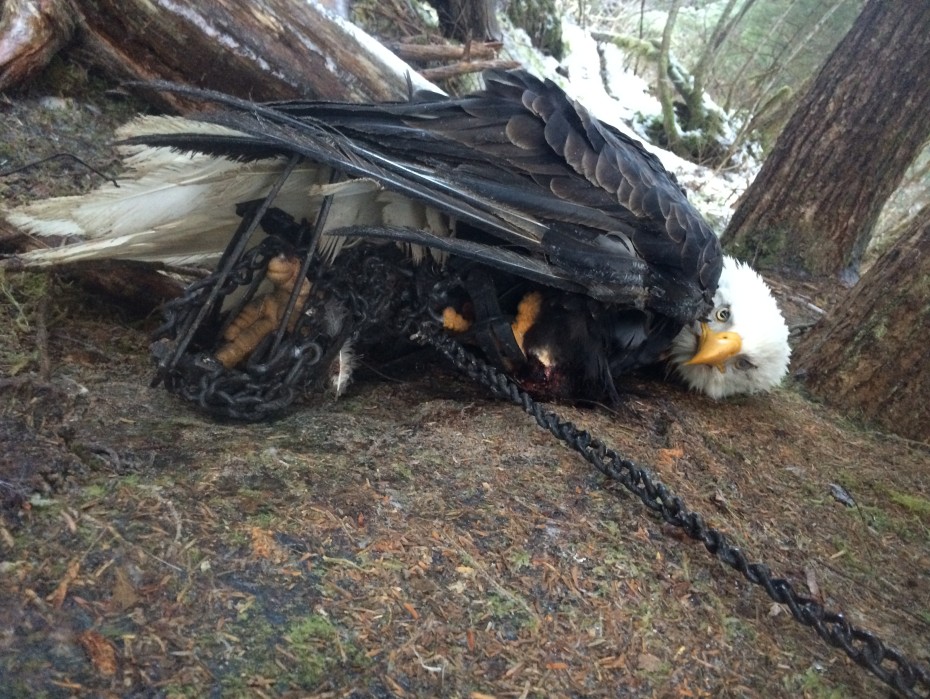
The woman who freed a trapped eagle and was cited for springing other traps is heading back to court. In January, the State of Alaska dropped its case against Kathleen Turley. Now, the trapper is suing her for damages in small claims court.

Download Audio:

Vm
Download Audio:

00:00 R P

Kathleen Turley encountered this eagle stuck in two traps Dec. 24, 2014. She freed the eagle and tampered with other legally set traps in the area. She’s now being sued. (Photo courtesy Kathleen Turley)

Pete Buist is a past president and board member of the Alaska Trappers Association. He’s now its spokesman. Buist doesn’t know the Juneau trapper, John Forrest, but understands why he’s suing. He says if it were him, he’d do the same thing.

“I say bravo for the trapper. The state won’t do what’s right. He should do what’s right,” Buist says.

Forrest, who’s suing Kathleen Turley for at least $5,000, declined to comment.

In January, Turley (formerly Kathleen Adair at the time of the events) says she sprang three traps on two separate days out of concern for the safety of dogs and hikers. She also freed an eagle that was caught in two traps. Despite her efforts to save the eagle, it was later euthanized.

Alaska Wildlife Troopers cited Turley for tampering with traps that Forrest had legally set, not for freeing the eagle. Hindering lawful trapping is a violation of state law that carries up to a $500 fine and 30 days in jail.

Turley wasn’t fined or jailed. At the arraignment, the state’s prosecutor used his discretion and advocated for the case to be thrown out, and it was.

Buist says members of the trappers association weren’t happy.

“I can fully understand why the lady rescued the eagle. I don’t have any problem with that whatsoever. And I think if she had just rescued the eagle, the trappers would’ve supported that. But she didn’t. She went back and tampered with the traps and broke the law,” Buist says.

Shortly after the State of Alaska dropped its case against Turley, Buist says several members of the trappers association complained to the attorney general’s office.

“And basically we were summarily dismissed as the fringe element and it fizzled after that,” Buist says.

Forrest has a lawyer, though it’s not required in small claims court. Attorney Zane Wilson is no stranger in the trapping community. He helped win a high profile case involving wildlife biologist Gordon Haber who freed a wolf from a snare in Tok in 1997. The biologist was being funded by an international animal advocacy organization. The trapper sued and the Tok jury awarded him $190,000.

Wilson is with Fairbanks firm Cook Shuhmann & Groseclose. He relayed through an employee he was “not authorized” to speak to me. Wilson is a lifetime member of the trappers association. Buist says Wilson’s uncle is Dean Wilson, a well-known trapper and fur buyer who’s been called the state’s patriarch of trapping.

A fellow Juneau trapper and a state wildlife biologist have said Forrest partially relies on trapping for income. The most targeted species in the Juneau area is marten. In the 2012-2013 season, the average price for raw marten fur was about $140. A state report says one even fetched $1,300. In Southeast, trappers also target mink, otter, wolf and beaver, among other animals.

Turley, who freed the eagle and sprung the traps, doesn’t think she owes Forrest anything. She says she’s never been contacted by him. Until she received the complaint in the mail in July, she didn’t even know his name.

“I was very surprised and confused. … I hadn’t heard anything about it. I had no idea that he felt there was money owed,” Turley says.

Turley is Alaska-raised and has lived in Juneau for 30 years. She grew up fishing and hunting and shot a bear at age 16. As an avid outdoors person, she’s seen traps before, but had never tampered with any before the eagle incident. Turley says she’s not against trapping, but thinks it’s better suited for other parts of the state.

She says she didn’t damage the traps when she sprung them. Turley hasn’t been on the Davies Creek Trail where she found the eagle since.

“I’ve completely avoided that area, which is a beautiful area, a very nice trail, but I haven’t gone anywhere near it. I don’t want anything do to with it,” Turley says.

She says the whole incident and the lawsuit have caused her a lot of stress and grief.

The trial is scheduled for Oct. 12. Turley doesn’t have a lawyer yet.

The Progressive Pope’s Regressive Stance on Birth Control

http://www.populationconnectionaction.org/site/PageNavigator/ActionFund/AFBlogArticle57.html

By John Seager, President

September 25, 2015

Pope_Francis_Photo_2.jpg

I get why people like Pope Francis—he is charismatic, humble, and has an awfully contagious smile. He’s also radical by papal standards; being the first pope to dominate the social media realm and the first to be named “Person of the Year’ by an LGBT magazine. I’d be lying if I said I didn’t admire his cool tenacity.

But as crowds gather to catch a glimpse of Pope Francis—the religious rock star—on his East Coast tour, I can’t help but wonder about the fans who praise him for his enlightened stance on poverty, inequality, and climate change. Because, unless Francis ends his backwards proscription of birth control, it will be impossible for him to make any long-lasting improvements in those arenas.

From championing efforts to reduce greenhouse gas emissions to speaking out against economic disparity, the pope’s attempts to make the world a better place are futile alongside his reluctance to endorse access to the full range of contraceptives as a necessary and moral good.

Contraception, quite literally, saves lives—especially those of women and girls in the developing world who are deprived of antenatal services. Mothers and babies perish when women are prevented from delaying, spacing, or avoiding pregnancies. And young children whose mothers die during pregnancy and childbirth are cruelly left to fend for themselves.

In fact, if every single woman living in the developing world used modern contraception, the number of unintended pregnancies would be reduced by 70 percent and unsafe abortions would drop by 74 percent. Imagine how much that would enable women and girls to obtain an education and career; not to mention boost entire economies.

Increasing universal access to contraceptives is also central to addressing the challenge of climate change—a cause that the pope considers so important that he revolved his entire encyclical around it. While it’s a welcome step in the right direction, Francis remains opposed to breaking the doctrinal chains that prevent the Vatican from recognizing the environmental impacts of unintended pregnancy and, in turn, unsustainable population growth.

According to a recent study, slowing population growth could significantly reduce carbon emissions and diminish the onslaught of dangerous climate change. It truly is a matter of life and death for millions of, what Francis would term, God’s creatures.

Having the ability to choose when and whether to have children gives people—especially women and girls living in poor nations—a greater shot at enduring and recovering from extreme weather events. Families that can prevent unintended pregnancies are usually much better equipped, financially and otherwise, to counter the effects of climate change.

But, for Francis, science and facts take a backseat to doctrine. It’s a fact that eliminating the barriers that prevent women from accessing birth control reduces the rate of abortion—one of the greatest “sins” in the eyes of the Catholic Church. It’s also a fact that increased use of birth control is crucial for attaining many of the proposed UN Sustainable Development Goals (SDGs), such as empowering women and girls. Yet, even those basic truths are not enough to sway the pope’s edict on modern contraception.

While reformism may have its limits in the Vatican, the championing of human rights shouldn’t. Planning and preventing pregnancy not only saves lives; it helps to fight poverty, close the inequality gap, and reduce the amount of greenhouse gas emissions that get pumped into the atmosphere.

It’s time for His Holiness to cease his condemnation of modern contraception and live up to his reputation as a progressive, egalitarian pope. Otherwise, Francis, the rock star, may become Francis, the one-hit wonder.

Lions, Tigers and Bears Attract State Scrutiny

http://www.pewtrusts.org/en/research-and-analysis/blogs/stateline/2015/09/25/lions-tigers-and-bears-attract-state-scrutiny?utm_campaign=2015-09-25%20Stateline%20Daily%20%20&utm_medium=email&utm_source=Eloqua

Snake© The Associated Press

Mack Ralbovsky, left, of the Rainforest Reptile Shows, gets assistance from state game wardens Timothy Carey, center, and Wesley Butler as they remove a python from a Vermont home. Many states ban the private ownership of exotic animals or require that owners get licenses or permits.

This summer, Milwaukee residents were captivated by reports of what appeared to be a lion-like creature roaming city neighborhoods. Authorities set up a dragnet and traps, but the big cat was never located.

Wisconsin state Sen. Van Wanggaard, a Republican, wasn’t surprised to hear of a wandering wild feline. He already was so concerned about the threat posed by dangerous exotic pets that he’d been crafting a bill to limit private ownership of them.

Wanggaard wants his state to join dozens of others that have passed laws banning or regulating big cats, bears, apes and other exotic pets, which animal welfare advocates say can threaten public safety when they escape and are at risk of being poorly cared for by private owners.

Although it’s difficult to determine exactly how many exotic creatures are privately owned, the Humane Society of the United States says they are part of a multibillion-dollar industry. Born Free USA, a wildlife conservation and animal welfare group opposed to private ownership, estimates that between 10,000 and 20,000 big cats alone are in private hands in the U.S. And because the federal government largely leaves it to the states to regulate exotic animals, legislatures have been grappling with the issue.

Since 2013, legislation that deals with exotic pet ownership has been proposed in more than a dozen states, including Wisconsin, according to Born Free. Of the 22 measures filed, 18 have failed and two have passed, including one that created an exemption allowing the owner of a Louisiana truck stop to keep his tiger, Tony, as a roadside attraction. Two remaining measures are pending, including Wanggaard’s in Wisconsin and another in Pennsylvania.

Opponents say many owners are ill-equipped to house and care for exotic pets, putting them in cages and enclosures that don’t meet the creatures’ basic needs.

“Wildlife belongs in the wild. It’s risky for everyone involved,” said Kate Dylewsky of Born Free. “It’s cruel to the animals to keep them in confinement, often isolated from members of their own species. And most people don’t have knowledge or the resources to care for these animals properly.”

Many exotic pet owners, breeders, private zoos and sanctuaries disagree. They say that state bans can hurt efforts to protect animals. And, some argue, the states shouldn’t meddle with an individual’s decision about what kinds of pets to keep.

Good regulations could help protect these animals, said Lynn Culver, executive director of the Feline Conservation Federation, which represents owners, breeders, private zoos and sanctuaries that keep wild cats. “But these [ban] laws are designed to stop future generations and clamp down on current populations.”

Culver said exotic animals need to be kept in captivity so they can breed. “They are the offspring of animals that were taken out of the wild. We’re morally obligated to manage them responsibly for future generations.”

States React

Federal laws restrict the sale and transportation of some exotic and wild animals, but don’t generally address private ownership. That falls to the states, which take a variety of approaches.

Some state laws specify which species are banned or regulated. The Wisconsin proposal lists several types of exotic animals that would be considered dangerous—including non-native big cats and bears, gorillas, chimpanzees, alligators and crocodiles. Others are more general, said David Favre, a professor at the Michigan State University College of Law and director of the Animal Legal & Historical Center, a website devoted to animals and the law.

“It usually takes some horrible event in a state, where people say, ‘How did you let this happen?’ for the legislature to act,” Favre said.

That’s what occurred in Zanesville, Ohio, after a suicidal man released more than 50 big cats, bears, primates and wolves in 2011. Police and animal control officers tried to use tranquilizers, but couldn’t control the situation and were forced to kill most of the animals.

At the time, Ohio had no law dealing with dangerous exotic pets. After the Zanesville incident, the Legislature in 2012 banned their possession or acquisition. Those who already owned such pets were allowed to keep them, but they had to apply for permits and comply with safety and care standards.

In Connecticut, the Legislature amended its law in 2009 to ban the private ownership of some primates after an incident that year in which a woman was blinded, lost both hands and had much of her face ripped off by her friend’s 200-pound pet chimp.

Wisconsin is one of five states without a law regulating the private ownership of dangerous exotic animals, according to Born Free. Fourteen states require licenses or permits. Twelve allow ownership of some exotic animals but prohibit others. And 19 have bans on a number of species.

Last year, West Virginia, which had not had a law, passed a measure that prohibited private possession of lions, tigers, bears, elephants and most primates. Owners were grandfathered in, provided they are registered. The rules went into effect earlier this year.

“When you don’t have any checks and balances in place, it was wide open for people bringing these exotic animals into our little state,” said former Democratic Del. Randy Swartzmiller, who introduced the bill. “The majority of the Legislature saw this as a bill that was not only going to protect people but also the well-being of these animals.”

But bills restricting or regulating exotic animal ownership often die in state legislatures. This year, six measures failed—in Indiana, Kansas, North Carolina, Oklahoma, Virginia and Wyoming—according to Born Free.

“In some of these states, it’s very hard to have a conversation about it,” said Born Free’s Dylewsky.

To pass laws, legislators and the public often must be educated about the potential threats to public safety and the animals’ well-being, said Nicole Paquette, vice president of wildlife for the Humane Society. Also, debates about which animals should be covered by new laws are usually heated.

Zuzana Kukol, co-founder of REXANO, or Responsible Exotic Animal Ownership, a nonprofit that advocates for exotic pet owners’ rights, opposes bans, saying they don’t really work. “Do bans on drugs or prostitution work? If people want it, they’re going to get it.”

Kukol, who with her fiance lives in rural Nevada and owns lions, tigers, bobcats, cougars and other exotic animals, dismisses the public safety argument. “The regular population isn’t getting killed by tigers and lions on the way to the store,” she said. “They’re much more likely to be killed by a drunk driver.”

Kukol said that many counties and cities already have regulations governing exotic animal ownership. In her area, she said, the county does an inspection every year and requires her to get an annual permit.

“I don’t think states should micromanage,” Kukol said. “They should take care of the roads, not worry about exotics. They are not telling me how many dogs or horses I can have.”

Strain on Resources

Wanggaard, who introduced the Wisconsin measure last month, points to a case in Kenosha two years ago. Police were called to a house where they found five rattlesnakes, a crocodile, two alligators and a poisonous Gila monster, and, dead in the backyard, an alligator and a snake. While these types of incidents have cropped up over the years, Wanggaard said, the recent Milwaukee lion scare might be the impetus needed to pass legislation.

Under his proposal, private possession of many dangerous exotic animals would be prohibited. Those who already own them would be able to keep them—but not to acquire any others—if their municipality allows it and they are registered. The proposal would exempt accredited zoos, wildlife sanctuaries and circuses.

A police officer for 30 years, Wanggaard said that he recalls times when police would respond to domestic violence calls and, arriving at a home, find a bear or an 8-foot alligator. “Not only is it dangerous for the officer, but these animals often aren’t being maintained in a humane way.”

Wanggaard said that exotic pets also put a strain on emergency services, noting that in Milwaukee this summer, 30 or 40 officers were busy trying to corral the lion.

Wanggaard, who is vice chairman of the Senate majority caucus, said that if his bill becomes law, authorities will have a better handle on where exotic animals are located and whether they’re legally allowed.

“We have hours of discussion in our towns and villages about somebody raising five chickens in their backyard,” he said. “We’re regulating that, but we won’t regulate it if you have a lion or a baboon in your basement.”

Patricia Randolph’s Madravenspeak: Black bear diaries: The pending murder of my mother, my brother, my sister, my cubs

dvoight09's avatarWisconsin Wildlife Ethic-Vote Our Wildlife

55f1a5bbd2d86.image

“The fear of bears comes out of the hunting culture. To feel good about killing these animals, we have to make them out to be ferocious. … They are misrepresented.” — Charlie Russell, bear man of Kamchatka

Wednesday, Sept. 9, the bear kill started, continuing for 35 days of what can only be called genocide (Webster’s: “the systematic extermination of a cultural group”). A record number of kill licenses, 10,690, have been sold with the goal of killing 4,750 bears, a 19 percent kill rate by Department of Natural Resources estimate. To put that in proportion to the Wisconsin human population, that will impact bears like killing more than 1 million humans in Wisconsin would impact us. It is horrifying carnage of a peaceful indigenous population, much like that inflicted on the American Indians.

In 2014, 70.7 percent of the male bears killed were less than 2 years old, as…

View original post 830 more words

Cormorant massacre underway

http://www.animals24-7.org/2015/09/25/cormorant-massacre-underway/

Headline shotby Bob Sallinger,  conservation director, Audubon Society of Portland

Further to my ANIMALS 24-7 posting of September 14,  2015,  Feds resume killing cormorants despite admitting “nesting population targets were met,  for the past two weeks, federal government employees from the Wildlife Services office of the U.S. Department of Agriculture have been shooting double-crested cormorants from a boat in the Columbia River Estuary near East Sand Island.  Shotgun blasts have been audible from shore.  Observers on shore have also been able to see three federal employees moving about in a small boat shooting cormorants out of the sky and collecting them from the water with nets. The U.S. Army Corps of Engineers,  which is in charge of the operation,  reports that they have shot 863 double-crested cormorants and 10 non-target Brandt’s cormorants in the past two weeks.  The Corps intends to continue the shooting into the fall in order to achieve their goal of killing more than 4,000 double-crested cormorants this season.

OPB photo #2

Oregon Public Broadcasting was able to get the first footage of the killings earlier this week. It is now posted on their website: