
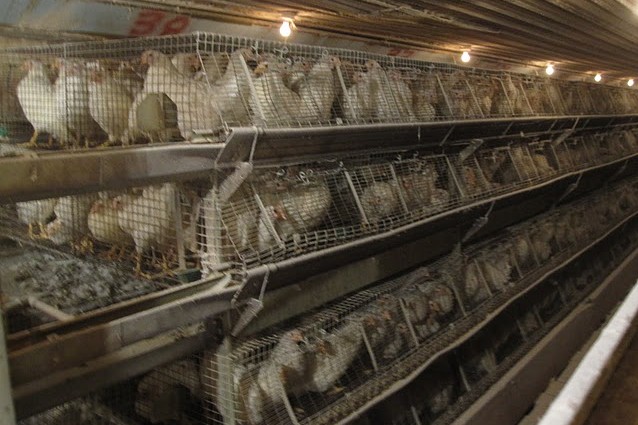
For 15 days in February 2010, an HSUS investigator worked inside 3 factory farms owned by Rose Acre Farms, the countrys second-largest egg producer. These facilities, located in Winterset, Stuart, and Guthrie Center, Iowa, confine nearly four million laying hens and about one million young hens (pullets). At the Guthrie Center location, battery cages are stacked eight high and hold more than two million birds. At the Stuart and Winterset locations, battery cages are stacked four high. This investigation revealed the below findings.
Broken bones: Workers roughly yank young hens (pullets) from their cages in the growing sheds and load them into mobile cages for transport to battery cages, resulting in a mass of twisted bodies.
Extremely rough handling: The HSUS investigator videotaped workers pulling young hens from the mobile cages and stuffing them into battery cages.
Cruel depopulation methods: The HSUS investigator documented workers grabbing hens by their legs, then cramming them into gassing carts where they’re killed with carbon dioxide.
Prolapsed uteruses: Hens suffer from “blow-outs” that go unnoticed and untreated due to the cage crowding.
Trapped birds unable to reach food and water: Battery cages can trap hens by their wings, necks, legs, and feet in the wire, causing other birds to trample the weakened animals, usually resulting in a slow, painful death.
High mortality in layer and pullet sheds: The HSUS investigator pulled dead young hens, some of them mummified (meaning they’d been rotting in the cages for weeks), from cages every day.
Failure to maintain manure pits: According to one worker, the manure pit under a pullet shed had not been cleaned in two years. Rose Acre workers claimed that some hens are blinded because of excessive ammonia levels.
Abandoned hens: Some hens manage to escape from their cages and fall into the manure pits below.
Keywords: Chicken, Animal Abuse, Animal Cruelty, Caged Farm Animals, Cruel Confinement of Farm Animals, Campaigns, Factory Farming, Farm Animal Welfare, Investigations, Protect Farm Animals
Cage-Free Eggs Are Good News for Chickens—but They Won’t Save McDonald’s
One week after McDonald’s announced that its breakfast menu was going to be an all-day thing, the fast-food chain gave customers a reason to feel a bit better about it: Soon your Egg McMuffin will be made with cage-free eggs.
Today McDonald’s said its 16,000 franchises in the United States and Canada will make the transition over the next 10 years (even though competitor Burger King has committed to going cage-free by 2017). The company already buys around 13 million cage-free eggs every year but will soon source all 2 billion eggs purchased annually from cage-free farms.
It’s worth noting that “cage-free” isn’t always all it’s cracked up to be. Earlier this year my colleague Tom Philpott wrote about how USDA regulations that animals must have “year-round access…to the outdoors, shade, shelter, exercise areas, fresh air, clean water for drinking, and direct sunlight, suitable to the species, its stage of life, the climate, and the environment” can be subject to interpretation. Animal rights activists who investigated cage-free egg producer Petaluma found hens were still in poor condition:
Footage taken from within the Petaluma facilities shows lots of birds wallowing tightly together, often amidst what looks like significant buildup of their own waste. The narrators use words like “stench, ” “filth,” and “misery” to describe the scene; and show several birds in obvious bad health—birds with blisters, missing feathers, one clearly caked with shit—along with birds that appear to be in decent shape. The crew dramatically rescues one pathetically injured bird, handing her over the fence, one activist to another, and whisking her to a vet in Berkeley, who declares her in dismal shape.
McDonald’s has been trying hard lately to rebrand itself, succumbing to consumer demands for healthier fare in the face of a increasingly dismal business outlook. Today’s announcement also included details about new menu items, including a new salad containing baby kale (an ingredient the company once said it would never use), and plans to replace liquid margarine with real butter. McDonald’s has also stopped serving chicken raised on antibiotics. It sells milk from cows not treated with artificial growth hormones, and last year it launched a campaign that utilized behind-the-scenes videos to prove it was serving real food.
It’s hard to say whether McDonalds’ efforts will give the company the boost it needs—even all-day breakfast is not a sure win, the Motley Fool recently argued. What’s more, the company still has an image problem: It continues to face criticism over low pay for workers, employee safety, and ads that target children.
Another wrinkle: The timing of McDonald’s all-day breakfast launch is not exactly ideal. Because of the recent, massive outbreak of avian flu, egg prices are now sky high, with no signs of dropping—and cage-free eggs are typically more expensive than conventional. (McDonald’s claims it won’t raise prices.)
Still, animal rights advocates herald today’s announcement as a step in the right direction. “This is a watershed moment in a decades-long effort to eliminate the cruelest confinement from our food supply,” Wayne Pacelle, president and CEO of the Humane Society of the United States, said in a press release. “McDonald’s admirable move makes clear that egg production’s future is cage-free.”
 Exposing the Big Game
How wonderful. McDonalds patrons will have more reason to visit a company that makes it’s money by having animals killed for pleasure. Patrons will have one fewer reason to feel guilty, knowing the chickens are in another space, born to be killed, with, maybe, a less uncomfortable short life prior to their brutal execution..
Is there anything worse than watching fat slobs stuffing their faces in a McD’s drive-thru? Can’t even walk out of a car to stuff their faces? Why don’t they just attach a funnel to the car window and pour everything down their throats.
There are much worse things, I know, but it is pretty bad. But, at least it’s a little progress in the right direction for factory farm animals.
Well, there is more bird flu waiting to happen. What kind of moral throwbacks own and work at these places? There isn’t much that human beings so arrogantly pride themselves on that is justifiable.
The quote in the article: “Still, animal rights advocates herald today’s announcement …. Wayne Pacelle, president and CEO of the Humane Society of the United States, said in a press release. “McDonald’s admirable move makes clear that egg production’s future is cage-free.” is by an ANIMAL RIGHTS advocate- or ANIMAL WELFARE.
I thought we could all use a smile, another winner of a commercial from Geico. The camels in the zoo one was terrific, but this one is too:
I love chickens, they are the most adorable birds. My neighbor raises some.