Extermination of large predators such as wolves and bears has a cascading effect on delicate ecological balance
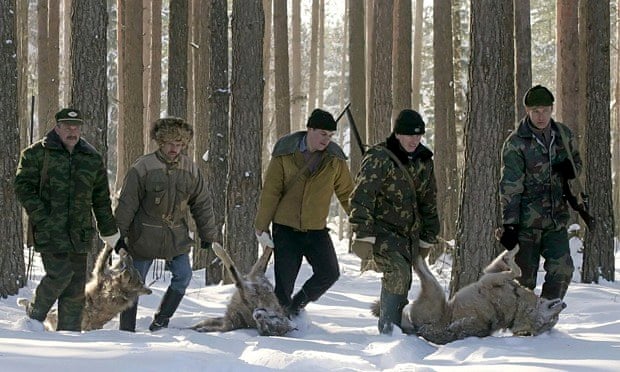
Belarus hunters drag wolves they killed overnight near village Pruzhanka, some 110 km south-east of Minsk February 8, 2005. Hunting for wolfs in Belarus is legal throughout the whole year with a hunter getting 168,000 Belarus roubles ($77 US dollars) for every wolf killed. Photograph: Vasily Fedosenko/Reuters
Press Association
Thursday 9 January 2014
A plea to restore populations of some of the world’s most dangerous animals has been made by scientists who claim the loss of large carnivores is damaging ecosystems.
More than three-quarters of the 31 species of large land predators, such as lions and wolves, are in decline, according to a new study. Of these, 17 species are now restricted to less than half the territory they once occupied.
Large carnivores have already been exterminated in many developed regions, including western Europe and eastern United States – and the same pattern of “carnivore cleansing” is being repeated throughout the world, said scientists.
Yet evidence suggests carnivores play a vital role in maintaining the delicate balance of ecosystems which cannot be replaced by humans hunting the animals they normally prey on.
“Globally, we are losing our large carnivores,” said lead researcher Prof William Ripple, from the department of forest ecosystems and society at Oregon State University in the US.
“Many of them are endangered. Their ranges are collapsing. Many of these animals are at risk of extinction, either locally or globally. And, ironically, they are vanishing just as we are learning about their important ecological effects.”
Humans have waged a long-standing war with large carnivores that kill livestock and threaten rural communities.
But the international team from the US, Australia, Italy and Sweden called for a global initiative to conserve large predators.
The scientists suggested it could be modelled on the Large Carnivore Initiative for Europe, an expert group affiliated with the International Union for the Conservation of Nature (IUCN). It is committed to helping European predators including the wolf, lynx and brown bear reoccupy many of their former habitats.
Leaving large predators alone also has a cascading effect, the “trophic cascade.” The key predators lower the numbers of their prey, and the next lower trophic level, which the prey overuse, tends to flourish. If wolves reduce the elk population, then the trees and plants that they would eat are left for another level to use as food, shelter, and habitat.
Dave Foreman, one of the founders of Earth!First has been involved in an organization, The Wildlands Project, to “rewild” and restore wilderness for the large predators. But the trophic cascade is often interrupted by human activity. Wilderness areas are shared by hunters, trappers, hikers, and loggers, etc. The corridors that bears, cougars, and wolves, in particular, need to traverse to live and seek food, are often broken up by roads, private property, logging sites, and ranches. The cascade is also interrupted by fish and wildlife agencies who “manage” the big predators by killing them to provide hunters with more deer, elk, and moose to shoot. They also destroy the “pests” at the lower trophic levels for the benefit of farmers and ranchers.
The human population is exploding and demanding more wilderness areas to use for resources and recreation. That population also requires increased food production and land dedicated to farming and ranching. The question is–will the trophic cascade ever be free to function as it should in the modern world?

 Exposing the Big Game
Reblogged this on "OUR WORLD".
Reblogged this on Sherlockian's Blog.
Mob mentality at work again. Blech.
Reblogged this on Rhya's Place.
Leaving large predators alone also has a cascading effect, the “trophic cascade.” The key predators lower the numbers of their prey, and the next lower trophic level, which the prey overuse, tends to flourish. If wolves reduce the elk population, then the trees and plants that they would eat are left for another level to use as food, shelter, and habitat.
Dave Foreman, one of the founders of Earth!First has been involved in an organization, The Wildlands Project, to “rewild” and restore wilderness for the large predators. But the trophic cascade is often interrupted by human activity. Wilderness areas are shared by hunters, trappers, hikers, and loggers, etc. The corridors that bears, cougars, and wolves, in particular, need to traverse to live and seek food, are often broken up by roads, private property, logging sites, and ranches. The cascade is also interrupted by fish and wildlife agencies who “manage” the big predators by killing them to provide hunters with more deer, elk, and moose to shoot. They also destroy the “pests” at the lower trophic levels for the benefit of farmers and ranchers.
The human population is exploding and demanding more wilderness areas to use for resources and recreation. That population also requires increased food production and land dedicated to farming and ranching. The question is–will the trophic cascade ever be free to function as it should in the modern world?
Why on earth would they think that?!?!?! We’re only messing with the natural balance of ecosystems and the food chain!! Get a clue idiots!!