Exposing the Big Game

Forget Hunters' Feeble Rationalizations and Trust Your Gut Feelings: Making Sport of Killing Is Not Healthy Human Behavior

Exposing the Big Game

You’re a Mean One, Mr. Fudd

[The following is a marriage between the Looney Tunes’ cartoon character who best depicts the average hunter and Dr. Seuss’ lyrics that so perfectly describe them…]

Elmer Fudd hunter

You’re a mean one, Mr. Fudd.
You really are a heel,
You’re as cuddly as a cactus, you’re as charming as an eel, Mr. Fudd.
You’re a bad banana with a greasy black peel!

You’re a monster, Mr. Fudd.
Your heart’s an empty hole.
Your brain is full of spiders, you have garlic in your soul, Mr. Fudd.
I wouldn’t touch you with a thirty-nine-and-a-half foot pole!

You’re a vile one, Mr. Fudd.
You have termites in your smile.
You have all the tender sweetness of a seasick crocodile,
Mr. Fudd.
Given the choice between the two of you,
I’d take the seasick crocodile.

You’re a foul one, Mr. Fudd.
You’re a nasty wasty skunk.
Your heart is full of unwashed socks;
Your soul is full of gunk,
Mr. Fudd.

The three words that best describe you
Are as follows, and I quote:
Stink!
Stank!
Stunk!

You’re a rotter, Mr. Fudd.
You’re the king of sinful sots.
Your heart’s a dead tomato squashed with moldy purple spots,
Mr. Fudd.

Your soul is an appalling dump heap
Overflowing with the most disgraceful
Assortment of deplorable rubbish imaginable,
Mangled up in tangled up knots.

You nauseate me, Mr. Fudd,
With a noxious super naus.
You’re a crooked jerky jockey and
You drive a crooked horse,
Mr Fudd!

ELmer Fudd hunter

You’re a three-decker sauerkraut
And toadstool sandwich,
With arsenic sauce!

Shades of a Canfield Ocean — Hydrogen Sulfide in Oregon’s Purple Waves?

robertscribbler's avatarrobertscribbler

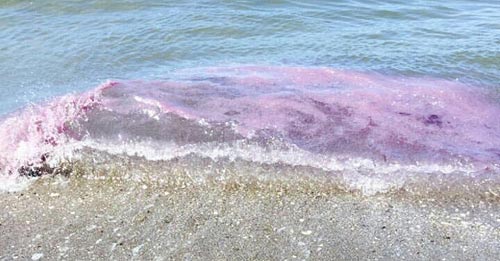
Are we already starting to awaken some of the horrors of the ancient hothouse ocean? Are dangerous, sea and land life killing, strains of primordial hydrogen sulfide producing bacteria starting to show up in the increasingly warm and oxygen-starved waters of the US West Coast? This week’s disturbing new reports of odd-smelling, purple-colored waves appearing along the Oregon coastline are a sign that it may be starting to happen.

Purple Waves

(Purple waves wash over the Oregon beach of Neskowin on August 15. A form of hydrogen sulfide consuming bacteria is known to color water purple. Is this an indicator that the deadly gas is present in Oregon’s waters? Image source: Jeanine Sbisa and Beach Connection.)

A Dangerous Beauty

Oregon beachgoers and ocean researchers alike are flummoxed. There’s something strange in the water. Something that’s coloring the waves of Oregon’s beaches purple even as the off-shore waters are painted…

View original post 1,348 more words

Human CO2 Emissions to Drive Key Ocean Bacteria Haywire, Generate Dead Zones, Wreck Nitrogen Web

robertscribbler's avatarrobertscribbler

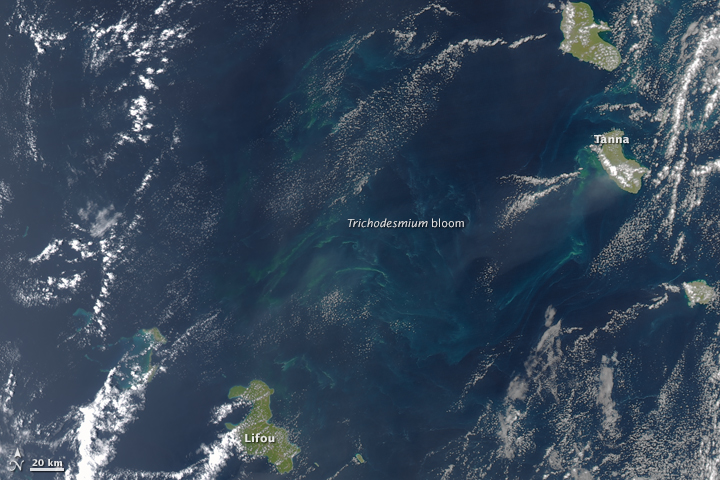
Trichodesmium. It’s the bacteria that’s solely responsible for the fixation of nearly 50 percent of nitrogen in the world’s oceans. A very important role for this microscopic critter. For without nitrogen fixation — or the process by which environmental nitrogen is converted to forms usable by organisms — most of life on Earth would not exist.

Now, a new study produced by USC and the Massachusetts-based Woods Hole Oceanographic Institution (WHOI), has found that human carbon emissions are set to drive this essential organism haywire. Forcing evolutionary changes in which the bacteria is unable to regulate its growth. Thus generating population explosions and die-offs that will be very disruptive to the fragile web of life in the world’s oceans.

Trichodesmium_bloom,_SW_Pacific

(A Trichodesmium bloom off New Caledonia. Image source: Earth Observatory.)

Trichodesmium — A Mostly Helpful Bacteria Essential to Ocean Life

Trichodesmium is a form of cyanobacteria. It…

View original post 1,173 more words

Tropical Hurricane in Late December at the North Pole? That’s Not Funny, That’s Fucked Up!

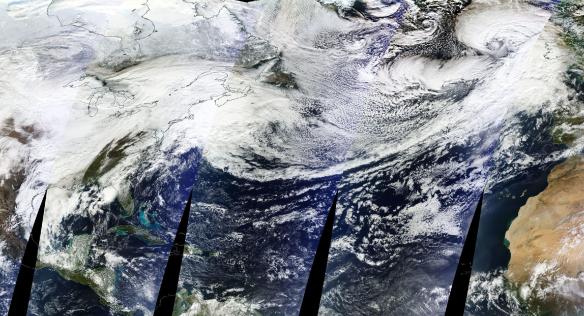
I understand if folks are getting tired of hearing about global warming or historic, record-breaking, weather events that crop up every few days. But you’d think a thousand-mile wide tropical hurricane invading and bringing rain to normally-frozen Arctic regions like the North Pole would be newsworthy, if only for what it portends for our future. Yet, a search of the subject produces almost nil in the way of useful information, as if the mainstream media is clueless or not allowed to talk about this with the general public for fear of causing a mass panic.

When I resorted to a local news source, I found they’d tried to turn it into a joke. Here’s what KOMO TV had to say about the situation:

“A storm that brought severe weather to the southeast over Christmas has moved out into the Atlantic, re-strengthened into another monster storm bearing down on Iceland…

“And has somehow managed to make it to where Santa’s elves at the North Pole are enjoying a warmer Wednesday morning than Seattleites rushing out the door to work…computer projections show temperatures were to be in the mid 30s around the pole, a bit warmer than the 30 degrees Seattle had Wednesday morning. (Tacoma could brag it was probably 10 degrees colder than the North Pole Wednesday as they were around 25 at daybreak.)”

Rather than suggesting what this kind of warm weather will mean to the life adapted to arctic conditions, the silly Seattle station summed up the report glibly with:

“So how is it that for the first time in forever, polar bears might just be able to indulge on a Frappuccino?”

To get a glimpse into just how these warm weather events can affect high Arctic wildlife, one might do better to check with people who make the habitat their home.Following a rainy winter in 2012 on Svalbard in Norway, unprecedented numbers of reindeer died after ice blocked their access to plants.

In an article in Science Mag, entitled, Arctic Faces an Ice-pocalypse,  reports:

“Ecologist Brage [Hansen of the Norwegian University of Science and Technology in Trondheim] and his co-authors focused on the rainy warm spell that brought record-high temperatures and prolonged rain to Svalbard over 2 weeks in January and February 2012. Temperatures during that period were routinely 20°C higher than normal, and on one day, the study notes, a Svalbard weather station recorded a daily average temperature of 4°C, which was “higher than at any weather station in mainland Norway on that day.” Another Svalbard station recorded 272 mm of rain during the 2 weeks; that station’s average for the whole year is 385 mm.

“The water created thick pools of slush and melted snow, kept cold by the frozen ground, known as permafrost. Then temperatures dropped and everything froze, leaving Svalbard’s fjords and towns coated in thick ice, terrorizing its roughly 2000 inhabitants and decimating the most abundant animals on the archipelago—wild reindeer. Scientists measured ground ice between 10 and 20 cm thick in 200 test sites, and more than half of the ground area they monitored was still covered in the ice 5 months later.

“The impact on Svalbard’s reindeer was severe, as ice prevented the animals from digging through the snow to eat plants.”

Meanwhile: “Winter rain in the Arctic may alter marine ecosystems as well as terrestrial ones, says Cecilia Bitz, an atmospheric scientist at the University of Washington, Seattle. The sea ice is where ringed seals live. Rain on snow “can collapse their snow caves where they raise their young,” she says. Along with the declining amount of floating ice, she adds, rain on snow is a reason the animals have been listed as threatened.”

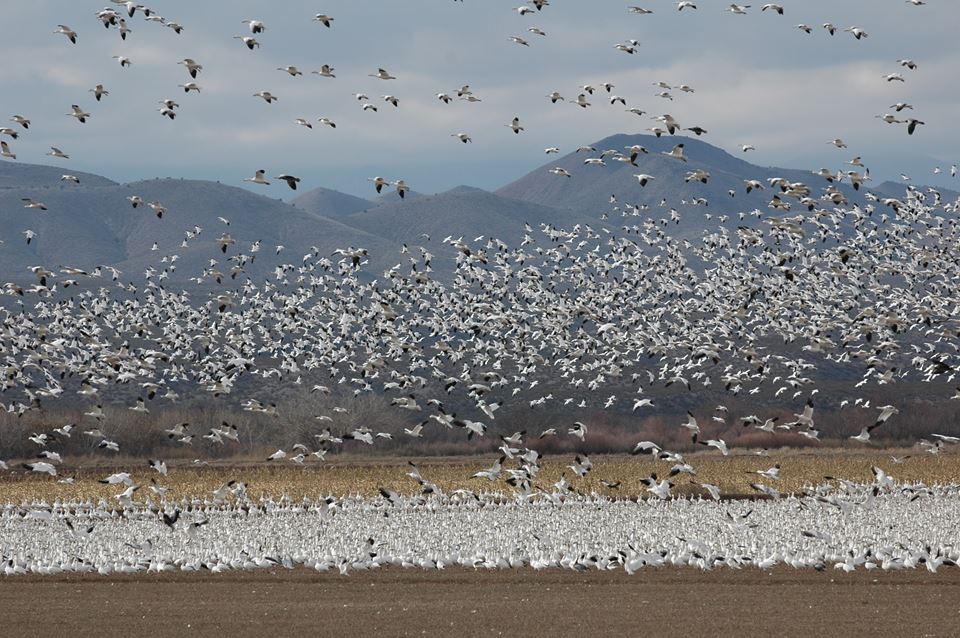
I don’t expect to hear of any polar bears ordering Frappuccino since the last polar warm spell, but let’s hope the caribou and seal pups make it through unscathed. At the same time, the U.S.’s southern border is seeing an unprecedented snowpack that may spell trouble for wintering waterfowl in areas such as the Bosque del Apache National Wildlife Refuge. Although the birds pictured here are called “snow geese”, it’s not because snow is their preferred habitat. 12196349_10153256579521188_5652107754797511661_n

Amidst Disasters Around the World, Top Scientists Declare Links Between Extreme Weather and Climate Change

robertscribbler's avatarrobertscribbler

Andy Lee Robinson said it all-too-well — “El Nino + Climate Change = El Diablo.”

And as the Washington Post so cogently notes — the world is now experiencing a rash of Freakish Weather from the North Pole to South America. It’s what appears to be happening as these two major record weather makers fire off simultaneously. A grim tally that includes the highest river levels ever seen in Missouri, the worst floods England has seen since the Middle Ages, the first time the North Pole has seen significantly above freezing temperatures during Winter in modern record keeping, city and region-crippling droughts spanning Central and South America, and seemingly everywhere, but especially in the North Atlantic where Greenland melt outflow has backed up the Gulf Stream, storms that seem to laugh in the face of our weather history.

Extreme weather on both sides of the Atlantic

(Extreme weather on both sides of the North Atlantic…

View original post 1,643 more words

Exposing the Big Game's avatarExposing the Big Game

Oregon Groups Sue to Reinstate Protected Status for Gray Wolves

The wolves were removed from the protected list in November.

Who will speak for the gray wolves? Oregon Wild, Cascadia Wildlands and the Center for Biological Diversity, that’s who.

That means, according to the National Wildlife Federation, they are no longer protected from anyone who would “harass, harm, pursue, hunt, shoot, wound, kill trap, capture, or collect, or to attempt to engage in any such conduct,” as well as “interfering in vital breeding and behavioral activities or degrading critical habitat” and “being traded or sold.”

But this morning, three conservation groups filed a legal challenge to that removal, saying in a press release by Oregon Wild that the Oregon Fish and Wildlife Commission “violated…

View original post 295 more words

Oregon Groups Sue to Reinstate Protected Status for Gray Wolves

The wolves were removed from the protected list in November.

Who will speak for the gray wolves? Oregon Wild, Cascadia Wildlands and the Center for Biological Diversity, that’s who.

That means, according to the National Wildlife Federation, they are no longer protected from anyone who would “harass, harm, pursue, hunt, shoot, wound, kill trap, capture, or collect, or to attempt to engage in any such conduct,” as well as “interfering in vital breeding and behavioral activities or degrading critical habitat” and “being traded or sold.”

But this morning, three conservation groups filed a legal challenge to that removal, saying in a press release by Oregon Wild that the Oregon Fish and Wildlife Commission “violated the law by failing to follow best available science and prematurely removing protections before wolves are truly recovered.”

There are 85 wolves in Oregon, which is four more than in 2014. But Noah Greenwald, endangered species program director at the Center for Biological Diversity, says in the press release: “It’s simply too soon to remove protections for Oregon’s wolves. The gray wolf remains endangered, and protections should never have been removed.”

Rob Klavins, a conservation advocate for Oregon Wild in Wallowa County, adds: “We look forward to the day we can celebrate the recovery of wolves in Oregon, but in a rush to declare ‘Mission Accomplished,’ the state caved to political pressure. If there were fewer than 100 elk or salmon or eagles left in the state, the agency would be scrambling to protect them. Wolves are being treated differently.”

Not everyone thinks the Oregon Fish and Wildlife Commission made the wrong call, though. Last year, we wrote about hostilities between conservationists and ranchers over the return of wolves in Oregon. €In rural parts of the state, many people are angry that wolves have been reintroduced at all, let alone protected. In that story, rancher and head of the Wolf Task Force said: “We didn’t want wolves here to begin with because we knew what the outcome was going to be, and that’s been realized now. So anything that has to do with a wolf being here at all is a compromise.”

As for when we can expect some sort of ruling on the challenge, Nick Cady of Cascadia Wildlands says it could be a while.

“Oregon Court of Appeals sometimes takes a very long time to complete cases, up to two years,” Cady told us over the phone. “We’re not sure when they’ll come out with an opinion on the matter.”

Ruling bars federal Wildlife Services Program from killing wolves

528624c939a88_preview-620

by on • 5:53 pm

Plaintiffs applaud judge’s conclusions

By Ann McCreary

A federal judge has barred the federal Wildlife Services program from participating in lethal removal of gray wolves in Washington, and rejected an Environmental Assessment (EA) prepared by the agency.

In response to a challenge brought by a coalition of conservation organizations, U.S. District Judge Robert Bryan said last week that Wildlife Services should have prepared a more in-depth environmental analysis of the effects of its proposed wolf management activities.

The lawsuit filed by five conservation organization earlier this year claimed that Wildlife Services, a federal program involved in wildlife management and conflict resolution, violated federal law by not preparing an adequately detailed environmental analysis of the effects of killing wolves that attack livestock in Washington.

An agency of the U.S. Department of Agriculture, Wildlife Services has worked under contract with Washington Department of Fish and Wildlife (WDFW) on lethal and non-lethal approaches to wolf-livestock conflict.

In 2014, Wildlife Services killed one wolf in the Huckleberry pack after state wildlife officials linked the pack to sheep kills. In 2012, Wildlife Services provided technical information to WDFW when the department killed seven wolves from the Wedge Pack following attacks on cattle.

In his ruling, Bryan said that “although Wildlife Services may have taken a hard look at the effects of lethal removal on non-target species, Wildlife Services did not take a hard look at the ecological effects of lethal removal or its effect on gray wolf populations” in its environmental analysis.

Bryan said the agreements on wolf management activities between WDFW and Wildlife Services left “the potential for substantial mismanagement of the Washington gray wolf population in the hands of Wildlife Services without the benefit of an EIS (Environmental Impact Statement).”

He said Wildlife Services failed to meet federal environmental policy requirements by not preparing an EIS and not taking a hard look at significant issues.

“Wildlife Services repeatedly but erroneously falls back on the position that it need not do so because it only intends to act at WDFW’s direction,” Bryan wrote.

Arbitrary action

The EA describes Wildlife Services’ intent to be bound to the state’s Wolf Conservation and Management Plan, which “is subject to changes or additions by WDFW, giving the public scant recourse,” Bryan wrote.

“Wildlife Services acted arbitrarily and capriciously and contrary to law by not preparing an EIS,” Bryan said. “Although aspects of Wildlife Services’ consideration under the Environmental Assessment and FONSI (finding of no significant impact) were sufficiently thorough, Wildlife Services misjudged the scope of its responsibility by deferring to WDFW, rather than diligently considering issues that may arise under the potentially broad scope of involvement in the Wolf Conservation and Management Plan.”

The judge ordered Wildlife Services to “not take any further wolf management actions in Washington” beyond the status quo that was in place prior to the Environmental Assessment and its finding of no significant impact.

The judge’s ruling was applauded by conservation groups that brought the case.

“The court made a wise and prudent decision that safeguards the legal right of citizens to know what their government is doing in their name,” said Timothy Coleman, executive director of the Kettle Range Conservation Group. “Wildlife Services cannot just grant itself authority to execute an endangered species absent the public interest or best available science.”

“We have been working for over a decade to hold Wildlife Services accountable for its blind, reckless lethal control programs,” said Nick Cady, legal director of Cascadia Wildlands. “This decision paves the way for meaningful analysis of the program’s impacts and hopefully a meaningful look at whether or not this wolf killing is worth it.”

“Wildlife Services has long asserted that it need not comply with our nation’s federal environmental laws, such as the National Environmental Policy Act, but this decision rejects those arguments and requires Wildlife Services to comply with all federal laws, not just those it finds convenient to comply with,” said John Mellgren, an attorney with Western Environmental Law Center, which represented the environmental organizations in court.

WDFW’s involvement

Donny Martorello of WDFW said that although Wildlife Services is now barred by the ruling from participating in lethal removal of gray wolves in Washington, the agency may continue to work on non-lethal management as requested by WDFW.

“Those activities have included trapping and collaring wolves, investigating reports of wolf-livestock depredations, and implementing non-lethal measures,” Martorello said in an email to members of the state’s Wolf Advisory Group.

WDFW filed a brief in support of Wildlife Services and Martorello said the two agencies are now considering their legal options for responding to the ruling.

In his order, Bryan said, “The decision on how to proceed — whether to prepare and EIS, renegotiate a narrower cope of involvement with WDFW, or abandon assistance efforts entirely — rests with Wildlife Services.”

Because the case is ongoing, WDFW would not discuss further details, Martorello said.

Organizations that brought the case are Cascadia Wildlands, WildEarth Guardians, Kettle Range Conservation Group, Predator Defense, and the Lands Council.

Gray wolves are protected as an endangered species throughout Washington under state law, and in the western two-thirds of the state — which includes the Methow Valley — under federal law.

There were at least 68 wolves in 16 packs in Washington according to a 2014 wolf census by WDFW. Two wolf packs have been confirmed in the Methow Valley.