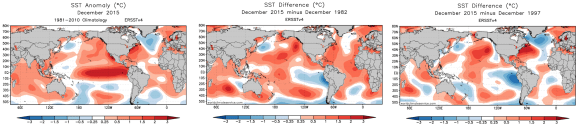
New Year’s Update from Rick Thoman: Sea Surface Temperature Anomalies for December 2015 compared to December 1982 and December 1997

aooscjanzen's avatarAlaska “Blob” Tracker

Rick Thoman from the National Weather Service, Alaska Region (Fairbanks) shared this with us in the New Year.

“Courtesy of Richard James at Prescient Weather  (Prescient Weather Website) Sea Surface Temperature anomalies (ERSSTv4) for December 2015 (left) and the differences from December 1982 (center) and 1997 (right). Cooler in the eastern Niño regions this winter, but warmer in the extratropical North”SSTs December 2015 compared to 97 copyDr. James gave a talk earlier this fall at UAF. Video and audio of his presentation are available here. Just scroll down to the bottom of the page at this link.

View original post

Showdown in the Malheur Marshes: the Origins of Rancher Terrorism in Burns, Oregon

http://www.counterpunch.org/2016/01/05/showdown-in-the-malheur-marshes-the-origins-of-the-armed-occupation-in-burns-oregon/

Malheur-Oregon-standoff-1

During the spring of 1995, shortly after the bombing of the Murrah Federal Building in Oklahoma City, James Ridgeway and I spent a couple of weeks traveling across the West for a series of stories in the Village Voice that chronicled  the rise of militant new rightwing movements of militias, white supremacists, Christian Identity sects and anti-government groups, including a profile of central Oregon rancher Dwight Hammond, now at the center of the armed seizure of the Malheur National Wildlife Refuge headquarters near Burns.

In the early 1990s, Hammond repeatedly transgressed federal environmental laws, trespassed on federal lands and hurled death threats at federal wildlife officials. Little action was taken against Hammond by a timid Clinton administration. Emboldened, Hammond and some of his fellow ranchers continued over the next two decades to flagrantly flout environmental laws and harass federal officials. These activities finally culminated in an act of poaching on Steens Mountain and two arson fires. Hammond and his son were convicted in federal court and sentenced to five years in prison. That conviction sparked the armed takeover of federal buildings now unfolding in Burns. Here is our report from 1995. — JSC

In the high desert of central Oregon, lies Harney County, a site of a long-festering and intense confrontation between federal officials and the militant property rights movement. Here federal Fish and Wildlife Service agents sought to fence off a wetland that had been trampled by a rancher’s cows on the Malheur National Wildlife Refuge about thirty miles south of the dust-caked town of Burns.

In an affidavit, Earl M. Kisler, a Fish and Wildlife Service enforcement officer, said that rancher Dwight Hammond had repeatedly threatened refuge officials with violence over an eight year period. On one occasion Hammond told the manager of the federal refuge that “he was going to tear his head off and shit down his neck.”

According to the affidavit, Hammond threated to kill refuge manager Forrest Cameron and assistant manager Dan Walsworth and claimed he was ready to die over a fence line that the refuge wanted to construct to keep his cows out of a marsh and wetland.

The tensions between the Hammond family and the government started when the refuge, which was established as a haven for migrating birds, refused to renew a grazing permit for Hammond’s cattle operation. Then came the incident over the wetland, which Hammond had been using as a water hole for his cows.

On August 3, 1994, a Fish and Wildlife Service crew turned up to complete the task of fencing off the marsh. They found the fence destroyed and a monkey-wrenched earthmover parked in the middle of the marsh. While the feds were waiting on a towing service to remove the Cat, Hammond’s son Steve showed up and began calling the government men “worthless cocksuckers” and “assholes.” Hammond then arrived at the scene, according to the government’s documents, and tried to disrupt the removal of the equipment. The rancher was arrested.

Susan Hammond said nine federal agents, five of them armed, took her husband into custody. “There five guns there, at least five guns there, and not one of them belonged to us,” she said. “We have been sitting and stewing and trying to figure something out. Trying to find out how something like this could happen in America.”

After Hammond’s arrest, Chuck Cushman of the American Land Rights Association, and a key organizer for the property rights movement in the West, said he helped stage a demonstration in Hammond’s defense in Burns. Refuge manager Cameron’s daughter attended the meeting. “She got up at our meeting,” Cushman told me. “She said she was tired of people vilifying her father. And I thought it was just wonderful. I got up and applauded her. She had the guts to do it. Too bad he didn’t have the guts to do the same thing.”

It was after that fateful gathering, while Cameron himself was 300 miles away in Portland completing the paperwork on Hammond’s arrest, that his family began receiving more threats, including one call threatening to wrap the Camerons’ 12-year-old boy in a shroud of barbed wire and stuff him down a well. Other callers warned Mrs. Cameron that if she couldn’t get along in the cow town, she ought to move out before something “bad” happened to her family. The families of three other refuge employees also received telephone threats after the meeting. Terrified, Mrs. Cameron packed up her four children, one of them confined to a wheelchair, and fled to Bend, more than 100 miles to the west.

Cushman later acknowledged that he may have “unintentionally” been a cause of these threats. Angered at the way the feds had arrested Hammond, the property rights organizer told me: “I went to the phone book and I picked out the names of all these guys and I wrote their phone numbers down. And I printed a sheet which I handed out to all the ranchers.  ‘Here are the names of the guys who went on that property. What I want you to do is everywhere these guys go in the community, when they go to the grocery store, when they go to the barbershop, look ‘em right in the eye and tell them: You’re not being a good neighbor. You’re not being friendly.’”

But, Cushman claimed, he also told Hammond’s supporters: “Do not harass these people. I said it right at the meeting and I said it in the document. If Cameron’s right, some people used that document and phoned them and made threats. I am very sorry that happened.”

Cushman nevertheless remained committed to keeping the pressure on federal wildlife agents. “I will make them responsible. Their names—no matter where they go or where they work—those people will know when they get there who they have to deal with. They will be a pariah for the rest of their lives. So the next time they will go to the county sheriff if they want to arrest a man and not the federal cops. They will take him to a local jail. They will not put the man in leg irons. They won’t treat them like vicious criminals.”

A year passed since Hammond’s arrest. The rancher  and his son both denied the government’s charges. No trial had taken place. In fact, after some rather questionable contacts between former Oregon congressman Bob Smith (a Republican) and the Clinton Justice Department, the government inexplicably reduced its original felony charges to misdemeanors.

“This whole thing has gone on longer than the O.J. trial,” Cameron told me. “But this case won’t resolve anything. There’s something deeper going on here, associated with the county movement. Until that’s resolved our position is going to remain pretty much the same.”

While the case was pending, Cameron and the other three employees at the wildlife refuge continued to be on the receiving end of threats from local ranchers and their allies. Shops in Burns began displaying signs warning, “This establishment doesn’t serve federal employees.” Two Harney County commissioners were recalled by voters angry that the county didn’t intervene against the wildlife refuge managers on behalf of the Hammonds and because the commissioners didn’t put the county supremacy ordinance up for a vote.

“We had an equally strange situation on the west side of the refuge,” said refuge manager Forest Cameron. “It was a place where cows would wander down off of BLM lands and onto the road at night. We’d had quite a few cow and car collisions. So we decided to put up a fence. You can’t just let cows lie down to sleep in the middle of a public highway in the middle of the night. That’s got to change. And there was fierce resistance to it, even though we worked closely with a lot of the local ranchers, relocated their corrals and the like. So we put up five miles of fence and then one night somebody hotwired one of the BLM backhoes and knocked down every foot of fence, tore up every fence post and demolished the backhoe. The point is that the harassment and intimidation continues in an open and confrontational way. In fact, it is branching out. Many of us feel that the legal process hasn’t moved swiftly or aggressively enough. We’ve been hanging in a kind of limbo. Maybe things will eventually work out. But right now all of us live in a state of anxiety. And you really worry about your kids.”

As for being a federal wildlife official in the West these days, Cameron chuckled darkly and said, “Well, it’s about learning to keep your head down.”

A version of this article originally appeared in the Village Voice.

Jeffrey St. Clair is editor of CounterPunch and author of Born Under a Bad Sky. James Ridgeway is a journalist living in Washington, DC.

One Week After Frank, Arctic Sea Ice Hits New Record Lows

robertscribbler's avatarrobertscribbler

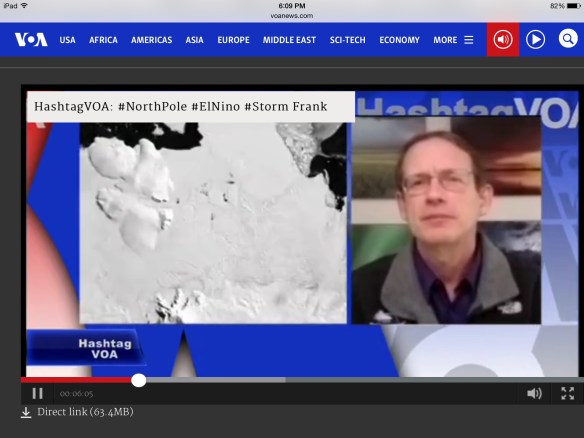
Extreme weather and climate change. The plight of human civilization facing loss of coastlines, stable climates, and predictable growing seasons. The plight of the polar bear. How are they all linked? Well, for one, it now appears that one of the most powerful storms to strike Iceland — an extraordinarily intense 928 mb low pressure system dubbed Frank by the UK Met Office — has played its hand in helping to drive Arctic sea ice to new daily record lows.

The storm, associated with a powerful high amplitude wave in the Jet Stream, aided in shoving some of the warmest temperatures ever recorded over the North Pole. Setting off a rare period of above freezing temperatures during polar night, this extreme weather event dumped an unprecedented amount of heat into the Arctic during what is typically its coldest season.

image

(Dr. Jeff Masters, chief meteorologist at Weather Underground, explains how…

View original post 740 more words

Informational YouTubeVideo: Beware the Blob! California’s Drought and Climate Change

aooscjanzen's avatarAlaska “Blob” Tracker

In this short video, you can learn how a similar “blob” of the past (though not named that in 1977) was related to a record drought in California, and how the Blob of 2013-* and corresponding drought (plus other weather extremes across the US) stands in the record!

Published on Jul 15, 2015

Interviews are with key scientists who are making the observations.

View original post

Recent Murre Strandings in Odd Places and How This Might Be Linked to2015 Bird Die-Off along the AK Coast

aooscjanzen's avatarAlaska “Blob” Tracker

“This most recent wave of murre strandings is part of a broader seabird die-off in coastal Alaska first reported in March and part of a widespread seabird die-off up and down the Pacific coast, possibly due to shortages of squid, krill and little fish the birds usually eat.

Ocean warming is a potential culprit; the body of warm water in the Gulf of Alaska that formed last year and earned the moniker “The Blob” is now expected to join the warm ocean currents of what’s predicted to be an extreme El Nino cycle in 2016.”

Read the Alaska Dispatch News Story here.

Photo Permitted by Gregory “Slobirdr” Smith at http://flickr.com/photos/22170893@N06/10573291084

View original post

2014 – 2015 Pacific Anomalies Science and Technology Workshop II to be held in Seattle, Washington January 20-21

aooscjanzen's avatarAlaska “Blob” Tracker

The second Pacific Anomalies Workshop will be held on the University of Washington campus on 20-21 January 2016.

The Steering Committee has developed an exciting interactive format for this workshop. There will be guided discussions (with both invited and participant contributed slides) around three central topics, each asking, “Do we understand the mechanism(s) involved?

While still under development by the Steering Committee, our three central topics are focused within:

  1. Atmosphere-ocean interactions: e.g., “What is the ‘blob’ generating mechanism and is it unprecedented?
  2. Open ocean-coastal interactions:  e.g., “What large and meso-scale processes, including upwelling, kept the blob offshore on the west coast? How did the offshore ocean interact with the upwelling zone?
  3. Ecosystem responses: e.g., “What are the mechanisms of ecosystem responses from plankton to predators, including effects from physical and chemical states associated with the blob?

While we are…

View original post 28 more words

Lions are actually raised to be killed in South Africa. And American

https://www.washingtonpost.com/news/energy-environment/wp/2016/01/05/lions-are-actually-raised-to-be-killed-in-south-africa-and-american-hunters-love-it/
“South African ranchers breed lions in captivity, from cubs to adults,
then release them just after the arrival of a hunter who pays about
$15,000 for a kill. Sometimes the animal is drugged to make it easier
game. Sometimes it’s lured by fresh meat to a place where the hunter
lurks. Sometimes the felines are so accustomed to humans that they
amble up to the person waiting to kill it. Not surprisingly, the
success of these hunts is 99 percent.”

Alberta coyote kill should be banned, says animal-rights group

http://www.cbc.ca/news/canada/edmonton/alberta-coyote-kill-should-be-banned-says-animal-rights-group-1.3390001

An animal protection group has renewed calls to end killing contests in Alberta, like the one scheduled to take place this weekend.

“These inhumane contests glorify killing a species that is essential to ecosystems, and can actually create new, more significant conflicts between wildlife and people,” said Michael Howie of the Association for the Protection of Fur-Bearing Animals.

Described as “reckless” and “inhumane” by critics, the 2015 contest prompted calls for the province to outlaw bounty hunts.

The organizer of this weekend’s coyote hunting contest said even death threats won’t stop him from hosting the tournament again this year.

The contest on Saturday offers a cash prize to the team of hunters that can kill the most coyotes in a single day.

“The science is clear,” Howie said in a statement issued Tuesday. “When coyotes are persecuted, their populations increase; when their social units or families are disrupted, conflict and depredation on livestock increases; and there is no argument — even if there is a healthy population size — to glorify the mass killing of sentient, ecologically significant animals.”

The organizer of the contest is a man named Paul, who asked that his last name not be used to protect his family from harassment. He said he has heard the critics and doesn’t agree with them.

“Coyotes are pests,” he said. “They’re legal to hunt any time of the year, with permission on farmers’ land.”

Howie said it is the Alberta government’s duty to manage land and wildlife habitat and regulate hunting and trapping.

“By allowing killing contests, Alberta’s leadership is showing a severe lack of stewardship,” Howie said, calling on Environment Minister Shannon Phillips and  Premier Rachel Notley to demand an end to such “inhumane” contests immediately.

A spokesperson for the environment minister’s office said the government is not planning to change the rules around hunting, noting when coyote populations are high they can threaten livestock and move into urban areas.

But the province does have the authority to restrict animal harvests if it is deemed necessary, the spokesperson said.

Vegan Jerky To Be Hand-Delivered to Oregon Cattle-Ranching Militia

http://www.peta.org/blog/vegan-jerky-to-be-hand-delivered-to-oregon-cattle-ranching-militia/

Written by PETA | January 5, 2016

The militant cattle ranchers currently occupying Malheur National Wildlife Refuge have appealed for snacks, and PETA is answering the call with a hand-delivered package of vegan jerky that contains more protein than beef does. The PETA staffers, who will bear signs reading, “The End (of Animal Agriculture) Is Nigh: Get Out Now!” are suggesting that militia members learn to raise crops, not cows—allowing the many species of wild animals the refuge was designed to protect to thrive.

Cows© iStock.com/narvikk

“People from all walks of life are increasingly appalled by the idea of slaughtering animals and realize, too, the harmful impact that animal agriculture has on the environment, so it’s time to face facts,” says PETA President Ingrid Newkirk. “These ranchers may have a beef with the feds, but their water use and the cattle’s production of methane mean that the world needs them to get out of the beef business.”

As PETA notes, the Worldwatch Institute estimates that animal agriculture is responsible for 51 percent of human-caused greenhouse-gas emissions and the University of Chicago determined that switching to a vegan diet is more effective in countering climate change than switching from a standard American car to a hybrid.

What You Can Do

Order PETA’s free vegan starter kit and do your part to start saving the planet and animals today!

IBMP plan calls for reduction of bison population in Yellowstone National Park

January 6, 2016, 36 mins ago

between Mammoth and Norris in Yellowstone National Park in November, 2013. (Neal Herbert/NPS Photo)

YELLOWSTONE NATIONAL PARK – Members of the Interagency Bison Management Plan (IBMP) have signed a winter operations plan that aims to reduce the current population of 4,900 animals.

The announcement was made in a press release from Yellowstone National Park.

The park says that because the Yellowstone bison population has high reproductive and survival rates, it will be necessary to cull 600-900 animals to offset the population increase expected this year.

The population will be decreased using two methods, according to the IBMP:

(1) Public and tribal hunting outside the park

(2) Capturing bison near the park boundary and transferring them to Native American tribes for processing and distribution of meat and hides to their members.

The press release says that bison are a migratory species and they move across a vast landscape. When they are inside Yellowstone, they have access to all habitat. But in the winter, when some bison migrate to lower elevations outside the park in search of food, the surrounding states and some private landowners don’t offer the same access to habitat.

Wild bison are only allowed in limited areas outside of Yellowstone…

“Many people are uncomfortable with the practice of culling bison, including the National Park Service,” says Yellowstone National Park Superintendent Dan Wenk.

More: http://www.ktvh.com/2016/01/ibmp-plan-calls-for-reduction-of-bison-population-in-yellowstone-national-park/

Also: http://billingsgazette.com/lifestyles/recreation/bison-plan-draws-comments-from-around-nation-world/article_8c85c77b-ba21-5aaa-b6e7-deb7187d70e2.html

And: http://billingsgazette.com/news/state-and-regional/montana/officials-agree-to-slaughter-to-yellowstone-bison-this-winter/article_96bf9650-d569-5838-9507-64465364b9c5.html?utm_medium=social&utm_source=facebook&utm_campaign=user-share