Climate Change is Causing Mt Rainier to Grumble

robertscribbler's avatarrobertscribbler

The volcanic Mt Rainier is grumbling. But it’s not what you think. At least not yet.

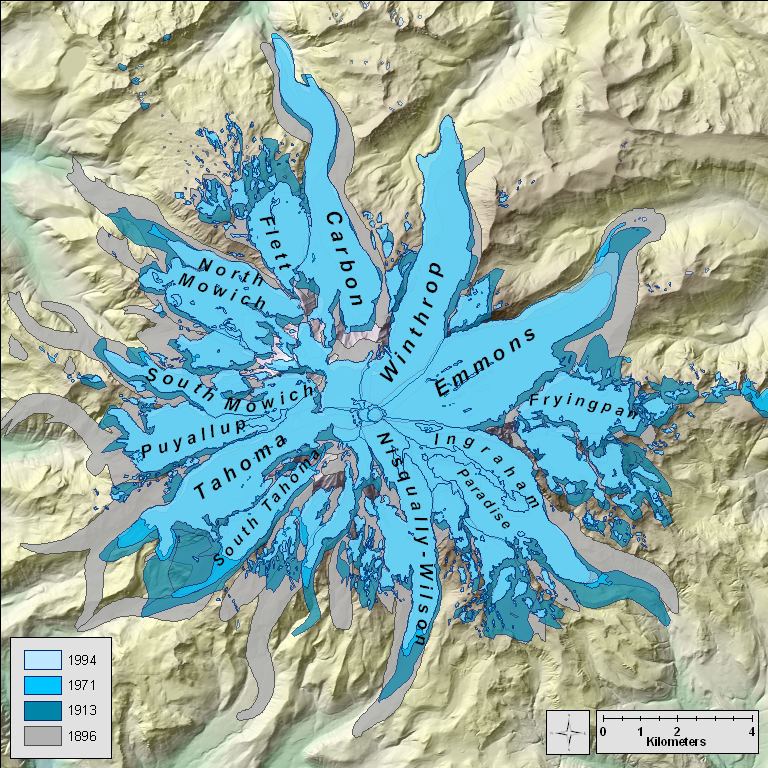
According to reports from the Seattle Times, the glaciers atop Rainier have melted to the point where they are becoming unstable. Particularly so with Tahoma Glacier which, all throughout July to mid August, has emitted large floods of muddy, ice-choked water. Tahoma sent its floods rumbling down the mountainsides, filling streams and rivers with roiling, brown outflows.

These glacier outburst floods issuing from Rainier have packed quite a punch. They’ve been strong enough to shake the earth, setting off seismographs in the region of Rainier. It’s a shaking and quaking that’s tumbled boulders down the mountainside, gouged out new flood channels and smashed great swaths of trees.

Mt Rainier Glaciers

(Over recent months, the Tahoma Glacier on the southwestern face of Mt. Rainier has been issuing large flows of glacial outburst material. Those familiar with…

View original post 324 more words

Climate Change’s ‘Waking Giant’ to Set off Rash of Volcanic Eruptions, Tsunamis, Earthquakes?

robertscribbler's avatarrobertscribbler

Calbuco Volcano 2

(Last week’s Calbuco eruption in Chile spews massive cloud of ash and sets off a fireworks display of volcanic lightning. Image source: IFLScience.)

If you look at the geological record of the end of the last ice age, there’s something that crops up that’s more than a little bit disturbing. The approximate 10,000 year period in which 4 degrees Celsius of warming took place was also punctuated by a rash of intense volcanic activity, earthquakes and tsunamis.

It was a time of extraordinary geophysical changes that not only saw the, sometimes catastrophic, melting of massive ice sheets and extreme rises in sea level — it also saw severe geological upheaval. In one region alone — Iceland — instances of volcanic eruption increased 30-50 fold during a period starting about 12,000 years ago. Overall, global spikes in volcanism began near the start of major melt events at around 18,000…

View original post 941 more words

Climate Change, Drought Fan Massive Sand Fire, Forcing 20,000 Californians to Flee

robertscribbler's avatarrobertscribbler

On Friday, amidst temperatures exceeding 100 degrees Fahrenheit, and at a time when California is now entering its fifth year of drought in a decade when seven out of the last ten years have been drought years, a rapidly growing and dangerous wildfire erupted in the hills north of Los Angeles.

(Sand Fire looms over Santa Clarita, California. Video source: Sand Fire Time Lapse.)

The Sand Fire, which some firefighters are calling practically unprecedented, sparked before typical wildfire season peak and began a rapid spread that consumed 10,000 acres per day from Friday through early Monday. Nearly 3,000 firefighters scrambled to gain a foothold against the blaze, but were somewhat unprepared as contracted water-bomb aircraft from Canada won’t be available until next month, during what is usually the worst part of fire season. The aircraft assistance was planned as extra fire-suppression capability for Santa Clarita, but typical fire…

View original post 594 more words

A Sense of Entitlement is Not the Same as Environmental Ethic

Exposing the Big Game's avatarExposing the Big Game

A friend asked me how I would respond to someone who wrote this: “Hunters started the conservation movement in the early part of the last century, and in the United States are the largest financially contributing group to Wildlife Restoration and Conservation.”

My answer?: The only reason hunters got involved is that they’d overhunted so many species practically to extinction and they wanted to save their sport. John Muir and others were around in the 1800s, selflessly speaking for wildlife and against hunting.

And, as another commenter to this blog just pointed out: “The stark reality is this: National Wildlife “Refuges” were originally set up to serve as “duck factories” for the hunting & trapping industries, along with opportunities for livestock grazing.”

Before hunters go around tooting their own horns, they should consider the motives behind their actions. If they’re ultimately self-serving, they are not necessarily all that praiseworthy. Don’t let hunters ‘shit you, an overblown sense of entitlement…

View original post 14 more words

Case Closed

Exposing the Big Game's avatarExposing the Big Game

You’ll never catch me making compromises by condoning the lesser of two evils or playing one type of wildlife killer off another.  I used to fish, but I don’t go around defending fishing while attacking hunting.

At the same time, I don’t hate myself for having gone along with a locally popular activity before finally seeing that fishing is not a victimless sport. “Hate” is not a word I use lightly; I reserve my hatred for those who get off on the killing and will never see the light or change their ways.

Farley Mowat used to be a hunter, I don’t “hate” him. My uncle and my wife’s father were hunters, but I didn’t hate them. I live where the vast majority of my neighbors and coworkers are hunters, but not all of them are rabid, Ted Nugent-types with lifetime subscriptions to wildlife snuff magazines. They just do it for the same stupid reasons I…

View original post 244 more words

Cool Cat: The Nine Lives of Christopher Walken, Movie Star and Feline Fan

by

07.24_WalkenCover-FTR

(Lori Fusaro/Best Friends Animal Society)

Christopher Walken likes to watch.

If that gives you the willies, you’re probably thinking of the Oscar-winning actor’s more unsettling roles—he’s played sadists, murderers, madmen, mobsters, mercenaries, psychopaths, evil masterminds and extremely messed-up Vietnam vets in the course of a career that began in the early 1950s.

“I have played a lot of villains,” he admits.

But what Walken likes to watch is just outside the windows of his home in rural Connecticut, on the cusp of a nature preserve, where he’s lived with his wife, Georgianne, a Hollywood casting director, for nearly 40 years.

“There were four deer in the driveway this morning,” he says. “There were turkeys here yesterday. My wife saw a snake in the driveway the other day. Hummingbirds come every day almost to the minute. They come right up the window and stare at me. It’s almost as though they know I’m there.

“I was born in the city and grew up in Manhattan. But when I got the chance, I moved out to a nice, quiet, green place.”

Now, that doesn’t sound so chilling and creepy, does it?

His Nine Lives

“My background is really in musical theater,” Walken says. “I did a lot of musicals when I was young. I got a job in a play, and then I got a movie, kind of accidentally, and my first parts where I got noticed were things like The Deer Hunter and Annie Hall, where I played troubled people, suicidal sometimes. I think I kind of got something going on there.”

More: http://parade.com/492231/npond/cool-cat-the-nine-lives-of-christopher-walken-movie-star-and-feline-fan/

“Beast Feast” etc., from AR News…

Big Win for Animal Rights: Navy Sonars Are Killing Whales, US Court Rules
http://www.natureworldnews.com/articles/25630/20160723/big-win-animal-rights-navy-sonars-killing-whales-united-states-court-rules.htm
“Blue whales can now live in peace and relative quiet after the Ninth
U.S. Circuit Court of San Francisco ruled out the U.S. Navy’s request
to use low-frequency sonar due to its potential harm to marine
animals.
“The U.S. Navy sought the approval from the National Marine Fisheries
Service to use the said sonar under the Marine Mammal Protection Act.
However, groups urged the Service to reassess, which led to their
decision not to give the go signal to the Navy’s request.”

Judge will allow animal rights’ vet to examine Cricket Hollow Zoo lions
http://www.thegazette.com/subject/news/public-safety/judge-will-allow-animal-rights-vet-to-examine-cricket-hollow-zoo-lions-20160722
“Animal Legal Defense Fund granted part of injunction”
“CEDAR RAPIDS — A federal judge Friday ordered owners of the Cricket
Hollow Zoo in Manchester to let a veterinarian examine two African
lions they are being sued over.”

A/w local OKC outdoor news:

Crossing Community Church, located in OKC, is having its annual “Beast
Feast” on Tuesday night.
Tickets are $15 each and there is a smoked pork dinner.
The guest speaker is a co-host of Inside Outdoors TV, based in Tulsa.
This show began their 10th season this month.
The “Beast Feast” includes a hunting and fishing expo with numerous
prizes to be given away.
This includes hunting trips, fishing trips, guns, rod and reels, knives and
gift cards.

Facing an uphill court fight, the US Fish and Wildlife Service announced
last week it was formally
removing the lesser prairie chicken from a federal protection list under
the Endangered Species Act.
This move follows recent court rulings in Texas that stripped the lesser
prairie chicken of federal
protection. However, federal officials say the removal doesn’t mean
authorities had concluded the
lesser prairie chicken didn’t warrant protection for biological reasons.
The agency stated “The service is undertaking a thorough re-evaluation
of the bird’s status and
the threats it faces using the best available scientific information to
determine anew whether listing
under the ESA is warranted.”
The previous rulings found that the Fish and Wildlife Service failed to
make a proper evaluation
of a multi-state conservation plan when it listed the lesser prairie
chicken as threatened.
Oil and gas groups had strongly opposed the threatened listing and
ranchers also opposed the
listing.
The lesser prairie chicken’s Great Plains habitat has shrunk by more
than 80 percent since
the 1800s and its population by 99 percent.
It lives primarily in Kansas. However, it also lives in Texas, New
Mexico, Okla. and Colorado.
To keep the birds off the endangered species list, these five states
organized their own
conservation program. It offers economic incentives to landowners and
companies who set
aside land to protect the birds.


13533278_1489665091056950_3215226751240158290_n

Delisting wolves was a mistake (OPINION)

http://www.projectcoyote.org/delisting-wolves-was-a-mistake/

by | Nov 24, 2015 | Notes From the Field |

The decision by the Oregon Fish and Wildlife Commission to delist wolves from the state’s Endangered Species Act protection was based on faulty science and political expediency. The biggest problem is with the department’s criteria for delisting — more than four breeding pairs of wolves for three years in a row— is that it fails to ensure full restoration of the wolf across the state. Many outside scientists, including myself, feel the small population of 80 to perhaps as many as 100 wolves statewide is hardily sufficient to guarantee a robust and speedy restoration of the species.

A hundred or fewer wolves may preclude the extinction of the species, but it does not restore the ecological function of the wolf. And restoring the ecological function of the species should be the prime goal of any conservation effort. Precluding extinction is a very low bar and does not serve the people of Oregon, the wolf or our ecosystems.

I did an analysis of the potential for wolf restoration in Oregon back in the 1990s and concluded that the state could easily support 1,500 to 2,000 wolves. Others have reached similar conclusions. Restoring wolves across the state so that they are functional members of the wildlife community should be the goal of the Oregon Department of Fish and Wildlife.

If, hypothetically, elk were the species under consideration and were protected under the state’s Endangered Species Act, I can almost guarantee you ODFW would want way more than 100 individuals before they would recommend delisting. They would want to see elk restored across the state.

Wolves are in a sense a “keystone” species that influences ecosystem health. Having a token population of wolves is not the same as having a functioning ecosystem member. Wolves not only eliminate weaker prey individuals but can shift habitat use; for instance they can reduce elk and deer foraging on aspen, willows and other browse species in riparian areas. Wolves can also affect the distribution and numbers of other species. Where wolves are present, there are often fewer coyotes. Coyotes kill the smaller Sierra Nevada red fox that is just hanging on in the Cascades. Restoration of wolves could thus assist the recovery of the red fox.

The rush to delist wolves is driven by false perceptions of wolf impacts on livestock and big game populations. Out of 1.3 million cattle and 195,000 sheep in the state, only 114 domestic livestock have been confirmed killed by wolves since the first wolves appeared in the early 2000s. Comparisons between Montana and Oregon are often made by ODFW. Using Montana, in 2014, the state’s 600 or so wolves killed 35 cattle and six sheep out of a total of 2.5 million cattle and 220,000 sheep respectively, By comparison, non-wolf losses accounted for 89,000 deaths. And though six sheep were killed by wolves, some 7,800 sheep died from other causes, like weather.

Wolves are simply not a threat, or even barely a factor, in the economic viability of the livestock industry.

The idea that hunting will be negatively affected across any significant portion of the state is also unlikely. Between 2009 and 2014, all wildlife management units (WMUs) of northeastern Oregon with established wolf packs had increasing elk populations, and two of the four (Imnaha and Snake River) were above the established management objectives for elk since wolves became established (ODFW data).

A similar situation exists in Montana, where elk numbers grew from an estimated 89,000 animals in 1992 (Montana Elk Plan) to 167,000 elk today (Montana Department of Fish, Wildlife and Parks, 2015). If this is what you get with wolf predation, I think most reasonable hunters would agree we could use more wolves in Oregon!

In the end, ODFW capitulated to mythology and false fears of hunters and ranchers without providing context and did not meet its wildlife responsibilities under the public trust doctrine to work diligently for full restoration of the ecological function of the wolf.

George Wuerthner lives in Bend.

Comments regarding the proposed delisting of gray wolves in Oregon from Adrian TrevesProject Coyote Science Advisory Board member