Wildlife Services, an Agriculture Department agency, killed animals from 335 species during its most recent fiscal year. The majority were birds, including these.
Until recently, I had never had any dealings with Wildlife Services, a century-old agency of the United States Department of Agriculture with a reputation for strong-arm tactics and secrecy. It is beloved by many farmers and ranchers and hated in equal measure by conservationists, for the same basic reason: It routinely kills predators and an astounding assortment of other animals — 3.2 million of them last year — because ranchers and farmers regard them as pests.
To be clear, Wildlife Services is a separate entity, in a different federal agency, from the United States Fish and Wildlife Service, whose main goal is wildlife conservation. Wildlife Services is interested in control — ostensibly, “to allow people and wildlife to coexist.”
My own mildly surreal acquaintance with its methods began as a result of a study, published this month in the journal Frontiers in Ecology and the Environment, under the title “Predator Control Should Not Be a Shot in the Dark.” Adrian Treves of the University of Wisconsin and his co-authors set out to answer a seemingly simple question: Does the practice of predator control to protect our livestock actually work?
A herd of bison grazes Aug. 3 in the Lamar Valley of Yellowstone National Park . A Montana legislative committee wants Native American tribes to be able to hunt bison inside Yellowstone National Park to better control herds of the animals that migrate into Montana during winter.
BILLINGS, Mont. — A Montana legislative committee that wants to limit Yellowstone National Park’s growing herds of bison from leaving the park sent a recommendation Thursday to park officials for Native American tribes to be allowed to hunt bison inside the park.
The committee’s letter to Yellowstone Superintendent Dan Wenk came a day after members voted 9-7 in favor of the plan — even though there are no requests by the tribes to hunt inside the park.
Tribal representatives said Thursday they already have enough opportunities to hunt the animals outside the park.
“The idea of gunning down animals in the Lamar Valley or near Old Faithful is nothing the tribes have proposed or are considering,” said John Harrison, an attorney for the Confederated Salish and Kootenai Tribes.
Supporters of tribal bison hunts inside the park including Republican Sen. Theresa Manzella of Hamilton pitched the idea as a potential solution to the dilemma posed by bison leaving Yellowstone and getting onto private property.
Democrats objected, pointing out that no tribes have asked to hunt inside the park.
Yellowstone spokeswoman Morgan Warthin said longstanding policy prohibits hunting in national parks unless specifically authorized by Congress.
Any tribes wanting to assert treaty rights to hunt in Yellowstone would have to submit the request to the U.S. Justice Department for consideration, she said.
Stephanie Adams with the National Parks Conservation Association said state officials had missed an opportunity to push for expanded habitat for bison outside the park. Under a program in place since 2000, thousands of the animals have been captured and sent to slaughter after they enter Montana.
Several tribes with longstanding treaty rights hold annual bison hunts just outside Yellowstone’s boundary.
Those hunts have stirred controversy — with bison often shot immediately after stepping beyond the park boundary — while failing to reduce the size of Yellowstone’s herds. Yellowstone at last count had roughly 5,000 bison, a near-record level for the modern era.
Many Yellowstone bison carry a disease, brucellosis, that can be harmful to livestock and cause pregnant animals to prematurely abort their young. However, no bison-to-cattle transmissions of the disease brucellosis have been recorded.
Yellowstone rejected requests from former Gov. Brian Schweitzer to allow public hunting inside the park when the Democrat was still in office.
All together now, I want everyone, collectively, to say out loud with doleful sorrowfulness: “Aw, you poor thing!”
That’s for the besieged trophy hunters out there who are feeling distressed lately over a series of events that have tarnished their image. In this YouTube era of widespread communications, they can publicly share their exploits—like throwing a spear into a bear as he ate, or shooting a curious lion, or showing scenes of a young girl overjoyed by ending the life of a giraffe.
They want to think that the problem is us: the vast majority of people who don’t do those things, and who don’t want to do them. They think that we just don’t get it.
Oh, but we do.
We are not perfect; but, we don’t go out of our way to kill big, magnificent creatures who are minding their own business, and we don’t display their body parts in our homes.
It’s called empathy: the ability to think in terms of what others might feel, and a desire not to be the source of their suffering.
I have the ability to “connect with nature” and feel more like a part of the ecological whole by observing and by taking an active role in defending—not ending—the lives of our “fellow travelers” through life. My camera, sketch pad, and paints give me far more insights into nature and other species than any gun ever could. I aim to save, not kill; to protect, not kill; to help, not kill.
Killing is all too easy for humans. Each day, via my computer screen, I see the accumulating evidence of us triggering the next great extinction event.
Hunters have “regulations” to curb the killing in order to have more to kill later on—but killing is increasingly difficult to rationalize as various populations of “game” species decrease.
Each month as I write these dispatches, I shake my head in disbelief at the rapidity at which anthropogenic climate disruption (ACD) is occurring. It’s as though each month I think, “It can’t possibly keep happening at this incredible pace.”
But it does.
By late April, the Mauna Loa Observatory, which monitors atmospheric carbon dioxide, recorded an incredible daily reading: 409.3 parts per million. That is a range of atmospheric carbon dioxide content that this planet has not seen for the last 15 million years, and 2016 is poised to see these levels only continue to increase.
Recently, Dr. James Hansen, a former NASA scientist and longtime whistleblower about the impending dangers of ACD, published a paper with several colleagues showing that ACD will push sea level rise into exponential levels by the end of this century. Their paper shows how melting is actually compounding itself, generating dramatically fast increases in both melting and sea level rise. We may well see the current three millimeter per year sea level rise grow to nearly five centimeters by 2056, and continue to increase in a nonlinear fashion.
Scientists in Antarctica are now astounded at the rapidity of the disintegration of the massive Antarctic ice shelves: It turns out the ice in Antarctica is far more fragile and predisposed to melting than was previously believed.
It was the picture which disgusted the world, the grinning face of a 12-year-old girl cuddling the giraffe she had just shot and killed for fun.
While most her age would be only too pleased to see these creatures running wild, sweet-faced Aryanna Gourdin guns them down for her trophy-hunting album.
Our exclusive story sickened animal lovers around the globe, none more so than Sir David Attenborough, who has devoted decades to conservation.
The TV legend today calls trophy hunting “incomprehensible”.
He says: “It’s what people did in the 19th century. One would’ve thought people would’ve gotten over that.”
The father of a 12-year-old big game trophy hunter making headlines around the world is a convicted poacher.
Aryanna Gourdin and her father Eli sparked outrage after photos of her rejoicing over the carcass of a giraffe she shot dead were published.
He has been accused of “brainwashing” her and using her in a social media campaign to promote their bloodthirsty exploits in the name of conservation.
They appeared on ITV’s Good Morning Britain last week wearing “stand up to anti-hunter bullying” after the Mirror highlighted the issue in a front page story.
Eli has been convicted of “wanton destruction of protected wildlife” which he was found guilty of in 2010.
Aryanna Gourdin with a giraffe she has hunted
In Utah where they live the crime relates to illegally killing big game such as deer, elk, moose and bison.
He also has 15 other convictions related to protected wildlife for which he was jailed in 2000. These include eight counts of transporting and selling protected wildlife.
Dr Pieter Kat of the Charity Lion Aid, said: “Despite breaking conservation laws this man has the audacity to loudly proclaim that hunting is conservation.
Given natural variability, we might expect August to remain hot if an El Nino were forming in the Pacific, but at that time, with a weak La Nina struggling to fire off, the exact opposite was the case. In other words, the El Nino/La Nina cycle, which typically helps to drive global warm and cool periods, was pointed in the direction of ‘cool’, but the world remained near record-hot levels.
(2016 Climate Year continues to redefine global temperature boundaries as August ties July for hottest month ever recorded. Image source: NASA GISS.)
So what the heck was going on?
Rising Greenhouse Gasses are Steadily Rearranging How the…
The world’s largest land animal, the biggest fish, the bird with the greatest wingspan, the largest primate: all are sliding towards extinction at astounding speed. If we will not protect such magnificent species, what are we prepared to do?
Last month the whale shark was classified as endangered. Some are still hunted for their meat and fins, and it seems that the revolting practice of live finning – slicing off the fins, then dumping the shark overboard to die slowly – continues. Most are killed as bycatch, in nets used to catch other species, especially tuna. Some fishing boats use whale sharks as markers (tuna tend to congregate under large objects), and deliberately cast nets around them.
Their decline – whale shark numbers have halved or worse in 75 years – reflects the global loss of ocean life. Since 1996 the fish catch has fallen by a million tonnes a year, as stocks are exhausted. Sieving the seas for what remains, fishing fleets will trigger the collapse of entire ecosystems.
Fishing also accounts for what has happened to the bird with the largest wingspan, the wandering albatross – whose population has fallen by about 30% in 11 years. Again, the tuna fishery is the principal threat, in this case through the use of baited longlines. The albatrosses dive for the bait, get hooked and drown.
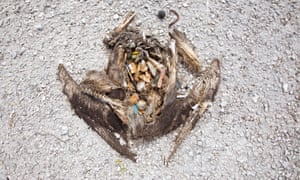
An albatross corpse rotting away to reveal the rubbish it’s consumed. Photograph: Alamy
Another cause is their junk food diet: the plastic they eat, then feed to their chicks through regurgitation. The photographs taken by Chris Jordan on Midway atoll of the albatross corpses rotting away to reveal the rubbish they contain are a synopsis of our treatment of the living world. However far we travel, our impacts precede us.
A week ago the status of the eastern gorilla, the world’s largest primate, was changed from endangered to critically endangered: it has declined by 70% in 20 years. Its habitat, in central Africa, has been ripped apart by logging, mining and farming, and the gorillas are hunted for meat. All the great apes are now either endangered or critically endangered, in the case of orangutans largely as a result of palm oil production. What does it say about us that we are prepared to drive our closest relatives towards extinction?
The great acceleration towards a bare, grey world is also reflected in this week’s State of Nature report, which shows that over 10% of the remaining species in the UK are now threatened with extinction.
Last week we learned that one-tenth of the world’s wild places, forest and savannahs, and other lands in which human impacts are not obvious, have been lost – de-wilded – in the past 25 years. The trajectory suggests that there could be almost none left by the end of the century.
These should be among the central issues of our age. Yet we treat these losses as sad but peripheral, though we commission them through the things we buy. Elephants, rhinos, lions, polar bears, the great sharks, turtles, condors, whales, rainforests, wetlands, coral reefs: they are all the bycatch of consumerism. We assert both the right to consume – whatever we want, however we want – and the right to forget the consequences.
Flying to Bratislava or Bermuda for a stag weekend, shopping trips to New York, driving our gas guzzlers 300 metres to school, buying jetskis, leaf blowers and patio heaters, furnishing our homes with rare wood, eating tuna, prawns and salmon without a thought as to how they were produced: these ephemeral satisfactions, to judge by the reactions when you question them, occupy a sacred and inviolable space. The wonders of the living world, by contrast, are dispensable.
People who would never dream of killing an albatross or a whale shark are prepared to let others do so on their behalf, so that they may eat whatever fish they fancy. People who could not bring themselves to gut a chicken are happy to commission the disposal of entire ecosystems.
The act of not seeing is sanctioned and normalised, while attempts to explain the consequences are treated as abnormal and impertinent. On the Guardian’s website you can read about the global collapse of tuna populations – then, in a recipe published the following day, learn how to prepare a tuna salad, without a word about the implications.
Such cultural norms, positioning us as consumers first and moral beings either second or not at all, grant the disposal of the living planet its social licence. They allow us to compartmentalise, to be conscious of the issues when there is little that we can do about them, and to forget them at the moment when we have the capacity to act (or to refrain from acting). This is the safe space we establish for consumerism.
The costs cannot be computed in financial terms. There is no price that can capture the awe aroused by a whale shark, the deep being of an elephant herd, the way in which your heart soars with the albatross as it mounts a column of air, the gorilla’s fathomless gaze. The albatross hangs around our necks with a weight that defies calculation.
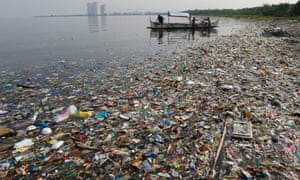
We were here: is this how we choose to be remembered? It is true that we existed: you can see it in the pulse of extinction. Are we to use our gift of life to snuff out other life forms? What will you leave behind, except your contribution to thePacific garbage patch?
‘What will you leave behind, except your contribution to the Pacific garbage patch?’ – a fishing boat works amid garbage in Manila Bay, the Phillipines. Photograph: Erik de Castro/Reuters
I believe we can do better, that we can position ourselves as just one participant in a world of wonders, blessed and cursed with higher consciousness, but using that capacity to embed ourselves within its limits.
We cannot wait for governments or schools or the media to deliver a new environmental ethics. Join the groups trying to defend the living planet; learn about the consequences of what you do; demand – from friends, from parents, from yourself – a better way of engaging with the world. By living lightly we enrich our lives.
• George Monbiot will answer questions on this issue in a live Guardian Q&A on Friday, from 10-11am, BST. Post questions now (below), or join us on the day. He will answer questions on any aspect of the problem, but is particularly interested in opening a discussion on consumerism and its ethics.
DON JENKINS/CAPITAL PRESS Published on September 13, 2016
Wolf advocates protest Sept. 1 in Ol
http://www.capitalpress.com/20160913/forest-service-disputes-humane-societys-washington-wolves-claimympia the shooting of wolves in the Colville National Forest. The U.S. Forest Service and Washington Department of Fish and Wildlife dispute a claim by the president of the Humane Society of the United States that state wildlife managers asked the Forest Service to withdraw a grazing permit to prevent conflicts between wolves and livestock.
The Colville National Forest issued a statement Monday contradicting a claim by the national head of the Humane Society of the United States that state wildlife managers asked the Forest Service to cancel grazing to prevent conflicts between cattle and wolves.
In a Humane Society blog post Sept. 9, Wayne Pacelle, the organization’s president and CEO, wrote that the state Department of Fish and Wildlife “saw a problem brewing and asked the U.S. Forest Service to withdraw the grazing permit, but the federal agency rebuffed the request.”
Through a forest spokesman, the Forest Service said it was not asked to pull permission to graze. The agency said it has been working with state officials and advisers to prevent wolves from attacking livestock.
“There has been no request made by the Washington Department of Fish and Wildlife or the Washington Wolf Advisory Group to withdraw the grazing permit. The Colville National Forest will continue working closely with these organizations to help reduce predator/cattle conflicts,” the Forest Service stated.
A WDFW spokesman said the department didn’t ask the Forest Service to withdraw grazing allotments.
“We know of no request from WDFW staff — even at the field level — for the USFS to withdraw grazing permits in the allotments associated with the Profanity Peak pack,” he said in an email.
Efforts to reach the Humane Society’s national office and Washington state director Dan Paul were unsuccessful.
A member of the Wolf Advisory Group, Paul agreed last spring to a policy that allows for state-protected wolves to be killed if efforts by ranchers to prevent depredations have failed.
The policy is under attack by animal-rights activists and environmental groups, some of whom have accused ranchers of willfully putting their livestock at risk.
Washington State University wolf researcher Rob Wielgus told The Seattle Times a rancher turned out cattle “on top” on a wolf den. WSU officials rebuked Wielgus and said the comment was inaccurate.
In his blog post, Pacelle said cattle were placed “right in the center” of the pack’s range.
According to WDFW, 198 cow-calf pairs cows were released 4 miles from the pack’s den in early June. The whereabouts of the den was unknown at the time, according to WDFW.
Wolves have attacked since early July at least eight cattle in the national forest and probably attacked five others, though there too little evidence to rule out another predator, according to WDFW.
Livestock have been attacked as far away as 10 miles from the pack’s den and rendezvous sites, according to WDFW.
The department has announced shooting six wolves and says it intends to kill the Profanity Peak pack’s other five members.
Although its policy calls for at least weekly reports on the number of wolves killed, WDFW has not provided an update since Sept. 2.
Pacelle stated that the Humane Society of the U.S. wants the Washington’s wolf policy to be re-examined. “We are urging that the idea of killing an entire pack be taken off the table entirely.”
WDFW’s lethal-control policy emerged from lengthy meetings between Washington ranchers, environmentalists, hunters and animal-rights activists.
The agreement has helped ease tensions and made future collaboration on managing Washington’s growing wolf population more promising, Washington Cattlemen’s Association Executive Vice President Jack Field said.
“I know there is a lot of attention and focus on the removal effort, but the department is following the protocol to a T,” he said.
The Wolf Advisory Group will meet Wednesday and Thursday in Issaquah. The two-day meeting was scheduled before WDFW started removing the Profanity Peak pack.
Field said he hoped conservationists on the advisory panel can withstand the pressure exerted by other environmental groups. “Because if not, we’re right back where we started,” he said.
LA PINE, OR — A Tillamook man faces charges after a fatal hunting accident near Paulina Lake.
The Deschutes County Sheriff’s Office says 52-year-old Michael Pekarek was bow hunting with 45-year-old Jeffrey Cummings, of Wood Village, Monday morning. Pekarek spotted a deer and was ready to fire when the animal moved. Investigators believe he turned to tell Cummings the deer was moving toward him when he released the arrow, shooting Cummings in the stomach.
Pekarek called 911 and performed CPR, but the victim was pronounced dead by first responders. Pekarek is charged with Criminally Negligent Homicide.



 Exposing the Big Game