by Stephen Capra We have entered a time when the psychological deformity of this President is coming into clear focus. The reincarnation of Andrew Jackson is creating a modern version of the “Trail of Tears” through his vicious, demented vision of ego driven power. His personal corruption and self-enrichment is at the core of every decision, his cruelty to staff and the American people is part of his deluded vision of power and control.
Today he has pulled us out of the Paris Climate accords. This move is designed for one purpose, to continue to create false hope for his followers and coal miners in particular, that “he” has their backs, while he moves to destroy their social safety net and any real promise of a future of jobs for the people he privately calls “stupid”, as his legislative agenda continues to stumble.
Few Americans probably know that their tax dollars paid to kill 76,859 coyotes in 2016. The responsible agency was Wildlife Services (WS), part of the U.S. Department of Agriculture. Its mission is to “resolve wildlife conflicts to allow people and wildlife to coexist.” This broad mandate includes everything from reducing bird strikes at airports to curbing the spread of rabies.
Controlling predators that attack livestock is one of the agency’s more controversial tasks. WS uses nonlethal techniques, such as livestock guard dogs and fladry – hanging strips of cloth from fences, where they flutter and deter predators. But every year it also kills tens of thousands of predators, including bears, bobcats, coyotes, foxes, hawks, cougars and wolves.
However, there is no clear evidence that lethal control works to reduce human-predator conflict. In fact, it can even make the problem worse. At the same time, research shows that predators play key roles in maintaining healthy ecosystems. As a conservation biologist specializing in human-wildlife conflicts, I see growing evidence that it is time to reconsider lethal control.
Warfare on the range
Coyotes have been a target ever since European explorers first arrived in their territory centuries ago. Nonetheless, their range has expanded from the western plains across most of the continent.
The most common reason for killing coyotes is to reduce predation of livestock, such as sheep and calves. In a 2015 USDA report on sheep losses, ranchers reported how many of their animals died in 2014 and how they died. Twenty-eight percent of adult sheep losses and 36 percent of lamb losses were attributed to predators. Of those animals, ranchers stated that 33,510 adult sheep (more than half of total predation losses) and 84,519 lambs (nearly two-thirds of all predation losses) were killed by coyotes.
Domestic sheep killed by a coyote in California.CDFW/Flickr, CC BY
According to the American Sheep Industry Association, about UD$20.5 million of ranchers’ losses in 2014 (roughly one-fifth of their total losses) were attributed to coyotes. Importantly, however, these numbers were based on self-reported data and were not verified by wildlife professionals. External review would be useful because even experienced ranchers may have trouble determining in some cases whether a sheep was killed by a coyote or a dog (dogs are second only to coyotes in reported predation on livestock), or died from other causes and later was scavenged by coyotes.
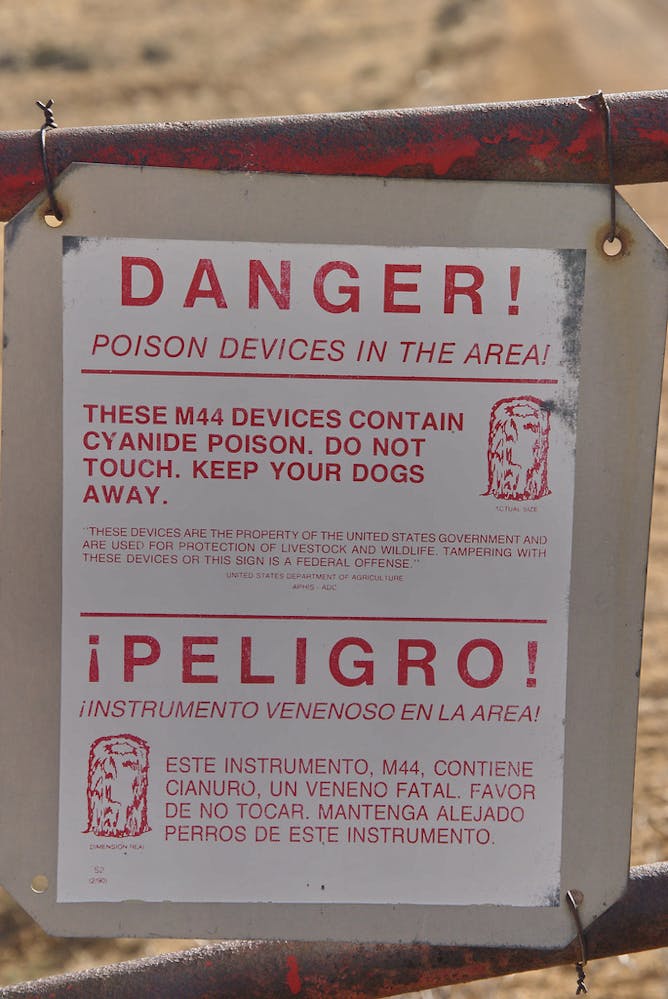
To keep coyotes in check, WS employees set neck snares and other traps, shoot coyotes on the ground and from planes and helicopters, arm sheep with collars containing liquid poison and distribute M-44 “bombs” that inject sodium cyanide into the mouths of animals that chew on them.
It is understandable for struggling ranchers to blame coyotes for economic losses, since kills leave tangible signs and killing predators seems like a logical solution. However, a widely cited 2006 study called coyotes scapegoats for factors that were more directly related to the decline of sheep ranching in the United States.
The author, Dr. Kim Murray Berger, who was then a research biologist with the Wildlife Conservation Society, built and tested a series of statistical models to explain the declining number of sheep being bred in the United States. She found that variables including the price of hay, wage rates and the price of lamb explained most of the decline, and that the amount of money spent on predator control had little effect.
Other research indicates that even if predation is one factor in ranchers’ economic losses, lethal control is not the best way to reduce it.
Warning in area baited with cyanide traps, Sandoval, New Mexico (click to zoom).Killbox/Flickr, CC BY-NC
One 2016 analysis reviewed studies that compared lethal and nonlethal strategies for controlling livestock predation. Lethal methods ranged from civilian hunts to government culls. Nonlethal methods included fladry, guard animals, chemical repellents and livestock protection collars. The review found that nonlethal methods generally reduced livestock predation more effectively, and that predation actually temporarily increased after use of some lethal methods.
Why would predation increase after predators are killed? When pack animals such as coyotes, dingoes and wolves are killed, the social structure of their packs breaks down. Female coyotes become more likely to breed and their pups are more likely to survive, so their numbers may actually increase. Packs generally protect territories, so breaking up a pack allows new animals to come in, raising the population. In addition, some new arrivals may opportunistically prey on livestock, which can increase predation rates.
These findings extend beyond the United States. A three-year study in South Africa found that using nonlethal methods to protect livestock from jackals, caracals and leopards cost ranchers less than lethal methods, both because less predation occurred and because the nonlethal methods cost less.
In Australia dingoes occupy a similar ecological niche to coyotes and are similarly targeted. In a recent case study at a cattle station, researchers found that ceasing all lethal and nonlethal predator control reduced predation of cattle by dingoes as the social structure of the resident dingoes stabilized.
Even research by USDA supports this pattern. In a recent study, researchers from several universities, USDA’s National Wildlife Research Center and the nonprofit advocacy group Defenders of Wildlife analyzed wolf predation rates for sheep producers on public grazing lands in Idaho. Predation was 3.5 times higher in zones where lethal control was used than in adjacent areas where nonlethal methods were used.
A USDA biologist installs fladry to deter predators on a ranch near Jackson, Wyoming.Pamela Manns, USAD/Flickr
A high-stakes placebo
Overuse of subsidized predator control is comparable to primary care doctors overprescribing antibiotics to human patients. Patients often demand antibiotics for common colds, although doctors understand that these infections are caused mainly by viruses, so antibiotics will be ineffective. But receiving a prescription makes patients feel that their concerns are being addressed. Lethal control is a high-stakes placebo for the problems that ail ranchers, and misusing it can increase problems for ranchers and the ecosystems around them.
Human-wildlife conflict is a complex issue. Often, as some colleagues and I showed in our recent book, “Human-Wildlife Conflict,” the real problem is confrontations between humans about how to deal with wildlife.
This means that we need to choose prevention and mitigation methods carefully. If cultural values and prevailing community attitudes are not taken into account, attempts to change ranching practices could increase hostility toward predators and make it harder for conservation groups to work with ranchers.
Federal employees at Wildlife Services are under tremendous pressure from the agricultural industry. And farmers and ranchers often act based on deeply rooted traditions and cultural attitudes. It rests with wildlife professionals to use current and well-grounded science to address human concerns without harming the environment.
This bear was killed by conservation officers in Hidden Valley May 19 after entering a pen and killing a goat. Another bear was shot by a property owner after it raided chicken coops.
Six bears have been killed in the Whitehorse area in recent weeks after coming into conflict with humans.
Two of the most recent kills — one on May 19 in Hidden Valley and one in Mount Lorne on May 22 — involved bears attracted to livestock, said conservation officer Ken Knutson.
The Hidden Valley bear entered a pen containing two goats, one of which was killed, before the bear was “destroyed for safety reasons” by conservation officers, said Knutson.
The Mount Lorne bear was lawfully shot by a property owner after it raided three other chicken coops in the area, said Knutson. The property owner lost 15 chickens.
Chickens are particularly tempting to bears, Knutson said, because they are high in fat and calories. Once a bear gets a taste for chicken it is very hard to deter them in the future which can be a death sentence for the animal, he said.
“I often say, ‘chickens kill bears,’” Knutson said. “We’ve destroyed many bears over the last five years over chickens. We have yet to see an instance of a bear that has gotten into chickens and doesn’t come back.”
The best way to protect chickens and other livestock from bears — and bears from being shot for eating chickens and livestock — is to use electric fencing, said Knutson.
“A shock from a fence is a deterrent, it’s not a very comfortable feeling … you don’t want to do it again,” he said.
It’s the responsibility of people to try to deter animals from entering their property in search of food, said Knutson. Livestock should be secure and people should take steps to manage bear attractants such as garbage or unlocked outdoor freezers.
“Just because you haven’t had a problem doesn’t mean you won’t,” he said. “No one is immune to bears.”
The number of bear interactions and bear kills from previous years in the Whitehorse area were not readily available for comparison.
Bear-human conflicts can occur at anytime outside of the animal’s hibernation period, Knutson said.
Bear sightings were reported earlier in the month along the Riverdale trail, a popular hiking area within city limits, although those bears — a sow and cubs — haven’t been seen recently Knutson said.
“We haven’t had any calls about that sow in a while — she’s being a good mama and keeping her cubs away from people,” he said.
People can report bear sightings or problem animals to Environment Yukon at 1-800-661-0525.
The department is also currently running a survey on grizzly bear management and conservation. The online survey closes May 27.
“We’re hoping a lot of Yukoners will contribute to it,” Knutson said.
May 31, 2017 at 6:03 am Updated May 31, 2017 at 7:17 am
FILE – In this May 18, 2017 file photo, President Donald Trump speaks in the East Room of the White House in Washington. A White House official says President Donald Trump is expected to withdraw the United States from the Paris climate accord. (AP Photo/Susan Walsh, File)
WASHINGTON — President Donald Trump is expected to pull the United States from a landmark global climate agreement, a White House official said Wednesday, though there could be “caveats in the language” announcing a withdrawal, leaving open the possibility that his decision isn’t final.
Exiting the deal would be certain to anger allies that spent years negotiating the accord to reduce carbon emissions.
The official insisted on anonymity in order to discuss the decision before the official announcement.
Tuesday 30 May 2017 11.43 EDTLast modified on Tuesday 30 May 2017 11.44 EDT
Robert De Niro has said that the US has become a “tragic, dumbass comedy” under Donald Trump, and urged students to “work to stop the insanity” of his presidency. The actor made the comments during a commencement ceremony speech at Brown University in Rhode Island, where he was receiving an honorary doctorate of fine arts.
“When you started school, the country was an inspiring, uplifting drama,” he told students. “You are graduating into a tragic, dumbass comedy. My advice is to lock the [university’s] Van Wickle Gates and stay here.
“But if you do leave, work for the change. Work to stop the insanity. Start now so the class of 2018 will graduate into a better world.”
Watch Robert De Niro’s speech to Brown University students
De Niro has been highly critical of Trump since his election win last November. Earlier this month he said that the Trump administration had shown “mean-spiritedness” in its budget proposal, which advocated cutting arts funding. De Niro also suggested that Charlie Chaplin would not be allowed into the US todaydue to Trump’s strict immigration policy.
Before Trump’s election win, De Niro came under fire for saying he would like to punch him in the face. He later revised his comments, adding that he would have to “respect” the fact that Trump was president.
Global warming is taking its toll on coral reefs in U.S. waters, and many of the marine sanctuaries near Hawaii, Florida and the Caribbean are expected to disappear within a few decades, according to scientists at the National Oceanic and Atmospheric Administration (NOAA). Despite strict conservation efforts in various protected areas in American seas, in a Tuesday report, NOAA reef experts told The Guardian that many reefs off Hawaii and Florida will start to see impacts from rising ocean temperatures as soon as this summer.
Some 70 percent of coral reefs across the globe have been affected by bleaching—which NOAA said is the most obvious visual indication of climate change in the marine environment. Coral reefs are typically vibrantly colored by photosynthetic algae called zooxanthellae—which provides the reef with food and oxygen. But exposure to carbon dioxide is causing water temperatures…
The United States and South Korean militaries taking part in drills at a multiple exercise range in Pocheon, South Korea, in April.CreditSeung-il Ryu/NurPhoto, via Getty Images
President Trump has promised the world that he will “solve” the North Korean nuclear crisis before the country’s leader, Kim Jong-un, can screw a nuclear weapon onto a missile that can reach San Francisco or Los Angeles, a grim feat that experts say he is on track to achieve during Mr. Trump’s first term. The president is right to point out that his predecessors succeeded only at kicking this problem down the road. But Mr. Trump hasn’t said how he plans to solve the problem.
History suggests that as Mr. Trump comes to understand the risks involved, he will settle for constraints on North Korean testing…
ANIMAL rights groups have called for hunters to be subject to compulsory breath-testing — much like drivers.
Hunters and those bearing arms cannot be under the influence of booze or drugs when in control of firearms.
Animal protection groups say the law does not go far enough and hunters should be subjected to random tests.
Hunters or those bearing arms could refuse breath test but it is understood police would be able to arrest them if they suspected someone carrying a weapon was intoxicated.
Victorian Advocates for Animals spokesman Lawrence Pope said his group had seen shooters drinking heavily the night before a dawn hunt.
But hunters and police rubbished the claims, saying that authorities focused on shooting hot spots.
MP Daniel Young said there was no evidence of a problem of drunken hunters. Picture: Mark Wilson
Shooters Fishers and Farmers Party MP Daniel Young said gun licence owners were the most scrutinised members of society and that there was no evidence of drunken hunters.
“Where is the evidence that this has ever been a problem?” he said.
A Redmond man who shot and killed a cougar in a Washington Department of Fish and Wildlife research trap has been barred from hunting in the state of Washington for two years.
SEATTLE (AP) — A Redmond man who shot and killed a cougar in a Washington Department of Fish and Wildlife research trap has been barred from hunting in Washington for two years.
The Seattle Times reported (http://bit.ly/2ry1LdX ) Saturday that the WDFW has stripped Ronald D. Wentz of his hunting privileges for the 2016 incident.
Wentz had been fined $1,300, but the WDFW made the move to take away his privileges after receiving a note from the Washington Director of The Humane Society of the United States, Dan Paul, urging the state to permanently ban Wentz from hunting again in the…






 Exposing the Big Game