Exposing the Big Game

Forget Hunters' Feeble Rationalizations and Trust Your Gut Feelings: Making Sport of Killing Is Not Healthy Human Behavior

Exposing the Big Game

Ban Cruel and Dangerous Elephant Parks

Nancy's avatar"OUR WORLD"

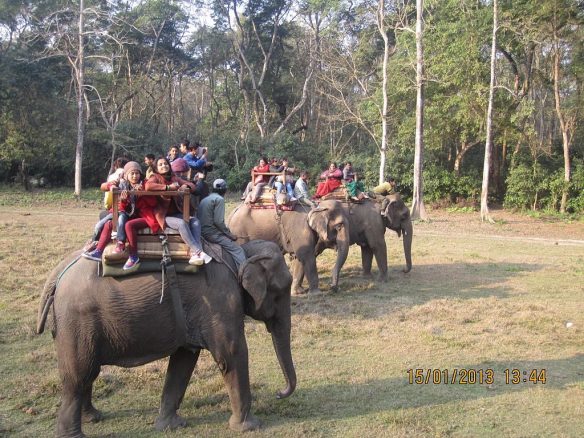
A tour guide in Thailand lost his life when an elephant being harassed by tourists fled in terror, trampling him and throwing two riders from its back. This is just one of many dangers of elephant ride parks, for both humans and elephants alike. Sign this petition to demand a permanent ban on elephant ride parks in Thailand.

Source: Ban Cruel and Dangerous Elephant Parks

View original post

Hunter Arrested After Killing His Wife For Not Given Him Enough Meat

[Not a long article, but it says it all.] article by Cholo Brooks


 http://gnnliberia.com/2017/08/21/hunter-arrested-killing-wife-death-not-given-enough-meat/

Police in central Liberia, Gbarnga, Bong County has announced the arrest of a hunter early Monday morning who killed his wife three months ago after fleeing the County to seek safe heaven at the Liberia/Guinea border.

According to a Correspondent of Liberian Broadcasting Corporation (LBS), the man in question has been at large after he killed his wife for not given him enough meat in his bowl, a situation; the Correspondent said over the past months has created fear in residents of the County.

The Commander of the Gbarnga Police Detachment, according to the LBS Correspondent has also confirmed the arrest of the alleged murderer and currently placed behind bars awaiting trial.

Ass-backwards Defined: Make good shot with your weapon, then with your camera  

Spend some quality time behind the camera and make the buck of a lifetime into a lifetime memory with a top-drawer photo.

Hunters in the Carolinas who take trophy bucks rarely turn down a trip to the taxidermist, even though a quality mount may cost hundreds of dollars. But few spend time taking capture quality photos of their kills. A shoulder mount over the fireplace will showcase a quality animal, but photographs from the day and place of the kill will better capture the event.

To make a great photographic memory, hunters need to be prepared and have a good digital camera ready in case a lifetime buck ventures into range. While a professional-level camera will take photos of the best quality, the technology available in most consumer-grade digital cameras is more than adequate.

Today’s cell phones do much more than just make and receive calls, and if their cameras shoot more than 5 megapixels, they are a valid option after a trophy buck hits the dirt. The key is to keep the phone/camera perfectly still to take the best shot.

Settings are important, and while hunters can fine-tun the white balance, focus, aperture and shutter speed, the auto functions on cameras and smart phones in most conditions.

If you have a digital camera, a small tripod can be helpful and can be purchased for as little as $20. Also, almost all cameras have a timer feature that can be used in concert with a tripod to take photos of the hunter with his trophy when no help is available.

 The only manual setting that should be adjusted is the flash. Even when sunlight is plentiful and the auto flash indicator didn’t turn on, adding flash can make a good shot fabulous. Adding flash is especially good when the sun is high because shadows can ruin a great shot, and hunters are likely to be wearing a hat or cap ­that will cover his or her face with shadows. A flash eliminates shadows, and during low-light conditions, it provide the light necessary to bring out colors and the fine detail in a crisp, quality photo. 

Beyond equipment, the biggest part of taking a good photo is the setup. The best photos are taken from the woods or in a natural setting where the deer was killed. Too many times, cameras aren’t pulled out until the deer is on the driveway, in the skinning shed or at the gas station where the background is ruined by an assortment of unwanted objects. Don’t let anything in the background take away from the photo.

The person holding the camera should set up several shots of the deer and hunter from different angles while always keeping the sun at the camera’s back. Any time the sun is off to one side or the other, it will cast shadows and can create glare that will ruin a photo. On extremely bright, sunny days, a few shots should be taken in a shaded area with the flash activated. While good sunlight is a positive, too much sun can cause the hunter to squint, and unwanted glare is a risk.

The best photos include the entire hunter and deer with just a little extra space all around. Fill up the frame with the subject; you need to be relatively close to the subject for the camera’s flash and focusing capacities to take effect. You can always crop the photo later.

A lifetime buck doesn’t come into range every day. Hunters should take precautions to take the best possible photos to preserve these special events for a lifetime of memories.

Hunting and politics, especially today’s version, never mix well

LINKEDIN 2COMMENTMORE

No modern political party has injected politics into Wisconsin’s hunting and wildlife-management programs like Republicans during Gov. Scott Walker’s administration, and yet several GOP leaders in key natural-resources positions have feeble credentials as license-buying, game-harvesting hunters.

Harsh? Not really. When Walker ran for governor in 2010, he touted “Scott’s Plan” for deer hunting. He promised voters he would appoint a “deer trustee” to revise the state’s deer hunting program, and told crowds, “Like most sportsmen, I’m tired of sitting in a deer stand all day and not seeing any deer.”

During the 2010 and 2014 races, as well as the recall election in 2012, “Sportsmen for Walker” signs were common statewide.

The GOP even institutionalized litmus tests for the outdoors. After taking office in 2011, Walker and his party passed Act 149, which requires at least three members of the seven-citizen Natural Resources Board to have held a hunting, fishing or trapping license in at least seven of the 10 years before they were nominated to serve. That policy took effect in May 2017 for the NRB, which sets policy for the Department of Natural Resources.

You’d think folks setting such standards would have impeccable qualifications themselves. But an open-records review of license purchases and game-registration files shows Walker himself wouldn’t have qualified for one of those license-based NRB seats until three years ago. He didn’t buy his first hunting license until March 2007, and didn’t fish until buying his first all-inclusive conservation patron license in March 2010.

RELATED:Following in Aldo Leopold’s footsteps along the Rio Grande

That standard also would have disqualified Cathy Stepp, who served as Walker’s DNR secretary from January 2011 through August 2017. Stepp didn’t buy a hunting, fishing or trapping license from 2003 through 2010. She then bought a fishing license, and hunting licenses for deer, turkeys and geese in March 2011, roughly two months after taking control of the agency the NRB oversees.

Unlike Walker – who has yet to register a deer in Wisconsin despite being licensed to do so every year from 2007 through 2017 – Stepp shot deer three straight years from 2011 to 2013. She added a turkey to her kills in May 2016.

Although Walker and Stepp would now qualify for any NRB seat, Sen. Tom Tiffany, R-Hazelhurst, does not. Tiffany, chairman of the Senate Committee on Sporting Heritage, Mining and Forestry, has owned hunting or fishing licenses only five times since 2004. He bought no licenses from 2009 through 2014, and none in 2017.

And even though only two of Tiffany’s licenses included deer hunting privileges, he felt qualified to lead efforts to eliminate earn-a-buck rules and October gun-deer hunts statewide in 2011. Earlier this year, he also helped relax baiting-feeding bans for deer hunting.

Even so, one of Tiffany’s cheerleaders is Mukwonago’s Greg Kazmierski, who’s been widely regarded by DNR staff as Wisconsin’s true “deer czar” since Gov. Walker appointed him to the NRB in 2011. “Kaz” is credited with getting the governor to appoint Texas’ James Kroll as Wisconsin’s deer trustee in 2012, and then rewriting deer regulations to his liking once Kroll went home.

Still, no one can look at Kaz’s license-buying history and lump him in with Stepp and Walker as a politically expedient deer hunter. He’s registered seven deer in 11 seasons since 2007, and bought gun and archery deer licenses annually since the state began tracking sales electronically in 1999.

But Kaz is no “hunting and fishing fool” – a compliment among outdoors-folks. He hasn’t bought a turkey license since 2005 or a small-game license since 2002, and never fished from 2001 through 2012. He even qualified for a $5 first-timer’s fishing license in 2013, but hasn’t fished since.

Current DNR Secretary Daniel Meyer, who replaced Stepp in September, has more diverse outdoors interests. Judging by his license purchases, Meyer routinely fishes. He also regularly hunts small game, including waterfowl and wild turkeys, but seems more casual about deer. Meyer bought an archery-deer license in 2003, never registered a deer from 2007 through 2016, and didn’t buy a gun-deer license in 2005, 2006, 2008, 2015 and 2016. However, Meyer killed a deer in November.

That brings us to Rep. Joel Kleefisch, R-Oconomowoc, chairman of the Assembly Committee on Natural Resources and Sporting Heritage. Given the modest overall credentials of the GOP’s aforementioned outdoors team, one might mistakenly think Kleefisch is trying to single-handedly boost the party’s hunting credibility.

He’s kept his hunting knife bloody since buying his first small-game license in 2003 and his first deer license in 2004. I say that with respect. Since the DNR began tracking individual harvest data on whitetails, wild turkeys and Canada geese in 2007, Kleefisch has registered 19 deer, 39 turkeys and 236 geese. Those aren’t misprints.

Further, by my unofficial tally, Kleefisch has spent $2,577 on tags, licenses and associated fees since 1999. Few of his fellow legislators can rival such numbers.

Unfortunately, Kleefisch likely leads the Legislature in game violations, too. The DNR cited him in 2013 for registering a deer too late, and cited him again in 2016 for overbagging turkeys when accidentally killing two with one shot. He also received three warnings for previous turkey- and goose-hunting violations.

One thing these GOP leaders seldom do, however, is donate extra money to state-run conservation efforts such as the Cherish Wisconsin Outdoors Fund, venison and turkey processing fund, or the endangered species or aquatic invasive species programs. Kazmierski donated $10 to Cherish Wisconsin in 2016. Walker gave $10 to general fish and wildlife funding in 2011; and twice contributed to venison processing, giving $1 in 2009 and $20 in 2010. The rest combined to give $0.

And just so you know, DNR records credit me with 12 deer registrations since 2007; 18 straight years of buying a patron’s license and extra tags for $2,602.50; and $49 in donations to the venison processing, fish and wildlife, Cherish Wisconsin and aquatic invasive species programs.

Does any of that make me special? Of course not. But I’m also not the one who uses hunting for political gain.

I’m just reporting it.

Shut Down Farm Allegedly Mistreating Chickens

Nancy's avatar"OUR WORLD"

A chicken farm in Florida is allegedly abusing its animals, forcing them to live in squalor and threatening the health of both them and the Americans who depend on the farm for food. Sign the petition to demand that the farm be shut down if these disturbing allegations are found to be true.

Source: Shut Down Farm Allegedly Mistreating Chickens

View original post

Winning Animal Rights: The Battle After the Victory

Marcia Mueller's avatarArmory of the Revolution

by Marcia Mueller

“Rights come before abolition of rights-violating practices, not after.” Rights of All Animals. David Cantor

“Our opposition must advance the total paradigm shift needed to reduce animal abuse by undermining the full range of animal-abusing policy, culture, and practice.” Animal Rights: Remedy to Trumpism, David Cantor. Responsible Policy for Animals.

“The Democratic Party is an engine of capitalism and the Biocaust.” Ibid.

Cantor’s excellent post and the Responsible Policy for Animals organization assert that the current paradigm of fighting animal abuse through welfare reform and promoting compassion and veganism needs to shift to a new paradigm of animal rights. That paradigm would give animals a “personhood status” that no longer keeps them subservient to human needs and give them freedom from property status, exploitation, and abuse.

But will conferring personhood on animals really given them the status and protection they need? Or will the success…

View original post 1,968 more words

Pet dog strangled in bobcat snare during family outing in SV

Pet dog strangled in bobcat snare during family outing in SV

Sage with Stewart’s grandkids.

STAR VALLEY, WYO – It was last weekend. Christy Stewart was with family walking her dog up Wickiup Knoll Trail outside of Afton same as she’d done almost every day for the past four years. Her dog, a 3-year-old Pyrenees named “Sage,” practically grew up on that run.

On Sunday, Sage died on that trail.

Sage

Out of sight for just minutes, the dog caught a scent of fresh meat used to bait a bobcat snare. It didn’t take long. Sage suffocated, hung in a trap just 20 feet off the trail.

Afton Game Warden James Hobbs investigated the incident and reported the trap, baited using a cubby set, was legal. It was not signed in any way that Stewart noticed, and that was her main complaint.

“To me, it’s common sense of not setting a snare so close to a popular recreation sight that would have avoided this nightmare. We all have our rights but there has to be a better way of avoiding senseless injury or death. Warning signs of “TRAPPING IN AREA” would be a good start,” Stewart said.

Stewart added that she wasn’t against trapping, per se, and is not interested in seeing laws changed in that regard. She just wants a heads up on any ongoing trapping so she or any other dog owner could be made aware.

“Nobody deserves a heartache like I have,” she said.

Trappers sometimes do not like to sign their traps for fear of vandalism from members of the public unsympathetic to the practice. Others don’t like to advertise where their traps are set to other trappers or opportunistic fur-gatherers.

Typical cubby set bobcat snare (Trapperman.com)

Lisa Robertson formed the advocacy group Wyoming Untrapped in 2012. WU is dedicated to creating a safe and humane environment for people, pets and wildlife through education, trapping regulation reform and compassionate conservation. The organization keeps the only statewide database of pet/trap conflicts.

WU has documented an escalation in incidents since fur prices began rising a few years ago. Recently, WU reported several trapping alerts in the last two months, including another snare trapping in Star Valley up Strawberry Canyon where a dog almost suffocated. Reports of traps near popular trails have also been reported in Shell and Ten Sleep.

“Traps are indiscriminate and deadly, causing pain and suffering to those who lose a beloved friend and family member,” Robertson posted on WU’s Facebook site.

With legal traps set so close to popular trails and little to no signage, and considering many dogs are allowed off-leash on the trails, Robertson said, “Basically, there are no safe areas for the public.”