Exposing the Big Game

Forget Hunters' Feeble Rationalizations and Trust Your Gut Feelings: Making Sport of Killing Is Not Healthy Human Behavior

Exposing the Big Game

Petition: Stop Wyoming’s Wolf Hunts!

Nancy's avatar"OUR WORLD"

687373-1517398168-wide

In 2017 why only started giving permits for Wolf hunts. This is entirely unnecessary wolf management strategy resulted in 44 wolves being needlessly killed.

Proponents of hunting say that it is necessary necessary to protect livestock, but wildlife management experts believe that if ranchers used non-lethal means like electric fences, most livestock losses could be minimized.

Gray wolves are not the problem. Human encroachment into wolf territory and a failure to manage land properly is.

https://www.thepetitionsite.com/takeaction/687/373/506/

View original post

Conservation Officer Reports for Recent Wolf Poaching Cases

Rod Coronado's avatarWolf Patrol

ONEIDA COUNTY DEAD WOLF Wolf shot in rear legs by Steven Kohl of Manitowoc, Wisconsin on 11/18/17.

The following are the reports written by Wisconsin and Michigan conservation officers (game wardens) investigating recent cases where a deer hunter and trapper illegally killed a gray wolf. These are not our exaggerations, they are the words of licensed law enforcement officers responding to the increase of violence directed towards the wolves of Wisconsin and Michigan. The wolf shot in its rear legs by Steven Kohl dragged itself 35 yards before she died from her wounds.

FROM WISCONSIN DNR CONSERVATION OFFICER CASE ACTIVITY REPORT 11/22/17:

“Once we got as close to the wolf as we thought we could get, we proceeded on foot to a large marshy swamp and located the deceased wolf very close to the location provided by the GPS collar. I saw that the wolf was generally black in color and lying on its…

View original post 633 more words

Montana won’t recommend Yellowstone grizzly hunting this year

Grizzly bear (copy)

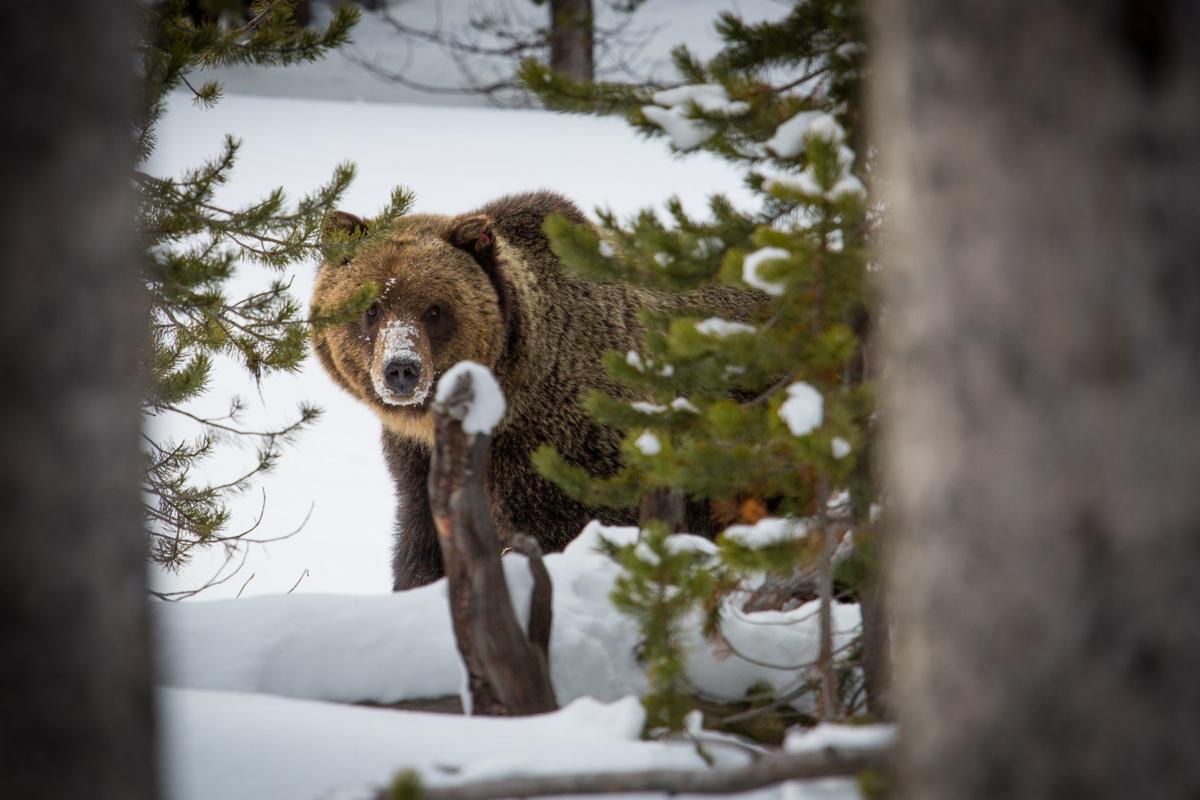
Grizzly bears were protected from hunting for mover 40 years while listed as threatened under the Endangered Species Act.

Public Domain/Neal Herbert via NPS

Not this year.

Montana Fish, Wildlife and Parks announced Thursday that it won’t ask the Montana Fish and Wildlife Commission to approve a hunting season for the recently delisted Yellowstone grizzly bears this year.

The bears were protected from hunting for more than 40 years while they were listed as threatened under the Endangered Species Act. Those protections were lifted in 2017, which opened the door for a potential hunting season. 

In a news release, FWP director Martha Williams said the decision is meant to reinforce the state’s commitment to the grizzly bear’s long-term survival.

“Holding off on hunting for now, I believe, will help demonstrate our commitment to long-term recovery and at the same time allow us the science-based management flexibility we need,” Williams said.

FWP will make the recommendation to its governing board at its next meeting Feb. 15.

The announcement comes weeks after Wyoming Game and Fish gained permission from its governing board to draw up grizzly bear hunting regulations, the first time since the 1970s that either state has had the legal authority to do so.

Removing Endangered Species Act protections for the bears gave more management responsibility to the states of Idaho, Wyoming and Montana. Prior to the delisting, each state had to create a framework for a potential hunting season, which was included in the final conservation strategy.

Part of the strategy is meant to limit the number of bears that are killed by humans. It created a level of “discretionary mortality” based on a population estimate. An agreement lined out before delisting split the allowable bear deaths between the three states.

The official government estimate puts the Yellowstone grizzly population at about 700 bears. Greg Lemon, a spokesman for FWP, said the allowable deaths for the three states was calculated to be 17.

Wyoming gets most of the allowable deaths, with the numbers this year being 10 males and 1 female. Idaho’s allowance is one female. Montana’s allowable mortality is 0.9 females and 5.8 males.

Montana will still retain its portion of allowable deaths, meaning the numbers for the other two states would remain the same whether the state decides to hunt bears or not.

FWP cited the ongoing legal challenge to the delisting as another reason it didn’t want to propose a hunting season.

At least five separate lawsuits over the delisting were filed by environmental groups and Native American tribes. They argue the bears shouldn’t have been removed from the list because the animals still face threats from climate change and shifts in their diets that result in more human-bear conflict.

Study: Climate Change Probably Won’t Kill All of Us

Exposing the Big Game's avatarThe Extinction Chronicles

http://nymag.com/daily/intelligencer/2018/02/study-climate-change-probably-wont-kill-all-of-us.html
@EricLevitz
A conveyor belt sits below excavated land at the Garzweiler open cast lignite mine. Photo: Krisztian Bocsi/Bloomberg via Getty Images

Due to a combination of prudence and morbid curiosity, a great deal of scholarly research (and journalism) about climate change has focused on the worst of all possible worlds. For scientists running climate-economic models, that nightmare scenario has a concrete definition: In 2011, such researchers established four baseline scenarios for the future of greenhouse gas emissions (ranging from the benign to the catastrophic) for the sake of facilitating comparable studies.

The most fearsome — and widely cited — of these baselines, known as “RCP8.5,” imagined a year 2100 in which an overpopulated, technologically underdeveloped humanity is digging up and burning every last piece of coal it can find. Thus, by the turn of the next century, coal — the most carbon-intensive major fuel source…

View original post 533 more words

Hunting fraternity gather to remember rider killed in fall from horse

Mr Graham, pictured in October

Get Daily updates directly to your inbox

+ Subscribe

Huntsmen and women from Leicestershire and further afield gathered at the weekend to pay tribute to a 54-year-old member of the Fernie Hunt who died in a horse-riding accident last week.

William Graham, formerly of Lubenham, near Market Harborough, fell from his dark bay horse as he jumped a timber fence in fields between Saddington and Mowsley on Wednesday, January 31.

An inquest on the father-of-three’s death has been opened and adjourned.

Mr Graham, pictured in action last month

On Saturday, people from the hunting fraternity gathered for a day’s hunting near Hallaton, in his memory.

Philip Cowen, joint-master of the Fernie Hunt, said: “Many people who are connected with hunting in Leicestershire and further afield came together for a special day’s hunting which was dedicated to Will.

“ There is an incredible bond which runs throughout those who are involved with the hunt, whether as riders, followers or supporters and the moving tributes on that day will last long in all our memories.

“Will was a true gentleman and we all owe him so much for a life which has been cut short far too soon.”

Mr Graham was a member of the Fernie Hunt (Image: Andrew Carpenter)

He added: “Will fell from his dark bay horse as he jumped a timber fence mid-way between Saddington and Mowsley. The horse was not injured in the fall.

“Although born in Scotland, Will had lived locally for many years. He leaves a wife, Lucy, and their nine-year-old daughter, with two older children from a previous marriage.

“Will’s tragic death whilst out hunting with the Fernie last week has stunned and shocked us all. Sadly, he died when his horse fell on top of him at a fence which has been jumped on numerous occasions previously, close to Saddington village.

“There are no words to describe such a devastating loss particularly for his family, but also a great many other people in the locality who knew him so well.

Mr Graham, pictured in October

“Our hearts and thoughts go out to them all at such a sad time. Will was a constant source of energy, passion, enthusiasm and determination in whatever he turned his hand to – whether in his line of business, when on the sportsfield or when relaxing at home. His loss to our community is immeasurable.”

He added: “Will was an accomplished and very competent rider who has followed the Fernie hounds for about 15 years.

“He particularly enjoyed both the social side of the sport, and the excitement which can be provided in both jumping natural obstacles and watching the hounds as they use their scenting abilities to follow the lines of the trail across natural country and open farmland.”

Polly Portwin, of the Countryside Alliance said: “Will was a great supporter and representative of the Alliance and we extend our deepest sympathies to Lucy, their family and all those closest to them.”

Chris Parker, also a joint-master of the Fernie Hunt said: “Sadly Will lost his life whilst enjoying a sport that he loved, and to which he has been a huge contributor both directly and behind the scenes for many years.

“He was clearly enjoying himself on the day in question right up to the moment that this dreadful accident occurred.

“Words do not adequately convey our emotions, or the profound degree of sympathy which we all feel for his wife, daughter and their wider family.

“He will be greatly missed by all his friends in not only the hunting world, but from many other aspects of life as well. He was also a hugely successful businessman, and he particularly enjoyed skiing and sailing.”

The inquest on the Mayfair, London, based investment management company director was opened at Leicester Town Hall and was adjourned, pending reports until April 23.

Your Cause is Lost Without Population Control

Exposing the Big Game's avatarExposing the Big Game

Despite how keenly aware Homo sapiens are of the potential overpopulation of other species, they don’t seem to think the same laws of nature apply to them. If any other large mammal added a staggering 200,000 to their population each day, humans would be in a panic to control their numbers—by any means possible.

But while humans are surging well past 7 billion, they act like the laws of carrying capacity and finite resources don’t apply to them. I wouldn’t want to be around when nature brings the hammer down and finds humans in contempt. It ain’t gonna be pretty…

By sheer coincidence, I just read the following passage from Rudyard Kipling’s 1893 classic, The Jungle Book. Clearly the monkeys (the Bandar-log) represent humans in Kipling’s story as they “danced about and sang their foolish songs,” ignorant of the consequences of their actions and describing themselves thusly, “We…

View original post 110 more words

Earth’s overpopulation exasperating climate change

https://www.bozemandailychronicle.com/opinions/letters_to_editor/earth-s-overpopulation-exasperating-climate-change/article_c811b4f6-1c1a-5083-9420-24afcbf82792.html

Every social and environmental issue is exacerbated by overpopulation. Fifty years ago, there were 3.4 billion people living. Now that number is 7.6 billion. Human population has grown more in the last several decades than in the past three million years. We add 80 million mouths to feed every year. At that rate, world population will grow to 12 billion by 2050.

Five results from overpopulation are: 1) hunger and starvation; 2) squandering natural resources until we run out; 3) landscalping and the loss of land fertility; 4) cultural, economic, and political upheaval; and 5) harm to wild things. 

In about 300 years, the acreage needed to feed humans has gone from less than 10 percent to nearly half of Earth’s land acres—more than a five-fold rise. Earth’s atmosphere, seas, and forests can’t soak up our industrial, transportation, and agricultural emissions of carbon dioxide, methane, and other greenhouse gases.

Between 1990 and 2003, U.S. per capita greenhouse gas emissions went up by 3.2 percent. But overall U.S. emissions went up 20.2 percent! How can this be? Our population rose 16.1 percent. So, unless we get a handle on population, we’ll never succeed in reducing greenhouse gas production. 

Economist Edwin S. Rubenstein recently wrote “The impact of U.S. population growth on global climate change.” He concludes that, “Over the long run, U.S. population growth is the most important factor in CO2 emissions emanating from this country.”

Experts writing in the Lancet say that “Prevention of unwanted births today by family planning might be one of the most cost-effective ways to preserve the planet’s environment for the future.”

 Norman A. Bishop

Bozeman

State drops deer cruelty charge against Washington hunter

 https://knox.villagesoup.com/p/state-drops-deer-cruelty-charge-against-washington-hunter/1685380

By Stephen Betts | Sep 06, 2017

WASHINGTON — A 58-year-old Washington man was convicted Wednesday, Sept. 6, of a trio of hunting violations,but the most serious charge, felony cruelty to a deer, was dismissed by the state.

Ronald Mole pleaded no contest in Knox County Superior Court to night hunting, placing bait to entice deer and discharging a firearm near a dwelling. The no contest plea results in a conviction, but allows him to challenge the facts in separate administrative or civil proceedings.

The District Attorney’s Office dismissed a more serious charge of aggravated cruelty to animals. The charge was considered to be the first time that the animal cruelty law had been used in relation to the shooting of a deer by a hunter.

Mole will be fined $1,000 if he adheres to terms of a deferred disposition over the next 12 months. The terms require him to obey all laws during the next year. If he commits any new offenses, he could face up to the maximum of 365 days in jail for the night hunting conviction.

The offenses occurred Nov. 6 and Nov. 7 on the Old Union Road in Washington, according to paperwork filed in court by Maine Game Warden Joey Lefebvre of the Maine Inland and Fish and Wildlife department.

The animal was shot while Mole was illegally night hunting, according to investigators. The deer was left to suffer during the night until Mole returned the following morning, the state claimed.

The cruelty charge had alleged that Mole acted in a way that “manifested a depraved indifference to animal life or suffering, did intentionally, knowingly or recklessly cause extreme physical pain to an animal, cause the death of an animal, or physically torture an animal.”

Generally, animal cruelty cases involve abuse to pets.

After Mole was charged, his attorney, Christopher MacLean, of Camden, had said he was amazed that his client had been charged with animal cruelty.

“In a state with such a proud hunting tradition, it absolutely amazes me to see a felony prosecution for animal cruelty in a case where the deer was lawfully shot and properly tagged by a licensed Maine hunter. Cases like this slowly erode hunting rights in the state; I fear the next step will be to restrict gun ownership itself by those who have no understanding of Maine’s hunting tradition,” MacLean said at the time the charges were brought.

The state said the hunting occurred at 8 p.m. Nov. 6. Sunset was at 4:19 p.m. Hunting is prohibited from 30 minutes after sunset to 30 minutes before sunrise.

Then District Attorney Geoffrey Rushlau said after the charge was filed that the theory of prosecution for this case was that there was a far greater chance of a deer’s suffering if it was hunted illegally at night when a clean shot is less likely and when the deer cannot be tracked as easily.

Firing a gun within 100 yards of a residential dwelling is illegal in Maine without the permission of the property owner.

A companion case against Lisa Black, 47, of Washington, was dropped by the state. Black had been charged with unsworn falsification and false registration of a deer.

Winter Olympics shines spotlight on dog meat trade in South Korea


by MARTIN ROGERS  |  USA TODAY SPORTS

 
2.5 million dogs are bred each year in South Korea for human consumption.
Combating the dog meat trade in Korea
2.5 million dogs are bred each year in South Korea for human consumption.
USA TODAY SPORTS

PYEONGCHANG, South Korea – As the Winter Olympics approach this week, figure skater Meagan Duhamel still shudders to think the dog she rescued from South Korea might have ended up on someone’s dinner plate.

Duhamel, a Canadian, is a contender with Eric Radford in the pairs competition and heads to Pyeongchang in search of gold, as well as another dog that she can save from slaughter.

Nami Kim, a prominent campaigner based outside Seoul,

Nami Kim, a prominent campaigner based outside Seoul, has sent more than 1,200 rescued dogs to the United States through her Save Korean Dogs program.
NAMI KIM

Eating dog meat is common and legal in Korea, as well as many parts of Asia, and is mainly eaten by older people. Dotted around the country are thousands of restaurants serving “gaegogi” dishes that, according to folklore, have strengthening and medicinal properties.

“It is just sad because when the world is watching the Olympics little is known or spoken about the (Korean dog meat trade),” Duhamel told USA TODAY Sports. ”There are hundreds of dog meat farms tucked away and nobody is talking about this. The buzz will be about the Olympics.”

More: Go behind the scenes at the 2018 Winter Olympics Athletes Village

More: Lindsey Vonn’s Olympic dreams driven by need for speed

According to The Associated Press, restaurants “nearly in the shadow of the Olympic Stadium” are still selling dog meat meals. According to the Humane Society International, around 2.5 million Korean dogs are killed for their meat each year.

The Korean government, realizing the issue is sensitive for foreigners, has offered money to restaurants if they stop serving dog meat during the Games and has requested that signs advertising the meals be covered up or removed.

“This is an Olympics story,” Marc Ching, a Bay Area activist who founded the Animal Hope and Wellness Foundation, said. “I am half Korean. Koreans are very proud of hosting the Olympics. Why this has to be tied to the Olympics is that the government itself is actually paying to hide this from the world. Maybe if … they just said ‘this is part of our culture,’ it would be different.”

In this photo from December, dog meat menus that explained

In this photo from December, dog meat menus that explained the dishes in English, Chinese and Japanese, are seen at Young Hoon Restaurant in Pyeongchang.
AHN YOUNG-JOON, AP

Animal rights activists claim that dogs, as well as cats, in the meat trade are subjected to horrific conditions and insist nothing is being done to end the practice. That is despite Korean President Moon Jae-in being a dog lover who recently adopted a pet saved from a dog meat farm. Campaigners are determined to use the Olympics to raise awareness and hope that support from athletes and international pressure may spark a change in legislation.

However, it is a difficult subject and, perhaps understandably, some athletes prefer not to speak out about something that is both culturally sensitive and controversial.

More: Vomiting illness spreads at Winter Olympics

More: Go behind the scenes at the Athletes Village

“Every country and every culture has different traditions and we are always respectful of those,” American ice dance skater Alex Shibutani said. “I can’t speak too much because I’m just not familiar with their culture.”

According to Ching, the issue is less about the consumption of dog meat, and more about the stomach-turning practices that are used to slaughter the animals.

“In Korea they usually put a noose around the dog’s neck and take them out back, hang them and beat them,” Ching said. “Another method is they just smash their head open. Sometimes they do electrocution. They shock them and burn them or de-fur them. With electrocution many times they are still alive. It is terrible.”

In many parts of Asia, dogs are often tortured and beaten before they are killed as it is believed that the adrenaline makes the meat more tender. Korean farmers defend their right to keep dogs packed in cages and to treat them as any other animal being raised for human consumption.

“How can we sell (them) when we’re training and communicating with them individually?” Kim Sang-young, president of the Korean Dog Farmers Association told the Hankyoreh news site. “They’re just livestock. We raise them with affection so they don’t suffer, but the purpose is different.”

On Monday, USA TODAY Sports sent a message requesting comment to the official press office email account of the Pyeongchang organizing committee and to Nancy Park, spokesperson and director of international media relations for the 2018 Olympic organizing committee.

USA TODAY Sports received a reply from the news desk of the organizing committee, with its “official statement on dog meat consumption.”

The statement read: “We are aware of the international concern around the consumption of dog meat in Korea. This is a matter which the government should address. We hope that this issue will not impact on the delivery or reputation of the Games and the province and we will support the work of the province and government on this topic as needed. Also, dog meat will not be served at any Games venue.”

Ben, a rescue from South Korea, was fostered by the

Ben, a rescue from South Korea, was fostered by the Peck family in Irvine, Calif.
LANA CHUNG PECK

Pets stolen for meat

Nami Kim, a prominent campaigner based outside Seoul, has sent more than 1,200 rescued dogs to the United States through her Save Korean Dogs program. Several have been fostered by a family in Irvine, Calif., Lana Chung Peck, her husband Kevin and their two young children.

Chung Peck said that the mental scars of mistreatment run deep. When the dogs first arrive they are often unaccustomed to positive human interaction. That was the case with their current foster, a Jindo named Julie.

“She would be frightened of anything in front of her,” Chung Peck said. “Any human, any dog, any sudden movement.”

“At first the dogs who come are almost feral,” Kevin Peck added. “They don’t want to walk, don’t want to be touched. But within weeks they are almost like a puppy.”

Four years ago, dog protection became a major issue during the Winter Olympics, with the plight of the strays of Sochi touching the hearts of visitors. Gus Kenworthy, a slopestyle silver medalist in freestyle skiing, rescued several animals. So did members of the United States hockey team. Kenworthy did not respond to a request for comment for this story.

The Korean dog farming industry tries to draw a distinction between dogs as pets and dogs as food, but Ching says some dogs that end up in restaurants are stolen from family homes. Ching has rescued dogs from slaughterhouses and found microchips embedded in them.

He also highlighted the enduring popularity of “gaesoju,” a potion manufactured by boiling a dog whole, in a pot mixed with herbs. Ching says that because the dog’s intestines are not removed, fecal matter remains inside them. He and Nami Kim also say that dogs are kept in such poor conditions that many of them are dying and terribly sick.

“It takes a truly disgusting mind to treat dogs in this way,” renowned dog trainer and author Tamar Geller, who trained Oprah Winfrey’s pets, said. “Receiving such cruelty is not just a torture of a dog’s body but also its mental state. Some of these animals know nothing but fear from the start to the end of their lives.”

Olympics highlight issue

Internationally, the issue of Korean dog meat has not been widely publicized. The Olympics, however, has a habit of bringing things to the fore.

“It’s an industry that – even in Korea – the vast majority of the population is against,” actress and animal rights campaigner Pamela Anderson said via email. “Removing the signs is great but I’d like to see them remove the restaurants altogether. If you’re visiting Korea for the Olympics, they do have some great vegan restaurants.”

Duhamel, meanwhile, is focused on trying to achieve her Olympic ambition but hopes that her stance will encourage more people to adopt. Olympic visitors may also be able to volunteer to transport dogs back to North America, such as Duhamel is doing with Toronto-based Free Korean Dogs.

At first she thought her current dog’s name Mootae, had some symbolic significance as he had been rescued by a Buddhist monk. In actual fact, Mootae just means “not big.”

The issue, for those who care about it, is anything but small. Duhamel is deeply conscious of Korea’s cultural differences, even though “it is so removed from our reality.”

But eventually the matter bothered her so much that she decided to take action. And whether she wins gold or not, she will be taking something precious back home.

View|9 Photos
Olympic flame begins journey from Greece to South Korea for 2018 Games


Originally Published 5:15 a.m. PST Feb. 7, 2018

Updated 7:08 a.m. PST Feb. 7, 2018

Activists Target Eric Trump During Worldwide Rally Against Trophy Hunting

Activists Target Eric Trump During Worldwide Rally Against Trophy Hunting

FEBRUARY 7, 2018   BY 

The News

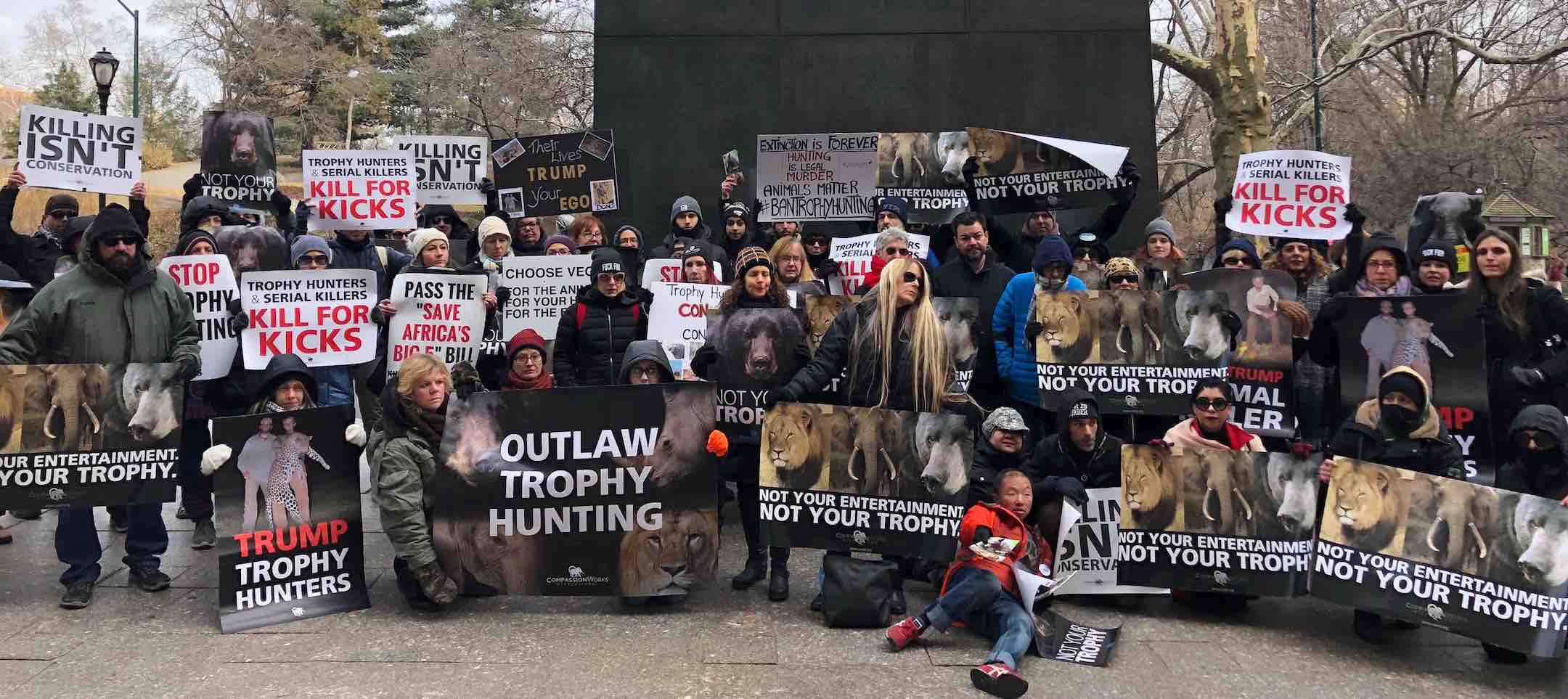
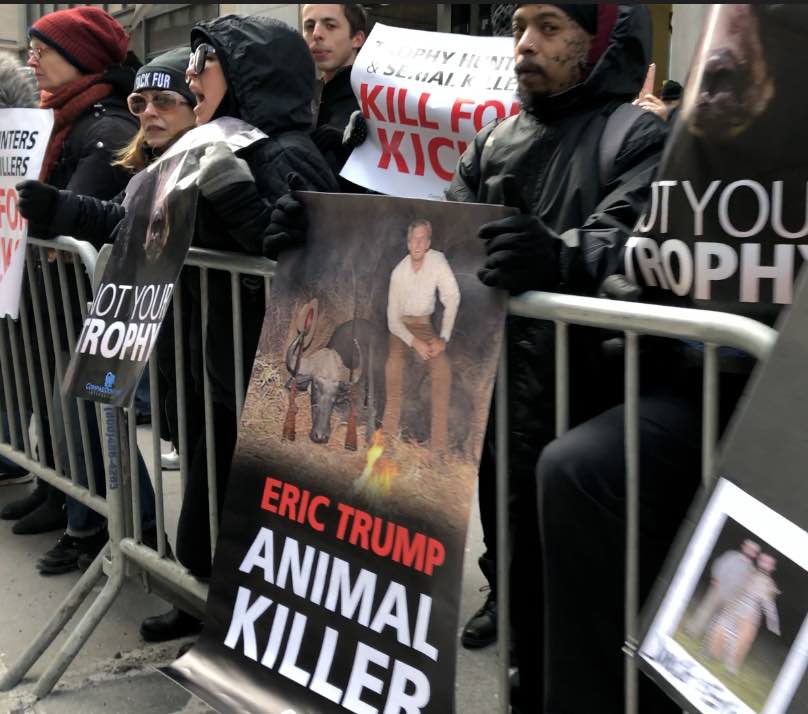
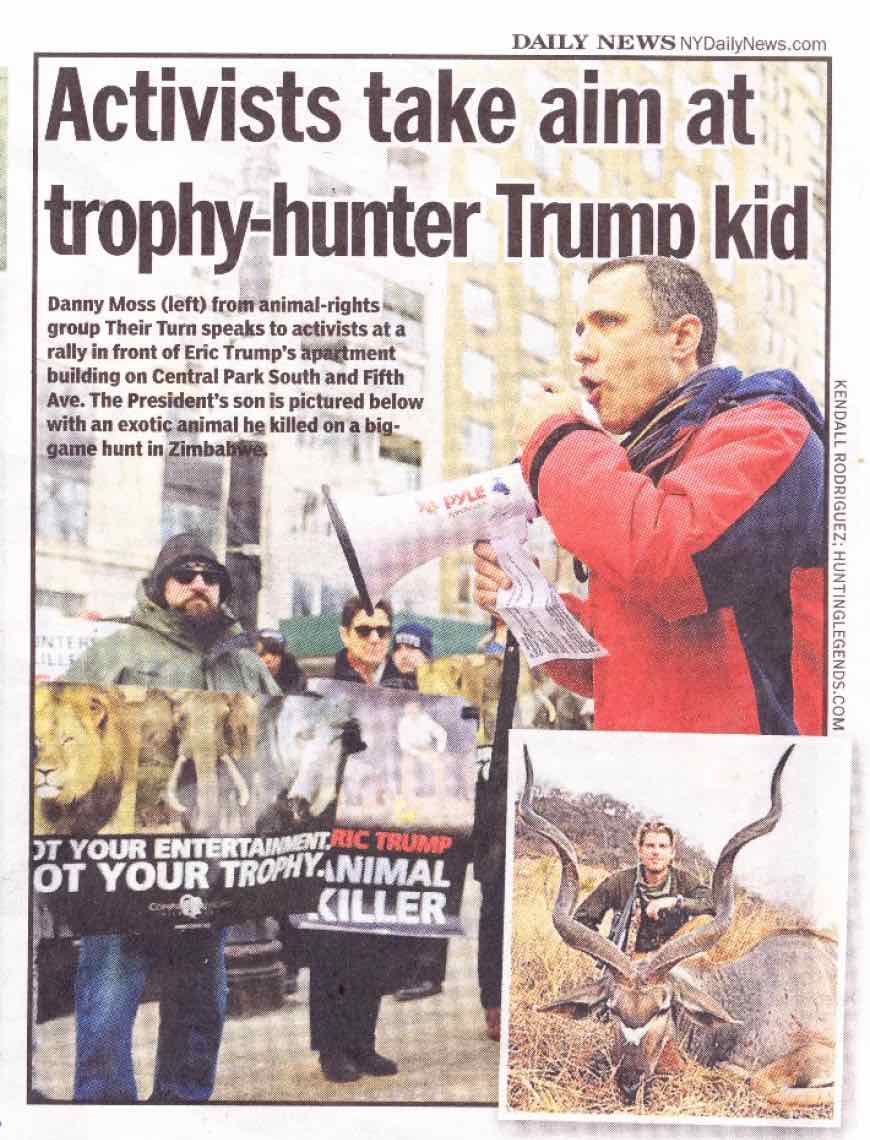
During the Worldwide Rally Against Trophy Hunting (WRATH), dozens of animal rights activists in New York City protested at the home and office of one of the planet’s most notorious trophy hunters — Eric Trump.  Several broadcast and print media outlets reported on the event.

https://www.facebook.com/plugins/video.php?href=https%3A%2F%2Fwww.facebook.com%2Ftheirturn%2Fvideos%2F2020944798155907%2F&show_text=0&width=560

During the rally, Edita Birnkrant, the Executive Director of the animal rights group NYCLASS, entered Eric Trump’s apartment building to deliver a letter to his wife, animal advocate Lara Trump, encouraging her to dissuade her husband from trophy hunting. Two reporters followed her into the building with their cameras rolling.

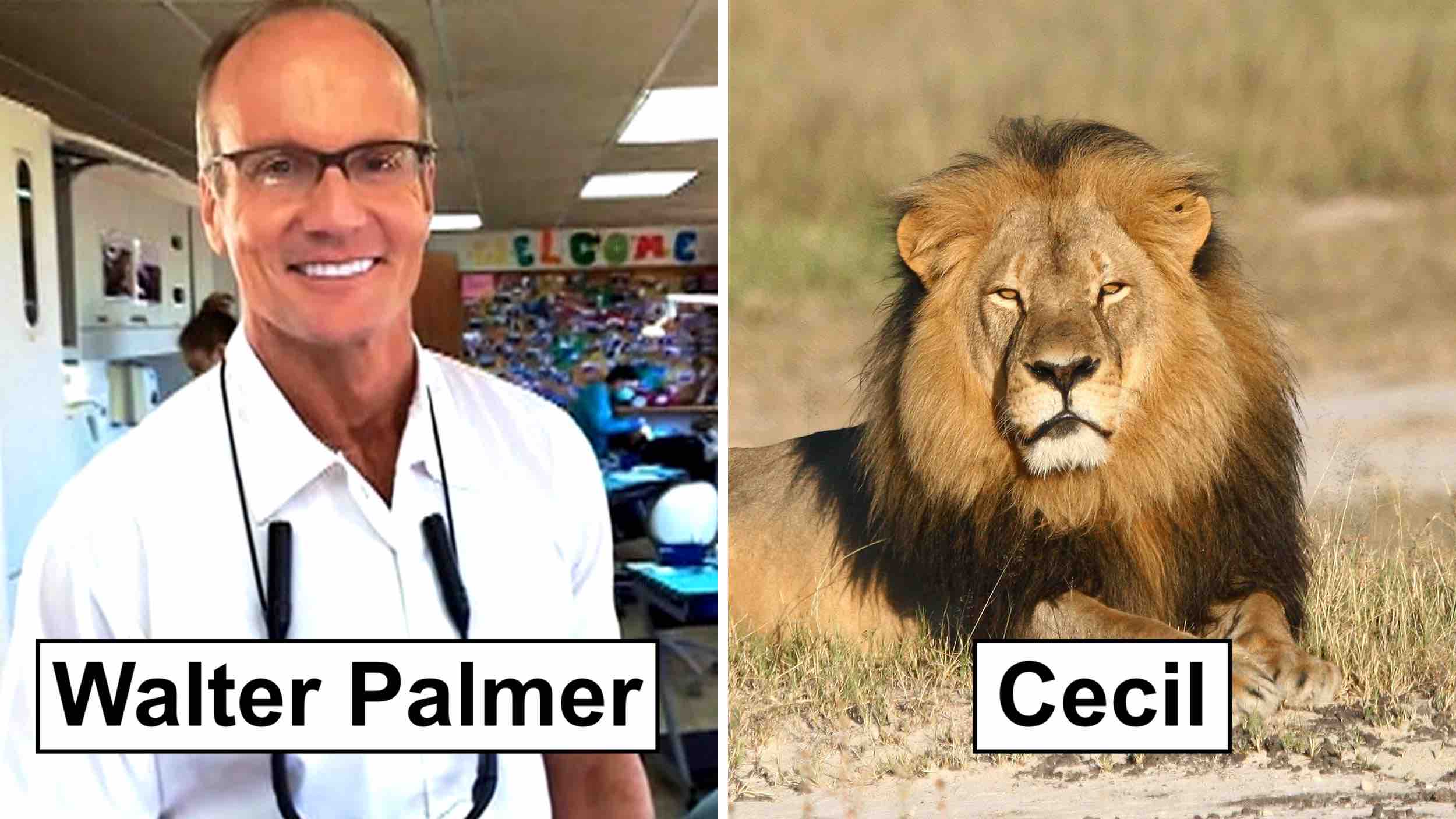
WRATH was created in 2016 by the animal rights organizationCompassionWorks International in response to the killing of Cecil, a beloved lion in Zimbabwe who was shot and beheaded by Walter Palmer, a trophy hunter from Minnesota. The death of Cecil sparked global outrage and triggered several weeks of public discourse around trophy hunting.

IN 2018, WRATH events took place in 32 cities in several countries around the world, including Australia, Ireland, Canada and Brazil.  

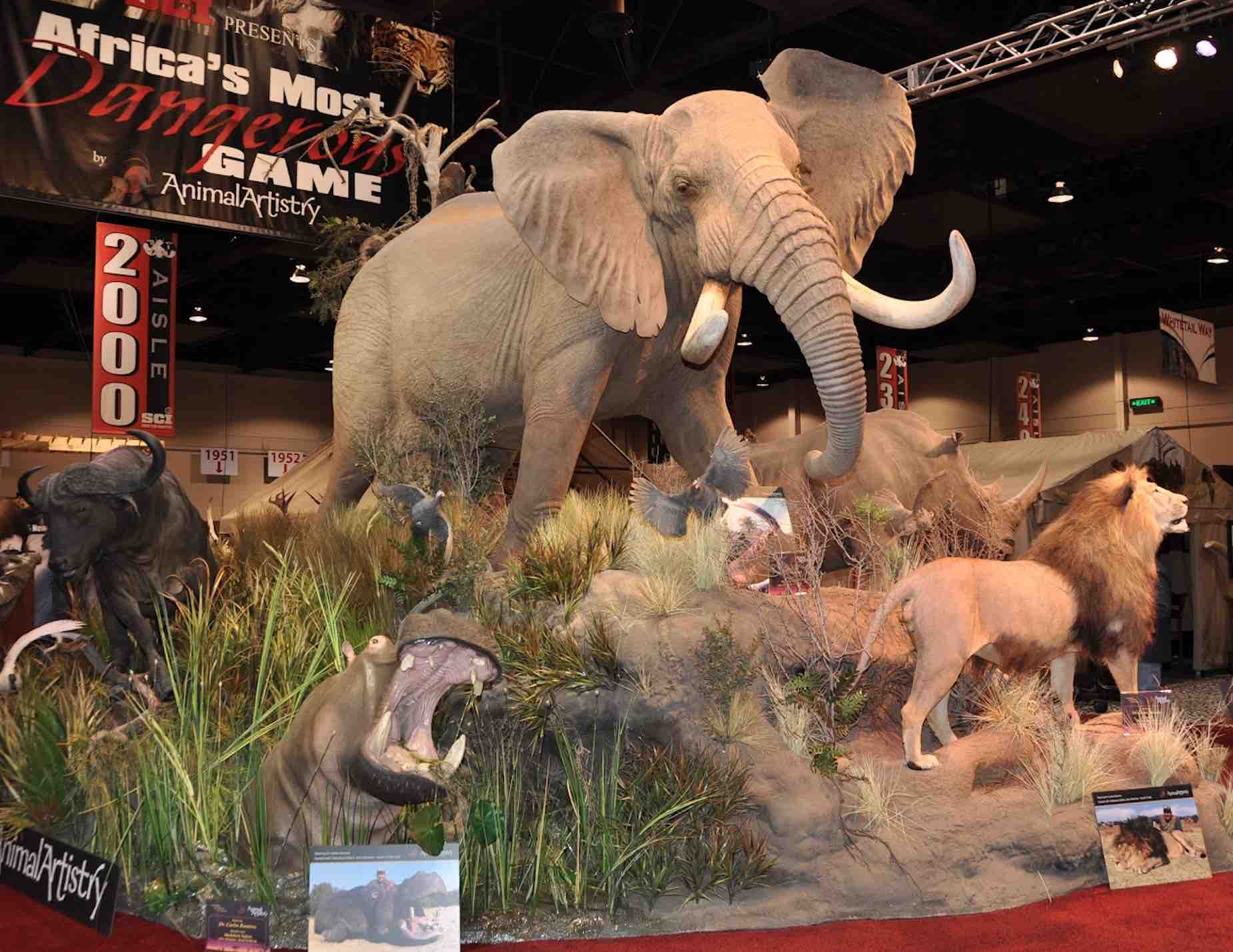
WRATH is held to coincide with the annual convention of Safari Club International, a 50,000 member Texas-based pro-hunting organization that spends millions of dollars each year lobbying elected officials to support their mission. During the convention, organizers auction off hunts with endangered & threatened species. In 2018, a polar bear hunt was featured in the in promotional materials for the convention. 

Trophy hunters justify the killing on the grounds that the money they spend helps to conserve the species and supports local community. Activists dispute that claim, arguing that most of the money spent by trophy hunters goes to the trophy hunting companies and to local government officials.

During the WRATH event in NYC, Nicole Rivard, a campaigner with Friends of Animals, told rally participants about pending trophy hunting legislation in the state of New York:  “We cannot rely on fluid federal law to ensure that Africa’s big five do not go extinct. When it comes to trophy hunting, federal law is not protective at all.  We have legislation – Save Africa’s Big Five bill – to stop trophies from entering New York. The state bill would ban the importation, possession, sale or transportation of the trophies of elephants, lions, leopards and black and white rhinos. New York is the busiest port of entry for African wildlife in the US. Let’s shut it down.”

Your Turn

Please follow CompassionWorks International on Facebook to stay apprised of the organization’s life-saving work.