Exposing the Big Game

Forget Hunters' Feeble Rationalizations and Trust Your Gut Feelings: Making Sport of Killing Is Not Healthy Human Behavior

Exposing the Big Game

Father shoots son in hunting accident

Exposing the Big Game's avatarCommittee to Abolish Sport Hunting Blog

http://www.hutchnews.com/news/20171119/father-shoots-son-in-hunting-accident-minor-injuries

An 11-year-old boy had minor injuries after being shot in the face by his father during a hunting accident Sunday morning roughly two miles south of Pretty Prairie, the Reno County Sheriff’s Office stated.

According to a press release: Jean Carlos Alcala, 37, of Wichita, reported he swung his 12-gauge shotgun to shoot a bird somewhere on the 26000 block of S. Dean Road and hit Gabriel Alcala in the face. The man said his son was walking about 20 feet ahead of him and off to his left when the accident occurred.

The release said the man was hunting with his son and 9-year-old nephew, Isaiah Quirarte. Police were notified around 9:45 a.m. The boy was taken to St. Joseph’s in Wichita. The release said the trio were on a walk-in-hunting field.

Walk-in-hunting is a program the Kansas Department of Wildlife, Parks and Tourism started in 1995. It…

View original post 29 more words

Top five hunting violations committed by Hoosiers

INDIANAPOLIS — With deer hunting season well underway in the state, Indiana Department of Natural Resources is reminding hunters to use their heads and follow the law when out in the woods.

To kick off firearms deer-hunting season Saturday, DNR re-shared a popular video recorded a few years ago that details some of the most common hunter violations and why they are important to follow.

Top 5 Hunting Violations According to DNR:

  1. Hunting/Tracking a deer from a vehicle
  2. Hunting on someone else’s private property
  3. Not wearing hunter orange
  4. Over-bagging and breaking the one buck rule
  5. Over-bagging any animal / killing more than the per-person limit

This laws are being carefully watched this year after an error in the law passed by the legislative session initially banned the use of rifles on state and federal property.

READ | Deer hunters CAN use rifles on state and federal property this year

The Department of Natural Resources issued an emergency state rule allowing hunters to use rifles during the 2017-18 season until they are able to update the law next year.

Two deer hunters die on firearms hunt opening day in Wisconsin

Exposing the Big Game's avatarCommittee to Abolish Sport Hunting Blog

https://www.jsonline.com/story/news/local/wisconsin/2017/11/19/two-deer-hunters-die-firearms-hunt-opening-day/879139001/

LINKEDIN 1COMMENTMORE

Two hunters were found dead in their stands in the same county on opening day of the gun-deer season.

Both men died in Marquette County, one of natural causes and one from a gunshot wound, Coroner Tom Wastart said Sunday.

Three other hunters were reported wounded in firearms incidents.

An estimated 600,000 hunters headed into the woods throughout Wisconsin for opening weekend of the nine-day firearms hunt.

Also Saturday, two hunters contacted the Juneau County Sheriff’s Department after finding human remains. The unidentified remains were found in woods in the Town of Lyndon around 10:30 a.m., the department reported.

In Marquette County, a 62-year-old Shawano County man was found dead in his tree stand on private…

View original post 253 more words

Alaskans say ‘no’ to cruel hunting methods for killing hibernating bears, wolf pups in dens

June 29, 2018

A rule recently proposed by the Trump administration would roll back an Obama-era regulation that prohibits controversial and scientifically unjustified methods of hunting on Alaska’s national preserves, which are federal public lands. These egregious hunting methods include the use of artificial light to attract hibernating bears and their cubs out of their dens to kill them, shooting wolf and coyote pups and mothers at their dens, using bait to attract brown and black bears, shooting vulnerable swimming caribou, including with the aid of motorboats, and using dogs to hunt black bears. Biologists have already condemned these methods, and now a supermajority of Alaska’s residents have spoken out resoundingly against allowing them in their state.

The telephone poll, conducted by Remington Research Group and released by the Humane Society of the United States, found a whopping 71 percent of Alaskan voters oppose allowing hunters to use artificial light to attract hibernating bears and their cubs out of their dens to kill them. Sixty-nine percent oppose hunting black bears with packs of hounds, and 75 percent oppose hunting swimming caribou with the aid of motorboats. Sixty percent of Alaskan voters oppose the baiting of bears with pet food, grease, rotting game or fish or other high-calorie foods, and 57 percent oppose killing whole packs of wolves and coyotes when they are raising their pups in their dens.

The poll also found that a majority of voters disfavor allowing trophy hunters and trappers killing wolves, brown bears, black bears, wolverines, lynx and other wildlife on state lands along the northeast boundary of Denali National Park and Preserve.

In complete disregard for the wishes of the state’s residents, however, the Department of the Interior’s National Park Service is now accepting public comments on the controversial rule that’s designed to benefit a handful of trophy hunters looking for their next big kill.

This indiscriminate killing of native carnivores such as grizzly bears and wolves is often justified as “protecting” ungulates, animals like caribou and moose. But in Alaska and elsewhere, studies show, such predator control, including trophy hunting or culling of wild native carnivores in order to grow game herds, just doesn’t work. In fact, that is precisely the finding of a comprehensive new study that was reported in Scientific American.

On the other hand, live native carnivores like grizzly bears and wolves contribute immensely to the state’s economy. In Alaska, wildlife-watching tourism brings $2 billion every year to local, rural economies.

Several studies in Alaska show that predator control is doomed to fail, because the unforgiving Arctic lands cannot sustain large numbers of prey herds in the short growing seasons followed by extreme winters. Alaska officials have also failed to acknowledge that with the massive killing of wolves or bears, other smaller predators rise up to compete for those same prey, rendering these cruel and harmful predator control practices utterly futile.

Most Alaskans do not want hunters, backed by the deep pockets of trophy-hunting groups like Safari Club International and Alaska Outdoor Council, treating their state as a shopping mall for bearskin rugs and wolf heads to adorn their walls. American wildlife is for all of us to enjoy, and you can do your part to help save it by submitting a commentopposing this new proposed rule by July 23.

Patricia Randolph’s Madravenspeak: Francisco Santiago-Avila’s mission to acknowledge moral standing for nonhuman animals

dvoight09's avatarWisconsin Wildlife Ethic-Vote Our Wildlife

My training in philosophy had taught me to be distrustful of claims of human exceptionalism, yet these claims are implicit everywhere in wildlife management and conservation.” ~ Francisco Santiago-Avila, Ph.D. candidate, UW-Madison Nelson Institute

I attended the Nelson Institute Earth Day primarily to hear Fran Santiago-Avila’s talk. His biography caught my attention:

“As part of the Carnivore Coexistence Lab, Fran’s research has revolved around the integration and application of environmental and animal ethics to coexistence with wildlife, and the evaluation of the effectiveness of lethal and non-lethal methods to prevent conflicts with large carnivores (the gray wolf, in particular). His main objective is to reform human-wildlife interactions by embedding in them the acknowledgment of moral standing for individual nonhuman animals.

I met with Francisco at Café Zuma on Atwood Avenue to understand more of his background and efforts.

He told me, “I see the urgency of getting the acknowledgement of…

View original post 786 more words

Young gorillas are working together to destroy poachers’ traps in Rwanda

Photo: Marian Golovic/Shutterstock

Young gorillas living in the Rwanda National Park have reportedly learned how to foil hunters and poachers, working together to dismantle the traps set for them. While older gorillas are usually powerful enough to free themselves, younger ones aren’t so fortunate. Traps usually work by tying a noose to a branch of bamboo stalk, and bending it to the ground, with another stick or rock holding it in place. When triggered, the noose tightens around the animal, even hoisting it into the air if the animal is light enough.

Gorillas, however, are taking a proactive approach to these traps. A research teamin Rwanda recently found groups of young gorillas actively seeking out and dismantling traps, to prevent their brethren from falling victim. The research team observed one gorilla bending and breaking the tree, while another disabled the noose, repeating the process for multiple traps. The team believes that gorillas have witnessed a correlation between these devices and the deaths of their peers, prompting their desire to neutralize them.

Chris Tyler-Smith, a geneticist at the Sanger Institute in the UK, said that “most of our genes are very similar, or even identical to, the gorilla version of the same gene.” This might help explain how gorillas are able to understand the mechanics of hunter traps, identify them in the wild, and coordinate their efforts to dismantle them. 

How Hunting Became a Macho Sport

Image
CreditLeigh Guldig

When you purchase an independently reviewed book through our site, we earn an affiliate commission.

By Bruce Barcott

Sport hunting enjoyed a long and snooty history centuries before the establishment of the United States. King Henry VIII hunted stags the way President Trump golfs: often, with entourage and without apology. During Henry’s reign, peasants were allowed to snare wild hares, but the noble deer was off limits to those of low parentage; the physician Andrew Boorde declared venison a “lord’s dish,” and observed that great men “do not set so much by the meate, as they do by the pastime of kyllyng it.” What defined a gentleman, in other words, was his pleasure in the fairly played hunt, not his vulgar appetite for the steak.

In America’s colonial era, hunting remained a sport reserved for the elite. At Mount Vernon, George Washington indulged in the occasional mounted fox chase. “But elsewhere in the early United States,” the historian Philip Dray writes in “The Fair Chase,” “there was little recognition of sport hunting.”

That would change, of course, and the evolution of a truly American style of hunting forms the subject of Dray’s enlightening and oddly bloodless new book. According to Dray, the critical turn from noble pleasure to blue-collar pastime came with the establishment of the myth of the frontier hunter. For that, America had Daniel Boone. Born on a Pennsylvania farm in 1734, Boone spent much of his early adulthood hunting and trapping beyond the western colonial border. A skilled woodsman, tough and common-born, Boone came to the world’s attention thanks to a land speculator named John Filson. Filson’s 1784 book, “The Discovery, Settlement and Present State of Kentucke,” was really a long brochure, meant to inflate the value of the author’s real estate near present-day Lexington. For drama, Filson included in his encomium a chapter on Boone’s adventures in “the best tract of land in North America, and probably in the world.”

“While Filson wanted Boone’s example to show that courage and hard work could conquer the frontier,” Dray writes, “neither author nor subject possibly could have dreamed the extent to which Boone would become a mythic figure, a representation of the young country’s hopes.” Like all colonials on the frontier, Boone stalked his game as a poacher. His favored “Kentucke” ground belonged to members of the Shawnee tribe, who seized his furs and guns when they caught him trespassing. Frontiersmen who hunted on Native American ground often acted as an advance guard for settlers who would later steal the land outright. Hunting became a seemingly democratic sport open to all classes of white folk largely because there was no sheriff to arrest them for bagging the king’s deer. Not to say it wasn’t risky. Two of Boone’s sons were killed by Indians, and Boone himself lived to tell the tale only because of his uncommon ability to talk his way out of trouble with the tribes.

America’s first sports periodical, American Turf Register and Sporting Magazine, appeared in the late 1820s, not long after Boone’s death. At the time, “sport” connoted a kind of “Guys and Dolls” lifestyle: hard-drinking bachelors laying action on horses, dice and fighting cocks. When one sporting publisher realized that “hunting stories — hunters pitted against elusive, dangerous animals in forbidding terrain — possessed unique narrative power,” as Dray writes, the hook-and-bullet genre was born.

Image

From the 1830s until the eve of the Civil War, men like Henry William Herbert made a living selling adventure tales larded with wily bucks and ferocious bears. Under the pen name Frank Forester, Herbert instructed his readers in the ways of rod and gun and, as a eulogist later wrote, “infected his readers with the same love of the chase he felt himself.”

In the United States, sport hunting is no longer merely a pastime. It’s often prescribed as an antidote to a recurring fear: the softening of the American man. Today’s alt-right blather about “snowflakes” and male feminization is nothing new. Washington Irving thought manly self-reliance ought to be instilled in America’s youth by sending them hunting on the Great Plains, rather than touring in Europe where they “grow luxurious and effeminate.” Outdoorsmen were vigorous, muscular Christians — nothing like those studious urban types, as Ralph Waldo Emerson noted, “with their pale, sickly etiolated indoor thoughts!”

Emerson’s fellow Transcendentalist, Henry David Thoreau, prefigured today’s hiker-hunter cultural split. In “Walden” Thoreau considered hunting a necessary but distasteful stage in a man’s development: “No humane being, past the thoughtless age of boyhood, will wantonly murder any creature which holds its life by the same tenure that he does.” The same schism played out a half-century later when the naturalist John Muir shared a camp at Yosemite with President Theodore Roosevelt. “When are you going to get beyond the boyishness of killing things?” Muir demanded of the famously avid hunter.

Any human who enjoys a Whopper with cheese kills things too, of course. He just does it indirectly. And therein lies one of the hunter’s greatest lines of defense. Dray, with typical evenhandedness, acknowledges as much. “Most of us reside somewhere along a very broad spectrum of hypocrisy regarding animal lives,” he writes. It’s a private and sometimes quirky thing, this ethical line each of us draws when it comes to hunting. I’ve hunted deer but could not justify going after elk. (I felt I hadn’t earned the right.) My dad hunted ducks with his father long ago but stopped because, he once told me, “I couldn’t see the sense in killing something that was so beautiful.” We both still love aquatic hunting — the pastime also known as sport fishing.

What is O.K. to hunt, when and why? “The Fair Chase” isn’t a book about ethics and philosophy, but Dray does a fine job introducing his readers to the issues in play. “Recreation,” he observes, “appears to be the offensive aspect” for a lot of hunting opponents. In a 2013 survey, 79 percent of Americans said they approve of hunting. Two years later, a separate pollfound that 59 percent of adults “think hunting animals for sport” is unacceptable. The difference seemed to be the word “sport.” Say “hunting” and many people think of grandpa stalking deer in October. “Sport hunting” conjures up images of rich white guys getting their jollies killing lions and giraffes. What emerges is a vague yearning for the culturally appropriate. It might be justifiable for members of the Makah tribe to hunt a gray whale, but it’s not O.K. for your white deer-hunter grandpa to shoot a beluga.

“The Fair Chase” can be frustrating at times. Dray’s historical method involves a bit of overlapping and backtracking, and he sometimes seems more interested in the literary description and public presentation of hunting rather than the act itself. Hunting is an emotional, blood-racing activity, and Dray seems happy to leave the intense feelings it provokes to in-the-field writers like Ted Kerasote, Pam Houston, David Petersen and Aldo Leopold. Still, he isn’t afraid to lay out hard truths, including the ways in which the National Rifle Association, once a hunting group, has hijacked an important and honorable pastime for gun-selling ends.

The history of American hunting is a decidedly mixed bag. “America’s love affair with sport hunting,” Dray writes, “led to enhanced appreciation of the great outdoors, and to public acceptance of the need for management of wildlife populations and wilderness; but it also contributed to the wholesale slaughter of birds and animal species,” and fed the myth of the American as heroic conqueror.

As Thoreau wrote, hunting may represent an early stage in human development. But it’s not one we’re likely to outgrow anytime soon.

Bruce Barcott is the deputy editor of Leafly and a contributing editor at Outside magazine.

Orphaned bear cub rescued after paws are scorched in Colorado wildfire

Exposing the Big Game's avatarCommittee to Abolish Sport Hunting Blog

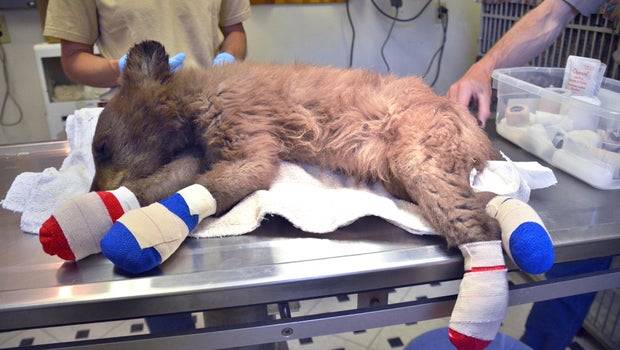
In this photo provided by Colorado Parks and Wildlife, a female bear cub lies on a table with bandages on its burned paws in Del Norte, Colo., June 27, 2018.

JOE LEWANDOWSKI/COLORADO PARKS AND WILDLIFE VIA AP

DURANGO, Colo. — An orphaned bear cub that suffered painful burns to its paws in one of a half-dozen wildfires scorching Colorado is being nursed back to health, state officials said Friday. Colorado Parks and Wildlife officers believe the bear will recover well enough to be released this winter.

“When the bear was brought in, I wasn’t sure if it was going to make it,” Michael Sirochman said, a Parks and Wildlife veterinary technician. “But she’s responding very well to treatment, and by winter we believe we’ll be able to return her to the wild.”

It was an encouraging bit of news amid an extreme drought and an outbreak of disruptive wildfires in…

View original post 375 more words

Hunter dies after falling 18 feet from tree stand in Cayuga County

Exposing the Big Game's avatarCommittee to Abolish Sport Hunting Blog

http://cnycentral.com/news/local/hunter-dies-after-falling-18-feet-from-tree-stand-in-cayuga-county

Cayuga County

AA

A Cayuga County deer hunter died over the weekend after he fell 18 feet from a tree stand, according to the Cayuga County Sheriff’s Office.

Gale Lytle, 54, of Port Byron, fell from the stand while he was in a wooded area off Center Road in the Town of Scipio.

He fell before he reached the top of the stand, which malfunctioned, causing him to fall to the ground.

Lytle was by myself in the immediate location but two others were hunting with nearby, authorities said. At the time, they weren’t within eye-shot or earshot, however.

According to the Sheriff’s Office, authorities are awaiting results of an autopsy by the Onondaga County Medical Examiner’s Office.

View original post

Female giraffe hunter scorned for posing with dead “dream kill”

Exposing the Big Game's avatarCommittee to Abolish Sport Hunting Blog

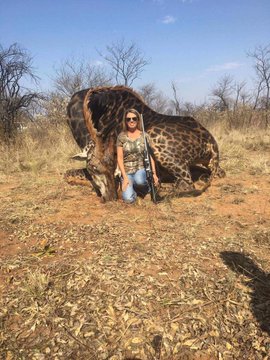
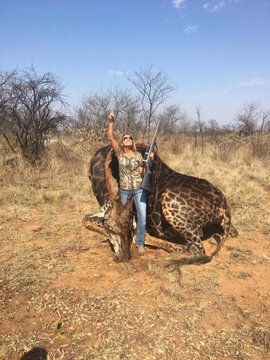
Photos of a female giraffe hunter posing for photos with her kill have made people angry. (Photo: Twitter/@africlandpost)
More

Photos of a female hunter showing off her “dream kill” — a black giraffe — has stirred emotions among the animal rights and hunting communities.

The images of Tess Thompson Talley of Texas standing proudly next to a dead giraffe bull in Africa have surfaced from a 2017 hunting trip, after the publication, Africland Post tweeted them. “White American savage who is partly a neanderthal comes to Africa and shoot down a very rare black giraffe courtesy of South Africa stupidity,” read the June 16th tweet.  “Her name is Tess Thompson Talley. Please share.”

View image on TwitterView image on Twitter
AfricaDigest@africlandpost

White american savage who is partly a neanderthal comes to Africa and shoot down a very rare black giraffe coutrsey of South Africa stupidity. Her name is…

View original post 679 more words