
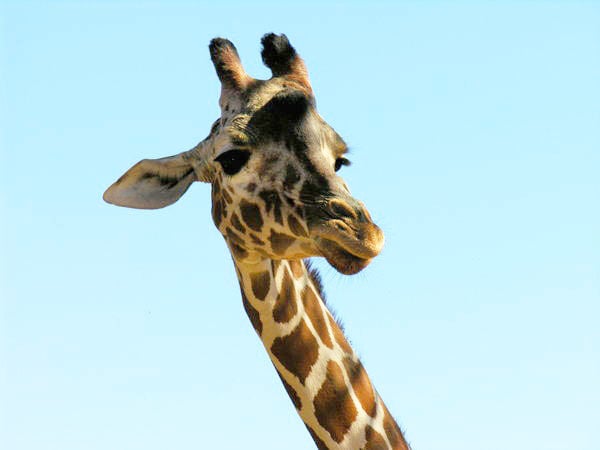
Giraffe
The column this week will be a little different – an invitation for readers, especially the hunters and fishers out there, to share your thoughts on a question I have been thinking about since college. It’s a topic that keeps popping up in the media again and again, most noticeably with Cecil the Lion but repeatedly since then as well. So here it is, the question in two parts:
1. Can hunting (or fishing) play a part in wildlife conservation?
2. And should it?
The reason I started thinking about this again was because this past weekend, I read a news article about an American woman, Tess Talley, who traveled to Africa to shoot a giraffe in a trophy hunt. The photo of this woman, standing next to this downed mountain of an animal with her rifle in hand, went viral and received immense amounts of backlash. Initially, some of the uproar was because the giraffe in question had a darker hide than normal and was being called a rare black giraffe. I didn’t research it too heavily, but it seems like the hunted animal’s coat color was largely because of age (with older individuals becoming darker). But that, I think, is beside the point. Once the photo went viral, the hunter would’ve received backlash regardless of the animal’s coat color. It was enough that it was a giraffe, and she killed it.
A few facts: While it’s not legal to hunt giraffes everywhere, this particular hunt was perfectly legal.
Talley and the hunting company she worked with in Africa both say the trophy fee (about $2,000-$3,000) stayed in the local community.
The overall giraffe population in Africa has declined as much as 40 percent since the ’80s and is predicted to keep declining in the future.
In college, I took a course called Ethics of Conservation, which was easily one of my favorite courses. It covered everything from how we think of wildlife and natural areas, to bioprospecting to ecotourism. And, yes, there was a big section on trophy hunting in the middle, too. As with all other topics, my professor was very good at selecting readings and examples that highlighted both sides – those in favor of hunting for conservation and those against. As a result, I have a well-rounded view (I think). I see both arguments.
Responsible hunters are very careful to follow bag limits, quotas and other restrictions that limit them to manageable take. Tess Talley was, all evidence suggests, very careful to select a company in an area of Africa where it was legal to shoot giraffes. She even took an individual that was not, or so she claims, contributing to the breeding population (although I don’t know if there’s solid proof of that). If done correctly, a large part of the trophy money does stay in local communities and provides jobs and a source of income for residents, either as part of the hunting company or working in the mini-lodges and tourist shops that support guest hunters. Theoretically, in an ideal world, this would mean that locals would be less likely to feel inclined to develop wildlife areas or poach game unsustainably. Why go out and shoot all the giraffes yourself for your own subsistence when you can make more money and secure a better livelihood, hosting hunters who shoot maybe one or two at a time? Whether or not the money does contribute to local communities is another question, cases of corruption being common, but that’s the best-case scenario.
Hunters also say they enjoy spending time in nature, they respect the animals they take, and they have a personal and deep connection with the wild areas that still exist. They also often involve their children in the activity – embedding a love for the outdoors in them at a young age. I have a friend who entered the world of conservation biology only because of his childhood hunting experiences, or so he says.
On the other hand, to the nonhunter, it all seems a little contradictory. If you love something, say giraffes, why do you then kill it? Why not just donate the $2,000 dollars directly to one of the many organizations that work to preserve giraffes or giraffe habitat? This question cuts a little more sharply when it’s a known fact that giraffes are indeed declining across the African continent. They aren’t our mallards or wood ducks: they are big, charismatic mammals that are dropping in number and will continue to drop in number in the future. For a lot of the angry people commenting on the photos of the dead giraffe, it is impossible to make the connection between wildlife conservation and the dead animal center frame. They read Tess Talley’s comments about how magnificent a creature the giraffe is and don’t believe her. Again, how can you call something magnificent and mean it, and then put a bullet through it? How can you claim to want to save or conserve something, and then reduce it to meat?
I’m not a hunter myself, and I don’t come from a hunting family. I caught a sunfish once when I was a kid and that’s about the extent of my fishing. We even put it back. But like I said, I can see both sides of the conservation/hunting debate and have no problems with hunting myself. More than that, I am very interested in the questions that situations like this bring up.
If you have an opinion, a perspective, an insight into the world of hunting and conservation, I’d love to hear it. Shoot me a line at eshelly@gcbo.org with your thoughts.
Emma Shelly is the Education and Outreach Manager of the Gulf Coast Bird Observatory. The GCBO is a nonprofit organization dedicated to saving the birds and their habitats along the entire Gulf Coast and beyond into their Central and South America wintering grounds.
 Exposing the Big Game
Reblogged this on Exposing the Big Game.
“Hunters also say they enjoy spending time in nature, they respect the animals they take, and they have a personal and deep connection with the wild areas that still exist.”
So do I, as a non-hunter, and I do not feel the need to kill in order to appreciate it! Hunting may have had a practical reason once, necessity, for food and/or protection – but none of those things apply today. To have it done for sport and enjoyment, or family bonding, or self-actualization, is just appalling.
I really cannot believe people insist on debating this point, dragging it out because they do not like the same negative response, and I won’t waste a minute more of my time on it.
Sure, hunting will preserve animals and wild lands if the only value they have is a trophy on a wall. We need to move on from this way of thinking, and preserve wildlife and wild lands for their right to be here and their value on the landscape, not a human-centric view of their existence.
There was a study done in 2014 (four years ago!) that showed the world’s wildlife has declined by 58% since 1970. I don’t know if there is a more current study. Does that sound like conservation by hunting is working, to anyone?
https://www.bbc.com/news/science-environment-37775622
I’m not convinced hunting leads to conservation, although it makes a convenient justification. If conservation of a species were so important, why does it make sense for hunters to kill the most magnificent member of a species they can find.
The hunts may be legal. I believe they are immoral. Animals should not lose their lives to give people a thrill.
Hunters say they love nature and the animals they hunt. I loved my cats and dogs too. That’s why I didn’t kill them.
If hunters are feeling philanthropic and charitable, they could donate all the fees and expenses involved to the villagers. Then they wouldn’t have to endure all the hard work of the traveling, tracking, and shooting.
They could also contribute to the local economy by paying for accommodations, meals, souvenirs, and guides to take photos instead of trophies.
Obviously, I hate hunting. And I’m suspicious of the long, involved explanations of why it is a such a good thing. Methinks they both protest too much.
If I am so blessed to make it to visit Africa one day, I won’t spend my vacation money in an economy that caters to trophy hunters, destroying their own magnificent gift of diverse wildlife on the planet for money. I don’t care why they need the money. It’s Kenya and countries like it for me!
I
Same here.
Always have thought that if these goons actually cared about nature, they’d cut out the middle man (firearms, ammunition, guides ect.) and just donate to conservation and philanthorpic efforts that don’t take from what they are trying to bolster, preserve and protect.
The number one thing taking away the numbers of not only giraffes, but elephants and lions are poachers…they first need to be eliminated and stopped…2nd…trophy hunting, no matter how you look at it, you are killing the animal..that can’t be debated…you are ending a life…True conservation is what steve irwin did…you save the animals, not murder them…you stop the murder of them, by everyone…trophy hunters and poachers..they all need to be stopped, any means necessary.