RUSSELL — A 14-year-old boy sustained gunshot injuries while duck hunting near Russell over the weekend, the Lyon County Sheriff’s Office reported.
While the Sheriff’s Office did not release information on the boy’s identity or condition, Sheriff Mark Mather said the incident was determined a hunting accident. The Sheriff’s Office received a call at 6:46 a.m. Sunday for a juvenile hunter who was shot by another juvenile hunter, about a mile north of Rock Lake near Russell. The boy was shot in the stomach and hand, the Sheriff’s Office said.
Mather said the victim was in stable condition when officers arrived at the scene. He was flown to Sioux Falls for medical treatment, the Sheriff’s Office reported.
Responders at the scene of the accident included the Balaton Ambulance, Russell First Responders and the Minnesota Department of Natural Resources.
A Northern Maine duck hunter stood in waist-deep water on the hull of his submerged boat for 12 hours before game wardens came to his rescue early Wednesday morning, authorities said.
On Tuesday night, Silver Ridge resident Bruce Thibodeau still hadn’t returned home from a duck hunting trip in Northern Penobscot County, so his wife, Joan, reported him missing, according to Cpl. John MacDonald of the Maine Warden Service.
Knowing that Thibodeau had gone hunting in the area between Herseytown and the unorganized territory of T7-R7 WELS, wardens eventually found the man’s empty car parked at the Sawtelle Deadwater.
Soon after, the searchers made voice contact with Thibodeau, and using a small boat, traveled about a mile up the deadwater to find the man standing on top of his flipped boat, waist-deep in water, MacDonald said.
How an animal welfare charity ended up endorsing seal killing – and what this says about our age
By George Monbiot, published in the Guardian 19th Septmber 2018
As the drive for growth and profit intrudes into all relationships, it captures even the bodies that exist to hold capital to account. Agencies of the state, newspapers and broadcasters, campaign groups and charities that claim to restrain corporate power fall under its spell. As their mission becomes confused and their purpose dissipates, substance is replaced with spectacle.
Fifty years ago, in his book The Society of the Spectacle, the French philosopher Guy Debord argued that “the spectacle” (the domination of social relationships by images) is used to justify the “dictatorship of modern economic production”. It both disguises and supplants the realities of capitalism, changing our perceptions until we become “consumers of illusion”. Here is an example of how it happens.
On Tuesday last week, the Royal Society for the Prevention of Cruelty to Animals (RSPCA) issued a press release about the “incredible story” of Marina, a seal it rescued, that had become trapped under a rock on a beach in South Wales. “Moving a three-tonne boulder presents numerous challenges, but we were able to work with partners to free this seal, before giving her the six months of rehabilitation she so urgently needed.” Marina’s rescue is “testimony to the RSPCA’s tireless commitment to wild animals, and their welfare.”
On the same day, the RSPCA’s head of campaigns, pushed into a corner during an online argument, wrote this: “Seal shooting is not culling it’s about humane pest control.” He was defending the slaughter of seals by Scottish salmon farms.
The contradiction is at first sight incomprehensible. But alongside its spectacular rescues of animals like Marina, the organisation has another role, which is to assess livestock farms, and award those that meet its standards its RSPCA Assured label. This seal of approval ensures that“you can feel good about your choice when shopping and eating out”. Of the 280 million animals whose production and slaughter it approves every year, salmon account for 200 million. The RSPCA accredits 63% of Scottish salmon farms.
It won’t publish a list of the farms it has approved, citing a “contractual clause in the membership agreement”. But of the 24 people who sit on the advisory group for its assurance scheme (according to the most recent published list), 20 work for salmon farming companies. These companies include the four named in an investigation into seal shooting in 2013, by the Global Alliance Against Industrial Aquaculture, as “the worst offenders”.
There is no closed season for shooting seals. When lactating mothers are shot, their orphaned pups starve to death on remote beaches. The RSPCA does not deny that farms it certifies shoot seals. It tells me it is urgently trying to bring the practice to an end. I might have found this more convincing if it hadn’t said the same thing in 2008. It also maintains that shooting seals is “a last resort”. But the majority of Scottish salmon farms fail to double-net their cages to exclude seals. This is more expensive than bullets, but you might have hoped it would be the minimum requirement for an RSPCA Assured farm.
The RSPCA tells me that “double netting is not suitable for all sites”, but is unable to tell me what proportion of the farms it certifies could use double netting. Where this method cannot be used, you might have hoped the society would say “that seals it: we will not certify salmon farming here.”
It insists that farms that want its accreditation that are at high risk of predation by seals must have “acoustic deterrent devices in place where appropriate”. These make a loud noise intended to scare seals away. Unfortunately, they also cause pain and distress to dolphins, porpoises and whales, disrupting their behaviour and driving them out of their feeding grounds. These are by no means the only problems caused by salmon farms.
Recent footage filmed inside a Scottish salmon cage shows fish being eaten alive. Much of their skin, flesh and fins has been consumed by sea lice, which have reached epidemic proportions on many farms. Sea lice are not only ripping through the caged population, where the mortality of salmon has risen from 7 to 14% in four years, but spill out to hammer the wild salmon and sea trout trying to migrate through the lochs, pushing their populations closer to extinction. Yet the RSPCA standards for sea louse numbers in the farms it certifies are no higher than the legal minimum, which fisheries scientists say is far too low.
In the hope of controlling this infestation, salmon farms dose their fish with organophosphate pesticides. These are likely to devastate crustacean populations in the sea lochs, and many other species that depend on them. Some of the companies providing the fish meal on which farmed salmon are fed trawl and grind up entire marine ecosystems, arguably causing greater environmental damage than any other fishing operation.
The harder you look at this industry, the more obvious it becomes that it is inherently incompatible with either animal welfare or environmental protection. Yet the Scottish government, which sees salmon farming as a crucial growth industry, wants it to double by 2030. It seems to me that the RSPCA’s assurance provides the necessary figleaf.
The RSPCA insists that it is not motivated by the fees it receives for certifying salmon farms. These, it says, “are ploughed back into the scheme’s running costs.” I’m sure this is true. The problem, I feel, runs much deeper: to my eyes, its mission seems to have slipped from preventing cruelty to modifying industrial animal farming. If its objective is to prevent cruelty, surely it should instead endorse the rapid shift towards veganism?
Marina is the spectacle: the actor in the spotlight, who helps to seal the RSPCA’s public image. The unapproved seals of Scotland and their orphaned pups, in the darkness behind the stage, are reduced to the status of pests. Debord defined the spectacle as “a negation of life that has invented a visual form for itself.” He was right.
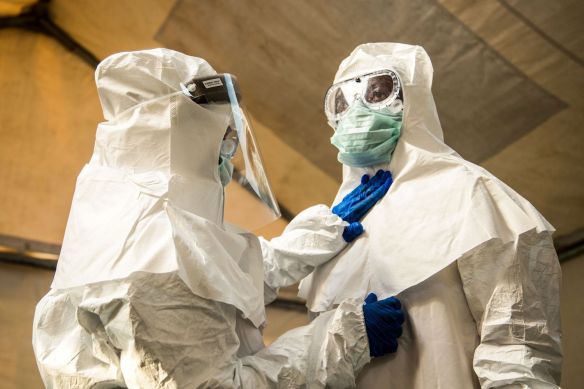
Medical staff check each other’s protective suits before entering the isolation unit at a hospital in Bundibugyo, western Uganda, during a suspected case of Ebola. Aug. 17. (Sumy Sadurni /AFP/Getty Images)
There are plenty of security threats that could keep a former homeland security advisor awake. There is the possibility of a terrorist attack, a cyber-cataclysm, or any number of natural disasters—all threats that are capable of visiting destruction on entire communities in a matter of hours. Right at the top of that list is the threat of a deadly pandemic—an outbreak of infectious disease that rapidly crosses international borders.
In January 2017, while one of us was serving as a homeland security advisor to outgoing President…
Wildlife watchers hoping to catch a glimpse of a grizzly sow and her cub line the roadside Friday between Sedge Bay and Lake Butte Overlook in Yellowstone National Park.
RUFFIN PREVOST/YellowstoneGate.com
Yellowstone National Park rangers are seeking information after a Saturday report that a man had fired a shotgun at wolves that were chasing his dog east of Sedge Bay, along the East Entrance road.
Rangers who responded to the scene found no evidence of injured wolves but they did find shotgun shells, according to a park press release.
Anyone with information about the incident is asked to contact the Yellowstone Tip Line at 307-344-2132.
Park Service officials took the opportunity to remind the public that although possession of a firearm in a national park is legal, firing a gun or hunting in Yellowstone National Park is not allowed.
Also, tourists with pets must keep their animals leashed…
The grizzlies were storing up reserves for winter at the Blackleaf Wildlife Management area. (Missoula Current file photo)
An archery hunter killed a sow grizzly and wounded her sub-adult cub this week on the Rocky Mountain Front.
Montana Fish, Wildlife & Parks biologists later found the cub, which was euthanized because of the severity of its injuries.
Here’s how Montana FWP described the incident in a written account on Thursday:
The hunter was in thick brush along a creek bottom in the Blackleaf Wildlife Management Area.
He encountered the sow, and shot and killed the bruin with a pistol. He also shot and wounded a 2-year-old cub. A second cub was in the area but was not shot.
The circumstances surrounding the shootings are under investigation by Montana FWP and the U.S. Fish and Wildlife Service.
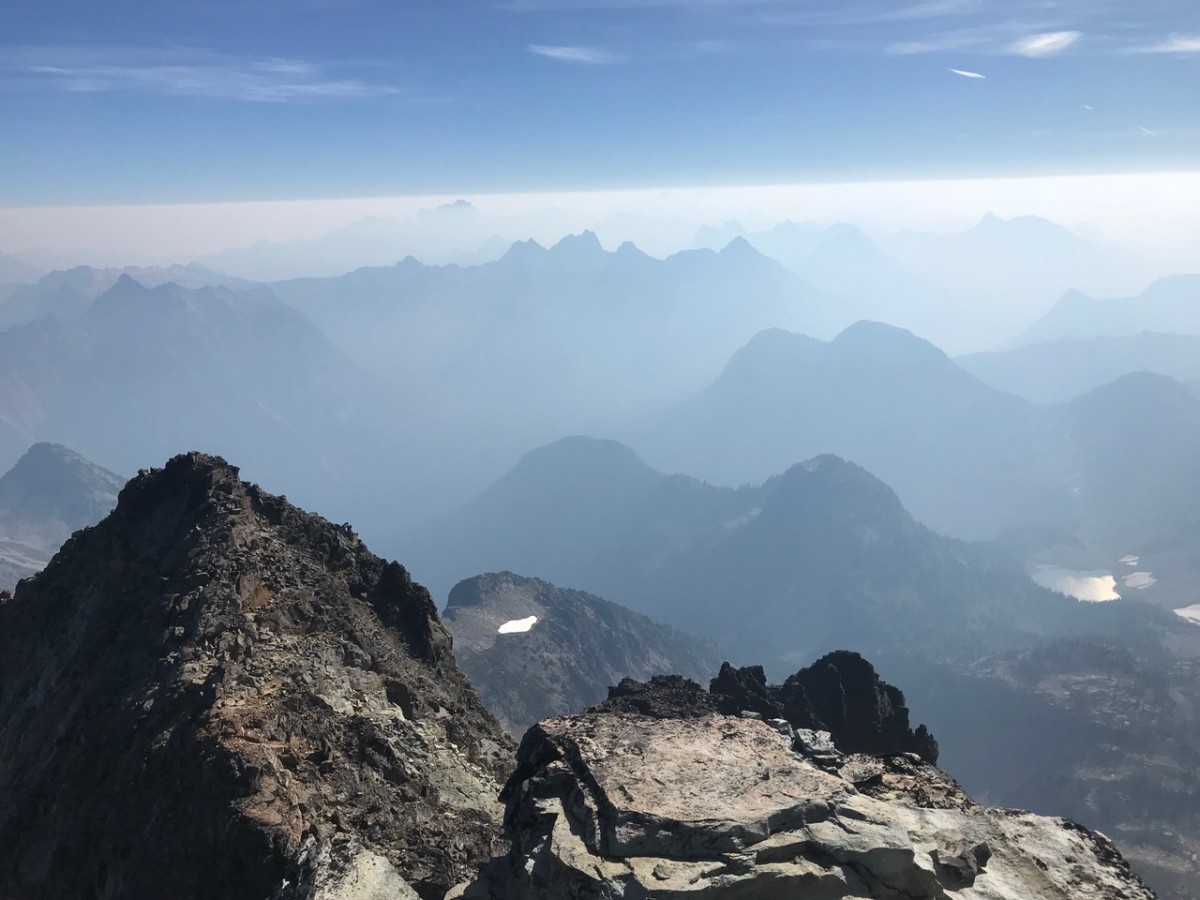
Smoke from wildfires in British Columbia, Eastern Washington and Montana enshrouds the Cascade Mountains of Washington State. In the Pacific Northwest, experiencing weeks on end of wildfire smoke during the summer months has become the “new normal.”DAHR JAMAIL
Over the years, writing these climate disruption dispatches has often weighed heavily on my soul. I’ve struggled to find a delicate balance between tracking this information, which these days means reporting on the demise of the biosphere, and living a meaningful life.
Recently, I again failed to achieve that balance, and needed to take a short respite from work to find my inner footing. I headed into my sanctuary, the mountains, for solace. I backpacked up into the northeastern Cascade Mountains of Washington State, where I live, and pitched a camp on the banks of a clear, turquoise alpine lake at 6,900 feet. I was surrounded by snowfields, high peaks, and mountain larch that will soon be turning from green to yellow as autumn rapidly approaches.
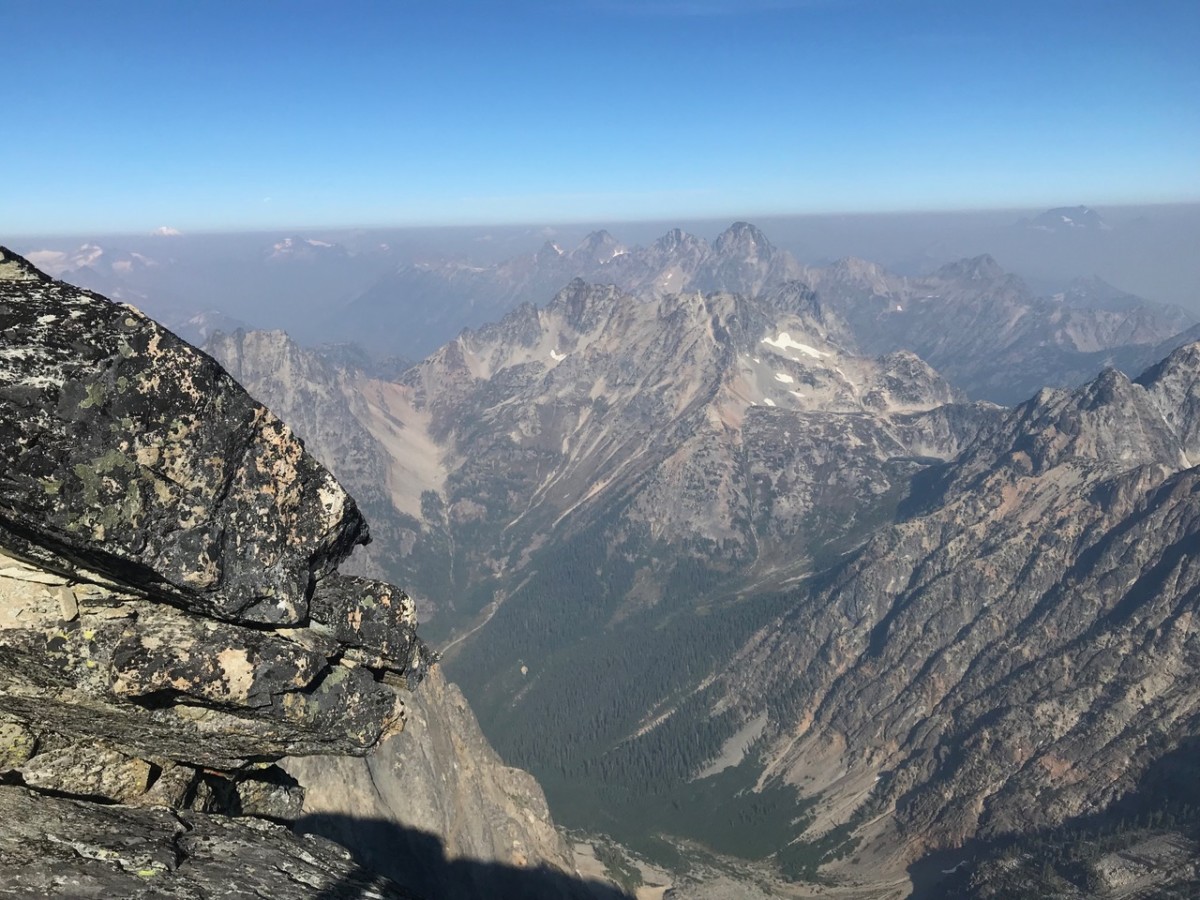
Despite smoke in the air from wildfires in Canada, eastern Washington, and beyond, conditions were beautiful. The next day I scrambled to the top of nearby Black Peak, but did so as the smoke became increasingly thick. My lungs felt scratchy, my eyes burned, and I could tell it was affecting my thinking. Atop the peak at 8,975 feet found me at roughly the elevation of the smoke line. Above were crystal clear blue skies; below, everything was shrouded in a brownish-grey sooty haze.
Wildfire smoke covering the Cascade Mountains from 9,000 feet and below. As anthropogenic climate disruption progresses, science shows wildfires becoming larger, burning hotter and occurring far more frequently.DAHR JAMAIL
After taking lunch on the summit and reveling in the majestic yet smoky views, I headed back down to camp, where the smoke was rolling in by way of thick clouds. I decided to break camp a day early and hike down to the trailhead to head to my home near the west coast, hoping the smoke might not be as thick closer to the Pacific.
Don’t miss a beat
Get the latest news and thought-provoking analysis from Truthout.
Two hours of driving later, the haze wasn’t as thick, but remained present. Not until I boarded the ferry and crossed the Strait of Juan de Fuca across Puget Sound did I finally emerge from the suffocating wildfire smoke.
The feeling of entrapment within the smoke, the coughing and wheezing while trying to breathe, the primal urge to escape it, all underscored to me how dire our situation is globally. Arriving back home, out of the smoke, I thought of future summers. Even up here in the verdant Pacific Northwest, wildfire smoke will be the norm. Yet, compared to those who’ve already lost their homes to the fires, or those who’ve had everything they own submerged by storm surges from hurricanes, or refugees fleeing war-torn countries destabilized by drought and climate disruption impacts, smoke inhalation is a minor problem. Such is the climate-triage of our new world.
Moreover, the impacts of runaway anthropogenic climate disruption (ACD) will assuredly continue to worsen.
In one of the more important recent scientific studies, published in the journal Science, researchers warn that ACD could cause many of the planet’s ecosystems to become unrecognizable.
“Our results indicate that terrestrial ecosystems are highly sensitive to temperature change and suggest that, without major reductions in greenhouse gas emissions to the atmosphere, terrestrial ecosystems worldwide are at risk of major transformation, with accompanying disruption of ecosystem services and impacts on biodiversity,” reads the abstract of the study.
Stephen Jackson, the lead author of the study, told The Washington Post, “Even as someone who has spent more than 40 years thinking about vegetation change looking into the past … it is really hard for me to wrap my mind around the magnitude of change we’re talking about.”
This summer’s extraordinary heat wave across the Northern Hemisphere was and is in no way an anomaly. Another recent study warned that there will be at least four more years of extreme temperatures. This means temperatures are expected to be warmer than expected, even above and beyond the abnormal warming being generated by ACD.
Given the fact that there are already places in the Arctic where the ground no longer freezes, even during the winter, this does not bode well.
Another recent report, What Lies Beneath: The Understatement of Existential Climate Risk by Australian researchers with the independent think tank National Centre for Climate Restoration, is blunt about the fact that we are rapidly leaving the safe zone for human habitability on the planet. They note that ACD poses an “existential risk to human civilization,” with dire consequences unless dramatic actions are taken toward mitigation. The paper also points out how climate research, including the work of the Intergovernmental Panel on Climate Change (IPCC), has consistently underplayed these risks and leaned towards conservative projections. The paper even goes on to call the IPCC “dangerously misleading” regarding its low-ball predictions of accelerating ACD.
“Climate change is now reaching the end-game,” the foreword to the report reads, “where very soon humanity must choose between taking unprecedented action, or accepting that it has been left too late and bear the consequences.”
One only need look at this past summer to see that we have, indeed, reached the end-game.
Earth
You know the Earth’s climate is warming extremely dramatically when a tree that used to grow in a warmer Alaska several million years ago is once again growing there. The tree requires warmer temperatures to grow, which are now once again occurring in Alaska.
Warming is now putting our food supply in grave danger. Globally, we are already seeing a weaker wheat crop this year due to record-breaking high temperatures around the world. It’s been well known for quite some time that higher carbon dioxide (CO2) levels in the atmosphere cause crops to be less nutritious, but researchers recently warned that the scope of the problem means hundreds of millions more people than previously thought will now be nutrient deficient as temperatures continue to climb. The research showed that 1.4 billion women of childbearing age, along with children less than five years old, will be living in regions with the highest risk of iron deficiency.
Making matters worse, another recent study warned that global crop losses due to increasing pests will soar as temperatures continue to climb. The study projects that increasing heat causes the number of insects — and the amount they eat — to grow, so that nearly 50 percent more wheat will be destroyed from just a 2°C increase in temperatures, along with 30 percent more maize and 20 percent more rice.
Another recent report revealed how in the Mojave Desert region in California and Nevada, there has been a precipitous (42 percent) decline in bird species in the past century alone, likely due to the impacts of ACD.
The heat in Europe this summer was intense enough that 22 people died from the West Nile virus there, as experts warned of more mosquito and tick-borne disease outbreaks as temperatures there continue to increase.
Another report warned of how high temperatures and increasing air pollution may well increase the risk of mental illnesses and suicide. Having recently spent days living amidst the thick smoke of wildfires, I can understand this warning, given the way in which experiences of this nature affect the psyche.
Water
Climate impacts across the Arctic continue to sound alarm bells with scientists.
At the time of this writing, at least 36 people have died from the impacts (mostly flooding) from Hurricane Florence that struck the US east coast.Days after it made landfall, rainfall persisted — 40 inches of rain in North Carolina alone — and rivers continued to swell, as thousands of homes and businesses were affected by record flooding that besieged several states. As the atmosphere warms, hurricanes now generate increasingly severe rain events, along with packing stronger winds from the increased energy produced by the warmer air and warmer waters over which they travel.
The oldest, thickest and strongest sea ice in the Arctic, which has never opened up in recorded history, has melted open twice this year … an occurrence that scientists have described as “scary.” Sea ice in that region is shrinking so much now that over the summer, for the first time, a container ship took the Arctic sea route.
Researchers recently announced that a pocket of warm ocean water under the surface of the Canada Basin could melt a large portion of the region’s sea ice, warning that the situation is a “ticking time bomb.”
Back on land, mountaineers in Europe are bemoaning the fact that ACD is literally melting the French Alps, causing rocks to become unstable and more prone to collapse as permafrost and ice melt.
Meanwhile, the oceans continue to warm unabated. In August off the coast of San Diego, scientists recorded an all-time high temperature of seawater, causing scientists to warn that much sea life is now “in peril.” The number of marine heatwaves doubled between 1982 and 2016.
Scientists have also warned of “unprecedented” changes to Japan’s marine life as atmospheric CO2 and acidification both continue to increase.
As land-ice melts and oceans warm, sea levels continue to rise unabated as well.
Jakarta, a mega city of more than 10 million, has now become known as the fastest-sinking city in the world. Large parts of the capital of Indonesia will be completely submerged by just 2050, and parts of it are already disappearing underwater. As Jakarta and other major coastal cities begin to be swallowed by the seas, we must ask: Where will these millions of people go?
Things aren’t much better in Europe, where a recent analysis showed that the cost of coastal flooding there could reach $1 trillion annually by 2100 if current trends continue. At the moment, there is no reason to think they will not.
Bangkok, another city of at least 10 million, is struggling to stay above water as some forecasts warn that large portions of it could be submerged in just over 10 years.
In India, while the monsoon is a regular event and always brings flooding, it is clearly amped up due to ACD impacts. Flash flooding in the southern Indian state of Kerala resulted in the death of at least 324 people, which officials there declared to be the worst in at least the last century.
In the US, historic flooding hit the northeast that same month, causing New Jersey to declare a partial state of emergency and evacuations occurred.
A recent study warned that the US West could experience three times as much destructive flooding if ACD is left unchecked, with communities in the Rocky Mountain and Sierra Nevada ranges at particular risk from rapidly flooding rivers and “rain-on-snow” flash floods that are predicted to become more frequent.
Meanwhile, droughts continue around the world.
A drought in Switzerland was bad enough this summer that the Swiss army had to airlift water to thirsty cows in pastures that were plagued with drought amidst the intense heat wave that swept that continent this summer.
You don’t need to read this dispatch to know this summer has been exceptional for wildfires.
At one point, Canada’s British Columbia had 566 wildfires burning across it, causing the province to declare a state of emergency that prompted thousands of people to evacuate. That declaration was then extended as the fires continued, with 2018 becoming the worst fire season on record(breaking the previous record, set just last year) for British Columbia. The warmer the atmosphere becomes, the longer, hotter and drier wildfire season becomes in British Columbia, as well as around the rest of the world.
Smoke from those fires, along with hundreds of others across the US West was visible from, literally, a million miles away in space.
In California something occurred never before seen in the history of wildfires in that state: A literal tornado of fire the size of three football fields emerged, as vast areas of that state burned in what has become a normal situation there during the summers, thanks largely to ACD.
Things were bad enough in Washington State that at one point western Washington saw its worst air quality on record. Because of the wildfires, in late August, Spokane had worse air quality than Beijing and Delhi combined.
Air
It is only a matter of time before several cities begin to see 50°C (122°F) temperatures — which is halfway to boiling — on a regular basis. This spring, Nawabshah, Pakistan, and two years before that Phalodi, India, both experienced 50°C. Bear in mind that even 35°C (95°F) temperatures, along with humidity, can be fatal to humans after just a few hours. A recent report warns that temperatures of at least 35°C will likely become common across India, Pakistan, southeast Asia and China sooner rather than later, with half the world’s population exposed to potentially deadly heat for 20 days a year by 2100.
Simultaneously, increasingly warm temperatures around the globe have sparked yet another feedback loop: Warmer temperatures are causing soil to release more CO2 into the atmosphere, which then causes temperatures to increase further.
Lastly in this section, to give you an idea of the intensity of this summer’s heat wave, Korea’s Ministry of Agriculture, Food and Rural Affairs reported recently that 4.53 million cows, ducks, pigs, chickens and other farm animals died from the heat wave that swept that country. This was a 56.5 percent increase over the number of animals killed by the heat last year during the same time period.
Denial and Reality
The usual ACD denial from the Trump administration continues, despite the planet spiraling deeper into abrupt ACD impacts daily.
During a visit to the apocalyptic Redding fire zone in California, Trump administration officials Agriculture Secretary Sonny Perdue and Interior Secretary Ryan Zinke refused to talk about ACD when it came to how to address the worsening wildfires.
The Trump administration also proposed a new rule that relaxes carbon limits on power plants, which allows the plants to run longer. The EPA’s own analysis has shown that this step could lead to 1,400 more premature deaths by 2030 due to the pollution. Explicit warnings about ACD impactswere also cut from the Trump administration plan to weaken curbs on power plant emissions.
Meanwhile, big oil has asked the federal government to protect its infrastructure from the impacts of ACD, as Texas aims to acquire billions of dollars of federal funding to build up its coast in an effort to protect its oil infrastructure from hurricanes, flooding and sea level rise.
On the reality front, the State of California recently passed legislation, including steps to take to make it happen, geared toward the cessation of using fossil fuels to generate electricity by the year 2045.
Yale’s climate change communication program released an up-to-date visualization showing that the vast majority of Americans believe ACD is real, as well as a graphic that enables one to focus in on the parts of the country where willful ignorance is the most rampant.
Things are already dire enough that several countries in the Caribbean recently pleaded with the Trump administration to grasp the dire threats that accompany ACD and do something about it. So far, of course, their pleas have not been answered with action.
A fascinating graphic was also published by The Revelator, which provides an interactive map you can use to zoom in on where you live to see how much your temperatures will increase by the year 2050. I strongly recommend looking at the map, paying particular attention to the US Midwest, given the realities of crop loss and decreasing nutrition in crops.
To conclude this month’s dispatch, a UN official recently announced that governments are “not on track” to cap global temperatures to below 2°C, the goal of the 2015 Paris climate talks. Many scientists have long warned that a 1°C warming was already enough to lock in catastrophic ACD impacts. We are already over 1°C. The ongoing failure of the world’s governments to face these facts guarantees a lasting and devastating impact for all species on Earth, including humans.
Scott Blake-Cummings, left, and his father, Jeffrey Cummings. Jeffrey Cummings was killed in a hunting accident in 2016. (Scott Blake-Cummings/Submitted photo) 7847013
A Tillamook man will serve a year in prison for accidentally killing his best friend on a bowhunting trip near La Pine, ending a case that divided the victim’s family on whether the man responsible should go to prison.
Michael “Shawn” Pekarek, 55, appeared Monday in Deschutes County Circuit Court, where he pleaded guilty to criminally negligent homicide for releasing an arrow that struck and killed his hunting partner and longtime friend Jeffrey Lynn Cummings.
The Deschutes County District Attorney’s Office in September 2016 charged Pekarek with first-degree manslaughter — a Measure 11 offense with a steep automatic prison term — along with the lesser charge of criminally negligent homicide.
For more than a century, hunters have played an important part in conserving wildlife in the United States and Canada. Government-based conservation in particular relies on revenues from hunting — but the number of hunters is fast declining. So where will funding come from? Will people who love wildlife, but don’t hunt, foot the bill?
“As sociodemographic trends continue to reshape the conservation landscape,” write researchers in the journal Human Dimensions of Wildlife, people have “questioned whether the current financial trajectory of wildlife conservation is sustainable and, perhaps more importantly, who is going to pay for it.”
Led by Nathan Shipley, an environmental scientist at the University of Illinois Urbana-Champaign, the researchers examine these questions through the lens of the U.S. Fish & Wildlife Service’s…
ALLAMUCHY — A 47-year-old hunter fell approximately six feet into an open sewer drain Friday night after allegedly shooting a deer with a bow and arrow in violation of the state’s 150-foot safety zone for bowhunting in residential areas.
The man, who sustained a head injury in the accident, later was flown to Morristown Medical Center.
Authorities were alerted to the accident, which occurred in a wooded area near the intersection of Old Allamuchy Road and County Road 517, shortly after 8 p.m. Friday.
Members of the Hackettstown Police Department, Hackettstown Rescue Squad and Hackettstown Fire Department arrived on the scene minutes later, as did paramedics from Saint Clare’s Health, where they observed the man in the sewer drain.
Firefighters and rescue squad volunteers rescued the man shortly afterward and transferred him to an Atlantic Ambulance helicopter.
Through a preliminary investigation, police determined that the man fell into the sewer drain while he and another person were attempting to retrieve the deer’s carcass. Although the man has not yet been charged, police indicated that it was determined through further investigation that he was hunting in illegal proximity to a nearby apartment building.
State law requires those engaged in bowhunting on lands to be at least 150 feet from a residential dwelling, and at least 450 feet from a school playground.
Those hunting with firearms must also do so from a minimum of 450 feet away from a residential building or school playground.
The matter remains under ongoing investigation by police, who are being assisted by the state Division of Fish and Wildlife.





 Exposing the Big Game