ASHEVILLE, N.C. —A couple is grieving the loss of their pet cat who suffered a terrible death after being shot with an arrow, and a rescue group has offered a reward for information leading to the arrest in the case.
The couple found their cat, Little Cutie, lying on the grass in a spot of sun Nov. 21, when they realized she had been shot with a hunting arrow.
A release from Brother Wolf Animal Rescue said: “The arrow, which had entered through her rear leg, pierced her upper body as she scrambled to get away and disemboweled her. Despite managing to crawl back to her home, desperate for help, her injuries were too devastating for her…
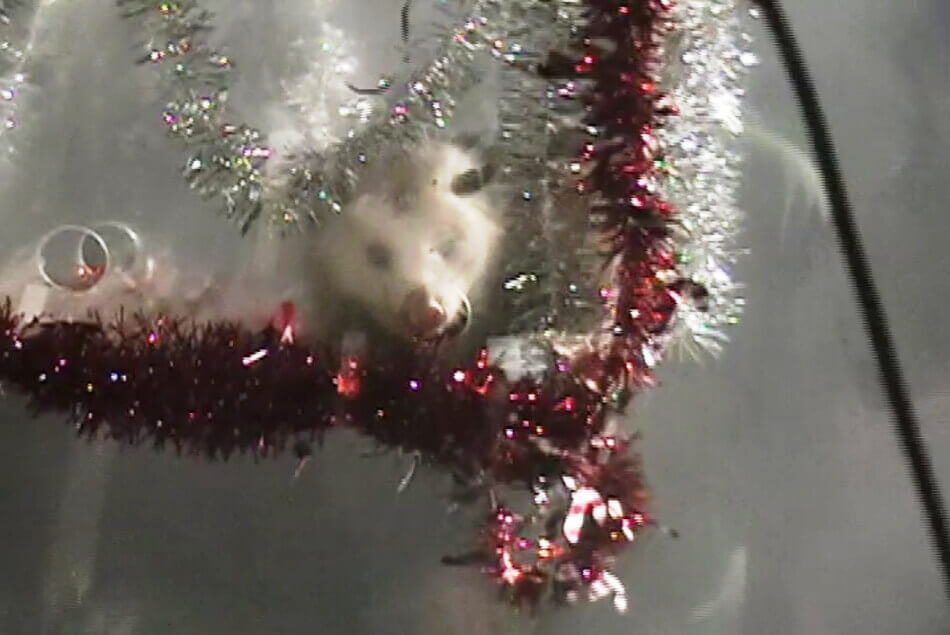
Andrews, North Carolina, apparently intends to “celebrate” New Year’s Eve by hosting a sadistic so-called “opossum drop,” during which a wild-caught opossum would be imprisoned inside a Plexiglas box for hours above a rowdy crowd. At midnight—after being forced to endure a near-constant barrage of live music, a noisy marching band leading the animal in, and fireworks displays replete with the usual explosions and smoke—the terrified opossum would be slowly lowered to signify the dawning of the new year. Because this sensitive and elusive prey species naturally avoids human contact at all costs, subjecting one of them to hordes of partiers, chaos, and blaring noise is inhumane and would very likely result in potentially fatal stress-induced conditions. PETA scheduled a meeting with Mayor James Reid in order to describe our concerns and to encourage city officials to “drop” any one of countless nonliving articles that won’t suffer, but he canceled the meeting at the last minute, even declining to discuss the matter by phone—so now it’s your turn!
Please politely urge the following city officials and event sponsors to cancel the cruel event, then spread this alert far and wide. Remember, it’s vital that you keep it polite! Polite comments can be directed to:
DES MOINES, Iowa — A Macksburg man is spending his Christmas in a hospital room surrounded by friends and family, after he accidentally shot himself while on a hunting trip. The experienced outdoorsman said a simple mistake almost cost him his life.
“All I had to do was barely drop it an inch and half, two inches and it went off and did all this. Went up through here [and] busted my wrist all up,” Ronald W. Butler said.
A 10 millimeter piece of bullet shot through his chest into his heart, after he dropped his loaded and primed muzzle-loader rifle while on a hunting trip with his young son back on Dec. 9.
He has spent the last few weeks in the hospital. The Butlers say they are making the best out of their Christmas, just thankful they can all be together.
On July 1, 2015, after suffering for approximately 40 hours, Cecil the lion was brutally murdered by American dentist Walter Palmer. This travesty has risen awareness about the brutual, selfish, and ego-driven activity known as “trophy hunting,” during which animals are senselessly slaughtered for the purpose of becoming a head hung on a wall or a skin thrown on a floor. Cecil was a father, a partner, a leader. He died because a very small man with a lot of money thought it would be fun to kill him.
In his honor, we fight.
In February 2016, individuals in 35 cities in 6 countries around the world came together to speak out for the animals being killed by trophy hunters. While we remember Cecil, we also remember all animals, both international and domestic, who are having their precious lives…
This time of year can be grueling for vegans, whose compassion is mocked and treated as a nuisance. But it’s worse for the animals who can’t escape exploitation.
Free range, organic turkey at a small farm in Canada, 2006 (Photo: We Animals)
It’s often said that turkeys wouldn’t vote for Christmas. But why would any animal put a tick in that box? The 12 days have become a festival of cruelty – the annual peak of human abuse of animals.
The exploitation begins at Christmas fetes. Reindeers endure long journeys to these events across the country. The Born Free Foundation says the journeys and the shows themselves cause huge suffering for the reindeers. Animal Aid recently filmed undercover at UK reindeer centers and documented abuses, including a worker repeatedly kicking a reindeer.
Horses and camels are sometimes dragged along to these fetes, too. Like reindeers, they are sensitive animals who should be free and joyful in the wild, not used as props to be paraded around in chains for human entertainment at festive circuses.
Meanwhile, puppies are arriving in the UK to meet Christmas demand. The Dogs Trust says that thousands of puppies are illegally smuggled in at this time of year. They are shipped in shocking conditions: puppies as young as four weeks old spend protracted journeys eating their own feces as they are smuggled in cramped crates.
For dogs, Christmas can be a time of rejection. However much we are reminded that a dog is for life, not just for Christmas, many will be unwanted as presents. Within days they are dumped at refuges, or simply left tied on the street. Dogs and other pets are often left at home for long periods at this time of year, as people travel to far-flung family get-togethers.
The centerpiece of these get-togethers is usually the turkey and the pig. Once everyone has stuffed themselves with so much food that they feel sick, the leftovers are scraped into the bin. If killing animals to eat them is dreadful, then killing animals to not eat them is surely even worse.
More than 14 million turkeys were killed in the UK last year – two million of them in December. Most spent their short lives in crowded industrial sheds and were never allowed to go outside. Countless abuses have been exposed at British turkey farms, including workers playing baseball with turkeys at a Bernard Matthews farm.
Between the ages of just eight weeks and 26 weeks, turkeys are sent to the slaughterhouse. They are hung upside down by their legs and have their throats slit. Or they are killed with gas, or by strangulation. You won’t see that on the supermarkets’ Christmas ads.
Alongside turkey on the Christmas dinner plate is a new favorite: pigs in blankets. The pig’s route to the plate is no happier. About 60 percent of sows reared in the UK are kept in metal crates which are just centimetres bigger than them. Little piglets have their ears punctured, teeth clipped, and tails cut without anaesthetic before being grown to the required size. One-third of pigs in the UK are slaughtered in gas chambers.
From the factory farm to the gas chamber, to the shop to the dinner table to the bin – the lives, and deaths, of these animals shame humanity. But then what Christmas has become is nothing to be proud of either.
From early November, shop are crammed with ‘gift’ ideas that are little more than brainless fops – tacky, plastic-bound, panic buys with just a tenuous connection to the recipient. Rather than being imaginative, heartfelt gestures, they scream ‘That’ll do’ and demean the giver, the recipient, and the festival itself.
It’s a festival that can be a particularly challenging time for vegans. At family meals, there is often one tipsy, bored relative who treats our compassion as an irritant or a joke. As meals are planned, for 12 days, we will repeatedly be seen as the ‘difficult’ one because we won’t eat the corpses of traumatized animals.
But at least as humans can choose how much of modern Christmas we buy into. For animals there is no way out – and many face a final terror on New Year’s Eve, as firework displays terrify pets and wild animals alike.
The compassion and godliness of this religious festival have been lost. In fact, at this time of year, I am reminded of a quote from William Ralph Inge:
We have enslaved the rest of the animal creation, and have treated our distant cousins in fur and feathers so badly that beyond doubt, if they were able to formulate a religion, they would depict the Devil in human form.
This move is a response to lobbying by the Ontario Federation of Anglers and Hunters (OFAH), who must now abandon any pretense that hunting isn’t cruel and wasteful.
Pair of cormorants in flight. Drawing by Barry Kent MacKay / Born Free USA. See more of Barry’s art – Art by Barry Kent MacKay.
To oppose this monstrous legislation, GO HERE TO LEAVE A COMMENT.
Deadline for comment is January 3, 2019.
Ontario’s newly elected premier, Doug Ford, in many ways as Trumpian as the Donald himself, has just proposed what is, I believe, the worst single wild game management decision in Canadian history. Did I say “game”? “Gamey” barely describes the essentially inedible double-crested cormorant, a species that was twice nearly wiped out in Ontario, and is not “game” by any traditional definition. And yet, so it is to be called, except that for the first time since game laws came into being, it will be legal to leave the carcasses of birds who have been shot as “game” to rot. The bag limit is 50 per day with no limit to possession. The season will be from March 15, the start of the cornmorant nesting season, to December 31, when all but a few stragglers have migrated south.
Ford’s government is a majority (which is like having control of both the House and Senate in U.S. politics), so there can be no effective opposition, and Ford’s term is four years. I doubt he’ll be re-elected, but it will take further years to undo damage he’s doing in this and other similarly Draconian legislation. I hate to think what’s to come.
This move is a response to lobbying by the Ontario Federation of Anglers and Hunters (OFAH), who must now abandon any pretense that hunting isn’t cruel and wasteful. “Hunting” has to be redefined, literally, with the Fish and Wildlife Conservation Act being amended so hunters can allow the meat of “game” to spoil. The birds are easily shot and highly vulnerable. There is no “fair chase” or “sustainable use” involved.
Born unfeathered, so ugly only a mother can love them, which she, and dad, do, protecting them from the elements. Drawing by Barry Kent MacKay / Born Free USA. See more of Barry’s art – Art by Barry Kent MacKay.
Cormorants nest in colonies of mixed bird species. Both parents need to tend the young, born naked. Would it not be deemed cruel to put a baby bird in the oven, turn the temperature to 90 or more Fahrenheit and leave it to die? That degree of abuse will be the fate of who knows how many hundreds, or thousands of baby cormorants, whose parents tend them with such great care – feeding them, shading them, warming them, and even bringing them water to cool them in the heat of the day.
Ford (brother to Toronto’s late crack-smoking Mayor Rob Ford) is not the sharpest knife in the drawer and probably bought into the much-debunked belief that fish consumed by cormorants would otherwise be available to commercial and sport fishing interests. A search of peer-reviewed scientific literature by ornithologists showed otherwise, but facts don’t matter to authoritarian right-wingers. Natural predation is usually “compensatory,” taking individual prey that would otherwise not survive, and only under exceptional circumstances is predation “additive,” meaning that it is above the number needed for the prey species numbers to continue. If this were not the case, all predators would wipe out their prey and go extinct. As The Department of Natural Resources for Minnesota puts it, compensatory mortality “…is common in all animal populations and this type of mortality [by cormorants] does not decrease fish populations.”
This is all too technical for Ford and OFAH, but even if they did understand such basic ecology, I doubt they would care. Numbers of hunters are in freefall decline, if “hunting” is defined in terms of science-based regulation, “fair chase” and utilization. The term has shifted to simply mean killing. The fact that cormorant guano, rich in nutriments, can kill off trees, plus the absurd belief that fish eaten by cormorants would otherwise wind up on hooks, in nets and creels, or glued to wooden plaques hung on walls, is all the excuses needed. With slob hunters now legitimized by Mr. Ford, watch, too, for killing of loons and other birds that dare to eat fish and are easily mistaken for cormorants.
To oppose this monstrous legislation, GO HERE TO LEAVE A COMMENT.
Deadline for comment is January 3, 2019.
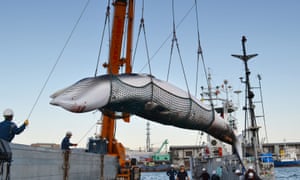
A minke whale is landed at a port in Kushiro on Japan’s northernmost main island of Hokkaido in 2017. Photograph: Kyodo News/Kyodo News via Getty Images
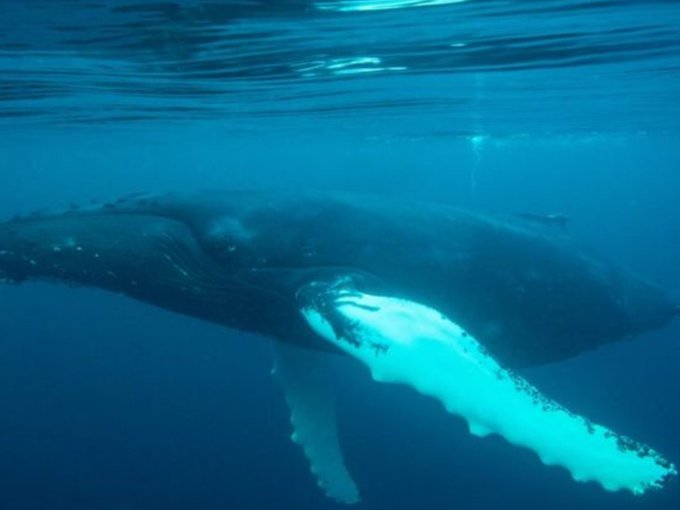
Japan is facing international condemnation after confirming it will resuming commercial whaling for the first time in more than 30 years.
The country’s fleet will resume commercial operations in July next 2019, the government’s chief spokesman, Yoshihide Suga, said of the decision to defy the 1986 global ban on commercial whaling.
Suga told reporters the country’s fleet would confine its hunts to Japanese territorial waters and exclusive economic zone, adding that its controversial annual expeditions to the Southern Ocean – a major source of diplomatic friction between Tokyo and Canberra – would end.
He said Japan would officially inform the IWC of its decision by the end of the year, which will mean the withdrawal comes into effect by 30 June.
Its decision prompted criticism from conservationists and other nations including the UK and Australia.
The UK’s environment secretary, Michael Gove, said he was “extremely disappointed” by Japan’s move.
He said in a tweet: “The UK is strongly opposed to commercial whaling and will continue to fight for the protection and welfare of these majestic mammals.”
Michael Gove
✔@michaelgove
Extremely disappointed to hear that Japan has decided to withdraw from the International Whaling Commission to resume commercial whaling. The UK is strongly opposed to commercial whaling and will continue to fight for the protection and welfare of these majestic mammals.
Greenpeace disputed Japan‘s view that whale stocks have recovered, noting also that ocean life is being threatened by pollution as well as overfishing.
“The declaration today is out of step with the international community, let alone the protection needed to safeguard the future of our oceans and these majestic creatures,” Sam Annesley, executive director at Greenpeace Japan, said in a statement.
“The government of Japan must urgently act to conserve marine ecosystems, rather than resume commercial whaling.”
It also accused Japan of timing the announcement to avoid criticism.
“It’s clear that the government is trying to sneak in this announcement at the end of year, away from the spotlight of international media, but the world sees this for what it is,” Annesley, said.
“Most whale populations have not yet recovered, including larger whales such as blue whales, fin whales and sei whales.”
Backbench Conservative MP and former foreign secretary Boris Johnson said Japan’s decision was “appalling” and urged it think again.
Astrid Fuchs, programme lead at Whale and Dolphin Conservation, said it was “terrible decision” that could encourage other countries to quit the IWC.
She added: “The oversight that the IWC was having over Japan’s whaling will now be lost. We won’t know how many whales they are catching, we won’t know how they will report it. It might spell doom for some populations. There is an endangered population of Minke whales off Japan, which is already under threat.”
Erik Solheim, a Norwegian diplomat who was the head of the United Nations Environment Programme until earlier this year, said Japan’s decision to leave the international whaling commission was “dangerous”.
In a tweet he called for a global campaign to urge Japan to reconsider.
Japan will start commercial whaling.
Let’s ask Japan to reconsider!
It’s dangerous when nations break out of global agreements and start setting their own rules.https://www.bbc.com/news/world-asia-46682976 …
In a joint statement on Wednesday, Australia’s foreign minister Marise Payne and the environment minister, Melissa Price, said the Australian government was “extremely disappointed” that Japan was withdrawing from the commission and resuming commercial whaling.
“The International Whaling Commission plays a crucial role in international cooperation on whale conservation,” they said.
“The commission is the pre-eminent global body responsible for the conservation and management of whales and leads international efforts to tackle the growing range of threats to whales globally, including by-catch, ship strikes, entanglement, noise, and whaling.
“Their decision to withdraw is regrettable and Australia urges Japan to return to the Convention and Commission as a matter of priority.”
The Australian Marine Conservation Society said the decision to halt the Antarctic hunt would be “welcome and long overdue”. Its chief executive, Darren Kindleysides, called on the Australian government to demand the Japanese fleet left immediately rather than at the end of its normal hunting season in February or March.
“Australians have been fighting for decades to get the whalers out of the Antarctic,” Kindleysides said. “However, it would be a bittersweet victory if it comes with unchecked commercial whaling by Japan in their own waters, and their leaving could damage the future of the IWC itself.”
Wednesday’s announcement had been widely expected after Japan recently failed to win IWC support for a proposal to change the body’s decision-making process – a move that would have made it easier for Japan to secure enough votes to end the commercial whaling ban, which went into effect in 1986 to protect dwindling whale stocks.
Japan argues that the moratorium was supposed to be a temporary measure and has accused a “dysfunctional” IWC of abandoning its original purpose – managing the sustainable use of global whale stocks.
“I support the government’s decision” to withdraw, Itsunori Onodera, a former defence minister who advises the ruling Liberal Democratic Party on fisheries, told public broadcaster NHK. “I have attended IWC meetings several times in the past, and I was struck by their extremely biased views. The IWC has become a dysfunctional organisation.”
Japanese fisheries officials claim that populations of certain types of whale – such as the minke – have recovered sufficiently to allow the resumption of “sustainable” hunting.
It has used a loophole in the ban to hunt a certain number of whales for what it claims is scientific research. Byproduct from the hunts is sold on the domestic market, although Japan’s appetite for whale meat has declined dramatically since the postwar years, when it was an important source of protein.
The country ate 200,000 tons of whale meat a year in the 1960s, but consumption has plummeted to about 5,000 tons in recent years, according to government data.
Japan will join Iceland and Norway in openly defying the ban on commercial whale hunting.
Climate scientists warn that 2019 may be the warmest year on record largely as the result of a possible El Niño event exacerbated by man-made global warming.
There is a 90 percent chance that El Niño will form and continue through the Northern Hemisphere winter of 2018-19 and a 60 percent chance that it will continue into the spring of 2019, according to the Climate Prediction Center at the National Oceanic and Atmospheric Administration (NOAA).
El Niño is a part of a routine climate pattern that occurs when sea-surface temperatures in the tropical Pacific Ocean rise to above-normal levels for an extended period of time. It can last anywhere from 4 to 16 months and it typically has a warming influence on the global temperature.
DIMPLE DELL, Utah (ABC4 News) – Dimple Dell residents are looking for whoever left an animal trap near Dimple Dell Park.
Someone found the trap near Dimple Dell Park last Wednesday. Signs went up around the area warning people of the traps. A reminder was also sent out saying hunting and trapping in the area is illegal.
The Dimple Dell preservation community says if anyone knows who is responsible or sees any traps to please contact Sandy Police.







 Exposing the Big Game