If US health care were a country, it’d rank seventh in the world in total emissions. Getty Images/Tetra images RF
Wildfire deaths. Smoky air. Floods. Droughts. There’s no escaping the reality that global warming is rapidly exacerbating threats to human health and communities in the United States and around the world. As the top scientists have told us over and over, we need to immediately lower our greenhouse gas emissions to avoid climate change’s most catastrophic effects. Governments and businesses are particularly on the hook, but so are citizens — we are all in this together.
That includes you, doctors.
In a New England Journal of Medicinecommentary published Wednesday, a pair of Boston doctors make the case that it’s high time medical professionals engage more…
The Humane Society of the United States and Humane Society International found imperiled wildlife parts for sale, possibly violating Nevada law, and canned lion hunts for sale in violation of SCI’s own rules
WASHINGTON – An undercover investigation by the Humane Society of the United States and Humane Society International revealed dozens of items made from imperiled wildlife for sale last week at the Safari Club International convention in Reno, Nevada. These items included elephant skin furniture, paintings on elephant ears, hippo skulls and teeth, and stingray skin belts. SCI is one of the world’s largest trophy hunting advocacy groups. Offering these items for sale likely violates Nevada state law on wildlife trafficking, and HSUS and HSI have reported their findings to enforcement authorities.
The investigation also found that canned lion hunts, the sale of which SCI banned at its conventions as of February 4, 2018, were easily available for purchase…
Published on: January 16, 2019 | Last Updated: January 16, 2019 4:48 AM EST
An injured cub found on the railway tracks north of Sudbury is now being cared for at the Bear With Us sanctuary in Muskoka. He was initially treated at Wild At Heart in Lively.JIM MOODIE/SUDBURY STAR
The resilient cub, who got that impressive name from his rescuers, is now on the mend at a Muskoka bear sanctuary after being struck by a train north of Sudbury last month.
Found concussed and bleeding on the tracks by rail workers, the bear was initially treated for his injuries at Wild At Heart in Sudbury.
Larry Burkholder of Capreol said he and his partner Joe Nadeau, of Garson, were in a high-rail truck performing maintenance duties on Dec. 9 when they spied the animal.
“We came around the curve and saw something between the rails,” he said. “We stopped about 40 feet away and got out and walked up on it, and there were little balls of snow on it, like marshmallows, so it had been lying there for some time with trains passing right over top.”
The cub wasn’t moving and neither man would have been surprised to find it deceased — not too many animals survive a collision with a train, let alone an extended period of time stuck between the rails — but this was one tough little bear.
As they got closer, “it blinked at us,” said Burkholder. “We looked at each other and it was just, you know, our hearts went out to the poor thing. We had to try to do something.”
The cub had a skull fracture and couldn’t use its legs, so the two scooped him up in a jacket — Burkholder said he weighed less than 20 pounds — and placed him in the back of the truck, although it wasn’t long before he was riding in the cab.
“We drove about four miles with him in the box, but there was no movement from the animal so we brought it inside,” Burkholder said. “We made him a spot on the floor of the backseat with my co-worker’s parka and he was compliant the whole way back.”
They had collected the bear near Felix, a train stop about 200 kilometres north of Sudbury. That provided a good name — or half of a good name, anyway — for the animal, but it was a long haul to get him to Wild At Heart.
The co-workers had to pull aside to let trains pass and then transfer the bear to another truck. In all, the trip took about five hours. En route they called Wild at Heart and kept up a kind of conversation with their passenger.
“We made some noises and he would groan back a little,” said Burkholder. “But he had a severe concussion. As we got closer to Lively he wasn’t making much of a sound, and you could tell his breathing was getting shallower.”
Luckily veterinarian and Wild at Heart director Rod Jouppi was there to help right away, stitching up the bear’s head wound and providing antibiotics and painkillers.
About a week later he had improved enough to be transferred to Bear With Us, a facility near Huntsville that specializes in rehabbing orphaned and injured bears.
Mike McIntosh of Bear With Us said Tuesday the cub has made significant strides.
“He’s coming along quite well and I think he’s going to be fine,” he said. “He’s still a bit disoriented but his motor skills have improved a lot.”
The cub was “very underweight” when he arrived, said McIntosh, but is packing on some pounds now, thanks to a steady diet of raw eggs, yogurt and blueberries.
“It will be a month before he hibernates because he still has to put on weight,” he said. “Once he’s fat enough, he’ll be comfortable, curled up in a mound of straw, but right now he’s still looking for food all the time.”
He doesn’t have to look far for friendship, however, as McIntosh recently installed another cub in the same space with Felix Beartholomew.
“I integrated him a week or so ago with another cub I got from Blind River on Christmas Eve,” he said. “The day after I put them together, they were cuddling up.”
McIntosh said he’s had other bears with head injuries that took longer to recover, so he’s quite optimistic about this one’s chance of leading a normal life and making a return to the wild.
“The credit goes to those two rail employees,” he said. “If they had assumed he was dead, he would be dead. It’s amazing he survived with those trains going over, straddling him — if anything was hanging down, he would be whacked. He’s a lucky cub in more ways than one.”
Burkholder said he’s just glad he and Nadeau were able to act before it was too late.
“If the ravens had got on it, the eyes would be gone and it would have been a different story,” he said. “So we were lucky there.”
Starvation would have kicked in, too, if a train hurtling over its head hadn’t struck sooner.
“That’s what really gets me,” he said. “Some trains are 10,000 feet long, and with this poor thing inches away, who knows how close it was to being finished off. But luck was with it.”
Burkholder said he and Nadeau named the bear because it was such a unique experience, and they were moved by its ability to hang on and beat the odds.
They are still following his progress, too, through updates from Wild At Heart and Bear With Us.
“Sometimes you don’t have to be with something very long to get a bond,” he said.
STANLY COUNTY, N.C. — Coyotes are a common sight in the Tarheel state.
Carolina Coyote Classic was started six years ago
For two days hunters target the animals statewide
PETA says the approach to remove the animals isn’t effective
“They’re starting to get in the urban areas and the problem is household pets are really considered an easy meal for them,” says Carolina Coyote Classic organizer John Macpherson.
It’s why John Macpherson, who lives in Stanly County, started the Carolina Coyote Classic six years ago. For two days hunters target the animals statewide. There’s a cash prize for the hunter with the most coyotes. Last year hunters killed 67 of them.
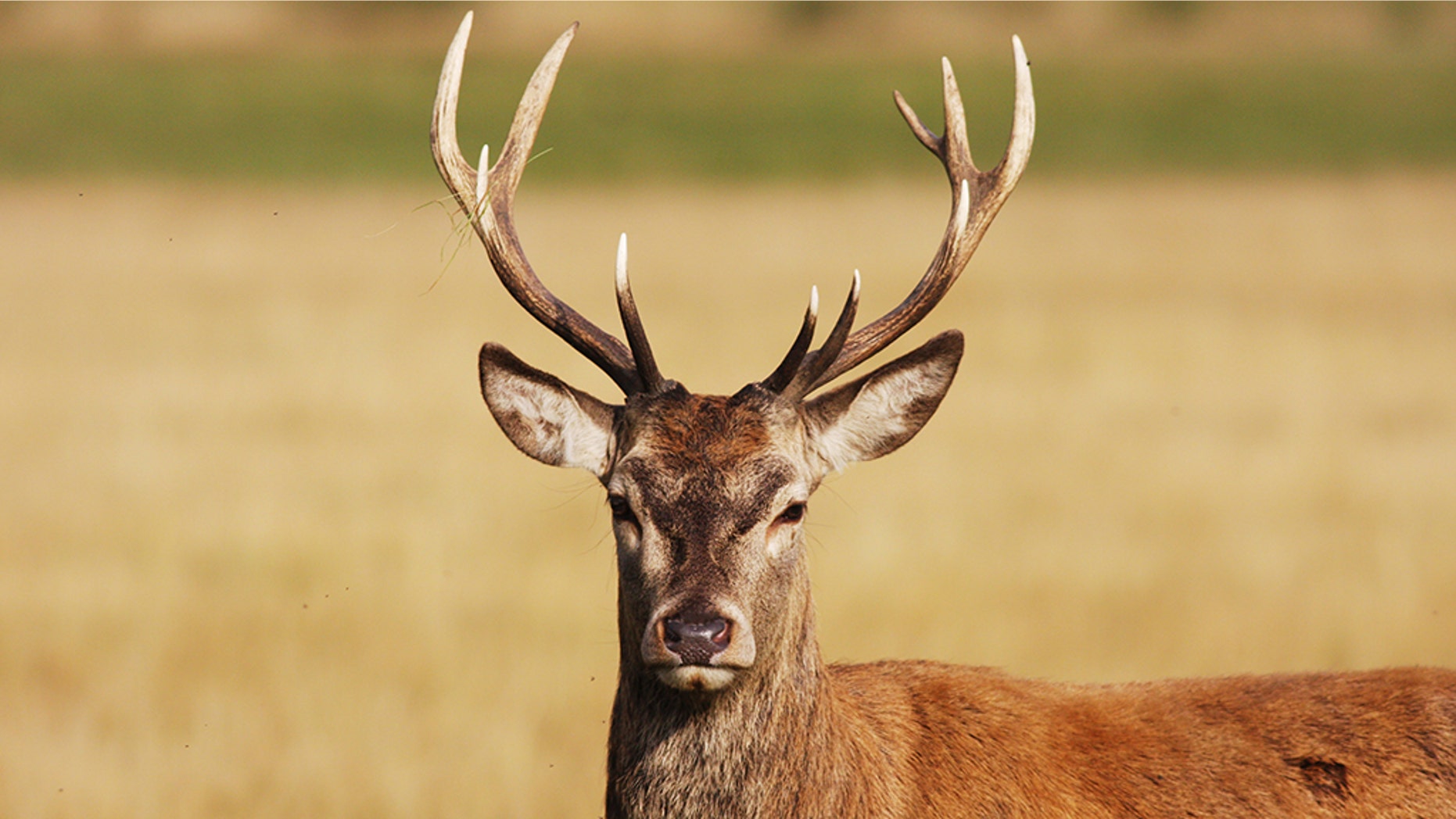
Of the total, 136,776 were antlered bucks, 30,116 were button bucks, and 123,447 were does, the MDC added. Hunters in Franklin County, West of St. Louis, bagged 5,826 deer — the most of any county in the state.
I use the extreme example of 10 to cut to the chase, get to the point.
With a low human population, human-caused climate change would not be a concern.
With a low human population, neither would habitat loss or any other of the current threats to the diversity of life on Earth.
It wouldn’t matter if every person in a low human population was the most rapacious sort of capitalist. They couldn’t make a dent. It wouldn’t matter if every one was socialist, communist, racist, atheist, Buddhist, Confucionist, Taoist, Christian, Jew, or Muslim. What packs the most clout is the sheer mass of the human population
This mass is the great hulking monster behind the threats to climate and biodiversity. And yet the growth of the human population has important sources of support. For the political leaders yearning for military might, it means bigger armies. For organized religion(s), it means bigger congregations. For the business world, it means more customers — and a labor supply abundant enough to make labor cheap. Over all this hangs a silence amounting to a near-universal taboo.
Everything I know or think I know persuades me that continuing on our present course will, sooner or later, plausibly beginning in the lifetime of children born since 1980, create conditions that will set off a severe and sharp culling of the human herd. But we’ll be bringing a lot down with us as we go, and we are already seeing all the evidence we need of that.
“Research suggests that the scale of human population and the current pace of its growth contribute substantially to the loss of biological diversity. Although technological change and unequal consumption inextricably mingle with demographic impacts on the environment, the needs of all human beings—especially for food—imply that projected population growth will undermine protection of the natural world.
“Numerous solutions have been proposed to boost food production while protecting biodiversity, but alone these proposals are unlikely to staunch biodiversity loss. An important approach to sustaining biodiversity and human well-being is through actions that can slow and eventually reverse population growth: investing in universal access to reproductive health services and contraceptive technologies, advancing women’s education, and achieving gender equality.”
Eileen Crist, Camilo Mora, Robert Engelman. The interaction of human population, food production, and biodiversity protection. Science 21 April 2017
~~~~~~~~~~~~~~~~~~~~~~~~~~~~~~~~~~~
“The individual scientist can survive for a long time by lying low in the valley of specialized intellectual interest … We in science must get up and face the wind, confront the future.”
William Bevan, “The Sound of the Wind That’s Blowing.”
By Kelvin Reynolds|January 18, 2019 at 7:14 PM CST – Updated January 18 at 7:14 PM
TUSCALOOSA COUNTY, AL (WBRC) – Loved ones and classmates at a Tuscaloosa County school gathered to celebrate the life of a good friend.
Hudson Fife died during an accidental shooting while hunting near Selma Sunday. He attended Englewood Elementary School.
On Friday morning, a balloon release was held in the fifth-grader’s honor. One of his teachers said this has been a tough week for folks there. They wanted to support one another and show their love for Hudson Fife.
“We loved Hudson. We wanted to do this to honor his memory and give the students the chance to have closure,” said teacher Angelia Ingle.
They released 500 orange, blue and white balloons. They’re the color of Oklahoma City Thunder –…
ELLENSBURG, WA – Hundreds of elk were caught on camera crossing a rural road outside Ellensburg recently, appearing like a furry, brown river flowing across the snowy high desert landscape.
A Puget Sound Energy worker filmed the elk as they crossed a road near the Wild Horse Wind and Solar facility, about 15 miles east of Ellensburg.
Two types of elk live in Washington. The larger Roosevelt elk live mainly on the Olympic Peninsula and west of I-5. The elk in the video are likely Rocky Mountain elk, whose range stretches across the state, from the woods and mountaintops of the Cascades to the grassy deserts that stretch east to Idaho.
Winter is primarily a food-finding season for elk. After the mating “rut” in fall, elk seek out shrubs and grasses to eat before elk calves are born in spring.
People queue to wash their hands with chlorine water to prevent Ebola contamination at a symbolic polling station on December 30, 2018, in Beni, Congo. Alexis Huguet/AFP/Getty Images
But it could get worse: Health officials this week are concerned that Ebola appears to be spreading in the direction of Goma, a major population center in DRC.
Just this week, DRC’s health ministry confirmed four cases of the deadly virus in Kayina, a town in North Kivu, where fighting among rebel and militia groups has repeatedly interrupted the painstaking work of health workers who are responding to the outbreak.
Kayina happens to be halfway between Butembo, currently one of the outbreak’s most worrisome hotspots, and Goma, where a million people live.
So far, the outbreak has not affected DRC’s biggest cities. But Ebola in Kayina “raises the alarm” for Ebola reaching Goma, Peter Salama, the head of the new Health Emergencies Program at the World Health Organization, told Vox on Friday.
Goma is a major transportation hub, with roads and highways that lead to Rwanda. “These are crossroad cities and market towns,” Salama added. People there are constantly on the move doing business, and also because of the insecurity in North Kivu. Ebola in Goma is a nightmare scenario WHO and DRC’s health ministry are scrambling to prevent.
Together, they’ve deployed a rapid response team, including a vaccination team, to Kayina. And if the virus moves on to Goma, Salama says Ebola responders are ready. They’ve already mobilized teams there, set up a lab, and prepared health centers where sick people can be cared for in isolation.
But as Ebola expert Laurie Garrett wrote in Foreign Policythis week, Ebola in Goma could also trigger a rare global public health emergency declaration by WHO, escalating the severity of an already dangerous outbreak.
An Ebola vaccine has been no match for DRC’s social and political chaos
When Ebola strikes, it’s like the worst and most humiliating flu you could imagine. People get the sweats, along with body aches and pains. Then they start vomiting and having uncontrollable diarrhea. They experience dehydration. These symptoms can appear anywhere between two and 21 days after exposure to the virus. Sometimes patients go into shock. In rare cases, they bleed.
The virus is spread through direct contact with the bodily fluids, like vomit, urine, or blood, of someone who is already sick and has symptoms. The sicker people get, and the closer to the death, the more contagious they become. (That’s why caring for the very ill and attending funerals are especially dangerous.)
Because we have no cure for Ebola, health workers use traditional public health measures: finding, treating, and isolating the sick, and breaking the chains of transmission so the virus stops spreading.
They mount vigorous public health awareness campaigns to remind people to wash their hands; that touching and kissing friends and neighbors is a potential health risk; and that burial practices need to be modified to minimize the risk of Ebola spreading at funerals.
They also employ a strategy called “contact tracing”: finding all the contacts of people who are sick, and following up with them for 21 days — the period during which Ebola incubates.
In this outbreak, there’s also an additional tool: an effective experimental vaccine. Since the outbreak was declared in August, more than 61,000 people have been vaccinated.But while the vaccine has tempered Ebola’s spread, it hasn’t overcome the social and political chaos in DRC, which has been called the world’s most neglected crisis.
“The brutality of the conflict is shocking,” Jan Egeland, head of the Norwegian Refugee Council, told the Thomson Reuters Foundation, “the national and international neglect outrageous.”
Presidential elections have “ratcheted up” the tension in an already tense situation
On December 30, after years of delays, voters went to the polls to elect a new president. In the days leading up to the election, tensions in North Kivu “ratcheted up,” Salama said. Protesters stormed Doctors Without Borders treatment centers in Beni, a recent outbreak hotspot, shutting them down for several days.
In January, the country’s electoral commission announced interim election results suggesting opposition leader Felix Tshisekedi had likely won the election. But leaked data and external analyses show there are irregularities with the voter count that point toward election fraud.
“All the outside observers — the African Union, the European Union, the Catholic Church — say the results of the election have been rigged,” and the people actually voted in Martin Fayalu for president, said Severine Autesserre, a political science professor at Barnard College, and author of the bookThe Trouble with the Congo. When the final results are announced in the coming days, more protests and riots are likely to follow.
But though the political instability isn’t making the Ebola response any easier, the war in Congo’s eastern provinces is a far bigger challenge. The 25-year-long conflict has displaced more than a million people, and made the already dangerous work of an Ebola response even more deadly, Autesserre said.
Between August and November, Beni had experienced more than 20 violent attacks, which put the outbreak response there on pause for days at a time. That meant cases had gone uncounted, and Ebola continued to spread.
But there’s also some more encouraging news, according to Salama: The outbreak of more than 200 people in Beni, a North Kivu town marred by decades of violence, has been brought under control.
“Many people would have been extremely skeptical that the outbreak in Beni could be controlled as quickly given force of infection we were seeing in November and December, and the fact that we’ve had nothing but volatility and insecurity since then,” Salama said. “But the fact that Beni has had only one confirmed case in two weeks is giving us a lot of hope and optimism.”
As of Friday, the two biggest hotspots in the outbreak were Butembo, with 51 cases, and a neighboring city, Katwa, with 119 cases. But the outbreak is geographically dispersed. There are active Ebola cases in 12 of the country’s “health zones,” the districts around which the DRC’s health system is organized. Because of the insecurity and difficulty reaching people, only 30 to 40 percent are coming from known contact lists, Salama said. That means the virus might already be in places no one’s discovered yet.
The military walks a fine line between the White House’s official climate denialism and the stark realities of a warming planet.
By Chris D’Angelo and Alexander C. Kaufman
U.S. ARMY NATIONAL GUARD VIA GETTY IMAGES
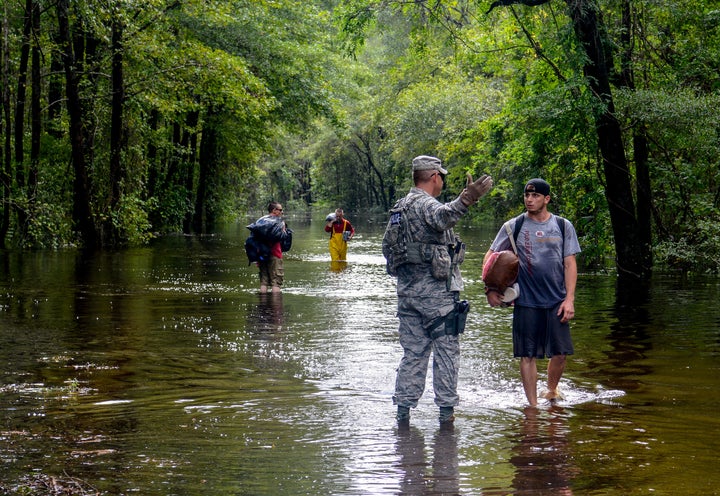
A U.S. Air Force member assigned to the South Carolina Air National Guard assists citizens during evacuation efforts after Hurricane Florence hit in September 2018.
More than a year after President Donald Trump nixedclimate change from his administration’s list of national security threats, the Pentagon has released an alarming report detailing how dozens of U.S. military bases are already threatened by rising seas, drought and wildfire.
“The effects of a changing climate are a national security issue with potential impacts to Department of Defense missions, operational plans, and installations,” states the 22-page document, which was published Thursday.
The congressionally mandated analysis looked at a total of 79 military installations around the country. The Defense Department found that 53 sites are currently vulnerable to repeat flooding. Langley Air Force Base in Virginia, for example, has experienced 14 inches of sea level rise since 1930. Additionally, more than half of the 79 bases are at risk from drought, while nearly half are vulnerable to wildfire.
These climate impacts are expected to pose a risk to several other installations over the next two decades, and the report notes that “projected changes will likely be more pronounced at the mid-century mark” if climate adaptation measures are not taken.
While the report is a clear recognition of the immediate threat that climate change poses to the nation’s military infrastructure, it makes no mention of the greenhouse gas emissions driving the crisis. It also doesn’t mention some of the most recent climate-related devastation to military bases, including the estimated $3.6 billion in damages that Camp Lejeune in North Carolina suffered during Hurricane Florence last year.
BLOOMBERG VIA GETTY IMAGES
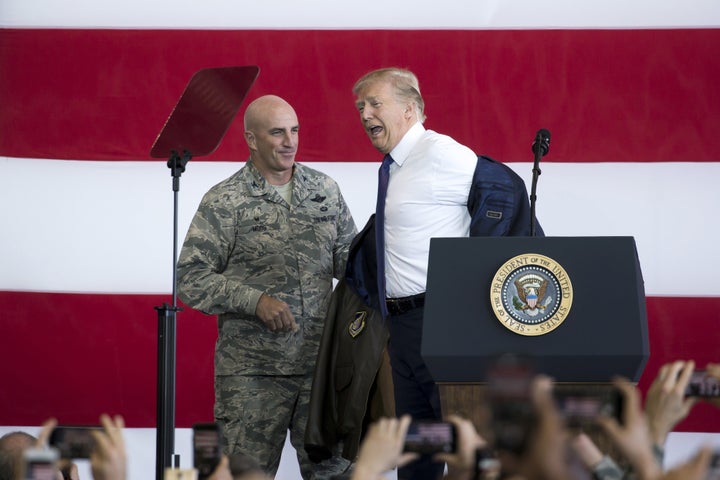
President Donald Trump removed any reference to climate change from the White House’s National Security Strategy report in 2017.
The Pentagon’s assessment comes just over a year after Trump eliminated any reference to climate change from the White House’s 2017 National Security Strategy report, breaking with two decades of military planning.
Even then, there was dissonance between the Defense Department and the White House.
A week earlier, Trump had signed the National Defense Authorization Act, which devoted about 870 words to the “vulnerabilities to military installations” over the next two decades and warned that rising temperatures, droughts and famines might lead to more failed states ― which are “breeding grounds of extremist and terrorist organizations.” “Climate change is a national security issue,” the legislation said, quoting then-Defense Secretary Jim Mattis; Gen. Joseph Dunford, the chairman of the Joint Chiefs of Staff; and four other former top military commanders. And it said that the Air Force’s $1 billion radar installation on a Marshall Islands atoll “is projected to be underwater within two decades.”
In Thursday’s report, the Defense Department describes climate change as “a global issue” and says it is “continuing to work with partner nations to understand and plan for future potential mission impacts.”
Subscribe to the Politics email.
How will Trump’s administration impact you?
The department said in a statement to HuffPost that the report delivers a “high-level assessment of the vulnerability of DOD installations.”
“DOD must be able to adapt current and future operations to address the impacts of a wide variety of threats and conditions, to include those from weather, climate and natural events,” Pentagon spokeswoman Heather Babb said by email. “DOD will focus on ensuring it remains ready and able to adapt to a wide variety of threats ― regardless of the source ― to fulfill our mission to deter war and ensure our nation’s security.”
The department did not respond to HuffPost’s questions about any White House role in the report.
Oddly, the new analysis omits the Marine Corps. It also doesn’t identify the top 10 military bases within each service branch that are most vulnerable to climate impacts, a requirement of the defense bill that Trump signed into law in December 2017.
“They don’t have the prioritization of impact. That’s confusing,” said John Conger, a former principal deputy under secretary of defense in the Obama administration and current director of the research group Center for Climate and Security.
Conger said he expects that Congress will tell the Pentagon to go back and fulfill its request.
Climate change was first publicly recognized as a major concern for the Pentagon in May 1990, when the U.S. Naval War College issued a 73-page report, titled “Global Climate Change Implications for the United States,” which found that “Naval operations in the coming half century may be drastically affected by the impact of global climate change.”
The issue gained prominence under President George W. Bush, despite that administration’s embrace of climate change denialism. In October 2003, the National Defense University published a report stating that “global warming could have a chilling effect on the military.”
Today, the military still walks a fine line when discussing climate issues, particularly given that many congressional Republicans reject the realities of human-driven warming. Officials at Naval Station Norfolk in Virginia, the world’s largest naval station, have admitted to avoiding language such as “sea level rise” when requesting maintenance funds to raise docks, according to journalist Jeff Goodell’s recent book The Water Will Come.
Sen. Jack Reed (D-R.I.), the ranking member on the Senate Armed Services Committee, called the new report “inadequate” and criticized the Trump-era Defense Department for “treating climate change as a back burner issue.”
“President Trump’s climate change denial must not adversely impact the security environment where our troops live, work, and serve,” Reed said in a Friday statement. “Whether the Trump Administration wants to admit it or not, climate change is already costing the Department significant amounts of taxpayer resources and impacting military readiness.”


/cdn.vox-cdn.com/uploads/chorus_image/image/62861923/GettyImages_601797385.0.jpg)




/cdn.vox-cdn.com/uploads/chorus_image/image/62871800/GettyImages_1075872430.0.jpg)
:no_upscale()/cdn.vox-cdn.com/uploads/chorus_asset/file/13700632/Screen_Shot_2019_01_18_at_4.20.49_PM.png)
 Exposing the Big Game