Exposing the Big Game

Forget Hunters' Feeble Rationalizations and Trust Your Gut Feelings: Making Sport of Killing Is Not Healthy Human Behavior

Exposing the Big Game

Alabama offers new license for bait hunting of deer and pigs

Exposing the Big Game's avatarCommittee to Abolish Sport Hunting Blog

MONTGOMERY, Ala. (AP) — A new license allowing bait to be used in the hunting of white-tailed deer and feral pigs in Alabama is now on sale.

The Alabama Department of Conservation and Natural Resources is issuing the annual bait privilege license after a new law was passed, Al.com reported .

The Alabama Legislature approved the baited hunting measure last month. The bill passed the House by a vote of 83-12.

  • Unlimited Digital Access for 95¢
  • Read more articles like this by subscribing to the San Francisco Chronicle

SUBSCRIBE

The new law could provide limited help with crop destruction and other problems caused by feral hogs, said Rep. Danny Crawford, R-Athens, who sponsored the bill in the House.

“I don’t know if you could ever kill enough feral hogs with a rifle to ever make a dent in it but it will help,” Crawford said.

Alabama Department Conservation Commissioner…

View original post 167 more words

Climate Change and the New Age of Extinction

People easily forget “last of” stories about individual species, but the loss of nature also threatens our existence.

The first documented extinction of 2019 occurred on New Year’s Day, with the death of a Hawaiian tree snail named George. George, who was about an inch long, had a grayish body, grayish tentacles, and a conical shell striped in beige and brown. He was born in captivity, in Honolulu, and had spent his unassuming life oozing around his terrarium, consuming fungi. Researchers with Hawaii’s forestry department had tried to find a partner for him—George was a hermaphrodite, but he needed a mate in order to reproduce—and when they couldn’t they concluded that he was the last of his kind, Achatinella apexfulva. A few days after he went, presumably gently, into that good night, the department posted a eulogy under the heading “farewell to a beloved snail . . . and a species.” “Unfortunately, he is survived by none,” it observed.

George’s passing prompted a spate of headlines, and then, it seems safe to say, was forgotten. Americans have, by now, grown inured to “last of” stories, which appear with the unsurprising regularity of seasonal dessert recipes. (George the snail was named for Lonesome George, a Pinta Island tortoise from the Galápagos, also the last of his kind, who died in 2012.) In February, the Australian government declared a ratlike creature known as the Bramble Cay melomys to be extinct. The melomys, found on a single low-lying island between Australia and Papua New Guinea, appears to have been done in by climate change, which has shrunk its habitat and brought ever more damaging flooding. Then, in April, Chinese state media reported that the last known female Yangtze giant softshell turtle had died. “Her species might die with her,” the Washington Post noted.

Last week, an international group of scientists issued what the Times called “the most exhaustive look yet at the decline in biodiversity.” The findings were grim. On the order of a million species are now facing extinction, “many within decades.” “What’s at stake here is a liveable world,” Robert Watson, the chairman of the group, Intergovernmental Science-Policy Platform on Biodiversity and Ecosystem Services, told Science.

The U.N.-backed I.P.B.E.S. is to flora and fauna what the Intergovernmental Panel on Climate Change is to the atmosphere. Based in Bonn, it is funded by a hundred and thirty-two member nations, including the United States. More than three hundred experts contributed to its latest assessment, which runs to more than fifteen hundred pages.

The authors trace two diverging trend lines: one upward-sloping, for people, and one sloping downward, for everything else. During the past fifty years, the planet’s human population has doubled. In that same period, the size of the global economy has quadrupled, and global trade has grown tenfold. If hundreds of millions of people around the world are still mired in poverty, there are many more people living in prosperity today than ever before.

To keep nearly eight billion people fed, not to mention housed, clothed, and hooked on YouTube, humans have transformed most of the earth’s surface. Seventy-five per cent of the land is “significantly altered,” the I.P.B.E.S. noted in a summary of its report, which was released last week in Paris. In addition, “66 per cent of the ocean area is experiencing increasing cumulative impacts, and over 85 per cent of wetlands (area) has been lost.” Approximately half the world’s coral cover is gone. In the past ten years alone, at least seventy-five million acres of “primary or recovering forest” have been destroyed.

Habitat destruction and overfishing are, for now, the main causes of biodiversity declines, according to the I.P.B.E.S., but climate change is emerging as a “direct driver” and is “increasingly exacerbating the impact of other drivers.” Its effects, the report notes, “are accelerating.” Watson wrote last week, in the Guardian,that “we cannot solve the threats of human-induced climate change and loss of biodiversity in isolation. We either solve both or we solve neither.”

How long can the two trend lines continue to head in opposite directions? This is the key question raised by the report, and it may turn out to be the key question of the century. Many documented species have already disappeared—to take the example of Hawaiian tree snails, Achatinella apexfulva is just one of hundreds of species that have been lost—and probably even more vanished before they could be identified. Many others, like the Yangtze giant softshell turtle, are functionally extinct.

So far, it could be argued, the casualties haven’t slowed us down. The I.P.B.E.S. report cautions, however, against assuming that this pattern will continue. Nature, it succinctly observes, “is essential for human existence.” The report points to pollinators as one group of organisms that humans can’t readily do without. Ninety per cent of flowering plants and seventy-five per cent of all types of food crops rely on pollination by animals—birds, bats, and (mostly) insects. Cash crops including coffee, cocoa, and almonds are pollinator-dependent. In many regions, important pollinators, like native bees, are in decline. It’s not clear exactly why, but probably one of the major factors is an increasing reliance on synthetic pesticides, which don’t distinguish between insects that are useful and those that are unwanted. These chemicals are supposed to prevent crop failures; the danger is that they may end up causing them.

As much as six hundred billion dollars’ worth of annual agricultural production “is at risk as a result of pollinator loss,” the I.P.B.E.S. warned. In an earlier report, on pollinators and the food supply, the group predicted that “total pollinator loss” would decrease production of the most important dependent crops “by more than 90 per cent.”

We would, it seems, be well advised to shift course, if only for our own, species-centric reasons. And, according to the I.P.B.E.S., there is still time for “transformative changes” in the “production and consumption of energy, food, feed, fibre and water.” Regrettably, though, all signs point to more of the same. In 2018, carbon-dioxide emissions from the energy sector rose to a new high of thirty-six billion tons. Also in 2018, nearly thirty million acres of tropical forest were lost—an area the size of Pennsylvania. As the Web site InsideClimate News noted, this destruction occurred “even as more corporations and countries made commitments to preserve tropical forests.” As long as we continue to tear through the biosphere, expect the losses to continue to mount. ♦

ADD YOUR NAME: Protect Gray Wolves from Extinction!

Exposing the Big Game's avatarCommittee to Abolish Sport Hunting Blog

Sign the petition from Environmental Action to help protect gray wolves from extinction!

It’s now or never for gray wolves in the Lower 48 states: The Trump administration has announced that they plan to end wolves’ Endangered Species Act protections.1

This could be a disaster. Delisting wolves in this way would leave them vulnerable across the entire Lower 48 states.

Hunting, trapping and poisoning nearly drove wolves to extinction in the 1900s.2 Without the proven protection of the ESA, we could see a repeat of last century’s tragedy.

What happens next depends on us. This is our moment to show the administration that Americans want wolves to have a future in this country.

When wolves lose the protection of the ESA, hundreds or thousands of them die. When the wolf population around the Great Lakes were taken off the list, 1,500 were killed before protection resumed.3

With…

View original post 403 more words

Grey whales free after beaching in Delta, B.C.’s, Boundary Bay

Fisheries and Oceans Canada, Vancouver Aquarium helped get animals free

A photo from the scene on Friday shows several people in the water of Boundary Bay, B.C., near the animals. (David Houston/Facebook)

54
comments

It just might be the happiest whale tale since Free Willy: a pair of grey whales stranded on the low-tide mudflats of Boundary Bay in B.C.’s Lower Mainland have escaped.

A rescue effort sprang into action Friday afternoon after the two whales — a mother and a calf — became beached near Centennial Park in Boundary Bay in Delta about a 40 minute drive south of Vancouver.

Fisheries and Oceans Canada led the effort with refloatation devices — large, inflatable airbags to lift the animals up — and a vessel. The Vancouver Aquarium was also on scene to handle any medical setbacks the animals may have suffered.

“It’s absolutely fantastic,” said Martin Haulena, the Vancouver Aquarium’s head veterinarian. “A very, very good ending.”

Haulena said the animals got stuck at approximately 2 p.m. PT. They were freed by about 6:30 p.m.

Fortunately for them, the tide was coming in to help their escape. A cheer rose from about 100 assembled onlookers as the whales began to move freely, flapping their fins.

Watch as the whales begin to right themselves in the rising tide:

CBC News Vancouver at 6
Whales get free in Delta, B.C.
 WATCH

00:00 00:34

After being stranded for much of Friday afternoon, a grey whale and her calf start to right themselves in the rising tide of Boundary Bay. 0:34

Dangerous position

Haulena said Boundary Bay — a wide, shallow bay straddling the Canada-U.S. border — is a place where grey whales could easily get stranded.

He described the animals as bottom feeders: they skim along the ocean floor filtering organisms from the sandy bottom through their mouths. He thinks they were likely foraging when the tide went out and became stuck.

As the tide rolled in the whales began to flap their fins and get free. (CBC)

Once out of the water, he continued, their large bodies put them in danger.

“They were never designed to bear weight,” he explained. “That can compress their lungs. They can’t breathe right. Their circulation gets very altered … it’s a very big deal potentially.”

He added that the whales are not out of the woods yet.

If they were injured too severely by their ordeal, they may still die.

Rash of beachings

Friday’s dramatic scene is one that has been happening all over the west coast of North America this year as an unusual number of grey whales have become stranded and died on their migration from their southern calving waters in Mexico to their northern feeding waters.

Some researchers are pointing to a lack of food as the cause.

Haulena said beachings tend to happen cyclically, with some years being worse than others, but agreed the population may be exhausting its food sources.

Fake meat: Don’t go bacon my heart, say butchers

Sausage dummies are pictured at the international meat industry fair IFFA in Frankfurt am Main, western Germany, on May 6, 2019. — AFP pic

FRANKFURT, May 12 — Slicing through juicy cuts of pork belly alongside rarer delicacies of ox brain and sheep intestine, young butchers at a Frankfurt trade hall cast a suspicious eye towards the so-called fake meat products on display.

Puzzlingly, for the butchers, the fake meat seems to be popular.

“As a butcher, it just can’t be that we have to get into plastic!” said Paolo Desbois, an 18-year-old French butcher, referring disparagingly to the synthetic burgers, sausages and nuggets at the IFFA meat industry convention.

The concept that animals are meat—and plants are not—never used to challenged.

But increasingly plant-based protein products are trying to muscle in on the meat market.

Derived from sources like soy, peas or beans, the synthetic products are being manufactured without using animals.

And Desbois, who placed second in a young butchers competition at the convention, feels they undermine “the essence of the profession”.

“It’s just not possible to work with synthetic meat,” he said.

Another budding elite butcher from Switzerland, 20-year-old Selina Niederberger, agreed.

“As a butcher, I’m for real meat. I think a lot of people would see it the same way,” she declared.

Non “real” meat products have been making headlines lately, backed by investors with an appetite for supplying plant-based burgers and sausages to the trendy diet-conscious masses.

The celebrity-backed vegan burger start-up Beyond Meat, for example, made a sizzling Wall Street debut on May 3 when it more than doubled its share price.

Backed by Hollywood star Leonardo DiCaprio and Microsoft founder Bill Gates, the firm and its competitors aim to turn plant-based foods mainstream and capture a huge potential market.

Ethical concerns

Whether meat substitutes will ever be able to 100 percent replicate the taste, colour, smell and texture of a freshly chopped up slaughtered animal is debatable.

But some young butchers suspect their growing popularity will inevitably have a transformative effect on their trade.

“It’s just shifting with the world and working with it rather than against it,” said 19-year-old British butcher Lennon Callister.

Trade skills are “what sets butchers apart from supermarkets,” he argued, but accepted consumers are starting to look at food differently.

Josja Haagsma from the Netherlands, who won the young butchers competition, agreed that synthetic meats were changing opinions.

“It makes you think about how you can use meat and how you can change it, how you can use more vegetables,” she said.

“Maybe the next generation” will be the ones pressed to apply their knives and creativity to the task, Haagsma said.

Vegetables used to be considered a side dish, at best, for carnivore connoisseurs.

But in increasingly health conscious societies, where governments warn about the dangers of consuming too much red meat, plant-based products are widening in appeal.

Alongside ethical concerns over animals bred for the dinner table and green advocates urging the public to eat less meat to save the environment, the scope for more no-meat products is growing.

‘They aren’t sausages!’

“It’s very important that we think about it, that we consume less” but “good quality meat,” said Haagsma.

“You can use organic meat and homegrown cows, and not the cows from the big companies,” she said.

The growing numbers of people turning to plant-based meat alternatives include vegans, who shun all animal products, and flexitarians, who advocate moderate consumption of meat.

One sign of their expanding popularity? Silicon-valley company Impossible has linked up with Burger King to offer a plant-based version of its signature Whopper.

Nestle and Unilever are also aiming to cement their presence in the sector.

The move by big conglomerates into the sector has made young butchers note that changes are on the way.

“There’ll be less of this mass-produced stuff, which is also really, really bad for the climate,” said 23-year-old German Raphael Buschmann.

However, while recognising environment-conscious citizens are rethinking their diets, Buschmann predicted a limit to the industry changes.

Vegetarian sausages would not be added to his displays any time soon.

“They aren’t sausages,” he said. “That’s just the way it is.” — AFP

Coyote pup rescued after mother is hit, killed by car while crossing road

Play Video

A state trooper helped rescue a coyote pup Sunday night after the pup’s mother was hit and killed by a car while crossing the road near Suffolk Downs.

State police said Trooper Carlo Mastromattei was originally dispatched to a report about a wounded dog Sunday night, but found the frightened pup on the busy Revere Beach Parkway. The trooper called various state agencies for help, but none were available.

Lisa Cutting, of Oceanview Kennel in Revere, was able to respond and brought a crate for the 4-week-old pup.

Mastromattei brought the pup home in the crate overnight, state police said.

Oceanview Kennel brought the pup, which was named Carlos, to Tufts Wildlife Center in Grafton the next day.

Veterinarians there examined the pup and found he was healthy, state police said.

“The little guy is going to be transferred to the care of a wildlife specialist in the Berkshires, who will rehabilitate him and acclimate him to life in the wild, where he will eventually be released,” state police said.

Follow this story to get instant e-mail alerts from WCVB on the latest developments and related topics.

As Capitalism Fails, We Need a Roadmap to Survive Climate Change

Exposing the Big Game's avatarThe Extinction Chronicles

As we enter an era of energy transition and the effects of climate change become more dramatic, our need for new forms of economic thinking is becoming increasingly urgent. The existing economic theories and models are clearly ill-equipped to address the intertwined challenges of a massive energy shift and climate change because they are all linked to the era of material abundance and cheap energy resources. The existing economic system has failed and if it continues it will lead to inestimable catastrophic consequences. But what would the policy framework of the much-needed new economics on energy, climate and environment look alike?

C.J. Polychroniou: Dr. Järvensivu, how did your research unit end up producing the background paper for the U.N. Global Sustainable Development Report?

Paavo Järvensivu: BIOS is an independent, multidisciplinary research unit, launched…

View original post 1,717 more words

A Field Guide to the North American Hunter

Exposing the Big Game's avatarCommittee to Abolish Sport Hunting Blog

People tend to paint all wildlife-killers with a single brush stroke, referring to them all simply as “hunters.” Yet close scientific observation reveals that there are at least five different categories, or sub-species, of the mutation of Homo sapiens known as the North American hunter (Homo hunter horribilis). Oddly, members of some sub-species don’t like to be associated with others. They can’t all be bad apples, can they? Read on…

1) Sport Hunter

This category can actually be applied to all the other sub-species, including theimagesD5ZT7PC1 universally maligned trophy hunter, as well as the so-called subsistence hunter, since nearly no one in this day and age really has to kill wild animals to survive anymore. Lately we’ve been hearing from a lot of hunter apologists quick to make a distinction between sport and subsistence hunters. Truth is there’s not all that much difference between the two. Sport hunters…

View original post 754 more words

Colorado wildlife commission rejects ban on bobcat hunting

Exposing the Big Game's avatarCommittee to Abolish Sport Hunting Blog

  • Updated 
bobcat
A bobcat.

GRAND JUNCTION — Colorado wildlife commissioners have rejected a citizen petition to outlaw the trapping and trophy hunting of bobcats.

The Denver Post reported Thursday that the Colorado Parks and Wildlife Commission heard arguments from both sides during a hearing in Grand Junction Thursday.

The commissioners say there is a lack of scientific evidence that harvesting bobcats at current levels is harmful to the species.

Supporters of the proposed ban submitted a petition with 208,000 signatures during the meeting.

Bobcats are killed both as hunting trophies and for their pelts. Coat makers in China and Russia sell bobcat-fur garments for thousands of dollars.

Records show licensed hunters and trappers in Colorado killed 1,978 bobcats last year, nearly three times the 680 killed in 2004.

View original post

Alyssa Milano Calls for ‘Sex Strike’ in Response to Georgia’s Anti-Abortion Law

https://www.thewrap.com/alyssa-milano-sex-strike-esponse-to-georgias-anti-abortion-law-sex-strike/

“JOIN ME by not having sex until we get bodily autonomy back,” actress-activist tweets

Last Updated: May 11, 2019 @ 9:49 AM

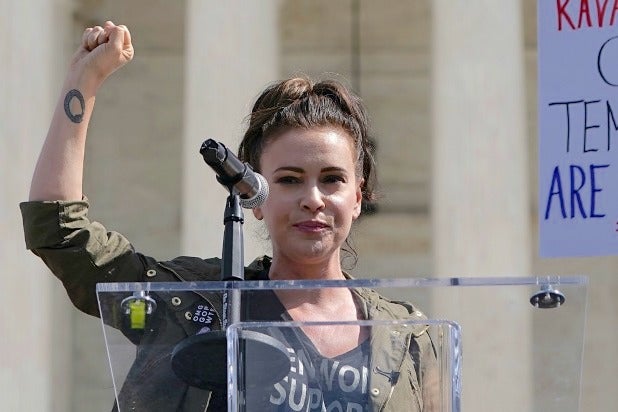
Alyssa Milano responded to Georgia’s anti-abortion law Friday night, calling for women to just say no to sex “until we get bodily autonomy back.”

“Our reproductive rights are being erased,” the actress-activist tweeted. “Until women have legal control over our own bodies we just cannot risk pregnancy. JOIN ME by not having sex until we get bodily autonomy back. I’m calling for a #SexStrike. Pass it on.”

ADVERTISING

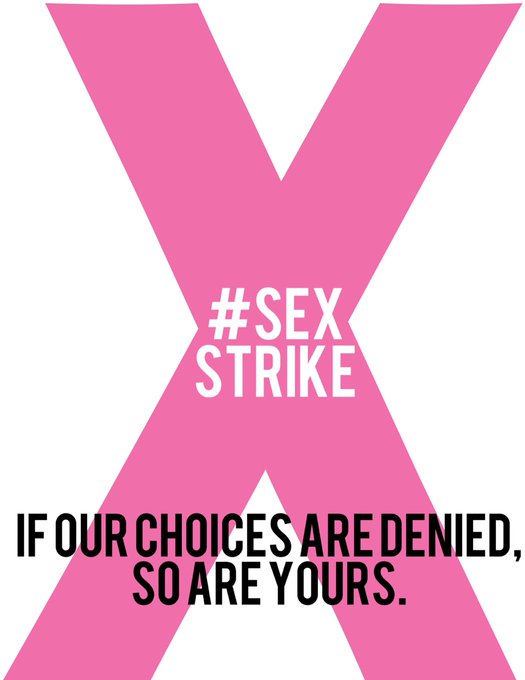
The message was accompanied by a giant pink “x” and the caption “If our choices are denied, so are yours.”

Milano’s call to action by female voters kicks up her protest of Republican Gov. Brian Kemp’s signed state legislation this week banning abortions after a fetal heartbeat is detected as early as six weeks into a pregnancy. Earlier in the week, she championed a boycott of the state of Georgia as a location of filming and where the second season of Netflix’s “Insatiable” is currently in production.

“I will do everything in my power to get as many productions as possible — including ‘Insatiable’ — to move out of this state which continues to put forth oppressive, hurtful policy that contradicts everything the entertainment industry stands for,” Milano said in a statement to TheWrapThursday.

She added: “Obviously, those who are already contractually obligated to be there, should fight to get their show out of Georgia while continuing their contractual obligation. I have to be there for another three weeks but you can be sure I will fight tooth and nail to move ‘Insatiable’ to a state that will protect our rights. And if it doesn’t move to another state, I will not be able to return to the show if we are blessed with a third season. This is my leverage. I will use it for the betterment of society and our great country.”

According to Georgia Trend, the Peach State overtook California as the top location for production of feature films in 2016, leading to an economic impact of $9.5 billion in fiscal 2017 and $2.7 billion in direct spending.

Alyssa Milano

@Alyssa_Milano

Our reproductive rights are being erased.

Until women have legal control over our own bodies we just cannot risk pregnancy.

JOIN ME by not having sex until we get bodily autonomy back.

I’m calling for a . Pass it on.