Exposing the Big Game

Forget Hunters' Feeble Rationalizations and Trust Your Gut Feelings: Making Sport of Killing Is Not Healthy Human Behavior

Exposing the Big Game

First human casualty from bird flu reported in Nepal

Exposing the Big Game's avatarThe Extinction Chronicles

KATHMANDU: Bird flu, also known as avian influenza (H5N1 influenza), has recently been determined as the cause of the death of an infected person from Kavrepalanchok district. This is the first reported avian flu casualty in the country, Ministry of Health and Population confirmed.

According to the health ministry, the 21-year-old patient whose identity has been kept under wraps, died on March 29 after having contracted the flu.

The results of the test on pathological sample extracted from the patient’s body, which was received on April 30, was found to be H5N1 influenza positive. The health officials who had diagnosed bird flu as the cause of the patient’s death had sent the patient’s sample to Japan for further tests.

Nepal witnessed an outbreak of the disease from early March this year.

Details to follow.

View original post

Dozens of grey whales washing up dead along migration route — and B.C. is their next stop

The whales appear emaciated but whether from decline of food supply or overpopulation is unclear

Every spring, the grey whales migrate from Mexico to the North Pacific. (Craig Hayslip/Oregon State University Marine Mammal Institute)

41
comments

An unusually high number of grey whales are washing up dead on West Coast shorelines on their annual migration north and B.C. is the next stop, warns a U.S.-based marine biologist.

More than 20 grey whales were stranded ashore in California this spring, and, further north along the coast in Oregon, several more have washed up recently.

Eleven whales were recently stranded in Washington state. Only one survived.

“We’re already beyond what we would typically consider high numbers and this is still early in our stranding season,” said Jessie Huggins, stranding co-ordinator for the Cascadia Research Collective.

in one of the longest migrations of any mammal, grey whales migrate from their wintering areas near Mexico to their summer feeding grounds in the North Pacific every year.

“They’re heading towards Canada,” Huggins told CBC’s On The Island. The whales are expected to pass by Vancouver Island.

Young grey whale pictured washed up on Ucluelet beach on Vancouver Island in 2016. (Les Doiron)

Food shortage

From necropsies on the animals, Huggins said it appears that food shortage is an underlying cause of the deaths.

“We’ve been seeing a lot of emaciated animals,” she said.

Grey whales feed on sediment along the ocean floor, which brings them closer to shore than other types of whales. Their proximity to land means they are more likely to wash ashore and for their deaths to be noted.

“Many other whales, when they die further off-shore, we never see them,” Huggins said.

“Especially skinny ones because they tend to sink first.”

Thanks to wildlife protection measures like the Marine Mammal Protection Act, grey whales became a “success story” and their numbers increased over the last decades.

The research hasn’t concluded whether the recent deaths are due to a decline in food sources or an overpopulation of grey whales or some combination of both.

“It’s difficult for us to tell at the moment, but we do know that, for the last year or two, there have been a number of very skinny whales,” Huggins said.

“They didn’t get enough food last summer and, along their normal migration patterns, are just not able to make it all the way to Alaska.”

On The Island
Dozens of grey whales washing up dead along migration route – and B.C. is their next stop
 LISTEN

00:00 06:53

An unusually high number of grey whales are washing up dead on West Coast shorelines on their annual migration north and B.C. is the next stop, warns a U.S.-based marine biologist. 6:53

Squirrel initially scares, then snuggles with subway riders

In this Monday, April 29, 2019 photo, provided by Rosanne Foley, a squirrel is perched on the arm of a Red Line Massachusetts Bay Transportation Authority commuter trolley as the train passes through the Dorchester neighborhood of Boston. Commuters say the squirrel bounded onto the Red Line trolley on Monday morning at an aboveground stop, prompting some passengers to hop onto their seats. (Rosanne Foley via AP)© The Associated Press In this Monday, April 29, 2019 photo, provided by Rosanne Foley, a squirrel is perched on the arm of a Red Line Massachusetts Bay Transportation Authority commuter trolley as the train passes through the Dorchester neighborhood of Boston. Commuters say the squirrel bounded onto the Red Line trolley on Monday morning at an aboveground stop, prompting some passengers to hop onto their seats. (Rosanne Foley via AP)BOSTON — A surprise passenger hitched a ride on a Boston commuter trolley, frightening some people at first, but warming their hearts when it willingly snuggled in a human passenger’s arms.

Commuters say a squirrel bounded onto a Red Line trolley Monday morning at an aboveground stop, prompting some passengers to hop onto their seats.

Passenger Rosanne Foley, the executive director of the Boston Landmarks Commission, posted a Twitter photo of the squirrel resting on another person’s arm. She tells boston.comsomeone even tried to feed the rodent a piece of granola bar.

The rodent rider was let off by passengers at another aboveground station.

Massachusetts Bay Transportation Authority spokeswoman Lisa Battiston commended the kindness of passengers but warned against interacting with wild animals on a train.

Beto O’Rourke now has the most robust climate proposal of any 2020 presidential candidate

But some activists think the plan doesn’t go far enough.

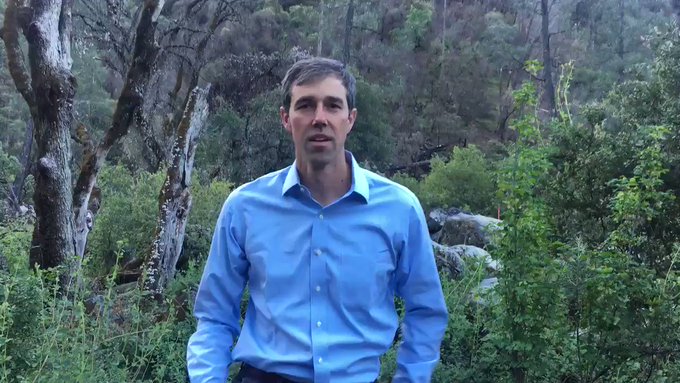
2020 presidential contender Beto O’Rourke toured Yosemite National Park on Monday, where he announced his $5 trillion plan to fight climate change. 
Beto O’Rourke/Twitter

Former Democratic Texas representative, 2020 presidential contender, and table-standerBeto O’Rourke on Monday released a new policy proposal, what he called “the most ambitious climate plan in the history of the United States.” While not entirely aligned with the Green New Deal resolution, the broad framework introduced to Congress in February, it’s the most comprehensive climate policy proposal put out by any 2020 contender to date.

Embedded video

Beto O’Rourke

@BetoORourke

Heading into Yosemite National Park to talk about our historic climate action plan. Follow along throughout the day and read the plan at http://BetoORourke.com/climate-change 

2,069 people are talking about this

O’Rourke is pitching big numbers and ambitious targets: $5 trillion in new investments, halving greenhouse gas emissions by 2030, and net-zero emissions by 2050. It’s his first major policy proposal and it’s a stab at distinguishing himself from the crowded field of 2020 presidential candidates on a major issue for Democratic primary voters. An April Monmouth Universitypoll of Iowa Democratic voters showed that climate change was the second-most important issue to voters after healthcare.

But getting more specific with his policies also opens him up to scrutiny and criticism. The plan has already drawn a scolding from activists who claimed right off the bad O’Rourke should have offered more aggressive goals. And Washington Gov. Jay Inslee, a fellow 2020 presidential contender, responded to the new plan by attacking O’Rourke’s record in Congress. These reactions are revealing a fissure between candidates and environmental activists who keep pushing further, a gap that could haunt both sides come election day.

O’Rourke’s climate plan brings more specifics and a narrower scope

The proposal lays out a four-pronged approach to how an O’Rourke administration will tackle climate change. That includes 1) executive action, 2) mobilizing $5 trillion over 10 years to invest in a clean energy transition, 3) guaranteeing net-zero emissions by 2050, and 4) preparing vulnerable communities for the impacts of climate change.

O’Rourke pulls no punches in laying out the stakes.

“Climate change is the greatest threat we face — one which will test our country, our democracy, and every single one of us,” he writes on his website.

Among its provisions, O’Rourke’s framework attaches dollar amounts to some specific line items, like $250 billion to research and development. It include grants for job training as part of its path to a cleaner economy, but for the most part, it’s narrowly focused on climate and energy — cutting emissions and creating alternatives.

Out of the top-line $5 trillion number, roughly $3.5 trillion in O’Rourke’s climate plan is allocated through tax incentives, loans, and other financing mechanisms for infrastructure, research, resilience, and clean energy deployment. The $1.5 trillion outlay would be funded by “structural changes to the tax code” that end tax breaks to fossil fuel companies and raise rates on corporations and top earners. Of that, $1.2 trillion would to grants for sustainable housing, transportation, public health, farming, and start-ups.

In that sense, O’Rourke’s climate plan actually looks quite a bit like the American Recovery and Reinvestment Act of 2009 in that it leverages a big chunk of public money and tax incentives to finance public infrastructure projects and spur innovation. In O’Rourke’s case, the aim to curb energy consumption and boost cleaner fuels and electricity sources.

However, it takes more than wind turbines and solar panels to fight climate change; you have to cut greenhouse gas emissions from existing fuel sources. And despite the attrition of coal, overall energy use, including fossil fuels, is still rising in the United States.

But rather than a carbon tax or a cap-and-trade system, O’Rourke is anchoring a legally binding net-zero emissions standard by 2050. “This standard will send a clear price signal to the market while putting in place a mechanism that will ensure the environmental integrity of this endeavor — providing us with the confidence that we are moving at least as quickly as we need in order to meet a 2050 deadline,” according to O’Rourke’s proposal. This doesn’t rule out pricing carbon but instead focuses on setting definitive goal posts.

While there is some funding allocated for job training, O’Rourke doesn’t include a federal jobs guarantee, a key element in the Green New Deal. And O’Rourke counts on market forces and incentives to move the needle toward cleaner energy to greater extent than the authors of the Green New Deal.

The backlash to O’Rourke’s proposal, explained

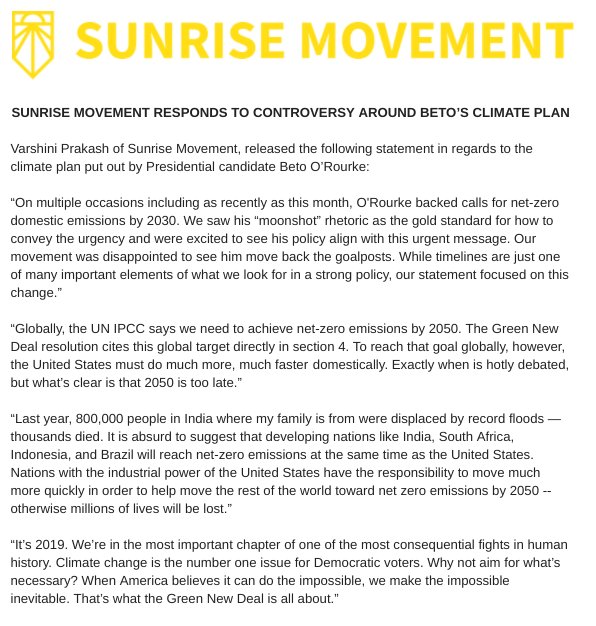
The Sunrise Movement, an activist group promoting the Green New Deal, immediately criticized the new proposal, not for its provisions, but for its timeline.

“Unfortunately, Beto gets the science wrong and walks back his commitments from earlier this month in Iowa to move to net-zero emissions by 2030,” Varshini Prakash, executive director of Sunrise, wrote in a statement Monday. “Beto claims to support the Green New Deal, but his plan is out of line with the timeline it lays out and the scale of action that scientists say is necessary to take here in the United States to give our generation a livable future.”

It’s true that O’Rourke said he wanted net-zero greenhouse gas emissions by 2030 during a campaign stop in early April. But that’s not in line with what scientists say is necessary. The Intergovernmental Panel on Climate Change reported last year that in order to keep global warming limited to 1.5 degrees Celsius this century, the world must halve greenhouse gas emissions by roughly 2030, get to zero net emissions by 2050, and go negative thereafter.

Getting to net-zero emissions by the middle of the century is already an incredibly ambitious target. Getting there in 10 years is damn near impossible.

Eric Holthaus

@EricHolthaus

My main concern with Beto’s plan is that net zero by 2050 is a global goal, not a U.S. goal. The U.S. goal needs to be much much more ambitious than that in order to motivate deeper cuts internationally that are consistent with the 1.5 degree target.https://twitter.com/EricHolthaus/status/1122888302678429703 

JesseJenkins@JesseJenkins

Okay. In my professional opinion, it is not really feasible to imagine a net zero transition by 2030, and the GND Resolution itself does not call for such a timeline. But I can see how you’d reach that conclusion from the IPCC report.

See JesseJenkins’s other Tweets

Back in March, Zeke Hausfather, a climate scientist and analyst with Carbon Brief, ran through, sector by sector, the extraordinary list of things that would need to happen in a 10-year mobilization to net-zero emissions vs. a 30-year mobilization.

Zeke Hausfather@hausfath

The targets set in the proposed Green New Deal are a bit ambiguous. It suggests a 10-year mobilization, but does not necessarily set a goal of net-zero carbon by 2030. Lets explore the impact of the goals on the climate and the challenge of mitigation *epic thread*. 1/27

93 people are talking about this

And even the Green New Deal’s framers aren’t aiming for net-zero emissions by 2030. My colleague David Roberts directly asked Sen. Ed Markey (D-MA), one of authors of the Green New Deal resolution, if this was the target. The senator emphatically said no.

Yet Sunrise at first said that the Green New Deal calls for a 10-year mobilization to meet 100 percent of US power demand with zero-emissions sources.

Update, Wednesday, 2:21 pm: Prakash released another statement acknowledging that the Green New Deal cited the IPCC target of net-zero emission by 2050, but that “2050 is too late.”

Sunrise Movement 🌅

@sunrisemvmt

Our statement on the controversy around @BetoORourke‘s climate plan:

THREAD

29 people are talking about this

Other environmental groups had a more favorable read of O’Rourke’s proposal. “This plan to confront the climate crisis is the kind of leadership we need from our next president,” Tiernan Sittenfeld, senior vice president for government affairs at the League of Conservation Voters, wrote in a statement.

O’Rourke isn’t counting on Congress to drive climate policy

Should O’Rourke take the oath of office in 2021, he says he will reenter the Paris climate agreement, implement rules to cut emissions of super-potent greenhouse gases like methane and hydrofluorocarbons, set tighter clean air rules, ramp up appliance efficiency standards, demand clean energy procurement from federal contractors, and end new fossil fuel leases on public lands.

Some states might sue to block these changes, but they are grounded in existing legal authorities and are likely the most feasible parts of his climate agenda, especially if Congress remains just as gridlocked after the next election.

Still, a comprehensive, enduring climate policy would still have to go through the House and Senate at some point. Lawmakers pushing the Green New Deal show no sign of letting up so far, but with the Senate filibuster in place, most meaningful climate policies have grim prospects barring a massive sweep in the next election. (O’Rourke has broached getting rid of the filibuster.)

O’Rourke deserves credit for going beyond simply giving a thumbs up or thumbs down on the Green New Deal like other presidential contenders. And it’s likely other candidates will soon weigh in with more robust climate proposals of their own. Sen. Elizabeth Warren (D-MA) as already taken a stab at climate policy through her plan for public lands released in April, which also calls for ending new leases for fossil fuel extraction. Her proposal adds a commitment to generate 10 percent of US electricity from renewables on public lands.

It’s Hard to Believe How Close This Asteroid Is Going to Get to Earth

Exposing the Big Game's avatarThe Extinction Chronicles

A simulation showing 99942 Apophis’s expected path past Earth. The blue dots represent orbiting satellites, and the pink line represents the International Space Station.
GIF: NASA

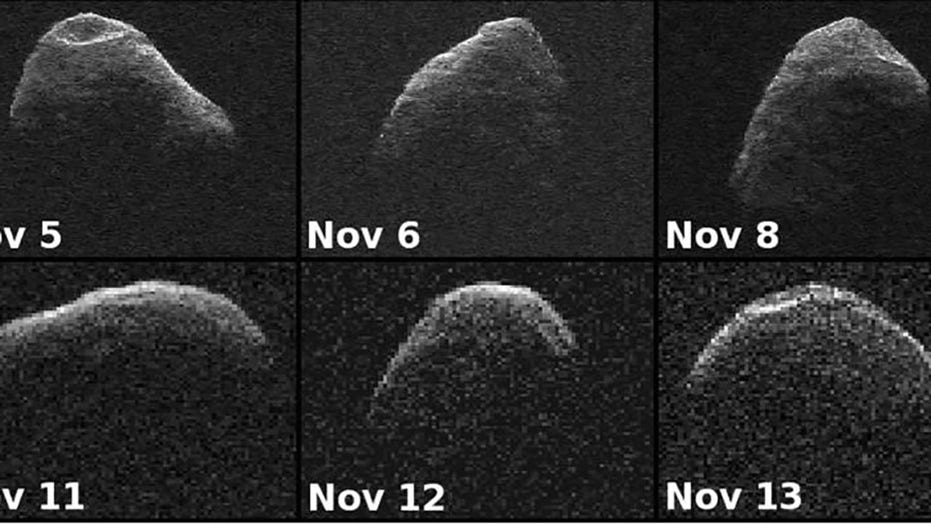
While space agencies simulate an asteroid impact this week at the 2019 Planetary Defense Conference, there’s a real asteroid they’re monitoring that will make a close appearance in just 10 years.

99942 Apophis is among the most infamous near-Earth objects. When astronomers at Kitt Peak National Observatory discovered it in 2004, they initially calculated a 2.7 percent chance that it would hit Earth and assigned it a level 4 on the Torino Scale, the highest assignment for a near-Earth object ever. Though it has since been downgraded and is expected to pose no threat to the planet, it’s a real-life version of the simulated asteroid scenarios that scientists are currently playing out.

“The Apophis close approach…

View original post 358 more words

Changing climate may affect animal-to-human disease transfer

Exposing the Big Game's avatarThe Extinction Chronicles

1 May 2019

Climate change could affect occurrences of diseases like bird-flu and Ebola, with environmental factors playing a larger role than previously understood in animal-to-human disease transfer.

Researchers from The University of Queensland and Swansea University have been looking at how different environments provide opportunities for animal-to-human diseases – known as zoonotic diseases – to interact with and infect new host species, including humans.

Dr Nicholas Clark, from UQ’s School of Veterinary Science, said this was a new line of thinking in this area, changing how we understand, and tackle, emerging zoonotic diseases.

“These diseases are caused by pathogens – for example, viruses, bacteria or parasitic worms – that cross from animals to humans, including notorious infections like bird flu, rabies virus and Ebola,” he said.

“In the past, we’ve primarily looked at how many different types of animal species a pathogen infects – widely considered an…

View original post 307 more words

Minnesota House moves to ban wolf hunting

Exposing the Big Game's avatarCommittee to Abolish Sport Hunting Blog

The Minnesota House on Tuesday, April 30, voted to ban hunting of wolves. National Park Service photo

ST. PAUL — By a one-vote margin, the Minnesota House on Tuesday, April 30, voted to ban hunting of wolves — a victory for wolf protectionists hoping to gird against the Trump administration’s plan to remove protections for the iconic animal.

A ban on wolf hunting would be a reversal for Minnesota — the only state in the Lower 48 where the animals were never eradicated and the first to adopt a hunting season when it became legal again several years ago.

Today, wolf hunting isn’t allowed — but only because the animal is on the federal endangered species list. Under current state law, if wolves were removed from the protections of the Endangered Species Act…

View original post 534 more words

Arizona Officials Consider Ban on Hunting Contests

Exposing the Big Game's avatarCommittee to Abolish Sport Hunting Blog

share this article

https://www.publicnewsservice.org/2019-05-01/endangered-species-and-wildlife/arizona-officials-consider-ban-on-hunting-contests/a66337-1

A proposed rule change by the Arizona Game and Fish Commission would end hunting contests that often target such apex predators as coyotes, bobcats and foxes. (GabrielAssan/AdobeStock)

May 1, 2019

CAREFREE, Ariz. – The Arizona Game and Fish Commission is considering a ban on wildlife-killing contests.

More than 20 of these events, also known as “targeted hunts,” currently are held each year in Arizona. The targeted species usually include coyotes, bobcats and foxes but sometimes focus on mountain lions, coatimundis, badgers and jackrabbits.

Sandy Bahr, who heads the Sierra Club’s Grand Canyon Chapter, said the contests often go after predator animals but serve no conservation function.

“These wildlife-killing contests do not serve wildlife management,” she said. “They focus on killing the most animals or the biggest. They really are more about killing a lot of animals. It’s not hunting.”

Typically, Bahr said, the participants join for a fee and…

View original post 197 more words

Huge ‘God of Chaos’ asteroid to pass near Earth in 2029: report

Exposing the Big Game's avatarThe Extinction Chronicles

A 1,110-foot-wide asteroid named for the Egyptian god of chaos will fly past Earth in 2029 within the distance of some orbiting spacecraft, according to reports.

The asteroid, 99942 Apophis, will come within 19,000 miles of Earth on April 13, a decade from now, but scientists at the Planetary Defense Conference are already preparing for the encounter, Newsweek reported. They plan to discuss the asteroid’s effects on Earth’s gravity, potential research opportunities and even how to deflect an incoming asteroid in a theoretical scenario.

NASA CHIEF WARNS ASTEROID THREAT IS REAL: ‘IT’S ABOUT PROTECTING THE ONLY PLANET WE KNOW TO HOST LIFE’

Scientists say most asteroids that pass near Earth aren’t more than 30 feet wide, making Apophis, named for an…

View original post 89 more words