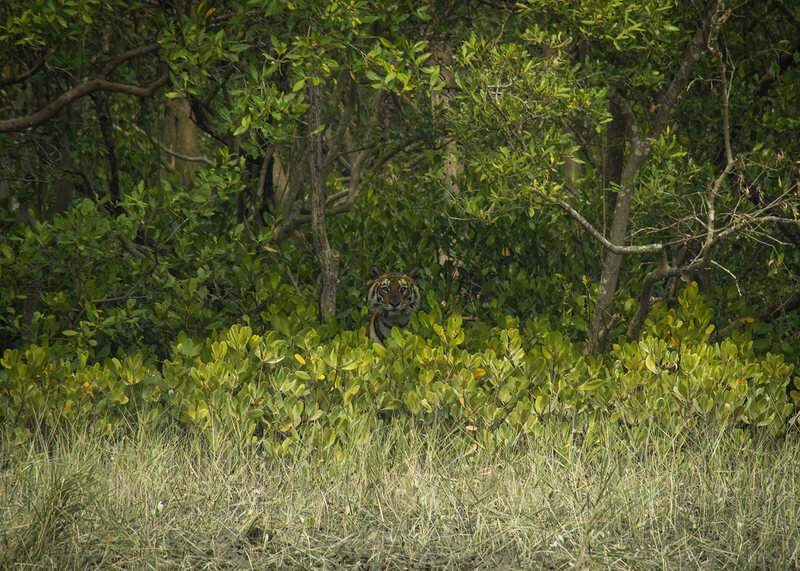
DEEP IN THE SUNDARBANS IN southwestern Bangladesh, one of the world’s largest mangrove forests saw its tigers disappear at an alarming rate. The population of big cats had begun to disappear at the turn of the 21st century, snatched by poachers and pirates who snuck their way into the wildlife sanctuary in search of tiger skin. But a recent effort to double down on illegal poaching has allowed the population of Bengal tigers in the Sundarbans to increase for the first time in 15 years, according to a new tiger census released on May 21, 2019, the Dhaka Tribune reports.
Split between Bangladesh and India, the Sundarbans mangroves spread their roots throughout 4,000…
On Oct. 14, 1996, Hiroshi Yagi photographed a wolf-like animal in the mountains of Chichibu, Saitama Prefecture. The creature was later called the Chichibu yaken (wild dog). | COURTESY OF HIROSHI YAGI
CHICHIBU, SAITAMA PREFECTURE – It was around 3 p.m. on a chilly day in December. The sky was overcast and the scent of rain hung in the air when Rina Kambayashi happened upon a creature she had never seen before. Opening the front door to her family’s gracefully weathered 150-year-old traditional wooden house, Kambayashi stepped out into the garden. She froze when she noticed a lone, dog-like animal standing among the withered shrubs growing by the rim of a small, empty, man-made pond. The distance between them was around 3 to 4 meters, the 53-year-old homemaker recalls when we meet in April at her residence on the outskirts of…
A northeastern Washington state wolf in a photo taken by a trail camera. State wildlife officials have determined that a rancher was justified in killing a wolf as it headed toward three calves that were in a fenced area.
WDFW
An Okanogan County rancher who shot and killed a wolf as it approached three newborn calves was promptly cleared by Washington Fish and Wildlife investigators, according to records released Tuesday.
The rancher shot the young male wolf the morning of April 29. The reports, released in response to a records request by the Capital Press, were redacted to withhold the names of the rancher and investigators, as well as the exact location.
The shooting occurred east of Highway 97, where wolves are not federally protected, but are a state protected species. The unjustified killing of a state endangered animal is a gross misdemeanor, punishable by up to a year in jail and a $5,000 fine.
“I could tell (the rancher) was very tense, and I assured (him) that we were present to document what had occurred, and we were there to advocate for his personal and property rights as much as the rights of wildlife,” according to one investigator’s report.
Another investigator noted that only five days earlier, Fish and Wildlife Director Kelly Susewind had issued a memo directing department employees to “maintain public safety as a priority.”
The investigator said he “wanted to make prompt decisions to alleviate any fear the family had.”
“I informed (the rancher and his wife) that it was a justified act and did not want them to stress about a delayed finding or decision,” he wrote.
Washington law allows livestock owners to kill without a permit one wolf that is attacking their domestic animals. The law does not apply to the western two-thirds of Washington, where wolves are protected by the federal Endangered Species Act.
The rancher told investigators he was home with two young children when he saw an animal near the house moving toward the fenced pasture between 8 and 9 a.m.
Three calves born the night before were near the fence. The rancher said he keeps newborn calves in the pasture closest to his house to protect them from predators.
The rancher said he wasn’t sure whether it was a wolf or coyote and yelled to scare it away. The animal continued toward the pasture. The rancher fired the only round in his rifle.
The bullet went over one cow, the rancher said. An investigator noted the bullet also would have passed a children’s jungle gym in the backyard.
Investigators found an entrance wound near the wolf’s heart and lungs.
The distance from the home’s back porch to the carcass was approximately 280 yards, according to measurements taken by the Fish and Wildlife investigators. The carcass was 56 yards from the pasture’s fence.
“Once in with the cattle, it may be difficult to shoot the animal actively attacking a calf,” one investigator wrote. “No charges were filed against the RP. Case closed.”
Fish and Wildlife investigators noted that the family had reported wolves around their ranch last fall and photographed one with a trail camera. A driver delivering a package reported seeing two pups on the property last fall.
Sorry you only heard this here first. But our media were understandably preoccupied by the President of the United States promoting a doctored video to try to embarrass our House Speaker by suggesting she was drunk. (Hint: she was not).
Meanwhile, the children who inhabit the rest of the world are more concerned about the survival of the planet.
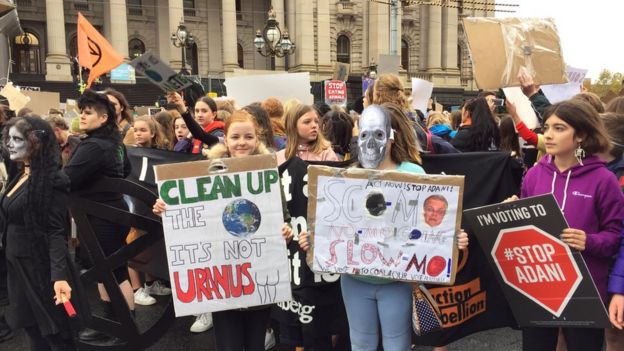
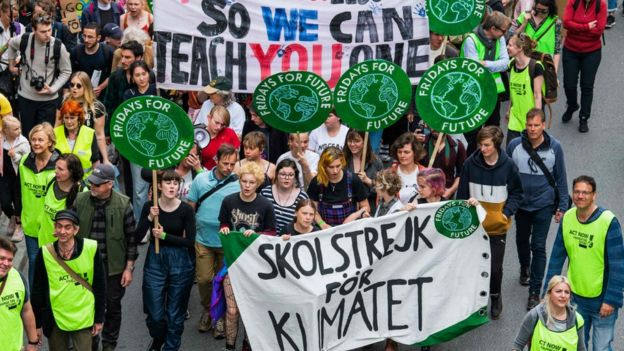
Hundreds of thousands of students around the world walked out of their schools and colleges Friday in the latest in a series of strikes urging action to address the climate crisis. According to event organizers Fridays for Future, over 1664 cities across 125 countries registered strike actions, with more expected…
A very big asteroid with its own little moon is going to zip past Earth tonight (May 25) — close enough that, with some preparation and a decent telescope, amateur astronomers may spot it blotting out the stars.
This moon-and-asteroid system, called 1999 KW4, is made up of two rocks. The big one is about 0.8 miles (1.3 kilometers) wide, according to NASA, and shaped like a spinning top. The smaller one is more elongated and stretches 0.35 miles (0.57 km) along its longest dimension. It points lengthwise toward its much larger twin.
Together, the asteroid and its minimoon will pass Earth at such a strange, steep angle that NASA called them “the least accessible … for a spacecraft mission of any known binary near-Earth asteroid.”
But that doesn’t mean they aren’t interesting to look at.
The two asteroids will pass closest to Earth at 7:05 pm EDT (1105 GMT), when they’ll be just 3,219,955 miles (5,182,015 km) from the planet’s surface. That’s more than a dozen times the distance between the Earth and the moon in its orbit around our planet, and much too far for the space rocks to pose any threat. In fact, this is the fourth approach the binary asteroids have made toward Earth since they were discovered in 1999, and not the closest. This is not the first time, according to EarthSky, that astronomers plan to make radar images of these asteroids as they pass.
Back on May 25, 2001, according to NASA, the asteroids passed about 6.7% closer to Earth than they will this time, at a distance of 3,005,447 miles (4,836,798 km). Seventeen years from now, on May 25, 2036, the rocks will pass 55.2% closer to Earth, at a distance of just 1,443,511 miles (2,323,106 km) — again, posing no threat worth worrying about.
These big rocks have been frequent flyers in our planet’s neighborhood for a long time.
“1999 KW4 approaches within 0.05 AU of Earth several times each century,” NASA’s report on the object said. “This trend exists from at least [the year] 1600 [to] 2500.” [Black Marble Images: Earth at Night]
“AU” refers to “astronomical units,” a unit equal to the distance between Earth and the sun. So 0.05 AU is equal to one-twentieth the distance between Earth and sun, or about 4,650,000 miles (7,480,000 km). The two asteroids have passed even closer to Earth, without incident, several times a century since William Shakespeare was writing, and they will continue to do so until this article is at least 500 years old.
EarthSky reported that during the space rocks’ closest approach, they’ll be most visible in the Southern Hemisphere, appearing as fast-moving shadows against stars in the constellation Puppis. The two asteroids will remain visible for several days, though, according to EarthSky. North American asteroid hunters may spot the objects near the constellation Hydra on the evening of May 27.
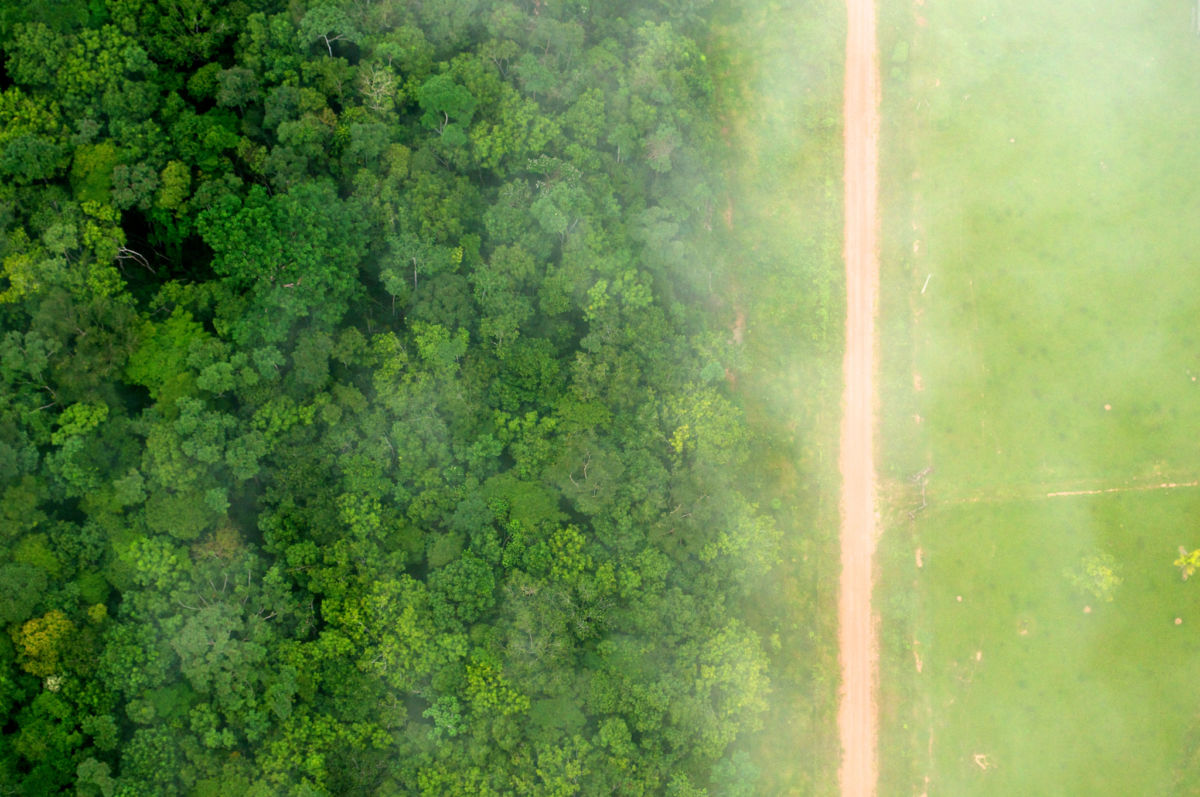
Rio Branco, Brazil — The state of Acre, on the western edge of Brazil, is so remote, there’s a national joke that it doesn’t exist. But for geochemist Foster Brown, it’s the center of the universe, a place that could help save the world.
“This is an example of hope,” he said, as we stood behind his office at the Federal University of Acre, a tropical campus carved into the Amazon rainforest. Brown placed his hand on a spindly trunk, ordering me to follow his lead. “There is a flow of water going up that stem, and there is a flow of sap coming down, and when it comes down it has carbon compounds,” he said. “Do you…
Greenland’s ice sheet is melting six times faster than it was in the 1980s — that’s even faster than scientists thought.
A new study has revealed that melting Greenland ice has contributed to more than half an inch of global sea-level rise since 1972. Half of that increase happened in the last eight years.
If all of Greenland’s ice were to melt, it would raise sea levels 23 feet, submerging some coastal cities. In the US, that would put everything south of West Palm Beach, Florida underwater.
Greenland’s ice is melting six times faster now than it was four decades ago.
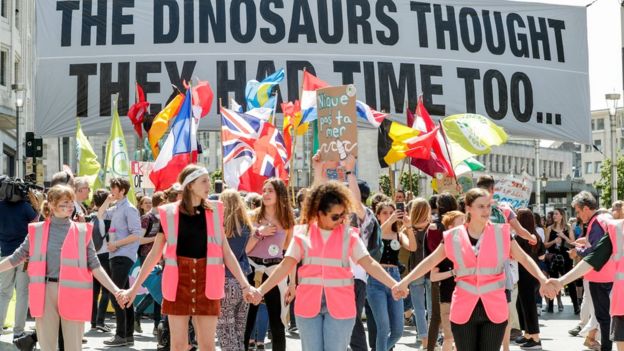
Media captionBelgium students among one million expected in more than 100 countries
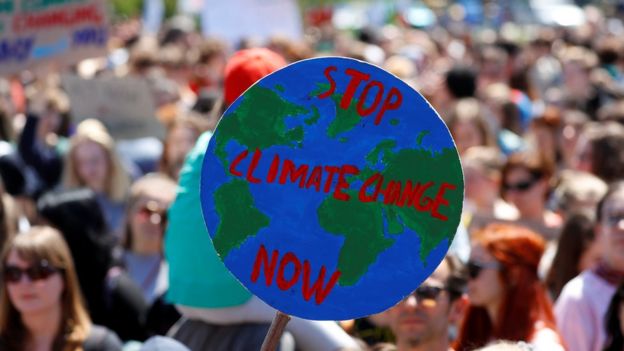
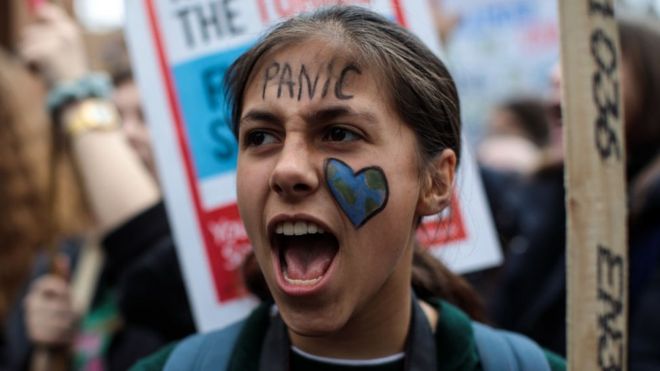
School students around the world have gone on strike to demand action on climate change.
Organisers said more than a million people were expected to join the action in at least 110 countries on Friday.
They are calling on politicians and businesses to take urgent action to slow global warming.
The strikes are inspired by student Greta Thunberg, who has become a global figurehead since protesting outside Sweden’s parliament in 2018.
Carrying a “school strike for climate change” sign, the then 15-year-old said she was refusing to attend classes until Swedish politicians took action.
Media captionThe Swedish teen behind the climate strikes
The solo protest led to various movements across Europe, the US and Australia, known as Fridays for Future or School Strike for Climate.
The last co-ordinated international protest took place on 15 March, with an estimated 1.6 million students from 125 countries walking out of school.
The action on Friday began in Australia and New Zealand.
In Melbourne, 13-year-old Nina Pasqualini said she was joining the strike because she was worried about “weather disasters”.
“Every time we have huge a bushfire here another animal might go extinct,” she told Reuters news agency.
Image copyrightREUTERSImage captionOrganisers are expecting more than a million students around the world to walk out
Australia just had its hottest summer on record and climate change is seen as the cause of the increasing frequency and severity of droughts, heat waves, floods and the melting of glaciers around the world.
As countries around the world woke up, the action spread.
Strikes were held in Asian nations including India, Afghanistan Thailand and Japan.
In Europe – where the movement first gained traction – images of mass strikes were shared on social media.
“Inaction equals extinction” and “save the world not your money” read some of the placards on display.
Image copyrightGETTY IMAGESImage captionGreta Thunberg led a march in Stockholm on FridayImage copyrightEPAImage captionProtesters in Brussels warned that time is running out to take actionImage copyrightEPAImage captionStudents in Frankfurt were among those calling for policies to save the planetImage copyrightREUTERSImage captionClimate protesters blocked the entrance to Norway’s central bank, demanding that it stop investing in companies that burn coalImage copyrightREUTERSImage captionDemonstrators in the Austrian capital said governments needed to act to “stop climate change now”
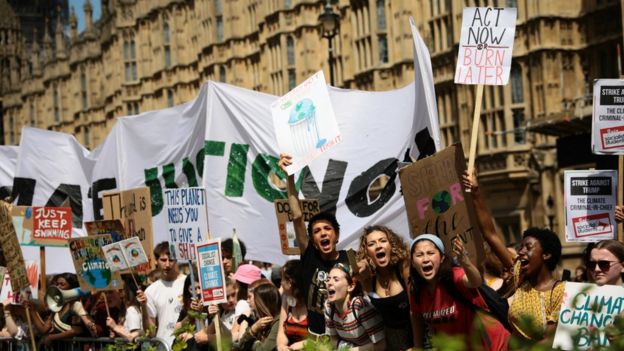
In London, scores of protesters congregated outside parliament, chanting “climate change has got to go”.
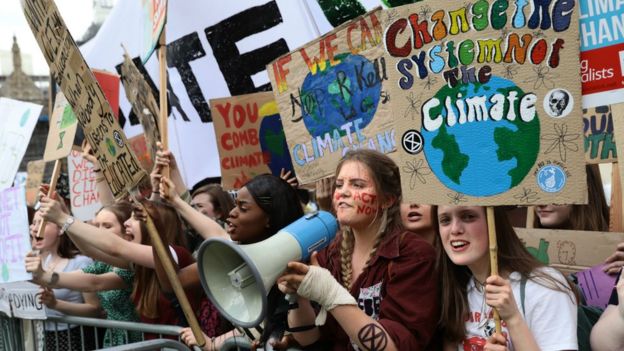
“Act now or burn later” and “change the system not the government” read some of the signs held up by participants, as they called for urgent action.
Student protesters want the government to reform the national curriculum to include more material on climate change.
Organisers said strikes had been organised in about 125 towns and cities across the UK.
Image copyrightGETTY IMAGESImage captionStudent protesters joined the global movement outside parliament in LondonImage copyrightGETTY IMAGESImage captionYoung people are calling on their governments to “act now” on climate change
An invitation to older generations
In an open letter published in Germany’s Süddeutsche Zeitung on the eve of Friday’s strike, Ms Thunberg and prominent German climate activist Luisa Neubauer, 22, called on older generations to join the action in September.
“This is our invitation. On Friday, 20 September, we will start an action week for the climate with a worldwide strike. We ask you to join us… Join in the day with your neighbours, colleagues, friends and families to hear our voices and make this a turning point in history.”
Fake meats at Arby’s? “Impossible,” says the Atlanta-based restaurant chain. ( Arby’s )
When VegNews published an article this week claiming “Arby’s Looks to Add Plant-Based Impossible Meat to Menu,” Arby’s decided it was necessary to point toward its slogan since 2014, “We Have the Meats.” And that means real meats.
An article in Food & Wine reports that a presentation targeting investors during Impossible Meats recent $300 million funding found, Arby’s was included among a group of chains that Impossible Meats claimed had reached out to them. But in a statement, Arby’s says it will never serve plant-based protein products.
“Contrary to reports this week, Arby’s is not one of the restaurant companies interested in working with Impossible Foods,” the statement said. “The chances we will bring plant-based menu items to our restaurants, now or in the future, are absolutely impossible.”













 Exposing the Big Game
