Exposing the Big Game

Forget Hunters' Feeble Rationalizations and Trust Your Gut Feelings: Making Sport of Killing Is Not Healthy Human Behavior

Exposing the Big Game

Climate Crisis Weekly: 2019’s extreme weather breaks records, UN says climate change threatens human rights, more

  • 2019 could feature some of the most extreme weather in 20 years. And yes, climate change is a major catalyst.
  • The UN says that the climate crisis is the greatest threat ever to human rights.
  • Why are hurricanes getting stronger? Three reasons.
  • British farmers say we don’t need to stop consuming beef to address the climate crisis.
  • And more…

2019 has not been a good weather year — and that’s an understatement. It could be one of the most disastrous in 20 years before we move into 2020. According to the Internal Displacement Monitoring Center in Geneva, extreme weather events displaced a record 7 million people globally during the first six months of this year.

There was Cyclone Fani in May in Bangladesh and India (3.4 million evacuated), and Cyclone Idai in southern Africa in March, which killed more than 1,000. There was flooding in Iran in March and April that affected 90% of the country, and massive flooding throughout the US Midwest and South in the first half of the year.

And that was before Hurricane Dorian battered the Bahamas, parts of the US Eastern Seaboard, and Nova Scotia last week. Typhoon Faxai (pictured above) hit Japan on Monday. Faxai was one of the strongest storms to hit Tokyo in a decade, with record-breaking winds. (FYI, the only difference between a hurricane and a typhoon is the location where the storm occurs.)

Alexandra Bilak, director of the Internal Displacement Monitoring Center, told the New York Times:

With the impact of climate change, in the future these types of hazards are expected to become more intense. Countries that are affected repeatedly like the Bahamas need to prepare for similar, if not worsening, trends.

And we’re not done yet, as we’re still in storm season. “The monitoring center estimates that the number of disaster-related displacements may grow to 22 million by the end of the year.”


Michelle Bachelet, the UN high commissioner for human rights, addressed climate change in her opening statement on September 9 during the global update at the 42nd session of the Human Rights Council.

She made five major points that she thinks should guide the world in climate action:

  1. Climate change undermines rights, development, and peace.
  2. Effective climate action requires broad and meaningful participation.
  3. We must better protect those who defend the environment.
  4. Those most affected are leading the way.
  5. Business will be crucial to climate action.

Bachelet said, “the world has never seen a threat to human rights of this scope.” Her entire speech can be read here.


As we’re at the height of storm season, the Environmental Defense Fund spells out very clearly and simply how climate change makes hurricanes more destructive on their website. In a nutshell:

  • More evaporation fuels storms. Evaporation intensifies as temperatures rise, thus increasing the water vapor pulled into the storms.
  • Sea level rise makes storm surges worse. As ice melts due to warmer ocean water, higher seas result in higher surges.
  • Storm-related flooding is on the rise. Intense single-day rain events are increasing.

And for those of you who prefer visual learning, Vox made this video in 2017 that explains how climate change makes hurricanes worse:


The British National Farmers’ Union says that farming can become climate neutral by 2040 without cutting out beef consumption. Agriculture causes about 10% of carbon emissions in the UK. (Farmers say they want to combat climate change; they work outside, and it affects their crops.) Their plan? Here’s a paraphrase from the Guardian:

  • Offsetting half of farming emissions “by growing willow, miscanthus grass, and other energy crops to use in bioenergy with carbon capture and storage power plants.”
  • Doubling of wind, solar, and biomethane energy on farms.
  • Storing more carbon in soils, peatlands, woodlands, and hedgerows offsets another fifth of agricultural emissions.
  • Cut one-quarter of farming emissions by raising animals and growing crops more efficiently. This includes feed additives to cut methane in animals, gene editing to improve crops and livestock, and controlled-release fertilizers.

Germany is planning to spend up to €75 billion ($83 billion) by 2030 to combat climate change, according to a proposal from the Transport Ministry.

Says Deutsche Welle:

Germany’s governing coalition parties will meet Friday to discuss measures targeting the transportation sector to ensure the country meets its 2030 goals to combat climate change.

Proposals call for tax breaks and subsidies to bolster electric car purchases, the construction of new cycle paths, improving public transportation, promoting alternative fuels, and overhauling the railway network, among other measures, to tackle the destabilization of Earth’s climate system.

The German government is expected to present a program by September 20.


Eight US states have banned single-use plastic bags. (That’s California, Connecticut, Delaware, Hawaii, Maine, New York, Oregon, and Vermont.) Cities who have bans as well are Boston, Chicago, Los Angeles, San Francisco, and Seattle. And on Sunday, September 15, Anchorage, Alaska, will be joining them.

Anchorage retailers will no longer be allowed to hand out plastic bags to customers. This also includes biodegradable bags, because the Alaskan city-states that they don’t biodegrade well in their climate.

“Sellers may provide non-plastic bags, such as paper, at a minimum cost of $0.10 per bag up to a maximum of $0.50 per trans action,” according to the Municipality of Anchorage’s website. Produce and meat bags have unfortunately escaped the ban. Weirdly, so has plastic bags for newspapers or an unfinished bottle of wine. (People, finish your wine and skip the bag.)

The Alaskan city is rightly pushing reusable bags. But while the single-use ban is welcome, perhaps it could have been a bit more stringent.


The Global Commission on Adaptation released a report on September 10 that details the ways in which the world needs to adapt to climate change in order to become resilient.

Commissioners are made up of world leaders in such sectors as government, business and NGOs, from Bill Gates to Ban-ki Moon to Paris mayor Anne Hidalgo and Kristalina Georgieva, CEO of the World Bank.

The 5 areas the commission recommends we invest in are:

  • Strengthening early warning systems
  • Making new infrastructure resilient
  • Improving dryland agriculture crop production
  • Protecting mangroves
  • Making water resources management more resilient

The commission states that if these five areas were implemented, total net benefits would be worth $7.1 trillion. The commission recommends paying for it with public sector, private sector, and international financial support in developing countries.

You can read the entire report here.


For those of you who are educators and want and/or need to teach their students about climate change, Yale Climate Connections provides a handy list of nine climate-change books to use. (Or hey, maybe you just want to learn more about it yourself.) You can peruse the list of nine by reading their article, but here are three books to start with:

Climate Change Education: Goals, Audiences, and Strategies: A Workshop Summary, by National Research Council. Sherrie Forest and Michael A. Feder, editors (National Academies Press, 2012) — Bonus! A free download of this book is available here.

Teaching Climate Change in the Humanities, edited by Stephen Siperstein, Shane Hall, and Stephanie Lemenager (Routledge, 2017)

The Teacher-Friendly Guide to Climate Change, edited by Ingrid H. H. Zabel, Don Duggan-Haas, Robert M. Ross, Benjamin Brown-Steiner, and Alexandra F. Moore (Paleontological Research Institution 2017) — Bonus! A free download of this book is available here.

Asteroids, supervolcanoes, and nuclear wars could block the sun

Exposing the Big Game's avatarThe Extinction Chronicles

castle bravo shrimp nuclear test blast bikini atoll mushroom cloud noaa
The mushroom cloud of the Castle Bravo nuclear test on March 1, 1954.
NOAA

Research suggests the consequences of supervolcano eruptions and nuclear bombs could be similar to the aftermath of the asteroid that doomed the dinosaurs.

About 74,000 years ago, for example, the Toba supervolcano eruption sent clouds of sulfur dioxide into the atmosphere, cutting sunlight by as much as 90%. That volcanic winter might have reduced the global human population to just 3,000 people, based on one analysis.

If enough nuclear bombs (thousands of them) were to explode, that could also bring on a nuclear winter that would reduce sunlight levels by more than 90%, according to a 1983 paper co-authored by Carl Sagan. Global temperatures could drop up to 45 degrees Fahrenheit in that scenario.

“Such rapid and drastic cooling could make farming impossible, even in those regions spared by the missiles,” Walsh writes.

Mt. St. Helens
The Mount…

View original post 770 more words

The world has a third pole – and it’s melting quickly

Exposing the Big Game's avatarThe Extinction Chronicles

An IPCC report says two-thirds of glaciers on the largest ice sheet after the Arctic and Antarctic are set to disappear in 80 years

The Mingyong glacier at the foot of Khawa Karpo.
 The Mingyong glacier at the foot of Khawa Karpo. Photograph: Tao Images Limited/Alamy Stock Photo

Many moons ago in Tibet, the Second Buddha transformed a fierce nyen (a malevolent mountain demon) into a neri (the holiest protective warrior god) called Khawa Karpo, who took up residence in the sacred mountain bearing his name. Khawa Karpo is the tallest of the Meili mountain range, piercing the sky at 6,740 metres (22,112ft) above sea level. Local Tibetan communities believe that conquering Khawa Karpo is an act of sacrilege and would cause the deity to abandon his mountain home. Nevertheless, there have been several failed attempts by outsiders – the best known by an international team of 17, all of…

View original post 1,914 more words

Impossible Foods To Make Its Supermarket Debut Next Week

‘Get ready to enjoy Impossible Burger where food tastes best – at home’
The meatless patty will hit selected stores this month (Photo: Instagram / Impossible Foods)

The meatless patty will hit selected stores this month (Photo: Instagram / Impossible Foods)

Plant-based startup Impossible Foods is to make its supermarket debut on September 20 – after a key ingredient received approval from the Food and Drug Administration (FDA) earlier this year.

The ruling – which cleared the use of soy leghemoglobin, aka heme, as a color additive – meant the company would be able to sell its products directly to consumers instead of only to restaurants.

‘Smells like palm trees’

Impossible Foods has kept secret the first location to stock its meat-free burgers, writing on Instagram: “Guess what city you can find us on shelves? Here’s a hint: Smells like palm trees.

“Get ready to enjoy Impossible Burger where food tastes best – at home. Stay tuned to find out where we’re headed first.”

Vegan controversy

Impossible Foods itself consider its meatless patty to be plant-based rather than vegan.

This is because in 2017 heme was fed to rats in order to test its safety. More than 180 rats were killed as a result of the testing.

CEO Pat Brown reacted to the controversy, publishing a statement titled The Agonizing Dilemma of Animal Testing.

Last convicted shark-dragger Benac will get fishing license back in 2022

Last convicted shark-dragger Benac will get fishing license back in 2022

(Beth Clifton collage)

If,  that is,  he does 250 hours of community service & finds an animal shelter that will take him for 125 hours

            TAMPA,  Florida––Holding out for a lighter sentence under a plea bargain offer did not wholly pay off on September 12,  2019 for Robert Lee “Bo” Benac III,  30.

But Benac did avoid a felony cruelty conviction and will get his fishing license back two years sooner than shark-dragging  buddy Michael Wenzel,  even if he will have to perform more than twice as much volunteer community service work meanwhile.

Benac was the last of three Florida men to settle charges originally filed as felony cruelty,  after they shot and dragged a blacktip shark to death behind a speedboat on June 26,  2017 near Egmont Key in Hillsborough County waters.

Mark Wenzel (left) & Bo Benac (right)
(Facebook photo)

Benac pleaded guilty to two misdemeanors

Benac,  of Bradenton,  Florida,  pleaded guilty to misdemeanor charges of aggravated cruelty to animals and violating Florida Fish & Wildlife Conservation Commission fishing rules.

Benac was sentenced to serve 10 days in the Hillsborough County jail ,  the time to be served on weekends,  plus 11 months on probation.  Benac is also to pay a $2,500 fine and perform 250 hours of community service,  half of those hours at an animal shelter.
Benac in addition lost his fishing license for three years.

Benac in March 2019 reportedly refused the same plea deal that fellow shark-dragger Wenzel,  22,  accepted.  Wenzel,  who was videotaped exulting as the men dragged the dying shark, accepted the same jail and probation time,  and the same fine of $2,500,  but was required to perform only 100 hours of community service,  and had his fishing privileges suspended for five years.

Clockwise from top: Michael Wenzel,  Bo Benac,  Spencer Heintz, & Nick Easterling.

Wenzel pleaded to one felony

Wenzel pleaded guilty,  reported Joe Hendricks of the Anna Maria Sun,  “to a third-degree felony count of aggravated cruelty to animals.  A second and similar third-degree animal cruelty charge was dismissed.”

Wenzel,  like Benac,  also pleaded guilty to violating Florida Fish & Wildlife Conservation Commission rules,  Hendricks wrote.

“The misdemeanor charge pertained to the illegal taking of a shark,”  Hendricks explained.  “Video shows Wenzel using a .38 caliber revolver to shoot the shark.  State law prohibits taking a shark by any other means than with a hook and line.”

From left, Michael Wenzel, Bo Benac, and the blacktip shark they dragged.

Charges dropped against third defendant

A third Florida man involved in the shark dragging incident,  Spencer Heintz,  23,  escaped prosecution when Florida assistant state attorney Andrew Hubbard on May 1,  2018 told the court that the state had dropped all charges against him due to a purported lack of evidence.

Heintz had faced two counts of aggravated cruelty to animals.

“Another Florida man on the boat that day,  24-year-old Nicholas Burns Easterling,  did not face charges,  because he provided information and cooperated with the investigation,” said Courthouse News.

The major evidence against the defendants was a widely distributed video that Wenzel posted to social media on July 24,  2017

.

B.C. predator cull would target 80 per cent of wolves in caribou recovery areas

Exposing the Big Game's avatarCommittee to Abolish Sport Hunting Blog

Thirty-day consultation with Indigenous communities and “targeted stakeholders” already underway, according to memo from B.C. Caribou Recovery Program

A five-year program of wolf reduction has turned a 15 per cent a year decline in the population of the Central Group of the Southern Mountain Caribou into a 15 per cent a year increase, according a memo from the B.C. Caribou Recovery Program. NORTHERN LIGHTS WILDLIFE WOLF CENTRE FILE PHOTO
https://vancouversun.com/news/local-news/b-c-predator-cull-would-target-80-per-cent-of-wolves-in-caribou-recovery-areas

The provincial government is proposing a predator cull that would kill more than 80 per cent of the wolf population in parts of central British Columbia that are home to threatened caribou herds, according to correspondence from the Ministry of Forests, Lands, Natural Resource Operations and Rural Development.

“The objective of this wolf reduction program is to reverse caribou population decline in the Tweedsmuir-Entiako, Hart Ranges, and Itcha-Ilgachuz herds,” says a memo signed by…

View original post 551 more words

The Companies Behind the Burning of the Amazon

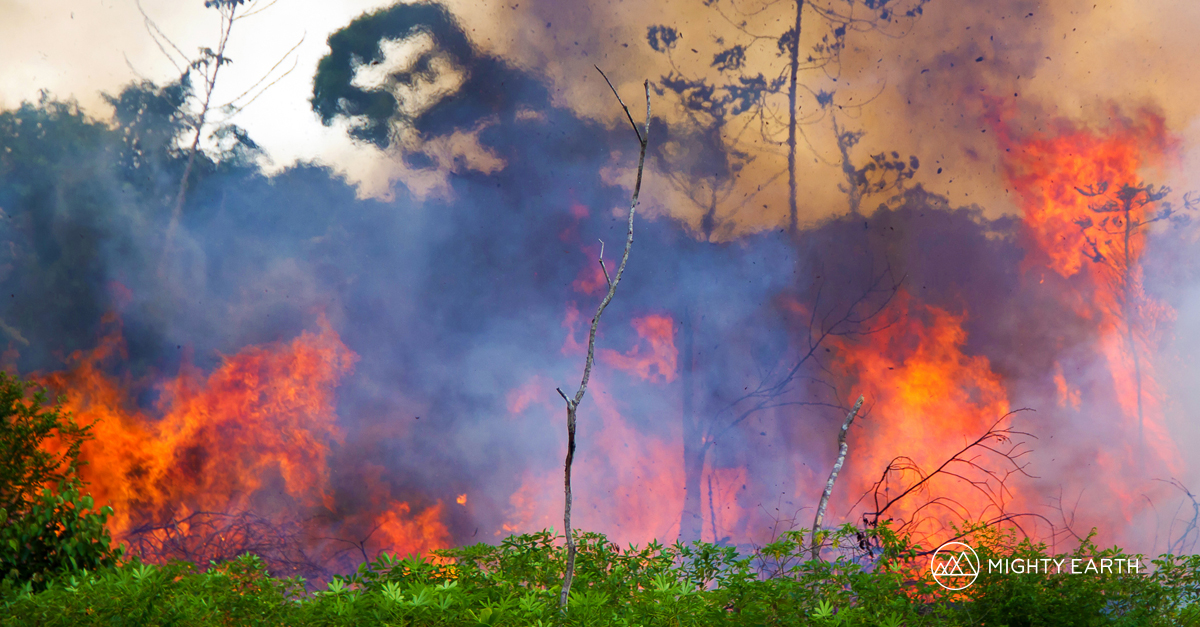
Big soy farmers routinely transport their soy down Highway BR-163 to Cargill’s major port at Santarem, where it is put on ships and sent around the world to be fed to livestock in Europe, China, and elsewhere.
Exposing the Big Game's avatarExposing the Big Game

The burning of the Amazon and the darkening of skies from Sao Paulo, Brazil, to Santa Cruz, Bolivia, have captured the world’s conscience. Much of the blame for the fires has rightly fallen on Brazilian President Jair Bolsonaro for directly encouraging the burning of forests and the seizure of Indigenous Peoples’ lands.

But the incentive for the destruction comes from large-scale international meat and soy animal feed companies like JBS and Cargill, and the global brands like Stop & Shop, Costco, McDonald’s, Walmart/Asda, and Sysco that buy from them and sell to the public. It is these companies that are creating the international demand that finances the fires and deforestation.

The transnational nature of their impact can be seen in the current crisis. Their destruction is not confined to Brazil. Just over the border, in the Bolivian Amazon…

View original post 2,441 more words

The Companies Behind the Burning of the Amazon

The burning of the Amazon and the darkening of skies from Sao Paulo, Brazil, to Santa Cruz, Bolivia, have captured the world’s conscience. Much of the blame for the fires has rightly fallen on Brazilian President Jair Bolsonaro for directly encouraging the burning of forests and the seizure of Indigenous Peoples’ lands.

But the incentive for the destruction comes from large-scale international meat and soy animal feed companies like JBS and Cargill, and the global brands like Stop & Shop, Costco, McDonald’s, Walmart/Asda, and Sysco that buy from them and sell to the public. It is these companies that are creating the international demand that finances the fires and deforestation.

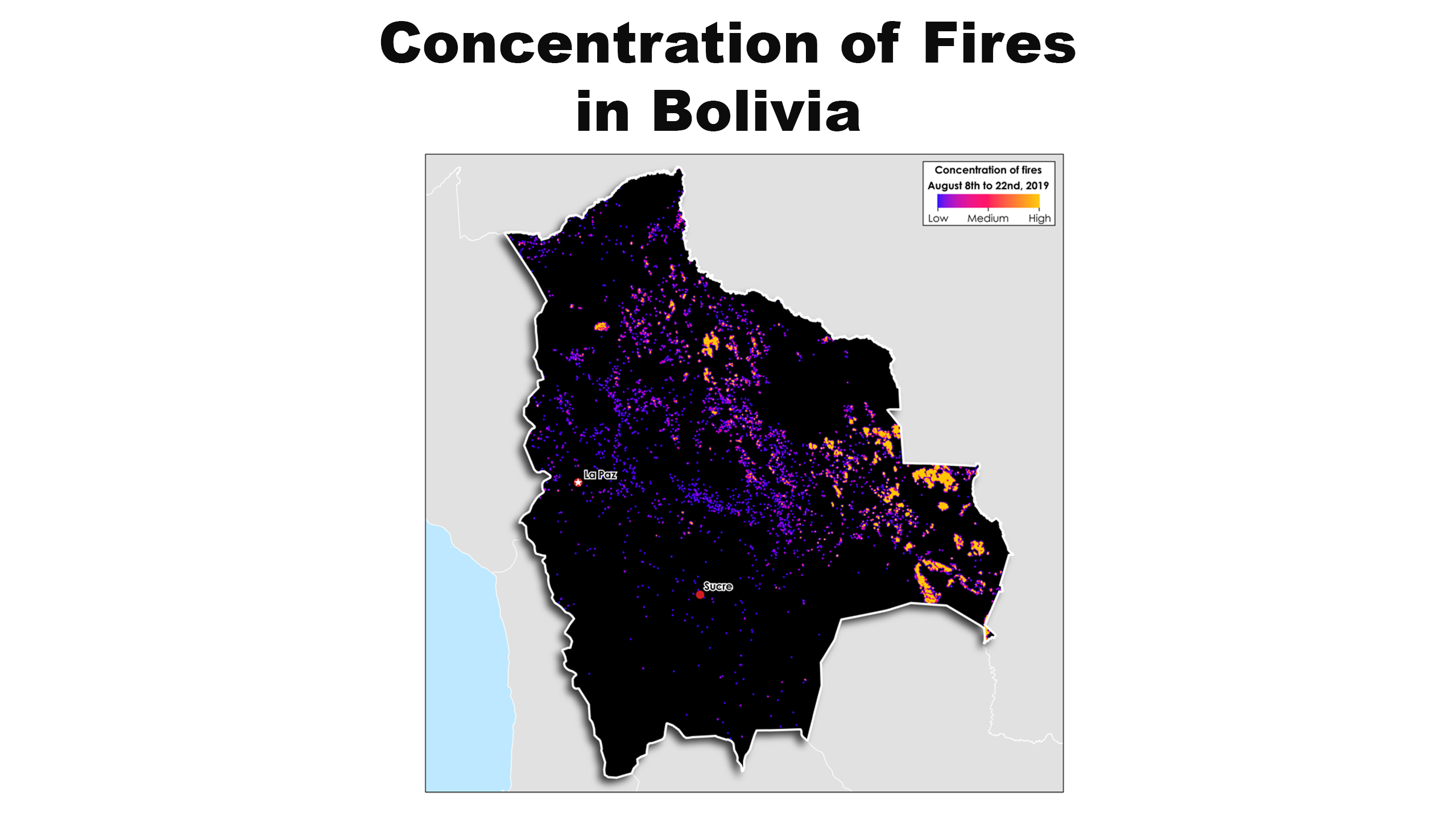
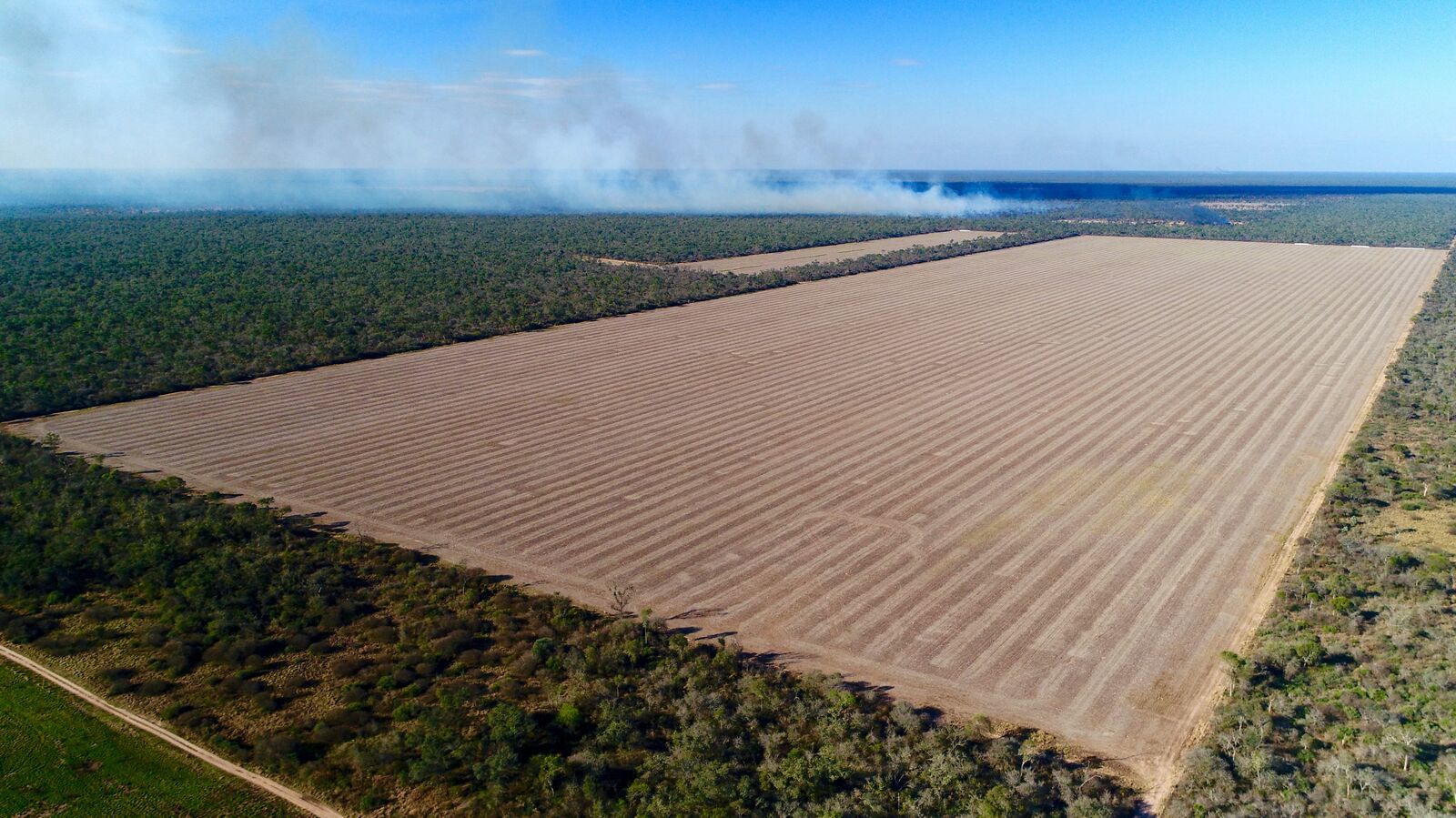
The transnational nature of their impact can be seen in the current crisis. Their destruction is not confined to Brazil. Just over the border, in the Bolivian Amazon, 2.5 million acres have burned, largely to clear land for new cattle and soy animal feed plantations, in just a few weeks. Paraguay is experiencing similar devastation.

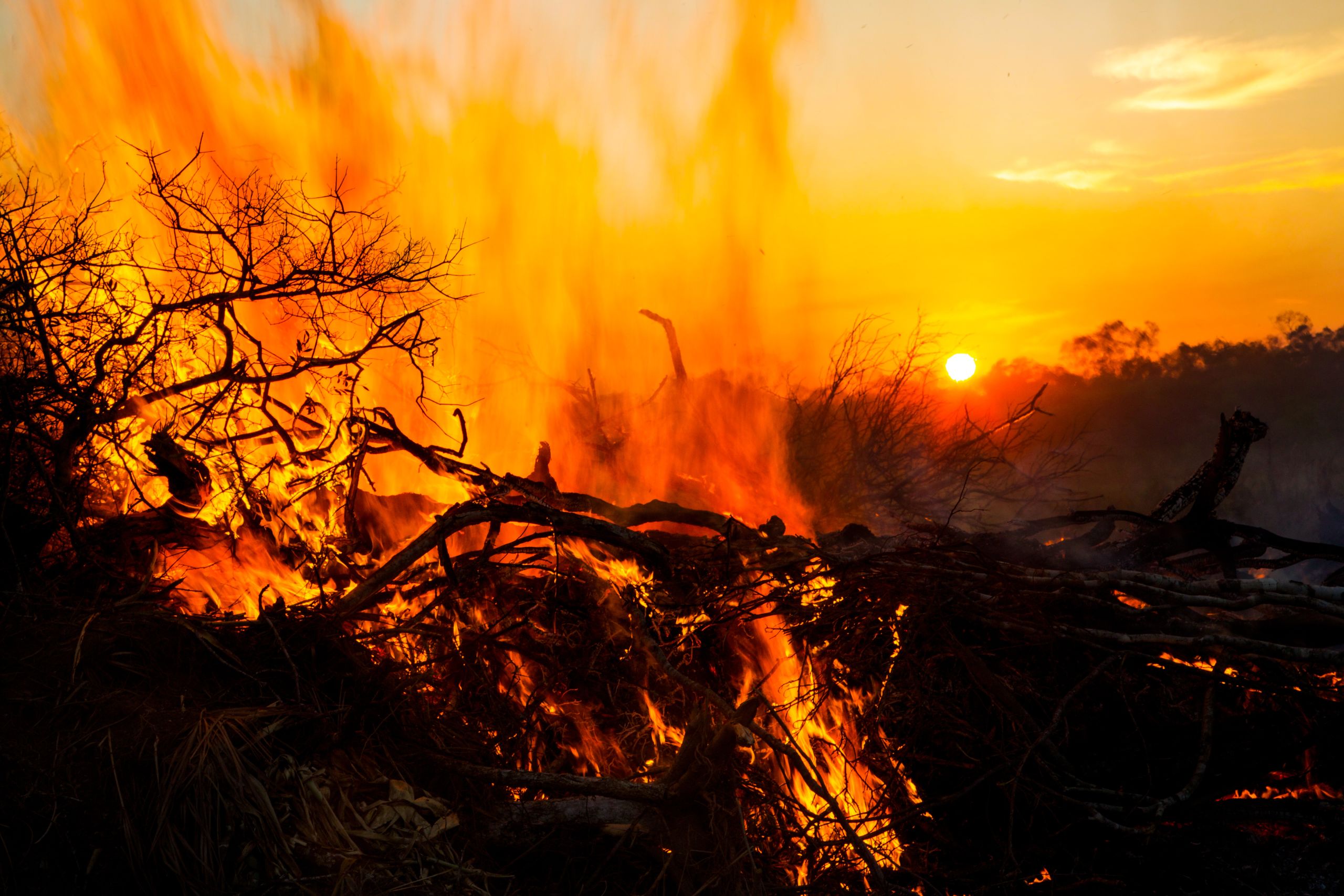
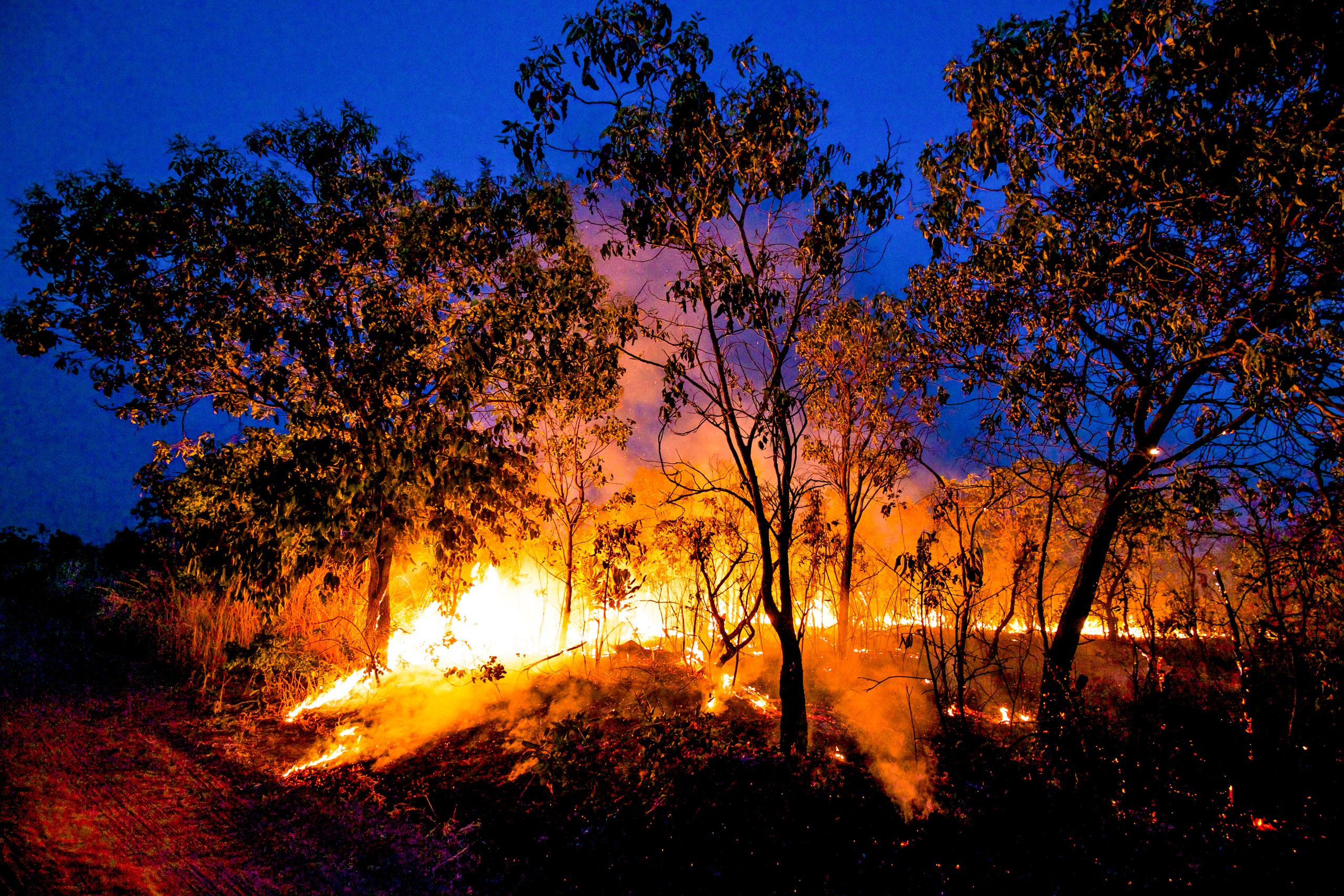
Logs burn at sunset in Bolivia. Photo Credit: 2017, Jim Wickens/Ecostorm

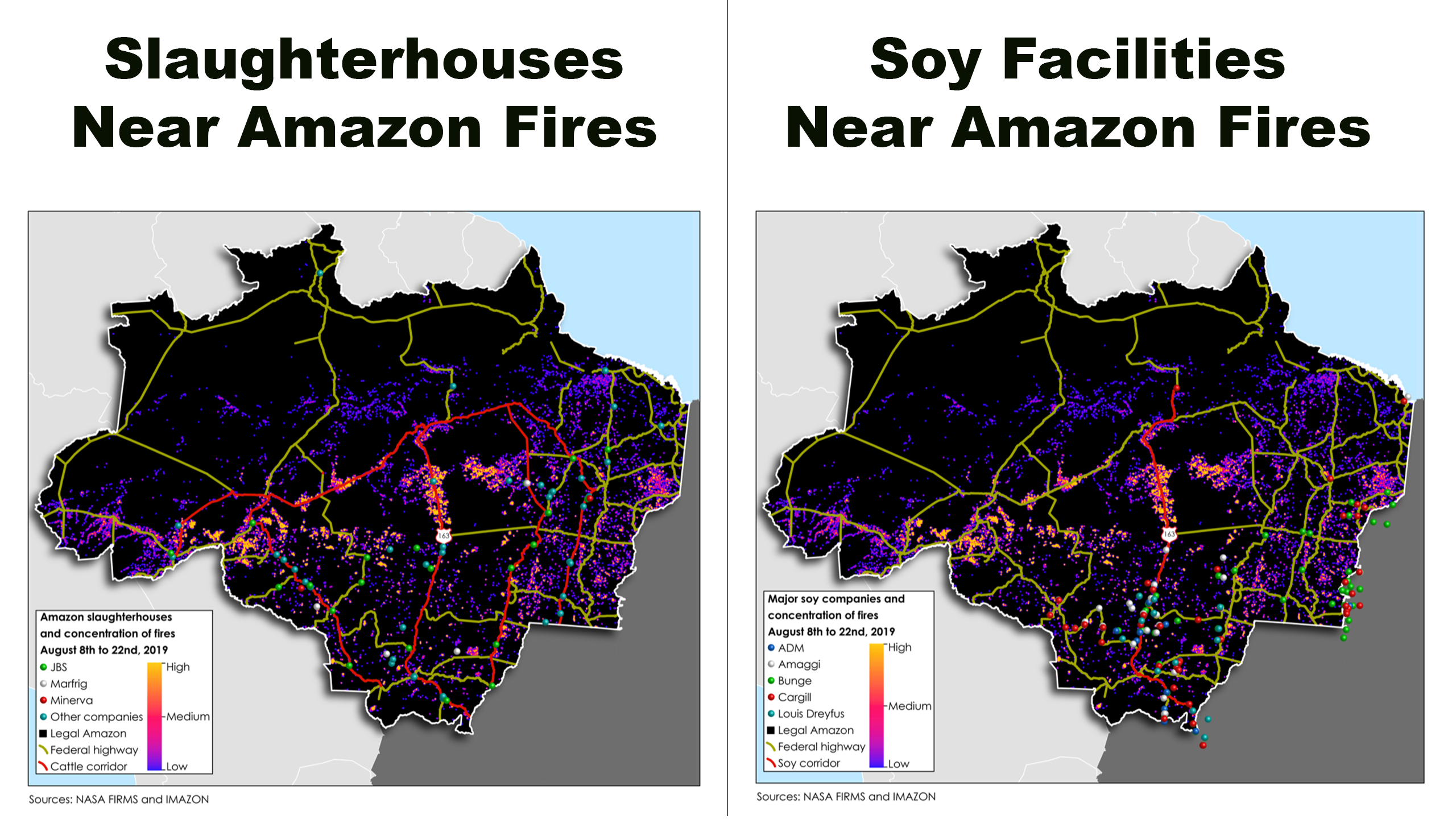
New maps and analysis from Mighty Earth, based on data from NASA, CONAB, and Imazon and released here for the first time, show which companies are most closely linked to the burning:

Cattle

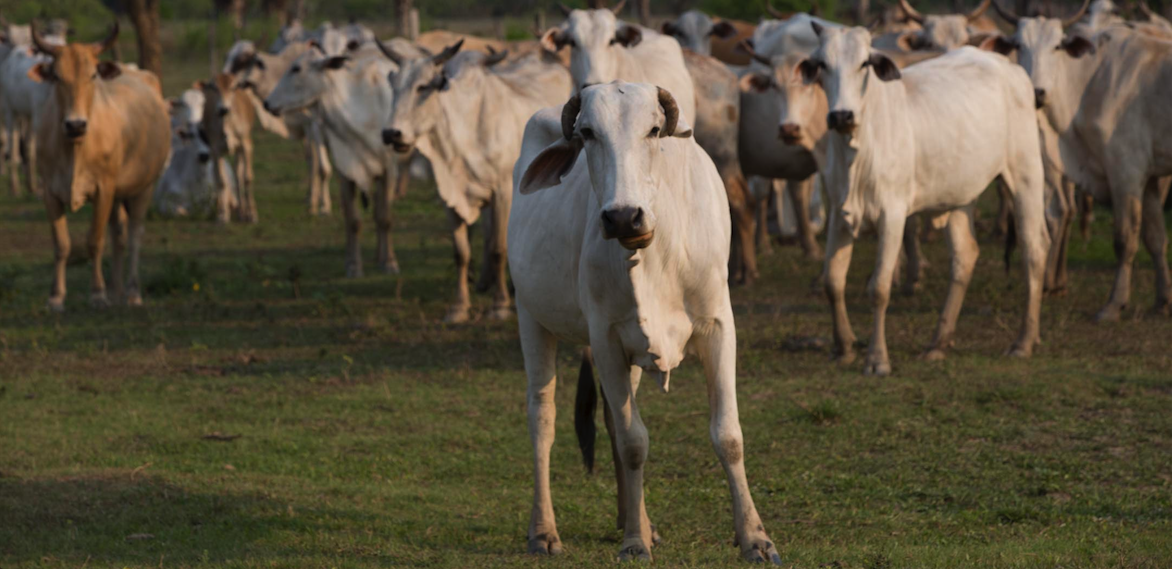
Both domestic and international demand for beef and leather has fueled the rapid expansion of the cattle industry into the Amazon. From 1993 to 2013, the cattle herd in the Amazon expanded by almost 200%  reaching 60 million head of cattle. While deforestation for cattle had been reduced thanks to both private sector and government action, the new wave of deforestation this year shows that the large international beef and leather companies and their customers and financiers continue to create markets for deforestation-based cattle.

The effects of this demand can be seen in the clustering of deforestation near slaughterhouses and roads that have access to slaughterhouses. The company most exposed to deforestation risk in the maps above is JBS,  both Brazil’s largest meatpacker, and the world’s largest meat company. JBS, like other major Brazilian meatpackers signed the 2009 Cattle Moratorium, pledging not to buy beef from cattle connected to deforestation. However,  investigations by government and NGOs have repeatedly found serious violations by JBS, including through laundering cattle.

These scandals reached their apotheosis with the Cold Meat (Carne Fria) scandal in 2017, in which the Brazilian government enforcement agencies produced extensive evidence showing that JBS was sourcing cattle from protected areas.  This and other investigations found that JBS violated both government and its own policies by buying laundered cattle that had been raised in areas linked to deforestation and then transported to “clean ranches” to evade the requirements. The two brothers who control the company were imprisoned for their role in corruption scandals in Brazil.

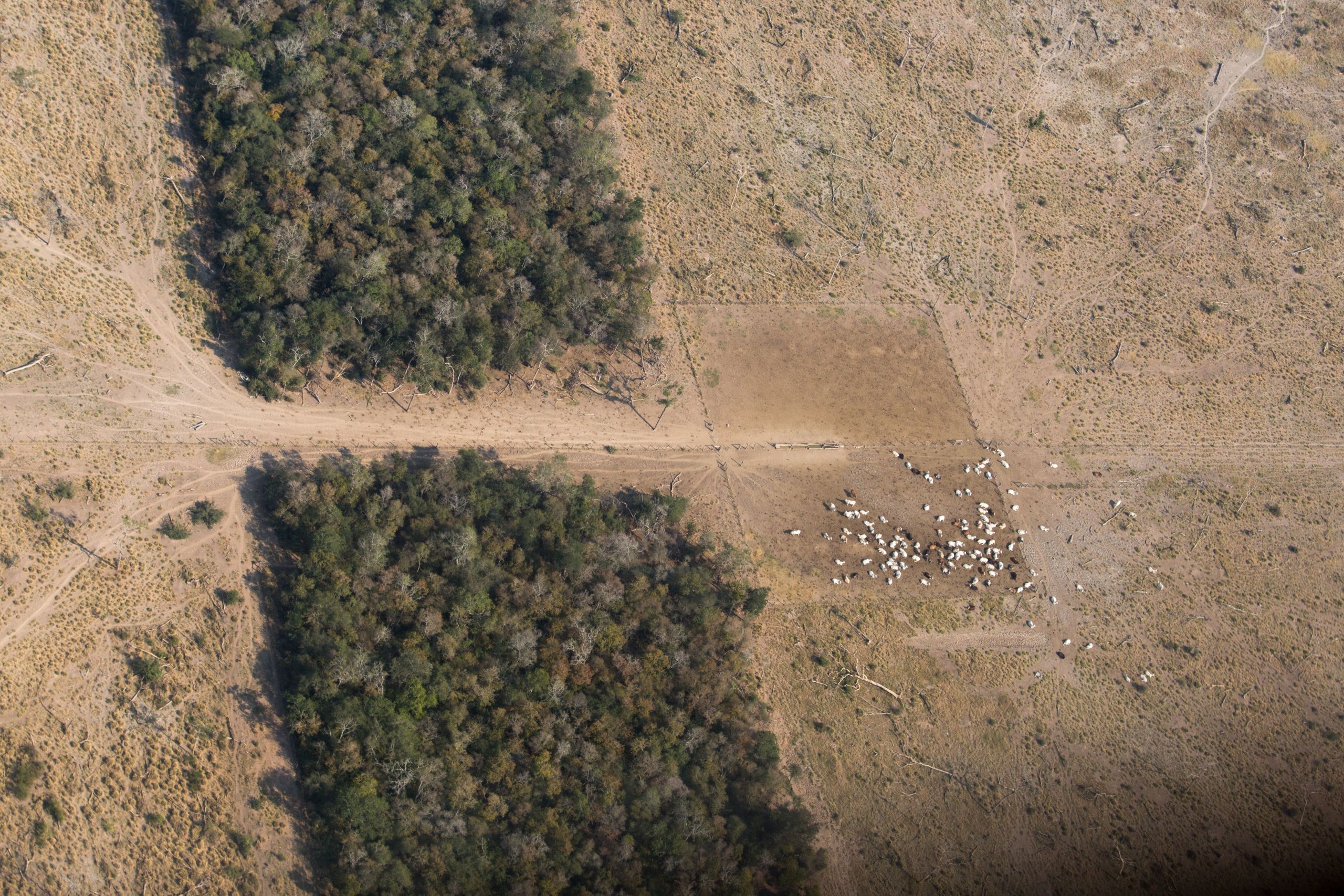
Aerial cattle field and forest edge. Photo credit: Jim Wickens/Ecosotrm

Soy

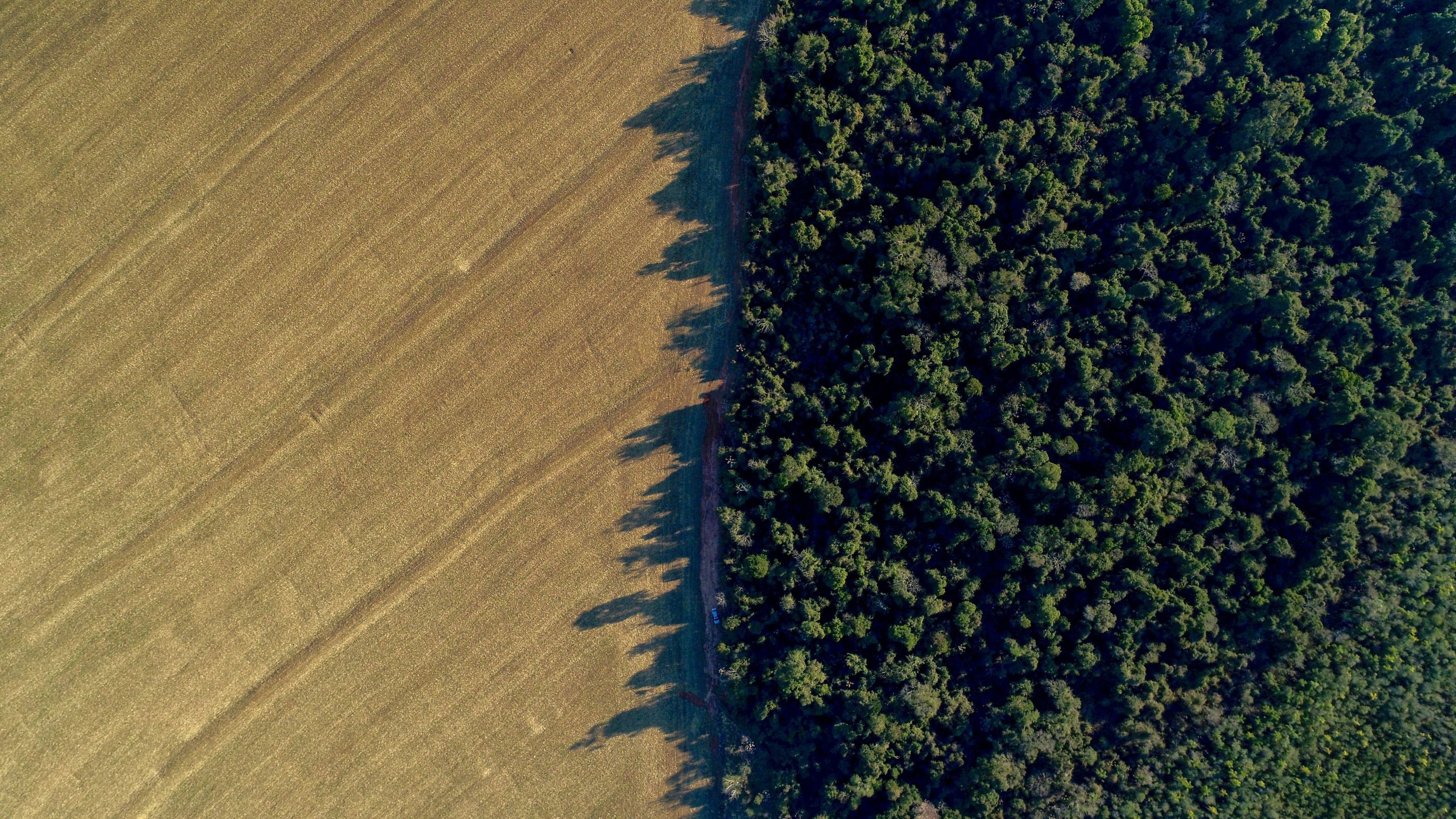
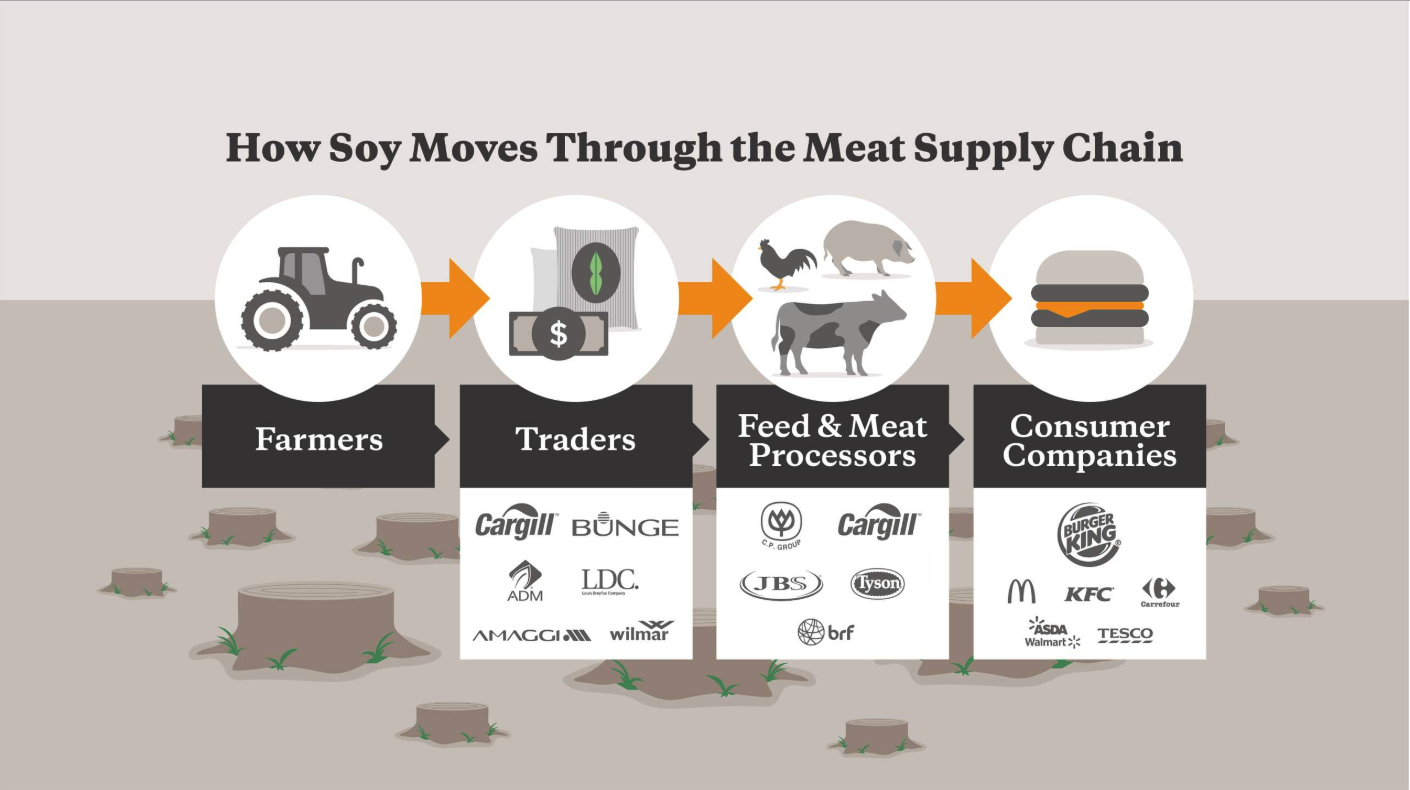
Soy supply chains work differently from cattle, and that is reflected in the maps above. Much of the current wave of deforestation has happened close to BR-163. Big soy farmers routinely transport their soy down Highway BR-163 to Cargill’s major port at Santarem, where it is put on ships and sent around the world to be fed to livestock in Europe, China, and elsewhere. There are similar dynamics around other highways on the map. Cargill, Bunge and other leading soy traders have participated in the Amazon Soy Moratorium in Brazil for the last dozen years, in which they committed to cease sourcing from suppliers who engaged in deforestation for soy. Overall, the Soy Moratorium has been a major success, virtually eliminating deforestation for soy.

However, the Soy Moratorium contained two major loopholes. First, the big soy traders can continue to purchase soy from farmers who engage in large-scale deforestation, as long as the deforestation is for crops other than soy. The location of the deforestation close to BR-163 suggests that farmers are exploiting this loophole to continue deforestation even as they sell soy to major traders like Cargill and Bunge. The location of the deforestation close to BR-163 suggests that farmers are exploiting this loophole to continue deforestation even as they sell soy to major traders like Cargill and Bunge.

Second, the Soy Moratorium only applies to the Brazilian Amazon. Major soy traders have continued to drive deforestation in the Bolivian Amazon Basin, the Brazilian Cerrado, and the Gran Chaco of Argentina and Paraguay, creating a major incentive for the rapid deforestation in Bolivia in the last several weeks. Mighty Earth’s reports The Ultimate Mystery Meat and Still At It showed Cargill’s extensive links to deforestation in the Bolivian Amazon basin, and its repeated refusal to take action against key suppliers even when confronted with repeated evidence. And as much attention as the Amazon is getting, Brazil’s half a billion acre, highly biodiverse forest-savannah mosaic known as the Cerrado has been even more deforested. While 80% of the Amazon is still intact, cattle, soy and agriculture interests have destroyed more than half of the Cerrado, putting this ecosystem at even greater risk. Mighty Earth found that in the Cerrado, where deforestation has continued, two companies were primarily responsible for driving deforestation, Cargill and Bunge.

Cargill is the largest trader of soy from Brazil and the world’s largest food and agriculture company. Mighty Earth’s July 2019 report The Worst Company in the World profiled Cargill’s extensive deforestation in South America and elsewhere around the world, building on previous investigations in Bolivia, Brazilian Cerrado, Paraguay, and Argentina.

Although Bunge is a bigger player in the Cerrado, across South America – in Bolivia, Paraguay and Argentina, Mighty Earth’s previous analyses of deforestation linked to soy animal feed in South America found Cargill most closely associated with deforestation. The company has refused to discontinue suppliers Mighty Earth found engaged in deforestation after evidence was shared with them, and has bitterly resisted efforts to expand successful industry-wide platforms for monitoring and policing deforestation to South America outside the Brazilian Amazon.

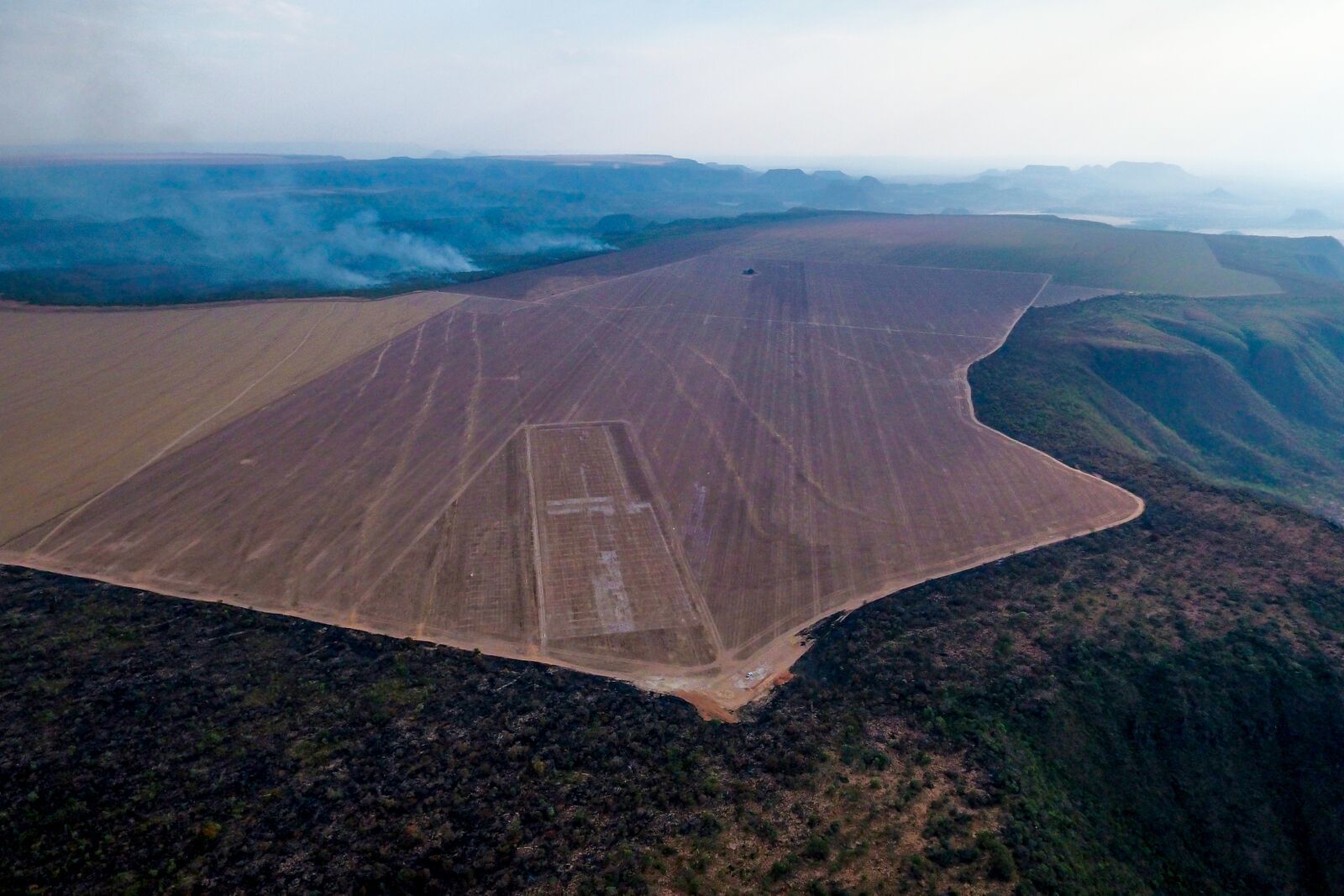
Table top mountains in the Brazilian Cerrado reduced to soy cultivation. Photo credit; Jim Wickens/Ecostorm

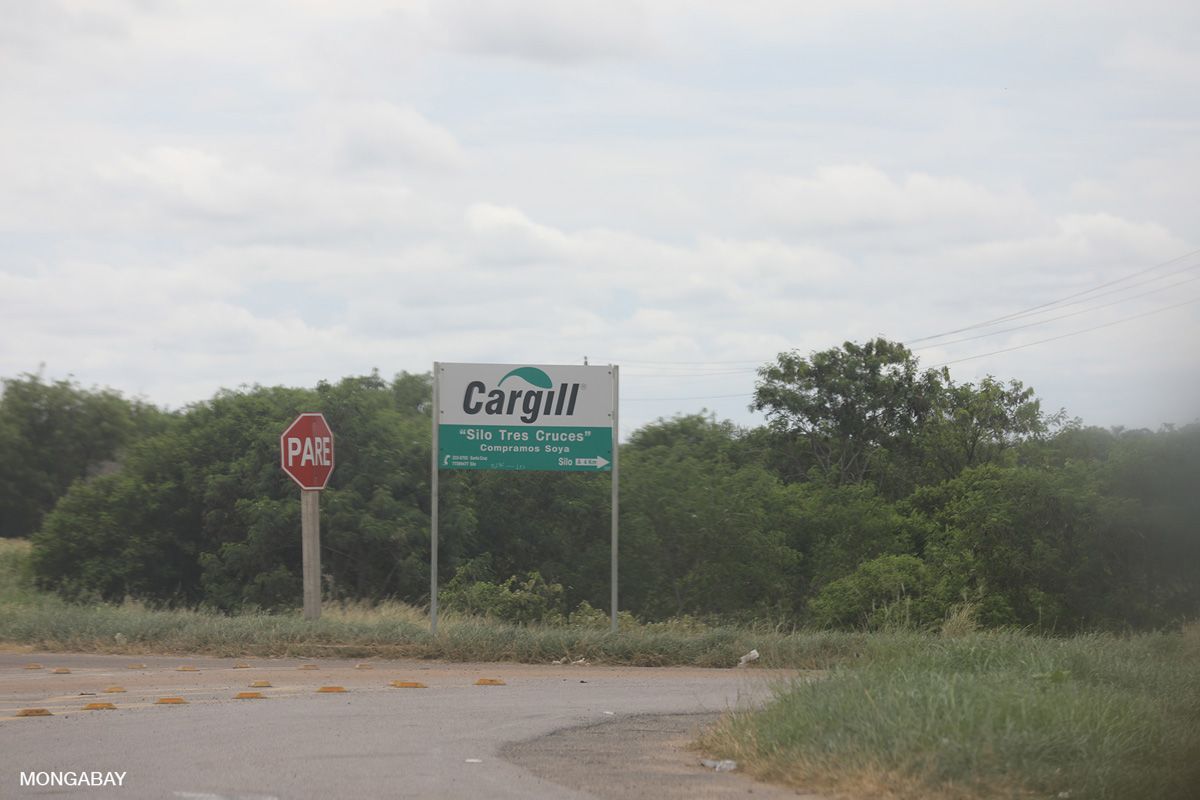
Sign for a Cargill silo in Bolivia reads ‘We buy soy’. Cargill is the biggest privately-held company in the U.S., and while it might not be a household name, people consume its products every day. Photo credit: Jim Wickens/Ecostorm

Five years ago, companies including Cargill, Unilever, and Yum Brands stood on stage at the Climate Summit in New York and proclaimed their commitment to removing deforestation from their supply chains by 2020. So too has the Consumer Goods Forum, whose members include Walmart, Mars and Danone.

They have yet to deliver on this commitment.

Now, with one year until their deadline and the Amazon in flames, it is far past time to act.

These companies must take responsibility for the impacts of their products. They must eliminate the market incentives that promote this reckless environmental destruction.

The Consumer Goods Forum and companies like McDonald’s, Burger King, and Ahold Delhaize – which owns Stop & Shop as well as Hannaford, Food Lion, Pea Pod, and Giant supermarkets – cannot continue to look the other way while the Amazon burns. They should instead source only from suppliers and regions that show evidence of eliminating deforestation. Not in another ten years. Not in five years. Not in one year. Now. Today.

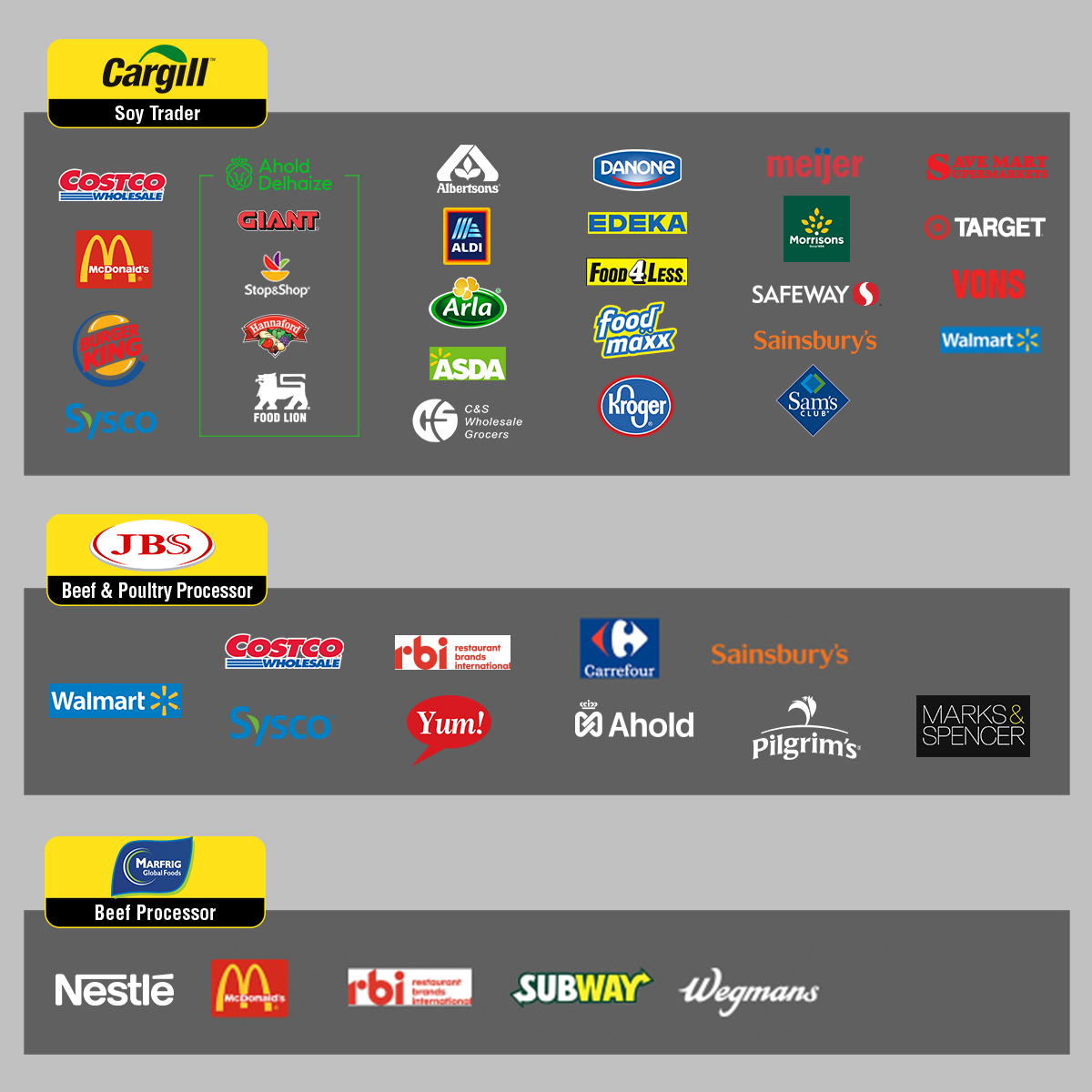
The chart below shows the largest customers of the slaughterhouses and soy animal feed traders most associated with cattle and soy deforestation, respectively.

Brands

Several brands stand out for their contracts and relationships with the suppliers most responsible for deforestation.

Ahold Delhaize: The Netherlands-based supermarket powerhouse owns the brands Stop & Shop, Giant, Food Lion, and Hannaford in the United States and Albert Heijn, Delhaize, Etos, Albert, Alfa-Beta, and others across Europe. While consistently touting its sustainability commitments, Ahold continues selling its customers products from some of the worst companies in the world. With knowledge of Cargill’s ongoing child labor issues and its role in deforestation across South America, Ahold has simultaneously pushed Cargill to do a better job even while launching a joint venture partnership with them to provide the store-branded meat to Stop & Shop stores. In addition, Ahold Delhaize conducted business worth a whopping $113 million with JBS in 2019 through food sales and other partnerships.

As egregious as Ahold Delhaize’s actions are, they are not alone:

McDonald’s: McDonald’s is probably Cargill’s largest and most important customer. McDonald’s restaurants are essentially storefronts for Cargill. Cargill not only provides chicken and beef to McDonald’s, they prepare and freeze the burgers and McNuggets, which McDonald’s simply reheats and serves.

Sysco: With $55 billion in annual revenue, Sysco is the world’s largest distributor of food products to restaurants, healthcare facilities, universities, hotels, and inns. Despite claiming that they will “protect the planet by advancing sustainable agriculture practices, reducing our carbon footprint and diverting waste from landfill, in order to protect and preserve the environment for future generations,” they have honored Cargill as their most valued supplier of pork and beef and did $525 million worth of business with JBS in 2019 through sales and other partnerships.

Costco: Both JBS and Cargill list Costco as one of their top customers. Popular with families and small business owners, it ranks as the world’s third largest retailer. Costco states that it “has a responsibility to source its products in a way that is respectful to the environment and to the people associated with that environment.” According to their website, “Our goal is to help provide a net positive impact for communities in commodity-producing landscapes, by doing our part to help reduce the loss of natural forests and other natural ecosystems, which include native and/or intact grasslands, peatlands, savannahs, and wetland.” Nevertheless, according to Bloomberg, Costco conducted $1.43 billion worth of business with JBS in 2019.

Burger King/Restaurant Brands International: Burger King’s practice of selling meat linked to Cargill and other forest destroyers has earned the fast food giant a ‘zero’ on the Union of Concerned Scientists deforestation scorecard. Burger King has asked Cargill to stop destroying forests in their supply chain…but the deadline isn’t until 2030. It is also a significant customer of JBS. Burger King is part of the Restaurant Brands International (RBI) chain that also includes Tim Horton’s and Popeye’s.

Nestle: Based in Switzerland, Nestle is the largest food and beverage company in the world. Nestle was among the first companies to make zero-deforestation commitments, but only started actually monitoring its supply chains nine years later in 2019 – and only for palm oil, not for soy or pulp/paper. Recently certifying 77 percent of its supply chain as deforestation-free, Nestle continues to buy from Cargill for its pet food subsidiary, Nestle Purina Petcare. Bloomberg data also shows Nestle as one of Marfrig’s top customers.
Carrefour: The French company Carrefour is one of the world’s largest supermarket chains, the majority owner of the largest supermarket chains in Brazil, and at risk for cattle-driven deforestation. It has significant supply chain links to Cargill and JBS. Carrefour has committed to eliminating deforestation from its products by 2020, but the policy does not apply to processed or frozen beef products—which means that only around half of Carrefour’s beef distribution in Brazil is covered by its zero-deforestation policy.  According to Chain Reaction Research, 35 percent of the beef and beef products it sampled came from slaughterhouses located within the Legal Amazon including a 2.3 percent from high-risk slaughterhouses.

Casino: Casino, which owns Pão de Açúcar, is a French supermarket giant that prizes its reputation for sustainability in its home country. But as the second-largest supermarket chain in Brazil, it continues to purchase from Cargill, Bunge, and Brazil’s major cattle suppliers.

Walmart: Arkansas-based corporation Walmart is the single-largest company in the world by revenue, and also the largest private employer. Walmart also has a major presence in the UK, through its wholly-owned subsidiary ASDA. Walmart’s stated policy is “as a member of the Consumer Goods Forum, we supported the resolution to achieve zero net deforestation in our supply chain by 2020,encourage our suppliers of [beef, soy, palm oil, pulp and paper] products to work to source products produced with zero net deforestation. We ask suppliers to avoid ancient and endangered forests, to encourage conservation solutions, and to increase recycled content.” Nevertheless, Walmart conducted business with JBS worth $1.68bn in 2018 and remains a leading customer of Cargill meats and other products.

E. Leclerc: E.Leclerc is a French retail chain, with more than 600 locations in France and more than 120 stores outside of the country. Of the supermarket chains in France, Leclerc has perhaps the least robust sustainability policies. A recent report by SherpaFrance Nature Environment and Mighty Earth shows Leclerc failing on soy sustainability measures across the board. The company refuses to join industry calls to protect the endangered Cerrado, has not fulfilled legal obligations to disclose its sources, and has neither develop an alert mechanism to identify risk or follow up on deforestation alerts provided by others.  E.Leclerc’s latest sustainability report makes no commitments on meat sourcing, or any other commodity but palm oil.

By night forest fires can be seen for miles, tearing through Brazil’s Cerrado ecosystems. Photo credit: 2017, Jim Wickens/Ecostorm

A Preventable Disaster

While the rate of burning has increased dramatically in the last several months in response to Bolsonaro’s policies, these companies have been driving deforestation for years across South America. In many cases, they have bitterly resisted efforts to create systems that would allow for agriculture to expand without deforestation.

Bolsonaro’s mobilization of the army to fight the fires may help in the short term, as will Bolivian president Evo Morales’ new willingness to accept international help to fight fires. But as long as these international companies are creating a market for beef, pork, and chicken that is indifferent to deforestation, this type of environmental disaster is likely to continue.

After years of remarkably successful conservation initiatives that cut Brazil’s deforestation rate by two-thirds, Brazil’s president Jair Bolsonaro has reopened the doors to rampant destruction as a favor to the agribusiness lobby that backs him. That industry is accountable for the atmosphere of lawlessness, deforestation, fires, and the murder of Indigenous peoples that followed. According to data released by Brazil’s National Institute for Space Research (INPE), deforestation of the Brazilian Amazon in July 2019 increased 278 percent over the previous July. Bolsonaro responded to this news by firing the head of the INPE.

The recent fires are the latest example of the cattle and soy industries trying to take advantage of a culture of impunity in both Brazil and Bolivia. Since January 2019, more than 74,000 fires have broken out across Brazil – an 85 percent increase from the same point in 2018. In Bolivia, 2.5 million acres have burned in two weeks.

These are not wildfires. Nearly all are the result of intentional land clearing attempts undertaken by ranchers and industrial soy farmers feeding global markets and international companies. In fact, on August 10, farmers in the Amazon held a “Day of Fire” to show their support for Bolsonaro’s policies.

According to the Smithsonian Institute, these fires, which are large enough to see their effects from space, pose a significant threat to the “lungs” of the planet, one of the world’s last best defenses against climate change.

The deforestation crisis in Brazil and Bolivia wouldn’t be happening without companies like Cargill, Bunge, and JBS and their customers – companies like Stop & Shop, McDonald’s, Burger King, and Sysco – who create the market demand that finances the destruction.

World’s most powerful greenhouse gas on the rise ‘due to green energy boom’

Exposing the Big Game's avatarThe Extinction Chronicles

Sulphur hexafluoride, or SF6, is widely used in the electrical industry to prevent short circuits and accidents

The most powerful known greenhouse gas has been leaking into the Earth’s atmosphere due to the green energy boom, it was reported on Friday night.

Sulphur hexafluoride, or SF6, is widely used in the electrical industry to prevent short circuits and accidents.

It is 23,500 times more warming than carbon dioxide (CO2), and just one kilogram warms the Earth as much as 24 people flying London to New York return.

The drive to use mixed sources of power, including wind, solar and gas, rather than coal as fuel has resulted in a rise in the number of electrical devices that use SF6, the BBC said.

A study from the University of Cardiff found that across all transmission and distribution networks, the amount used was increasing…

View original post 175 more words

Arctic sea ice is at a near-record low — but that’s just one of the north’s problems

Image

Exposing the Big Game's avatarThe Extinction Chronicles

From raging wildfires to melting ice in Greenland, the top of the world is screaming for help.
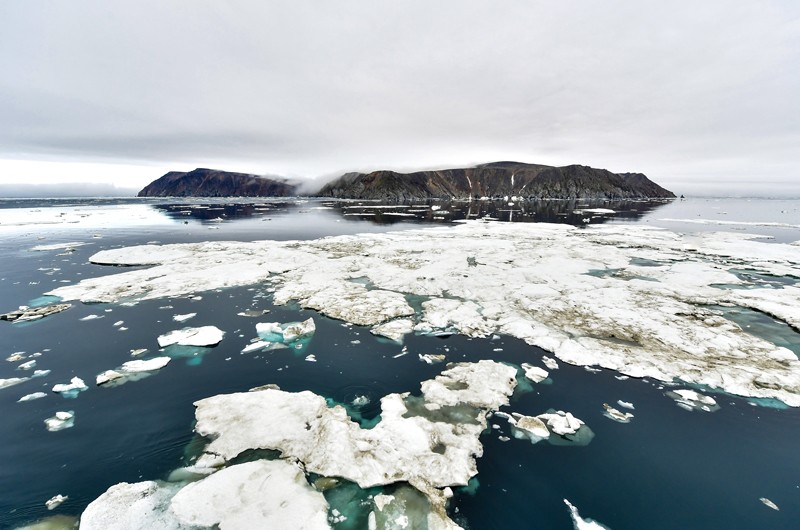
Herald Island, part of the Wrangel Island State Nature Reserve in the Arctic Sea

Sea ice has been sparse this summer in the Chukchi Sea between Russia and Alaska.Credit: Yuri Smityuk/TASS via Getty Images

Chelsea Wegner was shocked when she landed in Anchorage, Alaska, in July, on her way to a research cruise in the Bering Sea. Smoke from wildfires across the state had darkened the skies, and Anchorage was in the midst of a heatwave that saw temperatures soar past 32 °C for the first time in recorded history.

Wegner, a marine biologist at the University of Maryland in Solomons, also knew that the unusual warmth had melted away nearly all of the sea ice in the Bering Sea. “It was a really surreal moment,” she says.

Later, while sailing aboard a Canadian icebreaker off the coast of Alaska, Wegner watched…

View original post 1,058 more words