Exposing the Big Game

Forget Hunters' Feeble Rationalizations and Trust Your Gut Feelings: Making Sport of Killing Is Not Healthy Human Behavior

Exposing the Big Game

DNR encourages CWD testing this deer hunting season

Exposing the Big Game's avatarThe Extinction Chronicles

MADISON (WKOW) — Deer hunting season is right around the corner.

Archery and crossbow season begins on September 14.

The Department of Natural Resources encourages hunters to have their deer tested for chronic wasting disease.

Testing is available statewide and is free of charge.

This year there will be enhanced surveillance in 18 counties in northern Wisconsin — but testing is not required.

The DNR offers both in-person testing services and self-service options, in which you would drop off a sample to be tested at a kiosk location.

View original post

Scientists monitoring new marine heat wave off B.C. coast similar to ‘the Blob’

Exposing the Big Game's avatarThe Extinction Chronicles

Phenomenon occurs when sea surface temperatures are higher than normal for at least 5 consecutive days

Sea surface temperature anomaly maps from the U.S. National Oceanic and Atmospheric Administration show temperatures in the Pacific Ocean above normal in orange and red. The map on the right represents September 2019, while the figure on the left represents the early stages of the ‘blob’ phenomenon five years ago. (National Oceanic and Atmospheric Administration)
300
comments

A new marine heat wave spreading across a portion of the Pacific Ocean off the coast of British Columbia has so far grown into one of the largest of its kind in the last four decades, officials say, second only to the infamous “blob” that disrupted marine life five years ago.

The swath of unusually warm water stretches roughly from Alaska down to California, according to the National Oceanic and Atmospheric Administration (NOAA) in the United States…

View original post 455 more words

Male grizzly bear killed on Trans-Canada Highway

https://www.cochranetoday.ca/local-news/male-grizzly-bear-killed-on-trans-canada-highway-1674171

A 275-kg male grizzly bear was struck on killed on the Trans-Canada Highway.

A large male grizzly bear was struck and killed on the Trans-Canada Highway on provincial lands last week.

Provincial wildlife officials say a large 275-kg male grizzly was reported dead in the highway ditch on Wednesday evening (Aug. 28) near Jumpingpound Creek – the third large male grizzly to be killed in that area in the past five years.

“It’s a real drag because we’re trying to reduce mortality, and highway mortality is problematic,” said Jay Honeyman, human-wildlife conflict specialist with Alberta Environment and Parks.

“The volume of traffic these days on the Trans-Canada is quite heavy, even during the week and in the evenings,” he added.

“It’s really challenging for bears to cross that highway without having some kind of an incident. I guess it’s not a surprise that we’re having these incidents with all the traffic.”

Historically, Alberta is estimated to have had between 6,000 and 9,000 grizzly bears. Grizzlies once ranged across the whole of Alberta, across Saskatchewan and into Manitoba.

When extensive DNA research determined Alberta’s population had dipped to about 700 individuals, the grizzly bear was declared a threatened species in Alberta in 2010. The count is being updated.

Most grizzly bear deaths are caused by humans, including poaching, being mistaken for a black bear during the black bear hunting season, self-defense and accidents such as being struck on roads.

In those years, more than half of the human-caused grizzly bear deaths were due to poaching and accidental deaths on roads and railway. There have been 57 known poaching cases and 63 accidental in the past 10 years.

The Alberta Wilderness Association has concerns about the ongoing high numbers of human-caused grizzly bear deaths.

“Human-caused mortality continues to be a problem,” said Joanna Skrajny, a conservation specialist with AWA.

“Human contact and human incursion into grizzly bear wildlife habitat is the main reason why they are dying.”

Skrajny said the fact that three large make grizzlies have died in that area of the Trans-Canada Highway in the last few years suggests an obvious start is a study to determine if a crossing structure may be warranted.

“In situations where we keep coming into contact with grizzlies and they keep dying, we have to reassess what we’re doing,” she said.

AWA is waiting on an update of the status of the grizzly bear population in Alberta, as well as updated grizzly bear mortality numbers for 2018 and 2019.

Skrajny said high numbers of human-caused mortality could mean it’s hard for a grizzly bear population to regulate itself.

“It means we’re not doing a good job of keeping their habitat safe,” she said.

“Even if grizzly bears are coming in from B.C. where some of the numbers are higher, they’re coming here to die in the end and that means we’re not doing our job properly.”

In addition to bears dying on provincial lands, two grizzly bears have died in Banff National Park this summer.

A male grizzly was struck and killed by a semi-trailer on Highway 93 South just after midnight on June 4, about one kilometre south of the Trans-Canada Highway heading up the hill towards Storm Mountain.

On June 22, Parks Canada was forced to kill an injured and emaciated young female grizzly bear. It’s believed a vehicle struck the bear on the highway 10 days earlier. The yearling, its sibling and mother were on the wrong side of the fence meant to keep wildlife off the highway.

“We’ve also had a couple of confirmed strikes where we don’t know if the bear survived or not,” he said.

Arizona bans hunting contests for killing wildlife predators

Posted: 6:14 AM, Sep 05, 2019

https://www.kgun9.com/news/local-news/arizona-bans-hunting-contests-for-killing-wildlife-predators

Updated: 6:14 AM, Sep 05, 2019

PHOENIX (AP) – Arizona has banned organized contests where hunters try to kill the most coyotes or other wildlife predators for prizes such as cash or hunting equipment.

The Governor’s Regulatory Review Council voted 6-0 Wednesday to approve a rule initiated by the Arizona Game and Fish Commission.

The measure will take effect in 60 days.

The commission voted unanimously in June to ban contests that require registration and a fee and award prizes for killing the most coyotes or other fur-bearing animals or predators.

The Arizona ban doesn’t apply to lawful hunting of predators or other fur-bearing animals.

Wildlife-killing contests have drawn the ire of activists in recent years.

New Mexico banned the contests in April and several other states reportedly are considering similar rules or legislation.

Let the games begin; Hunting seasons open

Exposing the Big Game's avatarCommittee to Abolish Sport Hunting Blog

Let the games begin; Hunting seasons open
Two of the varieties of doves, mourning doves and white-winged doves, are legal when season opens September 7. (Photo by Glynn Harris)

It was back in May that we reluctantly bid adieu to hunting seasons 2018-19. Last season started for me with a whimper with doves. I sat alone in a field a friend had given me permission to hunt. There was probably a good reason I was the only one out that day. Except for a couple of high fliers, there were no doves.

Next, things looked up just a bit when I watched a few squirrels bite the dust, eventually winding up in a mulligan.

Next came deer season. Thankfully, I had venison left over in the freezer from the previous year because I came up empty handed this past season.

I didn’t hunt ducks or geese or quail or rabbits and as the seasons…

View original post 472 more words

Whipping proposal for wildlife smugglers gets thumbs up

This April 7, shows an Orang Utan baby found in a basket, by Marine police in Muar during an inspection.- NSTP/Adi Safri© Provided by Media Prima This April 7, shows an Orang Utan baby found in a basket, by Marine police in Muar during an inspection.- NSTP/Adi SafriKUALA LUMPUR: Stiffer penalties are needed to deter the smuggling of wildlife in the country.Malaysian Nature Society president Prof Dr Ahmad Ismail welcomed the recommendation for whipping wildlife crimes, adding that the move was “timely”.

“It is time that the government implemented severe punishment on wildlife poachers and smugglers, as well as on authorities who abuse their power.

“The current fine and imprisonment are too low to curb illegal wildlife activities, and the recommendation for whipping can help as a deterrent,” he told the New Straits Times.

Currently, the Wildlife Conservation Act 2010 under Section 38(2), carries a maximum fine of RM500,000 and imprisonment of not more than five years for those found guilty of hunting totally protected wildlife without a special permit.

Ahmad also praised the police for mobilising their battalions in the jungles to assist the Wildlife and National Parks Department (Perhilitan).

He however said more needed to be done to raise public awareness and the importance of conserving our wildlife.

“The society still lacks knowledge about the importance of saving tigers, for example,” he said.

On Tuesday, Inspector-General of Police Datuk Seri Abdul Hamid Bador said the police would be recommending mandatory whipping for criminals involved in the smuggling of wildlife.

He said the recommendation would be sent to the Legal Affairs Division for tougher penalties in efforts to combat poaching and wildlife trafficking.

The police’s Internal Security and Public Order Department, the air branch and marine police, together with Perhilitan carry out joint patrols in the jungles, by air and sea, under Op Bersepadu Khazanah.

The operations were also boosted by the expertise of the Elite Senoi Praaq Team and the General Operations Force.

© New Straits Times Press (M) Bhd

‘I can’t believe I killed a wolverine with an ax’: North Idaho native wins reality wilderness survival show, $500,000

UPDATED: Thu., Sept. 5, 2019, 11:05 a.m.

Janahlee Jonas sneaks up on her husband, Jordan Jonas, on the final day of the reality TV show, “Alone.” Jordan Jonas, originally from Athol, Idaho, won the sixth season of the show. (Janahlee Jonas / COURTESY)

When Janahlee Jonas stepped off the helicopter in Canada’s northern backcountry, she didn’t know what to expect.

She hadn’t seen her husband, Jordan Jonas, in 77 days. She wondered if Jordan, who is naturally lean, would be emaciated. Or sick. Or injured. Or all three. After all, he’d been living in the subarctic wilderness for nearly three months, eating only what he could hunt or scavenge.

But when the helicopters’ engines cut out, her worries dissipated in the frigid Canadian air.

“The first thing I heard was his laugh, and I was like ‘Oh, he’s fine. He’s totally fine,’ ” she said in an interview Wednesday. “He didn’t suffer at all out here.”

While others struggled in the harsh Canadian subarctic, Jordan Jonas, a native of Athol, Idaho, thrived.

For that, he won $500,000.

Jonas, 36, spent 77 days living near Canada’s Great Slave Lake for the sixth season of the History Channel’s reality television show “Alone.” Unlike other reality shows, camera crews didn’t follow his every movement. Instead, Jonas was given three cameras and tasked with filming himself.

His goal? Outlast nine other contestants.

1 / 4

Janahlee Jonas sneaks up on her husband, Jordan Jonas on the final day of the reality TV show, Alone. Jordan Jonas, originally from Athol, Idaho, won the sixth season of the show. (Janahlee Jonas / COURTESY)

Each contestant was allowed to bring 10 items. Jonas brought paracord, a saw, an ax, a sleeping bag, a frying pan, a ferro rod, fishing line and hooks, bow and arrows, trapping wire and a multitool. With those tools, he built a shelter and thrived in the punishing conditions.

When he shot a moose, he became the first person in the show’s history to kill a large animal. He also made a fishing net out of the paracord and caught a 25-pound pike on his final day.

Contestants don’t know when others have dropped out, making it both a physical and psychological challenge. Contestants’ health is checked regularly, though. If they lose too much weight, they can be pulled by the show’s doctors. Or they can choose to tap out at any time.

And so, on the 77th day, in late November 2018, when the crew came to check on Jonas, he had no idea he was the last person standing. Instead, he thought it was just another health check.

“I wasn’t ready for it to end,” he said. “At 77 days, I had zero hope of winning yet. I was completely surprised.”

Instead, he’d mentally prepared to be out there at least 90 days. When his wife stepped off the helicopter, he estimated he still had 200 pounds of moose meat, 60 pounds of fish, an entire wolverine (which he killed with an ax), hares and a squirrel.

Just days prior, other contestants were choking down boiled hare feet and reindeer moss.

“I actually had a lot of fun,” Jonas said.

The sixth season aired this past summer, with the season finale shown in late August. That’s when Jonas was announced as the winner.

His success is a testament to an adventurous life. Jonas grew up on a farm near Athol. After graduating from Sandpoint High School, he attended North Idaho College and worked at Lighthouse Foods in Sandpoint. Then he spent the “better part of a year” riding freight trains around the country with his brother.

“It felt like a good coming-of-age type thing to do,” he said. “You get exposed to a mode of life that is not scheduled, and it feels a lot more free.”

After hopping trains, he headed to Russia to help build orphanages. There he met, and eventually lived with, nomadic Evenki reindeer herders. They taught him how to live with, and off, the land.

“To be honest with you, when I went to Russia I didn’t know people still lived like that,” he said.

The rhythm of nomadic hunter-gatherers reminded Jonas of his time on the trains. Free and unstructured. A day determined only by the most immediate of needs.

“When you’re in the forest, you wake up in the morning and there are things that need to be done. You might need to fish or get food,” he said. “But you do it on your own time, according to your own wisdom.”

Jonas traveled to Russia and Siberia a half-dozen times over the next few years. Eventually, he met Janahlee. The two married and had two children, Ilana, 3, and Altai, 2. A third child is on the way.

Now, the family lives in Lynchburg, Virginia.

And then they called in the spring of 2018.

“I definitively knew it is what I’m good at,” he said. “It would be crazy to say no.”

He didn’t prepare much, although he said he practiced shooting with his recurve bow and tried to gain weight.

“In the history of the show, most people that have won have been pretty chubby,” said the 6-foot-2, , 175-pound Jonas. “And part of me was thinking I might be too thin for this sport.”

In August, he found out he’d be heading to northern Canada, a climate perfect for his Siberian experience. A month later, he watched a helicopter fly off. He was alone.

“It’s really surreal,” he said. “The helicopter flies away and you have your 10 items and you don’t know anything about your area.”

He didn’t waste time. Within an hour of being dropped off, he’d shot a rabbit. The pursuit of food dominated his mind – and his time.

“It was all about food,” he said. “I threw up a shelter in less than a day. Then 100% of my energy was get food. Get food.”

He set snares for rabbits, fished and hunted moose. A steady supply of rabbit meat and fish kept him moving, but he knew he’d need more if he was going to go the duration.

He’d built a series of fences to funnel any passing moose into a particular area, and he had hung a number of cans to warn him when they were there. On day 20, it all came together. A bull moose wandered in, possibly responding to Jonas’ call from the night before. Jonas shot, then tracked the animal, eventually finding it dead near the lake shore. He skinned and gutted it with his Leatherman.

“It was like this whole burden off your back,” he said. “You’re gonna starve, you’re gonna starve. Finally, I’d gotten that off my back for a while.”

But his success brought new challenges, including the question of how to store the meat. At first, he stored it in trees and on a shelf he’d made in his shelter. But he forgot about the resident wolverines. One morning he woke up and found a store of moose fat gone.

So he set out more tin cans, and a few days later he heard – then saw – a wolverine return. The animal was behind a bush, but Jonas decided to risk a shot anyway.

The arrow ricocheted through the bush and pierced the animal through its back leg, pinning it to the ground. Jonas charged the snarling creature and killed it with his ax.

“That was super intense,” he said. “I can’t believe I killed a wolverine with an ax.”

No other major obstacles appeared for Jonas. In fact, he enjoyed nearly his whole experience. The worst part, he said, was worrying about things that might happen. Like missing Christmas with his family. Or running out of food.

“I had stressors,” he said. “But they were all things that were far off in the future. Had I been completely focused on the present, I don’t think I would have had any issues at all.”

Day-to-day, he enjoyed being alone, in the woods hunting and fishing for a living. Worrying about simple things. Food. Dry clothes. Warmth.

In fact, in many ways the whole experience was more difficult for his wife. She had support from her extended family through the 77 days, but it was hard for her and the two children.

“Both kids were pretty much on me the whole time,” she said. “I think what ended up happening was they didn’t want me to leave. So they ended up circling around me and making sure I didn’t leave, too.”

Plus, she had no idea how her husband was doing. All the show producers would tell her was that he was still out there. Nothing about his condition.

“I felt like I ended up worrying and losing weight,” she said, “And he was totally fine.”

That made the reunion all the more sweet. And the $500,000 prize gives the family some breathing room and a chance to reconnect.

They plan to move back to North Idaho, at least part time, and Janahlee will likely study nursing at North Idaho College.

“I’m glad it went as well it as did,” she said. “Obviously, I was worried about him. I didn’t realize how well he’d done until I saw everything and heard everything.”

Hayden man attacked by grizzly last year makes Animal Planet television debut tonight

https://www.spokesman.com/stories/2019/sep/04/hayden-man-attacked-by-grizzly-last-year-makes-ani/

UPDATED: Wed., Sept. 4, 2019, 7:50 p.m.

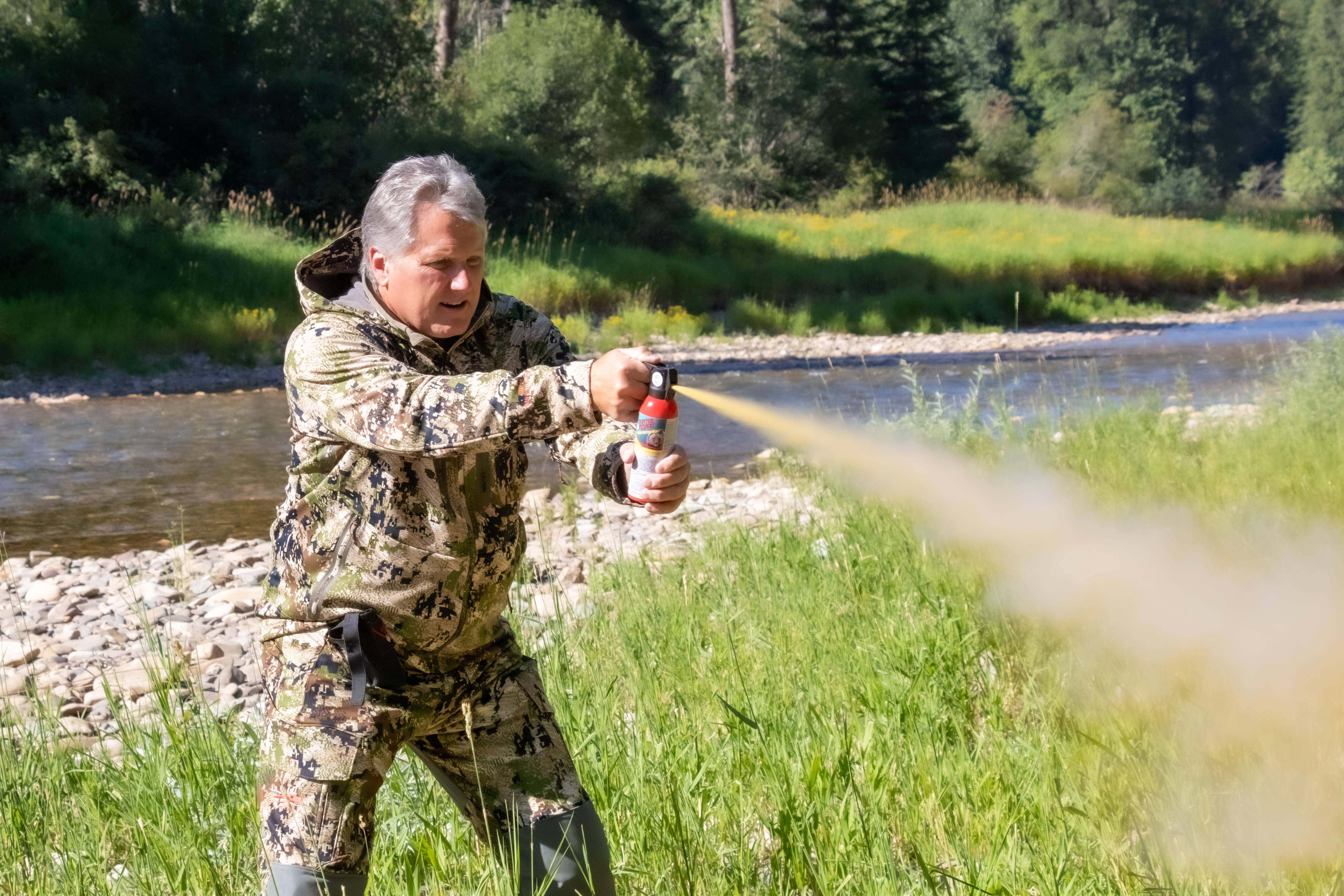
After being attacked by a grizzly bear last October,  Bob Legasa has started working with Counter Assault. Here he is pictured demonstrating how to use the company’s bear spray. Legasa’s story will be featured on Animal Planet’s “I was Prey” on Wednesday. (Bob Legasa/Freeride Media / COURTESY OF FREERIDE MEDIA)
After being attacked by a grizzly bear last October, Bob Legasa has started working with Counter Assault. Here he is pictured demonstrating how to use the company’s bear spray. Legasa’s story will be featured on Animal Planet’s “I was Prey” on Wednesday. (Bob Legasa/Freeride Media / COURTESY OF FREERIDE MEDIA)

Nearly a year ago, Bob Legasa was bloody and broken in the Montana backcountry, the unfortunate recipient of the maternal fury of an adult grizzly bear.

“It certainly was something I hope I don’t have to endure again,” Legasa said this week. “As far as the emotional and physical aspect of it, I’m lucky that I didn’t get mauled. That I wasn’t being rag dolled and tossed around. It was short and sweet. Or fast and vicious.”’

Tonight, Legasa will relive his Oct. 13 experience on national television. The Hayden resident’s story will be featured on Animal Planet’s “I Was Prey” show.

This is what happened: As Legasa and his partner, Greg Gibson, walked through tall sagebrush – between 6 and 8 feet – they startled a grizzly bear cub and its mother.

The mother bear tackled Legasa. Gibson, of Sandpoint, sprayed the bear with bear spray. The bear dropped Legasa, but not before breaking his arm with her mouth and clawing his face. She then started to charge Gibson. Gibson sprayed the bear again and she retreated.

Covered in blood and nearly blind from the spray, which had blown into their faces, both men hiked out.

In February, Legasa traveled to New York for an interview for Animal Planet’s show. Legasa, who owns his own outdoors media company, said he hesitated when first asked to participate. He worried that the show would overdramatize his experience or put an “anti-hunting” spin on it.

After being attacked online by hard-core vegans last year, he wondered if appearing on a television show would again make him a target. Ultimately, he decided to do it, reasoning that it provided him a good platform to spread a few important messages.

“Hunting has been in a weird limelight lately,” he said. “It seems like there are more people that are understanding hunting … but then there are also … some activist groups that are really going hard on trying to cut down or stop hunting.”

1 / 3

In February, Hayden resident Bob Legasa was interviewed by Animal Planet for their show “I was Prey.” Last fall, Legasa was attacked and injured by a mother grizzly bear while bowhunting for elk in Montana. The episode featuring Legasa will air Wednesday Sept. 4, 2019. (Animal Planet / COURTESY)

Legasa hopes to emphasize on the show that he hunts for many reasons. He loves being in the mountains and the challenge of stalking prey. He enjoys the pride and accomplishment of killing an animal that provides food for him and his family.

Showing the diverse reasons people hunt is a job many hunters are increasingly taking upon themselves. Only 5% of Americans 16 years and older hunt, according to a U.S. Fish and Wildlife Service study published in 2017. Fifty years ago, 10% of Americans 16 years and older hunted. Those decreased numbers mean that fewer people, especially in urban areas, know anyone who hunts.

“I was hoping that I could at least get a positive message across in that respect,” Legasa said.

In addition to burnishing the reputation of hunters, Legasa hopes to reiterate the importance of carrying bear spray, for hunters and nonhunters alike. Since his attack, he’s done promotional and testimonial work for Counter Assault bear spray, “preaching that bear spray works.”

“It should be the first line of defense,” he said. “It just gives you a better option than shooting.”

In Legasa’s case, if the two hadn’t had bear spray, they would have been out of luck. Because the bear was on top of Legasa, Gibson wouldn’t have been able to safely shoot the bear with his handgun.

With hunters and hikers heading to the hills this fall, that message couldn’t be more important.

As for Legasa, he’s mostly recovered from the attack last year. While he still has some residual pain from where the bear broke his arm, it hasn’t slowed him too much. Emotionally, he said the fallout has been minimal. Although recently, he did have his first bear-related dream.

“It wasn’t a nightmare, but there was a bear running at me,” he said. “It made me think for a second.”

That won’t stop him from hunting this year. In a week, he’s again heading to Montana for 12 days of bow hunting for elk.

“I’m going to get back on that horse and ride,” he said. “This is in my DNA. Being in the mountains is good for my soul. I’m just counting the days until I get back out there.”

California becomes the first state in the nation to outlaw fur trapping

Exposing the Big Game's avatarCommittee to Abolish Sport Hunting Blog

LINKEDINCOMMENTMORE

California has just become the first state in the nation to outlaw fur trapping. The Wildlife Protection Act of 2019, signed by Gov. Gavin Newsom Wednesday, will prohibit the trapping of native animals including grey fox, coyote, beaver, badger and mink, along with the sale of their pelts, which often end up in foreign markets.

The new legislation will officially end an industry that lawmakers argued was too small and costly to regulate.

Only 133 trapping licenses were bought in California in…

View original post 404 more words

Hunter dies after falling several hundred feet from bluff in eastern Oregon

Exposing the Big Game's avatarCommittee to Abolish Sport Hunting Blog

The Harney County Sheriff’s Office says a hunter died Saturday after falling several hundred feet over several bluffs near a mountain in eastern Oregon.
Search and rescue teams found the body of 40-year-old James Mucken, of Salem, Oregon, on a steep hillside on the Little Blitzen River on Steens Mountain, located about two hours south of Burns.
The recovery effort was suspended overnight Saturday due to darkness and dangerous conditions, but resumed Sunday. Due to the steep and difficult terrain of Steens Mountain and the surrounding area, search and rescue teams used more than 900 feet of rope to reach the area where the hunter had fallen. Several rescuers experience minor injuries during the recovery effort.

View original post