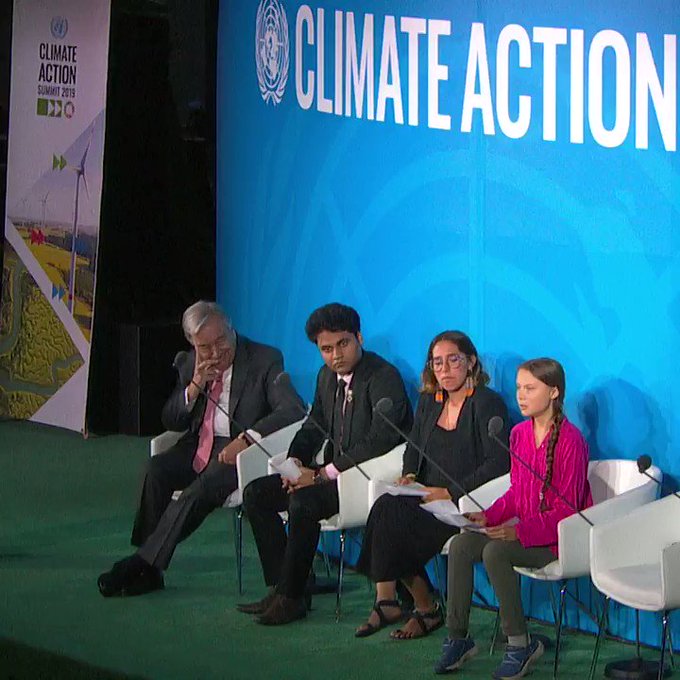
Environmental activist Greta Thunberg’s searing address at the United Nations earlier this week earned enthusiastic praise from climate researchers, with many saying that the 16-year-old has found ways to raise awareness of climate science, galvanize support and resonate with people in ways that they have struggled to for decades.
“Speaking as a climate change scientist who has been working on this issue for 20 years and saying the same thing for 20 years, she is getting people to listen, which we have failed to do,” said Saleemul Huq, director of the International Centre for Climate Change & Development in London.
“I thought it was the most powerful speech I’ve ever seen.”
Botswana has the world’s largest elephant population, with some 130,000 animals.
Greg Du Toit/Barcroft Images/Barcroft Media/Getty Images
Lebalang Ramatokwane surveys a jagged hole in the cement wall surrounding his half-built guesthouse on the outskirts of Kasane, a small tourist town in the far north of Botswana. A few days earlier, an elephant had knocked down part of the wall in two places, and now he’s wondering if he should beef up security before paying customers start to arrive.
“They are not only damaging what you see here,” Ramatokwane, a 37-year-old medical scientist, says. The thousands of elephants that roam freely around Kasane regularly destroy farmers’ crops and pose a real threat to people, he says. “These are wild, wild, wild animals. They are not conditioned.”
Botswana is home to some 130,000 elephants, more than any country in the world. For years, trophy hunters from the U.S. and…
The UK’s proposed large-scale cull of badgers to control the spread of TB in cattle has been postponed. Photograph: Natural Visions/Alamy
Mycobacteria and TB have been in the news a lot recently. In fact, one particular species has been hogging the limelight: Mycobacterium bovis. As its name suggests, it likes to infect cows, but as we’re recently all too aware, it’s quite happy in badgers too.
There are about 120 species of mycobacteria. They’re rod-like bacilli with a thick, waxy cell wall. The “human” member of the Mycobacterium family (using this word conversationally, as Mycobacterium is of course a genus, not a family, taxonomically) is M tuberculosis. From its point of view, it’s very successful. From our point of view, it’s the most important bacterial disease that afflicts us, causing about one-and-a-half million deaths a year.
This is how TB is caught: you breathe in tiny droplets of fluid containing just a few bacilli. In your lungs, your own immune cells move in and swallow up the bugs – but this is exactly what they want. Inside the immune cell, the bacilli replicate and pile up. More immune cells pile in. If you’re lucky, the bacilli are held tight in this lump, this tubercle. If you’re unlucky, the bugs get out and the disease spreads – through your lungs (and you start coughing up droplets with bacilli in, ready to infect someone else), through your whole body, even getting into your bones.
Not that long ago, TB in humans was thought to have been a fairly recent affliction, dating back to the neolithic and the origins of farming. This oft-repeated idea seemed reasonable – there didn’t seem to be any convincing cases of TB in skeletons dating to earlier periods. Perhaps close contact between early farmers and their cattle exposed them to M bovis, which then evolved into M tuberculosis in its new host.
But this isn’t the story written in the DNA of the bacilli. In 1999, an early genetic study cast doubt on the ancestor-descendant relationship between the bovine and human forms of TB. More studies confirmed the new story. If anything, the ancestor of both human and bovine forms must have been closer to the human form – with its larger chromosome. It’s even possible that cows caught TB from us (or at least, from another mammal that had caught “human” TB).
Using molecular clocks to date the age of M tuberculosis, looking for the last common ancestor of current versions of the bug, is problematic, and has produced a great range of dates from 15-40,000 years ago. All of these easily predate farming. However, this date is likely to just record a population crash in TB, probably because of a crash in the numbers of its host. Humans (and their ancestors) could have been suffering from TB for hundreds of thousands of years before then.
Earlier this year, filming for BBC2’s Prehistoric Autopsyseries, I visited Göttingen, and the lab of Professor Michael Schultz. He showed me a fascinating fossil, a piece of a Homo erectus skull, found in a travertine tile factory in Turkey. Scientific articles can be dry, stuffy things, but the one in which Michael described the fossil includes this fantastic quote: “Given the nature of its discovery in a factory workshop, the hominin was unfortunately reduced to a standard rough-cut tile thickness of 35mm.”
Despite the rough treatment of the fossil, the bone was very well preserved, and on the inner surface of the skull, Michael showed me clusters of small pits – things that just shouldn’t be there in normal bone. They were quite clearly pathological, and Michael believed that the best explanation for them, given their appearance and their position inside the skull, was meningitis caused by M tuberculosis. Here was evidence for a human ancestor suffering from TB, half a million years ago.
Back to the present, and TB has scarcely been out of the news for the past few weeks. The Great Badger Cull has become one of the hottest political potatoes of the year. So what is the scientific evidence? Well, it seems pretty clear that badgers do help spread bovine TB. But that also seems to be where the certainty ends. Bovine TB in the UK has been going up and up – but how much of that is due to better diagnosis? And could culling badgers really help to reduce it? A study published in the journal Nature in 2006 showed that culling badgers reduced the rates of TB among cattle in the area where the cull took place – but increased it in neighbouring areas. In 2011, based on the results of previous trials, scientists advised the current government that culling 70% of badgers in large areas could result in a 16% reduction in bovine TB. For the government, that was enough.
But some scientists are now concerned that the cull – particularly if carried out by free shooting, which hasn’t been trialled, or if targets are missed – could make matters worse.
For this winter, the badgers are safe. Like Caesar presiding over a bizarre gladiatorial contest, environment secretary Owen Paterson granted the badgers a stay of execution, at the eleventh hour. There are just too many of them to make a 70% cull achievable this late in the year.
So the debate continues. It’s an argument about science, politics and economics. It centres on protecting food animals from harm, just as our ancestors have done since farming first got started. But, to me, it also raises interesting questions about how we see ourselves and other animals. It’s about how much we see ourselves as a “dominant” species, entitled to subjugate the needs of other animals beneath our own. It’s about how much room we demand as a human population (with a taste for milk and beef) and how much room we’re prepared to make for wildlife.
And let’s not forget, if it hadn’t been for us, cattle and badgers might not have had TB in the first place.
By Jen Christensen, CNN
Video by Lacey Russell and Matt Gannon, CNN
Updated 12:29 PM ET, Fri September 27, 2019
Play Video
Waste could contaminate Florida’s water as seas rise 03:54
(CNN)A major UN report released this week shows the sea level is rising around the globe, which means people who live in coastal cities face real risks from losing their property, and in some cases their live, to the rising ocean and the intense storms these warmer waters bring.
And it will make it harder for more than 60 million people in the United States to flush their toilets.
About 1 in 5 US households rely on septic systems, according to the US Environmental Protection Agency. It’s a type of sanitary system that has worked since ancient Egyptian times, but the climate crisis and…
Frankly, she is skeptical. KENA BETANCUR/AFP/Getty Images
To her considerable and growing list of accomplishments, 16-year-old Swedish climate activist Greta Thunberg can now add another mark of distinction: She has been attacked by the troll-in-chief.
On Monday night, in response to Thunberg’s coruscating, impassioned speech to the UN, President Trump tweeted sarcastically, “[s]he seems like a very happy young girl looking forward to a bright and wonderful future. So nice to see!” (Thunberg promptly edited her Twitter bio to read: “A very happy young girl looking forward to a bright and wonderful future.”)
Trump’s sneering attack came amid a torrent of often misogynist and ableist abuse hurled at Thunberg since the speech, with conservatives attacking her demeanor, her looks, her mental health (she has autism), and above all her autonomy, claiming she is “brainwashed” or a victim of child abuse. Several have compared her speeches to Nazi propaganda.
“She’s ignorant, maniacal and is being mercilessly manipulated by adult climate bedwetters funded by Putin,” ranted C-list climate denier Steve Milloy, somehow fitting all the mutually contradictory stereotypes about powerful women into his pea brain at once.
John Ocasio-Nolte@NolteNC
I can’t tell if Greta needs a spanking or a psychological intervention…
What’s remarkable about this is not that the right-wing slime machine has gone to work against a new progressive threat. That’s what it was made for. What’s remarkable is how ineffective it’s been, how little it has affected Thunberg and her extraordinary influence.
The right-wing tabloid Daily Wire has published some of the vilest stuff about Thunberg. But when it sent Michael Knowles to Fox News to say Thunberg is a “mentally ill Swedish child who is being exploited by her parents and by the international left,” Fox took the rare step of apologizing to viewers and saying it would no longer book Knowles.
On a female-led Fox show, the lone male guest (“Buck Sexton,” I kid you not) went after Thunberg and was promptly scolded by the hosts for “kid bashing.” Up in Canada, Maxime Bernier of the far-right People’s Party of Canada was forced to apologize for calling Thunberg “mentally unstable.”
These moments of accountability on the right are rare, of course — there are dozens, hundreds more examples of attacks far uglier than this that have brought no pushback at all. But they help illustrate that Thunberg has the rare ability to tap into something human, something that, at least sporadically, can break through the media filter pushing the public into partisan camps.
As for Thunberg, her reaction to her attackers remains as bemused and clinical as ever:
I honestly don’t understand why adults would choose to spend their time mocking and threatening teenagers and children for promoting science, when they could do something good instead. I guess they must simply feel so threatened by us. ->
Even against the nuttiness of current events, Thunberg’s story is remarkable, in both human and political terms, as David Wallace-Wells masterfully captures in his recent New York magazine piece. He taps into the heady sense of a movement exploding but also offers a clear glimpse of the intently focused, achingly vulnerable teenager who finds herself at its white-hot center. Everyone should read it.
Here I just want to dwell on one theme of that piece, namely the unlikely confluence of personal history and characteristics that have made Thunberg so politically potent and so resistant to the right wing’s familiar smears.
It’s important to note, as she frequently does, that Thunberg has not single-handedly created this movement. She stands on the shoulders of generations of activists before and alongside her, many of them people of color, who are, to say the least, less likely to be adopted as icons by Westerners. (Check out this great thread on other young climate activists.)
But she has proven extraordinarily potent in crystallizing and focusing what has been a somewhat diffuse activist energy. She has brought a directness and simplicity to the movement that has been lacking. Her influence is growing, even as the right ramps up its barrage, and it is driving them out of their minds.
Greta avoids the trap of recommending specific policies
Across the world, businesses, scientific institutions, investors, and governments are effectively unanimous in recognizing the urgent need for action on climate change. The science has made it inescapably clear that business as usual leads to disaster. Many debates remain over the best path forward, but the basic case for action has become unassailable.
And so for the most part, opponents of action — generally far-right coalitions fueled by a mix of fossil-fuel cronyism and populist ethnonationalism — don’t assail it. They do everything they can to distract from it.
That almost always involves attacking the messengers (“Al Gore has a big house”) and their proposed solutions (“the Green New Deal will take away your hamburgers”). The scientists are after grant money; the activists are undercover socialists; the leaders are hypocrites; the marchers litter. Casting doubt on the motives and authenticity of people fighting for progressive causes is the right’s primary political tool, with efforts now led out of the White House.
For climate scientists and advocates, it’s a familiar trap. Any political program sufficient to address climate change at scale is, almost by definition, going to be radical, which allows the right to dismiss it as “far left.” The go-to attack on the climate movement is that it’s a “watermelon,” green on the outside and socialist red on the inside — that climate change is just a cover story for the political program.
Thunberg has sidestepped attacks on her motives by almost entirely refraining from endorsing specific political reforms or policies. “I can’t really speak up about things like [politics],” she told Wallace-Wells, “no one would take me seriously.”
Her insistence on this point was illustrated when she submitted the IPCC’s report on limiting warming to 1.5 degrees Celsius in lieu of testifying to the House. Attached was a short letter that said: “I am submitting this report as my testimony because I don’t want you to listen to me. I want you to listen to the scientists. And I want you to unite behind the science. And then I want you to take action.” She refuses to allow her opinions to become the focus.
United Nations
✔@UN
“The eyes of all future generations are upon you. And if you choose to fail us, I say we will never forgive you.”
Coming from almost any adult, this strategy would be vulnerable. Adults have political worldviews and very few have the discipline to keep them entirely hidden. But Thunberg is, in her own words, an “uneducated teenager.” She’s 16 years old! She can’t be expected to know what actions government agencies need to take and she doesn’t pretend to.
She just drags the focus back, again and again, to the subject grown-ups want to avoid: the need for immediate action and their longstanding failure to take any.
(The right has been circulating a picture of Thunberg with her parents in matching “antifascist all-star” T-shirts, claiming that it exposes her far-left politics. Ponder for a moment what it says about the right that it considers opposition to fascism politically compromising.)
Attempts to personally smear Greta have backfired
Right-wing media’s first instinct is to smear the messenger, to find some behavior on which to hang a charge of hypocrisy or some venal motive that allegedly undercuts moral authority. They have done it to everyone who has stuck their head up on climate change (beginning, famously, with Al Gore) for many decades now, snooping through stolen emails, filing lawsuits, and ruining careers.
But this is where Thunberg’s autism has proven, as she has put it, a kind of superpower. She has Asperger syndrome, an autism spectrum disorder that makes her indifferent, often blind, to social cues and incentives as well as inclined to focus intently on a single subject, a tendency Thunberg says is exacerbated by obsessive-compulsive disorder.
As Wallace-Wells notes, Thunberg fell into a depression when she was younger, after she learned about climate change, and spent a few friendless years eating and speaking little, barely motivated to leave the house. In her own words, her climate activism gave her a sense of focus and meaning that helped lift her out of depression.
(I’m far from the first to draw a connection between Thunberg’s autism, her authenticity, and her effectiveness. Steve Silberman wrote about it here on Vox; Naomi Klein and Liza Featherstone, among others, have made the point. Indeed, Thunberg herself has made it.)
In characteristically vile fashion, the right in both Europe and the US has attempted to use Thunberg’s mental health against her, but the attempt has largely backfired. For one thing, it is virtually impossible to watch her speak for any length of time and maintain a good-faith belief that she is responding to social pressure from adults. She is manifestly authentic, direct in a way unique among public figures, no more subject to flattery than to coercion.
ET Panache
✔@ETPanache
Greta Thunberg submitted a climate report during the House Foreign Affairs subcommittee hearing, along with the testimony of three other youth climate change advocates | https://tinyurl.com/y2yprgoz
Witness Thunberg’s utterly indifferent reaction to the plaudits lavished on her by congressional Democrats. “Please save your praise,” she said. “We don’t want it. Don’t invite us here to tell us how inspiring we are without doing anything about it. It doesn’t lead to anything.”
She’s not intimidated or dazzled by social hierarchy. She just drags the focus, again and again, back to her fixation, what the grown-ups don’t want to talk about: the need for immediate action and their long-standing failure to take any.
However the right tries to twist it, her personal story remains perfectly relatable. She’s a child who found out that the world she was born into is sliding headlong into crisis and suffering, and nobody’s doing much of anything about it. It depressed her. And it eventually motivated her to act.
The question is not why she was depressed and driven to action but why more children aren’t.
When Greta disregards social cues, it sends a social cue
The reason is simple: social cues. Children don’t see the adults around them acting like climate change is a crisis, so they don’t either. For most people, those social signals and affiliations — the building blocks of identity — are much more significant than “the facts” as conveyed by distant, disinterested authorities.
But, in part through their indifference to social cues, people with autism have a unique capacity to face the facts clearly. And the facts about climate change are fucking terrifying.
This, I think, helps explain why Thunberg has inspired so many people, especially so many young people: There’s a kind of courage in ignoring the pervasive social pressure to calm down about climate change. She takes the facts seriously, even when very few adults are modeling how to do so, even when it’s uncomfortable or inconvenient for those around her. She’s vegan, she won’t fly, and she’s devoting her young life to prodding adults into action; the default right-wing accusations of hypocrisy and duplicity simply don’t stick.
The right has established a social environment in which speaking up on climate change leads to bullying and shaming, but those tactics just don’t seem to work on Thunberg. And without them, the right has nothing to fall back on (not one of the hundreds of attacks launched at her has the courage to directly dispute the IPCC report she submitted).
In ignoring social cues, Thunberg has become one: A signal to other young people around the world that, yes, this really is an emergency, and yes, they really can and should speak up.
Making more Gretas. Photo credit should read TIMOTHY A. CLARY/AFP/Getty Images
Greta’s power will be in making more Gretas
So far, Thunberg has played her game expertly — mostly by being almost entirely oblivious to the other games being played around her — and I hope she does this as long as possible. I hope she continues to refrain from policy recommendations, live a low-carbon life, and drag the spotlight back to science. She has pulled off something like a political miracle, and I don’t want it to end any more than anybody else.
But the thing is, as much as Thunberg might now seem like a transparent lens, directing focus at climate science without the distractions of personal baggage, she is in fact a human being, one 16-year-old girl, and she cannot remain forever in the strange social position where she finds herself. Sooner or later, she’ll do something, join something, or say something that forces her out of the improbably apolitical space she now occupies — and the public tends to be unforgiving of females who disappoint their expectations, even young white ones. No human being can survive the full intensity of the right-wing smear machine undamaged.
If Thunberg is to have a meaningful long-term effect, it can’t be through staying in the spotlight. It must come from others adopting some of her focus, determination, and courage, learning to disregard the social pressures that suppress their fear and anger and prevent them from speaking up, connecting, and finding hope in one another. It will come from others, especially those in positions of power, listening to her and treating the threat to her generation’s future as a crisis.
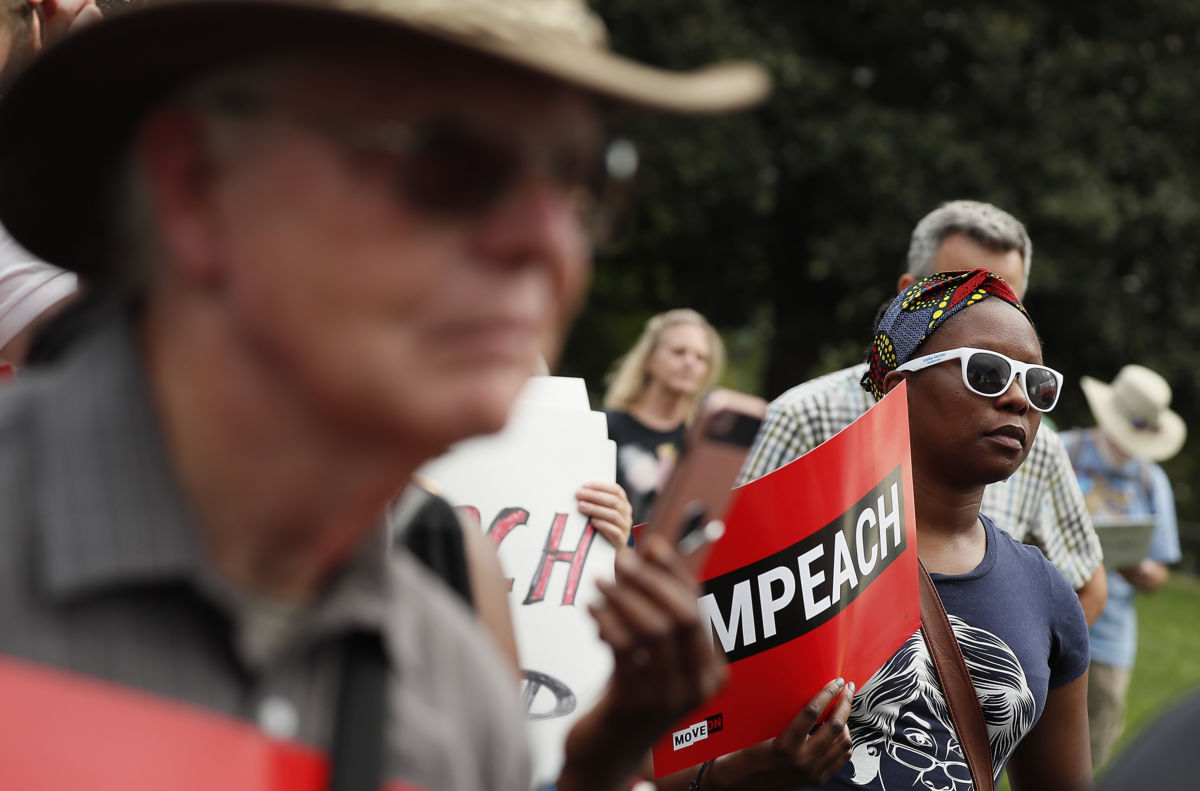
Members of Congress and activists support an immediate inquiry toward articles of impeachment against President Trump at the “Impeachment Now!” rally on the grounds of the U.S. Capitol on September 26, 2019, in Washington, D.C.PAUL MORIGI / GETTY IMAGES FOR MOVEON POLITICAL ACTION
Now that House Speaker Nancy Pelosi has enough votes in hand to open an official impeachment inquiry into the rogue presidency of Donald Trump, it is worthwhile to contemplate what got us here, or more specifically, what didn’t.
Meticulously documented cases of Trump obstructing justice didn’t get us here, nor did his ongoing violations of the emoluments clause, his ongoing policy of caging separated children in concentration camps, his Muslim ban, his public embrace of racism and fascist white nationalism, his frontal assault on the climate, his serial assaults on women, his 12,000 bald-faced lies, or his documented…
A visitor to the at the National Rifle Association annual meeting walked past signage for the event in Indianapolis, Saturday, April 27, 2019.
Michael Conroy/AP
Updated at 11:53 a.m. ET
The National Rifle Association acted as a “foreign asset” for Russia in the period leading up to the 2016 election, according to a new investigation unveiled Friday by Sen. Ron Wyden, D-Ore.
Drawing on contemporaneous emails and private interviews, an 18-month probe by the Senate Finance Committee’s Democratic staff found that the NRA underwrote political access for Russian nationals Maria Butina and Alexander Torshin more than previously known — even though the two had declared their ties to the Kremlin.
Then-NRA vice president Pete Brownell, who would later become NRA president, was enticed to visit Russia with the promise of personal business opportunities — and the NRA covered a portion of the trip’s costs.
The conclusions ould have legal implications for the NRA, Wyden says.
Tax-exempt organizations are barred from using funds for the personal benefit of its officials or for actions significantly outside their stated missions. The revelations in the Senate report raise questions about whether the NRA could face civil penalties or lose its tax-exempt status.
Attorneys general in the state of New York and the District of Columbia are conducting separate probes into alleged wrongdoing at the gun rights organization. These probes have a broader scope than the Senate report, which focuses on Russia.
Majority response: This is overblown
The Republican majority on the Senate Finance Committee, which was consulted periodically throughout the Democrats’ investigation, said Friday the report was overblown.
In the Republicans’ analysis of Wyden’s report, the majority argued that it does not account for U.S.-Russia relations at the time and contains “much conclusory innuendo… and repeatedly attempts to paint a picture that does not exist.”
The Republicans also argued that if the NRA committed any infractions, they would be small and do not put the NRA’s tax-exempt status at risk.
“To the extent NRA funds were used improperly in any facts discussed in the [Democratic report led by Wyden], it appears to have been minor, hardly a rounding error for an organization with hundreds of millions of dollars in revenue each year and nothing that cannot be corrected with minor intermediate sanctions,” the Republican analysis states.
Kremlin links were clear
Wyden’s 77-page report centers on Butina — a convicted Russian agent now in federal prison — and Torshin, a former Russian government official who has been sanctioned by the United States.
The report indicates that top NRA officials were aware of Butina’s and Torshin’s links with the Kremlin even as they sought to work more closely together under the banner of gun rights.
In an email later circulated to two senior NRA staff members, Butina wrote that a purpose of the 2015 Moscow trip was that “many powerful figures in the Kremlin are counting on Torshin to prove his American connections” by showing he could bring prominent NRA officials to Russia.
At another point, Butina suggested to participants on the 2015 NRA trip to Russia that she might be able to set up a meeting between them and President Vladimir Putin, referring to him as “Russia’s highest leader.”
NRA facilitated political access
Despite these declarations about their ties to the Russian government, NRA officials paid for and facilitated Torshin and Butina’s introduction into American political organizations.
Butina and Torshin received access to Republican Party officials at NRA events.
It was a explicit interest expressed by Butina: In one 2015 email to an NRA employee, Butina wrote, “is there a list of U.S. governors or members of Congress that might be present at some time during the [NRA] annual meeting?”
The employee responded with a list.
The NRA also helped them forge connections with groups such as the Council for National Policy, the National Prayer Breakfast, the National Sporting Goods Wholesalers Association and Safari Club International.
“NRA resources appear to have been used to pay for membership and registration fees to third party events for [Torshin and Butina] as well as to arrange for transit to and lodging for many of those events throughout 2015 and 2016,” the report states.
Report contradicts NRA denials
The Senate report notes that in 2018, then-NRA spokeswoman Dana Loesch repeatedly denied that the group leaders’ 2015 trip to Moscow was sanctioned by the gun rights group.
But in a letter obtained by the committee, then-NRA President Allan Cors wrote to Torshin on NRA letterhead after consulting with NRA staff and former NRA President David Keene.
Cors designated two NRA figures to lead the trip: “Dave Keene and [top NRA donor] Joe Gregory will represent the NRA and our five million members better than anyone else,” he wrote.
During the course of the investigation, Brownell’s lawyer also told the committee that Brownell believed the trip was an official NRA event.
This view is further strengthened by the committee’s evidence that NRA staff prepared itineraries, gathered briefing materials, applied for tourist visas, paid for some of the travel expenses, and provided the delegation with NRA gifts to give to Russian officials.
The Senate investigation also found evidence that the NRA tried to hide various payments related to the trip.
Brownell covered approximately $21,000 in expenses related to the trip; in June 2016, the NRA reimbursed Brownell just over $21,000.
After questions were raised about the trip in 2018, Brownell paid the NRA $17,000 — a transaction that Brownell’s lawyer told the committee was requested by the NRA as a way of “getting the trip off the NRA’s books.”
NRA leaders sought business opportunities
The Senate investigation concludes that a number of NRA figures on the 2015 trip traveled to Russia “primarily or solely for the purpose of advancing personal business interests, rather than advancing the NRA’s tax-exempt purpose.”
Brownell, then a vice president of the NRA, is the CEO of a major firearms supplier bearing his last name.
In an email to a staffer at his business, Brownell described his trip as “an opportunity to be hosted in Russia to broaden our business opportunities … to introduce our company to the governing individuals throughout Russia.”
“The NRA directly facilitated Brownell’s effort to travel to Moscow early to explore business opportunities with Russian weapons manufacturers,” the report concludes.
Another member of the trip, NRA donor and then-Outdoor Channel CEO Jim Liberatore, told the Senate committee through his lawyer that his participation in the 2015 Moscow trip was “purely commercial.”
Wyden seeks IRS probe
Wyden, the top Democrat on the Senate Finance Committee, said at the conclusion of his investigation that his staff had revealed information that shows that the National Rifle Association may have abused its tax-exempt status.
The next step, he says, is for the IRS to launch its own inquiry.
“The totality of evidence uncovered during my investigation, as well as the mounting evidence of rampant self-dealing, indicate the NRA may have violated tax laws,” Wyden said. “The IRS needs to examine these findings and investigate other publicly reported incidents of potential lawbreaking.”
On thin ice. This aerial view of the sea ice in East Greenland was captured by photographer Florian Ledoux using a drone 250 metres above sea level. Scientists have estimated that 2019 could be a record year for ice loss in Greenland. The melt season began weeks earlier than usual, and ice thawed faster than normal for the spring and summer months. During a summer heatwave, inland temperatures rose 12 °C above average and about 55 billion tonnes of ice melted in just 5 days.
Credit: Andrew McConnell/Panos
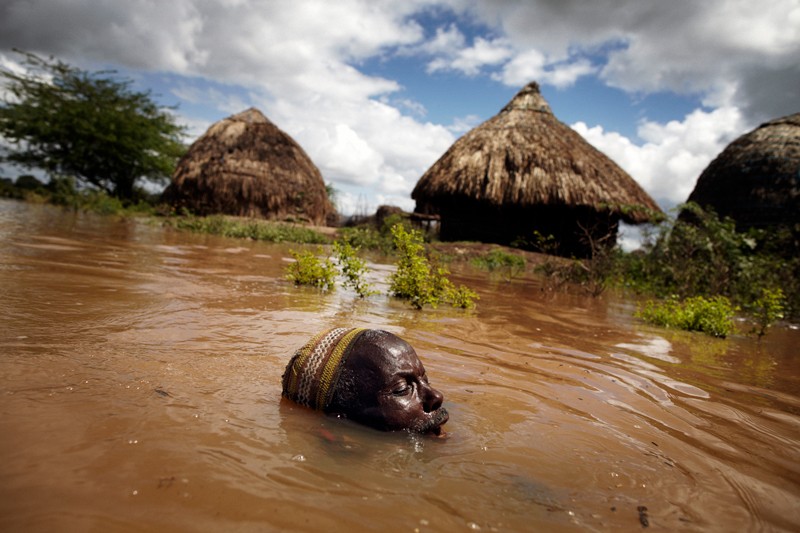
Burst banks. Pictured here in 2010, Idle Kasow, a chief of the Korlabe village in eastern Kenya, struggles in flood water after torrents during the rainy season caused the banks…






/cdn.vox-cdn.com/uploads/chorus_image/image/65325705/1170487570.jpg.0.jpg)



:no_upscale()/cdn.vox-cdn.com/uploads/chorus_asset/file/19234041/1169849395.jpg.jpg)



 Exposing the Big Game