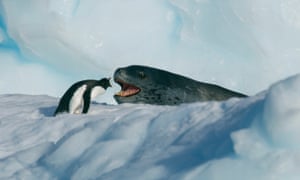
A face-off between a penguin and a giant leopard seal in Seven Worlds, One Planet. Photograph: BBC NHU
Any nature programme is now, in essence, just a list of things we’re killing. A record for posterity (whatever that looks like) of what we once had and fished, boiled and starved to death via climate breakdown. But if you can set aside the growing sense of fiddling with the remote control while Rome and every single other point on the globe burns, there is still much to enjoy in the latest offering from the BBC: Seven Worlds, One Planet.
Each earthly continent gets an episode narrated by David Attenborough (can you…
I research and write about science, policy and politics.
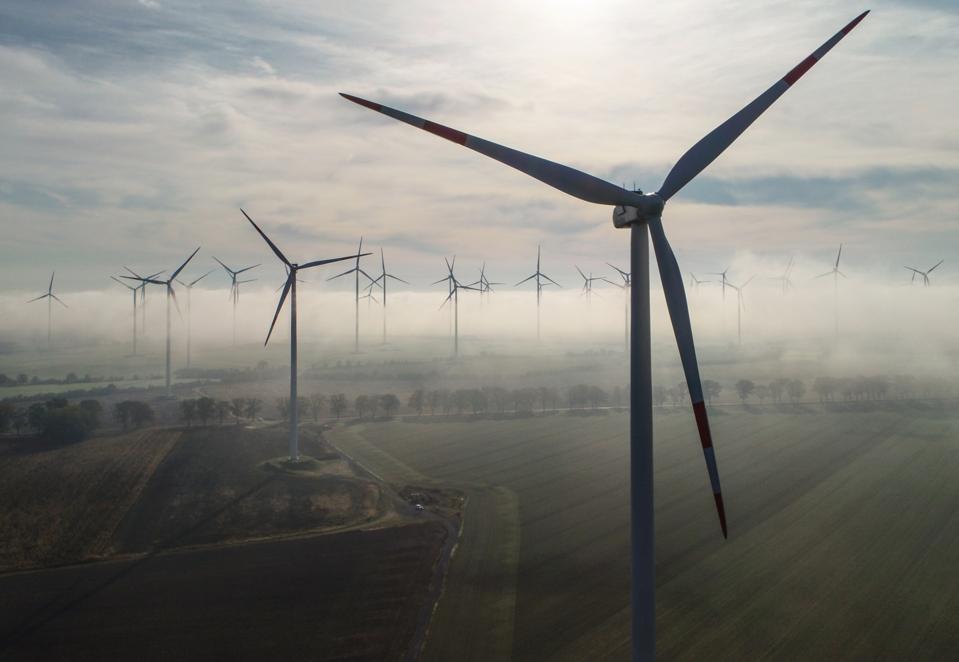
22 October 2019, Brandenburg, Sieversdorf: Wind turbines in the morning fog in the Oder-Spree … [+]
DPA/PICTURE ALLIANCE VIA GETTY IMAGES
Last year, the Intergovernmental Panel on Climate Change (IPCC) reported that “limiting global warming to 1.5°C would require rapid, far-reaching and unprecedented changes in all aspects of society.” Specifically, “Global net human-caused emissions of carbon dioxide (CO2) would need to fall by about 45 percent from 2010 levels by 2030, reaching ‘net zero’ around 2050.” Since then, many advocates and policy makers have proposed that target as a political goal.
Here I’ll show you the simple mathematics of what achieving the 2030 target entails. The evidence shows clearly that the world is far from being on a path that will come anywhere close to that goal. That is not an opinion, it…
These five bears travelled together in a pack in the Okanagan city of Penticton, B.C., before being put down by conservation officers on Thursday. (Submitted by Tobe Sprado/Conservation Officer Service)
comments
Five bears were destroyed by conservation officers in Penticton, B.C., Thursday after the group ventured too close to an elementary school.
Tobe Sprado, an inspector for the Okanagan region with the B.C. Conservation Officer Service, says the service has received 44 complaints about these particular bears since August.
“We were hoping that we’re going to be able to coexist with these bears,” Sprado said. “But things had escalated over that period of time.”
Sprado said the bears were attracted to garbage and fruit, and were starting to cause property damage.
On Wednesday afternoon, things escalated after one of the bears charged a person out walking.
“That [was] an aggressive behaviour that definitely put these bears more on our radar,” Sprado said.
“Then when they entered into the vicinity of the elementary school, we ended up making the decision to put down all five bears.”
The children and teachers were kept inside until the bears were shot dead.
Bears can cause problems in towns and cities as they look for food to eat before winter hibernation. (Submitted by Rachel Rowbottom)
Unusual grouping
Sprado said the bears would travel together in a pack, unusual for black bears. The group comprised three adult male bears and two females who were sub-adults.
“It wasn’t your typical sow with the cubs at all … [it’s] a bit of an anomaly from what we’re used to dealing with,” he said. “They could be a bunch of siblings.”
Sprado said his team was emotionally drained and frustrated by the turn of events.
It comes a little over a week after six bears were shot in the space of three days in the area of Lake Okanagan Resort northwest of Kelowna. In that case, the bears were eating garbage that hadn’t properly been secured and had lost their fear of humans.
An undisclosed company near Kelowna was fined $230 and ordered to improve the way it stores its garbage.
Sprado implored people to safely secure bear attractants like garbage, fruit, as well as pet food, bird feeders, barbecues and compost.
Beaver were once abundant throughout North America but they were trapped nearly to extinction by the end of the 19th century. A keystone species, the loss of beaver to our watersheds has been incalculable . . . streams that once had water in them all year round now run dry. Waters that once meandered slowly across the landscape began to cut down into stream banks once held together by riparian vegetation like willows, cottonwoods, and aspens. In the 1950s, the Army Corps of Engineers set out to remove what beaver remained and straighten stream channels to bring water down to multi-million dollar reservoirs more quickly. Now those reservoirs are filling with silt, and increasingly there is not even enough water to fill them, leaving farms and cities to fight over dwindling water supplies. Climate change promises to make these problems even worse. Higher temperatures…
Municipal Court Judge James Devine sentenced Catherine McCartney, 50, on Thursday, NJ.com reported. McCartney, who has a record of arrests related to bear hunt protests, pleaded guilty to obstructing “the administration of law and the prevention of the lawful taking of wildlife”.
McCartney, a dedicated animal rights activist, plans to appeal the sentence, relating to the incident in in Vernon, New Jersey.
In a statement she read in court, McCartney said she did not regret her decision in rescuing the bear cub from the painful trap.
“These animals are innocent and so I made the moral decision to let the bear go so he could run back to his mother, and it was the right thing to do,” she said.
The incident in question took place in October in a condominium complex. The New Jersey Department of Environmental Protection said it installed two culvert traps inside the complex campus to capture a bear—known as “Momma Bear” by activists—following two incidents with residents. None of these incidents resulted in injury.
Mark Nagelhout, who helped McCartney free the cub, also plead guilty to the same charges. However, he did not receive a jail sentence since this was his first offence.
Dogs can read human emotions. So, it appears, can horses. Whales have regional accents. Ravens have demonstrated that they might be able to guess at the thoughts of other ravens — something scientists call “theory of mind,” which has long been considered a uniquely human ability. All of these findings have been published within the past several weeks, and taken together they suggest that many of the traits and abilities we believe are “uniquely human” are, in fact, not so unique to us.
That statement probably sounds as if it is veering perilously close to anthropomorphism, and if you know anything about research concerning animal behavior, you likely know this: Anthropomorphism is bad. Animals are animals, and people are people; to assume that an elephant, for example, experiences joy in the same way a human does is laughably unscientific. This has been the prevailing mode of thought in this line of scientific inquiry for most of the last century — to staunchly avoid, and even ridicule, any research project that dared to suggest that animals might be thinking or feeling in the same way that humans do.
But new studies like these, along with a slew of recent books by respected biologists and science writers, are seriously considering the inner lives of animals. Now some prominent scientists are arguing that, though the impulse was well-intentioned, decades of knee-jerk avoidance of all things anthropomorphic may have mostly served to hold this field back. “It ruined the field,” biologist and author Carl Safina told Science of Us. “Not just held it back — it’s ruined the field. It prevented people from even asking those questions for about 40 years.”
New studies … are seriously considering the inner lives of animals. Though the impulse was well-intentioned, decades of knee-jerk avoidance of all things anthropomorphic may have mostly served to hold this field back.
The theme of Safina’s book Beyond Words: What Animals Think and Feel pairs nicely with a forthcoming title from famed primatologist Frans de Waal called Are We Smart Enough to Know How Smart Animals Are? Both scientists make the case for something the biologist Gordon Burghardt called “critical anthropomorphism” — using your own human intuition and understanding as a starting point for understanding animal cognition. “Thus, saying that animals ‘plan’ for the future or ‘reconcile’ after fights is more than anthropomorphic language: These terms propose testable ideas,” de Waal writes.
Animal behavioral science began in the 1910s and 1920s by focusing on description in order to combat superstition (cats are not witches’ familiars, tortoises are not especially tenacious, and grasshoppers are not lazy, etc). The problem is that, eventually, “[d]escription — and onlydescription — became ‘the’ science of animal behavior,” Safina writes in his book, which was published last summer. “Wondering what feelings or thoughts might motivate behavioral acts became totally taboo.” Here’s an example Safina uses: A “good” scientist’s notes might say something like, “The elephant positioned herself between her calf and the hyena.” A bad, anthropomorphic-leaning scientist, on the other hand, would observe the same scene and write, “The mother positioned herself to protect her baby from the hyena.” How can the scientist prove what the mother elephant was intending to do? You can’t see a thought; you can’t observe a feeling. Therefore, to presume that animals possessed either of these things was considered unscientific.
Even raising the mere question of animal awareness was once enough to potentially ruin a career. In the 1970s, the biologist Donald Griffin published a book that did almost exactly that: Question of Animal Awareness. Griffin at this point was a well-respected scientist who had recently made the discovery that bats use echolocation, or sonar, to navigate their surroundings. But after the publication of his book, his professional reputation was largely ruined. Even Jane Goodall caught some flak for going so far as to “humanize” her chimp research subjects by giving them names, and as recently as the 1990s, a writer in the prestigious journal Science advised that research concerning animal cognition “isn’t a project I’d recommend to anyone without tenure.”
Even raising the mere question of animal awareness was once enough to potentially ruin a career.
Better data, including advances in neuroimaging technology and videos from scientists doing fieldwork, is now forcing many to reconsider some very basic questions of animal cognition. Today it sometimes seems like barely a week goes by without the publication of some new study that shows evidence of one species or another demonstrating what might’ve once been considered a strictly “human” ability or emotion.
Evidence of empathy, and even comforting behavior, has been observed in a variety of species
A recent study proposed that the humble prairie vole, a rodent found across the United States and Canada, appears to console its fellow vole after mean scientists stress it out by giving it a (small) electric shock.
Behaviors that look a lot like consolation have also been observed in animals known for their sociability, like elephants. When one Asian elephant sees that another elephant is agitated, scientists have observed that the calmer one will respond by touching the distressed animal with its trunk. “I’ve never heard that vocalization when elephants are alone,” Joshua Plotnik, who led the study, toldDiscovery. “It may be a signal like, ‘Shshh, it’s okay,’ the sort of sounds a human adult might make to reassure a baby.”
Contagious yawning, some scientists argue, is another signal of empathy and has recently been observed and recorded in chimpanzees.
Some research suggests that a few animals have demonstrated signals of self-awareness
The best way scientists currently have of measuring this admittedly abstract concept is the mirror recognition test (though some recent work has called the accuracy of this method into question). This usually involves marking the subject with some kind of conspicuous, but odorless, dye and placing it in front of a mirror. Passing the test involves examining the mark in the mirror, and then examining it on their own body; this suggests that the animal grasps that the reflection is a representation of them. Apes and monkeys seem to be able to figure the game out.
In the early 2000s, a pair of scientists found that bottlenose dolphins could also pass the mirror test with flying colors. In her new book Voices in the Ocean, science writer Susan Casey nods to that study, and notes that, in subsequent years, elephants and magpies have also taken the mirror test and passed. (For context, humans don’t pass this test until they are about two.)
Some animals appear to be capable of understanding the perspective of others
Beyond the raven’s newly discovered behaviors, there is evidence that scrub jays are able to see the world from another scrub jay’s viewpoint, which helps them hide their food. Male Eurasian jays seem to be able to make a good guess at what sort of food female Eurasian jays might like to eat. “It was long thought that only humans could do this,” University of Cambridge psychologist Nicola Clayton told Wired of the jay research. “What we’ve shown in a series of experiments is that doesn’t seem to be the case.”
To be sure, in an era of viral videos, it’s easy to take this idea —Anthropomorphism is okay now! — and get carried away with it. A perfect recent example is a back-and-forth over a picture of a trio of kangaroos. According to the Facebook caption accompanying the photo, the female had recently died, and the male and baby were “mourning” it. Media outlets took this at face value and ran with it, with headlines like “Dying Kangaroo Mom Spends Last Moment Holding Her Baby.”
And then, as is the circle of life for a viral news story, came the debunkings: The male kangaroo was just trying to have sex with the female, these articles scolded, and to believe any differently was a sign of “naive anthropomorphism.” Safina’s impression of the photo, incidentally, is that there really isn’t much we can tell one way or the other from a still photo. Really, the photo — or, more specifically, the instantly polarized online reactions to the photo — tell us more about ourselves than they do about kangaroo behavior.
“The one thing that is almost never allowed, or never thought of, is that there can be nuance,” Safina said. “There can be a range of emotions that happen in nonhumans, just as there is in humans.” After a human death, for example, the person’s loved ones show a range of emotions — denial, confusion, even some terribly inappropriate laughter. “But with animals everything has to be either/or,” Safina continued. People either want to believe that animals are pure and kindhearted and all-around better than we are — or they want to believe the very opposite, that humans are the most remarkable creatures on Earth, and animal behavior is driven only by instinct. (As if human behavior isn’t, too.)
Rushing to an unsupported conclusion that animals are just like us is bad, biased science. But willfully ignoring evidence of animal behaviors that look suspiciously like human emotions is unscientific and biased, too. “The key point is that anthropomorphism is not always as problematic as people think,” de Waal writes, adding that this is probably particularly true of animals with brains like ours: apes, sure, but even elephants and some marine mammals like dolphins. After all, we’re animals, too.
This week Insight is looking at the emotions of dogs and their human companions. Do they actually love us? | Tuesday 26 April, 8:30pm SBS
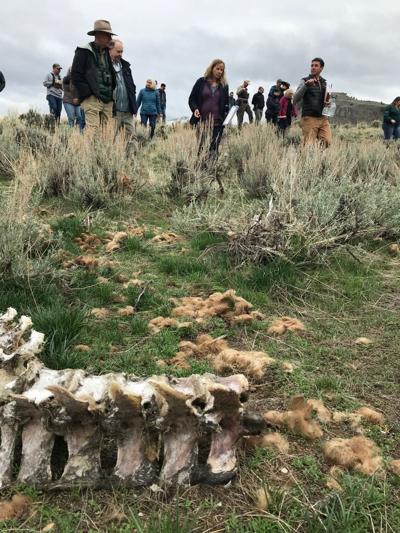
A backbone and scattered chunks of fur are all that remain of a bison killed by hunters near Beattie Gulch, one of two popular bison hunting areas north of Gardiner and Yellowstone National Park.
BRETT FRENCH, Billings Gazette
A Gardiner-area landowner is suing the National Park Service and U.S. Forest Service to halt the hunting of bison just outside Yellowstone National Park’s northern border, saying the agencies have failed to analyze the consequences of the hunt as required by law.
“The Park Service and Forest Service have never analyzed the impacts of hunting on private property owners, neighbors, and visitors” through the appropriate environmental process required by law, stated the complaint by Bonnie Lynn and Neighbors Against Bison Slaughter, which shares her address.
Lynn is seeking a permanent halt to any future bison killing within a mile of her home and rental cabins as well as a temporary restraining order to stop the hunt this winter.
The lawsuit argued that rather than address the situation, “the Federal Agencies have foisted the dangerous and concentrated impacts of bison hunting onto a small group of private property owners, neighbors, and visitors.”
The complaint specifically focuses on Forest Service land known as Beattie Gulch, which is just across the road from Lynn’s residence. Each winter and spring, as bison migrate out of Yellowstone in search of forage, tribal and state hunters concentrate at the pinch point to kill the big ungulates.
In the most extreme case, 389 bison were killed on the land in the winter of 2016-17, the majority of them by tribal hunters exercising their treaty rights. Bison gut piles, legs and other remains are often left behind after the hunts, attracting predators such as bears and wolves as well as scavenger birds.
The second complaint, filed by Lynn and L&W Construction LLC, is seeking $500,000 from the federal government claiming that because predators and birds have sometimes spread the carrion to her property it is a taking of her property rights, physically occupying her land, without just compensation. Bison are known carriers of brucellosis, a disease that can cause undulant fever in humans.
Lynn’s two complaints were filed Tuesday in a District of Columbia federal court. One of the attorneys representing her is former Montana U.S. House candidate Jared Pettinato.
Editors’ Note: Click on image to download high resolution version.
KODIAK, Alaska – A Coast Guard MH-60 Jayhawk helicopter aircrew from Air Station Kodiak medically evacuated an injured hunter from Kodiak Island, Friday.
The aircrew landed in Deadman Bay near a public use cabin at 3:41 a.m. and safely transported the 50-year-old man in stable condition to awaiting EMS personnel at Air Station Kodiak.
The hunter reportedly suffered from symptoms of an infection and complications after sustaining an injury on Oct. 16.
The Alaska State Troopers requested aircraft assistance from the Coast Guard’s 17th District Command Center after they received notification of an activated satellite communication device from the International Emergency Rescue
Coordination Center. With support from all partners, the 17th District watch standers were able to fully assess the situation and coordinated the medevac after a consultation call with the Coast Guard duty flight surgeon.
An Alberta trapper says California’s move to ban the sale of new fur products is an uninformed decision based on animal rights activists who don’t understand the environmental role played by trappers throughout North America.
“The narrative of the animal rights lobby is that trapping is inhumane and it’s torturing animals and threatening wildlife,” Bill Abercrombie, president of the Alberta Trappers Association, told CBC Radio’s Edmonton AM on Thursday.
“That really is not what trapping is about at all. It’s much more about conservation and sustainable use … [and] in modern times, the humaneness of it is not even an issue. It’s completely humane.”
Under a bill signed into law earlier this month, California will be the first state to ban the sale and manufacture of new fur…
Jellyfish Pictures/HHMI Tangled Bank Studios via AP
This rendering shows an ancient Carsioptychus mammal from the PBS NOVA special, Rise of the Mammals. In this recreation, Carsioptychus coarctatus eats plants in a newly diversified forest, 300,000 years after the mass extinction that wiped out the dinosaurs.
A remarkable trove of fossils from Colorado has revealed details of how mammals grew larger and plants evolved after the cataclysm that killed off the dinosaurs.
The thousands of specimens let scientists trace that history over a span of 1 million years, a mere eyeblink in Earth’s lifespan.
Sixty-six million years ago, a large meteorite smashed into what is now the Yucatan Peninsula of southeastern Mexico. It unleashed broiling waves of heat and filled the sky with aerosols that blotted out…








 Exposing the Big Game