Hole in Arctic’s ozone layer might be its largest ever01:09
(CNN)The Arctic’s ozone layer developed a tear, which grew into a hole, and then a bigger hole. Now, it may be biggest hole the North Pole’s ozone layer has ever incurred.
Ozone levels in the area have dropped steeply since then.
That’s unusual for a few reasons. While holes in the ozone layer are reported every year in the Antarctic, where temperatures are much colder, no sizable holes in the ozone layer have been recorded in the Arctic since 2011.
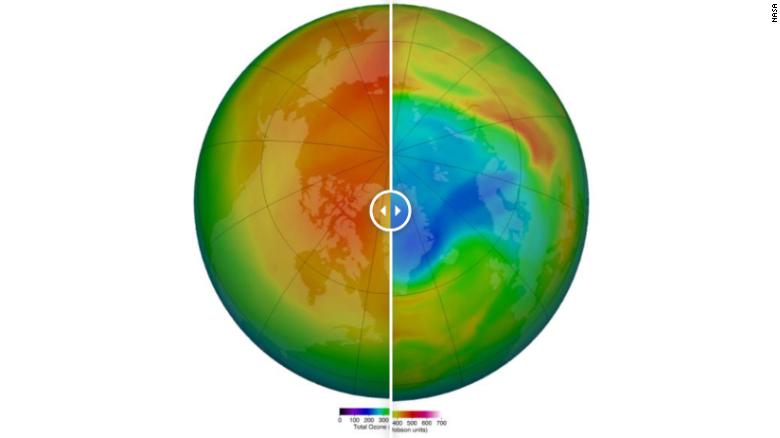
A false-color view shows the total ozone over the Arctic pole between April 2019 and April 6, 2020. Purple and blue mark areas with the least ozone, and the yellow and red mark areas with more ozone. This year, there’s signifcantly less ozone.
Even researchers with the Copernicus Program, the European Union’s Earth observation program, who first caught the hole say they aren’t sure why it’s so large.
close dialog
Receive Fareed Zakaria’s Global Analysis
including insights and must-reads of world news
Activate Fareed’s Briefing
By subscribing you agree to our
privacy policy.
“The ozone has been, in this layer, almost completely depleted,” said Vincent-Henri Peuch, director of the Copernicus Atmosphere Monitoring Service.
About the ozone layer — and ozone holes
Life on Earth relies on the ozone layer, which sits in the stratosphere between 9 and 22 miles above the Earth, to protect us from ultraviolet radiation, which is known to cause skin cancer and suppress the immune system. But human-made chemicals have been poking holes in it for years — there’s been a hole in the Antarctic ozone layer every year since 1985, when the first one was reported by the British Antarctic Survey.
There are a few conditions necessary to tear a hole in the ozone layer. Among them are chlorofluorocarbons (CFCs), manufactured chemicals that have been phased out of consumer products after they were banned in 1996, and halons, formerly found in fire extinguishers, which accumulate in the atmosphere after they’re emitted during human activity.
When the Antarctic is cloaked in below-freezing darkness, polar vortexes can form — those are swirls of stratospheric clouds that facilitate the reactions between CFCs and the ozone layer (holes typically form when the weather is -108.4 degrees Fahrenheit).
When conditions are right, and the first sunlight after winter arrives, the ozone breaks the CFC bond to release a chlorine atom, which can poke a hole in the ozone layer, according to NASA Ozone Watch.
It’s much rarer for ozone holes to form in the Arctic, where the mountainous terrain at high altitudes makes it difficult for polar vortexes to form and sustain their power, Peuch said.
But the existence of this record-breaking hole means that conditions must have been right in the Arctic. Peuch said it’s still not clear why this hole formed, though.
What the record-breaking hole means
The level of ozone fell steeply in the affected area throughout February and March, Peuch said.
As a result, the UV radiation that has made it to the Earth’s surface is slightly higher than usual. But because the hole occurred in the winter into early spring, the UV index reached a high of 5, which is unusually high for this region but fairly normal for much of the United States, which hovers around an index of 5 or 6, according to the EPA’s monthly UV averages.
This hole doesn’t pose a huge deal for humans, though, Peuch said. Because the UV radiation is mostly affecting northern Greenland, which he said is sparsely populated, and the exposure won’t last long, the effects of this ozone hole are minor.
One area that is of concern, he said, is how this could affect ecosystems in the area.
“That I cannot tell, but for human health, it’s fairly moderate,” he said.
And the hole isn’t permanent, either: Peuch said he expects it to begin to close as soon as next week.
Police reportedly found 17 bodies piled inside a small morgue at one of New Jersey’s largest nursing homes.(ShutterStock)
Police reportedly found 17 bodies piled inside a small morgue at one of New Jersey’s largest nursing homes.
According to the New York Times, the Andover Township Police Department in Newton, N.J., made the disturbing discovery after checking out an unfounded tip that a body was being stored in a shed at the Andover Subacute and Rehabilitation Center.00:0107:51
Instead, they found 17 bodies in a morgue at the complex meant to store four bodies.
“They were just overwhelmed by the amount of people who were expiring,” Andover Township Police Chief Eric Danielson told the Times.
A call to Danielson Wednesday night was not immediately returned.
The Times reported the bodies were among 68 recent…
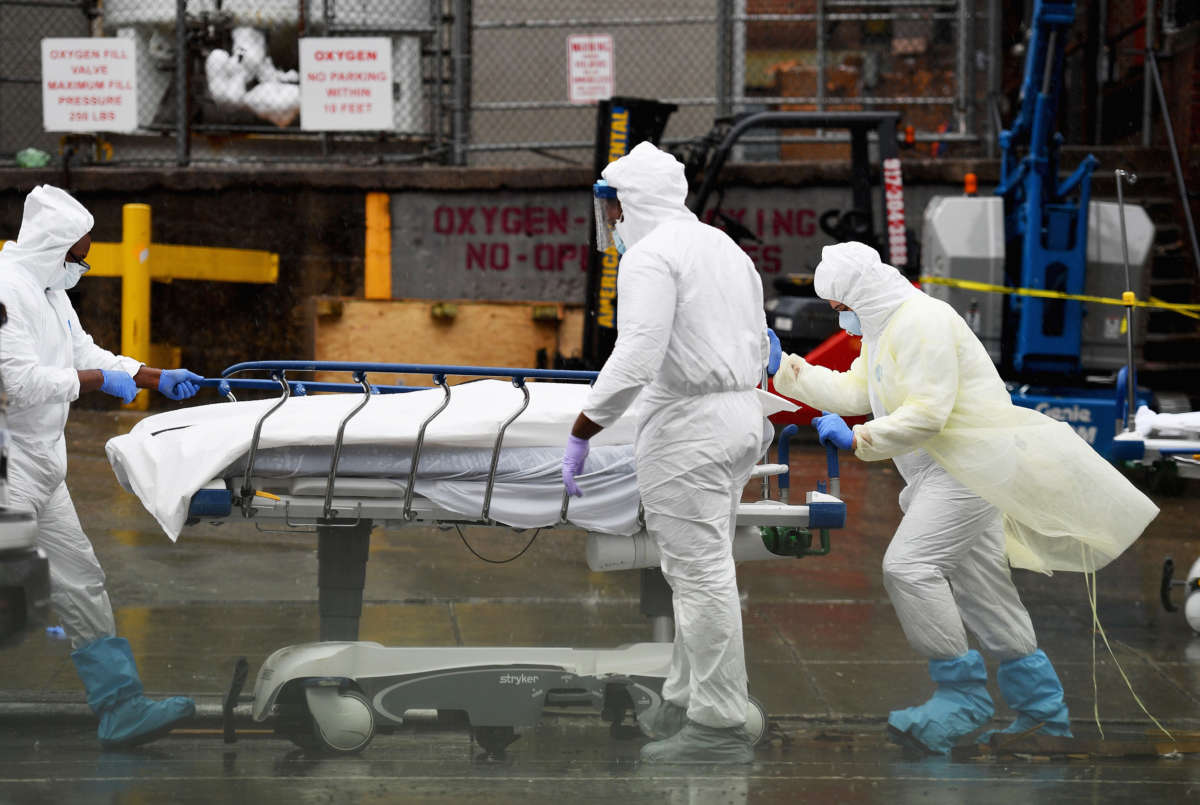
Medical personnel move a deceased patient to a refrigerated truck serving as a makeshift morgue at Brooklyn Hospital Center on April 9, 2020, in New York City.ANGELA WEISS / AFP VIA GETTY IMAGES
Two epidemiologists, writing an op-ed together in The New York Times on Wednesday, are suggesting that earlier efforts to mitigate the spread of the novel coronavirus — even implementing social distancing measures by just a week or two — could have saved tens of thousands of American lives.
Britta Jewell, a research fellow in the department of infectious disease epidemiology at Imperial College, London, and Nicholas Jewell, chair of biostatistics and epidemiology at London School of Hygiene and Tropical Medicine (and also a professor at the University of California, Berkeley), wrote in their opinion piece that earlier action could have been beneficial.
Tactics for dealing with COVID-19 and other diseases where there isn’t an effective treatment, much less a vaccine to prevent their spread, require intervention methods that “go back to the basics,” the researchers wrote, noting that social distancing measures (like limiting large gathering sizes or closing schools) must be implemented in those cases.
Even with the advisory in place, the White House did not order any state or municipality to quarantine or make a blanket stay-in-place proclamation for the nation at large. A few days later, California became the first state to issue such an order, followed by 14 other states over the next five days.
Both authors stated that their research models suggest, had the Trump administration acted earlier in deeming social distancing measures necessary to prevent the spread of COVID-19, thousands of lives could have been saved.
Current models forecast over 60,000 Americans may die from COVID-19 by August. Had social distancing measures been pushed by Trump a week prior, however, the researchers concluded that the number could have been just 23,000 — nearly a 60 percent drop in current death estimates. A decision to implement those measures two weeks earlier than when the president’s recommendations were made would have dropped estimates down by 90 percent.
Noting that modeling estimates aren’t always a “crystal ball,” and that their numbers could be off, the researchers maintain that “What matters more is the relative effect of moving earlier rather than later in trying to contain the spread.”
In other words, had the Trump administration taken things more seriously, the number of Americans who are likely to die from the disease could be starkly smaller.
“Whatever the final death toll is in the United States, the cost of waiting will be enormous, a tragic consequence of the exponential spread of the virus early in the epidemic,” they added in their op-ed piece.
Indeed, the week or so prior to Trump issuing his social distancing recommendations, the president was making a number of statements suggesting he didn’t see the crisis as being all that important or that such actions were warranted. On March 9, for example, Trump sent out a tweet in which he expressed a desire to resist calls for distancing measures, comparing such actions as being out of line for what we do during flu season each year, and thus unnecessary for COVID-19.
“Nothing is shut down, life & the economy go on” when flu season occurs, Trump pointed out.
Also on March 9, Trump sent out a separate tweet to his followers insinuating that fears about coronavirus were nothing more than mere partisan statements against him.
“The Fake News Media and their partner, the Democrat Party, is doing everything within its semi-considerable power (it used to be greater!) to inflame the CoronaVirus situation, far beyond what the facts would warrant,” Trump said, citing the words of Surgeon General Jerome Adams that week, who said, “The risk is low to the average American.”
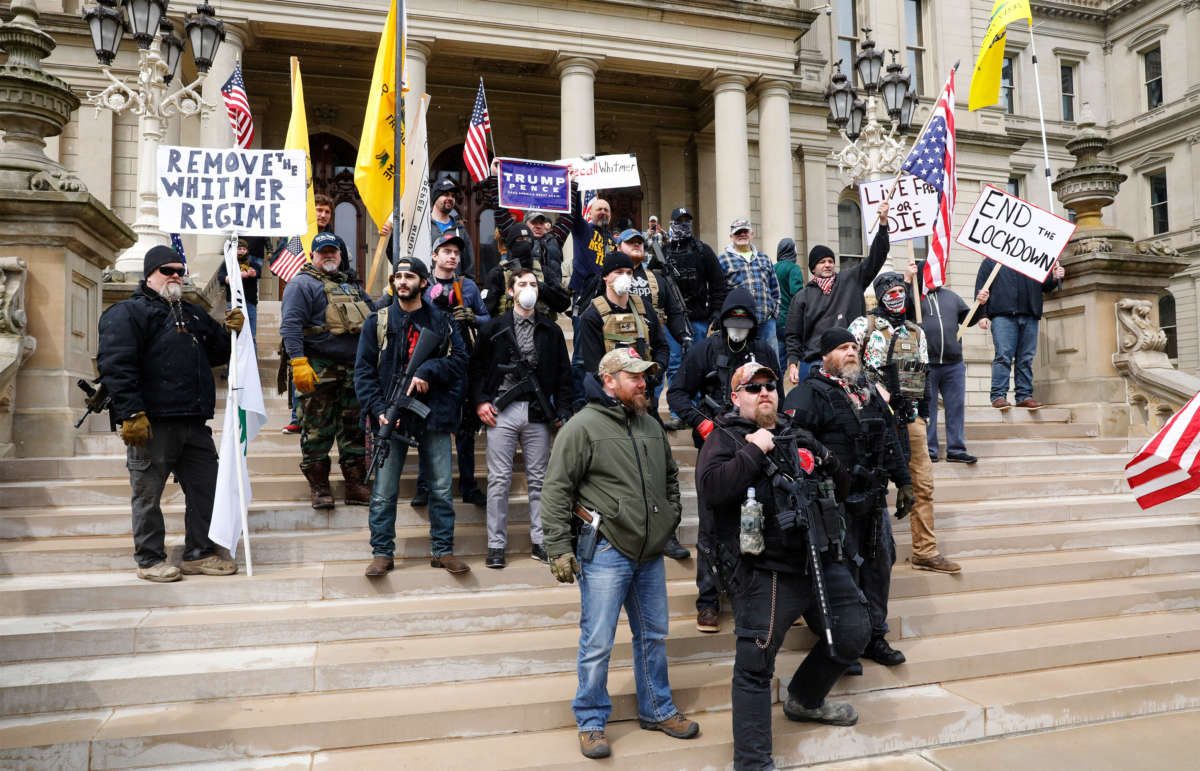
People take part in a protest for “Michiganders Against Excessive Quarantine” at the Michigan State Capitol in Lansing, Michigan, on April 15, 2020.JEFF KOWALSKY / AFP VIA GETTY IMAGES
In the finest traditions of Abraham Lincoln and Franklin Roosevelt — two of the U.S.’s most noteworthy wartime presidents — Donald Trump, the coronavirus “war” “president,” yesterday accused the state of New York of padding its coronavirus death toll, after New York revised its numbers to reflect thousands who died of COVID-19 before it had a name.
We’ve gone from “Fourscore and seven years ago” to “Nothing to fear but fear itself” to “Everything we have is documented and reported great,” which is how Trump responded to New York’s revised numbers. And you wonder why a new poll shows that 45 percent of Fox News viewers believe the coronavirus death toll numbers are inflated. The president said so!
Meanwhile, back in the middle of March when the COVID crisis was first beginning to roar but could have been better contained, the White House realized it had a shortage of face masks for its staff. This set off a scramble to get masks from Taiwan roundabout the 14th of that month. “At the time, the U.S. government was discouraging the public from wearing masks, saying that healthy people didn’t need them,” reportsThe Washington Post.
“A protest movement is taking hold targeting states that have extended social-distancing rules, closed schools, and restricted access to large religious gatherings,” reportsThe Daily Beast. “And it’s being fed by loyalists and political allies of President Donald Trump.”
These pro-Trump protests have been popping up in Idaho, North Carolina, Oklahoma, and other states that have not yet felt the full brunt of the pandemic. The most vivid example to date came just yesterday in Michigan, where thousands of right-wing protesters — a number of them packing AR-15s — swarmed the capitol building in Lansing to protest Gov. Gretchen Whitmer’s stay-at-home order. “Lock her up!” they chanted, because of course they did.
While Trump himself is largely responsible for this incredibly dangerous burst of deeply misplaced faux-patriotism, his ideological allies have been busy online. A misinformation-laden video denouncing Anthony Fauci, for now the other face of the daily coronavirus briefings, has gone viral with more than 6 million views. It accuses Fauci and others of being part of the “Deep State,” Trump’s favorite rhetorical target. Given Trump’s recent unsubtle hints that Fauci is telling too much truth, the appearance of this video puts one in mind of the old saying about how there are no accidents in politics.
Evangelical churches have been filled to capacity with Trump supporters who have been led to believe that these stay-at-home orders issued by state governors are an attack on their constitutional right to gather in worship as they please. Evangelicals, of course, have been the unshakable bedrock beneath Trump’s dwindling base of support.
Jerry Falwell Jr., president of the evangelical Christian crown jewel Liberty University, has been ardent in his outspoken belief that COVID is nothing to fear and a plot to undermine Trump. “Since March 29, when the first case was diagnosed in a Liberty student living off-campus, confirmed coronavirus cases in the Central Virginia health district, which surrounds Lynchburg and Liberty, have grown from seven to 78, reportsThe New York Times. “One person has died.”
Even as Trump’s most ardent supporters crush themselves together to protest necessary coronavirus restraints, COVID hotspots have begun to bloom in regions that have been, to date, the geographic core of his support.
Nebraska, Idaho, South Dakota and other rural farm belt states are experiencing spikes in confirmed COVID cases. In Nebraska alone, the state’s health department reports a 30 percent increase in cases over the last three days. That is the accelerating curve New York, Massachusetts and Washington State can tell Nebraska all about.
The so-called “curve” of cases does appear to be flattening nationally because a majority of people, especially in urban areas, are devoutly complying with the strictures of social distancing. There are about 30,000 new cases every day right now; the number is no longer accelerating, but is still horrifying to contemplate.
What happens when this thing really and truly burns through rural America? It has already begun, and because of all those Trump supporters standing shoulder to shoulder at capitols and churches to shout their defiance of science and the “Deep State” into the virus-polluted air, it will get worse.
It will get worse within days, if the pattern holds, and there is no reason to expect otherwise. The match has been lit. In two weeks, these rural areas — which have lost so many of their hospitals thanks to decades of conservative budget cuts — are going to be locked into the same nightmare the urban areas have been dealing with since March, but with far less medical infrastructure prepared to confront it.
It begs the deadly, wretched question: How many Trump voters are going to die between now and November? How many people who listened to their president and his Fox News mouthpieces, who jammed the Michigan capitol steps and the megachurches on Easter because the president said it was safe, will be dead by June?
Quite a lot, I fear. This is the very living essence of tragedy and farce. Trump has labored mightily to convince his people that this is all some sort of ruse to keep him from being re-elected, and millions of those people have swallowed it whole.
This is a snake eating its own tail in real time while the snake-handler-in-chief cheers it on … except we are not talking about snakes. These are people, all of whom are somebody’s children, many of whom have children. They trusted Donald Trump, and that will get many of them killed while subsequently prolonging a pandemic that has already infected 2 million people worldwide.
I wonder if they will still think it was worth it come the summertime. I wonder if they will want a word with Mr. Trump once the virus he called a hoax has its way with them.
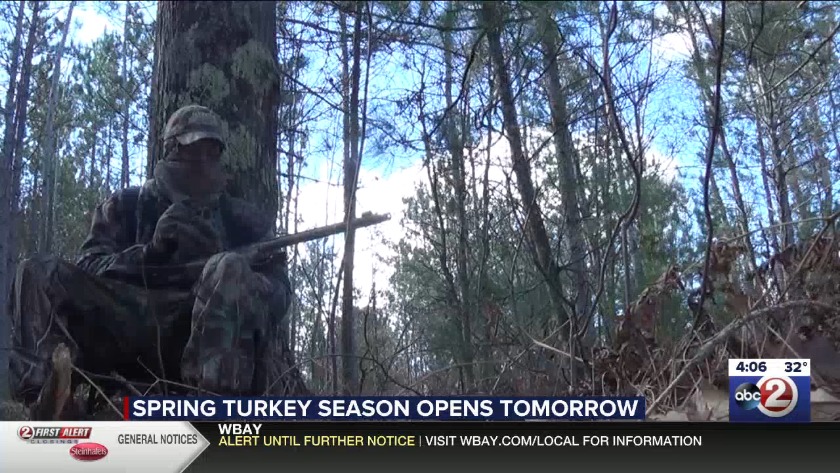
WATCH: Hunters urged to social distance when turkey season opens tomorrow
WATCH: Spring turkey season unaffected
By Jeff Alexander |
Posted: Tue 9:24 PM, Apr 14, 2020
GREEN BAY, Wis (WBAY) Wisconsin’s spring turkey season opens tomorrow with no major changes due to COVID-19.
That includes all public hunting grounds and a number state parks remaining open specifically for hunters.
“For a vast majority of the turkey hunters they’ll be able to go about their routine relatively unaltered from the way they’ve always done it,” says DNR District Wildlife Biologist Jeff Pritzl.
That’s because, according to Pritzl, turkey hunting is usually done alone.
“It’s a relatively solitary experience, a lot of people do it on private land close to home, but there are those that will have to take social distancing into consideration,” says Pritzl, who’s an…
AN EMERGENCY HOSPITAL DURING THE 1918 INFLUENZA IN KANSAS.
COVID-19
THE INFLUENZA KILLED 675,000 AMERICANS
A mysterious, very contagious, and lethal virus that had crossed over to humans from an animal spread quickly across Europe, and then the United States, leaving mass casualties in its wake. American officials, along with some members of the press, initially downplayed the significance of the 1918 influenza pandemic, promising it would soon go away. The public was told by some officials they should go about business as usual.
As the lethality of the virus became clear, with death resulting from pneumonia-like conditions as a result of the disease, officials delayed closing institutions, then pushed to have them reopened.
Protective equipment was in short supply, doctors and nurses became ill and died, and the country’s surgeon general gave the American people a lesson on how to make cloth…
JUNEAU, Alaska― Conservation groups today called on the U.S. Forest Service to take immediate steps to protect Alexander Archipelago wolves on Prince of Wales Island in Alaska’s Tongass National Forest following word that 97 percent of the most recent estimated population was killed this past trapping season.
In their letter the groups also urged the agency to implement other wolf-conservation measures established in a 2017 habitat-management program developed specifically to protect this vulnerable population.
“This is a shocking number of wolves to have been taken, and once again there has to be concern for the viability of wolves on Prince of Wales Island,” said Nicole Whittington-Evans, Alaska program director for Defenders of Wildlife. “The U.S. Forest Service must engage with the state on wolf management decisions to ensure that this imperiled wolf population and its forest habitat will remain healthy for future generations,”
Today’s letter follows a March 5 announcement from the Alaska Department of Fish and Game that 165 wolves out of an estimated population of 170 (as of fall 2018) were legally trapped during the 2019-2020 season in the game management unit that includes Prince of Wales and surrounding islands. This record number of killings is in addition to any illegal killing, which is known to have been significant in the past.
“While wolf management has always been a controversial issue in Southeast Alaska, it simply belies common sense for the Alaska Department of Fish and Game to allow legal trapping of 97% of any game population,” said Meredith Trainor, executive director for the Southeast Alaska Conservation Council. “With this letter we’re calling on the U.S. Forest Service to take a larger role in, at a minimum, ensuring sustainably managed wolf populations on Prince of Wales Island by partnering with the Alaska Department of Fish and Game to immediately return to the quota system.
The department lifted the wolf-trapping quota for this past season despite the fact that the population had only recently rebounded after falling to a historic low in 2014. Had the quota been in place, the legal trapping limit would have been 34 wolves.
“The unprecedented killing of these imperiled wolves is an appalling and completely predictable result of reckless mismanagement,” said Shaye Wolf, a scientist at the Center for Biological Diversity. “It’s difficult to see how state and federal officials can allow hunting and trapping next season without completely wiping out these wolves. They have a duty to protect these beautiful animals from extinction.”
In previous years the quota had been set at about 20% of the population estimate, and sometimes significantly lower than that due to conservation concern for the population. The Tongass Land Management Plan directs the U.S. Forest Service to “assist in managing legal and illegal wolf mortality rates to within sustainable levels” and to “develop and implement a wolf habitat management program in conjunction with” the Alaska Department of Fish and Game. The Forest Service finalized that plan in 2017.
Background
Alexander Archipelago wolves and their rainforest home are under continued threats from industrial logging, road building, unsustainable trapping and hunting and large-scale habitat loss.
The population of wolves in the management unit decreased from an estimated mean of 336 animals in 1994 to just 89 animals in 2014.
Concern about the animal’s survival led the Forest Service, U.S. Fish and Wildlife Service and the Alaska Department of Fish and Game to develop a Wolf Habitat Management Program. The program identified the key components of wolf management on Prince of Wales and surrounding islands as deer habitat, roads, mortality, den management and human dimensions. The program provided key recommendations in each category.
This interagency group considered quotas to be an important management tool in regulating mortality, reflected in these management recommendations:
● Maintain flexibility in quota management to alter quotas on a yearly basis to ensure wolf population and harvest sustainability;
● Continue to incorporate unreported human-caused mortality rates in developing wolf-harvest quotas using best available data;
● Monitor the wolf population to help evaluate program effectiveness;
● Prioritize and increase enforcement in pre-season and beginning of season, increase enforcement capabilities, and prioritize wolf-trapping season patrols in the game management unit.
Following implementation of the wolf-management program, the population recovered from a low mean estimate of 89 wolves in fall 2014 to 231 animals in fall 2016 and 225 wolves in fall 2017 before dropping to a mean estimate of 170 animals in fall 2018. The population estimates take several months to develop, so the fall 2019 estimate will not be available until August or September.
In addition to eliminating the wolf quota, the Alaska Department of Fish and Game also removed in-season monitoring of wolf mortality in the management unit. The department gave trappers more time to bring killed wolves to state officials for tagging and counting. The new deadline is up to 30 days after the trapping season ends, instead of 14 days after the animals are killed.
The Center for Biological Diversity is a national, nonprofit conservation organization with more than 1.7 million members and online activists dedicated to the protection of endangered species and wild places.
Defenders of Wildlife is dedicated to the protection of all native animals and plants in their natural communities. With over 1.8 million members and activists, Defenders of Wildlife is a leading advocate for innovative solutions to safeguard our wildlife heritage for generations to come. For more information, visitDefenders.org/newsroom
The president announced the White House will unveil new guidelines Thursday for reopening the country — and that at least 29 states should be ready to relax social restrictions soon. But what will the so-called “new normal” be when businesses open up again? We spoke with the National Institute of Allergy and Infectious Diseases director Dr. Anthony Fauci, who also serves on the White House Coronavirus Task Force, on Wednesday’s “CBS Evening News.” Here are our top takeaways from that conversation.
1. A vaccine could be closer than we thought
Public health officials had previously estimated a vaccine was 12-18 months from wide availability but, Dr. Fauci tells us, “It is possible to shave a couple of months off that. But you know you don’t want to over-promise, we’ll just have to see…









 Exposing the Big Game