

- by: Eric Rardin
- recipient: Senator Bernie Sanders
View original post 310 more words

View original post 310 more words

Billionaire philanthropist Bill Gates is defending the World Health Organization, blasting President Donald Trump’s decision to halt funding for the U.N. agency in the midst of the coronavirus pandemic.
Microsoft co-founder and his wife, Melinda, voiced support for the WHO in separate Twitter posts early Wednesday, a day after Trump announced that he is halting U.S. funding while the administration reviews the agency’s response to the Covid-19 outbreak.
“Halting funding for the World…
View original post 496 more words
Do you think about farmed pigs and chickens suffering in industrial warehouses? Elephants confined for entertainment in the circus? Aquatic animals suffocating from pollution and commercial fishing? The tragic fate of hunted bears? Dogs abused in puppy mills? Monkeys tortured in labs? The fires, floods, and deforestation destroying animals’ habitats and ending their lives in horrifying ways? People’s disregard for animals can cause compassionate people constant despair. Living in a culture that fails to respect other species is hard enough, but Donald Trump and his administration have made life exponentially worse for animals.
Sadly, false headlines that suggested Trump made animal cruelty a federal felony in the United States recently fooled many animal advocates. The news offered a sobering reminder of the challenges we face in a society that relies on dubious headlines for information, and the inaccurate narrative that results when readers don’t learn the truth about issues.
View original post 489 more words
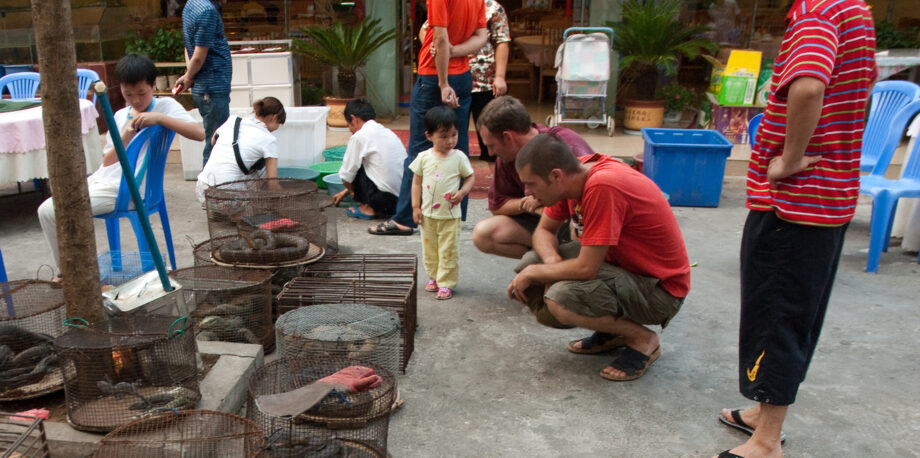 Illicit Endangered Wildlife Trade in Möng La, Shan, Myanmar Photo courtesy of Dan Bennett from Wikimedia, licensed under CC BY 2.0.
REPUBLISH
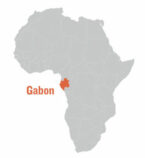
March 17, 2020 — Mayibout 2 is not a healthy place. The 150 or so people who live in the village, which sits on the south bank of the Ivindo River, deep in the great Minkebe forest in northern Gabon, are used to occasional bouts of diseases such as malaria, dengue, yellow fever and sleeping sickness. Mostly they shrug them off.
But in January 1996, Ebola, a deadly virus then barely known to humans, unexpectedly spilled out of the forest in a wave of small epidemics. The disease killed 21 of 37 villagers who were reported to have been infected, including a number who had carried, skinned, chopped or eaten a chimpanzee from the nearby forest.
I traveled to Mayibout 2 in 2004 to investigate why deadly diseases new to humans were emerging from biodiversity “hot spots” like tropical rainforests and bushmeat markets in African and Asian cities.
 It took a day by canoe and then many hours down degraded forest logging roads passing Baka villages and a small gold mine to reach the village. There, I found traumatized people still fearful that the deadly virus, which kills up to 90% of the people it infects, would return.
Villagers told me how children had gone into the forest with dogs that had killed a chimp. They said that everyone who cooked or ate it got a terrible fever within a few hours. Some died immediately, while others were taken down the river to hospital. A few, like Nesto Bematsick, recovered. “We used to love the forest, now we fear it,” he told me. Many of Bematsick’s family members died.
Only a decade or two ago it was widely thought that tropical forests and intact natural environments teeming with exotic wildlife threatened humans by harboring the viruses and pathogens that lead to new diseases in humans like Ebola, HIV and dengue.
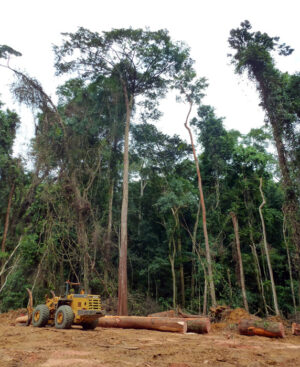
Logging and other habitat disruption creates new opportunities for disease organisms to move from non-human animals to people. Photo courtesy of euflegtredd from Flickr licensed under CC BY-NC-SA 2.0
But a number of researchers today think that it is actually humanity’s destruction of biodiversity that creates the conditions for new viruses and diseases like COVID-19, the viral disease that emerged in China in December 2019, to arise — with profound health and economic impacts in rich and poor countries alike. In fact, a new discipline, planetary health, is emerging that focuses on the increasingly visible connections among the well-being of humans, other living things and entire ecosystems.
Is it possible, then, that it was human activity, such as road building, mining, hunting and logging, that triggered the Ebola epidemics in Mayibout 2 and elsewhere in the 1990s and that is unleashing new terrors today?
“We invade tropical forests and other wild landscapes, which harbor so many species of animals and plants — and within those creatures, so many unknown viruses,” David Quammen, author of Spillover: Animal Infections and the Next Pandemic, recently wrote in the New York Times. “We cut the trees; we kill the animals or cage them and send them to markets. We disrupt ecosystems, and we shake viruses loose from their natural hosts. When that happens, they need a new host. Often, we are it.”
Increasing Threat
Research suggests that outbreaks of animal-borne and other infectious diseases like Ebola, SARS, bird flu and now COVID-19, caused by a novel coronavirus, are on the rise. Pathogens are crossing from animals to humans, and many are now able to spread quickly to new places. The U.S. Centers for Disease Control and Prevention (CDC) estimates that three-quarters of “new or emerging” diseases that infect humans originate in nonhuman animals.
Some, like rabies and plague, crossed from animals centuries ago. Others, like Marburg, which is thought to be transmitted by bats, are still rare. A few, like COVID-19, which emerged last year in Wuhan, China, and MERS, which is linked to camels in the Middle East, are new to humans and spreading globally.
Other diseases that have crossed into humans include Lassa fever, which was first identified in 1969 in Nigeria; Nipah from Malaysia; and SARS from China, which killed more than 700 people and traveled to 30 countries in 2002–03. Some, like Zika and West Nile virus, which emerged in Africa, have mutated and become established on other continents.
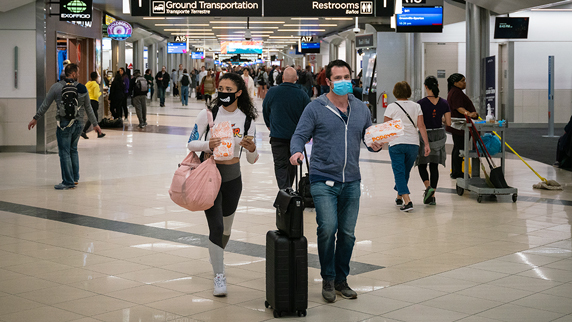
The emergence of COVID-19 as a global threat is drawing attention to the important connections between human and ecosystem well-being. Photo courtesy of Chad Davis from Flickr licensed under CC BY-SA 2.0.
Kate Jones, chair of ecology and biodiversity at UCL, calls emerging animal-borne infectious diseases an “increasing and very significant threat to global health, security and economies.”
Amplification Effect
In 2008, Jones and a team of researchers identified 335 diseases that emerged between 1960 and 2004, at least 60% of which came from non-human animals.
Increasingly, says Jones, these zoonotic diseases are linked to environmental change and human behavior. The disruption of pristine forests driven by logging, mining, road building through remote places, rapid urbanization and population growth is bringing people into closer contact with animal species they may never have been near before, she says.
The resulting transmission of disease from wildlife to humans, she says, is now “a hidden cost of human economic development. There are just so many more of us, in every environment. We are going into largely undisturbed places and being exposed more and more. We are creating habitats where viruses are transmitted more easily, and then we are surprised that we have new ones.”
Jones studies how land use change contributes to the risk. “We are researching how species in degraded habitats are likely to carry more viruses which can infect humans,” she says. “Simpler systems get an amplification effect. Destroy landscapes, and the species you are left with are the ones humans get the diseases from.”
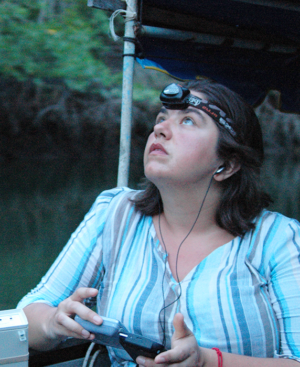
UCL biodiversity expert Kate Jones calls the spread of disease from wildlife to humans “a hidden cost of human economic development.” Photo courtesy of Kate Jones
“There are countless pathogens out there continuing to evolve which at some point could pose a threat to humans,” says Eric Fevre, chair of veterinary infectious diseases at the University of Liverpool’s Institute of Infection and Global Health. “The risk [of pathogens jumping from animals to humans] has always been there.”
The difference between now and a few decades ago, Fevre says, is that diseases are likely to spring up in both urban and natural environments. “We have created densely packed populations where alongside us are bats and rodents and birds, pets and other living things. That creates intense interaction and opportunities for things to move from species to species,” he says.
Tip of the Iceberg
“Pathogens do not respect species boundaries,” says disease ecologist Thomas Gillespie, an associate professor in Emory University’s Department of Environmental Sciences who studies how shrinking natural habitats and changing behavior add to the risks of diseases spilling over from animals to humans.
“I am not at all surprised about the coronavirus outbreak,” he says. “The majority of pathogens are still to be discovered. We are at the very tip of the iceberg.”
Humans, says Gillespie, are creating the conditions for the spread of diseases by reducing the natural barriers between virus host animals — in which the virus is naturally circulating — and themselves. “We fully expect the arrival of pandemic influenza; we can expect large-scale human mortalities; we can expect other pathogens with other impacts. A disease like Ebola is not easily spread. But something with a mortality rate of Ebola spread by something like measles would be catastrophic,” Gillespie says.
Wildlife everywhere is being put under more stress, he says. “Major landscape changes are causing animals to lose habitats, which means species become crowded together and also come into greater contact with humans. Species that survive change are now moving and mixing with different animals and with humans.”
Gillespie sees this in the U.S., where suburbs fragmenting forests raise the risk of humans contracting Lyme disease. “Altering the ecosystem affects the complex cycle of the Lyme pathogen. People living close by are more likely to get bitten by a tick carrying Lyme bacteria,” he says.
Yet human health research seldom considers the surrounding natural ecosystems, says Richard Ostfeld, distinguished senior scientist at the Cary Institute of Ecosystem Studies in Millbrook, New York. He and others are developing the emerging discipline of planetary health, which looks at the links between human and ecosystem health.
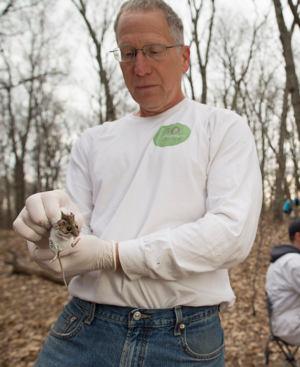
Disease ecologist Richard Ostfeld is one of a growing number of researchers looking at the human health impacts of ecosystem changes through a “planetary health” lens. Photo courtesy of Robin Moore © Cary Institute of Ecosystem Studies
“There’s misapprehension among scientists and the public that natural ecosystems are the source of threats to ourselves. It’s a mistake. Nature poses threats, it is true, but it’s human activities that do the real damage. The health risks in a natural environment can be made much worse when we interfere with it,” he says.
Ostfeld points to rats and bats, which are strongly linked with the direct and indirect spread of zoonotic diseases. “Rodents and some bats thrive when we disrupt natural habitats. They are the most likely to promote transmissions [of pathogens]. The more we disturb the forests and habitats the more danger we are in,” he says.
Felicia Keesing, professor of biology at Bard College, New York, studies how environmental changes influence the probability that humans will be exposed to infectious diseases. “When we erode biodiversity, we see a proliferation of the species most likely to transmit new diseases to us, but there’s also good evidence that those same species are the best hosts for existing diseases,” she wrote in an email to Ensia.
The Market Connection
Disease ecologists argue that viruses and other pathogens are also likely to move from animals to humans in the many informal markets that have sprung up to provide fresh meat to fast-growing urban populations around the world. Here animals are slaughtered, cut up and sold on the spot.
The “wet market” (one that sells fresh produce and meat) in Wuhan, thought by the Chinese government to be the starting point of the current COVID-19 pandemic, was known to sell numerous wild animals, including live wolf pups, salamanders, crocodiles, scorpions, rats, squirrels, foxes, civets and turtles.
Equally, urban markets in west and central Africa see monkeys, bats, rats and dozens of species of bird, mammal, insect and rodent slaughtered and sold close to open refuse dumps and with no drainage.
“Wet markets make a perfect storm for cross-species transmission of pathogens,” says Gillespie. “Whenever you have novel interactions with a range of species in one place, whether that is in a natural environment like a forest or a wet market, you can have a spillover event.”
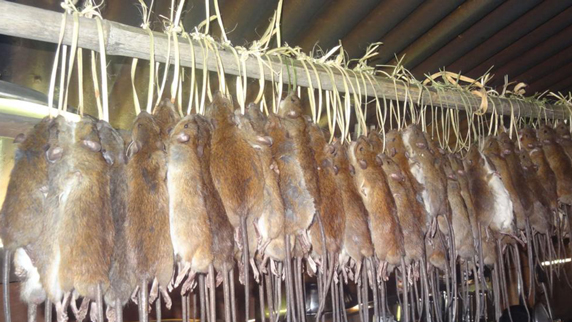
Bushmeat is one channel through which viruses can travel from wild animals to humans. Photo courtesy of Karsing Megu & Victor Meyer-Rochow.
The Wuhan market, along with others that sell live animals, has been shut by the Chinese authorities, and the government in February outlawed trading and eating wild animals except for fish and seafood. But bans on live animals being sold in urban areas or informal markets are not the answer, say some scientists.
“The wet market in Lagos is notorious. It’s like a nuclear bomb waiting to happen. But it’s not fair to demonize places which do not have fridges. These traditional markets provide much of the food for Africa and Asia,” says Jones.
“These markets are essential sources of food for hundreds of millions of poor people, and getting rid of them is impossible,” says Delia Grace, a senior epidemiologist and veterinarian with the International Livestock Research Institute, which is based in Nairobi, Kenya. She argues that bans force traders underground, where they may pay less attention to hygiene.
Fevre and Cecilia Tacoli, principal researcher in the human settlements research group at the International Institute of Environment and Development (IIED), argue in a blog post that “rather than pointing the finger at wet markets,” we should look at the burgeoning trade in wild animals.
“[I]t is wild animals rather than farmed animals that are the natural hosts of many viruses,” they write. “Wet markets are considered part of the informal food trade that is often blamed for contributing to spreading disease. But … evidence shows the link between informal markets and disease is not always so clear cut.”
Changing Behavior
So what, if anything, can we do about all of this?
Jones says that change must come from both rich and poor societies. Demand for wood, minerals and resources from the Global North leads to the degraded landscapes and ecological disruption that drives disease, she says. “We must think about global biosecurity, find the weak points and bolster the provision of health care in developing countries. Otherwise we can expect more of the same,” she says.
“The risks are greater now. They were always present and have been there for generations. It is our interactions with that risk which must be changed,” says Brian Bird, a research virologist at the University of California, Davis School of Veterinary Medicine One Health Institute, where he leads Ebola-related surveillance activities in Sierra Leone and elsewhere.
“We are in an era now of chronic emergency,” Bird says. “Diseases are more likely to travel further and faster than before, which means we must be faster in our responses. It needs investments, change in human behavior, and it means we must listen to people at community levels.”
Getting the message about pathogens and disease to hunters, loggers, market traders and consumers is key, Bird says. “These spillovers start with one or two people. The solutions start with education and awareness. We must make people aware things are different now. I have learned from working in Sierra Leone with Ebola-affected people that local communities have the hunger and desire to have information,” he says. “They want to know what to do. They want to learn.”
Fevre and Tacoli advocate rethinking urban infrastructure, particularly within low-income and informal settlements. “Short-term efforts are focused on containing the spread of infection,” they write. “The longer term — given that new infectious diseases will likely continue to spread rapidly into and within cities — calls for an overhaul of current approaches to urban planning and development.”
The bottom line, Bird says, is to be prepared. “We can’t predict where the next pandemic will come from, so we need mitigation plans to take into account the worst possible scenarios,” he says. “The only certain thing is that the next one will certainly come.”

In a welcome animal rights victory, landmark legislation prohibiting the third-party sale of puppies and kittens for profit has become law in England, the UK government announced.
Lucy’s Law — named after a cavalier King Charles spaniel who was born in a Welsh puppy farm in 2008 and callously bred to produce multiple puppy litters — is designed to stop illegal puppy farming and ban third-party dealers, making all dog and cat breeders accountable for the welfare of the animals in their care.
People who want to add a puppy or kitten to their family will now have to acquire one directly from a licensed breeder or adopt from a rescue center. Traders who sell these animals without a licence can face up to six months in prison, or an unlimited fine.
The new legislation came into effect following a long campaign headed by veterinarian and animal welfare advocate Marc Abraham, which was supported by high-profile figures such as Brian May, Ricky Gervais and Peter Egan.
“I’m incredibly proud to have led the 10-year campaign to ban cruel puppy and kitten dealers and to get this essential Lucy’s Law legislation over the line,” said Abraham, who is also the founder of Pup Aid. “I’d like to give a huge thanks to the UK Government for passing this law, as well as every animal-loving parliamentarian, celebrity, welfare organization, and member of the public that supported us.”
“Lucy was an incredibly brave dog,” he continued, “and it’s right that her memory is honoured with such an important piece of legislation to help end puppy farm cruelty; protecting breeding dogs just like her, as well as cats, their young, and also unsuspecting animal-lovers from the dangers of irresponsible breeding and cruel puppy and kitten dealers.”
|
|
||
Dr. Anthony Fauci has called wildlife markets “a superhighway” for transmission of disease. Above, a wildlife market in Indonesia. Photo by Dog Meat Free Indonesia The World Health Organization is calling on nations to end wildlife markets because of the high risk they pose for the spread of pathogens like the coronavirus that can jump from animals to humans. This week, David Nabarro, a medical doctor and the special envoy on COVID-19 and special representative of the United Nations secretary general for food security and nutrition, told the BBC that 75 percent of emerging infections come from the animal kingdom. “This is dangerous. We have similar concerns about bushmeat. Really, be very, very careful when you’re basically eating wild animal meat or killing wild animals. All these things are higher risk,” he said. Nabarro’s statements on behalf of the WHO, which has 192 member countries, including China, Indonesia, Thailand, Malaysia and Vietnam—where many of these markets exist—came this week even as media reports circulated about wildlife markets beginning to reopen in China. The WHO does not have the authority to require governments to close down such markets, but, Nabarro said, “what we have to do is offer advice and guidance, and there’s very clear advice from the Food and Agriculture Organization and WHO that said there are real dangers in these kinds of environments.” In recent weeks, Elizabeth Maruma Mrema, the United Nations’ acting head of biodiversity, and Dr. Anthony Fauci, director of the U.S. National Institute of Allergy and Infectious Diseases, have made similar calls to end live wildlife markets around the globe. Fauci has called wildlife markets “a superhighway” for transmission of disease. The Humane Society family has been urging the WHO to take a stand against wildlife markets and we are pleased to see the global health body do so. Earlier this month, Humane Society International along with 240 organizations around the globe, sent a letter to the WHO urging it to recommend a permanent ban on wildlife markets and the use of wildlife in traditional medicine to governments worldwide. The Humane Society Legislative Fund lobbied support for a letter co-signed by nearly 70 U.S. Senators and Representatives to the WHO, the Organization for Animal Health and the Food and Agriculture Organization of the United Nations, urging them to take aggressive action to shut down live wildlife markets and ban the international trade in wildlife that is not intended for conservation purposes. Earlier this month, HSI released a white paper detailing scientific evidence of the link between COVID-19 and the wildlife trade that has been sent to 188 governments worldwide. HSI also sent an open letter to governments around the world asking them to ban wildlife trade (including wildlife markets), transport and consumption. While we have expanded our efforts to move lawmakers and global organizations to take action because of the urgency created by the coronavirus pandemic, this is not a new fight for us. We have been calling for the closure of wildlife markets for many years now not only due to animal welfare concerns but because these markets often trade in endangered and at-risk animals or exploit captive bred animals. Wildlife markets are filthy, crowded places where sick, injured and scared animals are displayed in small cages. Once purchased, they are often slaughtered on-site, creating a perfect breeding ground for transmission of disease from animals to humans. Moreover, many of the animals traded and killed at the markets are threatened with extinction. In fact, global wildlife experts say trade in live wild animals is one of the biggest threats to the survival of some species. Health authorities have long cautioned the world about the risks these markets pose to human health: wildlife markets have been implicated in the spread of several disease outbreaks in recent years, including Severe Acute Respiratory Syndrome (SARS), bird flu, Ebola and Middle Eastern Respiratory Syndrome (MERS). The novel coronavirus pandemic was traced to a wildlife market in Wuhan, China. Now, we hope to see decisive permanent action from key nations to end the wildlife trade and its connections to pandemic risk. China in February announced a ban on wildlife consumption as food, but it has not yet codified that ban into law. This week, the Wall Street Journal reported that Chinese authorities are offering tax breaks to the multibillion-dollar animal products industry for the export of wild animals. Around the world, the trade in wildlife continues. The United States, where hundreds of thousands of wild animals are imported and commercially traded each year, is a WHO member state, and we urge the federal government here, as well as state governments, to crack down on the wildlife trade to minimize the likelihood of another pandemic. This trade causes tremendous suffering to millions of animals each year and now, with the novel coronavirus sickening nearly two million people worldwide and killing more than 120,000, the writing is on the wall. The wildlife trade is rife with dangers, and the sooner we put an end to it, the safer the world will be. The post World Health Organization says nations should end wildlife trade appeared first on A Humane World. Related Stories |

Paris (AFP) – World-renowned British primatologist Jane Goodall says the coronavirus pandemic was caused by humanity’s disregard for nature and disrespect for animals.
Goodall, who is best known for trail-blazing research in Africa that revealed the true nature of chimpanzees, pleaded for the world to learn from past mistakes to prevent future disasters.
During a conference call ahead of the release of the new National Geographic documentary “Jane Goodall: The Hope”, the 86-year-old also said everyone can make a difference.
– How do you view this pandemic? –
Goodall: It is our disregard for nature and our disrespect of the animals we should share the planet with that has caused this pandemic, that was predicted long ago.
Because as we destroy, let’s say the forest, the different species of animals in the forest are forced into a proximity and therefore diseases are being passed from one animal to another, and that second animal is then most likely to infect humans as it is forced into closer contact with humans.
It’s also the animals who are hunted for food, sold in markets in Africa or in the meat market for wild animals in Asia, especially China, and our intensive farms where we cruelly crowd together billions of animals around the world. These are the conditions that create an opportunity for the viruses to jump from animals across the species barrier to humans.
– What can we do about these animal markets? –
It’s really good that China closed down the live wild animal markets, in a temporary ban which we hope will be made permanent, and other Asian countries will follow suit.
But in Africa it will be very difficult to stop the selling of bush meat because so many people rely on that for their livelihoods.
It will need a lot of careful thought on how it should be done, you can’t just stop somebody doing something when they have absolutely no money to support themselves or their families, but at least this pandemic should have taught us the kind of things to do to prevent another one.
– What can we hope for? –
We have to realise we are part of the natural world, we depend on it, and as we destroy it we are actually stealing the future from our children.
Hopefully, because of this unprecedented response, the lockdowns that are going on around the world, more people will wake up and eventually they can start thinking about ways they can live their lives differently.
Everyone can make an impact every single day.
If you think about the consequences of the little choices you make: what you eat, where it came from, did it cause cruelty to animals, is it made from intensive farming — which mostly it is — is it cheap because of child slave labour, did it harm the environment in its production, where did it come from, how many miles did it travel, did you think that perhaps you could walk and not take your car.
(Also consider) ways that you could perhaps help alleviate poverty because when people are poor they can’t make these ethical choices. They just have to do whatever they can to survive — they can’t question what they buy, they must buy the cheapest, and they are going to cut down the last tree because they are desperate to find land on which they can grow more food.
So what we can do in our individual lives does depend a little bit on who we are, but we all can make a difference, everybody can.
For Immediate Release:
April 13, 2020
Contact:
Brooke Rossi 202-483-7382
Springdale, Ark. – After a Tyson pig slaughterhouse in Iowa was shuttered because dozens of its employees tested positive for COVID-19—and because workers at one of its plants in Tennessee may be infected as well—PETA has written to Tyson CEO Noel W. White, calling on him to get ahead of the curve and transition to producing exclusively vegan meat. PETA is offering to help cover the cost of retraining the company’s employees.
“The filthy conditions inside slaughterhouses and meat markets are breeding grounds for swine flu, SARS, avian flu, and other diseases and threaten the health of every human being on the planet,” says PETA President Ingrid Newkirk. “PETA is calling on Tyson to ditch its current business model, recognize the growing interest in plant-based foods as well as the necessity to move away from foods made from animal flesh, and reinvent itself as a producer of healthy and 100% humane vegan meat.”
Swine flu began on a U.S. factory farm, and the novel coronavirus originated in a Chinese “wet market,” where live and dead animals were sold for human consumption. Health authorities confirm that influenza viruses and coronaviruses are zoonotic (transmissible from other animals to humans). Grocery store sales of plant-based foods that directly replace animal “products” have grown 29% in the past two years to $5 billion.
Last week, PETA—whose motto reads, in part, that “animals are not ours to eat” and which opposes speciesism, a human-supremacist worldview—held a demonstration outside the shuttered slaughterhouse. Photos are available here.
For more information, please visit PETA.org.
PETA’s letter to White follows.
April 13, 2020
Noel White, CEO
Tyson Foods
Dear Mr. White,
After learning that Tyson shut down a pig slaughterhouse in Columbus Junction, Iowa, after more than two dozen workers contracted COVID-19, I’m writing with a lifesaving suggestion. Why not modernize and get ahead of the consumer curve by shutting down meat production permanently and making the transition to producing only vegan meat instead? PETA would chip in to defray the cost of retraining employees.
Filthy factory farms threaten everyone’s health—not just that of workers and meat-eaters—by providing a breeding ground for deadly diseases. Swine flu—which came from farmed pigs—has killed hundreds of thousands of people worldwide, and bird flu can spread easily on severely crowded chicken farms. Now, while the world is battling the current pandemic—which originated in a meat market—it’s crucial that all of us, including Tyson, do our part to make positive changes that will help prevent future outbreaks.
Even before the current crisis, working on a kill floor was a dangerous and dirty job. Workers are obligated to keep up with absurdly fast slaughter speeds, in addition to witnessing and participating in revolting practices, such as hanging live chickens upside down by their legs and stunning petrified pigs. Now they also have to worry about becoming infected with COVID-19.
Tyson already produces some vegan meats, so while the writing is on the wall, please switch to producing only vegan meats, which aid human health, the environment, and, of course, animals.
I look forward to hearing from you.
Very truly yours,
Ingrid E. Newkirk
President
A new public records request to Idaho Department of Fish and Game reveals that Idaho wolf trappers are capturing nearly as many non-target species as they are capturing wolves. 47% of the species captured between the 2012/2013 to 2018/2019 trapping seasons, including rare fishers, wolverine, eagle, and lynx were non-target species. Of the non-target species captured, 57% of those were killed. During the period covered by the public records response, wolf trappers killed 813 wolves, caught 620 non-target species of which 269 were released alive and 351 were killed. It is likely that a percentage of those animals that were released alive eventually died from injuries sustained from the traps that either killed them outright or made it difficult for them…
View original post 497 more words
It’s likely Covid-19 originated in bats, scientists say. But did it then spread to pangolins and humans?

In the public mind, the origin story of coronavirus seems well fixed: in late 2019 someone at the now world-famous Huanan seafood market in Wuhan was infected with a virus from an animal.
The rest is part of an awful history still in the making, with Covid-19 spreading from that first cluster in the capital of China’s Hubei province to a pandemic that has killed about 80,000 people so far.
Stock footage of pangolins – a scaly mammal that looks like an anteater – have made it on to news bulletins, suggesting this animal was the staging post for the virus before it spread to humans.
But there is uncertainty about several aspects of the Covid-19 origin story that scientists are trying hard to unravel, including which species passed it to a human. They’re trying hard because knowing how a pandemic starts is a key to stopping the next one.
Prof Stephen Turner, head of the department of microbiology at Melbourne’s Monash University, says what’s most likely is that virus originated in bats.
But that’s where his certainty ends, he says.
On the hypothesis that the virus emerged at the Wuhan live animal market from an interaction between an animal and a human, Turner says: “I don’t think it’s conclusive by any means.”
“Part of the problem is that the information is only as good as the surveillance,” he says, adding that viruses of this type are circulating all the time in the animal kingdom.
The fact that the virus has infected a tiger in a New York zoo shows how viruses can move around between species, he says. “Understanding the breadth of species this virus can infect is important as it helps us narrow down down where it might have come from.”
Scientists say it is highly likely that the virus came from bats but first passed through an intermediary animal in the same way that another coronavirus – the 2002 Sars outbreak – moved from horseshoe bats to cat-like civets before infecting humans.
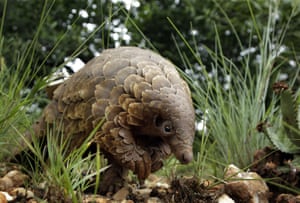
One animal implicated as an intermediary host between bats and humans is the pangolin. The International Union for Conservation of Nature says they are “the most illegally traded mammal in the world” and are prized for their meat and the claimed medicinal properties of their scales.
As reported in Nature, pangolins were not listed on the inventory of items being sold in Wuhan, although this omission could be deliberate as it’s illegal to sell them.
“Whether the poor pangolin was the species at which it jumped, it’s not clear,” Turner says. “It’s either mixed in something else, mixed in a poor pangolin, or it’s jumped into people and evolved in people.”
Prof Edward Holmes, of the University of Sydney, was a co-author on a Nature study that examined the likely origins of the virus by looking at its genome. On social media he has stressed that the identity of the species that served as an intermediate host for the virus is “still uncertain”.
One statistical study looked at a characteristic of the virus that evolved to enable it to latch on to human cells. Pangolins were able to develop this characteristic, but so were cats, buffalo, cattle, goats, sheep and pigeons.
Another study claimed to have ruled out pangolins as an intermediary altogether, because samples of similar viruses taken from pangolins lacked a chain of amino acids seen in the virus now circulating in humans.
The study Holmes worked on suggested that the scenario in which a human at the Wuhan market interacted with an animal that carried the virus was only one potential version of the Covid-19 origin story. Another was the possibility that a descendent of the virus jumped into humans and then adapted as it was passed from human to human.
“Once acquired, these adaptations would enable the pandemic to take off and produce a sufficiently large cluster of cases to trigger the surveillance system that detected it,” the study said.
Analysis of the first 41 Covid-19 patients in medical journal the Lancet found that 27 of them had direct exposure to the Wuhan market. But the same analysis found that the first known case of the illness did not.
This might be another reason to doubt the established story.
Prof Stanley Perlman, a leading immunologist at the University of Iowa and an expert on previous coronavirus outbreaks that have stemmed from animals, says the idea the link to the Wuhan market is coincidental “cannot be ruled out” but that possibility “seems less likely” because the genetic material of the virus had been found in the market environment.
Perlman told Guardian Australia he does believe there was an intermediary animal but adds that while pangolins are possible candidates, they “are not proven to be the key intermediary”.
“I suspect that any evolution [of the virus] occurred in the intermediate animal if there was one. There has been no substantial changes in the virus in the three months of the pandemic, indicating that the virus is well adapted to humans.”
So-called wet markets – where live animals are traded – have been implicated in previous outbreaks of coronaviruses, in particular Sars.
Dr Michelle Baker, an immunologist at CSIRO who studies viruses in bats, says some of the research on Covid-19’s origins have stepped off from what was known from the past.
But “we really don’t know” how accurate the origin story is, she says: “There’s some sort of connection [to the Wuhan market] and there were people exposed to the market that were infected.”
Baker says what is “very likely” is that the virus originated in a bat. “It’s a likely scenario but we will never know. The market was cleaned up quite quickly. We can only speculate.”
“These wet markets have been identified as an issue because you do have species interacting,” she says. “It’s an opportunity to highlight the dangers of them and an opportunity to clamp down on them.”
Turner adds: “We’ve found the ancestors of the virus, but having broader knowledge of the coronavirus in other species might give us a hint about the evolution of this thing and how it jumped.”
 Exposing the Big Game