The Louisiana Department of Wildlife and Fisheries has had to respond to several fake news articles, one regarding increased fishing fines and, most recently, the supposed forced closure of hunting and fishing season because of the COVID-19 pandemic.
None of it is true.
Any valid information regarding LDWF actions is on the organization’s swebsite at www.wlf.la.gov or our Facebook page at https://www.facebook.com/ldwffb/. Please verify the accuracy of any information at these sites before sharing it on social media.
“It is incredibly unfortunate that some individuals would go out of their way to spread false information with the intent of creating confusion for the wonderful people of Louisiana,” said LDWF Secretary Jack Montoucet. “At a time when we are pulling together to deal with a deadly health crisis, there are some who find such actions amusing.”
A popular spot for birders and surrounded by ranchettes, the 2,800-acre Lee Metcalf National Wildlife Refuge north of Stevensville borders more than 4 miles of the Bitterroot River, extending 1 to 2 miles east of the river. (Laura Lundquist/Missoula Current)
Two national wildlife refuges near Missoula may allow people to hunt more wildlife, including black bear.
On Thursday, the U.S. Fish and Wildlife Service published potential changes to hunting and fishing opportunities offered on the Lee Metcalf and Swan River national wildlife refuges. The public has until April 30 to comment on the draft changes.
If finalized, any changes would likely go into effect before the fall hunting season.
A popular spot for birders and surrounded by ranchettes, the 2,800-acre Lee Metcalf National Wildlife Refuge north of Stevensville borders more than 4 miles of the Bitterroot River, extending 1 to 2 miles east…
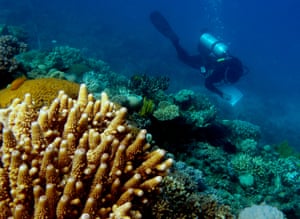
Zoe Richards has seen great changes in the corals off Lizard Island since she started monitoring them in 2011. Photograph: Mike Emslie
When coral scientist Dr Zoe Richards left the Great Barrier Reef’s Lizard Island in late January, she was feeling optimistic.
Richards is a taxonomist. Since 2011 she has recorded and monitored 245 coral species at 14 locations around the island’s research station, about 270km north of Cairns.
In 2017 she saw “mass destruction of the reef”. Back-to-back mass bleaching in 2016 and 2017, and cyclones in 2014 and 2015, had wreaked havoc.
But in January, she saw thousands of new colonies of fast-growing Acropora corals that had “claimed the space” left by dead and degraded corals. In a three-year window without spiralling heat or churning cyclones, some corals were in an adolescent bloom – not mature enough to spawn, but getting close.
“It was an incredible recovery,” says Richards, of Curtin University. “But I knew if it was hit again, it would be trouble – and that’s exactly what happened.”
In 2020, mass bleaching returned to Lizard Island – perhaps not as badly as in previous years – but enough, says Richards, to turn the clock back on the recovery she had seen.
Zoe Richards@ZoeR_Coral
Day 1 of coral biodiversity re-surveys @ Lizard I, GBR. After 2 cyclones & 2 bleaching events in a decade, it’s great to see a range of healthy young Acropora colonies fighting back! #coralnotcoal#recoveryispossible
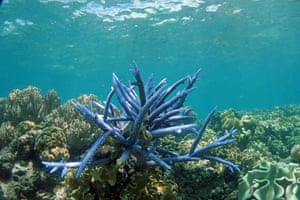
A. echinata (blue), A. speciosa (pink) & A. spathulata (orange)
This summer has delivered a third mass bleaching for the reef in just five years. The back-to-back bleaching of 2016 and 2017 was mostly confined to the northern and central sections.
Data from aerial surveys is still being analysed, but the Great Barrier Reef Marine Park Authority has said preliminary results suggest the 2020 bleaching had a much broader footprint.
When bleaching is mild, corals can and do recover, although it can make them more susceptible to disease. But severe bleaching can kill corals. Estimates are that the 2016 bleaching killed about 29% of the reef’s shallow water corals and the 2017 event took another 19%.
Some scientists are now concerned global heating may have reached a point where tropical reefs bleach almost every year.
What this means for the reef in the coming decades is an area of live research and debate among scientists.
Can we fix it?
Scientists Guardian Australia spoke to say the reef’s fortunes hang on the answers to two questions.
The first is whether governments around the world will make deeper cuts to greenhouse gas emissions than they have already agreed and, if so, how close they will get to keeping global heating to 1.5C.
A second is whether efforts to first identify and then deploy a swathe of potential measures that could reduce the impact of rising temperatures will be successful.
What seems clear is that without some human intervention, the magic of the world’s greatest coral reef system will be lost.
Prof Peter Mumby, professor of coral reef ecology at the University of Queensland, is the chief scientist at the Great Barrier Reef Foundation – the once-small not-for-profit that was awarded a controversial $443m government grant in 2018.
He said the 2020 bleaching “is giving us greater pause, given it seems we can see quite frequent coral bleaching events earlier than people had previously expected”.
Mumby says bleaching events have been “patchy”, and the fact that some areas have escaped “means there’s an opportunity for management”.
What keeps the reef functioning as a single ecosystem is the way each reef connects to another through the way corals reproduce. They all either spawn, or produce larvae, that can float in the water column and settle on nearby reefs.
Mumby and colleagues have identified about 100 reefs along the GBR that are well spread, well connected to other reefs by ocean currents, and tend to experience cooler temperatures.
He says making sure those reefs stay as healthy as possible – in particular by managing outbreaks of the coral-eating crown of thorns starfish – could be crucial in keeping the wider reef viable.
The reef’s unrivalled size and diversity – almost 4,000 reefs, cays and islands stretching for more than 2,000 kilometres – gives it extra resilience, he says.
Climate change is still the reef’s biggest threat and society will need to focus on tackling it, “but there needs to be a way to adapt to how we manage reefs so that they can roll with the punches – we have to do both those things”.
The Australian Institute of Marine Sciences (AIMS) has produced an as-yet unpublished study, sent to the federal government, that reviews more than 160 different interventions that have been suggested for the reef, identifying about 40 that could be worth further study.
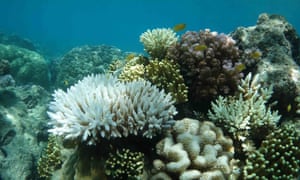
Heat-stressed corals off Lizard Island in February 2020. Photograph: Dr Lyle Vail, Director of the Australian Museum’s Lizard Island Research Station
Dr Lina Bay, a principal research scientists at AIMS, says one promising area of study is what’s known as “assisted gene flow”, where the spawn of corals with better tolerance for heat could be captured and then dispersed.
“Not all corals are created equal,” she says. “Some have a higher stress tolerance than others. Over many years we’ve shown that the variation in bleaching tolerance is hereditable – it gets passed from parents to offspring.”
She says these differences can exist even among the same species, meaning those corals can be selectively grown in a lab setting to promote more heat tolerance.
AIMS scientist Dr Neal Cantin has just finished a three-year experiment with one fast-growing coral species called Pocillopora acuta, which behaves like a weed by filling in the gaps when less hardy corals die off.
Starting with 90 parent specimens taken from three different parts of the Great Barrier Reef, Cantin and colleagues grew 7,500 offspring and then subjected them to rising levels of CO2 and temperatures of up to 2C warming.
Even at high temperatures, some of these corals survived, and they were able to tolerate higher levels of heat as the experiment went on.
Having a street-fighting weedy coral like this is important, says Cantin. Dead areas of coral reefs tend to get covered in algae, but Cantin says a weedy coral that can compete with the algae can then make room for slower-growing corals to also grow.
“The whole goal of a lot of these interventions is to work with species that can be successful on their own. We won’t be able to work with 600 species of corals, but we could probably work with 20 that fill the functional roles of a healthy reef community.
“You can’t deny bleaching events are becoming more frequent and more severe and they’re impacting across a bigger area than before. We can just document that demise, or we can learn from it and have some corals for future generations.”
An unbleached specimen of Acropora clathrata on the Great Barrier Reef. Photograph: Zoe Richards
That demise is clear and it happens at scale, and also in detail. Zoe Richards has already seen evidence of likely local extinctions of some corals at Lizard Island. One is a spiralised plate coral – Acropora clathrata – that she hasn’t been able to find for years.
“It’s these silent extinctions that go on,” she says.
“The entire reef is operating like one big meta population with sub-populations that are connected to each other. If you successively take out nodes in that population, sooner or later you will end up with parts that don’t connect. It will be fragmented into subsets that will continue to erode in terms of diversity. It’s degradation of the [coral] community at a very large scale.”
‘At 3C, you basically have nothing’
Prof Ove Hoegh-Guldberg, of the University of Queensland, has done pioneering work on the study of coral bleaching going back to the mid-1980s.
He remembers Lizard Island as a “picture perfect” place to do research on corals in the late 80s, when his research there found rising temperatures caused corals to lose their “symbionts” – the algae that lives in the coral and gives them much of their nutrients and colour.
The Great Barrier Reef’s first major mass bleaching event happened in 1998. There was another in 2002, and again in 2016, 2017 and 2020.
Hoegh-Guldberg says: “We knew there was a temperature effect, and we knew that temperatures were going up. At the end of the 90s, I could put those two things together.”
The year after the reef’s first mass bleaching, Hoegh-Guldberg took climate models to forecast that if greenhouse gas emissions kept growing then, by 2020, “the average bleaching event is likely to be similar or greater than the 1998 event”.
As 2020 approached, the models showed reefs across the northern, central and southern regions would see between eight and 10 bleaching events per decade.
“I wished I’d been wrong” he says. “I think I said at the time that I’d have egg on my face if I was wrong. But there’s no egg on my face.”
Corals at Lizard Island had been showing signs of recovery before this year’s bleaching. Photograph: Dr Lyle Vail, Director of the Australian Museum’s Lizard Island Research Station
Hoegh-Guldberg says manually replanting corals is uneconomic at scale but there’s merit in helping the dispersal of coral larvae, pointing to a technique being developed by a scientist at Southern Cross University that captures millions of larvae in floating pools.
But he says the main game is keeping global heating down.
“Let’s say we get to 1.5C and then we can stabilise – that’s really the last call for reefs. Corals will come back and there will be winners and losers, but you’ll have a functional reef that supports fisheries and tourism.”
The problem is that right now, government pledges under the Paris agreement are enough to raise temperatures by 3C – not 1.5C.
“At 2C all the reef-building corals have plummeted and instead you are looking at the dominance of other organisms like algae. At 3C you basically have nothing.
“I’m fearful that in the next 10 years we will see the loss of coral across the planet at phenomenal rates,” he says. “That’s what keeps me up at night.”
Kim Prather, a leading atmospheric chemist at the Scripps Institution of Oceanography, wants to yell out her window at every surfer, runner, and biker she spots along the San Diego coast.
“I wouldn’t go in the water if you paid me $1 million right now,” she said.
The beach, in her estimation, is one of the most dangerous places to be these days, as the novel coronavirus marches silently across California.
Many beachgoers know they can suffer skin rashes, stomach illness and serious ear and respiratory infections if they go into the water within three days of a heavy rain, because of bacteria and pathogens washing off roads and into the ocean. Raw or poorly treated sewage entering the ocean also poses major health risks.
Prather fears that SARS-CoV-2, the virus that causes COVID-19…
A local man was shot in the foot on Wednesday while hunting for squirrels with two other people, wildlife officials said.
The Maine Warden Service was investigating the shooting, which was reported about 4 p.m. It was determined he had been shot by one of his hunting companions. The injury was not considered life-threatening.
Details about the man were not immediately available as wardens continued to investigate Wednesday night.
A body wrapped in plastic is prepared to be loaded onto a refrigerated container truck used as a temporary morgue by medical workers due to COVID-19 concerns, Tuesday, March 31, 2020, at Brooklyn Hospital Center in the Brooklyn borough of New York. (AP Photo/John Minchillo)
PHILADELPHIA (AP) — There are the new dead. And then there are the bodies waiting in overcrowded mortuaries to be buried as cities struggle to meet demand and families wrestle with rules on social distancing that make the usual funeral rituals impossible.
Med Alliance Group, a medical distributor in Illinois, is besieged by calls and emails from cities around the country. Each asks the same thing: Send more refrigerated trailers so that we can handle a situation we never could have imagined.
“They’re coming from all over: From hospitals, health systems, coroner’s offices, VA facilities, county and state health departments, state emergency departments and funeral homes,” said Christie Penzol, a spokeswoman for Med Alliance. “It’s heart-wrenching.”
The company has rented all its trailers and there’s an 18-week wait for new materials to build more, she said.
Bodies wrapped in plastic are loaded on to a refrigerated container truck operating as a makeshift morgue while being handled by medical workers wearing personal protective equipment due to COVID-19 concerns, Tuesday, March 31, 2020, at Brooklyn Hospital Center in the Brooklyn borough of New York. (AP Photo/John Minchillo)
With U.S. medical experts and even President Donald Trump now estimating the death toll from the coronavirus pandemic could reach 240,000 nationwide, the sheer practicalities of death — where to put the bodies — are worrying just about everyone as cities, hospitals and private medical groups clamor to secure additional storage.
The need is compounded by private mortuary space that is occupied longer than usual as people wait to bury their loved ones— regardless of how they died— because rules on social distancing make planning funerals difficult.
It’s a crisis being repeated worldwide.
In Spain, where the death toll has climbed to nearly 12,000, an ice rink in Madrid was turned into a makeshift morgue after the city’s municipal funeral service said it could no longer take coronavirus bodies until it was restocked with protective equipment. In Italy, embalmed bodies in caskets are being sent to church halls and warehouses while they await cremation or burial.
And in the coastal Ecuadorian city of Guayaquil, macabre images and pleas from families on social media show dead loved ones wrapped in plastic or cloth, waiting for days to be taken away by overwhelmed morgue workers.
In the U.S. epicenter of New York City, where the death toll was nearly 1,900 on Saturday, authorities brought in refrigerated trucks to store bodies. At Brooklyn Hospital Center, a worker wheeled out a body covered in white plastic on a gurney and a forklift operator carefully raised it into a refrigerated trailer.
Cities and states that haven’t been hard-hit yet are trying to prepare for the worst.
It’s hard to say exactly how much morgue space is available nationwide. Many cities and counties submit emergency preparedness plans for review by state and federal officials, but tallies aren’t always complete and private mortuaries aren’t always included. Trade groups like the National Association of Medical Examiners don’t track those capacities either.
But, in general, few morgues in the country can hold even 200 to 300 bodies.
In Washington, D.C., which has a morgue that can hold about 270 bodies, officials said they would seek help from federal partners if needed. Dallas has a plan for refrigerated space as part of its emergency preparedness efforts. And Chicago is already using a trailer outside the medical examiner’s office for the bodies of coronavirus victims, and may use a refrigerated warehouse if needed.
Meanwhile, the Federal Emergency Management Agency has asked the Defense Department for 100,000 body bags, Pentagon spokesman Air Force Lt. Col. Michael Andrews said Thursday.
On a daily basis, the system works at essentially full capacity in most jurisdictions, said Robert A. Jensen, co-owner of Kenyon International Emergency Services, a private disaster response company based in Texas.
“They’re not made for surge. They’re made to handle the daily numbers,” said Jensen, whose company has helped with mass fatality incidents from 9/11 to Hurricane Katrina to the 2004 tsunami in Thailand, all of which involved using refrigerated trucks to store bodies.
In Pennsylvania, the state coroner’s association is working to figure out resources and help with what will likely be regional planning.
Brian Abernathy, Philadelphia’s Managing Director, said the city had secured refrigerated trucks to help with any overflow storage needed for bodies. The city had reported 26 deaths as of Friday.
“This isn’t because we expect a large influx of people succumbing to the illness, but rather it’s likely that there will be fewer funerals, which will cause backups in both our city morgues as well as the hospital morgues,” Abernathy said.
Brian Murphy, the CEO of Arctic Industries, which manufactures walk-in coolers and quick-assemble modular structures in Miami and Los Angeles, said he is getting calls seeking help. In the past, most clients were from the food industry, but with restaurants shuttered, calls about mortuary needs have risen.
He says his company is prioritizing work related to COVID-19 and is considering working more hours to meet needs.
“Everything is very much in flux,” Murphy said.
The families of the dead, meanwhile, are making do.
Rosina Argondizzo of Glenview, Illinois, was buried in March with just a priest and four people present: her husband of 58 years, her son Peter, his wife and their son. Another son who lives in Italy didn’t travel. Peter Argondizzo said his 79-year-old mother, who died after contracting pneumonia and the flu, would have had a very different funeral in normal times.
“We’re Italian so it would have been a lot of people. … It would have been big,” he said, adding they would have hosted a meal in her honor, something they now hope to do at a later date. “She would have wanted everyone to have been well-fed.”
David Dittman said he inquired about waiting to hold a funeral for his 94-year-old mother, Ruth, who died after battling cancer, so more family could attend.
But the funeral home handling arrangements in Connecticut didn’t want to hold the body for more than two weeks.
He said he understood: “Especially with this rush of people that may be coming at them. They may be overwhelmed, you know.”
This bear took advantage of an empty downtown Asheville on Thursday, using the opportunity to explore. (Photo: WLOS staff)
ASHEVILLE, N.C. (WLOS) – It was a quiet afternoon in downtown Asheville on Thursday. The streets were mostly empty with very few people out and about.
One visitor took advantage of an empty downtown and used it as an opportunity to explore. A black bear wandered the streets as a few remaining workers watched.
“Wow, a bear in downtown Asheville. I never thought I’d see the day, ” said Tamara Hardy, who is classified as an essential worker.
“Yes, we are trying to do our best to social distance,” Jenna Walley said.
Both said they think people are taking orders to stay at home seriously.
“There’s hardly anyone on the road, at least when I am driving in and out,” Tim Henderson said. “That makes the commute outstanding.”
Both agree it would be nice to see a bustling downtown area again, but that can only happen one way.
“Maintain these social distancing guidelines. Everyone should do that so eventually we can come back out,” Henderson said.
“Please stay home. It’s important for the health of the community and other people that are at risk and certainly the hospitals,” Walley said.
That message was echoed by county leaders.
“If you don’t have an urgent or pressing need to be out, you need to be at home,” BunCombe County’s Eric Barnes said during a Thursday afternoon update.
County officials believe that, generally, people are following the guidelines for social distancing.
“I would say that most people are following this guidance,” said Jennifer Mullendore, of Buncombe County Health and Human Services. “I see couples out for walks. I see families walking their dogs. I don’t see a lot of people congregating.”
The city closed all parks last week. City workers have gone as far as removing netting from basketball hoops to discourage people from congregating.
Asheville police said they will be enforcing the closure. They will first issue warnings to those who violate the closure. Repeat offenders will be ticketed.
Greenspaces and city trails will remain open for now, but still the city wants to make sure people are keeping the proper distance.
In this March 24, 2020 photo, New York Gov. Andrew Cuomo speaks during a news conference against a backdrop of medical supplies at the Jacob Javits Center that will house a temporary hospital in response to the COVID-19 outbreak in New York. (AP Photo/John Minchillo)
ALBANY, N.Y. (WRGB) – The NRA is suing New York Governor Andrew Cuomo for deeming gun stores non-essential during the coronavirus crisis, forcing them to close.
NRA
✔@NRA
NEWS: NRA Sues NY, Seeks Gun Stores to be Designated “Essential”
“This is clearly another assault by Gov. Cuomo on the NRA, on the rights of New Yorkers to defend themselves and their families, and on our 2A freedoms. NRA will continue to fight all such attacks.” –Wayne LaPierre
New York City has more than 80 wet animal markets that are notorious for keeping, slaughtering animals in filthy conditions, putting the world at risk of another outbreak
China’s infamous wet markets have recently drawn the attention of the world after it was revealed that the coronavirus outbreak originated from one such wild animal market in the city of Wuhan that sold meat, fish as well as exotic animals, usually in unsanitary conditions, making them a hotbed for deadly bacteria and viruses like COVID-19.
However, China isn’t alone as a shocking new report has revealed that New York City also has dozens of…


.png)





 Video
Video
 Exposing the Big Game