


April 23, 2020
SEATTLE — Washington state’s wolf population is on the rise, according to a new count, but conservation groups say the species still has a long road to recovery.
Wolf numbers increased to at least 145 in 2019, up from 126 in 2018.
Zoe Hanley, Northwest representative for Defenders of Wildlife, says that’s good news but wolves aren’t out of the woods yet.
She says one concerning point in the Washington Department of Fish and Wildlife’s report is that nine wolves were removed because of their interactions with livestock or livestock depredation, and most conflicts occurred on public lands.
“It’s disappointing to see lethal removal in the same locations every year,” she states. “Wolves should have the right of way on our public lands.”
Defenders of Wildlife notes that in Oregon, where wolf management is similar, the state did not remove any wolves for interacting with livestock and depredation numbers were down 43% last year.
Hanley says there needs to be more proactive prevention methods in place, such as moving cattle away from high-use wolf areas.
Still, Hanley says it’s encouraging to see wolves recovering in the state.
“Wolves are extremely resilient and they’re so valued for their really positive impacts to the ecological systems and also the way that humans have a great way of relating to them, so we’re really excited that they’re coming back,” she states.
Wolves remain sparse in the western part of Washington, where they still are federally listed as endangered.
Scientists found a “cliff edge” instead of the slippery slope they expected.

Climate change could result in a more abrupt collapse of many animal species than previously thought, starting in the next decade if greenhouse gas emissions are not reduced, according to a study published this month in Nature.
The study predicted that large swaths of ecosystems would falter in waves, creating sudden die-offs that would be catastrophic not only for wildlife, but for the humans who depend on it.
“For a long time things can seem OK and then suddenly they’re not,” said Alex L. Pigot, a scientist at University College London and one of the study’s authors. “Then, it’s too late to do anything about it because you’ve already fallen over this cliff edge.”
The latest…
View original post 651 more words

The giant Ibis, a mega-sized bird that can stand more than a meter (3 feet) tall and weigh more than 4 kilograms (9 pounds), was once thought to be extinct in Cambodia. But in 1993, scientists working with the Wildlife Conservation Society (WCS) rediscovered the birds on the border with Laos, and since then, a small, but viable, population has lived in Cambodia, with most in…
View original post 810 more words
The Arctic Ocean will be ice-free in the summer within the next 30 years, a study says, which will result in “devastating consequences for the Arctic ecosystem,” according to McGill University in Montreal.
Sea ice is frozen ocean water that melts each summer, then refreezes each winter. The amount of summer sea ice in the Arctic has been steadily shrinking over the past few decades because of global warming. Since satellite records began in 1979, summer Arctic ice has lost 40% of its area and up to 70% of its volume, the Guardian said.
In fact…
View original post 349 more words
More than a week ago, Smithfield Foods, one of the largest pork processors in the U.S., shut down its Sioux Falls, South Dakota, plant after more than 230 employees tested positive for COVID-19 and two people died. (Smithfield’s plants in North Carolina, Wisconsin and Missouri also reported that employees had tested positive and have shut down.)
Many other meat processing plants — including Tyson, JBS and Cargill — have also temporarily shut down in cities across the U.S. and in Canada (some of Tyson’s plants have opted not to shut down despite having sick employees) and several more deaths have occurred. Reports surfaced that the shutdown, coupled with panic buying, will result in meat shortages.
So, will it actually be difficult for consumers to buy meat soon? Experts advise there’s no need to panic. Let’s take a look at how grocery store shelves may look in the near future.
The real problem right now is that the U.S. has too much meat but nowhere to send it.
“I don’t see any shortage in meat,” Mike Phillips, co-owner and salumiere of Minneapolis’ Red Table Meat Co., told HuffPost. “In fact, it’s the other way around, especially for the farmers I work with. They can’t get rid of enough. They’re worried they’re going to go bankrupt. They have a lot of money [invested] in feeding animals and nowhere for them to go.”
With distribution channels including restaurants and schools severed, a surplus of animals remain on farms. “The model only works when the pigs are ready,” Phillips said. “When the animals are ready, they’re ready. It’s going to cost a lot more to keep feeding them. Is there a place where it can be processed? Are those people still working if you process it? Who buys it? If nobody is going to buy it, where is it stored? Who pays the processing fees while no one is buying any of it?”
Not only is there nowhere for the meat to go, but in many cases there’s also no mode of transportation to get it there.
Ron Joyce is president and CEO of the North Carolina-based family-owned Joyce Farms. He said the media has fueled a panic-buying mentality and that, in his experience, the real problem of grocery store shortages has to do with transportation issues.

“If a store normally receives a truckload of products per day and, through panic buying, consumers are buying four or five times their normal quantities, it is not possible to immediately get four to five trucks per day,” he said. (According to Joyce Farms’ chief ranching officer, Allen Williams, “Food has to travel more than 1,500 miles in the U.S. to get to its final destination of a grocery store or restaurant.)
“I think America has the ability to produce the meat we need overall, but there could be short-term and/or regional shortages due to logistics and plants being closed,” Joyce said.
On the grocery side, many stores have been able to keep up with meat demand, for the most part. One such chain is Whole Foods.
“Since we work with a variety of local and regional suppliers all over the country, it allows us to be more flexible with supply source and safely move inventory as needed to combat possible shortages,” Theo Weening, Whole Foods’ vice president of meat and poultry, told HuffPost.
“Specific product availability and replenishment in-store varies across the country based on a number of factors, such as shopper habits and supplier outages,” Weening said. “However, both our local and regional supplier partnerships, which meet our rigorous quality standards, have provided us with opportunities to be flexible and bypass interruptions to supply chains where possible, getting product to stores as quickly as we can.”
Another fear is that meat prices will increase at grocery stores because of supply and demand. But there’s not too much cause for concern, according to the experts.
Currently, the price of retail beef has indeed increased, even though the price of cattle is down, due in part to the meat supply pivoting from restaurants to retail (restaurants aren’t ordering as many filet mignons, but consumers are buying ground beef to make burgers at home).
But Phillips says he and farmers like him pay a “fixed” price for their livestock and that the price is “steady.”
“The farmer knows what the pig costs to grow and process,” he said. “I don’t see much change in those prices even in a 10-year period.”
“The production of meat and poultry in America is very efficient and is sensitive to demand,” Joyce said. “If demand increases, pricing normally increases short term and the supply increases, bringing pricing back down. If demand decreases, the opposite happens. Competition normally keeps pricing in balance in the long term. However, different animals have different grow-out times, so production adjustments can vary. Chickens are the quickest and easiest to adjust to demand because of their short growth period. Pork takes a little longer and beef takes the longest.”
But ultimately prices are influenced by consumers.
“When the consumer votes with their dollars to demand cheap meat, then you’re going to get places like Smithfield that will rise to the demand and give it to people,” Phillips said. “But if people vote with their dollars differently, then for sure you could sure see the farmers who are struggling right now, they have plenty of pork to sell.”
Despite what appears to be a temporary shortage in supply chains, consumer relief is on the way. “Producers and retailers typically plan for steady demand increases and were not prepared to deal with the rapid surge we saw with the onset of the crisis,” the U.S. Department of Agriculture wrote on its blog. “But over the next few weeks, as retailers restock their shelves and demand from overstocked consumers declines, we will see fewer empty shelves and prices should stabilize or even decline.”
Additionally, the USDA announced that “in both commercial and public storage, the U.S. has stockpiled 925 million pounds of frozen chicken, 491 million pounds of frozen beef and nearly 662 million pounds of frozen pork,” and the federal government announced that it plans to purchase some of the farmers’ surplus meat and give $16 billion in direct payment to farmers. So it seems like a shortage might be overblown.
Once the pandemic tapers off, what will the future of agriculture look like, or what should it look like?
“I think there will be more emphasis on local or regional production of food,” Joyce said. “I would like to see more people engaged in how and where food is produced. Most are not aware that a lot of it travels across the country or even from other countries to get to them.”
Phillips offered a similar sentiment. “I’m hopeful that people are going to be interested in quality and local things and creating more food themselves and understanding the real costs and price of foods …. This isn’t the first virus that’s going to come down the pipeline. Things are probably going to have to change a bunch, I would imagine. I feel like it is a chance for people to reconnect with the wheres and whys and hows of their food, and examine the system and decide what’s actually healthy for us and what’s not.”
Experts are still learning about the novel coronavirus. The information in this story is what was known or available as of press time, but it’s possible guidance around COVID-19 could change as scientists discover more about the virus. Please check the Centers for Disease Control and Prevention for the most updated recommendations.
But China is hardly the only country where live animal markets and other squalid operations are common. Some 80 of them operate within the five boroughs of New York City alone, according to Slaughter Free NYC, a nonprofit group that opposes them. They are near residences, schools and public parks.
Less notorious but much more commonplace threats to public health are the “concentrated animal feeding operations” (CAFOs) scattered throughout the South and Midwest. These factory farms warehouse thousands of animals that wallow in their own waste with limited or no airspace, routinely creating conditions for the proliferation of super bugs and zoonotic pathogens. Nearly the entire supply of animal products consumed in the United States originate from these industrial factory farms.
The Centers Disease Control and Prevention (CDC) and World Health Organization (WHO) have warned us against the risks of factory farms for years. The unsanitary living conditions inside CAFOs weaken animals’ immune systems and increase their susceptibility to infection and disease. The factory farms’ response has been to pump the animals full of antibiotics that make their way into our food supply and onto our dinner plates, systematically fostering in humans a lethal resistance to the medicines that once quelled everyday infections. Such practices have brought humanity to the point that the WHO now estimates that more than half of all human diseases emanate from animals.
Many of us are privileged enough to stay at home in safety with our loved ones to avoid the coronavirus. But how much thought are we giving to the individuals and communities that are directly affected by our choices and lifestyles? Tens of thousands of Americans face threats to their daily health and well-being from neighboring CAFOs and the animal waste that mists or flows over their properties. They are unable to be “safer at home.” Will we apply the same energy we have put into overcoming this virus into preventing future outbreaks and helping dismantle the industries inflicting so much damage to communities across the country?
As this disaster continues to ravage society, we must examine our role in the emergence of the coronavirus and our vulnerability to a growing number of diseases as a result of our impositions on the animal kingdom and the environment. This probe cannot end with bats, monkeys, pangolins and other exotic wildlife supposedly to blame for recent contagions. It should encompass all of the supporting industries that contribute to the debilitation of communities, our susceptibility to illnesses and our complete defenselessness in their wake. A real public-health reckoning would have us reshape our patterns of consumption, curbing our dependence on animal products. A bacteria-infested (and inhumane) food supply makes people sick.
Covid-19 is a devastating indicator of what’s to come if we don’t make rapid and sweeping changes, the least inconvenient of which is closing down all live-animal markets and CAFOs in the midst of this global pandemic.

Donald Howe Sr., 75, of Edina, Missouri, is charged with second-degree involuntary manslaughter, unlawful possession of a firearm and hunting on private land without permission.
The deadly deer hunting accident happened on November 17, 2019, on private property outside Baring, Missouri.
Investigators told KTVO at the time that Andrew Howe, 17, of Edina, was killed when his grandfather mistook him for a deer and shot him.
The victim was pronounced dead at the scene.
According to court documents, Donald Howe allowed Andrew to walk through the woods without wearing hunter orange.
Andrew Howe was fatally shot with an 8mm hunting rifle, a weapon…
View original post 67 more words
A FOOD market at the centre of the deadly coronavirus outbreak has claimed they sold live koalas, snakes, rats and wolf pup to locals to eat.
The Huanan Seafood market in Wuhan, China is under investigation after officials believe the coronavirus originated from a wild animal that was sold at the venue.


In a desperate attempt to contain the killer virus, the market — labelled “ground zero” by local authorities — has since been shut down.
So far, the highly-contagious virus has killed 26 people and infected hundreds around Asia.
A translation of the markets’ advertising board revealed how they sold live foxes, crocodiles, wolf puppies, salamanders, snakes, rats, peacocks, porcupines and even koalas.
Amidst the global health threat, stunned locals took to Chinese social media site Weibo to show their surprise.
One user, clearly shocked at the sale of live animals, wrote: “Just take a closer look at the viral wild animal menu — they even eat koalas.
“There’s nothing Chinese people won’t eat.”
Just take a closer look at the viral wild animal menu — they even eat koalas
Weibo User
According to the list, there were 112 live animals and animal products readily available to purchase.
Coronavirus represents a wide variety of viruses present in animals that can, in certain circumstances, jump to humans.
Amid fears it could become a global pandemic, the Chinese government has put the city into lockdown and plans to shut down the airport and public transport.
More than 500 people have been infected, but there are fears that figure could now be as high as 10,000.
Experts now fear that the new strain is “as deadly as Spanish flu”, which killed 50 million people in 1918.
Professor Neil Ferguson, an expert in mathematical biology at Imperial College London, said the death rate was “roughly the same as for the Spanish flu epidemic, at around one in 50”.
Several countries increased border health checks to guard against the disease’s spread, including Australia, the US, the UK and Russia.
In worrying circumstances, people are being treated for suspected coronavirus in Britain after flying in from China.
Recent footage also emerged today showing a suspected coronavirus victim being wheeled out of an airport in a quarantine box.


Stop the Wildlife Trade: The renowned conservationist says we are putting economic growth ahead of environmental protections and destroying our children’s future
The coronavirus pandemic may have grounded Dr Jane Goodall but she is putting her time in lockdown to good use – by calling for a global ban on wildlife markets linked to the outbreak.
The renowned conservationist, 86, who typically travels 300 days a year, has pivoted to making calls, recording podcasts and videos around the clock, relentlessly pushing her lifelong message of protecting the natural world.
She told The Independent: “I have never been busier in my entire life, except perhaps the last days of trying to get my PhD thesis written.”
In the 1960s, Dr Goodall’s research on the behaviour of chimpanzees in Tanzania discovered that our closest living relatives were a lot more like us than previously believed – they have their own personalities, can use tools, mimic each other and grieve for the loss of friends.
For decades, she has urged the world to respect nature, a message that has never been more acute in the face of the coronavirus that had led to more than 98,000 deaths and 1.6 million confirmed cases around the world, also decimating the global economy.
Environmentalists told The Independent last month that the coronavirus would not be the last pandemic to wreak havoc on humanity if we continue to ignore links between infectious diseases and destruction of the natural world.
Zoonotic diseases – those transmitted from animals to humans – cause 2.5 billion cases of human illness and 2.7 million deaths each year around the world, according to the National Institutes of Health. The spread of diseases such as HIV, Ebola, Sars, Mers and Zika are also believed to have originated in animals.
Dr Goodall, along with fellow activists and the UN’s acting executive secretary on biological diversity, Elizabeth Maruma Mrema, are calling for restrictions on wildlife trafficking and the sale of live animals at “wet markets”. The coronavirus outbreak is believed to have originated at such a market in Wuhan, China, where wild animals were sold, and made the jump to humans from animals kept in close proximity.
“As we destroy the environment, animals are living in smaller and smaller spaces, and viruses are transferring from one animal to another,” Dr Goodall says.
“Then there’s wildlife trafficking and the handling of wild animals. They are kept crowded together with people in the meat markets. Not just in China, but across many parts of Asia and also with the bushmeat trade in Africa.
“The awful thing is that this has been predicted. People knew it was coming, they talked about it but nobody did anything.”
She adds: “We have moved into this destructive and greedy period of human history where we are destroying the environment and putting economic growth ahead of environmental protections, even though we are thus destroying the future for our own children.
“Now we see this resulting in this current pandemic, which is having a horrific effect on the planet.”
Dr Goodall says she hopes the pandemic will inspire international action.
“I’m hoping that governments around the world will cooperate with the facts and that there will be a global ban on all of these markets, trafficking and eating of wildlife.
“But we also have to remember that some of these epidemics have started with viruses jumping from domestic animals in awful intensive farms, where the conditions are horrendous, with crowding and poor hygiene.
“It’s not just wildlife, it’s the way that we treat our domestic animals, too.
“Science has now admitted what as a little girl I learned from my dog. Animals, like us, are sentient. They can feel fear and despair. They have personalities and are amazingly intelligent.
“When we talk about wildlife trafficking, we just think, ‘Oh, that’s wildlife’. But it’s millions of individuals who can suffer, feel pain and despair.
“We need to respect the natural world. We can’t go on and on taking natural resources for economic development on a planet with finite natural resources.
“If we go on treating animals the way that we are, that is going to hit back on us, as it has.”
In an op-ed this week, Dr Goodall wrote: “This is a global trade, and every country and individual must do its part to create more comprehensive legislation to protect wildlife, end illegal trafficking, ban trafficking across national borders, and ban sales (especially online). And we must fight corruption that allows these activities to continue even when they are banned or illegal.”
Dr Goodall, who was created Dame Commander of the Order of the British Empire (DBE) in 2003, says individuals, too, can play a role.
“Some people are raising moneys to help NGOs keep going. We are trying to protect chimpanzees in Africa because they can catch [Covid-19] from us and they are endangered.
“Our Jane Goodall Institute (JGI) people are wonderful – they’re rising to the challenge. Many people giving even small donations makes a big difference to our teams in the field to get the proper testing kits.”
It is crucial that any bans on markets and trafficking take into account the people in different parts of the world whose livelihoods and diets currently depend on wildlife, Dr Goodall says.
“If we suddenly close everything down, as there has been a demand to the United Nations, we have got to think of how these people rely on wildlife and find alternative ways for them to make a living.”
The JGI’s Tacare programme helps communities move away from wildlife trade. “It’s our method of community-based conservation. It’s very holistic but it includes helping people find alternative ways of making a living without destroying the environment,” Dr Goodall says.
“There’s a microcredit program where groups, mostly women, can take out tiny loans to buy a few chickens and sell the eggs or have a tree nursery and sell the saplings, for example.
“It’s what people want, not what we impose upon them. The only criteria is that it’s got to be environmentally sustainable.”
The coronavirus pandemic has amplified the devastating consequences that can unfold when we don’t respect boundaries with nature.
In the US, Donald Trump has rolled back environmental protections, withdrawn the country from the Paris Agreement on climate change and overhauled the Endangered Species Act, which environmentalists say puts more wildlife at greater risk of extinction.
Dr Goodall is not optimistic that Mr Trump will change his views on protecting the environment, even in the wake of the coronavirus.
“I kind of doubt it. I don’t know, it should do,” she says. “But our prime minister in the UK is also pushing economic development ahead of environmental protections. The same is true in Brazil and Tanzania.
“It’s not just President Trump, but he sort of hits the media because he sometimes says some very strange things.”
But there are some leaders that give cause for optimism, Dr Goodall says.
“Leaders of countries like Costa Rica and Colombia and a couple of African countries are taking very firm steps to protect the environment. More and more European and US NGOs are doing what they can to help.”
She adds: “What I’m hoping is because of the shutdown worldwide, many places are now seeing unpolluted air. I think a lot of people living in the cities have never known what it’s like and now they’ve got experience.
“I’m hoping that there will be a groundswell of people who are so horrified at the thought of going back to polluted skies that the sheer numbers will force governments to change their policies.”
Since 1991, she has encouraged young people to protect the natural world through her youth scheme, Roots & Shoots.
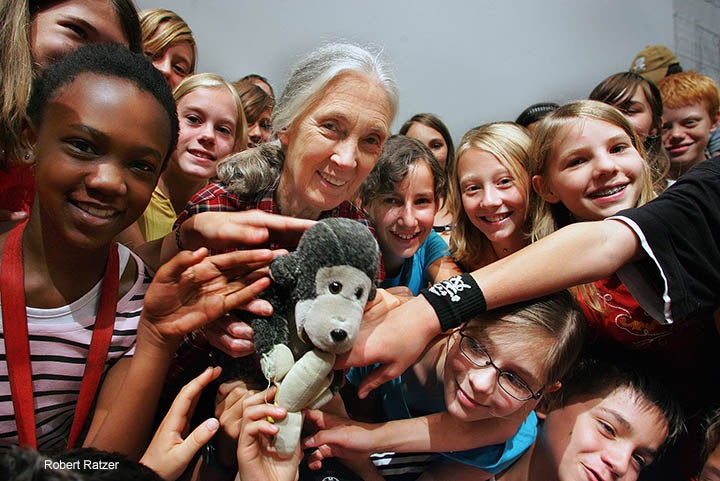
“Roots & Shoots is now in 65 countries, and my vision is to have the programme everywhere. That’s just a dream, but on the other hand, it began with 12 high school students, and since then hundreds of thousands of young people have been through the programme. Each group of Roots & Shoots chooses three projects to make the world better: One to help people, one to help animals and one to help the environment.
“Many of them are now in influential positions, and they hang on to the values that they acquired. Their message is every one of us makes an impact every single day and we can choose what sort of impact, unless we are living in desperate poverty – in which case we just do what it takes to stay alive.”
At a time when there is so much despair and anger from young people about the future because of climate change and environmental destruction, Dr Goodall tries to offer hope from her own experiences.
“I lived through the second world war when I was a little girl. It was very grim. We were then fighting a physical enemy, and this is an invisible enemy but the results are sort of the same. We never knew where the bombs were going to fall, which houses would be destroyed, which of our friends would be killed, and that’s a little bit the same now. But we came through it.
“I was in New York at the time of the fall of the Twin Towers, the 9/11 terrorist attack. It seemed like the end of the world but we got through that.
“There’s this indomitable human spirit you can see all around the world in communities helping each other.
“I’ve seen so many wonderful stories of people helping each other, taking food around and making themselves available for telephone calls from lonely, frightened people.”
She adds: “I myself have started reading children books so that they can get these stories while they’re forced to be at home and sending out video messages of encouragement that we will get through this – we must not give up, and let’s do our bit.”
The coronavirus, Dr Goodall says, may alter how she spreads her message.
“It may force change. I imagine when the airlines start flying again they may have to put their fares up so it may not be possible to do as much flying as I did.
“I look on it as practice for the time when my body says, ‘No Jane, enough, we‘re not going to allow you carry on like this’. Because it’s very exhausting, all the travelling I was doing.
“However, we have to get the message out that we’ve got to change but let’s have hope that we’re going to come out of this better people.
“We have to push our politicians in the right direction that we want.”

 Exposing the Big Game