Exposing the Big Game

Forget Hunters' Feeble Rationalizations and Trust Your Gut Feelings: Making Sport of Killing Is Not Healthy Human Behavior

Exposing the Big Game

Are Dairy Digesters the Renewable Energy Answer or a ‘False Solution’ to Climate Change?

Capturing the massive quantities of methane dairy farms emit could reduce overall carbon pollution. But critics say the effort is propping up Big Dairy.


logo for covering climate nowThis article is published in partnership with Covering Climate Now, a global journalism collaboration strengthening coverage of the climate story.

At first, California dairy farmer Felix Echeverria was skeptical about installing a dairy digester on his 12,000-cow operation. The process, which involved covering a pit of liquid manure and capturing the methane emissions it releases before “digesting” it anaerobically, is expensive and complex, and not something he was qualified to run. But he saw the benefits neighboring farmers in the Bakersfield area reaped from their digesters and decided to get ahead of a state law that would require him to reduce emissions by 2030.

“I realized I could stay ahead of the curve on greenhouse gas emissions,” Echeverria told Civil Eats. “To know we’ve been able to comply [with the law], that was the motive.”

The other deciding factor: Echeverria learned that he didn’t have to invest in or build the digester, as farmers in years past have. Instead, he partnered with a developer, California Bioenergy LLC (CalBio), that applied for public funding to help pay for the project and now operates the equipment. And in exchange for his manure biogas, Echeverria earns a percentage of sales from the electricity generated by the digester.

Get the latest articles in your inbox.

“There’s absolutely no drawbacks,” Echeverria said of the digester, which has operated on the farm since 2018.

Agriculture accounts for nearly a quarter of global greenhouse gas emissions, and as its role in changing the climate has become increasingly clear, farmers like Echeverria are being asked to do their part. In recent years, much of the attention—and the bulk of public dollars—has focused on anaerobic digesters, which help meat and dairy production facilities convert animal waste into energy that fuels vehicles and power grids.

Farmers, researchers, and policymakers across the U.S. see methane digestion as cost-efficient, effective, and revenue-generating for farmers. Proponents also see biogas and its cleaned-up version, biomethane (also known as renewable natural gas, or RNG) as a renewable source of energy that has a huge potential to replace more harmful legacy fuels.

Over the past decade, more than 250 digester projects have been built across the country, most of them on dairy farms. California alone has funded more than 100 digester projects, spending nearly $200 million of its ambitious California Climate Investments dollars on them. The state is poised to spend an additional $20-$25 million this year, though it’s unclear how the COVID-19 pandemic will impact the funding process going forward.

“The primary beneficiaries of these projects are the citizens of California. By reducing greenhouse gases, we are contributing to reducing global warming,” said Joyce Mansfield with the California Department of Food and Agriculture (CDFA), which runs a grant program for dairy digesters.

But digesters do have some drawbacks. They’re complex, expensive projects that farmers can’t afford on their own; they cost $3-5 million dollars each and typically require public subsidies to build—in the form of federal loans, state grants, tax credits, rebate programs, and myriad other incentives.

In the past, environmental advocates have supported digesters, but many have begun to see the technology in a new light. They say the emission reductions are not worth the massive public funding given that most manure-powered biogas comes from large-scale industrial dairy facilities known for their significant environmental impacts. (Straus Family Creamery in Northern California is one of a few exceptions.) As such, advocates say public financing of digesters amounts to supporting and helping to perpetuate large-scale factory farming—and in some cases, causing farms to grow in size—under the guise of mitigating climate change.

“Digesters are definitely reducing methane and generating fuel [and] electricity. It all sounds very good, but it’s not a clean fuel,” said Rebecca Spector, the West Coast director for the Center for Food Safety. “These enormous dairies are polluting the air and the water … and the state is promoting a false solution while propping them up.”

Ultimately, Spector said, portraying digesters as a panacea to dairies’ environmental woes is thwarting the move to a farming system that supports smaller-scale producers, reduced herd sizes, and cows on pastures. “We want dairies to move to more sustainable solutions and we support the state incentivizing that,” she said.

Pressure to Reduce Emissions

Large industrial dairies, also known as concentrated animal feeding operations, or CAFOs, clean manure out of their barns with water and store the liquid waste in large lagoons. As naturally occurring bacteria break down the manure, they release large quantities of methane, a greenhouse gas with a 25 times greater impact on global warming than carbon dioxide. In fact, more than half of California’s methane emissions come from dairies.

Manure management accounts for about 7 percent of agriculture emissions and in recent years, dairies across the U.S. have faced increased pressure to reduce that number. In California, the country’s largest dairy state, producers are required by 2030 to decrease their methane emissions by 40 percent from 2013 levels. And while much of the methane comes from cows belching, dairy manure lagoons account for approximately 25 percent of the state’s overall methane emissions.

Reducing those emissions is no small feat. In 2017, California housed 1.7 million cows—the vast majority of them residing in the Central Valley on approximately 1,300 dairies. According to the U.S. Environmental Protection Agency (EPA), an average dairy cow produces approximately 120 pounds of manure every day.

The digesters capture methane, convert the biogas to biomethane, and inject it into utility pipelines as renewable compressed natural gas (R-CNG) to power trucks, buses, and cars. In some cases, digesters also generate renewable electricity that’s used by the dairy, with the remainder sent into the grid. Dairy methane can also be turned into renewable electricity without combustion to power electric vehicles.

Because of the expense and scale of the projects, digesters are geared toward large dairies.

In the past, dairy producers built and operated their own digesters. But in recent years, as the projects have become more complex and their price tags have ballooned, big developers have largely taken over their funding, building, operating, and maintenance. Most of the digesters are now part of clusters, with the biogas sent to a centralized cleaning hub.

Because of the expense and scale of the projects, digesters are mainly geared toward large dairies—2,500 cows with support stock could support a standalone digester, according to digester developers. If a dairy is near a cluster project, it might work for it to be somewhat smaller.

While digesters may be expensive, data collected at the state level shows digester projects are cost-effective when it comes to reducing greenhouse gas emissions. In fact, the digester program is the second most cost-effective of the state’s 68 climate programs.

“Our projects are providing high value for the state in terms of return on their investment,” CalBio’s President Neil Black wrote in an email. “We are destroying methane, which has greater short-term warming impacts in initial years… [so] the climate benefits will be seen much sooner than projects that reduce carbon dioxide.”

Indeed, the greenhouse gas reductions can be substantial. Echeverria’s dairy digester was expected to cut its manure methane emissions by approximately 75 percent. It will also reduce energy costs and its use of fossil electricity from the grid. The digester delivers approximately 8 million kilowatt-hours of renewable electricity annually to state utility, Pacific Gas & Electric (PG&E). And the dairy is part of the Kern County Dairy Biogas cluster, a group of 16 dairies with approximately 60,000 milk cows that collectively produce approximately 6 million diesel gallon equivalents per year.

For large dairies, digesters can be a godsend: they cut the cost of complying with environmental rules, and offer a new source of revenue to supplement volatile milk prices. Farmers can also use electricity-engine waste heat to refrigerate their milk, resulting in further savings.

Digesters also provide benefits beyond emission reductions, Echeverria said. “We don’t have as much solids to deal with in the waste stream because a lot more material gets digested and turned into gas. We can move it around easier, our lagoons stay cleaner, and we get a better fertilizer source,” he said, referring to the fact that nutrients are broken down more thoroughly in the digester and are more available to the plants when the manure is spread on fields. And because digester projects are required to double-line the lagoons, he says nitrates don’t leach into groundwater.

Digesters also reduce emissions of hydrogen sulfide and other gases, said Black, CalBio’s president, improving air quality and reducing odors. The company is working to help convert truck fleets from diesel to natural gas, he said, which will significantly reduce nitrogen oxides, a major component of smog, in the highly polluted Central Valley where residents live with some of the worst fine particle pollution in the nation.

But Spector with the Center for Food Safety contends that while digesters do provide some benefits, they don’t solve the issue of nitrates contaminating groundwater—a major issue in the Central Valley, where low-income residents are often forced to rely on bottled water. That’s because nitrates often leach from manure applied as fertilizer into groundwater. Spector says that when digesters burn biogas they also produce air pollution. In addition, the digesters don’t address the climate impacts of enteric emissions (from cows releasing gas) which account for about half of the methane emissions from dairies.

Subsidies for Developers, Revenue to Industrial Dairies

Critics also decry the fact that much of the public funding for dairy digesters has gone into the hands of just a few developers.

In California, the CDFA has created a research and development program that is funded with the state’s cap and trade dollars. From 2015 to 2019, the program has awarded over $180 million to 108 projects, the agency told Civil Eats. And yet the vast majority of that money has gone to just two developers (only 12 developers have ever applied, the agency said).

CalBio has receive the largest amount: $99 million to date. And Maas Energy Works has been awarded $82.5 million. The CDFA grants require a 50 percent financial match, though those funds can also come from other public sources. Both companies also say they have received other public funding for their projects. Additional capital for the projects comes from investors and lenders.

CalBio currently operates five projects in California and is developing, according to its officials, more than 60 additional digesters in seven clusters of existing dairies that will produce renewable compressed natural gas for use in vehicle fleets. Maas Energy Works has a total of 27 digester projects, including 22 in California, three in Washington state, and two in Oregon.

“California has required the dairy industry to reduce their methane emissions by 40 percent. The best way to achieve that reduction is with dairy digesters,” Maas Energy Works spokesman Doug Bryant told Civil Eats via email.

The digester projects are a financial boon to both the developers and farmers. While in previous years, their value was based around renewable electricity generation and the sale of carbon credits, it now comes from the production of low carbon fuel, through the sale of natural gas, as well as the generation and sale of “credits” that can be sold to polluting companies and other organizations that use them to comply with state and federal requirements or voluntary emissions goals.

Precisely who benefits from these income streams varies from project to project. But with the new generation of digesters, it is often the developers who bring in the capital and who then own the digesters while the dairy producers rent their lagoon and provide the manure in return for a cut of the power sold. “Our company helps bring in the capital from lenders and investors. The dairies… receive the payment for contributing their manure, and the better the project performs, the more they will make,” said CalBio’s Black.

He added that dairies have an opportunity to invest in their projects, but that is optional. In Maas Energy Works projects, on the other hand, over half of the projects are 100 percent owned by the dairy farmer and the developer simply operates the digester for a fee, the company told Civil Eats.

Fight Over Renewable Gas

In the coming years, digester developers and dairy farmers may tap into an even bigger source of income as the gas industry looks to replace some of the “fossil-based” natural gas it currently sells. Natural gas companies such as SoCalGas and PG&E have heavily promoted biogas as a cost-effective, reliable “renewable natural gas.” The private utilities say that mixing RNG with regular gas in their pipelines will reduce its carbon intensity. And it appears the gas industry may get its way, at least in the short term.

While in the past, digester projects generated electricity for export to the grid, the current focus is on using the dairy biomethane—in the form of CRNG—as an alternative vehicle fuel and energy source. Out of 108 projects funded by the CDFA since 2015, 102 produce or will produce CRNG. And in recent years, these are built in a cluster of digesters that pipe gas to a centralized hub.

Two years ago, a new California law essentially mandated that a certain amount of biogas from manure and other renewable sources be included in utilities’ energy mix and for it to be injected into the gas pipeline system. The California Public Utilities Commission is currently in the process of creating a procurement standard to make that possible.

Legislators recently extended the ability to tap into $40 million in subsidies through a program that connects manure digesters to utility pipelines. And the SoCalGas settlement for the Aliso Canyon gas leak is also channeling $26.5 million toward the construction of dairy digester projects.

While some have praised this move, critics say it has created a whole set of ethical issues. Jim Walsh, a senior energy policy analyst with Food & Water Watch, says that using California Climate Investment funds to produce renewable gas from biomethane that utilities want in their portfolio supports not only factory farming but also the legacy fossil fuel industry—and could ultimately allow it to continue its polluting ways.

“These cap and trade funds are huge subsidies that utilities and other large polluters pay for to avoid their own emission reductions…. It allows them to greenwash themselves while proceeding with their practices,” Walsh said. “This is really just a shallow attempt to extend the life of their industry in the face of a growing backlash against fossil fuel development.”

Using biogas from manure as part of utilities renewables portfolio isn’t cost effective either, Walsh added, and will significantly increase rates for consumers. Methane-derived RNG can also leak through pipelines when transported, just like natural gas. And the bet on biogas from dairies is happening just as cities around the country are focusing more on electricity and passing laws to stop the building of new gas infrastructure.

In California, state officials have also pushed electricity as a strategy for cutting emissions from homes and workplaces. Meanwhile, utilities like SoCalGas counter that using biogas as part of their energy mix can reduce greenhouse gas emissions faster and cheaper than electrifying buildings.

Ultimately, what could make utilities’ move to biogas problematic is simply a problem of supply. Studies show there likely won’t be enough RNG/biomethane to meet the state’s climate goals.

Alternatives Underfunded, Lag Behind

Dairy digesters aren’t the only way to manage manure’s methane impact, but environmentalists say that other, more cost effective and sustainable methods tend to be much harder to get funded.

The CDFA runs a second methane reduction grants program called the Alternative Manure Management Program (AMMP). Those include projects focus on different ways to handle manure, such as composting and conversion to something called dry scrape collection, as well as enhanced pasture-based management practices (though few producers have applied to move their cows to pasture).

The program’s funding makes up only 20-30 percent of the total available for methane reduction programs, records show. More producers apply for the AMMP funding than for digester dollars, but in 2019 about half were rejected due to lack of funding.

The CDFA told Civil Eats that the dairy digester program has greater reductions of greenhouse gases than the alternative program. But Jeanne Merrill, policy director of California Climate and Agriculture Network (CalCAN), said the agency’s comparison is flawed. The CDFA calculates emission reduction impacts from AMMP projects on a 5-year project basis, she said, while those from the digester projects are calculated on a 10-year basis. “That’s comparing apples to oranges,” Merrill said.

CDFA officials said they use those time spans because they represent the expected duration of the projects. But Merrill said when greenhouse gas reductions are compared across both programs using similar timeframes, the AMMP projects fare quite well and sometimes do a better job with emission reductions per dollar.

AMMP projects are also faster to implement. Of the 108 digester projects awarded grants since 2015, only 13 are now complete and operational. The remaining 95 are at different stages of implementation.

Alternative methane reduction projects can also help protect water and air quality, Merrill added. Because they’re less expensive, they’re accessible to smaller farms and have greater geographic impact. And while digester projects are only guaranteed for 10 years (although Maas Energy Works told Civil Eats its digesters are expected to survive for at least 20), alternative projects are not subject to changes in complex technologies so are easier to maintain long-term.

“The trouble with digesters is that they only work for a quarter of the state’s dairies,” Merrill said. “Small and middle-sized dairies don’t have enough manure or capital to justify building digesters.”

Given the benefits, Merrill added, the CDFA should allocate half the available funding to non-digester programs.

Coronavirus May Stem the Tide of Funding

As the COVID-19 pandemic rages through California and the rest of the country, it’s still unclear how it might impact dairy digester projects. The pandemic has battered many smaller dairy farmers, with demand for dairy dropping and milk prices at historic lows. But both California Bioenergy and Maas Energy Works told Civil Eats that beyond minor delays and a slow-down in financing, the virus has had a limited impact on their operations so far.

In the near term, the impact may be financial. Before the pandemic, California’s governor Gavin Newsom proposed a budget that included a new ambitious Climate Catalyst Fund of $1 billion over the next four years. Companies—including farms and digester developers—could apply to get low-interest loans to reduce their climate impacts. That budget proposal, Newsom now says, “is no longer operable” and will have to be revised.

But given the fact that CDFA set its budget for 2020 loans last year, even the pandemic isn’t likely to stop the state’s fledgeling dairy digester industry from progressing—at least for the foreseeable future.


Top photo: The Riverview Dairy Digester in Pixley, California. It receives manure from roughly 3,000 cows, plus replacement stock. (Photo courtesy of Maas Energy Works)

3 workers killed, 277 infected in coronavirus outbreak at E. Wash. beef plant

Exposing the Big Game's avatarThe Extinction Chronicles


A memorial to three employees who died of COVID-19 stands at the entrance to the Tyson Fresh Meats plant in Wallula, Wash. (KEPR-TV News photo)

WALLULA, Wash. – An outbreak of COVID-19 at an Eastern Washington meatpacking plant has now killed three employees there and infected 277 other employees.

A memorial with photos of the three employees who died now sits outside the entrance to the Tyson Fresh Meats beef plant in Wallula, Wash.

Guadalupe Olivera, Bernardo Torralba and Jorge Castaneda all contracted COVID-19 and died from complications related to the virus. All three men worked at Tyson for years.

Their pictures are adorned with flowers next to the plant’s entrance.

The coronavirus outbreak closed the plant for about two weeks while the Walla Walla County Department of Public Health conducted mass testing of the facility’s 1,400 employees.

View original post 145 more words

COVID-19 Risks to People With Asthma Much Lower Than Expected

Exposing the Big Game's avatarThe Extinction Chronicles

https://www.aarp.org/health/conditions-treatments/info-2020/coronavirus-and-asthma.html?cmp=SNO-ICM-FB-COVID-HLTH&socialid=3345804363

Doctors say the lung condition isn’t a major factor in serious infections

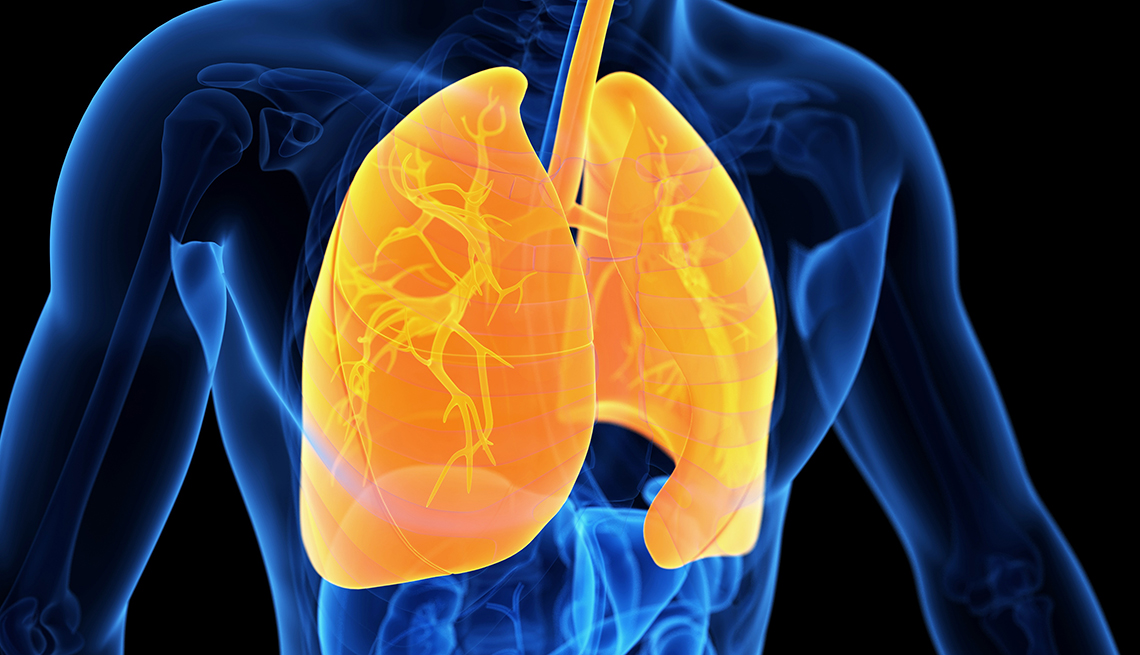
illustration of human body internal structure with the lungs highlighted in a different color

GETTY IMAGES

En español | It makes sense that the respiratory symptoms of COVID-19 could present a serious menace to those who suffer from asthma — which inflames and narrows airways, making breathing difficult. And since the early days of the pandemic, the Centers for Disease Control and Prevention (CDC) has warned that people with moderate to severe asthma may be at higher than average risk for severe illness from the disease caused by the new coronavirus.

But several months into the pandemic, medical experts say that the numbers tell a somewhat different story. “Asthma really hasn’t shaken out to be a significant risk factor,” says Benjamin J. Seides, M.D., director of interventional pulmonology at Northwestern Medicine Central DuPage Hospital.


For the latest coronavirus…

View original post 530 more words

LETTER: Hope Smithfield focuses on vegan meats

  • 2
  • 3
  • 4

Never Miss A Story

Subscribe to The Register-Mail

Subscribe Now

OUR PICKS

Previous

Latest Highlights for Your Favorite Teams

Editor, Register-Mail: I hope Smithfield Foods stays closed for a while — and then focuses on vegan meats rather than animal flesh when it’s safe to reopen (“PETA demonstrators take to Monmouth Public Square,” May 13).

Filthy, crowded factory farms, meat markets, and slaughterhouses threaten the health of everyone — not just workers and meat-eaters— by providing a breeding ground for deadly diseases, such as COVID-19, swine flu, bird flu, and more. And the bloody, gruesome process of slaughtering, cutting up, and packaging the corpses of once-sentient individuals can cause those who inflict cruelty to animals to suffer from mental and physical health problems.

Fortunately, meat is not essential. There are tasty, healthy, humane, and environmentally friendly vegan options. Let’s enjoy them. See www.PETA.org for more information and a free vegan starter kit.

Sincerely

 — Heather Moore, PETA Foundation, Norfolk, Virginia

Suffocating healthy farm animals during a pandemic is not ‘euthanasia’

With the COVID-19 outbreak shutting down, at least temporarily, an estimated 20 major slaughterhouses and processing plants in North America, millions of farm animals are left in limbo with nowhere to go.

In Iowa, the nation’s biggest pork-producing state, farmers are reportedly giving pregnant sows abortions by injection and composting dead baby pigs to be used for fertilizer. Amid supply chain bottlenecks, local political leaders warn that producers might be forced to “euthanize” around 70,000 pigs a day.

In Minnesota, JBS, the world’s largest slaughter operation, reopened its Worthington plant last month for the sole purpose of killing and dumping excess pigs. The meat processing plant partially reopened for business last week. Roughly one-quarter of the facility’s 2,000 workers have tested positive for the coronavirus.

And in Delaware and Maryland, Allen Harim Foods depopulated 2 million chickens last month, citing a 50% decline in its workforce.

Using the terms “slaughter” or “euthanasia” to describe the rapid destruction of farm animals is a misnomer. Slaughter is killing for human consumption; to ensure meat quality, the animal typically dies from blood loss. Under the federal humane slaughter law, animals (except birds) are first stunned, which means they are rendered insensible to pain.

Euthanasia literally means “a good death.” It involves ending an animal’s life in a way that minimizes or eliminates pain and distress, according to the American Veterinary Medical Association.

The AVMA defines the term “depopulation” as “the rapid destruction of a population of animals in response to urgent circumstances with as much consideration given to the welfare of the animals as practicable.”

Among the depopulation methods deemed acceptable is using a layer of water-based foam to drown and suffocate birds. During ventilation shutdown, operators flip a switch to turn off the airflow in a barn and ratchet up the heat to as high as 120 degrees, leaving trapped birds and pigs to die from a combination of heat stress and suffocation. The process can take hours and likely results in severe suffering. In fact, other than burning animals to death or burying them alive, it is difficult to imagine a more horrific end.

The last time such gruesome depopulation methods were widely used was in 2015 in response to highly pathogenic bird flu, the worst animal disease outbreak in U.S. history, which killed nearly 50 million chickens and turkeys. In that case, birds were sick and suffering, and the justification given for the extreme step of depopulation was that it would slow the spread of the disease in the shortest time possible.

During the current pandemic, however, animals are not suffering from disease, nor are they at risk of transmitting disease to other animals or to humans. Instead, they are being killed, and their bodies disposed of, because meat companies failed to protect their workers properly from exposure to COVID-19.

The meat industry is using depopulation as a quick fix for its lack of emergency preparedness. The conventional animal agriculture industry operates a highly consolidated system that has a hard time adjusting in response to a crisis. It routinely runs slaughter lines at dizzying speeds, provides the lowest level of care to animals crammed in stressful, unsanitary environments, and extends minimal health and safety protections to its workers — to date, thousands have become ill or been exposed to the coronavirus, and some have died. This intensive, high-production system leaves no room for error, yet giant corporations give little consideration to how animals will fare in emergency situations — from disease outbreaks to natural disasters to devastating barn fires.

That hasn’t stopped industrial agriculture from begging for federal assistance, warning of meat shortages and skyrocketing prices. Farmers are also asking the federal government to bankroll depopulation efforts, along with compensating them for their losses.

Already, the Department of Agriculture has pledged that government officials and veterinarians will step in, if necessary, to “advise and assist on depopulation and disposal methods.” Because there are no federal or state regulations governing farm animal euthanasia or depopulation, more than 20 members of Congress sent a letter last week to Agriculture Secretary Sonny Perdue urging his department to curb extreme measures, including ventilation shutdown and water-based foam methods.

We simply cannot trust powerful industry players and federal regulators to safeguard animal welfare. According to a recent report by the Animal Welfare Institute, JBS’s Worthington plant, a Smithfield Foods plant in Sioux Falls, South Dakota, and a Tyson Foods plant in Waterloo, Iowa, were the top three worst large livestock slaughter plants in the country for animal welfare violations from 2016 to 2018. These three facilities account for 12% of all U.S. hog production. Violations included multiple incidents of failing to stun animals before shackling and hanging them to be dismembered, likely causing the animals excruciating pain.

Depopulation during the current pandemic is being pursued solely as a consequence of the meat industry’s failure to protect its workers, not because the animals present any real risk to human or animal health. These blatantly inhumane killing methods are completely unjustifiable.

Because these animals cannot be brought to market, millions of animal lives will be wasted. At the very least, we should spare them a cruel death.

Dena Jones is the farm animal program director for the Washington-based Animal Welfare Institute.

Vegan activists protest Spring meat processing center amid COVID-19 pandemic

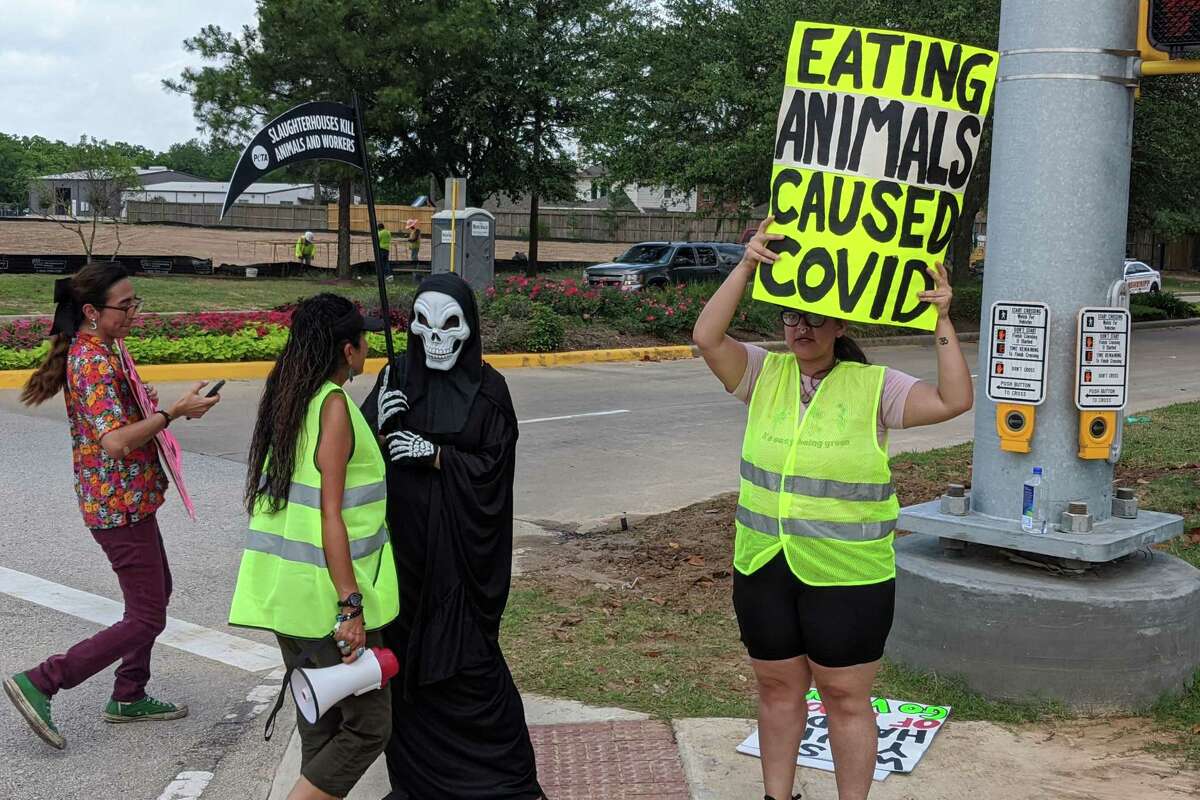
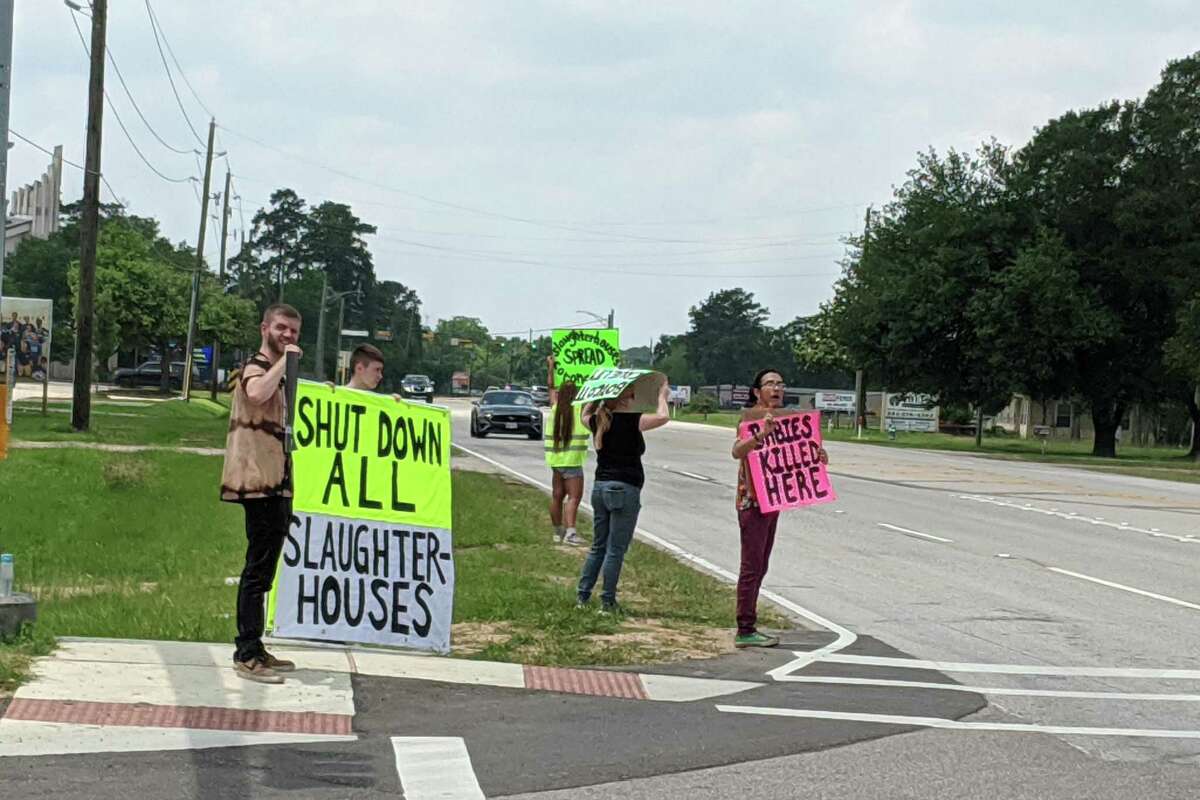
Around a dozen protesters were camped out at the intersection outside the Fisher Ham and Meat Co. headquarters in Spring on Friday, demanding the meat processing facility be shut down amid the coronavirus pandemic.

Dani Alexander, one of the organizers of the event, called factory farms and slaughterhouses breeding grounds for new strains of dangerous bacteria and viruses, likening the spread of coronavirus from animals-to-humans to diseases such as bird flu and swine flu.

https://www.houstonchronicle.com/neighborhood/spring/news/article/Vegan-activists-protest-Spring-meat-processing-15273855.php#photo-19419456

Fish & Wildlife Service focuses on food-related causes for 2018 seabird die-off

  23 HOURS AGO

A group of seabirds — murres, specifically — nesting in the cliffs. (Photo from the public domain, via Wikimedia Commons)

The exact cause of the 2018 seabird die-off that affected more than a thousand birds in the Bering Strait region, is still unknown. However, scientists with the U.S. Fish & Wildlife Service believe it is not related to a strain of avian flu that was found in two seabirds, which is at odds with prior theories from a researcher at the University of Alaska Fairbanks.

According to Kathy Kuletz, the seabird section coordinator for Fish & Wildlife Service in Alaska, 26 carcasses from the 2018 die-off were sent to them for sampling. Those seabirds were then transferred to the USGS National Wildlife Health Center in Madison, Wisconsin.

“Some of them were not in real good shape when they (United States Geological Society) got them, but they were able to determine that 14 died of starvation, they were highly emaciated. One died from some kind of trauma and two they couldn’t determine. All of those were tested for avian influenza. Two of those came back positive.”

The two birds that tested positive for avian influenza were a kittiwake from Wales and a thick-billed murre from Savoonga. That thick-billed murre was the exact same bird a University of Alaska Fairbanks researcher came across during her studies on St. Lawrence Island in 2018.

“Of course, birds were starving, so that may have been poor foraging ability, that may have been a result. But we’re looking a little bit more at ‘maybe they were sick,’” said Alexis Will, a researcher with UAF’s Institute of Arctic Biology. Will recently explained how she and her fellow researchers found no evidence thick-billed murres experienced food shortages in 2018.

She cited the thick-billed murre from Savoonga with avian influenza as an indicator that the cause of the die-off from 2018 could be due to disease and not food-related.

U.S. Fish & Wildlife Service disagrees.

“Both H10N6 viruses and H16N3 viruses (or avian flu) have previously been detected in apparently healthy birds,” said Andy Ramey, a research geneticist with USGS’ Alaska Science Center.  “And again, none of these previous detections have been associated with die-off events.”

Based on his more than ten years of studying avian influenza, and previous scientific findings, Ramey is skeptical that the bird disease caused the 2018 die-off. Fish & Wildlife Service is doing more tests and studies to confirm that disease like the avian flu did not cause this large-scale event to happen.

Meanwhile, Ramey, Kuletz and fellow Fish & Wildlife Service seabird biologist Robb Kaler, believe there are other factors contributing to hundreds of birds starving and dying in the Bering Strait region. Those include record warm ocean temperatures, lack of sea ice, and the absence of a cold-water barrier in the Bering Sea from 2018.

“So with the warm water and the lack of sea ice, that’s going to affect the metabolism of both the predator, in this case the seabird, and the prey, whether it’s krill, euphasids or forage fish,” Kaler said. “But that warm water could also affect the abundance and distribution of that prey.”

Although the scientists acknowledge there is still food available for seabirds to eat near St. Lawrence Island, and in the Bering Sea, their prey base is changing and may not be as nutritious as normal. Kaler refers to these types of fish as “junk food.”

“Capelin are very rich in nutrients versus pollock or cod, juvenile cod or pollock, being brought to the nests of a thick-billed murre. Capelin are king and there’s a junk food hypothesis about less nutritional…so the parent has to work harder to provision the nest if they’ve got junk food that they’re bringing back to their chick.”

With ecosystem-wide changes underway in the Bering Sea, Fish & Wildlife Service isn’t ruling out food-related causes of death or that there were potential effects of avian influenza or harmful algal blooms (HABs).

The agency is, however, emphasizing that the 2018 seabird die-off in the Bering Strait region was most likely not associated with avian influenza. Ramey also points out that emaciation is not a clinical sign of influenza in birds, and many of the seabirds they sampled were found to be emaciated.

According to Kaler, they anticipate another seabird die-off will be seen in the Bering Sea this summer while Fish & Wildlife Service works to solve the mystery of the 2018 event. If the Bering Strait region experiences another large-scale dieoff this year, that would be the sixth year in a row featuring mass seabird deaths.

Farmers to euthanize pigs as meat plants remain closed, pork council says: ’10 million pigs with nowhere to go’

placeholder

The coronavirus pandemic has dealt a new blow to the American meat industry, as farmers will have to euthanize as many as 10 million pigs by the middle of September to avoid overcrowding in their facilities, the National Pork Producers Council (NPPC) has warned.

Though President Trump invoked the Defense Production Act in late April to keep meat processing plants open through the COVID-19 crisis, outbreaks of the viral disease have shuttered some plants and slowed operations at others. Consequently, pork farmers have not been able to send or sell tremendous numbers of market-ready hogs in recent weeks, creating a bottleneck in the supply chain.

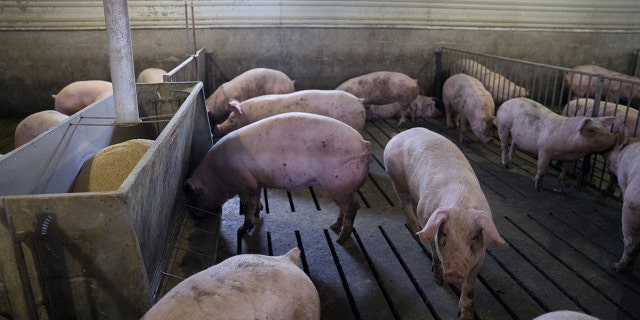
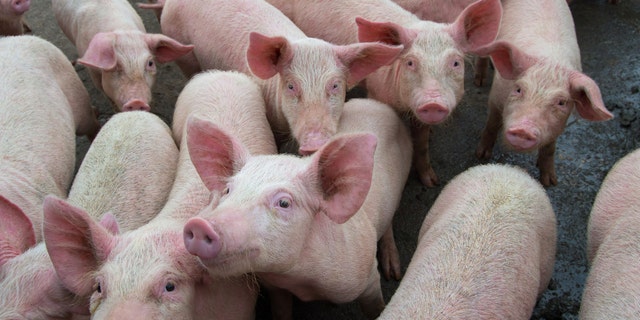
Young female pigs stand in pen at a hog farm in Smithville, Ohio, in this April photo.

Young female pigs stand in pen at a hog farm in Smithville, Ohio, in this April photo. (Dane Rhys/Bloomberg via Getty Images)

TYSON FOODS TEMPORARILY CUTTING PRICES ON BEEF PRODUCTS AMID SPIKE IN GROCERY PRICES

Now, there are few viable accommodations for an estimated 170,000 pigs to be sent to the operative plants each day for processing into the food supply, the NPPC says. According to the council, these hogs will eventually grow “too large” for admission to harvest facilities, creating a “tragic reality” for farmers in the U.S., who have raised “10 million hogs with nowhere to go.”

Producers cannot continue to house the market-ready hogs, the council said, as they need make room for younger hogs entering the supply chain. Farmers plan about 10 months in advance for how many hogs to prepare for market through the spring and summer, with the pandemic greatly upending their 2020 projections.

“Producers face a wrenching and tragic choice; watch their mature animals suffer because they can’t care for them or euthanize them. The only humane option is to euthanize them, a tragedy for farmers who work to produce food for people,” the NPCC said in a statement last week. “Destroying these animals and the food they represent goes against every farmer instinct.”

There are few viable accommodations for an estimated 170,000 pigs to be sent to the operative plants each day for processing into the food supply, the NPPC said.

There are few viable accommodations for an estimated 170,000 pigs to be sent to the operative plants each day for processing into the food supply, the NPPC said. (iStock)

Overcrowding on hog farms can result in aggression and injuries, impacting the pigs’ ability to eat, drink and rest. It is also a challenge to maintain a comfortable air quality and environment for the animals.

placeholder

FOLLOW US ON FACEBOOK FOR MORE FOX LIFESTYLE NEWS

As of May 6, pork harvest capacity is down almost 40 percent due to coronavirus-related slowdowns and shutdowns, the NPPC said.

Now, the pork council is asking for federal assistance to address the unprecedented crisis. The NPPC seeks congressional authorization to fund $1.173 billion for the USDA Farm Service Agency Emergency Assistance for Livestock, Honeybees and Farm-Raised Fish (ELAP) for pork producers who cannot market their pigs due to coronavirus-related plant shutdowns and slowdowns.

The group also hopes to receive an additional $505 million for euthanasia and depopulation expenses as well as the facilitation of environmentally responsible disposal, in partnership with the USDA Animal and Plant Health Inspection Service, National Resource Conservation Service and FEMA.

Without this assistance, the NPPC argues, thousands of farmers will have to liquidate their assets, ultimately driving up pork prices for the American people.

CLICK HERE FOR FOX NEWS’ CONTINUING CORONAVIRUS COVERAGE

In response, the USDA established a National Incident Coordination Center last month to help farmers euthanize and dispose of these animals because of the processing plant closures, National Hog Farmer reports.

“None of us want to euthanize hogs, but our producers are facing a terrible, unprecedented situation,” said Bob Krebs, president of meatpacking company JBS USA Pork.

Last month, JBS announced that it would be reopening a temporarily closed pork production plant in Minnesota as a humane euthanasia facility, which capacity to euthanize about 13,000 hogs per day.

Doctors Protest Continued Operation of Smithfield Foods Slaughterhouses In Virginia

Doctors to Protest Continued Operation of Smithfield Foods Slaughterhouses In Virginia

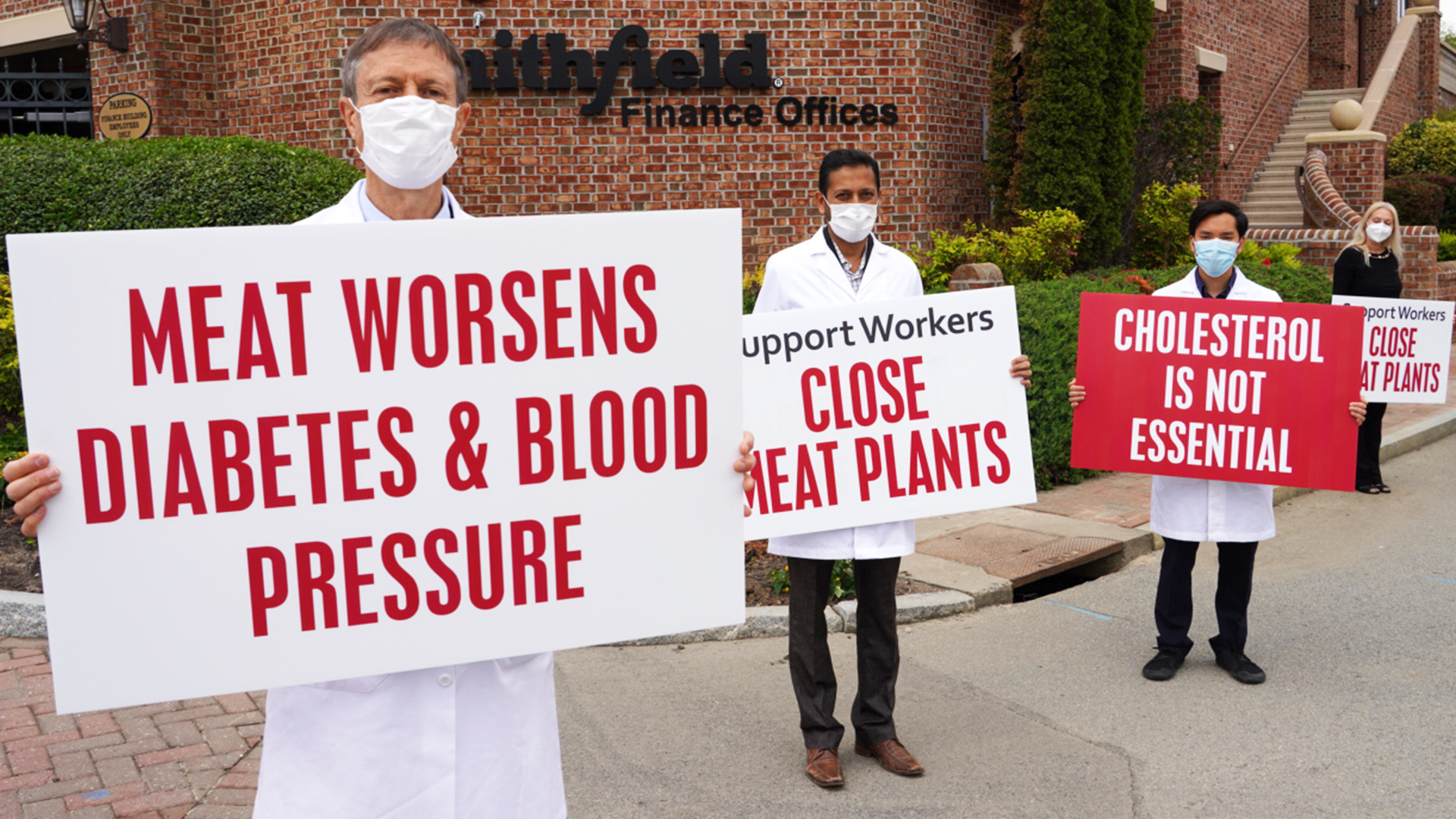
SMITHFIELD, Va.—Doctors with the Physicians Committee for Responsible Medicine called for the closure of meatpacking plants during a demonstration on May 14. The doctors will held signs reading “Support Workers, Close Meat Plants,” “Meat Worsens Diabetes & Blood Pressure,” and “Cholesterol Is Not Essential.” They maintained social distance while protesting outside of Smithfield Foods Headquarters, 200 Commerce Street, Smithfield, VA 23430, at the corner of Commerce Street and Luter Drive.

“Keeping Smithfield plants open harms the health of workers, the surrounding community, and consumers—all to line the pockets of the meat industry,” says Neal Barnard, MD, FACC, president and co-founder of the Physicians Committee for Responsible Medicine.

More than 15,500 meat plant workers are infected with COVID-19, and at least 60 have died. With workers lined up in close proximity, viruses are easily spread within the slaughterhouse environment. Although studies show that infectious viruses easily survive during refrigeration and freezing, meat companies do not routinely test the extent to which meat products are contaminated with the virus.

Meat consumption raises the risk for many of the underlying medical conditions—diabetes, hypertension, obesity, and chronic obstructive pulmonary disease—that can make COVID-19 infections more deadly. A recent study found that regular consumption of processed meat, red meat, or poultry increases the risk for cardiovascular disease. Research also links red meat, poultry, and fish to an increased risk for diabetes.


Media Contact

DONNA STEELE

202-527-7342

dsteele@pcrm.org

Founded in 1985, the Physicians Committee for Responsible Medicine is a nonprofit organization that promotes preventive medicine, conducts clinical research, and encourages higher standards for ethics and effectiveness in education and research.

More on COVID-19

Even if you test negative for COVID-19, assume you have it, experts say

Exposing the Big Game's avatarThe Extinction Chronicles

By Nicoletta Lanese – Staff Writer 

No diagnostic test is 100% accurate, but experts have still expressed concern at the accuracy of the COVID-19 tests.

  • [My wife had a test come up negative, even though she’s sure she had it…]

 Comments (7)

PCR tests being prepped

(Image: © Shutterstock)

Conventional diagnostic tests for the novel coronavirus may give false-negative results about 30% of the time, meaning people with an active COVID-19 infection still test negative for the disease, according to news reports.

“Unfortunately, we have very…

View original post 1,856 more words