Michael Moore has a long history of releasing documentaries that ask tough questions in challenging times. In fact, as evidenced by films like “Bowling for Columbine” and “Fahrenheit 9/11,” it would be fair to say that his signature move is shaking up the status quo, skewering sacred cows and asking his audience to confront what he calls “the awful truth.”
Moore is also a trailblazer when it comes to finding creative ways to capture the attention of his audience…
Worldwide emissions of carbon dioxide are forecast to drop about 8% in 2020.
An energy expert calls it “a historic shock to the entire energy world.”
Coal use has been especially hard hit during the lockdowns, as has natural gas use.
The coronavirus pandemic has led to an “unprecedented decline” in global carbon emissions, a new report says.
Worldwide emissions of carbon dioxide – the greenhouse gas most responsible for global warming – are forecast to drop about 8% in 2020, a record annual decline that’s due to COVID-19 lockdowns. The restrictions have caused a massive plunge in fossil fuel use, according to a report released Thursday by the International Energy Agency.
“This is a historic shock to the entire energy world,” said Fatih Birol, the IEA executive director, in a statement. “Amid today’s unparalleled health and economic crises, the plunge in…
Reaction and analysis from Copenhagen Consensus Center president Bjorn Lomborg.
Get all the latest news on coronavirus and more delivered daily to your inbox. Sign up here.
If you live in Michigan and need a condom, you’re in luck: The state health department this week launched a free condom delivery service, meaning residents can still get the protection they need — even while coronavirus-prompted lockdown and social-distancing measures continue.
The Michigan Department of Health and Human Services (MDHHS) announced the new condoms-by-mail service in an effort to prevent unintended pregnancies and the spread of sexually-transmitted diseases in communities across the state. The idea was sparked after local health agencies were forced to stop handing out free condoms at government buildings, bars…
Parks and Wildlife Commission votes to end competitive killing of coyotes, foxes, prairie dogs and other species for prizes
DENVER, CO—A coalition of leading wildlife protection organizations is applauding the Colorado Parks and Wildlife Commission for their vote today to ban wildlife killing contests for furbearer and certain small game species in the state. Colorado is now the sixth state in the country to ban these cruel events.
The proposal, advanced by Colorado Parks and Wildlife staff and approved today by the Colorado Parks and Wildlife Commission, prohibits killing contests that target species including mink, pine marten, badger, red fox, gray fox, swift fox, striped skunk, western spotted skunk, beaver, muskrat, long-tailed weasel, short-tailed weasel, coyote, bobcat, opossum, ring-tailed cat, raccoon, as well as Wyoming ground squirrel. Species also include white-tailed, black-tailed and Gunnison’s prairie dogs.
Upon enactment, this new regulation will put an end to events such as the High Desert Predator Classic in Pueblo, the Song Dog Coyote Hunt in Keenesburg, and the San Luis Valley Coyote Calling Competition. Winners of wildlife killing contests often proudly post photos and videos on social media that show them posing with piles of dead coyotes and other animals, often before disposing of the animals in “carcass dumps” away from the public eye.
“Participants of wildlife killing contests often use unsporting and cruel techniques—such as calling devices that mimic the sound of prey or even pups in distress—so that they can lure shy coyotes and other animals to shoot at close range,” said Aubyn Royall, Colorado state director for the Humane Society of the United States. “We thank[http://?]Colorado Parks and Wildlife and the Commission for taking decisive action to ensure that Colorado no longer supports such barbaric and wasteful killing of its treasured wildlife.”
“Colorado’s ban, which is supported by the best scientific data available, is one of the strongest in the country,” said Johanna Hamburger, wildlife attorney for the Animal Welfare Institute. “The state has now joined multiple fish and wildlife agencies and commissions in concluding that these contests compromise the effective management of wildlife populations, fail to increase game populations and harm ecosystems.”
Colorado joins five other states—California, Vermont, New Mexico, Arizona and Massachusetts—that have taken a stand against cruel, unsporting and wasteful wildlife killing contests. California banned the awarding of prizes for killing furbearing and nongame mammals in 2014; New Mexico and Vermont outlawed coyote killing contests in 2019 and 2018, respectively; and Arizona and Massachusetts prohibited killing contests that target predator and furbearer species in late 2019.
“Wildlife killing contests are a bloodsport just like dogfighting and cockfighting, which have been outlawed nationwide,” said Camilla Fox, founder and executive director of Project Coyote. “We commend Colorado Parks and Wildlife and the Commission for relegating these ecologically and ethically indefensible events to the history books.”
“The majority of Coloradans respect and value wildlife and this step forward by our state wildlife department in line with those values,” said Lindsay Larris, Wildlife Program Director for WildEarth Guardians. “We look forward to seeing CPW to continue to advance policies that reflect the importance of wildlife protection to all people in Colorado.”
“Recognizing that all species play an important role in their ecosystem,” said Stephanie Harris, senior legislative affairs manager for the Animal Legal Defense Fund, “we commend Colorado Parks and Wildlife and the Commission for this forward-thinking, science-based decision to prohibit the senseless slaughter inherent to killing contests.”
“We’re thrilled that Colorado is banning these wasteful wildlife killing contests,” said Collette Adkins, carnivore conservation director with the Center for Biological Diversity. “Coyotes and other carnivores play such important ecological roles but had been mercilessly targeted by these barbaric events. Today’s decision by the Colorado Parks and Wildlife Commission is a big win for Colorado’s coyotes, and we’re celebrating.”
Delia Malone from the Colorado Sierra Club said, “All native wildlife species are essential. Ecology and ethics require that we protect all native species–including species that have historically been vilified or dismissed as unimportant. Natives such as coyotes and prairie dogs contribute to healthy, viable, resilient ecosystems, and deserve our respect and our protection. We are gratified that Colorado Parks and Wildlife has chosen conservation.”
Wildlife agencies and professionals across the country have expressed concerns about killing contests because they reflect poorly on responsible sportsmen and sportswomen. In 2019 alone, the Arizona Game and Fish Commission and the Massachusetts Fisheries and Wildlife Board voted to prohibit these gruesome killing contests, citing the grave damage that such events could inflict on the image of hunting in their states. Wildlife management professionals have also noted that wildlife killing contests contravene modern, science-based wildlife management principles. In 2018, more than 70 renowned conservation scientists issued a statement citing peer-reviewed science that refutes claims that indiscriminately killing coyotes permanently limits coyote populations, increases the number of deer or other game species for hunters, or reduces conflicts with humans, pets or livestock. In fact, randomly shooting coyotes disrupts their pack structure, leading to increases in their populations and more conflicts. Nonlethal, preventive measures are most effective at reducing conflicts with wildlife.
Wildlife killing contests are also destructive to healthy ecosystems, within which all wildlife species play a crucial role. Coyotes and other targeted species help to control rabbit and rodent populations and restrict rodent- and tick-borne disease transmission. And prairie dogs are an important keystone species in Colorado’s ecosystem, providing essential food and digging underground tunnels used by other native wildlife.
Dow futures were pointing to a sharp decline at Friday’s open after President Donald Trump threatened new tariffs on China over the coronavirus outbreak, which originated in the Chinese city of Wuhan late last year. The negative tone in the market on the first day of May comes after the Dow broke its three-month losing streak and finished April with its best monthly gain since January 1987. (CNBC)
FILE – This April 18, 2020, file photo, shows the JBS USA Pork Plant in Worthington, Minn. Officials estimate that about 700,000 pigs across the nation can’t be processed each week and must euthanized. Most of the hogs are being killed at farms, but up to 13,000 a day also may be euthanized at the JBS pork plant in Worthington. (Aaron Lavinsky/Star Tribune via AP)
DES MOINES, Iowa (AP) — After spending two decades raising pigs to send to slaughterhouses, Dean Meyer now faces the mentally draining, physically difficult task of killing them even before they leave his northwest Iowa farm.
Meyer said he and other farmers across the Midwest have been devastated by the prospect of euthanizing hundreds of thousands of hogs after the temporary closure of giant pork production plants due to the coronavirus.
The unprecedented dilemma for the U.S. pork industry has forced farmers to figure out how to kill healthy hogs and dispose of carcasses weighing up to 300 pounds (136 kilograms) in landfills, or by composting them on farms for fertilizer.
Meyer, who has already killed baby pigs to reduce his herd size, said it’s awful but necessary.
“Believe me, we’re double-stocking barns. We’re putting pigs in pens that we never had pigs in before just trying to hold them. We’re feeding them diets that have low energy just to try to stall their growth and just to maintain,” said Meyer, who also grows corn and soybeans on his family’s farm near Rock Rapids.
It’s all a result of colliding forces as plants that normally process up to 20,000 hogs a day are closing because of ill workers, leaving few options for farmers raising millions of hogs. Experts describe the pork industry as similar to an escalator that efficiently supplies the nation with food only as long as it never stops.
More than 60,000 farmers normally send about 115 million pigs a year to slaughter in the U.S. A little less than a quarter of those hogs are raised in Iowa, by far the biggest pork-producing state.
Officials estimate that about 700,000 pigs across the nation can’t be processed each week and must be euthanized. Most of the hogs are being killed at farms, but up to 13,000 a day also may be euthanized at the JBS pork plant in Worthington, Minnesota.
U.S. Rep. Collin Peterson, a Minnesota Democrat who chairs the House Agriculture Committee, went to the plant Wednesday, in part to thank JBS officials for agreeing to kill the hogs at his request.
“The only thing they wanted out of me was for me to come down here and say I’m the one who asked for this, not them. … Blame me if you don’t like it,” he said.
It all means that meat can’t be delivered to grocery stores, restaurants that now are beginning to reopen or food banks that are seeing record demand from people suddenly out of work. Some of that demand is being met by high levels of meat in cold storage, but analysts say that supply will quickly dwindle, likely causing people to soon see higher prices and less selection.
To help farmers, the USDA already has set up a center that can supply the tools needed to euthanize hogs. That includes captive bolt guns and cartridges that can be shot into the heads of larger animals as well as chutes, trailers and personal protective equipment.
Iowa officials have asked that federal aid include funding for mental health services available to farmers and the veterinarians who help them.
Meyer said euthanizing healthy animals is a difficult decision for a farmer.
“It is a tough one,” he said. “We got keep our heads up and try to be resourceful and if we can make it through this cloud, I think there will be good opportunities if we’re left standing yet.”
The USDA has a program designed to connect farmers with local meat lockers and small processors that can slaughter some hogs and donate the meat to food banks. However, that effort has been hindered by the fact that small processors already were overwhelmed with customers who have turned away from mass-produced meat and instead bought a hog or cow to be processed locally.
Chuck Ryherd, owner of State Center Locker in State Center, Iowa, said he’s almost completely booked through the end of the year and has been turning away customers.
Chris Young, the executive director for the American Association of Meat Processors, a trade group for about 1,500 smaller meat lockers, said that while some local processors in Indiana, Illinois and Wisconsin have been able to take a few extra hogs, the shortage is being felt nationwide.
“When the pandemic started, all across the country, a lot of these small processing plants with a retail store in the front were just overrun,” he said. “They’re still crazy busy. It hasn’t really backed off.”
On Wednesday, President Donald Trump used the Defense Production Act to order that large meat processors remain open, giving hog farmers hope the situation could improve.
However, Howard Roth, a Wisconsin farmer and president of the National Pork Producers Council, said farmers will need to keep euthanizing pigs as the slaughterhouses struggle to resume their full production. Farmers will definitely need federal help to keep them afloat.
“We are going to need indemnity money for these farmers,” he said. “This situation is unprecedented.”
Peterson also said he’ll seek a change in the law so that the USDA can retroactively compensate farmers for euthanizing healthy animals in such emergencies. He said the USDA told him it doesn’t have the authority at the moment to do that for healthy animals, just diseased animals, as it did during for chickens and turkeys in the bird flu outbreak.
“It’s going to be in there, I’ll guarantee you,” he said.
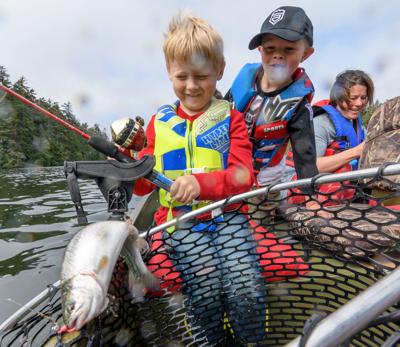
Splashes fly as Jackson and Dawson Miller, both 5, participate in the 2019 Kids Fishing Derby at Heart Lake in Anacortes. This year, in the middle of a pandemic, some outdoor activities are opening back up on Tuesday, but only with safe social distancing between people not living in the same household.
Those wanting to get outdoors to fish and hunt will have an opportunity to do so beginning Tuesday.
The state Department of Fish and Wildlife will reopen some recreational fishing and hunting, taking a phased approach following the state’s efforts to limit the spread of COVID-19.
There are caveats, however. If anglers and hunters want to stay outdoors to pursue fish and game, they will have to do so locally while practicing social distancing.
“We’ve had so many people doing their part to stay home, and we’re…
A booth was taped off to ensure social distancing at a coffee shop in Woodstock, Ga., on Monday, as Gov. Brian Kemp eased restrictions in the state and allowed dine-in service.Photo by Dustin Chambers – Bloomberg via Getty Images
As millions of people remain socially isolated and anxious about COVID-19, several U.S. governors are at leastmaking plans to relax controls in their states and revive economic activity — against the advice of many public health professionals.
New York Times science and health reporter Donald G. McNeil Jr. warns that the push to reopen is premature. “We’re nowhere near getting on top of this virus,” he says.
McNeil has spent decades at the Times covering infectious diseases, including AIDS, Ebola, malaria, swine and bird flu, and SARS. He describes the ways that some Americans are approaching social distancing measuresas a “giant…
AN 11-year-old boy was fatally shot in an apparent hunting accident near Birmingham on Friday, authorities said.
The Jefferson County Sheriff’s office said the child was hunting turkey with a group of people when the shooting occurred Friday morning. Sgt. Joni Money told WBMA-TV the child’s father was with him in the woods at the time.
Police are investigating the shooting as an accident, and officials did not immediately release the name of the victim.
NRPLUS MEMBER ARTICLE M ichael Moore and Jeff Gibbs have released a new movie. Entitled “Planet of the Humans,” the film examines the question of whether “green energy” can “save the planet” from global warming. Their answer is an unequivocal “no.” Instead, a more effective final solution is needed for the human problem.
Planet of the Humans has been received warmly by many on the right, and coldly by much of the left, because it forcefully attacks wind, solar, and especially biomass as false solutions to the energy needs of industrial civilization. The film is replete with images of giant solar energy projects built a few years ago with much hullabaloo at taxpayer expense now lying around as fields of junk, rusting broken wind turbines, and devastated forests. It does not hesitate to show how pitiful the energy yields and CO2 emission reductions from such projects have been. It is merciless in portraying Al Gore, Bill McKibben, the Sierra Club, and other noteworthy green energy promoters as profiteers, scamming the public while destroying the environment for personal greed. As a cinematic hit job on the green-energy movement, it is without peer.
That said, Planet of the Humans stands among the most perverse movies ever made, one that should not be touched by conservatives with a ten-foot pole. Green energy cannot sustain industrial civilization, Moore says. Therefore, he says, industrial civilization should not be sustained.
Moore and Gibbs affect concern for the forests that are being incinerated to produce electricity. Yet they express no interest whatsoever in well-proven technologies that make such destruction unnecessary. For example, a single 1000 MWe nuclear power plant produces about 100,000 terajoules (TJ) per year of thermal energy, saving about a million tons of dry wood from combustion. In 2019, the U.S. had the electricity-generation equivalent of 93 such nuclear plants, 182 natural gas-fired plants, 111 coal-fired plants, 22 oil-fired plants, and 32 hydroelectric stations. Collectively, this amounts to a savings of 440 million tons of wood per year, or about 90 times as much wood as actually is being burned.





 Exposing the Big Game