Exposing the Big Game

Forget Hunters' Feeble Rationalizations and Trust Your Gut Feelings: Making Sport of Killing Is Not Healthy Human Behavior

Exposing the Big Game

Loggerhead sea turtle run over by vehicle while laying eggs at Cape Hatteras National Seashore beach

NORTH CAROLINA

CAPE HATTERAS, N.C. (WAVY) — A loggerhead sea turtle was believed to have been run over by a vehicle early Monday morning at Cape Hatteras National Seashore beach while it was nesting. The incident happened at a time when the beach is closed to vehicles.

Staff found the dead sea turtle on the beach around 5:30 a.m., about 0.10 miles south of Ramp 49 in Frisco.

Officials believe the female sea turtle came onto the beach to lay a nest in the sand. Then, they say a vehicle struck and ran over the turtle as she was laying her eggs.

Eggs, which were still intact, were discovered near the turtle.

The seashore is seeking information about a vehicle driving on the beach at Ramps 49 or 48 in Frisco between 9 p.m. on May 24 and 5:30 a.m. Monday, May 25.

Anyone with information that may help determine the circumstances and events that led to the death of this sea turtle is asked to contact the Dare County Community Crime Line or the National Park Service’s Investigative Services Branch (ISB)

National Park Service ISB Tip Line:

  • Call or text the ISB Tip Line at 888-653-0009
  • Online at www.nps.gov/isb and click “Submit a Tip”

“At this time of year, ocean-facing off road vehicle ramps are closed between 9 p.m. and 6 a.m. for an important reason – to protect nesting sea turtles. It is very unfortunate that a vehicle appears to have disregarded the Seashore’s regulations which has resulted in this turtle death,” stated Superintendent David Hallac.

Ramp 49, along with other priority off-road vehicle ramps (ramps 2, 4, 25, 27, 43, 44, 48, 49, 70, and 72), are closed to vehicles nightly from 9 p.m. to 6 a.m.

All other ocean-facing off-road vehicle ramps are closed to vehicles from 9 p.m. to 7 a.m. Visitors are reminded that sea turtles, while predominately nesting during nighttime hours, may be present on seashore beaches at any hour of the day.

COVID-19 Exposes Flaws in Animal Protein Production

Exposing the Big Game's avatarExposing the Big Game

 from Sentient Media

COVID-19 Exposes Flaws in Animal Protein Production
Reading Time: 3 minutes

Our food system is breaking due to COVID-19 closures, but this collapse has been looming for decades.

We were warned years ago that another deadly pandemic was inevitable—but we did not listen. Instead, humans have continued prioritizing low food prices and convenience over public safety and pandemic prevention.

Though there are many contributors to the current collapse—including a growing global population and deep-rooted cultural norms—big meat and dairy companies, farmers, producers, and consumers are all to blame for the system’s demise. Demand for animal protein and deep-seated industrialization of animal farming have created the perfect breeding grounds for disease.

Due to the COVID-19 pandemic, many slaughterhouses across North America have been shut down or are working at limited capacity because of large outbreaks among farm and slaughterhouse workers. The closing of restaurants, schools…

View original post 488 more words

COVID-19 Exposes Flaws in Animal Protein Production

 from Sentient Media

COVID-19 Exposes Flaws in Animal Protein Production
Reading Time: 3 minutes

Our food system is breaking due to COVID-19 closures, but this collapse has been looming for decades.

We were warned years ago that another deadly pandemic was inevitable—but we did not listen. Instead, humans have continued prioritizing low food prices and convenience over public safety and pandemic prevention.

Though there are many contributors to the current collapse—including a growing global population and deep-rooted cultural norms—big meat and dairy companies, farmers, producers, and consumers are all to blame for the system’s demise. Demand for animal protein and deep-seated industrialization of animal farming have created the perfect breeding grounds for disease.

Due to the COVID-19 pandemic, many slaughterhouses across North America have been shut down or are working at limited capacity because of large outbreaks among farm and slaughterhouse workers. The closing of restaurants, schools, and hotels—responsible for significant amounts of meat and dairy consumption—has contributed to a drop in demand for animal products.

As a result, there are now major backlogs of animals on farms. Eggs are being crushed, milk is being dumped, and our animal protein production system appears to be crumbling before our eyes—a reality that demonstrates the dire need for reform within our animal-dependent food system.

“The system is breaking up,” says Dr. Sylvain Charlebois, professor of food distribution and policy in the Faculties of Management and Agriculture at Dalhousie University, in Canada. What we see happening today, he says, “is really showing the limits of our system,” and the cost “are the lives of animals that were produced for no reason.”

Meat Production Is Showing No Signs of Slowing Down
Though COVID-19 has threatened food supply chains, meat production in 2021 is forecast to rise nearly 4 percent higher than in 2020 due to recovery in all major types of meat.

From an economic perspective, “the problem remains in processing,” Charlebois explains. Our food system was transformed over a century ago from local abattoirs to massive corporate slaughter plants. A centralized food system, he adds, “makes the entire supply chain vulnerable.”

Adam Clark Estes—Deputy Editor of Recode at Vox—explains that “Meatpacking remains consolidated to a few dozen Midwestern processing plants, many of which are owned by a handful of huge corporations, like JBS and Smithfield.” That’s why, he says, “when a few of these processors get shut down, due to a pandemic or something else, the country’s entire meat supply suffers.”

Read the full story

Covering COVID-19
With the worst global pandemic we’ve seen in over a century, it’s more important than ever to make sure the truth is reported in its entirety, not just what’s convenient.

Grizzly Advisory Council should recommend against hunting: No good reason to hunt grizzly bears

Exposing the Big Game's avatarCommittee to Abolish Sport Hunting Blog

Grizzly bears are a paradox — at once valued and vilified, long-studied yet mysterious, powerful but vulnerable. Currently, they are protected under the federal Endangered Species Act. However, last fall Governor Bullock convened an 18-member Citizen’s Advisory Council to recommend how the complex animals should be managed by the state if, in the future, those protections are removed.

I commend the council members for the time, energy and thought they have dedicated to this difficult task — particularly during recent months under such trying circumstances.

One issue the council is grappling with is whether, or to what extent, grizzly bears should be hunted. The Council should recommend instead that FWP continue its important focus on conflict prevention, public education, and long-term recovery, and not subject grizzlies to a future hunt.

Importantly, such a recommendation would not be “anti-hunting.” Instead, it would be a recognition that there are…

View original post 537 more words

Black bear hunting season proposed in Missouri

Exposing the Big Game's avatarCommittee to Abolish Sport Hunting Blog

Black bear

The Missouri Department of Conservation is seeking public input on a proposed limited hunting season for black bears in the state.

The Missouri Department of Conservation is seeking public input on a proposed limited hunting season for black bears in the state.

Laura Conlee, furbearer biologist, said a season could occur as soon as the fall of 2021. The season would be open only to Missouri residents.

The conservation department is asking for public comments through June 5.

She said during the last 50 years bear numbers in the Missouri Ozarks have increased significantly and today Missouri is home to between 540 and 840 black bears.

Most of the black bear population is found south of the Missouri River and is primarily south of Interstate 44.

In response, the conservation department is proposing to establish three Bear Management Zones in…

View original post 788 more words

Colorado wildlife agency’s past research raises questions about mountain lion hunting levels

Exposing the Big Game's avatarCommittee to Abolish Sport Hunting Blog

CPW says preliminary findings of 10-year study released in 2015 “are no longer valid,” but won’t explain why

Provided by Brady Dunne

This photo of a mountain lion was taken on the Uncompahgre Plateau of western Colorado by photo safari company owner Brady Dunne.

Five years ago, Colorado Parks and Wildlife scientists found that killing mountain lions at the levels agency managers allow across much of the state — including what’s now being planned for the next decade on the Western Slope — will lead to declining numbers, contrary to the goal of ensuring stability for this species.

The CPW biologists determined, from research done between 2004 and 2014 for the purpose of guiding agency decision-making, that wildlife managers cannot let hunters kill more than 12% of lions a year without triggering a decline, according to a report summarizing…

View original post 2,027 more words

Why ‘Carbon-Cycle Feedbacks’ Could Drive Temperatures Even Higher

Exposing the Big Game's avatarThe Extinction Chronicles

https://e360.yale.edu/features/why-carbon-cycle-feedbacks-could-drive-temperatures-even-higher

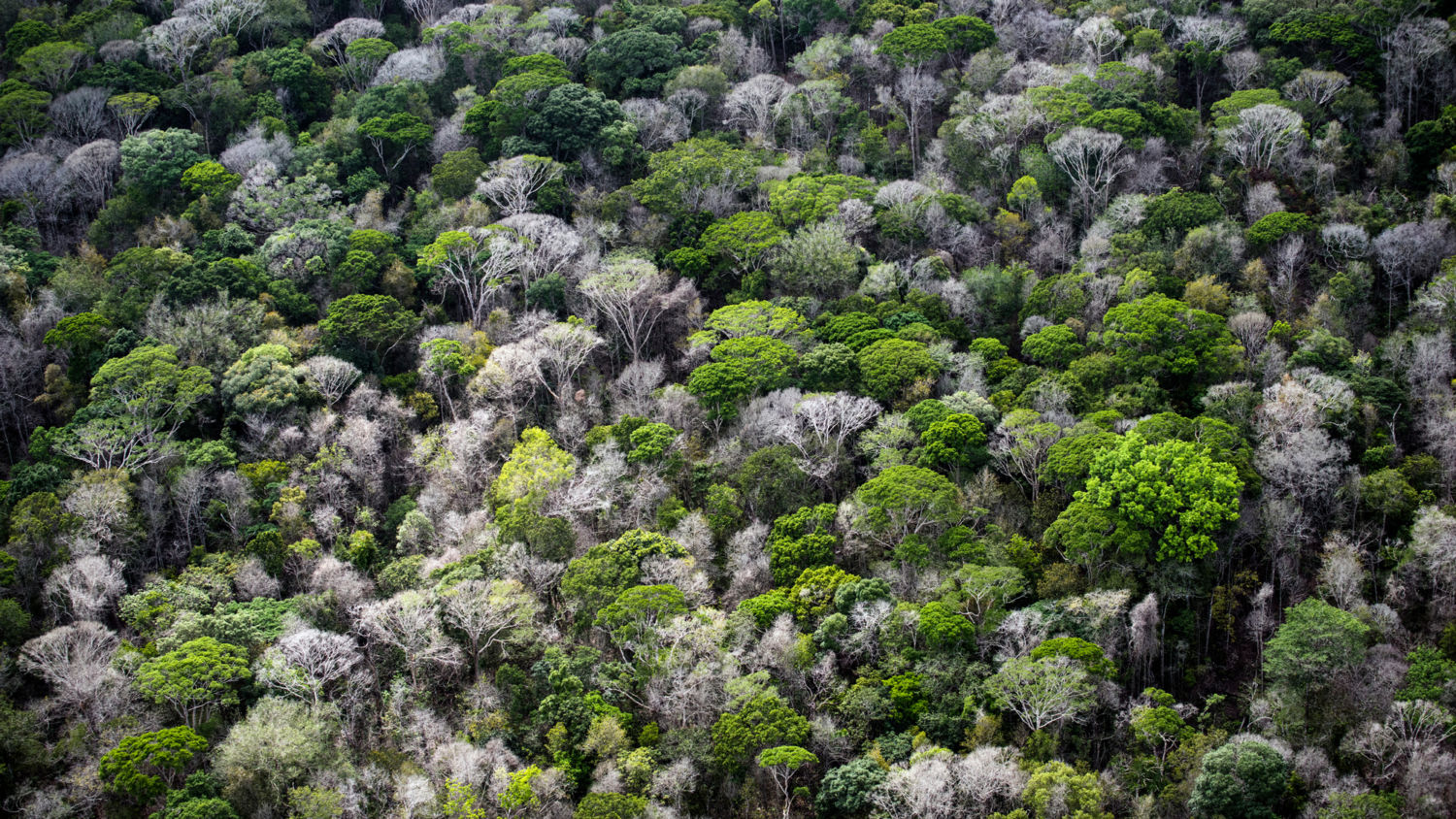
Dead trees are visible in the canopy of the Amazon rainforest, 60 miles southwest of Macapa, Brazil.

Dead trees are visible in the canopy of the Amazon rainforest, 60 miles southwest of Macapa, Brazil. DANIEL BELTRÁ / GREENPEACE

New research indicates that parts of the Amazon and other tropical forests are now emitting more CO2 than they absorb. Some scientists are concerned this development, which is not yet incorporated into climate models, could put the temperature goals set by the Paris Agreement out of reach.

It is not often you meet a scientist breathless with excitement about their new findings. But it happened to me last September at the National Institute for Space Research in the Brazilian research city of Sao Jose dos Campos. Atmospheric chemist Luciana Gatti was rushing to tell her colleagues the result of her latest analysis of carbon dioxide emissions from the Amazon rainforest, which she had completed that morning.

For a decade…

View original post 2,167 more words

Scientists understand cattle not climate villains, but media still missing message

FOR a long time emissions from cattle have been lumped in with emissions from other sources as the same destructive forces for the planet in the global climate change narrative.
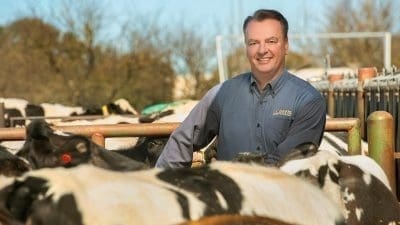
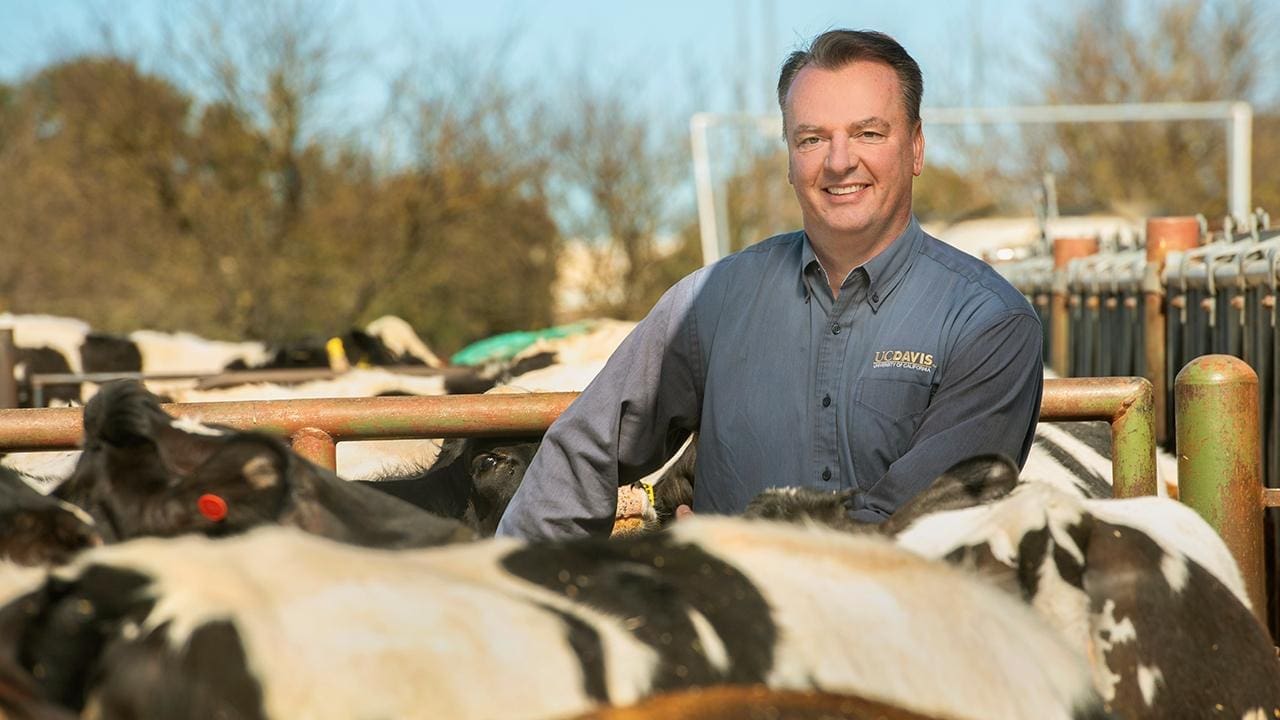
However, through research overseen by scientists including Dr Frank Mitloehner (right) from the University of California Davis and Dr Myles Allen from Oxford University, scientific consensus is starting to build around the point that livestock-related greenhouse gases are distinctively different from greenhouse gases associated with other sectors of society (more on this below).

Dr Mitloehner, an internationally recognised air quality expert, explained to the Alltech One virtual conference on Friday night (Australian time) that the concept of accounting for methane according to its Global Warming Potential, as opposed to just its volume of CO2 equivalent, which showed that not all greenhouse gases are created equal, has now made it all the way to the International Panel on Climate Change.

However, despite increasing awareness and understanding at a scientific level, the message has still not been taken up by the mainstream media.

“What I find interesting is that the one missing entity in this whole discussion so far has been the media,” he told Alltech president and CEO Dr Mark Lyons in a live streamed video interview.

“I have not seen any major reporting on this even though it’s such a hot topic.

“I mean, the world talks about what the impact of our food systems are on our environmental footprint.

“Now, this is a major new narrative. And to me, it’s very unusual and it’s very confusing as to why the same outlets that have touted this topic as being so paramount are not talking about these new findings whatsoever.

“So to me that’s problematic. And we have to think about why that is. Have we not explained it right? Is it too early for them to report about it? I don’t know, but this narrative is not going away.

“You will see it will gain momentum, and it will become the new reality.”

Why all greenhouse gases are not created equal

Dr Mitloehner said to date the global climate change debate has tended to focus only on how much greenhouse gases are emitted by different sources.

Most discussion fails to recognise that certain sectors of society, such as forestry and agriculture, also serve as a sink for greenhouse gases.
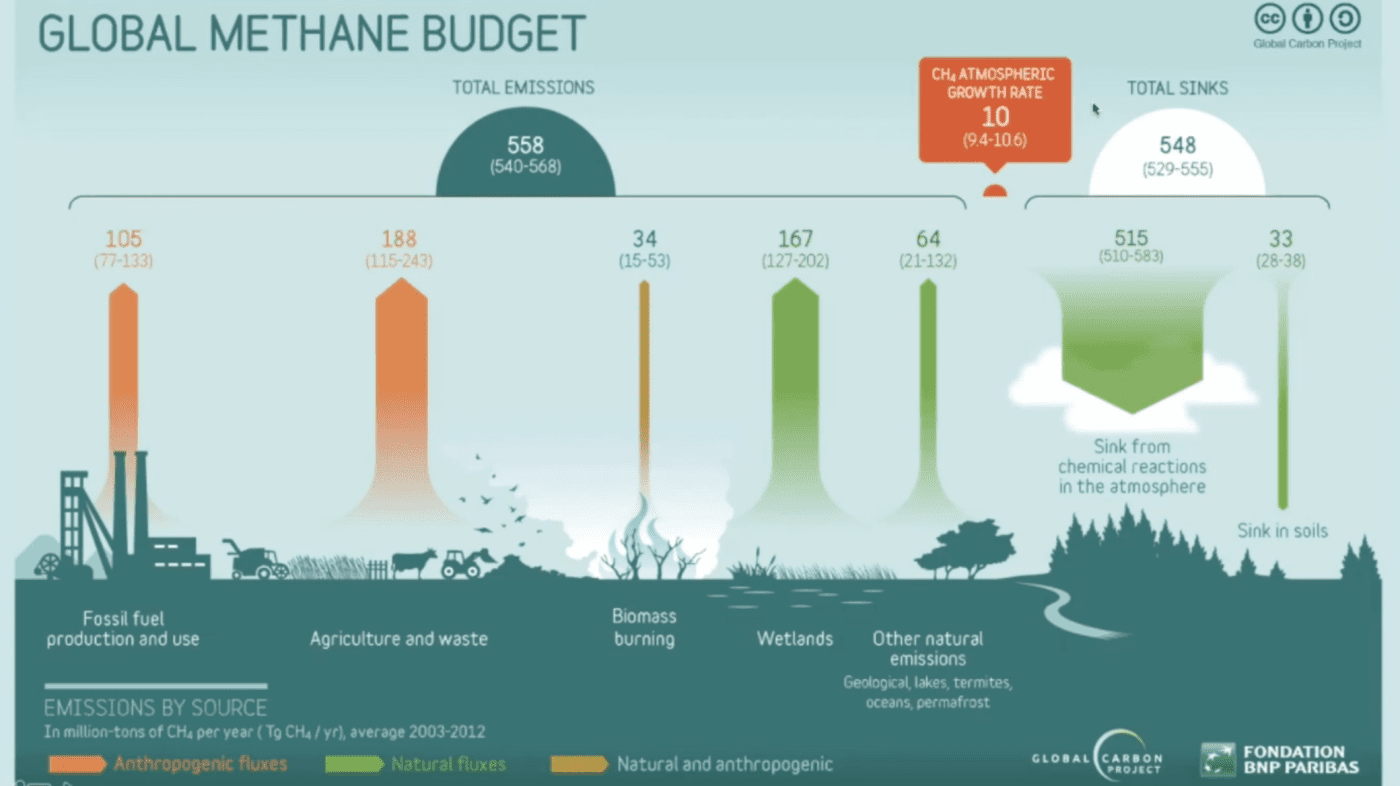
Climate debate focuses on the 560 tera-grams of methane emitted each year but tends to ignore the 550 tera-grams sequested by sinks like agriculture and forestry (right).

After the Kyoto protocol, the climate change debate centred on the 560 tera-grams of methane emitted into the atmosphere each year from all sources, including fossil fuel production and use, agriculture and waste, biomass burning, wetlands and other natural emissions.

“That is where most people stop the discussion, even though they shouldn’t,” he explained.

“Because in addition to emissions putting methane into the atmosphere, we also have sinks on the right side of this graph (above).

“And these sinks amount to a very respectable total number of 550 teragrams.

“So in other words, we have 560 teragrams of methane emitted, meaning put into the atmosphere, but then we have 550 teragrams of methane taken out of the atmosphere.

So in other words, the net emissions per year that we are dealing with is not 560, but it’s actually 10.

“Yet everybody talks about 560.”

In a biogenic carbon cycle, constant livestock herds or decreasing livestock herds over time did not add additional carbon to the atmosphere, he explained.

The carbon emitted by animals is recycled carbon. It came from atmospheric CO2, captured by plants, eaten by animals and then belched back out into the atmosphere, after a while becoming CO2 again.
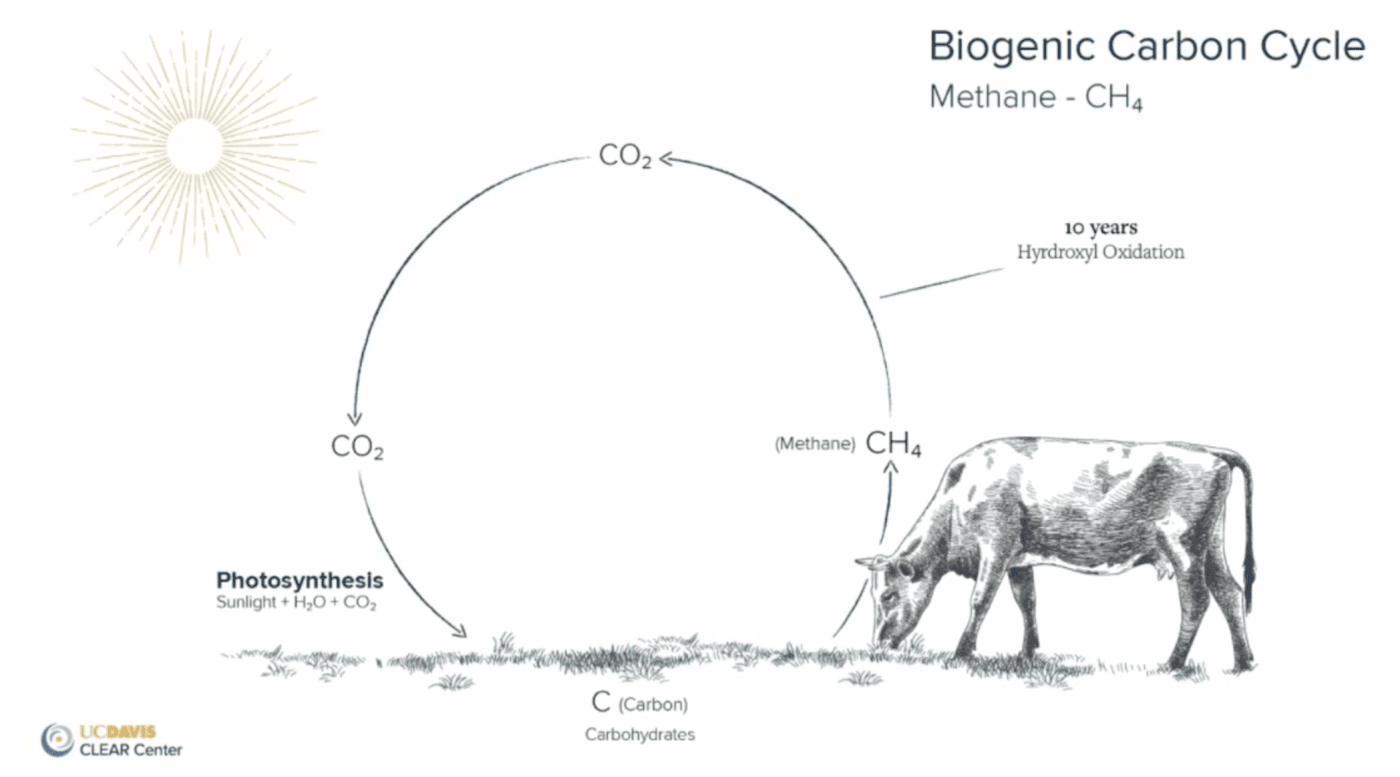
Methane is a heat-trapping, potent greenhouse gas, and he stressed he was not suggesting that “it didn’t matter”.

But the key question for livestock is do ruminant herds add to additional methane, meaning additional carbon in the atmosphere which leads to additional warming?

The answer he said was clearly “no”.

Oxford University authors including Professor Myles Allen have shown that biogenic methane is not the same as fossil methane.

It is the same chemically, but the origin and fate “are totally, drastically different”.
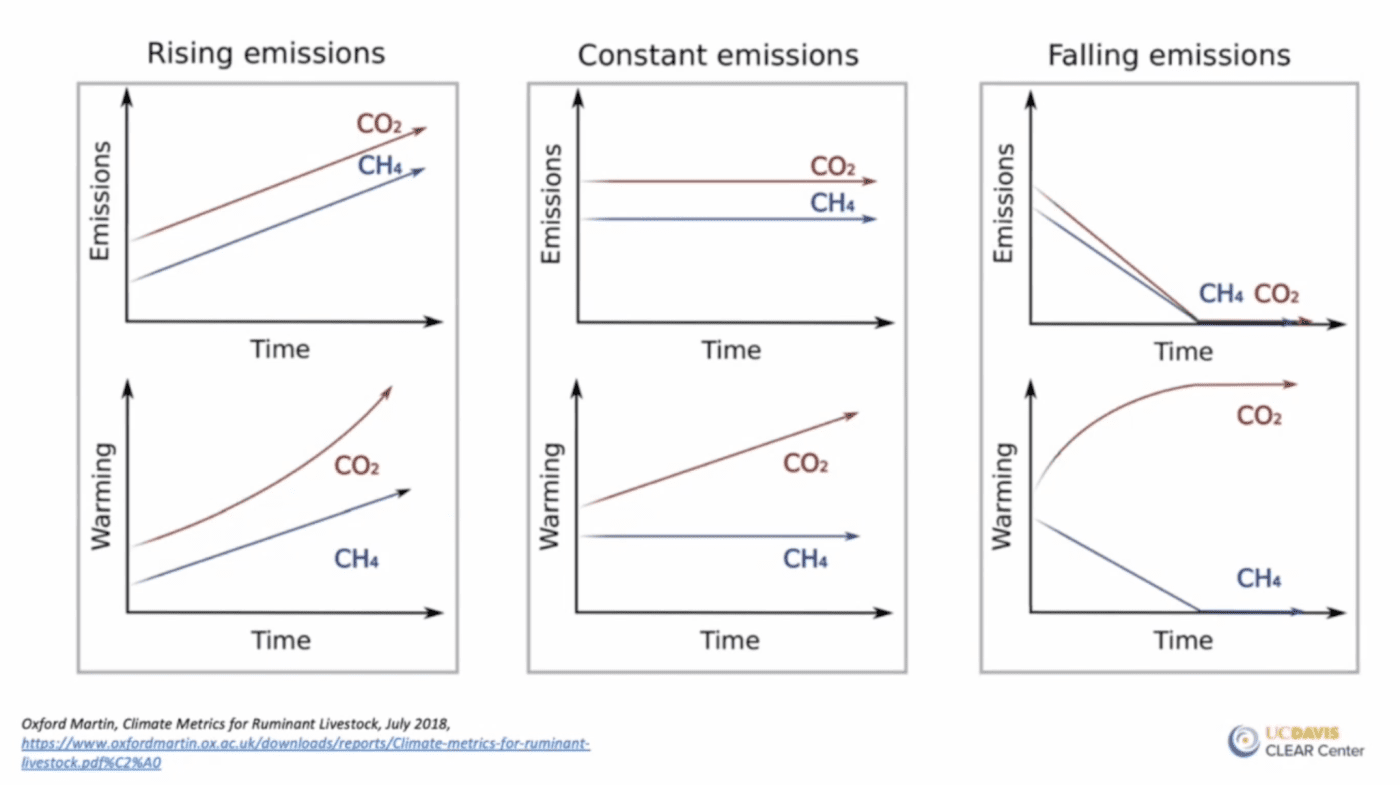
“As long as we have constant herds or even decreasing herds, we are not adding additional methane, and hence not additional warming.

“This is a total change in the narrative around livestock. And I think this will be the narrative in the years to come.”

A chart documenting the size of the US cattle herd since 1867 shows it has decreased to around 90 million beef cattle and 9 million dairy cattle, down from peaks of 140 million beef cattle in the 1950s and 25 million dairy cattle in the 1970s.
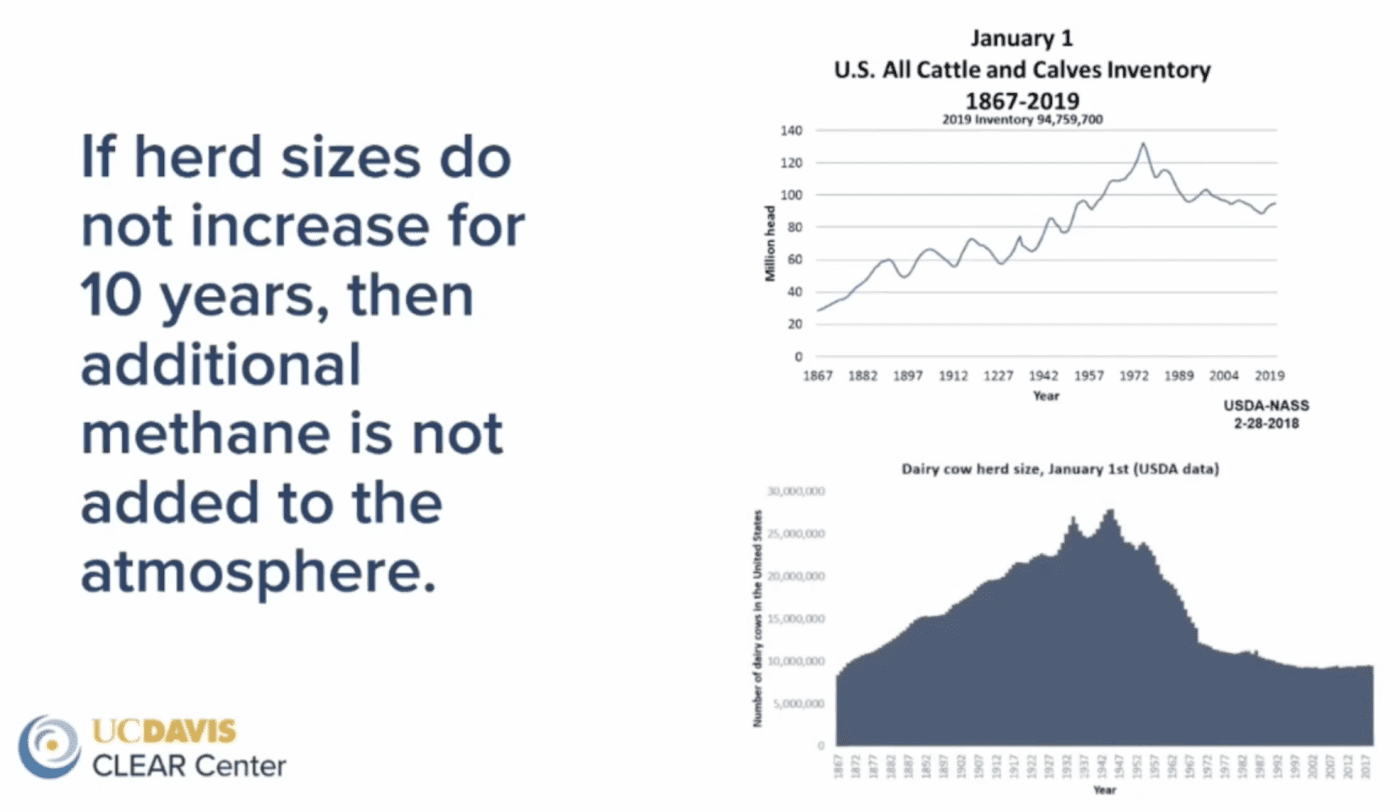
The Australian cattle herd has similarly decreased from a peak of over 33 million cattle in 1976 to around 24 million today.

“We’re clearly see a decreasing number of livestock over the last few decades meaning with respect to livestock numbers, we have not cost an increasing amount of carbon in the atmosphere, but indeed we have decreased the amount of carbon we put into the atmosphere,” he said.

By contrast emissions from fossil fuel extractions were not part of a cycle, but “a one-way street”, because the amount of CO2 sent into the atmosphere in this process by far overpowered the potential sinks that could take up CO2, such as oceans, soils or plants.
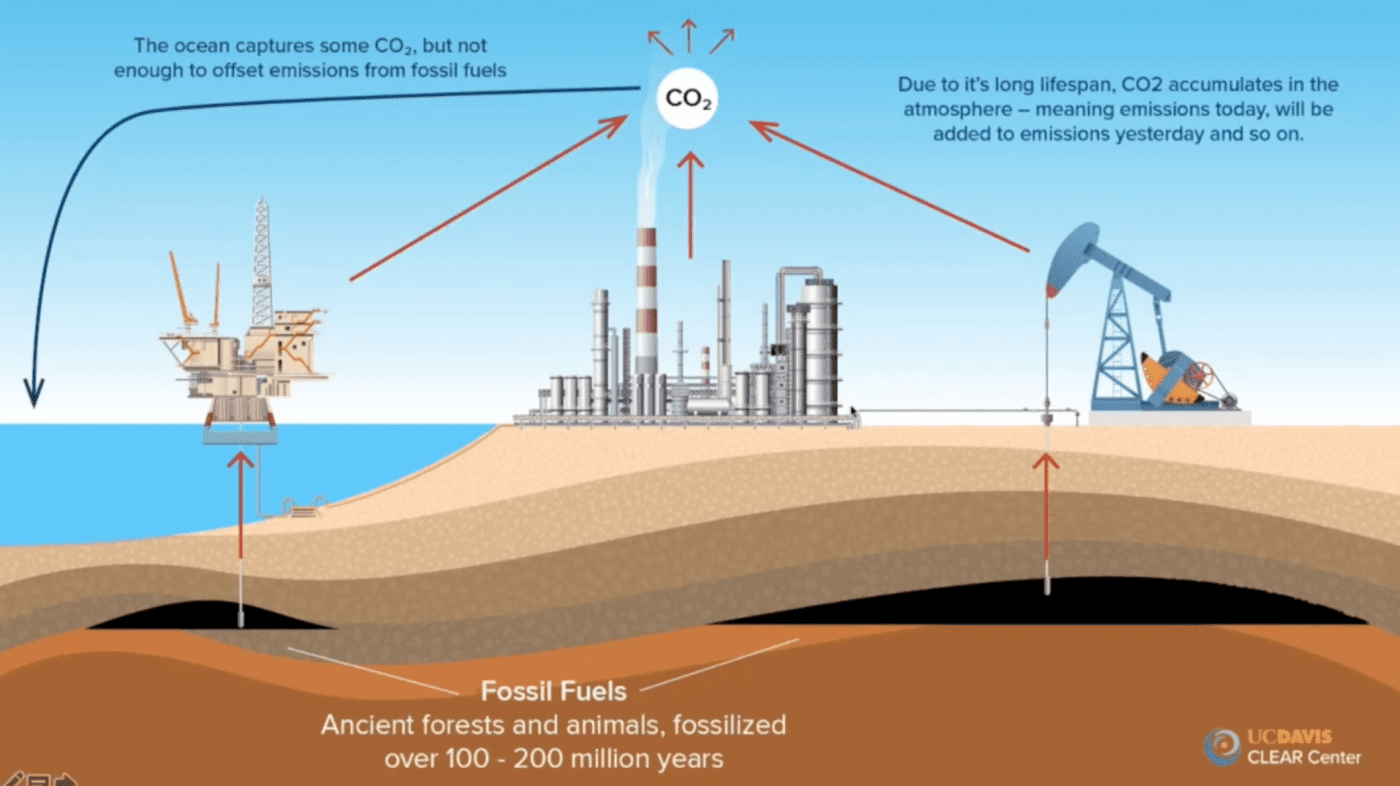
“So here we have a one-way street. And this, ladies and gentlemen, is the main culprit of greenhouse gases in our atmosphere and the resulting warming.

“I have yet to see a climate scientist who would say that it’s the cows that are a primary culprit of warming. Most of them will agree that the primary culprit is the use of fossil fuels.”

“However, people critical of animal agriculture always point at cows, and cattle, and other livestock species. And they feel that this is a very powerful tool to ostracize animal agriculture as we know it.”

Not only were cattle not the primary culprit of global warming, they were also potentially part of the solution, as an explanation of stock gases versus flow gases demonstrated.
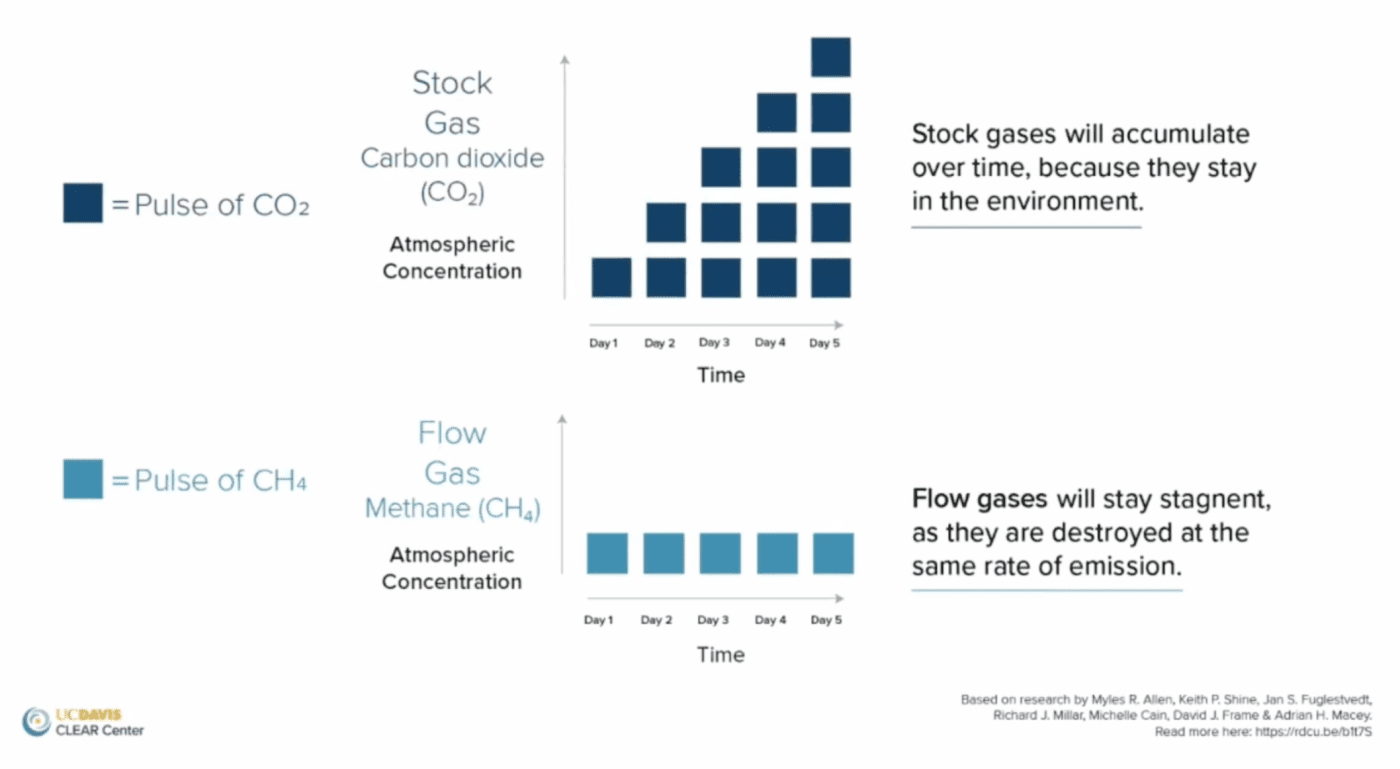
Long-lived climate pollutants such as Co2 were referred to as ‘stock’ gases because they last in the atmosphere for 1000 years. “Every time you put it into the atmosphere, you add to the existing stock of that gas,” he explained.

Methane (CH4) was a ‘flow’. Provided it was coming from a constant source, what was being put into the atmosphere was also being taken out.

“The only time that you really add new additional methane to the atmosphere with the livestock herd is throughout the first 10 years of its existence or if you increase your herd sizes.

“Only then do you actually add new additional methane and thus new additional warming.

“So please remember there are big differences between long-lived stock gases such as CO2 or nitrous oxide versus short-lived flow gases such as methane.”

He invited the audience to imagine a scenario where methane emissions from cattle were decreased by 35 percent.

If this could be achieved, it would have the effect of taking carbon out of the atmosphere and create a net cooling effect.

“If we find ways to reduce methane, then we counteract other sectors of societies that do contribute – and significantly so – to global warming, such as flying, driving, running air conditioners, and so on.

“So if we were to reduce methane, we could induce global cooling. And I think that our livestock sector has the potential to do it. And we are already seeing examples where that happens.”

He offered several examples of how the agricultural sector has already had success in reducing methane.

A few years ago the California legislature wrote a law called SB 1383 mandating a 40 percent reduction of methane to be achieved by the year 2030.

California’s farms and ranches have reduced greenhouse gases by 25pc since the laws were enacted.

This was achieved by using “a carrot rather than cane approach”, by rewarding farmers and ranchers who wanted to reduce emissions by giving them financial incentives to invest in anaerobic digesters or alternative manure management practices.

“I know if we can do it here, it can be done in other parts of the country and in other parts of the world.

“And if we indeed achieve such reductions of greenhouse gas, particularly of short-lived greenhouse gases such as methane, then that means that our livestock sector will be on a path for climate neutrality– on a path to climate neutrality. And that, to me, is a lifetime objective.”

Agriculture needs to work harder to tell its story

Dr Mitloehner said it was important the industry work harder to ensure the public understands the science around cattle production and greenhouse gas emissions.

“I feel that it is actually critical to get what we find in our research environment translated and communicated with the public sector.

“Because only if what we find makes its way to the light of the day, only then it matters”

It was also important that the public discussion used accurate and not misleading numbers around livestock emissions.

It is often stated that livestock emissions represent 14 percent to even as high as 50 percent of total emissions, but Dr Mitloehner said this did not reflect actual livestock emissions in developed countries such as the US were the number was closer to just 3 percent of all US emissions.

HAVE YOUR SAY

Your email address will not be published. Required fields are marked *

Name *

Comment

Your comment will not appear until it has been moderated.
Contributions that contravene our Comments Policy will not be published.

Scientists understand cattle not climate villains, but media still missing message

COMMENTS

WHY DESTROYING THE PLANET IS BAD FOR OUR HEALTH AND WHAT WE CAN DO ABOUT IT

Why destroying the planet is bad for our health and what we can do about it
TEXT SIZEAaAa

Since the pandemic began, pollution levels have droppedanimals are returning to areas they had previously abandoned and more people have taken to travelling on foot and by bicycle. Although short-lived, we have already seen some of the effects changing our behaviour can have on our own lives and on the natural world.

For many, these unexpected positives have brought a new understanding about the relationship between the environment and our health.

So could human health and planetary health be more closely linked than we think? We’ve seen how problems like deforestation and rising temperatures have increased the risk of extinction for all kinds of species. But, as part of the global ecosystem, humans aren’t immune from the effects of climate change either.

Extreme climates pose a threat to us by affecting things like water supplies, air quality and food production. In 2018 the World Health Organisation estimated that global warming would cause an additional 250,000 deaths between 2030 and 2050.

GETTY via Canva
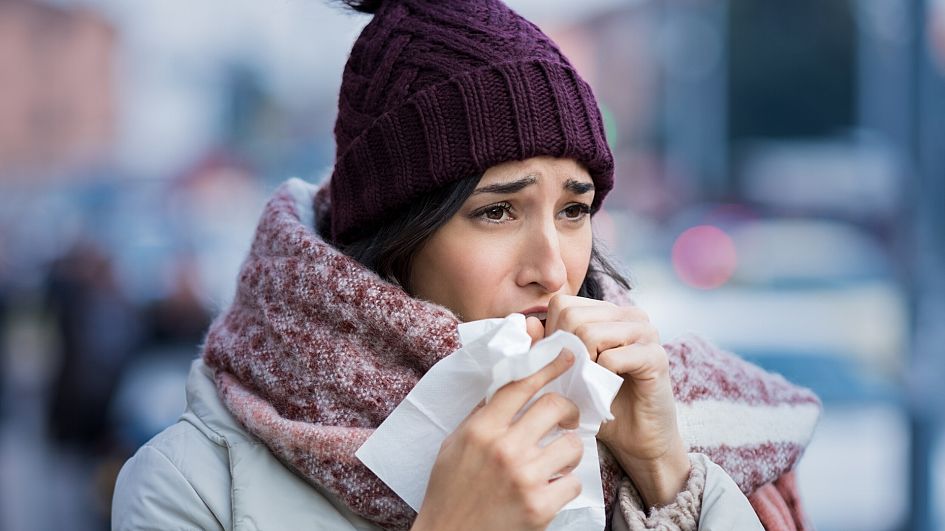
Our health and the health of the environment are linked.GETTY via Canva

BUT JUST HOW IS THE DESTRUCTION OF THE ENVIRONMENT MAKING US SICK?

Unclean air

Nine out of ten people in the world breathe polluted air with an estimated 7 million dying every year from conditions associated with exposure to microscopic particulates. As a result of burning unclean fuels like coal, diesel, kerosene, and even biofuel and trash, these very small pollutants find their way into our lungs. Alongside methane emissions from industrial agriculture and oil and gas production, human actions are making the air we breathe unclean. Air pollution can lead to a variety of health problems like lung cancer, strokes and heart disease.

Air pollution can lead to a variety of health problems like lung cancer, strokes and heart disease.

More than 90 per cent of deaths related to air pollution occur in low and middle income countries – but high income countries are not immune. A study in 2019 found that air pollution causes an extra 800,000 deaths a year in Europe. “To put this into perspective, this means that air pollution causes more extra deaths a year than tobacco smoking, which the World Health Organization estimates was responsible for an extra 7.2 million deaths in 2015,” co-author of the study, Professor Thomas Münzel told EurekAlert!.

Diseases passed between animals and humans

More than 70 per cent of emerging diseases affecting people originated in wildlife and domestic animals. The UN Environment Programme lists an increased amount of close contact between animals and humans as the most significant risk for zoonotic diseases.

By changing the nature of vital habitats through human actions like agriculture and industry, the ‘buffer zones’ which separate us from wildlife have been seriously reduced. A statement by experts from the Intergovernmental Science-Policy Platform on Biodiversity and Ecosystem Services (IPBES) explains that a system which prizes economic growth over the protection of natural resources has created a “perfect storm” for diseases to spread from wildlife to humans.

That means taking care of the environment through stronger and more stringently enforced regulations will be essential post-pandemic, say the experts.

Limited access to nutritious food

Good health is reliant on a balanced diet that supports your immune system. The WHO says that because of its influence on food production, biodiversity is directly linked to nutrition.

A wider variety of species helps soil to remain productive for longer and provides a resource for discovering new plants, livestock and marine species that can be harvested for food.

But food security isn’t just about not having enough. Where 800 million people are facing the risk of food shortages, 2.1 billion are obese or overweight. Most of our energy needs are being met by just three crops; rice, wheat and maize. Much of this ends up as highly processed items like bread or is turned into ingredients including sweeteners in confectionery. Unfortunately, our highly industrialised, intensive food production system makes nutritionally poor food cheap and easily available.

Destroying natural sources of medicine

Changes in habitat due to agriculture, climate change and overharvesting are eating away at environments rich in biodiversity. This is a problem because these areas are often where the next big medical breakthroughs are found, deriving from natural sources. In the US nearly 80 per cent of leading prescription drugs are based on natural sources and many of these are particularly important in the treatment of cancer.

With natural resources in rapid decline, we could be losing important medicinal species before we even discover them.

Millions of people worldwide also rely on traditional and non-formal sources of medicine collected from the natural environment for their healthcare. In some countries, these medicinal plants are an essential part of healthcare systems. Loss of species vital for these traditional remedies would reduce the treatment options available to billions.

A shortage of clean water

To keep ourselves clean and well hydrated, the average person uses up to 50 litres of water a day. If we continue using and polluting it at the current rate, more than two-thirds of the world’s population could be living in areas with water stress by 2025, says the UN. Already, 1.8 billion people are at risk of contracting diseases linked to unclean drinking water.

“Currently there are 844 million people – one in nine of the world’s population – who do not have clean water close to home,” says Jonathan Farr, Water Aid’s Senior Policy Analyst, in response to the release of the United Nations World Water Development report. “Others face an unreliable supply of water because agriculture, industry or wealthier sections of society are able to take more than their fair share of water.”

The World Health Organisation has encouraged regular hand washing throughout the pandemic as a way of controlling the spread of the virus but, without access to basic handwashing facilities, millions of people are unable to follow this advice. In a survey of 42 countries, less than half the population had access to basic soap and water in their homes.

The covid-19 crisis has brought the global water crisis to the fore, highlighting the urgency of making sure that everyone has access to clean supply.

Unsplash
Hand washing has proved a vital part of preventing the spread of coronavirus.Unsplash

You can find some more of the ways environmentally damaging behaviour is putting global health at risk on the UNEP website.

BUT IT’S NOT ALL BAD NEWS, EXPERTS PREDICT A GREEN RECOVERY

Although irresponsible behaviour may be increasing our chances of getting sick, our recovery on the other side of the pandemic could provide an opportunity for systemic change.

Only by restoring a healthy balance between people and nature can we prevent future outbreaks and their impact on society

 Patrick ten Brink
EU policy director for the European Environmental Bureau

The idea of a ‘green recovery’’ already has the support of a significant number of Europeans. 1.2 million people have joined an appeal for the EU to launch “the biggest green investment plan the world has ever seen”. The Green10 coalition, made up of the ten largest environmental organisations in Europe, has called for billions in investment for solutions like widespread use of renewable energy, restoration of natural habitats and the greening of agricultural practices. All of which will help to tackle the effects of climate change impacting global health.

“The new budget must reflect the need to save resources, cut pollution and fight climate breakdown,” says Patrick ten Brink, EU policy director for the European Environmental Bureau. “Only by restoring a healthy balance between people and nature can we prevent future outbreaks and their impact on society.”

Tempers Rise as Wolves Move Closer to Southwest Washington

Exposing the Big Game's avatarCommittee to Abolish Sport Hunting Blog

Wolf Population Increases
A motion-triggered camera captures members of the Profanity Peak Pack in northeastern Washington in June 2017.

Since their reintroduction, gray wolves have continued to spread over the Washington landscape, and a fierce debate has followed them.

Some ranchers and hunters vilify the predators, while many conservationists say they are a part of the natural landscape that needs to be protected.

The issue is so contentious that the Washington Department of Fish and Wildlife recently cancelled open-house style meetings with the public to discuss future management of the species. Activists on all sides of the issue were planning to use disruptive tactics at the meetings. The WDFW will now hold interactive online webinars instead.

Wolves will eventually move into Southwest Washington. WDFW wolf specialist Benjamin Maletzke reports there are areas in…

View original post 786 more words