People just covered themselves in fake blood in the middle of a downtown Toronto street

Save Posthttps://www.facebook.com/v2.5/plugins/share_button.php?app_id=100616073343311&channel=https%3A%2F%2Fstaticxx.facebook.com%2Fx%2Fconnect%2Fxd_arbiter%2F%3Fversion%3D46%23cb%3Df3b34ef0be3b33c%26domain%3Dwww.blogto.com%26origin%3Dhttps%253A%252F%252Fwww.blogto.com%252Ff1aff1556bd9478%26relation%3Dparent.parent&container_width=94&href=http%3A%2F%2Fwww.blogto.com%2Fcity%2F2020%2F07%2Ffake-blood-toronto-street%2F&layout=button_count&locale=en_US&sdk=joeyhttps://platform.twitter.com/widgets/tweet_button.c4b33f07650267db9f8a72eaac551cac.en.html#dnt=false&id=twitter-widget-5&lang=en&original_referer=https%3A%2F%2Fwww.blogto.com%2Fcity%2F2020%2F07%2Ffake-blood-toronto-street%2F&size=m&text=People%20just%20covered%20themselves%20in%20fake%20blood%20in%20the%20middle%20of%20a%20downtown%20Toronto%20street&time=1595093742184&type=share&url=http%3A%2F%2Fwww.blogto.com%2Fcity%2F2020%2F07%2Ffake-blood-toronto-street%2F

https://www.blogto.com/city/2020/07/fake-blood-toronto-street/

Stay in the loop

Sign up for our free email newsletter. Unsubscribe anytime or contact us for details.ShareTweetSave this Article

Hundreds of animal rights advocates marched through the streets of Toronto this afternoon to demand justice for Regan Russell, the activist who was killed by a pig transport truck while protesting at Fearman’s slaughterhouse in Burlington. 

Russell was dragged by the truck for more than 15 metres during the incident, and charges against the driver have not yet been pressed as Halton Police are still investigating. 

On Friday, protestors took to the streets to demand that Russell’s memory be honoured and that justice be served. https://platform.twitter.com/embed/index.html?dnt=false&embedId=twitter-widget-0&frame=false&hideCard=false&hideThread=false&id=1284158186807689216&lang=en&origin=https%3A%2F%2Fwww.blogto.com%2Fcity%2F2020%2F07%2Ffake-blood-toronto-street%2F&siteScreenName=blogTO&theme=light&widgetsVersion=9066bb2%3A1593540614199&width=550px

Activists marched from CBC Headquarters to Queen’s Park, where speakers including Russell’s husband, Toronto Pig Save’s lawyer, activists and friends of Russell passionately addressed the crowd. https://platform.twitter.com/embed/index.html?dnt=false&embedId=twitter-widget-1&frame=false&hideCard=false&hideThread=false&id=1284196253342085121&lang=en&origin=https%3A%2F%2Fwww.blogto.com%2Fcity%2F2020%2F07%2Ffake-blood-toronto-street%2F&siteScreenName=blogTO&theme=light&widgetsVersion=9066bb2%3A1593540614199&width=550px

At one point, while walking down Queen Street West, activists laid down in the middle of sidewalk and street and covered themselves in fake blood in order to make a statement about Russell’s tragic death. https://platform.twitter.com/embed/index.html?dnt=false&embedId=twitter-widget-2&frame=false&hideCard=false&hideThread=false&id=1284217385109651456&lang=en&origin=https%3A%2F%2Fwww.blogto.com%2Fcity%2F2020%2F07%2Ffake-blood-toronto-street%2F&siteScreenName=blogTO&theme=light&widgetsVersion=9066bb2%3A1593540614199&width=550px

The entire protest was livestreamed from the Animal Save Movement’s Facebook page, and it shows masked protestors holding signs saying things like “We are Regan Russell,” and “Go vegan 4 Regan.”https://platform.twitter.com/embed/index.html?dnt=false&embedId=twitter-widget-3&frame=false&hideCard=false&hideThread=false&id=1284189643794251777&lang=en&origin=https%3A%2F%2Fwww.blogto.com%2Fcity%2F2020%2F07%2Ffake-blood-toronto-street%2F&siteScreenName=blogTO&theme=light&widgetsVersion=9066bb2%3A1593540614199&width=550px

In addition to honouring Russell, activists also demanded that Bill 156 be repealed and replaced.

The new legislation was passed by the Ontario government earlier this year and makes it much easier for farms to hide the conditions in which animals are kept from the public.https://platform.twitter.com/embed/index.html?dnt=false&embedId=twitter-widget-4&frame=false&hideCard=false&hideThread=false&id=1284220436495110144&lang=en&origin=https%3A%2F%2Fwww.blogto.com%2Fcity%2F2020%2F07%2Ffake-blood-toronto-street%2F&siteScreenName=blogTO&theme=light&widgetsVersion=9066bb2%3A1593540614199&width=550px

“The Bill is intended to protect farm animals, the food supply, farmers and others from risks that are created when trespassers enter places where farm animals are kept or when persons engage in unauthorized interactions with farm animals,” reads theexplanatory note at the beginning of the bill.

The law states that activists, media and any other trespassers could receive fines of up to $25,000 for entering a farm property for a number of reasons, including to document the animals’ living conditions or to simply interact with them.

“Activists are demanding that Bill 156, the ag-gag law passed by the Ontario legislature just two days before Regan was run over, be converted into Regan’s law, which protects farmed animals from abuse as well as the whistleblowers who expose the suffering of animals,” reads a statement from protestors. 

“Doug Ford and the members of the Ontario legislature need to know what Regan Russell stood for and how Bill 156 has failed her!!!”Lead photo by 

Toronto Pig Save

We must confront the short and long-term threats of methane emissions. This is how | Opinion

Exposing the Big Game's avatarThe Extinction Chronicles

A Marcellus shale gas-drilling site along PA Route 87, Lycoming County. Nicholas A. Tonelli | Flickr Commons

By Jeffery W. Perkins

As communities across Pennsylvania try to recover from the devastation wrought by COVID-19, state and corporate leaders have a rare opportunity to address another threat to public health, our climate and an entire industry’s future: dangerous levels of methane emissions from the oil and gas sector.

Natural gas is primarily made up of methane, which oil and gas companies then sell. But during the production process, methane and other smog-forming pollutants escape, threatening our air quality, health, and the climate.

As Pennsylvanians face the pandemic, our primary concern is safeguarding peoples’ health, particularly the most vulnerable among us, like seniors and those with underlying chronic and respiratory conditions.

The air pollution caused by methane emissions makes it much more difficult to protect…

View original post 420 more words

Cecil the lion’s killer is back — slaughtering endangered rams in Mongolia

Exposing the Big Game's avatarCommittee to Abolish Sport Hunting Blog

Enlarge Image

The “driller killer” from Minnesota who killed the beloved Cecil the lion bagged an endangered ram in Mongolia last year.

Dentist Walter Palmer, 60, forked over almost $100,000 for the pleasure of killing an endangered Altai argali — the world’s biggest ram — in Mongolia last August. The enormous sheep are considered a national treasure and, with only 19,000 left in the world, are on the endangered species list.

Coincidentally, Donald Trump Jr. caused…

View original post 542 more words

Clear strategies needed to reduce bushmeat hunting

Exposing the Big Game's avatarCommittee to Abolish Sport Hunting Blog

NEWS RELEASE 

Disease prevention and protection of species require differentiated strategies

MAX PLANCK INSTITUTE FOR EVOLUTIONARY ANTHROPOLOGY

IMAGE: RESEARCHERS STUDIED A WILDLIFE TRADING NETWORK IN CÔTE D’IVOIRE, WEST AFRICA, AND COMPILED ONE OF THE MOST COMPREHENSIVE DATA SETS TO DATE. view more 

CREDIT: WILD CHIMPANZEE FOUNDATION

Covid-19 and the associated global economic, health and societal distortions have shed light on the alarming threat of infectious diseases emerging at an increasing rate. Around 60 percent of emergent infectious diseases are zoonotic, originating in animals; among the most prominent are Sars, Mers, Ebola, HIV and Covid-19. More than two-thirds of those originate in wild species. Many voices have called for higher restrictions or even a blanket ban on the wildlife trade. This demand is also fuelled by the devastating effects of unsustainable hunting that threatens hundreds of species.

However, millions of people, especially in the Global South, depend on wild meat…

View original post 878 more words

Victory! Court says San Francisco fur ban will stay

Exposing the Big Game's avatarCommittee to Abolish Sport Hunting Blog

Calendar Icon July 17, 2020

A federal court judge last night threw out a challenge to San Francisco’s ban on the sale of fur, in a historic victory against this unnecessary and immensely cruel commodity.

The city’s ban, which passed in 2018, took effect earlier this year and it led the way for many wins against fur, including a similar, statewide ban in California. But soon after it ​took effect this January, the ​law was challenged by the fur industry, which claimed it was unconstitutional merely because San Francisco’s decision to ban fur sales in the city hurt its bottom line.

In April, the Humane Society of the United States intervened in the case to…

View original post 663 more words

California Foie Gras Ban Upheld By U.S. District Court

16 July 2020

Man force feeding a goose in an indoor pen with other geese watching

Despite some misleading news coverage this week, the claim that foie gras is back on California restaurant menus is FALSE, says California attorney Bryan Pease, in concurrence with The Humane Society of the United States, who reports that the U.S. District Court “ruled that the state’s foie gras sales ban is entirely constitutional, reaffirming California’s authority to keep cruel products out of its marketplace.” See Court rules California’s foie gras ban is constitutional.

Pease explains that the July 14, 2020 ruling by the U.S. District Court in Los Angeles was “a final rejection” of the foie gras industry’s continued attempts to circumvent the Ninth Circuit and U.S. Supreme Court rulings upholding CA’s humane law against the sale of foie gras.

Foie gras is a diseased-liver “delicacy” obtained from slaughtered ducks and geese whose fat-sickened livers are produced by cranking slop in metal pipes down their throats.

California’s ban on the production and sale of foie gras went into effect July 1, 2012, having been signed into law by CA’s governor in 2004.

Foie gras can be legally shipped by out-of-state-producers for consumption at home in California, but restaurant sales are prohibited.

Attorney Bryan Pease clarifies that it “has never been illegal to purchase foie gras out of state and bring it in. The ban is simply against the sale of foie gras from force-fed ducks [and geese] within the state, such as restaurants or stores. It was never a possession ban or an import ban.”

The July 14th ruling, he says, “DENIES Hudson Valley Foie Gras’ motion to reconsider, and specifically notes that as to foie gras purchased outside of CA, ‘once the foie gras reaches California, it cannot be resold within the state.’”

https://upc-online.org/ducks/200716_california_foie_gras_ban_upheld_by_us_district_court.html

For more information, see:

Animal Welfare Campaigners and UK Politicians Clash Over Live Exports

SHARE:FacebookTwitterLinkedInPinterestEmailWhatsApp

Prime Minister Boris Johnson promised to ban live animal exports as soon as Britain officially left the EU. But an upcoming court case is spreading doubt about whether or not he will follow through.Reading Time: 4 minutes

transport truck cattle
Jo-Anne McArthur/We Animals

UK animal welfare campaigners who saw a vote for Brexit as an opportunity to end live farmed animal exports are perplexed by recent government efforts to defend the trade. 

Told for years that European Union laws prevented a British ban on live exports, campaigners reasoned a pro-Brexit vote to leave the EU was the solution. That belief was backed by promises from Prime Minister, Boris Johnson. In June, Johnson reiterated his promise to ban live exports as soon as Britain officially leaves the EU on December 31st this year.

But an upcoming court case is spreading doubt about those promises. The case, taken by British welfare group Compassion in World Farming (CIWF), seeks to end the export of unweaned calves from Scotland. A win, said CIWF lawyer Peter Stevenson, could have repercussions throughout the EU.

The problem for campaigners is that both the British and Scottish governments have taken recent steps to oppose CIWF’s case—due to be heard again in October—effectively protecting live exports.

On the British side, Stevenson said, opposition to CIWF’s case comes in an official document, submitted to the Scottish court by the Department for Environment, Food and Rural Affairs (DEFRA). In Scotland, the government has appointed a barrister to fight the case.

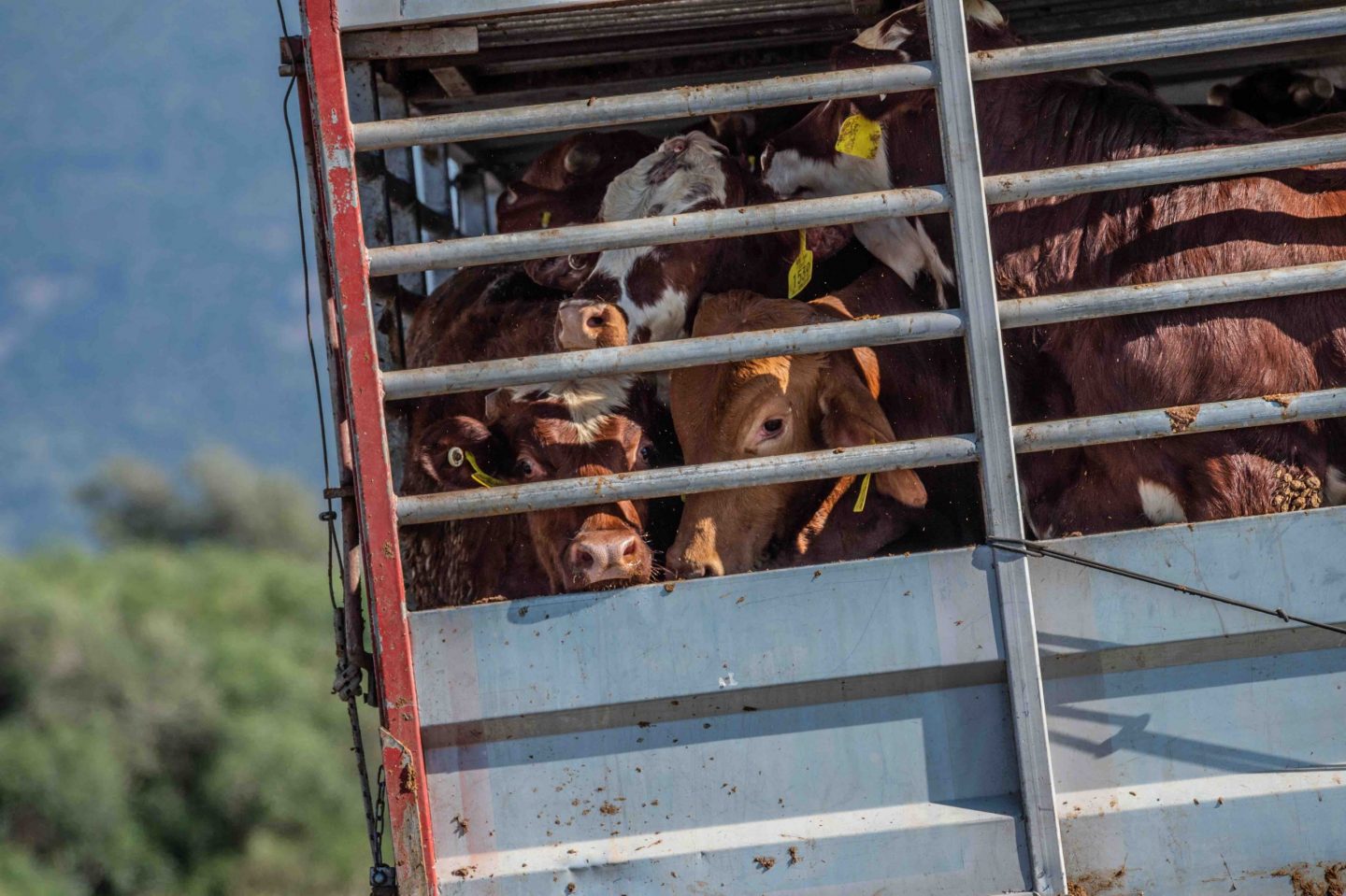
Campaigners abhor live export for many reasons but top of the list is the experience of farmed animals in transport. Calves and sheep exported from the British port of Ramsgate spend many hours in ‘roll on, roll off’ trucks taking them from collection points to the port, onto ferries, and then to different parts of Europe.

For calves, the misery is compounded by a lack of liquid milk replacer. Other concerns include the rate at which the trucks fill with feces and urine, poor access to water, extreme heat in summer, cold in winter, cramped conditions, and the risk of injury or trampling. 

Last year, official figures obtained by welfare organization, Eyes on Animals, show almost 3,500 unweaned (or milk-reliant) calves left from Ramsgate, a small port town in southeast Britain, along with 17,000 sheep. 

Asked about the apparent contradiction of promising an end to live export, while fighting CIWF in court, DEFRA refused to comment on an ongoing legal case. In an email, however, a DEFRA spokesperson said the British government “has committed to improving the welfare of animals during transport and ending excessively long journeys for slaughter and fattening.”

A Scottish government spokesperson replied in a similar vein, saying it “would not be appropriate to comment while legal proceedings are ongoing.” The email added that “our preferred policy intention is not to support unnecessary long journeys involved in the export of livestock.”

Lorraine Platt, co-founder of the Conservative Animal Welfare Foundation (CAWF) said she found the Scottish government’s opposition to the CIWF case “deeply disappointing.” 

CAWF patrons include high-profile politicians and peers, among them Lord Zac Goldsmith, recently appointed as Minister of State at DEFRA; Theresa Villiers, Minister of Parliament (MP); Sir Roger Gale MP; Sir David Amess MP and Carrie Symonds, Boris Johnson’s partner. “And they are very vocal,” in support of a live export ban, said Platt.  

Asked if she remained optimistic about ending live exports, despite the opposition to CIWF’s case, Platt said yes. “We never give up hope. There is great political will to end this. Boris Johnson wants to end it. And his partner Carrie Symonds and his father Stanley Johnson.”

She added that CAWF is equally hopeful that Brexit will lead to further animal welfare initiatives, notably bans on imports of fur and foie gras. 

Other protesters variously described government opposition to CIWF’s case as frustrating, strange, illogical, or hypocritical. One, who asked to remain anonymous due to fears of retaliation by farmers or live export companies, wondered whether politicians had gone soft. “I understood that with the Brexit vote, the ban on live exports might not be immediate. But now they are defending [the CIWF case] in court. We think they are trying to wriggle out of it, or they lied,” the protester said.

The protester is one of many regulars at the Ramsgate demonstrations, which can draw crowds of up to 100 people. The demonstrations are organized by KAALE – Kent Action Against Live Exports. KAALE’s secretary is Yvonne Birchall. She too voted Brexit in the hopes of ending live exports.   

Speaking the morning after a July 9th Ramsgate protest, Birchall said that despite government opposition to the CIWF court case, she believes a ban will happen. “Boris won our votes on the promise of banning live export. If he breaks that he won’t get re-elected by us,” she said.

There are other reasons for optimism, added Birchall. One of those is an amendment to the Agriculture Bill that could ban live exports for slaughter and fattening tabled by Baroness Fookes, Conservative Party member and Life Peer in the House of Lords. “We think there will be cross-party support for that.” 

Birchall said the previous night’s protest had been tough. “[The police commander] was very aggressive. The lorries [carrying animals to the port] came round the roundabout [where the protesters stand] at high speed – too quick for the conditions and the number of people. Our video team started to film, as we always do, and then the police were trying to stop us. That does not normally happen. I was shocked.” 

Birchall added more details in a Facebook post and told Sentient Media she had a “sneaking suspicion” the police were trying to prevent filming “because we have been finding so many things wrong.” 

Responding to Birchall’s criticisms, Kent chief inspector Alan Rogers said while police understand the “depth of feeling” protesters might have, they are “impartial and officers have a duty of care to keep everyone safe.” Rogers added that officers are specially trained “to respond proportionately to peaceful protest, prevent crime and disorder, and allow businesses to go about their lawful trade.”

The lawfulness of trade is, however, exactly the issue protesters want to see examined in court, using the evidence—provided to CIWF for their case—collected over many years by what Birchall calls KAALE’s “machine of people” that bear witness at the port.

REPORT: FACTORY FARMING IS THE “SINGLE MOST RISKY BEHAVIOR” FOR FUTURE PANDEMICS

https://vegnews.com/2020/7/report-factory-farming-is-the-single-most-risky-behavior-for-future-pandemics

VegNews.CowsFactoryFarmDairy


“The recipe for disaster is surprisingly simple: one animal, one mutation, one human, and a single point of contact,” Michael Webermann, US Executive Director of ProVeg International, said about the pandemic risk posed by intensive animal farming. 

by ANNA STAROSTINETSKAYA

JULY 16, 2020


305 Shares

Anew report published today by global food awareness organization ProVeg International singled out intensive animal farming as the “most risky human behaviour in relation to pandemics.” The Food & Pandemics Report outlines the interacting factors that lead to zoonotic disease, namely the destruction of natural habitats and biodiversity (driven by animal agriculture); the use of wild animals for food; and the use of farmed animals for food. It points out that while new diseases are thought to have originated in wild animals, many have in fact come from domesticated animal origin, including diphtheria, measles, mumps, the rotavirus, smallpox, and influenza A. The report explains that the fatality rate of COVID-19 is 4.7 percent (or 47 percent higher than that of the typical flu strain) and that of H5N1 (or “bird flu” which is of avian origin) is at 60 percent, and predicts that future pandemics will be deadlier and more frequent. The report urges that a vast transformation of the global food system away from intensive factory farming—which it said “functions as a large-scale zoonotic incubator”—is necessary to prevent future pandemics such as COVID-19.

“The recipe for disaster is surprisingly simple: one animal, one mutation, one human, and a single point of contact. We don’t yet know the full story about the emergence of COVID-19, but there is no uncertainty regarding swine flu and avian flu: those viruses evolved on factory farms, where conditions are perfect for the evolution and transmission of viruses, as well as for the development of antimicrobial resistance,” Michael Webermann, US Executive Director of ProVeg International, said. “Factory farms are perfect breeding grounds for future pandemics.”

ProVeg International’s report has drawn support from the United Nations Environment Programme (UNEP). “The ProVeg report clearly demonstrates the connection between industrial animal production and the increased risk of pandemics,” Musonda Mumba, Chief of the Terrestrial Ecosystems Unit of the UNEP, said. “Never before have so many opportunities existed for pathogens to jump from wild and domestic animals to people.”

‘Meat Shame’ Protest Planned for QFC

ShareTweet

PETA Will Praise Shoppers Who Save Animals and Protect Slaughterhouse Workers by Buying Vegan Foods

For Immediate Release:
July 15, 2020

Contact:
Brooke Rossi 202-483-7382

Seattle – Slaughterhouse Shame Month continues on Thursday with a PETA protest outside QFC, where the group’s supporters will stand with paper bags over their heads that read, “Meat Shame,” and shirts that say, “I Bought Meat and a Slaughterhouse Worker Died From COVID-19” or “I Bought Meat and an Animal Was Killed for It.”

When:    Thursday, July 16, 12 noon

Where:    QFC, 1401 Broadway, Seattle

Other PETA supporters will offer shoppers a choice of two bags: a nice tote sporting the words “I Care About Animals and Workers. I Buy Vegan Foods” or a paper bag that states, “I Don’t Care About Animals or Workers. I Buy Meat.” The group notes that confining and killing animals for food has been linked to SARS, swine flu, bird flu, and COVID-19—and a new strain of swine flu with “pandemic potential” is now spreading from pigs to humans in China.

“Anyone who is still supporting slaughterhouses, where animals’ throats are slit and more than 35,000 workers have tested positive for COVID-19, should be ashamed,” says PETA Executive Vice President Tracy Reiman. “PETA is urging everyone to practice compassion by choosing only delicious, healthy, and versatile vegan foods that never caused a pandemic.”

PETA—whose motto reads, in part, that “animals are not ours to eat”—opposes speciesism, which is a human-supremacist worldview. For more information, please visit PETA.org.