Wyoming Untrapped has petitioned the Wyoming Game and Fish Commission to consider trapping reform earlier than later. One change the Jackson-based group has pushed for is 24-hour trap check. Currently, the state mandates traps must be checked every 72 hours. Photo: Jeff Vanuga
JACKSON, Wyo. – A Jackson-based wildlife advocacy group took a big step in petitioning for trapping reform in Wyoming by getting the Wyoming Game and Fish Commission to at least consider changes to current regulations two years earlier than the agency had planned to revisit the issue.
Wyoming Untrapped (WU) petitioned the Wyoming Game and Fish Commission to consider trap-free reform in 2020 instead of the scheduled 2022. The Commission responded by directing the Game and Fish Department to look into the matter by initiating an internal trapping reform stakeholder process statewide and deliver information…
By Kitty Block and Sara Amundson July 16, 2020In our video, a former big lick trainer says that “without some type of soring, they’re not going to do the big lick.” What that means, essentially, is that a horse who is not sored would not have a chance of winning at the Celebration or any big lick walking horse event. Photo by the HSUSTrainers who paint horses’ legs with harsh acids and chemicals that burn through the skin, causing unspeakable pain to the animals, then add heavy shoes and tie chains on top of those wounds to intensify their suffering. Trainers who hit horses with sticks and shove electric prods in their faces to get them to do what they want. Trainers who drag and force horses to stand when they are hurting too much to do so.A video we are releasing today presents some shocking scenes from the Humane Society of the United States’ undercover investigations of the Tennessee walking horse industry. Above all, it shows the abject cruelty visited upon the animals to get them to perform an artificial, high-stepping gait called the “big lick” at competitions by “soring” the animals.It is some of the worst animal abuse you will see, but here’s the kicker: it has been allowed to continue for half a century with very little to no accountability for those who break the law.Even now, as the nation reels under a pandemic, the big lick segment of the industry, after several months of forced shutdowns, is returning to business as usual. Preparations for the annual Tennessee Walking Horse National Celebration at an arena in Shelbyville, Tennessee, to be held between August 26 and September 5, appear to be on in full swing, despite a reported increase in coronavirus cases in Bedford County, which is home to Shelbyville.The only acknowledgement of the coronavirus threat was the organizers noted in their press release that they felt it “prudent to select two alternates for this year’s show in case any of the five initial selections were to fall ill and be forced to quarantine.”Such callousness is not surprising in an industry that has always put winning ribbons above animal welfare. The Celebration has, in recent years, been little more than a showcase for some of the industry’s worst offenders, and there’s little reason to think that it will be any different this year. In our video, a former big lick trainer says that “without some type of soring, they’re not going to do the big lick.” What that means, essentially, is that a horse who is not sored would not have a chance of winning at the Celebration or any big lick walking horse event.What has made it easier for these animal abusers to get away with their misdeeds is the increasingly lax enforcement of the Horse Protection Act by the U.S. Department of Agriculture under the Trump administration. The USDA is charged by Congress with the job of inspecting horses at shows to ensure they have not been sored. But as we have been reporting, the number of citations and enforcement under the law has plummeted in recent years. The USDA has also repeatedly stated that the industry’s self-run inspection programs should be the primary line for enforcing the HPA.Not surprisingly, those industry groups—riddled with conflicts of interest—rarely, if ever, cite violations or issue penalties, and even allow participants to keep their prizes and titles if they’re found in violation after their wins. Making matters worse, the rider/trainers of the top three placing horses in the Celebration’s World Grand Championship class last year were all slated to begin federal disqualifications after they were allowed to compete. One doesn’t even begin his USDA-set disqualification until after this year’s Celebration, and another, after the 2022 show.The administration has taken other steps to facilitate the scofflaws. In 2017, the Trump administration withdrew a federal rule that had broad bipartisan support and was finalized in the last week of the Obama administration. That rule would have ended walking horse industry self-regulation and banned the use of the torture devices that are integral to the soring process. The HSUS and Humane Society Legislative Fund are suing the agency for withdrawing the rule.Congress remains our only hope now if we are to stop this abuse swiftly, and a sweeping majority there, cutting across party lines, is eager to end soring.Last year, in a historic vote, the House voted to pass the Prevent All Soring Tactics (PAST) Act by an overwhelming margin of 333 to 96. The bill would ban the use of devices integral to the soring process, end the industry’s failed system of self-policing, and significantly increase penalties for violators. Recently, the House Appropriations Committee also voted to double funding for HPA enforcement in FY 2021.The PAST Act has a bipartisan majority of 52 cosponsors in the Senate but it has languished in the upper chamber for months now because some senators, including Senate Majority Leader Mitch McConnell, are co-sponsoring competing legislation, introduced by Sen. Lamar Alexander, R-Tenn., and supported by those engaged in horse soring, which allows the industry to continue policing itself with no accountability and no restriction on the use of soring devices or tougher penalties.The HSUS and HSLF have long shined the spotlight on soring, and we won’t stop until it’s stamped out for good. As the cruelty on display in our video shows, it is high time for our elected leaders to stop giving cover to those who break the law and bring the PAST Act to a vote on the Senate floor. Please contact your senators to urge them to cosponsor the PAST Act, S. 1007, and do all they can to help secure swift passage of this crucial bill. It’s the only solution now before us to end the gruesome and archaic practice of soring that has caused so much unnecessary suffering for so many horses, all in the name of “entertainment” and for the sake of a ribbon.Sara Amundson is president of the Humane Society Legislative Fund.The post HSUS/HSLF video lays bare the terrible practice of soring, as industry prepares for annual walking horse ‘Celebration’ appeared first on A Humane World.Related StoriesHSUS/HSLF video lays bare the terrible practice of soring as industry prepares for annual walking horse ‘Celebration’HSUS/HSLF video lays bare the terrible practice of soring as industry prepares for annual walking horse ‘Celebration’ – EnclosureSouth Carolina pet owners sue Petland for selling them sick puppies
LONDON (Reuters) – Swedish activist Greta Thunberg said on Thursday the world needed an economic overhaul to have a chance of beating climate change and that countries should be prepared to tear up old deals and contracts to meet green targets.
The 17-year-old spoke to Reuters TV after she and other activists sent an open letter to European leaders urging them to take emergency action and saying people in power had practically “given up” on searching for a real solution.
“We need to see it as, above all, an existential crisis. And as long as it’s not being treated as a crisis, we can have as many of these climate change negotiations and talks, conferences as possible. It won’t change a thing,” Thunberg said, speaking via video from her home…
For Immediate Release: July 16, 2020Contact: Randi Feilich, Project Coyote Southern Cal. Rep. (310) 498-2975, rfeilich@projectcoyote.org Camilla Fox, Project Coyote Executive Director Incident Under Criminal Investigation ~ Wildlife Protection Organizations Call for Justice VALLEY VILLAGE, CA—California-based Project Coyote has released a video depicting a coyote pup captured in an illegally set leghold trap in the upscale neighborhood of Valley Village (adjacent to North Hollywood), and law enforcement agencies are currently investigating the incident for possible criminal violations.The video shows—in graphic detail—the coyote pup struggling in the trap, desperate to free itself, with no cover in the searing summer heat on the Fourth of July weekend when illegal fireworks and firecrackers no doubt terrorized the trapped pup further. According to neighbors, the pup likely suffered in the trap for days before local residents heard him crying. The animal’s injuries were so severe that he had to be euthanized by LA Animal Services.The coyote was trapped through a GoFundMe campaign organized by Valley Village resident Lisa Johnson Mandell who solicited money from neighbors for “humane wildlife removal.” “This was a reprehensible act of animal cruelty to a young coyote pup, separated from his mother, dying in a slow painful death,” said Project Coyote Southern California Representative Randi Feilich, and added, “Neighbors are shocked to learn that donations were used to hire a trapper to set cruel, indiscriminate and illegal leghold traps.” The GoFundMe page has since been deleted.The trapper is believed to have violated multiple state laws and is now under investigation by Los Angeles Animal Cruelty Task Force and the California Department of Wildlife. “Leghold traps were banned by California voters in 1998 so this trap set is clearly in violation of that law,” said Camilla Fox, Project Coyote Founder and Executive Director. “Moreover, California law requires that trappers check their traps daily and obtain written permission from property owners when setting traps less than 150 yards from a residence, which this trapper clearly failed to do.””Despite a state law banning leghold traps, many private trappers and ‘pest’ control businesses continue to use them in clear violation of the law,” said Fox. “Until these trappers receive more than a slap on the wrist, they will continue to flagrantly violate the law. We must crackdown on this unconscionable cruelty so another animal does not suffer such a painful and needless death.”Watch the video of the captured coyote here.Warning: Graphic ContentProject Coyote’s Coyote Friendly Communities program offers humane and proactive educational resources, tools and expertise to help communities peacefully and safely coexist with coyotes and other wild neighbors. Learn more here.
The Chinese government has banned pangolin scales from use in traditional Chinese medicine, and elevated pangolins to be a level one protected species within China.
Conservationists say they believe this move will completely shut down the commercial trade of pangolin parts within China and slow the international trade of the species.
Pangolins are one of the most widely trafficked animals in the world, despite being protected under CITES Appendix I, which bans most international trade.
The Chinese government has officially removed pangolin scales from a list of approved ingredients in traditional medicine, a momentous move that could bring an end to the large-scale illegal trade in the scaly anteaters, conservationists say.
The eight species of pangolins are together one of the most widely trafficked animals in the world, with more than a million individuals traded since 2000, according to a CITES report. In 2019 alone, more than 97 tons of scales from more than 150,000 African pangolins were intercepted by authorities, according to data collected by the African Pangolin Working Group.
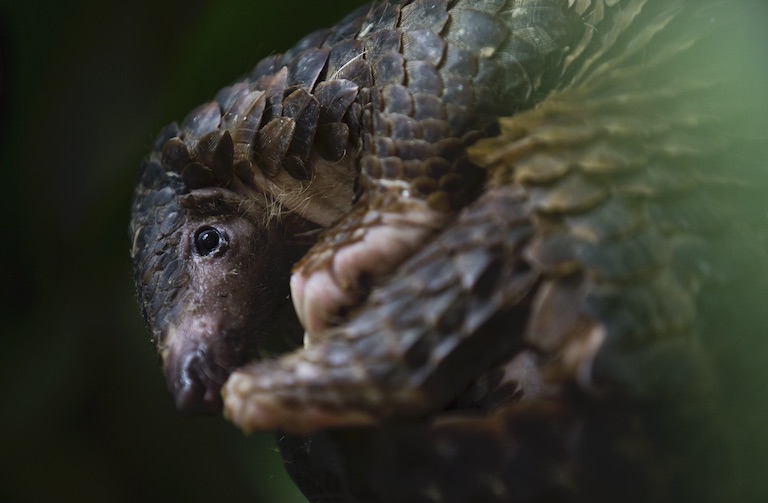
Pangolins are one of the most trafficked species in the world. Image by Paul Hilton for WildAid.
“That’s only the scales that are intercepted, which is only about 10% of the trade, so you can imagine how many pangolins are being traded on the African continent,” Ray Jansen, chairman of the African Pangolin Working Group and member of the IUCN Species Survival Commission Pangolin Specialist Group, told Mongabay.
This trade has persisted despite pangolins being a protected species under CITES Appendix I, which prohibits all international trade except in extraordinary circumstances. However, CITES does not regulate the commercial trade of the species within a country, which is why the sale of pangolin parts has persisted in China.
The delisting of pangolins for use in traditional Chinese medicine (TCM), which was reported on June 9 by media outlet China Health Times, follows the Chinese State Forestry and Grassland Administration’s (SFGA) announcement that pangolins are now a national level one protected species in China. That gives pangolins the same protection as a species listed under CITES Appendix I, says Steve Blake, the chief China representative for WildAid.
Pangolin scales seized in Cameroon. Image by Keith Cameron / USFWS via Wikicommons (CC BY 2.0)
This news follows the Chinese government imposing a ban on the consumption of wildlife and moving to shut down existing wildlife farms in several Chinese provinces. Those actions, in turn, were precipitated by the COVID-19 pandemic, believed to have started at a wildlife market in Wuhan.
Blake said he welcomes the news of pangolins being delisted for TCM, which he said will lead to a termination of the legal trade of pangolin products in China.
“More details are yet to come on the products already on the market or how long legal sales will still be available, but it’s only a matter of time now,” he told Mongabay. “And when they are all illegal it sends a very clear signal to both the consumer and enforcement officers, leaving no room for confusion or laundering illegal products. It is a very significant step in curbing the pangolin trade. It’s a very similar situation to what happened in 1993 when tiger bone and rhino horn were removed, recognizing that the use of these products in the practice is not sustainable with such rapidly depleting populations, and that there are many viable alternatives available.”
A baby Philippine pangolin (Manis culionensis). Image by Gregg Yan.
But it’s doubtful the trade will end overnight, Blake said, adding that more work is required to enforce these new rules.
“There needs to be a combination of clearer regulations, stronger enforcement, and stronger public awareness to effectively end these wildlife consumption issues,” he said. “All three of these are headed in the right direction, but just last year alone saw authorities around the world seize 130 tons of pangolin products. This is enormous. There needs to be even more initiatives to reduce demand and punish illegal sales to end this trade. But these two recent announcements from China will help with that tremendously.”
Pangolin scales are widely used in TCM based on the belief that they have special medicinal and spiritual qualities, despite only consisting of keratin, the same substance that makes up human hair and fingernails. The scales are ground up into a powder and sold in more than 60 different commercial products in China, according to Jansen, who works with the South African government to monitor the trade.
Pangolin. Image by Paul Hilton for WildAid.
“Banning pangolin scale powder out of Chinese pharmacopoeia means literally that there is and will be no more demand,” Jansen said.
He added he doesn’t believe the pangolin trade will “go underground” following the announcement.
“Once it’s banned, I think it’s going to be very, very difficult to make it commercially available in China because it [TCM] is almost like Western medicine and regulated,” he said. “So it’s a massive turning point in terms of the conservation of all eight species of pangolins.”
Banner image caption: A baby pangolin holding onto its mother. Image by Paul Hilton for WildAid.
Elizabeth Claire Alberts is a staff writer for Mongabay. Follow her on Twitter @ECAlberts.
FEEDBACK: Use this form to send a message to the author of this post. If you want to post a public comment, you can do that at the bottom of the page.
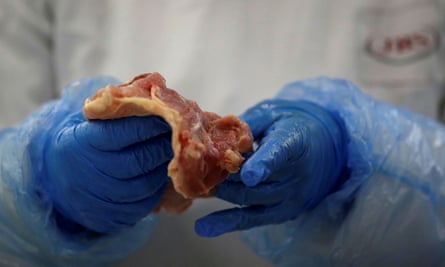
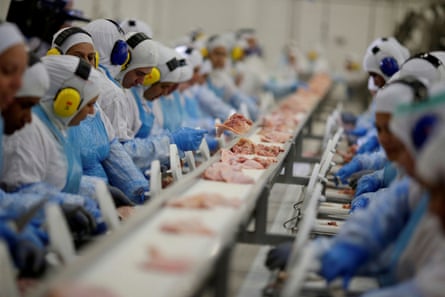
JBS and BRF, two of the country’s biggest meat companies, are under the spotlight over their handling of the coronavirus pandemic. Photograph: Ueslei Marcelino/ReutersAnimals farmed is supported byAbout this contentDom Phillips in Rio de JaneiroPublished onWed 15 Jul 2020 06.32 EDT
1,319
Brazilian meat plants helped spread Covid-19 in at least three different places across the country as the virus continues to migrate from big cities to the country’s vast interior, experts have said.
At the beginning of this week the country was second only to the US with 1.88 million confirmed Covid-19 cases and 72,833 deaths .
Its powerful agribusiness sector is allied with the country’s far-right president, Jair Bolsonaro, who has dismissed the pandemic as a “little flu”. The beef sector is worth $26bn (£20.7bn), according to the Brazilian Confederation of Agriculture and Livestock (CNA), while its chicken industry is worth another $8bn.
Meat plants have stayed open during the pandemic, and staff work closely together, often in refrigerated areas. Other countries, including the US, Canada, Ireland and Germany, have also seen clusters around slaughterhouses.
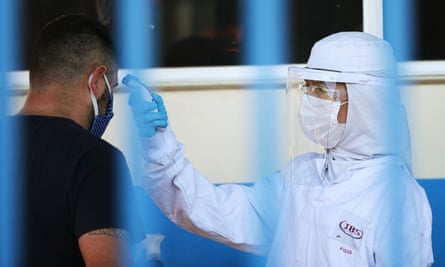
A JBS employee in Passo Fundo has his temperature checked. China recently suspended imports of meat from plants owned by BRF and JBS. Photograph: Diego Vara/Reuters
The conditions can create perfect Covid-19 breeding centres, said Priscila Schvarcz, a prosecutor from the Public Ministry of Labour (MPT), a branch of the federal prosecution service charged with supervising labour laws.
“We see a lot of workers infected,” said Schvarcz, a member of a national meat plant taskforce based in Rio Grande do Sul state in southern Brazil.Advertisement
Rio Grande do Sul has been hard hit. As of 23 June, 4,957 meat workers had tested positive at 32 plants in the state – a third of the total coronavirus cases in the area, prosecutors said. Five employees and 12 people in contact with them had died.
A study for the MPT showed that Covid-19 cases in central and southern Brazil were clustered around towns where meat plants were located and workers lived. “There is a direct relationship,” said Ernesto Galindo, the researcher who produced the study.‘Either we change or we die’: the radical farming project in the AmazonRead more
China, Brazil’s biggest trading partner, suspended imports of meat from plants owned by two of Brazil’s largest meat companies, BRF and JBS, at the beginning of this month. Brazil’s ministry of agriculture also suspended exports from a JBS plant in Rio Grande do Sul, business daily Valor said.
BRF said it was working with the Brazilian and Chinese authorities to resume deliveries. The company said that 98 of 2,873 workers at its plant in Lajeado, Rio Grande do Sul, tested positive in late May. JBS did not comment on China’s suspension of imports.
‘The focus was cows, not employees’
At a JBS plant in Dourados, in Mato Grosso do Sul state in the centre-west region, more than 4,000 employees were tested and nearly a quarter were positive, prosecutors said. The company suspended 1,600 workers on full pay but did not close the plant. As of 14 July, the town had 3,481 cases, a quarter of the state’s total.
The JBS plant in Dourados “was the initial focus for the outbreak”, said Andyane Tetila, an infectious diseases specialist in Dourados who works for the state health service. The JBS plant has 103 indigenous workers, many of whom live in nearby reserves where more than 150 people were subsequently infected, said Indianara Machado, an indigenous nurse who works in the reserve.
Employees work at JBS in Lapa in March. Prosecutors have said close working conditions at meat plants make them vulnerable to the spread of Covid-19. Photograph: Ueslei Marcelino/Reuters
JBS said it had put all its indigenous workers on paid leave and is supporting initiatives to control and prevent new coronavirus outbreaks in more than 100 municipalities across Brazil. Labour prosecutors said JBS moved quickly to contain the outbreak. “The company collaborated,” said Jeferson Pereira, a labour prosecutor in Dourados. “It contracted nurses and technicians to accompany visits.”Advertisementhttps://tpc.googlesyndication.com/safeframe/1-0-37/html/container.html
Another 85 people tested positive at a BRF plant in the town. The company said workers in this situation are suspended on pay, given medical attention and monitored by occupational health specialists at the company until they recover.
In June, a judge closed a JBS plant in the remote Amazon town of São Miguel do Guaporé in the north-west of Brazil for the second time after infections rocketed. As of 25 June, 377 of the plant’s 940 employees were infected – then more than half of the town’s caseload, prosecutors said.
Leandro da Conceição, 33, one of the workers in the plant, said he lost his sense of smell and taste. When he told his supervisor, he was ignored and kept working even though he got sicker and sicker.
Conceição was sent home after he produced his own positive test result. He and another worker later lost their jobs after a WhatsApp audio that featured them and other workers complaining about infections at the plant was published by local media. Both men were told falling production was the motive. “They had no reason to sack us,” he said. “I never missed work.”
Local labour prosecutor Helena Romero said: “We realised that the company was not carrying out containment measures, we observed that often workers kept working even though they had symptoms, and this could have contributed to spreading the illness.” The plant has since reopened.
After the outbreak in Lajeado, BRF signed an extrajudicial deal with labour prosecutors. The company said it had tested 31,000 employees nationwide in the past two months. Four of its plants had closed for testing and all 34 are now operating. Preventative measures included reducing bus capacity by half and suspending workers in Covid-19 risk groups. A permanent committee of specialists monitors its actions.
JBS did not explain why it had no agreements with labour prosecutors and declined to comment on outbreaks at individual plants. “JBS does not comment on legal decisions,” it said.
The company said that the health and safety of its team members was its key priority. It had adopted a strict protocol on control, prevention and safety at all processing units, in full compliance with government-mandated rules.
JBS said it followed guidance from the US Centers for Disease Control and Prevention and the World Health Organization as well “specialised physicians”. “Each test assessment takes place on a case-by-case basis,” the company said. It disinfected factories daily and takes workers’ temperatures, and has increased its fleet of buses and put those in risk groups and anyone with symptoms on paid leave.
Less than a month ago the world was shocked when the temperature in the Arctic Circle reached a record-breaking 100.4 degrees Fahrenheit. While remarkable in its own right, it was merely the exclamation point on an astonishing, prolonged and widespread heat event across all of the Siberian Arctic.
The extreme and unusual warmth in this region alarmed scientists worldwide, prompting a group of 14 scientists from six countries to collaborate in a study to figure how something this out-of-bounds could occur. On Wednesday, the researchers released their findings in a comprehensive climate attribution study, declaring, “This large-scale prolonged event would have been essentially impossible without climate change.”
To put it into perspective, the team found that if, hypothetically, you lived in this region before around 1900, when human-caused climate change began to emerge, a heat event this widespread, prolonged and intense would…
International Union for the Conservation of Nature’s Red List changes ocean giants’ status to ‘critically endangered’
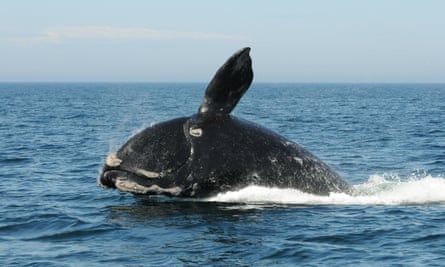
A North Atlantic right whale feeds on the surface of Cape Cod bay off the coast of Massachusetts. Fewer than 250 mature individuals remain in a population of roughly 400. Photograph: New England Aquarium/IUCN/PA
With their population still struggling to recover from over three centuries of whaling, the North Atlantic right whale is now just “one step from extinction”, according to the International Union for the Conservation of Nature (IUCN). The IUCN last week moved the whale’s status on their Red List from “endangered” to “critically endangered” – the last stop before the species is considered extinct in the wild.
The status change reflects the fact that fewer than 250 mature individuals probably remain in a population of…
“Among the slew of new rules includes hunting bears, as well as their cubs in their dens, caribou from motorboats and bears with bait at several national preserves. It also permits brown bear hunting from ‘registered bait stations’ in Alaska’s Kenai National Wildlife Refuge for the first time.” [USA Today, May 30, 2020]
Don Jr. wins again. He must be tired of winning. I know the rest of the country is.
Back in my Navy days, my friends in a submarine crew would have described young Donnie as being “an oxygen thief.” They worked an old diesel boat. When the hatch was closed and they submerged, they had the air they had and everyone was breathing it. Some crewmen worked to keep the boat operating; some just hung out and breathed. They were the oxygen thieves.
One of the research team’s remote photos shows a North American red squirrel carrying nest-building materials through a wildlife underpass in Quebec in the summer of 2014. (Submitted by April Martinig)
Wildlife crossings like those in Banff National Park are meant to help animals cross highways safely, but ecologists have long been asked about possible unintended consequences of the structures.
New research out of the University of Alberta disproves a common theory that predators could exploit the corridors by using them to trap prey.
Researchers tested the prey-trap hypothesis by placing remote cameras in 17 wildlife passages in the Laurentides Wildlife Reserve in Quebec between May of 2012 and August of 2015.
They measured how often some small and medium-sized predators and prey — such as weasels, mice, moles and raccoons — appeared on the passages. A camera at each entrance, when triggered by heat and movement, took a series of photographs.
An aerial view of a wildlife overpass in Banff National Park. (Parks Canada)
The cameras captured more than 11,000 mammals using the wildlife underpasses but did not capture a single predation episode or attempt.
The researchers also found no photo evidence of any larger predators, like wolves, coyotes or lynx, using the wildlife passages.
Based on the images gathered, predators did not follow prey into the passages and prey tended to avoid the paths after predators had used them. “This study is showing that one of our biggest concerns, which was predators catching on to the prey using the passages, isn’t actually as much of a problem as we thought it would be,” April Martinig said Tuesday in an interview with CBC’s Radio Active.
Martinig said she found the results reassuring since she often hears from members of the public who worry wildlife crossings could be putting smaller animals directly in predators’ paths.
Scientists will still need to monitor wildlife passages in case predators eventually catch on, she said, but for now, building structures that exclude predators should not be a concern.
Study captured thousands of images of mammals using structures in Quebec
Madeleine Cummings · CBC News · Posted: Jul 14, 2020 5:16 PM MT | Last Updated: July 14
One of the research team’s remote photos shows a North American red squirrel carrying nest-building materials through a wildlife underpass in Quebec in the summer of 2014. (Submitted by April Martinig)
Wildlife crossings like those in Banff National Park are meant to help animals cross highways safely, but ecologists have long been asked about possible unintended consequences of the structures.
New research out of the University of Alberta disproves a common theory that predators could exploit the corridors by using them to trap prey.
Researchers tested the prey-trap hypothesis by placing remote cameras in 17 wildlife passages in the Laurentides Wildlife Reserve in Quebec between May of 2012 and August of 2015.
They measured how often some small and medium-sized predators and prey — such as weasels, mice, moles and raccoons — appeared on the passages. A camera at each entrance, when triggered by heat and movement, took a series of photographs.
An aerial view of a wildlife overpass in Banff National Park. (Parks Canada)
The cameras captured more than 11,000 mammals using the wildlife underpasses but did not capture a single predation episode or attempt.
The researchers also found no photo evidence of any larger predators, like wolves, coyotes or lynx, using the wildlife passages.
Based on the images gathered, predators did not follow prey into the passages and prey tended to avoid the paths after predators had used them. “This study is showing that one of our biggest concerns, which was predators catching on to the prey using the passages, isn’t actually as much of a problem as we thought it would be,” April Martinig said Tuesday in an interview with CBC’s Radio Active.
Martinig said she found the results reassuring since she often hears from members of the public who worry wildlife crossings could be putting smaller animals directly in predators’ paths.
Scientists will still need to monitor wildlife passages in case predators eventually catch on, she said, but for now, building structures that exclude predators should not be a concern.


 For Immediate Release: July 16, 2020Contact: Randi Feilich, Project Coyote Southern Cal. Rep. (310) 498-2975,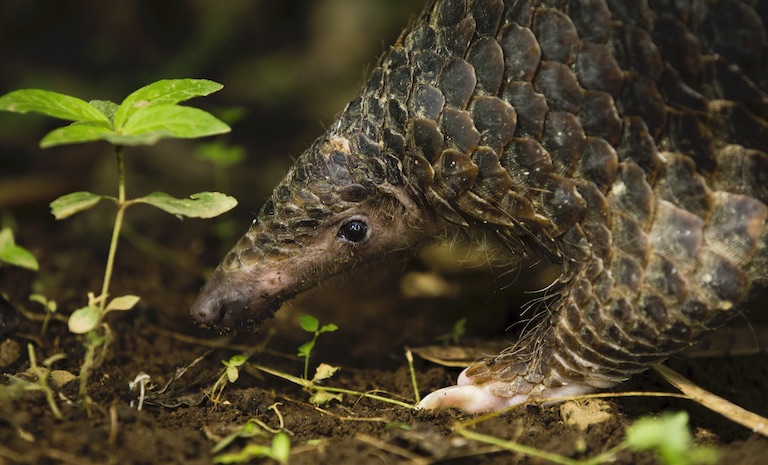


.png)




 Exposing the Big Game