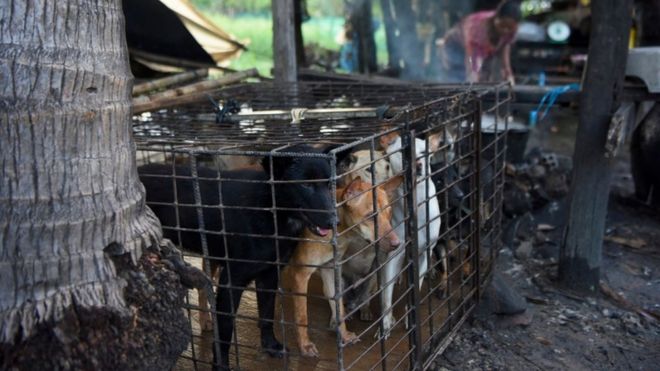
The director of Siem Reap’s department of agriculture, forestry and fisheries, Tea Kimsoth, told Reuters news agency that tourism had led to a growth in demand for dog meat in the region.
“Dog meat has been a lot more popular following the arrivals of foreigners, especially among the (South) Koreans,” he said.
Media captionSouth Korea dog meat: The dogs saved from being eaten
The charity Four Paws welcomed the ban.
“We hope that Siem Reap will serve as a model for the rest of the country to follow suit to protect the lives of millions of dogs,” Dr Katherine Polak, the charity’s head in south-east Asia, said.
According to the Humane Society International (HSI), 30 million dogs are killed for meat across Asia every year.
In April, Shenzhen became the first city in China to ban eating cats and dogs, while India’s north-eastern state of Nagaland outlawed the import, trade and sale of dog meat earlier this month.
Living near prime wildlife habitat means that at any given moment you might witness the astounding sight of great Vs of migratory ducks or cackling Canada geese flying right overhead. If you’re lucky, trumpeter swans might be among the waterfowl feeding and calling in the nearby estuary. And wood ducks or hooded mergansers might pay your inland pond a visit while searching for a quiet place to nest.
The downside of living near a natural wonderland? Being awakened Sunday morning at first light by the repeated volley of shotgun blasts, as though all-out war has been declared on all things avian (as is currently happening here this morning). The Elmers (hunters) out there (no doubt dressed in the latest expensive camo-pattern—a fashion statement apparently meant to impress the other Elmers out there) must be reveling in the fact that the dense morning fog…
Footage captured at a zoo in Beijing, China shows a captive tiger walking in endless circles in his enclosure. A staff member told reporters that this type of behavior is actually common for animals who have been staying at the zoo for a long time.
Representatives with the zoo say that the Bengal tiger was later given “psychological counseling” after zookeepers noticed the strange behavior. However, the so-called “psychological counseling” that the animal was given did not seem very professional.
“We have taken the animal to receive behavior training. We also brought more food and toys for the tiger. It’s like “psychological counseling”,’ a zookeeper told reporters.
When tigers are in the wild, they usually cover a lot of ground and do a lot of exploring in their day to day activities, and that is what their instincts tell them to do.
Sun Quanhui, a senior scientific adviser at a non-profit organization called World Animal Protection China told the South China Morning Post that this is a common problem in Chinese zoos.
“Let’s just give the example of how beasts of prey are kept. In almost every Chinese zoo, we see them in cement cages or behind steel bars, which to some extent is considered maltreatment. Some are species that naturally live in groups, but they’re often isolated, which also causes them huge psychological distress.” Quanhui said.
Tigers are listed as Endangered on the IUCN Red List since 1986. As of 2015, the global wild tiger population was estimated to number between 3,062 and 3,948, but the number in captivity is far higher.
Incident Under Criminal Investigation ~ Wildlife Protection Organizations Call for Justice
VALLEY VILLAGE, CA—California-based Project Coyote has released a video depicting a coyote pup captured in an illegally set leghold trap in the upscale neighborhood of Valley Village (adjacent to North Hollywood), and law enforcement agencies are currently investigating the incident for possible criminal violations.
The video shows—in graphic detail—the coyote pup struggling in the trap, desperate to free itself, with no cover in the searing summer heat. It is believed that the pup suffered in the trap for days before local residents heard it crying in pain and came to its rescue. The animal’s distress was so great, as is evident in the video, that at one point a caring girl felt compelled to offer water…
Authorities at the Louisiana Department of Wildlife and Fisheries (LDWF) captured and tranquilized a 10-foot, roughly 300-pound American alligator without incident after members of the New Orleans’s Lakeview community reported spotting the reptile ambling along a residential street on the morning of July 3.
In less than two hours, LDWF agents made it to the scene and were able to capture and tranquilize the alligator without incident, only to euthanize it later after contacting a licensed “nuisance alligator hunter.” The hunter in question has chosen to remain anonymous in the media, fearing targeted backlash from the public.
Many locals have expressed anger and even grief concerning the unjust fate of the Lakeview alligator. “What, too hard to drive him out to Barataria or a suitable habitat? Sounds like bad…
(CNN) — Russian authorities have warned people near the country’s border with Mongolia not to hunt or eat marmots after an outbreak of bubonic plague.
Two cases of the plague were recorded in the Khovd province in western Mongolia, reported Russian state media agency TASS on Tuesday.
Marmots are large ground squirrels, a type of rodent, that have historically been linked to plague outbreaks in the region.
Officials from the Republican Ministry of Agriculture and Food told citizens in the border area not to hunt marmots or eat marmot meat, and take preventive measures against insect bites.
Rodents are the main vector of plague transmission from animals to humans, but the disease can also be passed on through flea bites.
Plague killed an estimated 50 million people in Europe during the Black Death pandemic in the…
It could take decades before cuts to greenhouse gases actually affect global temperatures, according to a new study. 2035 is probably the earliest that scientists could see a statistically significant change in temperature — and that’s only if humans take dramatic action to combat climate change.BE READY FOR THE LONG HAUL
Specifically, 2035 is the year we might expect to see results if we switch from business-as-usual pollution to an ambitious path that limits global warming to under 2 degrees Celsius — the target laid out in the Paris climate agreement. The world isn’t on track to meet that goal, so we might not see the fruits of our labor until even later. That means policymakers need to be ready for the long haul, and we’re all going to need to be patient while we wait for the changes we make now to take effect.
“I foresee this kind of train wreck coming where we make all this effort, and we have nothing to show for it,” says lead author of the study, Bjørn Samset. “This will take time.”
It will be time well spent if we manage to cut emissions — even if we have to wait to see results. Humans have so far warmed up the planet by about 1 degree Celsius. That’s already come with more devastating superstorms and wildfires and has forced people from Louisiana to Papua New Guinea to abandon their homes as rising sea levels flood their lands. Even keeping the planet to the 2 degree goal would result in the near annihilation of the world’s coral reefs. Taking into consideration all of the commitments from world leaders to work together on climate change, we’re currently careening toward global warming of about 3 degrees Celsius above preindustrial levels.
To avoid burnout and keep aspirations high when it comes to tackling climate change, scientists and policymakers will need to be realistic about what’s ahead. The first line of the new study, published today in the journal Nature Communications, reads: “This paper is about managing our expectations.”
The study looks at the effects of cutting down on carbon dioxide, black carbon, and methane emissions. Carbon dioxide is the toughest greenhouse gas to tackle because so much of the world economy still relies on burning fossil fuels.
Methane (a more potent greenhouse that comes from agriculture and natural gas production) and black carbon (a big component of soot) are, in theory, easier to cut back. Using climate models and statistical analysis,Samset and his colleagues wanted to know whether addressing these other pollutants might lead to faster results. Their analysis isolated the effects that reducing methane and black carbon might have. They found that temperatures might respond quicker to axing these pollutants, but it wouldn’t have as big of an effect in the long term as pushing down our carbon emissions. The best bet is to tackle all three at once.“IS THERE A SHORTCUT?”
“We kind of break this apart and try to see, is there a shortcut? Is there anything we can do to give people the impression that things are having an effect? And unfortunately, the answer is no,” says Samset. “There’s no quick fix to this.”
Part of the problem is that carbon dioxide can persist in the atmosphere for hundreds of years after being released by burning coal, oil, and gas. Natural variations in climate can also delay the impact that cutting down greenhouse gases has on global temperatures.
“There is this fundamental misunderstanding of the climate system by non climate scientists trying to use trends on a 10 year time scale for climate change, when [with] climate change a 100 or 200-year timescale is relevant,” explains Natalie Mahowald, a climate scientist at Cornell University who was not involved in the study.
“All our hard work today, we will not be able to see for 20 or 30 years — this is the crux of the problem,” Mahowald says. “Humans have a really hard time doing something for future generations.”
Try looking on cloud nine, just down the road from El Dorado, a few miles past the pot of gold at the end of the rainbow.
Odds are, they’re still there – in paradise. Why? Because a pro-plant-based hashtag was trending on Twitter. Trending – during COVID-19, police brutality, protesting and heartache, on a platform subjugated by a sniveling, angry man in the high castle: #theendofmeatishere.
It all started when the New York Times story – aptly headlined “The End of Meat Is Here” – was able to briefly capture the ADHD-ridden spotlight of modern social media, leading to a whirlwind of pro- and (mostly) anti-vegan sentiment.
It did what others before it were unable: It succinctly and methodically laid out all the benefits of a plant-based diet while simultaneously dismantling several myths. Such as that we need animal protein (we don’t), or that farmers would suffer most if we allowed the factory farming system to collapse (they wouldn’t).
The part that struck me most, though, was its assertion around meat’s role in COVID-19 – and how the pandemic might not exist without it. According to the Centers for Disease Control and Prevention, 3 of 4 new or emerging infectious diseases are zoonotic – meaning they spread from animal to human, the primary avenue being consumption.
Remember the 2002 SARS outbreak? The World Health Organization linked it to some sort of animal, though its origin is uncertain. How about the bird flu? Swine flu? A mystery their source is not.
What’s more, our broken relationship with animal consumption keeps finding its way into our other foods. In 2018, the Food and Drug Administration investigated factory-farmed cows as a source of a massive E. coli contamination of lettuce. E. coli is a bacterium that primarily lives in intestines.
According to a study of U.S. Department of Agriculture data on factory farms in Yuma County in Arizona by foodandwaterwatch.org, “Samples of nearby irrigation canal water tested positive for the same strain of E. coli that caused the outbreak. The canal is close to a CAFO that can hold more than 100,000 head of cattle at any one time.”
And while the industry has discovered clever workarounds for E. coli in the beef itself – mostly by washing the meat in ammonia before it’s shipped – we still deal with massive food recalls like clockwork.




/cdn.vox-cdn.com/uploads/chorus_image/image/67026008/VRG_ILLO_1777_AK_globe.0.0.jpg)

 Exposing the Big Game