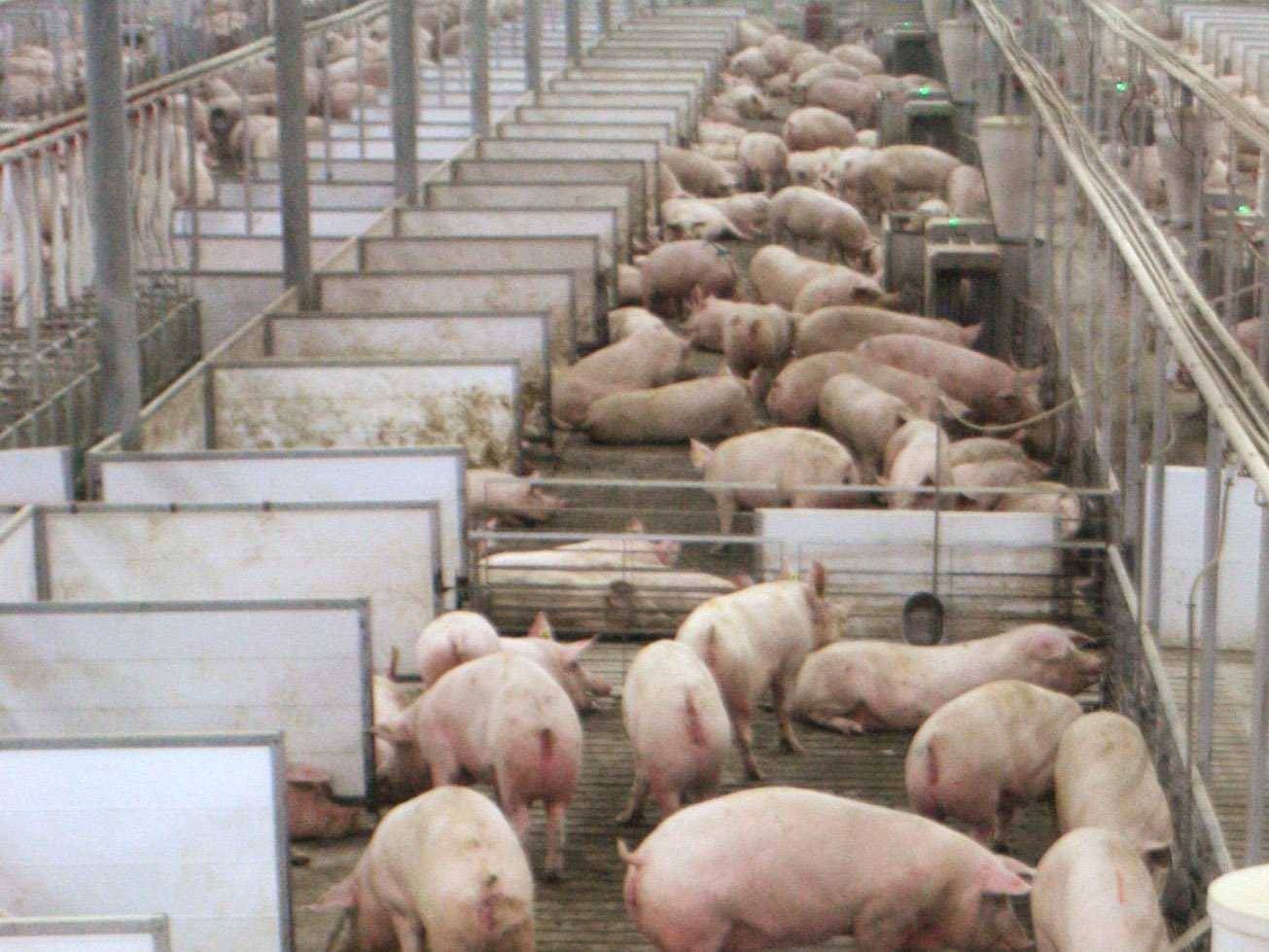
Revealed: Covid-19 outbreaks at meat-processing plants in US being kept quiet

https://www.theguardian.com/environment/2020/jul/01/revealed-covid-19-outbreaks-meat-processing-plants-north-carolina

Testing has found positive cases at North Carolina facilities, but officials refuse to release the information
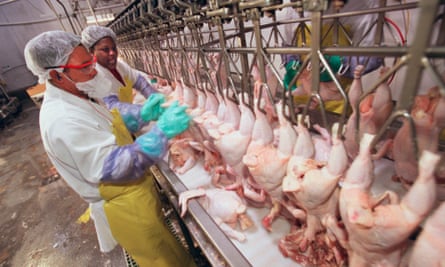
Pilgrim’s Pride chicken processing plant in Marshville, N.C.

Pilgrim’s Pride chicken processing plant in Marshville, North Carolina. Photograph: Francisco Kjolseth/APAnimals farmed is supported byAbout this contentLewis Kendall in Durham, North CarolinaPublished onWed 1 Jul 2020 05.00 EDT

2,915

Achicken processing facility in western North Carolina reportedly underwent widespread testing for Covid-19 in early June.

Workers at the plant were scared. Several employees had already tested positive and the company, Case Farms – which has been repeatedly condemned for animal treatment and workers’ rights violations – was not providing proper protective equipment.

“We don’t have a lot of space at work. We are shoulder to shoulder,” said one worker, who declined to be identified, during a recent union call. “I’m afraid to go to work, but I have to go.”

The testing turned up 150 positive cases at the facility, the worker said.

On 8 June, the health department for Burke county, where the Case Farms facility is located, reported 136 new Covid cases, a 25% increase in its total caseload. Yet neither the company, county officials nor the North Carolina department of health and human services would confirm whether those cases were connected to Case Farms.

It is just one example of the currently taut relationship between public health and the economy in North Carolina, as the number of Covid-19 cases and hospitalizations rises.

North Carolina is one of the largest pork and poultry producing states in the US, exporting roughly $1.25bn in hogs, chickens and turkeys every year. Health departments in rural parts of the state, areas that often lean on large meatpacking or food processing facilities as primary sources of employment, have so far been tight-lipped about Covid-19 outbreaks in those plants.

In late April, while outbreaks began emerging at meat processing plants across the country, Donald Trump signed an executive order forcing the facilities to remain open. That same month, the US exported a record amount of pork to China, despite industry claims of a domestic shortage.
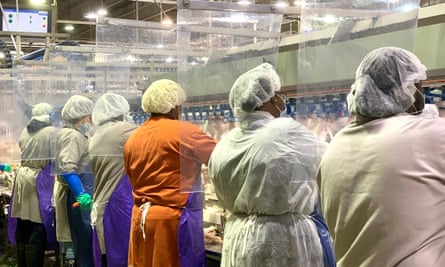
Workers wear protective masks and stand between a plastic dividers at a Tyson Foods poultry plant in Georgia.

Workers wear protective masks and stand between a plastic dividers at a Tyson Foods poultry plant in Georgia. Photograph: AP

Since the pandemic began, more than 36,000 meat processing and farm workers have tested positive for Covid-19 and at least 116 have died, according to a tally by the Food and Environment Reporting Network, though the true number is likely higher.

Through case interviews and contact tracing, the Burke county health department, where Case Farms is located, does have data about where people with positive cases work, but are choosing not to release it, said spokeswoman Lisa Moore.

“We know where they are, but we are not a county that can divulge every place where they are,” Moore said.

Case Farms requested the health department direct all questions regarding their facility to a company representative, Moore added.

In response to a series of detailed questions from the Guardian, a Case Farms spokesperson wrote that the company is “committed to continue producing food for our nation’s food supply, while taking additional safety measures to protect our employees, our company and our customers, in accordance with USDA regulations and CDC guidelines.”

Earlier this year, North Carolina’s health department had reported the names of farms with two or more positive cases, but in May replaced the names with addresses in order to “better reflect the location of the outbreak”, according to a department spokesperson.

“Why, when a nursing home has an outbreak, it’s in the paper, but when a meatpacking facility does, it’s not?” said Mac Legerton, a longtime grassroots policy advocate and co-director of the Robeson County Cooperative for Sustainable Development, and is among those who have criticized local and state governments’ approach to case reporting.

“The law needs to be that in a pandemic all outbreaks at public and private facilities are made public to protect the employees of the institutions and to inform the public.”

As of Thursday, there were 2,772 confirmed cases of Covid-19 in 28 meat processing plant “clusters” around the state, the department said, but would not specify further.

North Carolina as a whole has seen a marked increase in cases and hospitalizations over the past several weeks, prompting a “concerned” Governor Roy Cooper to announce last week that the state would pause in the second phase of its reopening plan.
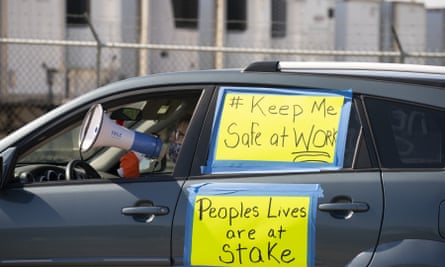
Demonstrators protest working conditions at a Pilgrim’s Pride poultry processing facility in Minnesota.

Demonstrators protest working conditions at a Pilgrim’s Pride poultry processing facility in Minnesota. Photograph: Jeff Wheeler/APAdvertisementhttps://tpc.googlesyndication.com/safeframe/1-0-37/html/container.html

The state requires only a few types of businesses to report outbreaks, which it defines as two or more cases, including congregate living facilities, daycare centers and schools. For all other businesses, local health departments and the state DHHS depend on companies volunteering their own data or tracking down clusters through case interviews.

But failure to disclose outbreaks demonstrates that officials and company executives are prioritizing economic interests over the wellbeing of marginalized workers and communities, Legerton said.

“That lack of information puts both employees and the public at risk,” he said.

In a letter to several of the largest meat companies last week, senators Elizabeth Warren and Cory Booker called on the corporations to disclose infection figures in their plants.

Virginia also recently moved to create a set of safety rules to protect workers from Covid-19 – the first of its kind in the nation – following a petition from workers in the state’s poultry processing and meatpacking industries. The drafted rules, which include requiring employers to mandate social distancing and notify employees of potential exposure, would be enforceable through fines and closures.

The Occupational Safety and Health Administration has received nearly 350 Covid-related complaints from employees at North Carolina businesses. One business, Pilgrim’s Pride, a poultry processing plant in Sanford, was the subject of at least eight separate complaints, with workers alleging the company was not informing them of positive tests or mandating the wearing of some protective equipment. A worker there died in May.

In Robeson county – home to a large Campbell’s Soup facility, Mountaire Farms and Sanderson Farms poultry processing plants, as well as many factory farms – businesses have been generally forthcoming with the health department, according to Bill Smith, the county’s health department director.

Smith’s office received $600,000 in federal Covid funding, which it used to set up testing sites around the county and hire school nurses as contact tracers. Smith and his team have also been collaborating on daily calls with health departments from surrounding counties, as well as coordinating closely with the local Lumbee Tribe.

But companies can make this work difficult, muddying the waters for case reporting in communities where they are one of very few employers, Smith said.

“A lot of the packing places are your largest employers, therefore it’s an economic issue,” he said. “There may be pressures from them to stay out of the packing world, if you will.”

Companies also choose to weigh public health considerations alongside public relations in determining what information to release, Smith said, pointing to publicly traded giants like Sanderson Farms and Smithfield Foods, which have “a brand they’re trying to protect”.

“If you say something about Smithfield Foods, they’ll see an effect immediately: you’ll see someone not buy Smithfield in the grocery,” he said.

Still, the decision by state and county health departments to report some outbreaks and not others appears inconsistent with the need for transparency in a public health crisis, Smith noted.

“When you’re releasing nursing home names with two illnesses, yet another place that has 900 you refuse to give, there’s some disagreement there from a public health perspective,” he said.

A new swine-flu strain with ‘pandemic potential’ was just found circulating in Chinese pigs

https://www.businessinsider.in/science/news/a-new-swine-flu-strain-with-pandemic-potential-was-just-found-circulating-in-chinese-pigs/articleshow/76700999.cms?fbclid=IwAR3BHWT1I-RPtJEPOTygvzScXDym8xxIzCW9ezWm7hN_-JyA7qh979Tk0yM

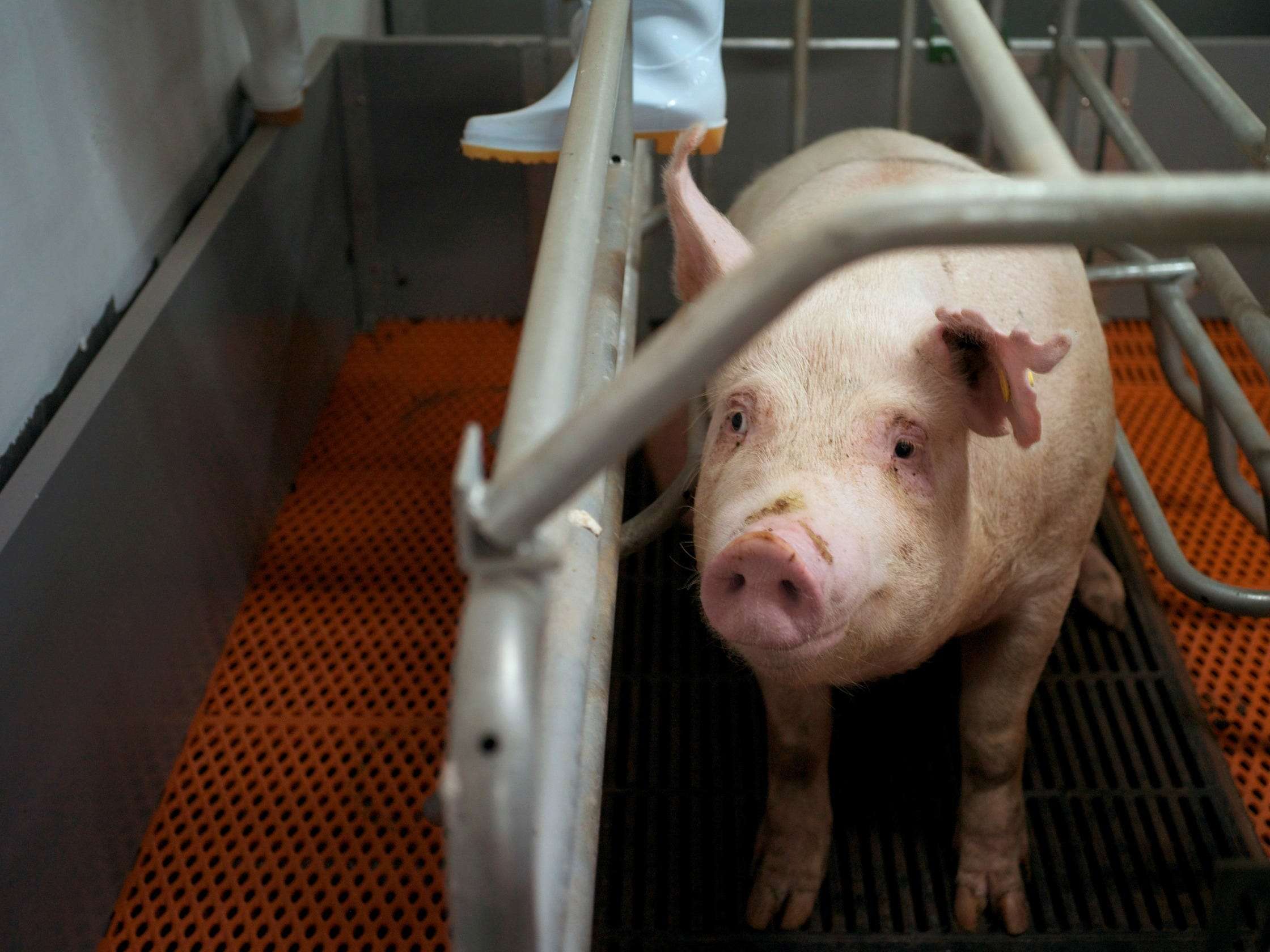
HOLLY SECONJUN 30, 2020, 23:29 ISTLocal animal husbandry workers inject a pig to collect a blood sample at a pig farm in Zhangye, Gansu province, China on October 28, 2019.REUTERS/Stringer
  • study published on Monday describes a new strain of influenza found in pigs in Chinese slaughterhouses.
  • The strain is a combination of a bird-flu virus and the virus that caused the 2009 swine-flu pandemic, giving it “pandemic potential” in humans, the researchers wrote.
  • The flu strain was also found in a small number of farmers, but it doesn’t seem to spread human-to-human. The researchers said that could change, however.

A nearly decadelong study of Chinese pigs has found a potentially dangerous new type of influenza virus.

The study, published on Monday in the journal Proceedings of the National Academy of Sciences, describes a flu strain that shares genes with the one that caused the 2009 swine-flu pandemic. The researchers behind the work warned that the flu strain has “pandemic potential.”They described the virus as a combination of three strains: one from European and Asian birds, the one that caused the 2009 pandemic, and one from North America that has genes from bird, human, and pig flu viruses.Advertisementhttps://06db0d292e84275a90b6d094dae35c6f.safeframe.googlesyndication.com/safeframe/1-0-37/html/container.html


The new strain could pose a major threat if it’s able to circulate among humans, the researchers wrote. It doesn’t seem to do that yet, but antibodies to this type of virus were detected in 35 slaughterhouse workers, indicating that they may have been infected at some point in the past few years. The researchers said that because the strain contains parts of the 2009 swine-flu virus, it “may promote the virus adaptation” that leads to human-to-human transmission.

Dr. Anthony Fauci, director of the National Institute of Allergy and Infectious Diseases, said at a Senate briefing Tuesday that this new virus was “not an immediate threat” but something to “keep your eye on.”Given the devastation the coronavirus pandemic has caused, the researchers behind the study said, it’s critical to take proactive measures now to protect people against this swine flu.Advertisement


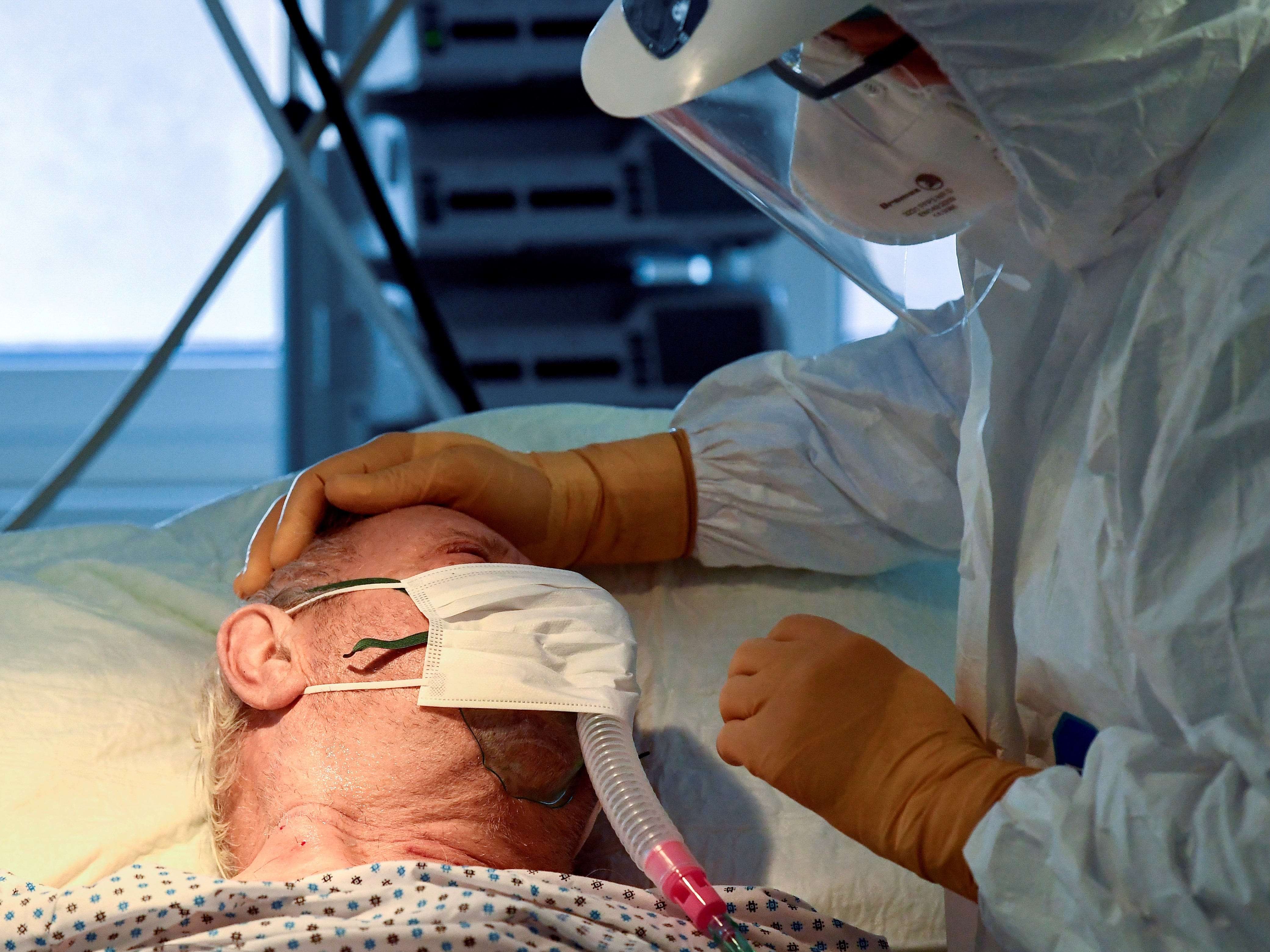
A patient suffering from the coronavirus in the intensive care unit at the Circolo hospital in Varese, Italy, on April 9, 2020.REUTERS/Flavio Lo Scalzo

An emerging type of swine flu

Identifying new virus strains in pigs is crucial for preventing another pandemic. The 2009 H1N1 pandemic was caused by an influenza A virus that emerged from pigs. The animals can serve as a reservoir for infectious diseases, since they can be infected with bird, pig, and human influenza strains.Advertisementhttps://06db0d292e84275a90b6d094dae35c6f.safeframe.googlesyndication.com/safeframe/1-0-37/html/container.html


When multiple strains of influenza infect the same pig, the viruses can swap genes in a process called reassortment, leading to the creation of a new disease.

The team of Chinese researchers that conducted the new study aimed to identify those types of potentially dangerous, never-before-seen viruses in pigs. From 2011 to 2018, they looked at nearly 30,000 swabs from pigs in slaughterhouses in 10 Chinese provinces and another 1,000 swabs from pigs with respiratory symptoms at a local veterinary teaching hospital.The researchers found 179 virus strains, but this one stood out.Advertisementhttps://06db0d292e84275a90b6d094dae35c6f.safeframe.googlesyndication.com/safeframe/1-0-37/html/container.html


Thomas Suen/Reuters

The worrisome new strain, which the researchers named G4 EA H1N1, has emerged on a larger scale in pig populations since 2016, the study said — it was “the predominant genotype in circulation in pigs detected across at least 10 provinces,” they wrote.They added that the virus was “distinct from current human influenza vaccine strains, indicating that preexisting immunity derived from the present human seasonal influenza vaccines cannot provide protection.”Advertisementhttps://06db0d292e84275a90b6d094dae35c6f.safeframe.googlesyndication.com/safeframe/1-0-37/html/container.html


The team tested the virus in a lab and found that it reproduced in animals’ respiratory systems. It can spread via airborne particles. The flu strain also transmits easily among ferrets, a species scientists frequently use as an indicator of how bad a virus may be in humans because they display human-like flu symptoms.

Whether or not the virus mutates to start spreading human-to-human will determine how dangerous it is.”Controlling the prevailing G4 EA H1N1 viruses in pigs and close monitoring in human populations, especially the workers in the swine industry, should be urgently implemented,” the researchers wrote.Advertisementhttps://06db0d292e84275a90b6d094dae35c6f.safeframe.googlesyndication.com/safeframe/1-0-37/html/container.html


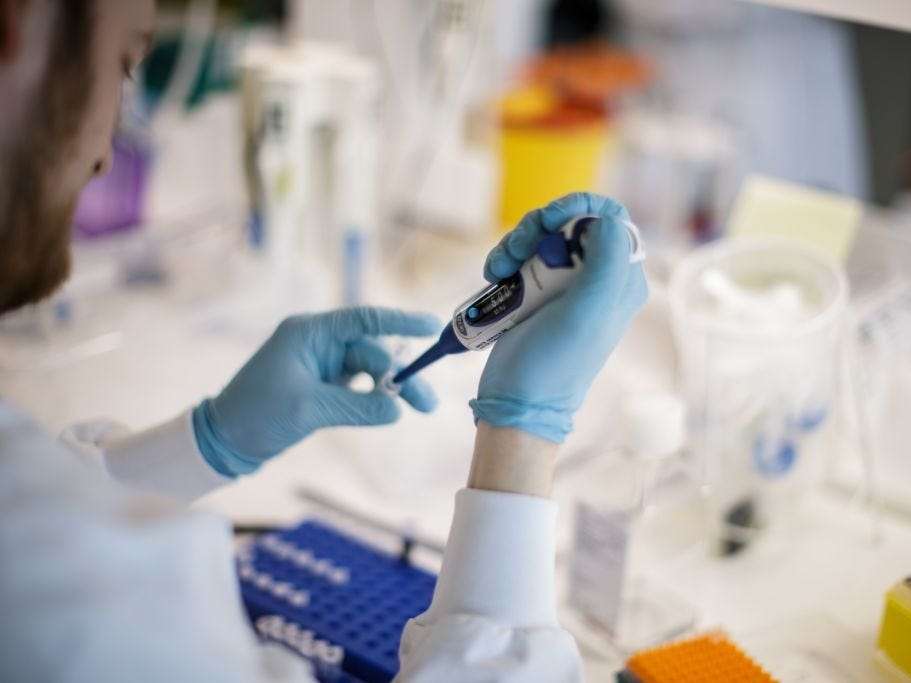
A researcher works on a vaccine for the coronavirus at the Copenhagen University research lab in Copenhagen, Denmark, on March 23, 2020.THIBAULT SAVARY/AFP via Getty Images

The threat of another swine-flu pandemic

H1N1, which emerged at the end of 2008, infected about 60.8 million people in the US through 2010. It was referred to as “swine flu” because it originally jumped to humans from pigs. Estimates of global H1N1 deaths range from 151,700 to 575,400. But H1N1 differed from other flu outbreaks in that 80% of the virus-related deaths were people younger than 65; in other flu outbreaks typically about 70% and 90% of deaths are people older than 65.Advertisementhttps://06db0d292e84275a90b6d094dae35c6f.safeframe.googlesyndication.com/safeframe/1-0-37/html/container.html


Scientists think mammals and birds around the globe host about 1.7 million undiscovered types of viruses. Viruses in birds, bats, and pigs are especially risky for people.

Because China has the world’s largest pig population, scientists there monitor the animals to try to find emerging diseases before they spread.”Systematic surveillance of influenza viruses in pigs is essential for early warning and preparedness for the next potential pandemic,” the researchers behind the new study wrote.Advertisementhttps://06db0d292e84275a90b6d094dae35c6f.safeframe.googlesyndication.com/safeframe/1-0-37/html/container.html


Pigs walk across a slatted floor at Fair Oaks Farms in Fair Oaks, Indiana on May 18, 2015.AP/M.L.Johnson

Their surveillance uncovered other concerning trends: The researchers found that the portion of pigs studied that had diseases increased over time, rising to 8.2% in 2018 from 1.4% in 2011, with a sharp increase after 2014.A similar surveillance system also exists for coronaviruses in bats. Scientists think that the novel coronavirus, known as SARS-CoV-2, jumped to people from bats, likely via an intermediary animal species.Advertisementhttps://06db0d292e84275a90b6d094dae35c6f.safeframe.googlesyndication.com/safeframe/1-0-37/html/container.html


Correction: An earlier version of this story incorrectly said the new flu strain had not yet been seen in humans. The story has been updated.

This 23-year-old Texas woman took precautions and still got the coronavirus

Exposing the Big Game's avatarThe Extinction Chronicles

View original post 961 more words

Fears koalas could be extinct in NSW by 2050 prompts calls to halt salvage logging

JUNE 30 2020 – 1:30PM

Federal Politics

https://www.canberratimes.com.au/story/6812635/game-has-changed-dramatically-fears-koalas-could-go-extinct-in-nsw/#gsc.tab=0

Even before the fires, koalas had seen a 26 per cent decline in numbers in NSW. Picture: Karleen Minney.

 Even before the fires, koalas had seen a 26 per cent decline in numbers in NSW. Picture: Karleen Minney.

The NSW government has been urged to rethink salvage logging operations in the state, after a parliamentary inquiry found koalas could become extinct in the next 30 years without urgent action.

A Greens and Labor-dominated NSW parliamentary committee has found koala populations have been shrinking throughout the state, due to the effects of land clearing for agriculture, mining and development.

It concluded the official government estimate of 36,000 koalas within the state was “outdated and unreliable”, given dramatic declines in key local populations since 2012.

At least 5000 koalas are also estimated to have perished during the 2019-20 bushfires.

Some parts of the state, such as Port Macquarie, lost up to 90 per cent of their koala populations in the fires.

“Given the scale of loss to koala populations across New South Wales as a result of the 2019- 20 bushfires and without urgent government intervention to protect habitat and address all other threats, the koala will become extinct in NSW before 2050,” their report said.

The committee called for a halt to salvage logging operations in light of the fires.

“In light of the above evidence and the ongoing recovery efforts in burnt forests, the committee acknowledges that the forests are essential habitats for not just koalas, but other threatened species, and need to be monitored for recovery before any further decisions about salvage logging are made,” their report said.

“The committee thus recommends that the government consider the impacts of logging in all public native (non-plantation) forests in the context of enabling koala habitat to be first identified and then protected by a combination of transferring land to national parks … where appropriate.”

It also urged the government to rule out opening up old growth forests in the state forest reserve for logging.

The inquiry was set up more than a year ago after series concerns about the future of the koala.

Even before the fires, the species had seen a 26 per cent decline in numbers.

The committee heard from James Fitzgerald, a wildlife carer based near Canberra, who lost both his home and all of his animal enclosures in the January fires. The koalas he had rescued from earlier fires were also lost.

Mr Fitzgerald said many koalas he was now finding were extremely thin and had to euthanised.

“Their luck is running out because there is just no food across vast areas,” Mr Fitzgerald told the inquiry.

The species was also vulnerable to the increasing impacts of climate change.

The recent drought also meant koalas were no longer able to get adequate hydration from eucalyptus leaves, and were descending from trees to drink from garden hoses and water bowls.

Chair of the committee, Greens MP Cate Faehrmann, warned future generations may not see a koala in the wild again if the report was ignored.

“Following the disastrous 2019-20 bushfire season, it is undoubtable that the game has changed dramatically for koalas. The evidence could not be more stark. The only way our children’s grandchildren will see a koala in the wild in NSW will be if the government acts upon the committee’s recommendations,” Ms Faehrmann said.

Seattle Police disperse protesters in occupied CHOP area after emergency order

Exposing the Big Game's avatarThe Extinction Chronicles

(CNN)Police dispersed protesters in Seattle’s Capitol Hill Occupation Protest (CHOP) area and arrested at least 31 people on Wednesday after an emergency order by Mayor Jenny Durkan.

Durkan issued an executive order Tuesday in response to “reported life safety, public health and property issues” in and around the East Precinct and Cal Anderson Park area, which protesters have occupied for the past few weeks and which has been marred by a series of shootings.
“Due to ongoing violence and public safety issues in the East Precinct/Cal Anderson Park area, Mayor Jenny Durkan has issued an executive order to vacate the area. Seattle police will be in the area this morning enforcing the Mayor’s order,” the Seattle Police Department tweeted.
Seattle Police look on as DOT workers remove barricades Tuesday at the CHOP zone in Seattle.

View original post 401 more words

Ontario Passes Controversial New Ag-Gag Law, But Animal Rights Activists Aren’t Backing Down

Kayo Brewster

Reading Time: 3 minutes  

On June 17, 2020, the Ontario government passed Bill 156, an ag-gag law that criminalizes whistleblowing on factory farms.

Under this law, it is now illegal for anyone to photograph animals in transport or to approach trucks to offer water to animals that have legally been transported without food, water, or rest for up to 36 hours in sweltering conditions. The new legislation also targets journalists, whistleblowers, and investigators, preventing them from exposing animal cruelty on farms and in slaughterhouses. 

Without the cruelty unveiled by undercover investigators and whistleblowers, animals will continue to live in squalid conditions and be subjected to inhumane treatment without repercussions for the farm owners or workers committing these acts.

Amy Soranno is one of the many investigators fighting back, with the support of the Canadian Association of Journalists, the Canadian Civil Liberties Association, and thousands of activists who believe the new law poses a serious threat to free speech.

In a recent video, Soranno discusses her life as an animal rights activist, including organizing Canada’s first mass farm occupation Meat The Victims, and investigating some of the country’s largest animal farming operations.

Following the video’s release, we chatted with Soranno about Ontario’s new ag-gag law and what the further criminalization of on-farm activism in Canada means for the rest of the animal protection movement.

“The animal agriculture industry wants to scare animal activists away from escalating their tactics or taking part in direct action because they recognize that these actions are highly effective,” Soranno states. “My hope is that Bill 156 (and other ag-gag laws) will have the opposite effect, lighting a fire within activists to fight even harder, challenging Bill 156 in court, and fighting for animals to be protected under the law.”
The Importance of Whistleblowers and Undercover Investigators
The meat and dairy industries’ unsavory practices are upsetting and unprofitable, so companies do what they can to “humane wash” their marketing strategies—giving the illusion that their products come from happy, well-treated animals. Undercover investigators, activists, and whistleblowers continue to risk their mental and physical health to expose the truth.  In June of 2019, Animal Outlook—formerly Compassion Over Killing—and the Public Justice Food Project brought suit on behalf of a whistleblower following a hidden-camera investigation inside the Superior Farms lamb slaughterhouse conducted in Dixon, California from May to November 2016. In a first for the animal agriculture industry, Superior Farms entered a consent decree with the USDA to reform its killing methods and other inhumane and otherwise misleading practices that Animal Outlook’s investigation brought into question.
 In July of 2019, Animal Recovery Mission’s (ARM) investigation at Natural Prairie Dairy stands as the first-ever cruelty investigation into an organic dairy farm in the United States, and the third installment of the largest dairy investigation of all time into Fairlife and Select Milk Producers, Inc. The first two investigations released by ARM were Operation Fair Oaks Farms and Operation Fairlife. After the investigations gained media attention, Fairlife milk and Natural Prairie Dairy products were pulled from grocery store shelves across the country.
 In October of 2019, Animal Outlook released the first-ever undercover footage of a salmon aquaculture farm—Cooke Aquaculture. The farm is a massive salmon hatchery whose subsidiary, True North, has partnered on a new seafood brand with Martha Stewart. The footage reveals heinous scenes of animal abuse, giving consumers a first look into the highly secretive salmon farming industry. Animal Outlook submitted their evidence to authorities, and after being contacted about the investigation, Cory Baker, COO of Marquee Brands—which owns the Martha Stewart True North Line—replied promptly. Booker stated that the company will be opening its own investigation immediately and is committed to “sustainability and of course ensuring cruelty free practices.”
Similar ag-gag laws are being introduced and implemented into provinces across Canada, including Alberta and British Columbia.

“These bills would increase penalties for people who attempt to rescue animals from harm and would implement higher charges for those who trespass onto farm properties, like hundreds of thousands of dollars in fines or years in jail…This is for entering a business and taking out your phone to record. These new Bills are one of the biggest threats to Canadian farmed animals right now. Not only are the animals being silenced, but now so are their advocates.”

Read the full story here
Getting our facts right is vital in journalism. Join us Thursday, July 23rd at 9am PT to learn from author, researcher, and lecturer Christopher Sebastian how to fact check effectively. Sign up here.
Covering COVID-19
With the worst global pandemic we’ve seen in over a century, it’s more important than ever to make sure the truth is reported in its entirety, not just what’s convenient.

Help us share the facts during these uncertain times and make sure the world knows our species cannot survive if we continue our exploitation of the planet and nonhuman animals.