Kenyan police said Tuesday they had arrested a fugitive who is wanted by the
United States for large-scale trafficking of rhino horn and ivory, as well
as heroin smuggling and money laundering.
Rhino-poaching-horn-getty
Getty Images
Abubakar Mansur Mohammed Surur, a Kenyan citizen, was arrested after
arriving in the port city of Mombasa on a chartered aircraft from Yemen,
according to a statement by the Directorate of Criminal Investigations.
The statement said he “had been flagged as a wanted person in the United
States for ivory-related offences”.
Surur was indicted in 2019 by the US Drug Enforcement Agency along with
three others for alleged “large-scale trafficking of rhinoceros horns and
elephant ivory and heroin distribution.”
They are accused of “conspiracy to smuggle at least 190 kilogrammes of
rhinoceros horns and at least 10 tonnes of elephant ivory valued at more
Calls to ban wildlife trade have been a key response to COVID-19 but are not the solution. •
The major drivers of the emergence of infectious diseases include habitat destruction and industrialised livestock production. •
Indiscriminate wildlife trade bans risk doing more harm than good, both from a conservation and development perspective. •
Conservation–linked responses to COVID-19 need to address the key drivers, respect rights and ensure local participation in decision-making.
Abstract
One of the immediate responses to COVID-19 has been a call to ban wildlife trade given the suspected origin of the pandemic in a Chinese market selling and butchering wild animals. There is clearly an urgent need to tackle wildlife trade that is illegal, unsustainable or carries major risks to human health, biodiversity conservation or meeting acceptable animal welfare standards. However, some of the suggested actions in these calls go far beyond tackling these risks and have the potential to undermine human rights, damage conservation incentives and harm sustainable development. There are a number of reasons for this concerns. First calls for bans on wildlife markets often include calls for bans on wet market, but the two are not the same thing, and wet markets can be a critical underpinning of informal food systems. Second, wildlife trade generates essential resources for the world’s most vulnerable people, contributing to food security for millions of people, particularly in developing countries. Third, wildlife trade bans have conservation risks including driving trade underground, making it even harder to regulate, and encouraging further livestock production. Fourth, in many cases, sustainable wildlife trade can provide key incentives for local people to actively protect species and the habitat they depend on, leading to population recoveries. Most importantly, a singular focus on wildlife trade overlooks the key driver of the emergence of infectious diseases: habitat destruction, largely driven by agricultural expansion and deforestation, and industrial livestock production. We suggest that the COVID-19 crisis provides a unique opportunity for a paradigm shift both in our global food system and also in our approach to conservation. We make specific suggestions as to what this entail but overriding all is that local people must be at the heart of such policy shifts.
To date, more than 425,000 people globally have signed petitions to G20 government leaders, urging them to curb the global wildlife trade. In Canada, 29,000 concerned residents have signed our petition and according to our latest polling data, Canadians want to see our government act on this issue.
In July 2020, World Animal Protection commissioned Northstar Research Partners to conduct an online survey among a nationally representative sample of Canadian residents to understand the perspective we have on the wildlife trade.
The results are clear: Canadians care greatly about wild animals and their fate.
* 75% want the Federal government to support a permanent ban on wildlife markets.
* 70% support a ban on the commercial trade in wild animals, with 1 out of 5 Canadians being in support of better regulations and measures to control the trade.
* A majority does not support the use of wildlife for trophy hunting, fur, exotic pets, traditional medicine and entertainment.
* Nearly all Canadians agree that the wildlife trade is cruel and can cause suffering (93%), threatens biodiversity (89%), and public health (89%).
We can no longer afford to ignore the fact that the current pandemic and previous major epidemics around the world are fundamentally linked to our poor treatment and exploitation of wild animals and our encroachment on their habitats. Millions of wild animals are captured, bred and traded every year for a variety of purposes including food, traditional medicine and as exotic pets. Animal suffering occurs and zoonotic infections can spread at every stage of the trade.
The Federal government can take the following steps to answer the call of a growing coalition of Canadian and international animal protection organizations, academics, conservationists, zoonotic disease experts, and concerned Canadians by:
* Urging other G20 countries to support the immediate and permanent closure of wild animal markets.
* Committing at the G20 to end the international trade in wild animals and wild animal products that could contribute to the spread of zoonotic diseases.
Working with provinces and territories to mitigate risks to public health, animal welfare and our natural environment inherent to the keeping, use and trade of wild animals and to harmonize and strengthen regulations and enforcement to drastically reduce captive breeding, transport and the physical and online trade in wild animals.
Sign the petition to join our campaign
Join us and thousands of other Canadians in calling on the Canadian government to support and champion a global ban on the wildlife trade. Sign now:
The fleet, found just outside a protected zone, raises the prospect of damage to the marine ecosystemSeascape: the state of our oceans is supported byAbout this content
Mon 27 Jul 2020 20.01 EDTFirst published on Mon 27 Jul 2020 19.42 EDT
Shares13,659
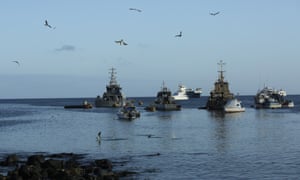
Fishing and tourist boats are anchored in the bay of San Cristóbal, Galapagos Islands, Ecuador. Photograph: Adrian Vasquez/AP
Ecuador has sounded the alarm after its navy discovered a huge fishing fleet of mostly Chinese-flagged vessels some 200 miles from the Galápagos Islands, the archipelago which inspired Charles Darwin’s theory of evolution.
About 260 ships are currently in international waters just outside a 188-mile wide exclusive economic zone around the island, but their presence has already raised the prospect of serious damage to the delicate marine ecosystem, said a former environment minister, Yolanda Kakabadse.
“This fleet’s size and aggressiveness against marine species is a big threat to the balance of species in the Galápagos,” she told the Guardian.
Kakabadse and an ex-mayor of Quito, Roque Sevilla, were on Monday put in charge of designing a “protection strategy” for the islands, which lie 563 miles west of the South American mainland.
Chinese fishing vessels come every year to the seas around the Galápagos, which were declared a Unesco world heritage site in 1978, but this year’s fleet is one of the largest seen in recent years.
Sevilla said that diplomatic efforts would be made to request the withdrawal of the Chinese fishing fleet. “Unchecked Chinese fishing just on the edge of the protected zone is ruining Ecuador’s efforts to protect marine life in the Galápagos,” he said.
He added that the team would also seek to enforce international agreements that protect migratory species. The Galápagos marine reserve has one of the world’s greatest concentrations of shark species, including endangered whale and hammerhead varieties.
Kakabadse said efforts would also be made to extend the exclusive economic zone to a 350-mile circumference around the islands which would join up with the Ecuadorian mainland’s economic zone, closing off a corridor of international waters in between the two where the Chinese fleet is currently located.
Ecuador is also trying to establish a corridor of marine reserves between Pacific-facing neighbours Costa Rica, Panama and Colombia which would seal off important areas of marine diversity, Kakabadse said.
Ecuador’s president, Lenín Moreno, described the archipelago as “one of the richest fishing areas and a seedbed of life for the entire planet”, in a message on Twitter over the weekend.
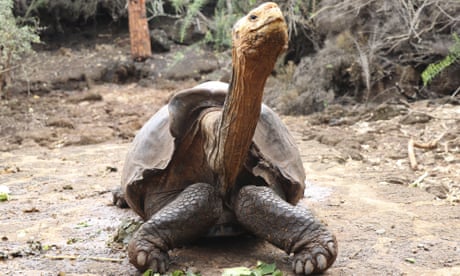
The Galápagos Islands are renowned for their unique plants and wildlife. Unesco describes the archipelago – visited by a quarter of a million tourists every year – as a “living museum and a showcase for evolution”.Advertisementhttps://tpc.googlesyndication.com/safeframe/1-0-37/html/container.html
The Ecuadorian navy has been monitoring the fishing fleet since it was spotted last week, according to the country’s defence minister, Oswaldo Jarrín. “We are on alert, [conducting] surveillance, patrolling to avoid an incident such as what happened in 2017,” he said.
The 2017 incident he referred to was the capture by the Ecuadorean navy within the Galápagos marine reserve of a Chinese vessel. The Fu Yuan Yu Leng 999, part of an even larger fleet than the current one, was found to be carrying 300 tonnes of marine wildlife, mostly sharks.
“We were appalled to discover that a massive Chinese industrial fishing fleet is currently off the Galápagos Islands,” said John Hourston, a spokesman for the Blue Planet Society, a NGO which campaigns against overfishing.
On a spring day in 2019, Alexander Kizyakov rappelled down the 60-meter headwall of the Batagay megaslump in eastern Siberia, pausing to chisel out chunks of ice-rich soil that had been frozen for eons. “One of my hobbies is rock climbing,” says Kizyakov, a permafrost scientist at Lomonosov Moscow State University. Colleagues below sampled the most ancient soil along the base of the cliff. Such work is too dangerous in summertime, when the constant crackling of melting ice is punctuated by groans as slabs of permafrost, some as big as cars, shear off the headwall.
Known to locals as the “gateway to the underworld,” Batagay is the largest thaw slump on the planet. Once just a gully on…
Logging in the Brazilian rainforest. ‘Human activity has created a continuous cycle of viral spillover and spread.’ Photograph: Brazil Photos/LightRocket via Getty Images
In late 2013, in the village of Meliandou in rural Guinea, a group of children playing near a hollow tree disturbed a small colony of bats hiding inside. Scientists think that Emile Ouamouno, who later became the first tragic “index” case in the west African Ebola outbreak, was likely exposed to bat faeces whileplaying near the tree.
Every pandemic starts like this. An innocuous human activity, such as eating wildlife, can spark an outbreak that leads to a pandemic. In the 1920s, when HIV is thought to have emerged in what is now the Democratic Republic of the Congo, scientists believe transmission to humans could have been caused by a bushmeat hunter cutting themselves while butchering a chimpanzee. In 2019, we can speculate that a person from south-west China entered a bat cave near their village to hunt wildlife for sale at the local wet market. Perhaps they later developed a nagging cough that represents the beginning of what we now know as Covid-19.Now, a growing human population, ever-encroaching development and a globalised network of travel and trade have accelerated the pace of pandemic emergence. We’re entering a new pandemic era.Advertisementhttps://6e1601c5dd35a5062108976ebb5bcf12.safeframe.googlesyndication.com/safeframe/1-0-37/html/container.html
Most pandemics begin in the emerging disease hotspots of the world; the edges of forests in regions such as west Africa, the Amazon basin and south-east Asia. Tropical rainforests are home to a rich diversity of wildlife, which in turn carry an array of viruses. We know far more about these animals than we do about the viruses they carry. An estimated 1.7m viruses exist in mammals and birds (the origins of most pandemics), but less than 0.1% have been described. They spread to millions of people each year; though they often don’t cause noticeable symptoms, the sheer volume means that plenty can.
Before humans became an agricultural species, our populations were sparser and less connected. A virus infecting a hunter-gatherer might only reach family members or perhaps a hunting group. But the Anthropocene, our new geological epoch, has changed everything. A great acceleration of human activity has dramatically altered our planet’s landscapes, oceans and atmosphere, transforming as much as half of the world’s tropical forest into agriculture and human settlements.
About one-third of emerging diseases are the product of these rapid changes in land use, as people are pushed into contact with wildlife they would once have rarely encountered. The viruses that emerge, such as Zika, Ebola and Nipah, include the latest of our foes, Covid-19, transported from the altered rural landscape of China to a city near you.
Human activity has created a continuous cycle of viral spillover and spread. Our current approach is to wait for outbreaks to start, and then design drugs or vaccines to control them. But as we’ve seen with Covid-19, this approach isn’t good enough: while we wait for a vaccine, hundreds of thousands of people have died, and millions have been infected. By the time the US produced sufficient doses to vaccinate against the H1N1 influenza pandemic in 2009, the virus had already infected about a quarter of the people on our planet.
If we are to prevent future pandemics, we will need to reassess our relationship with nature, blocking each step in the chain of disease emergence. This should begin with reducing the rampant consumption that drives deforestation and wildlife exploitation. We’ll also need to remove viral-risk species from wildlife markets, crack down on the illegal wildlife trade and work with communities to find alternatives. We should be putting more pressure on industries that harvest tropical timber and wildlife products, rewarding corporate sustainability and legislating against overconsumption. Consumer-led campaigns against palm oil, for example, have had a ripple effect on sustainability.
In a recently published paper, a number of scientists, myself included, laid out the economic case for preventing the disease spillover that leads to pandemics by reducing deforestation and the wildlife trade. We estimate that the annual costs of programmes to reduce deforestation and the wildlife trade and build pandemic surveillance in disease hotspots would be $17.7–26.9bn, more than three orders of magnitude smaller than the current estimate cost of Covid-19 economic damages, of $8.1-15.8tn. Our costs include the collateral benefits of carbon sequestration by reducing forest loss. While the coronavirus pandemic has devastated the global economy, our current trajectory could see the cost of future pandemics rocket into the tens of trillions.
As we rebuild our economies after the coronavirus pandemic, rather than returning to the system of unchecked consumption that brought us Covid-19, we have an opportunity to green our economies. Centuries of environmental exploitation have put us in a fragile position on this planet. While some may balk at the costs of avoiding environmental breakdown, or fail to understand the value of preserving a species of butterfly, frog or fish, most of us recognise that Covid-19 has brought death and economic misery on a global scale. Once we accept that human activity is what led to this, we may finally be empowered to escape the pandemic era.
• Peter Daszak is president of EcoHealth Alliance, a non-profit dedicated to analysing and preventing pandemics
Lloyd’s of London syndicates are not liable for an accident where a hunter fell from a faulty ladder and broke his back, a divided federal appeals court said Monday, in affirming a lower court ruling.
The majority opinion by the 6th U.S. Circuit Court of Appeals in Cincinnati agreed with a lower court that the coverage provided by the syndicates was for a hunting club, and the injured man was not a club member.
Brent Russcher had arranged a hunting expedition with Mark Thompson, who operated both a hunting outfitting business, Ohio Whitetail Adventures, and a hunting club, the Mark & Tommy Hunt Club, according to the ruling in Brent Russcher; Jamie Russcher, Holland Community Hospital v. Outdoor Underwriters, Inc; Certain Underwriters at Lloyd’s, London et al.
Hunting outfitters act as professional hunting guides, while hunt clubs are private groups that leased…
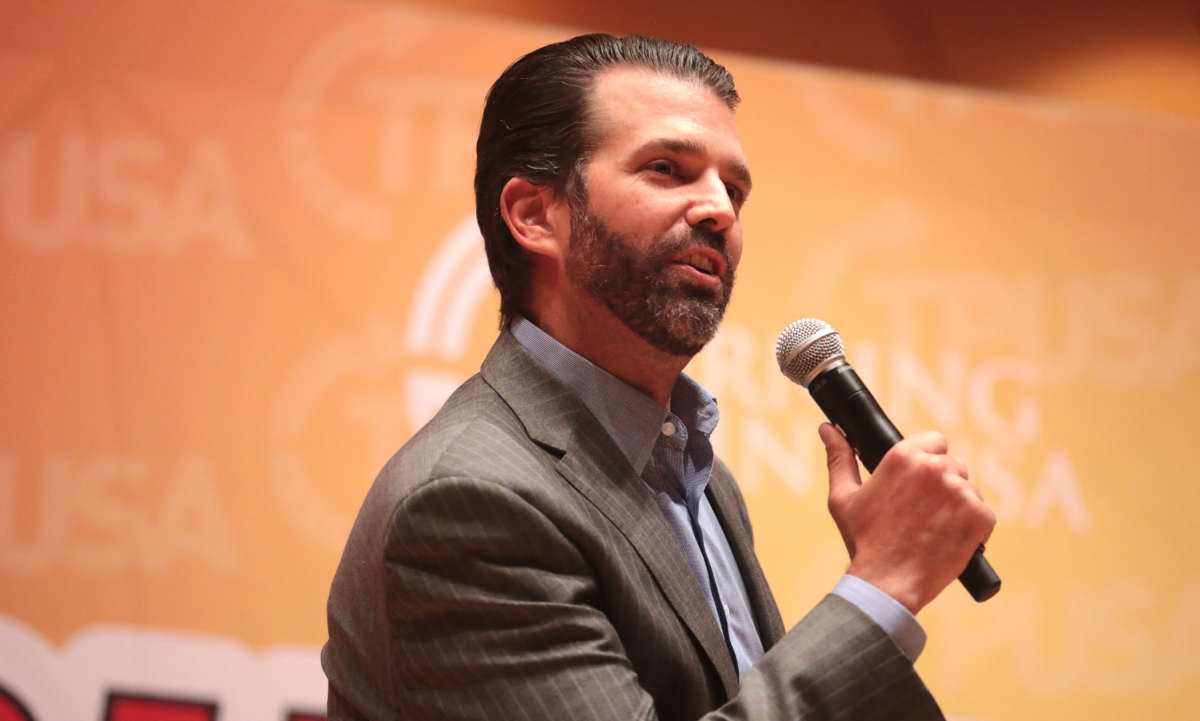
Donald Trump Jr., the eldest child of President Donald Trump, has received a suspension from the social media site Twitter for sharing potentially harmful information related to coronavirus.
“The Tweet is in violation of our COVID-19 misinformation policy,” a spokesperson for Twitter said. “The account will be locked until the account owner removes the Tweet.”
Twitter announced in March that it would regulate and remove content “when it has a clear call to action that could directly pose a risk to people’s health or well-being.” That includes content with descriptions “of alleged cures for COVID-19,” as well as the promotion of “harmful treatments or protection measures which are known to be ineffective.”
The post in question that Don Jr. had shared seems to fit those descriptors.
The president’s son retweeted a post that falsely promoted hydroxychloroquine as a cure for coronavirus. The video also showed individuals, claiming to be doctors, telling viewers “you don’t need masks” to protect themselves from the disease, contradicting recommendations from the Centers for Disease Control and Prevention (CDC).
In spite of the fact that President Trump has himself come around on the issue of masks, he, too, shared the dubious and misinformative video on his Twitter account on Tuesday, which also took aim at Anthony Fauci, the director of the National Institute of Allergy and Infectious Diseases. Twitter removed the original post, but took no action against the president’s account, as the company has a separate policy around world leaders’ accounts, stating that they will be allowed to remain in place because of their “public interest value.” However, Twitter appears not to have followed through on its policy of placing such tweets “behind a notice that provides context about the violation” in this case, though it has done so to the president’s tweets in the past.
Other social media sites, including Facebook and YouTube, have also taken actions against users who have shared the same video.
Twitter’s actions come after President Trump petitioned the Federal Communications Commission (FCC) to take more regulatory steps toward social media sites earlier this week. Trump is seeking to require such companies to “publicly disclose accurate information regarding its content-management mechanisms” in order to allow “users to make more informed choices about competitive alternatives.”
Trump also complained on Monday about Twitter’s trending topics feature, arguing that it was promoting content that portrayed him in a negative way.
“They look for anything they can find, make it as bad as possible, and blow it up, trying to make it trend,” he said.
Moves to change how the FCC treats social media are being opposed by the two Democratic appointees on the commission, who view the attempts to do so as a means for Trump to politically pressure the site.
“While social media can be frustrating, turning this agency into the President’s speech police is not the answer,” FCC Commissioner Jessica Rosenworcel said in response to Trump’s request.
By Kitty Block and Sara Amundson July 28, 2020Between March 26th and April 20th this year, FSIS approved waivers for 17 slaughterhouses to operate at faster speeds than they already did. This includes 16 chicken plants, which were allowed to speed up slaughter lines from an already lightning-fast 140 birds killed per minute to 175 per minute. Photo by Erin Van VoorhiesSlaughterhouses have emerged as hotspots for the coronavirus pandemic in the United States, with more than 37,000 cases tied to meatpacking plants and more than 160 workers dead. But instead of curtailing practices that put workers at greater risk, like fast slaughter speeds that require them to work closer together at a breakneck pace, the Trump administration has pandered to the industry by quietly issuing a record number of waivers that allow slaughterhouses to operate their lines at a faster rate than they already did. This not only exacerbates the disease risk for workers, but it also creates an animal welfare catastrophe.Today, Sen. Cory Booker, D-N.J., introduced a bill in Congress, the Safe Line Speeds During COVID-19 Act, that would require the U.S. Department of Agriculture’s Food Safety and Inspection Service (FSIS) to suspend all waivers for increased line speeds it has issued to chicken and cattle slaughterhouses during the pandemic, and stop issuing any new waivers. It would also suspend, during the pandemic, implementation of a recent rule that allows certain pig slaughterhouses to operate without any restrictions on line speeds. The bill, if it becomes law, would address many pressing animal welfare, worker safety and public health concerns caused by increased slaughterhouse line speeds.Earlier this month, Rep. Marcia Fudge, D-Ohio, introduced a similar bill in the House, H.R. 7521.Just between March 26th and April 20th this year, FSIS approved waivers for 17 slaughterhouses to operate at faster speeds than they already did. This includes 16 chicken plants, which were allowed to speed up slaughter lines from an already lightning-fast 140 birds killed per minute to 175 per minute. FSIS also granted a waiver to a cattle plant, allowing the company to increase slaughter speeds and shift inspection duties from its own inspectors to untrained plant employees.The waivers, oddly enough, were handed out even as federal agencies, including the USDA, acknowledged slower speeds could be necessary in the midst of the pandemic. A report from the Centers for Disease Control and Prevention recommended that facilities reduce their rates of animal processing to allow for critical social distancing measures. And the Occupational Safety and Health Administration called upon slaughterhouses to modify production lines to minimize the spread of the virus and allow time for workers to wash their hands with soap and sanitize equipment.Such breakneck line speeds benefit no one other than the corporations, which, according to media accounts, continue to look out for their long-term investments during the global health crisis while misleading the American public. The New York Times reported that even as meat companies warned Americans that the pandemic was pushing the United States “perilously close to the edge in terms of our meat supply,” they exported record amounts of meat to China.The animals pay a heavy price for this greed, enduring tremendous suffering in their final moments. At chicken slaughterhouses, for instance, workers struggling to keep up with the rapidly moving slaughter lines grab the chickens and slam them into shackles, injuring the animals’ fragile legs. Some birds miss the throat-cutting blade and enter the scalder—a tank of extremely hot water—alive and fully conscious, resulting in a terrible death. Dialing up line speeds only further increases the risk for more animal suffering.The conditions at crowded slaughterhouses also compromise the safety of the food placed on American dinner tables because cruel handling during slaughter increases the risk of food contamination, for example, from birds defecating in the scalder tank.We applaud Sen. Booker and Rep. Fudge for their leadership in introducing the Safe Line Speeds During COVID-19 Act and their efforts to protect animals, consumers and workers from the dangers posed by higher-speed slaughter systems. We are also grateful to the original cosponsors of the bill in the House (Reps. Rosa DeLauro, D-Conn., and Bennie Thompson, D-Miss.) and in the Senate (Sens. Richard Blumenthal, D-Conn., Dianne Feinstein, D-Calif., Kamala Harris, D-Calif., Jeff Merkley, D-Ore., Bernie Sanders, I-Vt., and Elizabeth Warren, D-Mass.)The Humane Society of the United States and Humane Society Legislative Fund have been at the frontlines of the fight to end high speed slaughter: we are challenging these systems in court, we are pressing Congressional leadership to act to end it with urgency through the appropriations process, and we will support this bill wholeheartedly until it becomes law. Big Ag has a century-long history of ignoring worker safety and animal suffering to safeguard its profits, and we will not stand by silently while our government facilitates such bald-faced greed, especially during a pandemic.Sara Amundson is president of the Humane Society Legislative Fund.The post Bills introduced in Congress to stop faster speeds at slaughterhouses appeared first on A Humane World.Related StoriesBills introduced in Congress to stop faster speeds at slaughterhousesBills introduced in Congress to stop faster speeds at slaughterhouses – EnclosureFlorida black bear cub poaching incident is a reminder of the need to coexist with wildlife
Conservation should indeed be a global priority. But understanding of the complexity and colonial roots of this problem and the shocking double standards that exist, is vital
NEXT BLOG ❯
By Tarsh Thekaekara
Last Updated: Wednesday 22 July 2020
Understanding the complexity and shocking double standards applied in global conservation is vital. Photo: Wikimedia Commons Understanding the complexity and shocking double standards applied in global conservation is vital. Photo: Wikimedia Commons Understanding the complexity and shocking double standards applied in global conservation is vital. Photo: Wikimedia Commons
It’s almost surprising when anything other than novel coronavirus disease (COVID-19) makes international headlines, but the gruesome deaths of 350 odd elephants in Botswana broke through. I’m an elephant researcher based in the Nilgiri Hills of South India. So within hours, I was deluged by queries from shocked elephant enthusiasts.
The images were distressing. They didn’t look like rotting carcasses — they seemed…






 Exposing the Big Game