Harrison SilcoxPublished: Jan 11, 2021 11:57 AM | Updated: Jan 11, 2021 1:06 PM
BARTHOLOMEW COUNTY, Ind.– The Indiana Department of Natural Resources (DNR) is investigating an apparent hunting accident that claimed the life of a Bartholomew County man.
When a hunter failed to return home Sunday morning, a family member went to look for him and found him unresponsive. Conservation officers were dispatched to the 9200 block of South State Road 58 at 9 a.m.
John Walker, 54, of Columbus, was found with a gunshot wound that initial investigation suggests came from an accidental discharge of his firearm. Walker was pronounced dead at the scene.
DNR is awaiting autopsy results and the investigation remains ongoing.
Have you ever spoken to your pet thinking you went crazy? You can now calm yourself down since studies have shown that talking to your pet doesn’t mean you are nuts but smart.
Pet owners often talk to their beloved furry companions. Many who don’t own pets might think that people who talk to their pets should go check themselves. But it’s now official, people who speak to their pets are smarter than those who don’t.
Studies have shown that people who have conversations with their pets considered to be of higher intelligence. Anthropomorphizing is the act of attributing human characteristics and purposes to inanimate objects, animals, plants, etc.
Nicholas Epley, a professor of Behavioral Science at the University of Chicago said: “Historically, anthropomorphizing has been treated as a sign of childishness or stupidity, but it’s actually a natural byproduct of the tendency that makes humans uniquely smart on this planet,”.
The most common way humans anthropomorphize is giving pets human names. While Anthropomorphizing can also be attributing of human characteristics to inanimate objects, your brain would get confused for a second if you see human eyes on a door.
Anthropomorphism is a sign of intelligence and creativity and it higher your pet intelligence as well. Speaking to your pets, teaches them words and gestures, think about it, does your dog know when you are angry with him? As a by-product of anthropomorphism, they notice that you’re angry and manipulate you with a sad face.
Ariana Quesada, 16, holds a photo of her father, Benito Quesada, with her little brother, Aldrin, as she stands in front of the RCMP detachment in High River, Alta. Her father died after becoming one of hundreds of workers at Cargill’s High River meat-processing facility to contract COVID-19. (Justin Pennell/CBC)
705 comments
Ariana Quesada, 16, walked into the RCMP detachment in High River, Alta., on Friday and filed a formal complaint asking police to investigate potential criminal negligence in the death of her father.
Benito Quesada, a 51-year-old immigrant from Mexico supporting a wife and four children, was hospitalized with COVID-19 in mid-April, one of hundreds of workers at the town’s Cargill meat plant infected with the coronavirus.
He had been in a coma and on a ventilator when he died on May 7. His family had been barred from visiting — except to say goodbye.
The Quesadas are demanding accountability from Cargill, alleging the company didn’t do enough to protect Benito from the coronavirus.
“We have filed a complaint … to finally bring justice to my dad … to finally hold Cargill accountable for what they did,” Ariana Quesada said, fighting back tears.
“I spent Christmas with one less person to hug,” she said. “And all the executives and general managers, everyone at Cargill got to spend Christmas with their loved ones. And I did not get that.”
Workers prepare beef to be packaged at the Cargill facility near High River, Alta., before the pandemic was declared. The plant is the site of what was at one point the largest COVID-19 outbreak in North America. (Name withheld)
The RCMP confirmed it has now opened an investigation. The probe is the first known instance in Canada of police investigating a workplace-related COVID-19 death.
“We have created a file, so to speak. An investigation has commenced,” Staff Sgt. Greg Wiebe, the detachment commander, told CBC News late Friday, noting the matter is in its preliminary stages as the RCMP review the complaint and assigns appropriate resources.
“It’s not going to be your routine investigation, certainly. There’s probably a lot of moving parts to it,” Wiebe said.
At least 950 staff at the Cargill plant — nearly half its workforce — tested positive for COVID-19 by early May in what remains the largest workplace outbreak in Canada.
As part of the national food supply chain, slaughterhouses and meat-processing facilities were deemed essential by governments, and Cargill stayed open as the pandemic worsened. It continued operating until April 20, when it was shut down for two weeks because of the surging outbreak among its staff.
Cargill spokesperson Daniel Sullivan declined to comment without seeing the complaint to police. But in an email on Saturday, he said that safety is a top priority for the company and that since the beginning of the pandemic, it has worked closely with provincial health and occupational health and safety officials.
“Maintaining a safe workplace has long been one of our core values, and we recognize that the well-being of our plant employees is integral to our business and to the continuity of the food supply chain throughout Canada,” the statement read.
Cargill is also facing a proposed class-action lawsuit on behalf of individuals who had close contact with Cargill employees. They allege the company operated without adequate safeguards despite public health warnings.
Across Canada, at least 33 compensation claims for work-related deaths have been accepted by provincial insurance boards for people who contracted COVID-19 on the job, according to figures obtained by CBC News.
But the real number of workplace deaths from the illness is likely far greater, given that not all cases are reported and not all workplaces are covered by provincial compensation plans.
WATCH | Ariana Quesada hopes to ensure other families won’t suffer:
Daughter lays police complaint in COVID-19 work death
2 days agoVideo0:59Family prompts COVID-19 police probe into Alberta meat plant — Canada’s largest workplace outbreak. 0:59
But there are other similar cases from the first wave of the pandemic that police have been asked to investigate.
A union representing front-line health-care workers in Ontario has called for investigations into the COVID-19 deaths of three personal support workers in the Greater Toronto Area who allegedly didn’t have adequate personal protective equipment (PPE) in the early weeks of the health crisis.
The cases raise questions about the strength and effectiveness of Canada’s occupational health and safety system and its ability to protect essential workers from exposure to the virus.
Pressure to work despite positive COVID-19 tests
The complaint filed on Friday against Cargill cites the Westray Law, a Criminal Code provision named after a deadly mining disaster in Nova Scotia in 1992 that imposes a duty on all employers to take “reasonable steps to prevent bodily harm” to workers.
The Quesadas allege that Cargill failed to heed early public health warnings and failed to protect workers from a known, deadly threat.
“Employers need to do far better than what happened in High River in the spring,” said Michael Hughes, a spokesperson for the United Food and Commercial Workers union, which has been helping the Quesada family.
Cargill’s meat-processing facility in High River, Alta., on Jan. 8. The company is facing an RCMP investigation and a proposed class-action lawsuit following a large COVID-19 outbreak at the plant. (Justin Pennell/CBC)
Hughes said that for a company such as Cargill, which reported revenue of $113.5 billion US in 2019, the threat of fines for labour and safety violations isn’t necessarily a strong deterrent, which is why the complaint was made to police.
“I think what the situation at Cargill really exposed is that there are severe limits to accountability” under current workplace rules, he said.
The written complaint suggests Benito Quesada died due to criminal negligence and alleges the following failures by Cargill to prevent the spread of the virus:
The company failed to provide adequate PPE.
Workers on production lines were not physically distant.
Lunchrooms were crowded, with tables less than half a metre apart.
Company medical personnel cleared workers for duty despite positive COVID-19 tests or symptoms.
Workers faced unpaid, temporary layoff if they didn’t report for work out of fear of the virus.
Workers were promised a $500 bonus for not missing a shift over a two-month period.
The family says that while Benito Quesada isolated at home as a precaution and told family members to stay away from him, he continued to go to work, motivated by the $500 that would have made a big difference for the family of six.
The RCMP investigation is now in its preliminary stages and no charges have been laid. The allegations have not been tested in court.
The CBC’s own investigation last spring found numerous workers who said they continued to work elbow to elbow and felt pressured to show up when sick as Cargill tried to keep its meat-processing lines moving.
Four workers said they were pushed to report for shifts or even cleared for duty by a company nurse, despite testing positive for COVID-19 or continuing to exhibit symptoms.
Provincial health and safety inspectors did not conduct in-person inspections at the Cargill plant in the first few months after the pandemic was declared.
Alberta Occupational Health and Safety instead conducted an inspection via video link on April 14 — around the same time Benito Quesada was admitted to hospital.
Officials allowed the plant to remain open. Alberta Agriculture Minister Devin Dreeshen reassured staff the worksite was safe during a telephone town hall on April 18.
But two days later, with at least 360 confirmed cases among its workers, Cargill announced a complete shutdown for two weeks.
The Quesada family’s police complaint alleges Cargill managers failed to provide an accurate picture of conditions inside the plant during the province’s video inspection.
Cargill’s spokesperson said in a statement that provincial officials have been on-site multiple times during the pandemic and have approved of the company’s actions. The spokesperson also said the company’s operations meet or exceed federal health and safety standards.
Police probes sought in Ontario
Police in Ontario have been reluctant to step in after receiving formal requests for criminal negligence investigations in the deaths of three front-line health-care workers.
Arlene Reid, 51, Sharon Roberts, 59, and Christine Mandegarian, 54, were all personal support caregivers who contracted COVID-19 in April. They worked in the homes of elderly patients or inside long-term care facilities.
Their union filed complaints last spring with police in Toronto and Peel Region against their three employers alleging criminal negligence and failure to provide adequate protective equipment to staff. The union also accuses provincial health and safety officials of failing to ensure that the essential workers were safe.
Arlene Reid, 51, Sharon Roberts, 59, and Christine Mandegarian, 54, were personal support caregivers in Ontario who died after contracting COVID-19 in April. They worked in the homes of elderly patients or inside long-term care facilities. (Submitted)
“A worker inside a home, a nursing home, happens to be a woman, and happens to be a woman of colour, dies because of an infection that she contracted at work. If this was a construction site, it would have been shut down immediately and investigated,” said Sharleen Stewart, president of SEIU Healthcare, which represents more than 60,000 front-line health-care workers in Ontario.
Stewart said health-care facilities in Ontario should have been much better prepared for COVID-19 given the recommendations that came from the public inquiry into the deadly SARS outbreak of 2003.
All three employers expressed sadness and offered condolences to the families of the workers who died. But they also flatly rejected the union’s claims, arguing each closely followed public health advice and infection control protocols.
“Facing the first wave of a global pandemic of the scale of COVID-19, Downsview Long Term Care Centre did everything possible to protect the health and safety of our workers and our residents,” James Balcom, chief operating officer at GEM Health Care Group, which owns the facility where Sharon Roberts worked, said in a statement to CBC News.
“These allegations by the union are false and highly irresponsible.”
Unlike the RCMP in Alberta, police in these three cases have not opened criminal investigations and have instead deferred to provincial coroners and the Ontario Ministry of Labour. Criminal charges carry more serious penalties than the provincial charges the ministry can impose.
Labour inspector investigations are ongoing in all three cases.
Health and safety system swamped by complaints
Katherine Lippel, a law professor at the University of Ottawa, says provincial health and safety inspectors across Canada struggled to do their jobs in the early days of the pandemic.
She called it a “catastrophic” situation in which essential industries scrambled to protect workers while the provincial health and safety system was swamped by a wave of employee complaints stemming from fears of exposure to the virus.
Katherine Lippel, a workplace safety law expert at the University of Ottawa, says ideally, provinces would have more trained inspectors in the field to prevent workplace deaths. (Submitted by Katherine Lippel )
“On paper, the laws look pretty good. But in practice, there is no assurance on a day-to-day basis that we’re prepared for something like COVID-19,” Lippel said in an interview.
While asking police to investigate is serious business, Lippel said, Canada has a poor track record of actually prosecuting and convicting employers under the Westray Law for failing to protect workers. There have been only six convictions or guilty pleas under the law since it was passed in 2004.
Ideally, she said, provinces would have more trained inspectors in the field to prevent workplace deaths in the first place.
“The police tend to look for a criminal. They don’t look for the cause of the crime,” Lippel said. “And what we really need, if we’re going to have adequate prevention, is competent and numerous inspectors who are looking at the cause of the catastrophe.”
A tiny mouse-like animal has been spotted on Santa Catalina Island off Southern California for the first time since 2004, showing that the species is not extinct.
A Catalina Island Shrew was spotted in a photograph taken by a remote “camera trap” during a major effort to detect the diminutive animal early last year, the Catalina Island Conservancy said Wednesday.
(Photo by Catalina Island Conservancy)
“We have been looking for the Catalina Island Shrew for years,” said conservancy wildlife biologist Emily Hamblen said in a statement. “I thought, and really hoped, that they still existed somewhere on the Island.”
The Catalina Island Shrew was listed as a species of special concern by the California Department of Fish and Wildlife in 1996.
An adult shrew is just 3.74 inches (95 millimeters) long…
The gray wolf has been removed from the federal Endangered Species List, allowing the Wisconsin Department of Natural Resources and other state agencies to assume management of the species.
The delisting decision, announced by the U.S. Fish and Wildlife Service in late October and published in early November, became effective Jan. 4.
The change allows lethal measures to be used on the animals, including the killing of wolves that cause depredation of livestock as well as the use of hunting and trapping seasons to manage populations of the native predators.
In a statement, the DNR said it has “successfully managed gray wolves for decades and will continue to do so in accordance with the laws of our state and the best science available.”
The state most recently held management authority over wolves from 2012-14, when it held three hunting and trapping seasons and killed 528 wolves. A federal judge returned wolves to the Endangered Species List in Dec. 2014.
Wisconsin law requires a wolf hunting and trapping season to be held when the species is not under protections of the Endangered Species Act. The DNR plans to begin the next wolf season Nov. 6.
The agency also said it is working to complete a 10-year wolf management plan to help guide future management decisions for the species in Wisconsin.
Although delisted, it remains unlawful to shoot a wolf unless there is an immediate threat to human safety. Or, if on private land, a wolf can be shot and killed if it is in the act of killing or wounding livestock or a domestic animal such as a pet.
Under state management, the payouts for wolf depredations will also be delayed until the end of the year, and could be pro-rated based on available funds, said Brad Koele, DNR wildlife damage specialist.
State statute allows payments of $2,500 to hound hunters and others who have lost dogs to wolves. But that could be reduced if insufficient funds are available.
Wolf depredations in Wisconsin were running higher in 2020. A DNR report through the end of October showed 90 confirmed or probable wolf depredations, compared to full-year depredations of 82, 73 and 61 in 2019, 2018 and 2017, respectively.
No wolf depredation of a farm animal or pet has occurred in Wisconsin so far in 2021, according to state data.
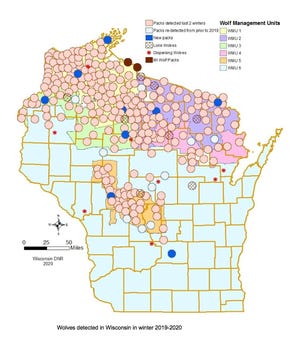
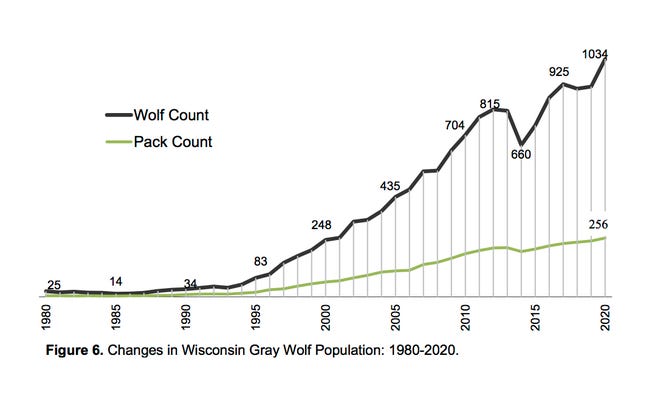
The DNR estimated the 2019-20 Wisconsin wolf population at a modern-era high of 1,195 animals and 256 packs.
No case of a wolf attack on a human has been verified in Wisconsin history.
If wolf depredation is seen or suspected, the public should contact USDA-Wildlife Services at (800) 228-1368 in northern Wisconsin and (800) 433-0663 in the rest of the state.
To assist with the investigation, USDA-Wildlife Services recommends not moving or unnecessarily handling a carcass as well as preserving any evidence at the kill site by using a tarp to cover a carcass to discourage scavengers and preserve any tracks, scat and other material.
The delisting was opposed by American Indian tribes and many environmental and animal protection organizations.
Several groups, including Defenders of Wildlife, have vowed to overturn the delisting through legal action.
At least that’s the assessment of Kim Thorburn, a Washington Department of Fish and Game commissioner from Spokane.
“I’m pretty upset about what’s going on,” she said. “We’re looking at hunters as an enemy.”
Although she believes the assault has been brewing for a long time, Thorburn points to a recently filed lawsuit looking to outlawspring bear huntingand last year’s ban oncoyote killing contests.
“They just come one item at a time,” she said.
Meanwhile, the appointment of two new WDFW commissioners by Gov. Jay Inslee has drawn criticismand concern from hunters and hunting groups. Some environmental organizations praised the appointments. The commissioners both have backgrounds in wildlife…
Polar vortex set to unleash Arctic air after a two-year hiatus
Frigid temperatures already sending gas prices to record highs
Lake Michigan as the Polar Vortex sent temperatures well below zero in Chicago on Jan. 7, 2014. Photographer: Raymond Boyd/Getty Images
High in the atmosphere above the North Pole, a spike in temperatures may soon send bone-rattling chills spilling down through the Northern Hemisphere.
The icy blasts threatening to sweep across North America, Europe and Asia starting in late January are from the same weather pattern that triggered the 2014 cold snap known as the polar vortex, which plunged temperatures in Chicago to minus 16 degrees Fahrenheit (minus 27 Celsius).
It’s common during winter for frigid air to roar down from the Arctic. But the cold mostly stayed bottled up around the North Pole in the season of 2019-2020. Now, after a nearly two-year hiatus, winter is threatening to return at last.
To be clear, forecasters aren’t expecting the cold to be as brutal as during the 2014 polar vortex, which was an extreme example of Arctic weather marauding south. But it will feel unmistakably like winter.
The cold has already descended upon Western Europe and China, sending prices for gas in Spain, and liquefied natural gas in Asia, to record highs. Paris has been 3.5 degrees below normal and Madrid 6.9 degrees cooler, while Beijing temperatures fell to a record low of minus 9 Thursday, said Tyler Roys, a meteorologist at AccuWeather Inc.
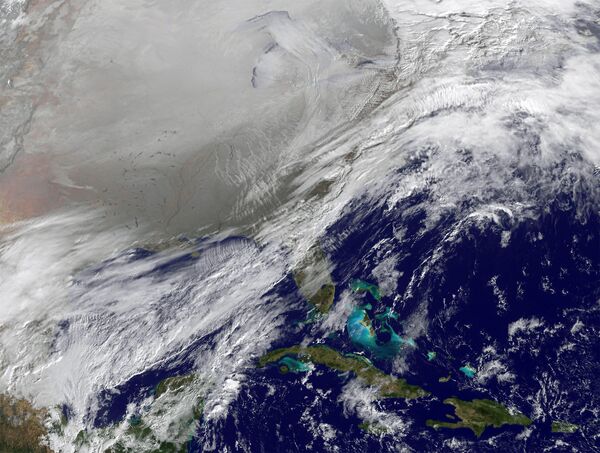
A satellite image shows the entry of a large area of low pressure, from the Polar Vortex, into the Northern U.S., on Jan. 6, 2014.Photographer: NOAA/Getty Images
The vortex of seven years ago kept shoppers indoors, grounded flights and made it harder for shippers to fill product orders. This year, the pandemic has already hobbled travel and in-store shopping. Snowstorms, however, could be a nightmare for delivery services.
Technically, the polar vortex refers to a band of winds that encircle the Arctic and keep the cold locked far to the North. But with that temperature spike, known as sudden stratospheric warming, the band can buckle, allowing frigid air to head south. Gas traders used to call it the “polar pig.”
That could mean chills anywhere in the Northern Hemisphere, though this year it’s likely to end up in the U.S. according to Ryan Truchelut, president of Weather Tiger LCC. A wave of deep cold could give the Great Lakes and East Coast their first real blast of frigid winter weather, along with a storm pattern that delivers snow storms as well.
It will be a big shift for the U.S., where winter has been a bit lackluster so far. In New York, January readings have been 5.1 degrees above normal through Thursday, and Chicago has been 7.2 degrees warmer for the month.
Still, there’s no guarantee it will happen. While a sudden stratospheric warming usually leads to a burst of frigid weather, sometimes the clockwork of gears in the atmosphere doesn’t deliver.
“Many times in the past, the forecast for a cold weather event across the country resulted in a false alarm,” said Jim Rouiller, lead meteorologist with the Energy Weather Group LLC.
As Congress and President Donald Trump’s Cabinetfacemounting pressure to immediately remove him from office for inciting a violent mob at the U.S. Capitol, Twitter announced Friday that it is permanently suspending the president’s personal account,@realDonaldTrump, for violating the platform’s rules.
“After close review of recent tweets from the@realDonaldTrumpaccount and the context around them — specifically how they are being received and interpreted on and off Twitter — we have permanently suspended the account due to the risk of further incitement of violence,” the social media companyexplainedin a blog post.
Karen Hobert Flynn, president of Common Cause, said in a statement that…
PARIS (AFP) — French producers of foie gras called Thursday for a mass preventive cull of ducks to try to halt the spread of a severe strain of bird flu that is ripping through poultry farms in the southwest of the country.
The highly pathogenic H5N8 virus was first detected in a bird in a pet shop on the Mediterranean island of Corsica in November before spreading to duck farms on the mainland in December.
Several European countries have reported cases of infection, five years after a major outbreak prompted the slaughter of millions of ducks in France.
“The virus is stronger than us. New clusters are constantly emerging,” the…












 Exposing the Big Game