A study in the journal Nature Climate Change figures the carbon pollution already put in the air will push global temperatures to about 2.3 degrees Celsius.
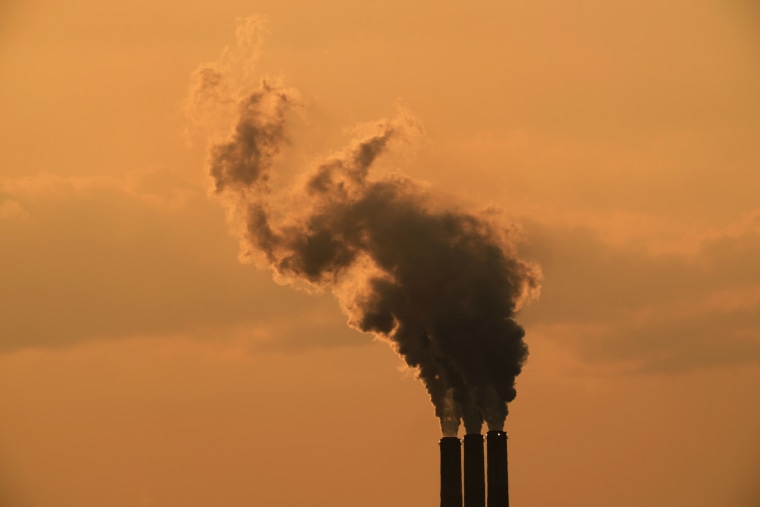
Smoke billows from the Jeffrey Energy Center coal-fired power plant on Sept. 12, 2020, near Emmet, Kan.Charlie Riedel / AP fileJan. 5, 2021, 6:15 AM PST/UpdatedJan. 5, 2021, 6:17 AM PSTByAssociated Press
The amount of baked-in global warming, from carbon pollution already in the air, is enough to blow past international agreed upon goals to limit climate change, a new study finds.
But it’s not game over because, while that amount of warming may be inevitable, it can be delayed for centuries if the world quickly stops emitting extra greenhouse gases from the burning of coal, oil and natural gas, the study’s authors say.
For decades, scientists have talked about so-called “committed warming” or the increase in future temperature based on past carbon dioxide…
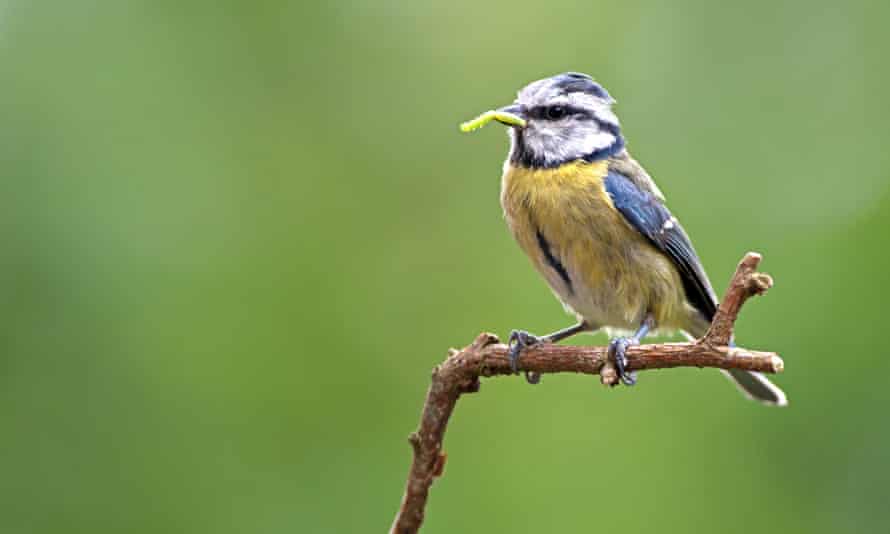
A blue tit with food for its young. If they fail to respond rapidly to earlier springs, their numbers will plummet. Photograph: Lisa Geoghegan/AlamyStephen Moss@stephenmoss_tvSun 3 Jan 2021 01.45 EST
Lockdown has sparked a renewed interest in our garden birds, with millions of us enjoying watching them from our windows. But could some species – including the common and familiar great tit – vanish from Britain’s gardens by the end of the century?
Researchers from the Norwegian University of Science and Technology, working with the University of Oxford, have modelled how great tits are reacting to the climate crisis. Specifically, are the birds able to respond to the earlier emergence of the caterpillars on which they feed their chicks?
Birds such as great tits have evolved to time their breeding cycle so it coincides with the peak of moth caterpillars that feed on oak leaves, which traditionally happens in late May and June. But as temperatures rise, so oaks are coming into leaf earlier, and the caterpillars have responded by hatching out earlier too.
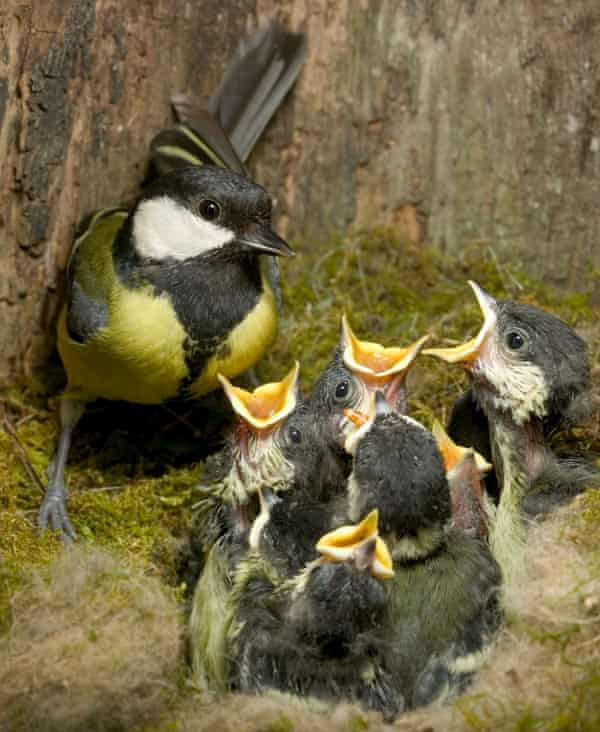
This means that when the great tit chicks are ready to be fed, the peak of caterpillars is already coming to an end. Because the parent birds need to find 1,000 caterpillars every day for their hungry offspring, any mismatch is likely to dramatically reduce breeding success.
A great tit with lots of hungry mouths to feed. Photograph: Andrew Darrington/Alamy
The researchers found that although the birds can respond to climatic shifts, they are not doing so quickly enough. Lead author Emily Simmonds estimates that the tipping point comes when oak leaves, and their associated caterpillars, appear 24 days earlier than usual.
The discovery that birds can and do respond to climate change by breeding earlier than normal was first made in the 1990s by Dr Humphrey Crick, a scientist working at the British Trust for Ornithology. He was analysing thousands of cards from the BTO’s long-running Nest Record Scheme, which had been filled in by amateur birdwatchers over the previous half-century, detailing the dates when eggs are laid and chicks hatch.Advertisementhttps://9911c2d216ab4f245f95ddb4284ceb8c.safeframe.googlesyndication.com/safeframe/1-0-37/html/container.html
Crick noticed a surprising trend: for many species, the date on which they laid their eggs had moved forward by an average of nine days. The resulting landmark paper, “UK birds are laying eggs earlier”, published in the journal Nature in 1997, provided some of the earliest empirical evidence that wild creatures were already responding to a warming climate.
A decade later, in 2006, I remember Bill Oddie introducingd Springwatch with the astonishing news that every blue tit nest they were monitoring had already fledged young – several weeks earlier than usual. Because blue tits only have one brood, they must respond very rapidly to changes such as earlier springs. If they fail to do so quickly enough, their numbers will plummet.
At the end of his 1997 paper, Humphrey Crick made this prophetic comment: “For birds, earlier nesting could be beneficial if juvenile survival is enhanced by a prolonged period before winter. Conversely, birds may be adversely affected if they become unsynchronised with the phenology of their food supplies.”
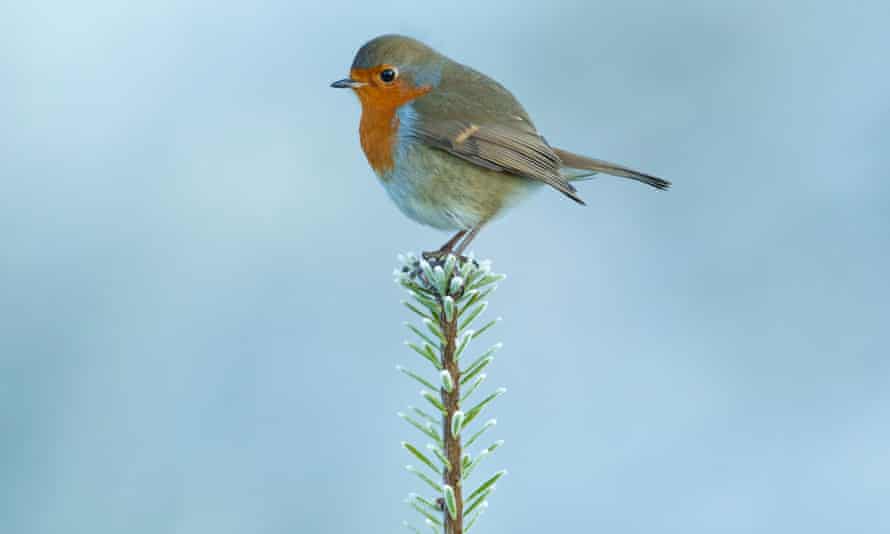
A longer breeding season benefits birds such as the robin, which produce two or more broods. Photograph: incamerastock/Alamy
Less than a quarter of a century later, both parts of that prediction appear to be coming true. In the short term, a longer breeding season has benefits, especially fr birds such as the robin, blackbird and song thrush, which produce two or more broods of young. Starting to nest earlier in the year might allow them to squeeze in an extra brood, and so produce more offspring in total.
Professor James Pearce-Higgins, the BTO’s director of science, points out that our smallest birds, such as goldcrests, wrens and long-tailed tits, are benefiting from another aspect of climate change: the much milder winters of recent years.
He also points to the positive impact of our habit of feeding garden birds, which helps species such as blue tits, great tits and goldfinches. At present, he suggests that the advantages of higher winter survival rates outweigh the failure to synchronise with the spring food supply, though that may not always be so.
Another climate-driven success is the way many species are now expanding northwards. The latest European Breeding Bird Atlas reveals that, on average, the ranges of Europe’s breeding birds have shifted north by 28km (17.5 miles) since the original survey was done in the late 1980s – almost 1km every year.
But as our climate becomes less predictable, with more extreme weather events such as storms, droughts and floods, what scientists have called the “honeymoon period” will come to an abrupt end.
As Professor Pearce-Higgins notes, ground-feeding birds may not be able to cope with prolonged summer droughts, which make it harder for them to find food: “One potential exception to this positive picture of warmer temperatures is thrushes and blackbirds, which rely on soil invertebrates. We know, from a study we have run recently asking schoolchildren to count earthworms in school playing fields, that the availability of worms – a major food source for many species – declines significantly in summer, particularly when it is dry.”
So, as we stand on the precipice of a runaway warming world, the future for many of our best-known and best-loved birds remains in the balance.
Foreign policy experts are sounding the alarm that U.S. President Donald Trump could launch an assault on Iran in the final weeks of his administration, potentially provoking a full-blown war just days before President-elect Joe Biden’s inauguration.
Fears of a military confrontation are mounting in the wake of the Pentagon’sannouncementSunday that the USS Nimitz would remain in the Middle East — a reversal of Friday’sdecisionto signal a de-escalation of hostility toward Tehran by redeploying the aircraft carrier out of the region prior to this past weekend’s one-year anniversary of the Trump-orderedassassinationof Iranian general Qasem Soleimani.
Nature has equipped Earth with several giant “sponges,” or carbon sinks, that can help humans battle climate change. These natural sponges, as well as human-made ones, can sop up carbon, effectively removing it from the atmosphere.
But what does this sci-fi-like act really entail? And how much will it actually take — and cost — to make a difference and slowclimate change?
Sabine Fuss has been looking for these answers for the last two years. An economist in Berlin, Fuss leads a research group at the Mercator Research Institute on Global Commons and Climate Change and was part of the original Intergovernmental Panel on Climate Change (IPCC) — established by the United Nations to assess the science, risks and impacts…
(CNN)UK Prime Minister Boris Johnson reimposed a lockdownin Englandon Monday as a more transmissible variant of Covid-19 fuels a surge in infections and hospitalizations in the country.”It is clear that we need to do more to bring this new variant under control,” Johnson said. “That means the government is once again instructing you to stay at home.”During his televised address to the nation, Johnson reimposed measures seen during the first lockdown last spring, including closures of secondary and primary schools to all except the children of key workers and vulnerable children. People will be allowed to leave their homes for limited reasons like shopping for essentials, exercise, and medical assistance.Johnson also said people could still leave home “to escape domestic abuse” — an issue thatarose earlier during the pandemic
(CNN)The top House Republican has quietly blessed an effort by conservative lawmakers to overturn President-elect Joe Biden’s victory when a joint session of Congress meets later this week, even as other top congressional Republicans are raising alarms that the push could cause lasting damage to a pillar of democracy.The conservatives said on Sunday that House Minority Leader Kevin McCarthy has been supportive of their plans, a stark contrast from the position of many prominent Republicans — including Senate Majority Leader Mitch McConnell, Wyoming Rep. Liz Cheney and the former House speaker, Paul Ryan — who have publicly and privately raised major concerns about an effort that is doomed to fail but is bound to sow distrust over the sanctity of US elections.The internecine fight, which will play out on Wednesday when a joint session of Congress meets to affirm Biden’s Electoral College win, has turned into a loyalty test of sorts to President Donald Trump who has launched an unprecedented campaign to subvert the will of voters by making unsubstantiated claims of a rigged election that have been rejected by courts across the country.McCarthy, who has yet to acknowledge Biden’s victory and has said little publicly about the challenge, has joined two GOP conference calls in recent days during which the January 6 battle has been a subject of debate, including one on Saturday night and another on New Year’s Day.Content by Blue ApronThis meal kit is like having your own personal chefMiss restaurant-quality menus? Blue Apron is like having a sous chef in your own kitchen.On the New Year’s Day call, some members pressed McCarthy to specify his position, according to a person with knowledge of the call.On Sunday, several of those conservatives said there’s little doubt where McCarthy stands.close dialog
Sign up for CNN What Matters NewsletterEvery day we summarize What Matters and deliver it straight to your inbox.Sign Me UpNo ThanksBy subscribing you agree to ourprivacy policy.“Kevin McCarthy’s part of the team,” said Rep. Mo Brooks, Republican from Alabama who is leading the charge, adding that the California Republican has “told that to the President of the United States” as well as Ohio Rep. Jim Jordan.Asked if McCarthy had discouraged the effort at all, Jordan told CNN on Sunday: “Kevin’s been great. Kevin’s been fine. Kevin’s been great on this whole process.”Asked for comment, a McCarthy spokesman referred a reporter to comments the GOP leader made Saturday night on Fox News where he welcomed an audit into the election results, something that 11 GOP senators called for on Saturday before agreeing on whether to vote to affirm Biden’s win.
Republican efforts to undermine Biden victory expose growing anti-democratic streak“If you want to unite this nation, you start with having integrity in your election,” McCarthy said. “There are questions out there. … What’s wrong with bringing the information back so people have all the information to make those decisions?”Yet with GOP court challenges failing across the country, states certifying the results and the Electoral College voting to make Biden’s win official, some of McCarthy’s deputies and many Senate Republicans say joining Trump to mount a baseless campaign against the election will only hurt faith in democracy.On the New Year’s Day call, Cheney, the No. 3 House Republican, made clear her distaste for the push, multiple sources told CNN.Cheney told House Republicans that voting on the election is more consequential than any other vote — including votes to authorize war, according to two sources. She also argued that nothing in the Constitution supports the notion that Congress can substitute its views for voters in those states selecting the next President.In a 21-page memo sent to Republicans on Sunday, Cheney argued that objecting to the Electoral College count is unconstitutional and sets an “exceptionally dangerous precedent.””As you will see, there is substantial reason for concern about the precedent Congressional objections will set here. By objecting to electoral slates, members are unavoidably asserting that Congress has the authority to overturn elections and overrule state and federal courts,” she wrote. “Such objections set an exceptionally dangerous precedent, threatening to steal states’ explicit constitutional responsibility for choosing the President and bestowing it instead on Congress. This is directly at odds with the Constitution’s clear text and our core beliefs as Republicans.”Also on Sunday, a group of seven other House Republicans said in a joint statement that they also do not support their colleagues objecting to the certification of Electoral College votes this week because it is the responsibility of the states to choose electors, not Congress. They did not dismiss allegations of voter fraud, but pointed to “the narrow role” Congress has in the presidential election process.”We must respect the states’ authority here. Though doing so may frustrate our immediate political objectives, we have sworn an oath to promote the Constitution above our policy goals. We must count the electoral votes submitted by the states,” wrote the group, which included Reps. Thomas Massie of Kentucky, Kelly Armstrong of North Dakota, Ken Buck of Colorado, Mike Gallagher of Wisconsin, Tom McClintock of California and Chip Roy of Texas and Rep.-elect Nancy Mace of South Carolina.While the effort is certain to fail, it’s bound to put Republicans in a difficult spot. If one senator joins with a House member to object to a state’s electoral count, each chamber must debate the merits of the objection for up to two hours before casting a vote on whether to affirm the objection. The objections are certain to fail in both chambers, even though they could win the backing of a majority of House Republicans.
Nearly a dozen Republican senators announce plans to vote against counting electoral votesCheney’s argument has been echoed by a number of top Republicans, including McConnell and his deputies, as well as the party’s 2012 presidential nominee, Sen. Mitt Romney of Utah.Ryan sided with his 2012 runningmate Sunday. “Efforts to reject the votes of the Electoral College and sow doubt about Joe Biden’s victory strike at the foundation of our republic,” the former speaker said in a statement. “It is difficult to conceive of a more anti-democratic and anti-conservative act than a federal intervention to overturn the results of state-certified elections and disenfranchise millions of Americans. The fact that this effort will fail does not mean it will not do significant damage to American democracy.”Others made clear they want their colleagues to drop the effort.”I like to come up with plans that have a chance of being successful,” said Sen. Roy Blunt, a member of the Senate GOP leadership team.Sen. Dan Sullivan, a Trump ally who just won reelection in Alaska, said he would “listen to” the arguments, but is “very dubious.”Yet at least a dozen Senate Republicans, including four incoming freshmen, are indicating they plan to vote against certifying the election results, arguing instead there needs to a commission to probe potential voter fraud, even as courts have turned back dozens of challenges by Trump and his allies about the election results since November 3.Sen. Roger Marshall, the new freshman Republican from Kansas, defended the effort.”I had to make a decision of the heart,” Marshall said of his decision to join the effort. “And this is a decision of the heart to follow through on some of these irregularities.”Sen. Tommy Tuberville, the incoming Alabama freshman who also is part of the effort, claimed he had “not lately” spoken to Trump about the challenge and said “no,” he hadn’t spoken with McConnell, either. He declined to address criticism he’s received from the effort, which is opposed by the senior Alabama senator, Republican Richard Shelby.
Why Josh Hawley’s move could endanger Senate Republicans“I’m on the other side of that,” Shelby said when asked if he would join Tuberville. “It’s time to move on.”Trump’s staunchest defenders are plotting to object to six states’ election results, something that could extend floor debate through the day on Wednesday and into Thursday.But even after Trump loses the votes, his closest allies say he still shouldn’t concede the race where the result has been clear for nearly two months.”Absolutely not,” Brooks said when asked if Trump should concede after the joint session affirms Biden’s victory. “There’s no question at all in my mind that, if we were to only count lawful votes cast by eligible American citizens, Donald Trump won the Electoral College. Under those circumstances you should never concede because you didn’t lose. It was stolen.”This story has been updated with additional developments.
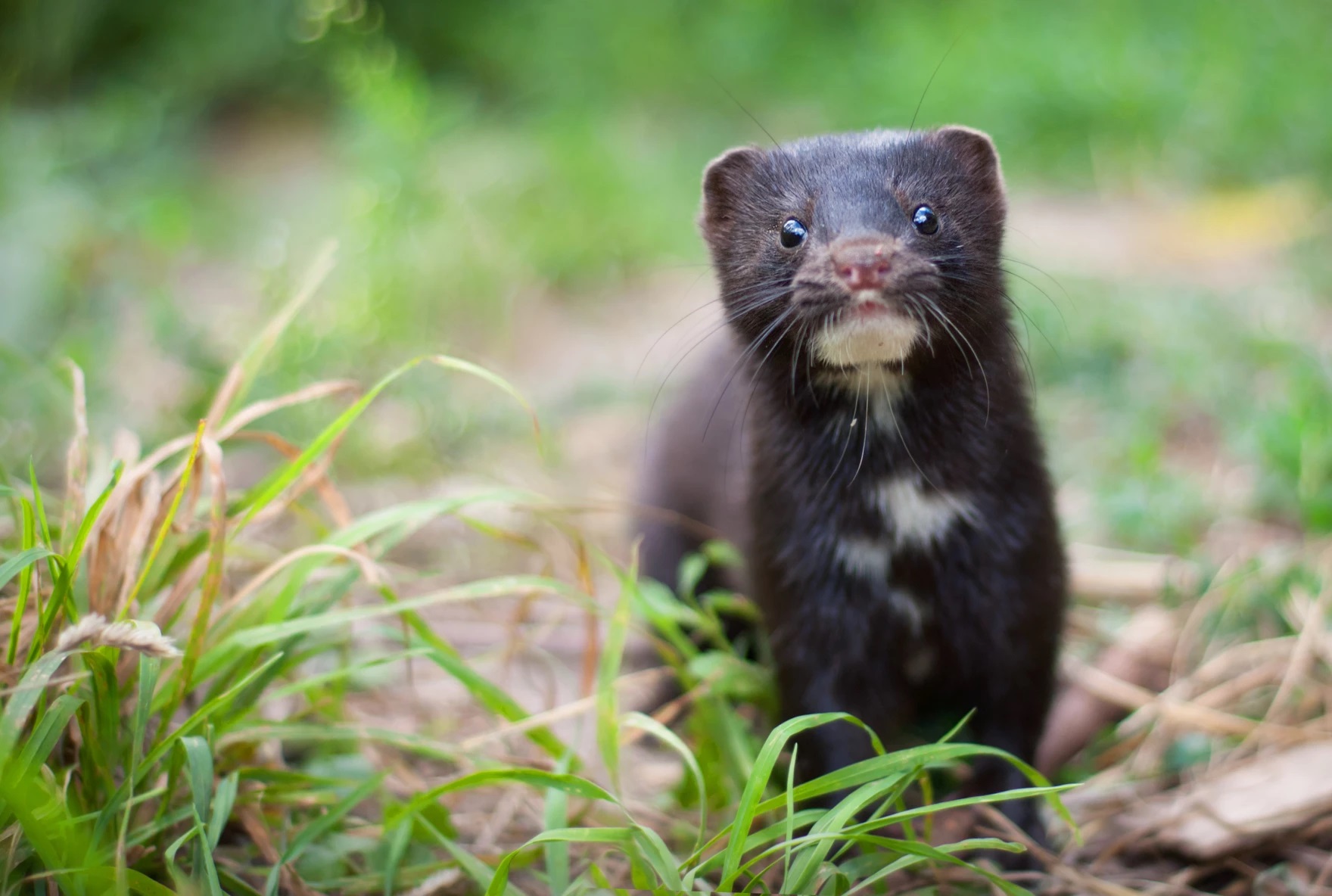
“Mink are related to a range of other species, including badgers, martens, fishers, weasels, otters, and wolverines,” said Jonathan Evans, the center’s environmental health legal…
In a comment on one of the many tragic hunting accidents I’ve blogged about lately, a gentle reader mentioned there should be a hunt the hunters hunting season, to which another compassionate soul replied, “I’d contribute to that.”
We’ve all heard (ad nauseam) hunters boast that their license fees pay for wildlife programs, implying that it entitles them to kill the subjects of their alleged generosity—of course hunters don’t contribute out of the kindness of their hearts or their profound love for living animals. This got me to thinking we need a non-hunter license and tag system that emulates hunter tags, to finally put to rest this notion that hunters alone pay for wildlife through their consumptive use licenses…
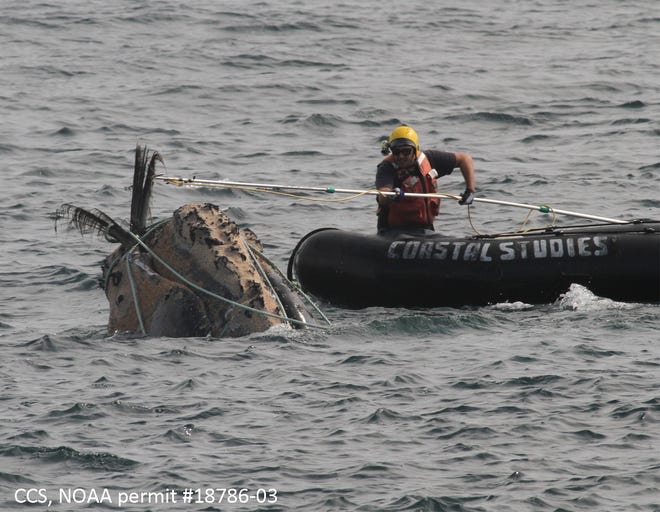
The National Ocean and Atmospheric Administration released a much-anticipated plan on Wednesday that it says will reduce North Atlantic right whale mortalities from entanglement in fishing gear by 60%.
The right whale is the most endangered great whale on the planet, with around 360 individuals remaining, including less than 100 breeding-age females.
The new plan achieves the 60% mortality reduction through new seasonally closed areas, increases in the number of pots connected to a buoy line and requirements to add more weak links that allow a whale to break vertical lines and hopefully shed lines and pots.
New closures include an area south of Nantucket where right whales are congregating year-round but had been subject only to voluntary speed reductions.
NOAA will be holding public hearings on the draft environmental impact statement for the new whale plan, and public comments will be taken until March 1, with an eye toward having new regulations in place for the beginning of the new fishing year on May 1.
The North Atlantic population size has been lower, with an estimated 270 individuals in 1990. The population rebounded to 481 by 2011.
Since then, however, the species has been in decline. Recently, as right whales have migrated into new territory in Canada in search of food, the number of dead right whales caught in fishing gear or hit by vessels has shot up. Particularly hard hit were females, leading some researchers to worry that the species could reach functional extinction — too few females to rebuild the species — within a decade or two.
Scientists have determined that less than one right whale per year, on average, can die of human-induced causes. But that number has been exceeded every year, particularly since 2017 when 17 right whales died, including 12 in Canada and five in the U.S.
NOAA reported that there were only 22 calves born from 2017 to November 2020, with 31 mortalities over that same period. An additional 13 right whales are considered to have life-threatening injuries. Ship strikes were once the leading cause of right whale death, but that has changed, with entanglements causing 85% of mortalities between 2010 and 2015.
The NOAA plan resembles one that was passed by an advisory group, the Atlantic Large Whale Take Reduction Team, over a year ago that also sought a 60% reduction in mortalities, including a 50% cut in the number of vertical lines in Maine and a 30% cut in Massachusetts, the two leading states in landings and effort for the lobster fishery. Maine subsequently withdrew from that multi-state agreement, and NOAA then took over the plan.
Environmental groups, scientists and animal rights activists worried that NOAA was going too slow as right whales continued to die and inch closer to extinction. Many also saw the measure as just an intermediate step bridging to the development of affordable and effective technology that would remove much of the vertical lines that ensnare whales by having gear buoys resting on the bottom until summoned by a signal from the fishing boat on the surface.
“After such an unprecedented delay, this new rule will help stem the surge of right whale deaths we’ve seen over the last several years,” said Erica Fuller, senior attorney at the Conservation Law Foundation. “Ropeless fishing is the only solution that protects whales and fishermen, and the rule expands that practice. However, NOAA must end its reliance on weak rope as a solution and get emergency protections on the water immediately while this rule is finalized.”
Sharon Young, the field director for marine wildlife protection for the Humane Society of the United States, worried that the fishing industry and others might think this was the solution.
“It’s a step in the right direction, however, there will still be a lot of risk-prone lines in the water that will entangle whales, and what we need to work towards is line-free fishing,” Young said. “By no means does this fix the problem of fatal entanglements in a declining species.”


 Planting 1 trillion trees is one way to store unwanted carbon.(Image: © Shutterstock)




 Exposing the Big Game