Climate change has added to the stress bears face, making simple actions for survival, such as finding enough food or staying in their dens long enough to hibernate, difficult.Photo by C MacDonald/iStock.com
Agroundbreaking billintroduced in California today would end all trophy hunting of black bears in the state. If successful, California would be the first state to implement such a ban, setting a magnificent precedent for the rest of the nation to follow.
Thebill was introducedby State Sen. Scott Wiener, D-San Francisco, and it reflects concerns over the fragile state of black bear populations in California. The state endured devastating wildfires last year, and wildlife there, including California’s iconic bruins, are struggling to forage and survive in the changing forest ecosystems.
Each year, trophy hunters kill more than 1,000 bears in the state. This places unnecessary pressure on these animals who reproduce…
Mink fur farming poses such a risk that fur farmers in Wisconsin will be eligible for the next round of vaccines in the state, along with educators and essential workers. Above, a mink in the wild. Photo by Wendy Keefover/The HSUS
One more nation, Sweden, announced today that it will suspend all mink fur farming this year to prevent the spread of the coronavirus and its mutations.
Sweden’s announcement contrasted starkly with a media report in the United States this week that authorities in Utah, one of the nation’s largest fur producing states, allegedly did not disclose the fact that a worker at an infected mink fur farm had died of COVID-19, the disease caused by the coronavirus. As we have been reporting, the United States has failed to act on concerns about the pandemic risk posed by fur farms even as other nations with infected mink have acted swiftly to curtail it, with some even ending mink fur farming for good.
A Utah Department of Health spokesperson, in an interview with Newsweek, appeared to continue to downplay the risk, saying, “At the time the person became ill, community spread had been increasing rapidly in the surrounding area. No additional deaths associated with mink farms have been reported. Currently, there is no evidence of mink-to-human transmission in the United States.”
Such continuing failure to acknowledge and act on the terrible risk mink fur farming poses to public health is appalling and dangerous. Utah residents—and residents of Michigan, Oregon and Wisconsin, the other fur-producing states in the United States where mink have tested positive—deserve more transparency and concern for public health from their authorities. In December, there were reports of a mutation of the virus discovered on a mink fur farm in Utah.
Mink fur farming poses such a risk that fur farmers in Wisconsin will be eligible for the next round of vaccines in the state, along with educators and essential workers.
We are hopeful that the Biden administration will take steps to end the fur farming industry in the United States. Around the world, we have seen nations act swiftly and decisively to temporarily or permanently shut down the mink fur farming industry over fears of pandemic spread. The Netherlands, the first country where such infections were reported, moved swiftly last year to announce a permanent end to its mink fur farming industry, two years ahead of a previously set deadline. By December last year, all mink cages on fur farms in that country stood empty.
While Sweden’s ban is temporary, we are urging it to use this opportunity to shut down this cruel industry altogether. Denmark, which suspended mink fur farming temporarily until 2022, is moving to proactively shut down the industry, by offering fur farmers funding to transition to other industries.
In November, Hungary announced a ban on fur farming for certain species like fox and mink, which are not farmed in the country now, to prevent fur farmers from other parts of Europe moving there. Officials attributed the ban to fears of zoonotic disease spread from fur farming.
France also announced plans to end mink fur production and one of the farms there has already shut its doors following a coronavirus outbreak.
With the pandemic raging through U.S. mink fur farms, we need similar action here. There is already great momentum for ending fur farming in this country, and in 2019, California became the first state to ban fur sales. Lawmakers in Hawaii and Rhode Island introduced similar proposals last year. The town of Wellesley, Massachusetts, passed a fur sales ban last year.
As we’ve also reported, the mink industry in the United States is in free fall, with 2019 being the industry’s worst on record, according to latest data in a U.S. Department of Agriculture report. Fashion designers, retailers and consumers are increasingly turning away from fur.
Millions of animals live and die in extremely inhumane conditions on fur farms each year for this unnecessary commodity, as our investigations have revealed. They are denied the most basic needs, confined in tiny cages, bludgeoned to death, and sometimes skinned alive. The pandemic has given us one more compelling reason why every nation that still allows fur farming needs to stop this cruelty for good.
Sara Amundson is president of the Humane Society Legislative Fund.
The Montana trapping bills continue to come, quickly and worsening by the week! Thursday 1/28 Lengthening the wolf trapping season and Tuesday 2/2 Snaring of wolves hearings!
Hearing Thursday, Jan. 28, House Fish Wildlife and Parks Committee:
Montana HB225 Revising Wolf Trapping Season Laws.
(8) The commission may authorize a wolf trapping season that opens the first Monday after Thanksgiving and closes March 15 of the following calendar year, except that the commission may adjust the dates for specific wolf management units based on regional recommendations.” - END
In other wordsincrease the length of the Montana wolf trapping seasonfrom the current December 15 – February 28 to run from the end of November to March 15. Additionally, this billallows different regions of the state to do so.
We need you to speak up for the wolves and the many other innocent victims that will be trapped, injured, and…
Opinion Contributorhttps://imasdk.googleapis.com/js/core/bridge3.436.0_en.html#goog_411783738Volume 20%00:0000:59More Videos00:31Trump planned to oust acting AG to overturn Georgia election results: report00:38Judge temporarily blocks Biden administration’s deportation freeze00:56What rejoining the Paris climate accord means for the U.S.00:45Capitol Police chief apologizes, admits to department’s failures in Jan. 6 Capitol riot00:52Surprising discoveries in new 10B pixel photo of Vermeer’s famous ‘Girl With a Pearl Earring’00:31Seven Senate races to watch in 202200:31Hawley files ethics counter-complaint against seven Democratic senators00:32What the 2020 census will reveal about America’s future00:39Sanders defends his inauguration outfit: In Vermont, ‘we’re not so concerned about good fashion’00:35Wealthy Canadian couple flew to remote indigenous community to get COVID-19 vaccine: reportsClose
“Trophy hunting and poaching are essentially the same, except that trophy hunters pay thousands of dollars for the pleasure. Or the American taxpayer pays for it—Donald Trump’s sons have regularly hunted endangered species at tax-payer’s expense because security guards go with them. And it’s hard to see where sport is involved—one of the president’s sons killed an elephant by shooting a high-powered rifle at him from a plane, and all trophy hunters hunt with guides or guards to protect them. In contrast, most of the poachers are from the local populations and are hunting because they’re far from rich and need the money. But the result is exactly the same—literally thousands of animals, especially endangered species, are killed by these people.”
—Elizabeth Marshall Thomas
“We live in a time of ‘consumer civilization’ and elephants and lions…for hunters on safari, are fundamentally, like cars and refrigerators: objects that are ‘consumed’, that is, destroyed, to give way to others which are better or cheaper…But whereas cars and refrigerators can be replaced with the greatest ease, lions and elephants, once they are’ consumed’ disappear forever.”
—Alberto Moravia, “Which Tribe do You Belong To?,” 1972
“I do not want to live on a planet where there are no lions anymore.”
—Werner Herzog
Photo credit: Lysander Christo
How many times have we heard rangers say, why should I spend years, possibly sacrifice my life for a lion, or elephant or rhino, if someone is going to come to this park and kill these animals? “These animals are sacred,” a ranger told us in the Selous, one of the main centers of the elephant poaching crisis a decade ago, where 50,000 were killed in Tanzania alone, due to poaching. We had gone to Tanzania 20 years ago and there were more than 100,000 elephants then. What happened? They were shot and destroyed by the poaching crisis, in the same areas where trophy hunting was allowed to exist. Today there may be only about 40,000 in all of Tanzania. Over 60 percent loss. A supreme tragedy.
While some celebrities have been attacked recently for voicing their concern about trophy hunting, specifically in The Guardian article of January 15, they are not the voices we should be worried about. They are not working against conservation. They may not have the pedigrees and scientific know how some are invested in. But they are also not accepting donations from hunting lobbyists. They are not making baseless claims, they are simply concerned citizens who are very worried that their children may indeed only have the fictional “Lion King” to witness in the not very far-off future. Because the lion is trending towards extinction. They are not basing their stance on “myths” as Pieter Kat of Lion Aid exclaims and ignoring science. Rather it is the other way around. As he underscores, “Trophy hunting proponents have never been able to clearly show that trophy hunting actually benefits the survival and conservation of targeted species, and instead rely on soundbites and slogans. The list of species supposedly benefiting from trophy hunting in the article is laughable – none of them have flourished because of trophy hunting. Sure, rhino numbers have increased in South Africa, but only because they were placed in private ownership on game farms where the owners could do what they wanted with them. Trophy hunters were one source of income for these rhino farmers, but rhinos were removed from the wild to stock the farms, and no privately held rhino can in any way be seen to contribute to conservation of the wild population. It is dumbfounding to see that lions are also on the list of species “conserved” by trophy hunters as there is absolutely no evidence of this – to the contrary, there are multiple examples where significant damage has been caused to lion populations living at the borders of national parks that abut hunting concessions.”
If one needs any more proof … a case in point, just a few days ago, a guide in Ruaha, Tanzania, one of the last great strongholds of the lion on the entire continent, wrote me to say that lions are not doing as well as they used to in Ruaha. Why? Because only a few miles away are several hunting concessions targeting lions. He should know what he is talking about. He was born a few miles from the park and has been a guide for more than 15 years. Lions don’t stay put. They move around and once outside the park’s perimeters, if there are trophy hunters eager to blow their brains out, that’s what happens. Areas that have allowed trophy hunting as in the Selous have been ransacked, especially in the last decade. Elephants were massacred as they haven’t been in 30 years.
The children without degrees, without science backgrounds, without PhD’s, know that we are diminishing nature almost beyond repair. As the great philosopher Kant once said, we are not the “titular lords of nature.” But we continue to act as if we were. Africa’s native people did not knock out 10 million elephants in the last century. Foreigners did. From Europe, America and of late, Asia. Native people, pastoralists from the Simien mountains in Ethiopia, to the Serengeti in Tanzania and the Mara in Kenya, and all over Africa were kicked off their lands to make way for wildlife reserves and some of these were made into hunting concessions. All those like Roosevelt who triumphantly made Africa their playground.
The local people were evicted, yes, even for reserves, and National Parks, all in the name of “green” colonialism as Guillaume Blanc makes abundantly clear in his book “L’Invention du Colonialisme Vert” (Flammarion 2020). As European countries and America have hugely benefited from the gifts of Africa’s lands over the last century, it will be time for greater investments to be made to the oldest continent or else the movie the “Lion King” will indeed be all that the children have to look forward to. The practice of trophy hunting for the sheer sake of killing is entirely a foreign construct.
Make no mistake. Where trophy hunting is allowed, poaching often follows. While the 200 million dollar trophy business – industry is doing well, it is not sustainable for the long term survival of species involved. Safari clubs pay researchers and scientists to vindicate their claims. In corrupt countries “poor governance and weak regulation” thrive according to Kat of Lion Aid, which leads to “unsustainable trophy hunting.”
When is the wildlife of the world ever going to be able to breathe? Hopefully before they breathe their last because with climate change creating a fury in the gestation of animals worldwide, one day any kind of trophy hunting will be considered a barbarity. As animals have shorter gestation periods they end up having earlier than expected births, which affects feeding patterns and many other cycles humans have altered over the last few decades.
The best reason to be much more circumspect about whether to even want to kill any animals for trophies is that their very life support system is being undermined. A few cases in point. Gray whales have been washing up on shore in the dozens the last few years. An endangered species having a hell of a time holding on, hunting or no hunting. The mass mortality of saiga antelope in central Asia where 200,000 just keeled over back in 2015, the year of the Paris Climate Agreement. The culprit? High temperature and humidity helped bacterium pasteurella multocida type B to run rampant. In the blood the bacteria create toxins that breaks down the immune system. The mortality rate was 100 percent. The same kind of event happened with 300 elephants in Botswana in the summer of 2020, that fateful year due to cyanobacteria poisoning in waterholes. Do we need any more proof that we need to cool our jets, particularly the bullets that come flying out of our guns, aimed at the innocent, not for food but for vanity?
It is not just our immune systems that are breaking down, it is Nature’s as well. And frogs and fish and birds. It is our very place in the world that is unravelling. That is one very good and enormous reason why trophy hunting will have to be replaced with a greater humane, moral and philanthropic consideration from the elite. If the moral argument isn’t enough for making trophy hunting a thing of the past, then perhaps the climate chaos, the irrevocably altered temperature gradient of existence that will force us to change our ways. Once and for all.
Photo credit: Lysander Christo
Hunting to survive belonged to the first peoples of the world long before colonialism started to bag lions and tigers and bears. Of course, the bounty Europeans put on wolves could fill entire ledgers over the last 2,000 years. And what the Roman Emperors did with gladiators mutilating innocent predators from Africa and the Middle East to entertain their guests was shameful. We have not changed much. But in Africa, you would be hard put to find any African needing meat, who would hunt for fun. Now that we have lost 70 percent of the world’s animal population, we need a new act in our social behavior towards other species. The bacteria and microbes are unto us. And bagging large game won’t mean much when we’re the one’s being decimated by the soldiers of plague.
Long ago, a remarkable writer called Elspeth Huxley who knew Kenya like the back of her hand, wrote, “It isn’t sport; it isn’t even exciting. True sport involves equality between the rivals, you see. They give handicaps in everything from horse racing to ping pong, in order to achieve a rough equality; but they never give a handicap to the beast. It isn’t sport its murder. There’s only one sporting way to hunt big game, and that’s the old way, the way these natives follow- to hunt on foot with spears and bows and arrow, weapons a man can make himself out of materials ready to his hand. That’s fair and that’s fun. It’s a battle of wits between one man and one beast: a test of which can command the greatest cunning, the keenest senses, the highest skill. Man, if he uses his wits, can usually win; but it’s a victory worth having, because it doesn’t go to the coward or the dolt. So you have the brains and resources of every one from geniuses like Priestley and Pasteur to modern big business combines like ICI and du Pong, pitted against the wits of one poor African lion.” And as for the element of danger. Huxley explains, “There’s no danger at all in going after some wretched animal, whose only idea is to escape, armed with a battery of expensive high velocity rifles and flanked by a couple of professional sharpshooters. If any one wants to hunt, let him use a bow and arrow and match his wits against those of a lion or an elephant, as some of these natives do.”
Fortunately we have met with these early elephant hunters, the best on earth and they used bows and arrows exactly to Huxley’s recommendations except that they had been on the land tens of thousands of years before the European powers ransacked and desecrated the bush. The question today remains, how much are we willing to spend on conservation to make sure the wild holds on to even a glimmer of itself? The facts speak for themselves. While millions of dollars are spent on animals being bagged, the local communities do not pocket the money…It goes to the hunting factions. It goes to the government. It goes to private industry. And animals and the local people do not benefit. It is the last great gasp of colonialism in the most mercenary sense.
Elizabeth Marshall Thomas, who knew a thing or two about the old ways and who actually wrote “The Old Way: A Story of the First People” (2007) and who authored the classic on the oldest people on earth, the Bushmen, in “The Harmless People” (1959), exclaimed that “trophy hunting and poaching are essentially the same.” She should know. She spent serious time in Botswana in the 1950s before most of us were even born. And she knew the greatest hunters on earth intimately. For people to survive on the ground for 80,000 years straight is no mean feat. For 1,500 centuries humans roamed as hunting clans and survived and killed in order to eat and clothe themselves. Our civilization will have claimed maybe 3,000 years, industrial society, maybe 200 years. And in that short period we have brought the earth to its knees.
Areas that have allowed trophy hunting as in the Selous have been ransacked, especially in the last decade. Elephants were massacred as they haven’t been in 30 years because of a wayward morality spent on the lapels of vanity.
Save African Animals’s report “The Myth of Trophy Hunting as Conservation” underscores the same argument, that limited “legal” hunting is indeed a “smokescreen” for poaching. Considering mammals all over the world are experiencing the effects of viral infections and climate change due to changes in the marine or land environment, it would behoove all of us, to rethink our love affair with carcasses and animal body parts. It seems obscene and insane to be taking part in these grim and gruesome rituals when Nature is facing upheaval.
Behold the financial argument. Money is involved. It helps the local communities. Actually, hardly any money goes to the indigenous people.
Kat adds as for “community support” – schools, clinics, fees paid, durable employment – there is precious little evidence as the trophy hunting industry has always worked under veils of opacity, tax avoidance, bribery, false financial reporting and similar murkiness. Claims of “sustainable” hunting are largely unsatisfactory as the hunting operators do not allow independent assessments of trophy species’ population numbers in their areas – quotas are largely assigned on the basis of the operators’ own population counts and negotiations with wildlife authorities. With regard to “saving millions of acres for wildlife” – the facts again are not there. This is most clearly evidenced by the lack of interest in current tenders for hunting areas, as 40 percent of former hunting areas in Zambia and up to 70 percent in Tanzania are so devoid of wildlife that hunting operators have lost all interest. And finally, claims that hunting operators effectively control poaching in their concessions — there is no worse example of this myth than the Selous Game Reserve made up of 80 percent hunting blocks — where elephant carcasses were piled up high and deep during the recent poaching epidemic in Tanzania.
Much of the money goes to the middlemen, the commercial outfitters who make the operations possible. The amount of financial support local communities could use now is staggering. It will not be alleviated by killing off the best of Africa’s mammals. They have enough to deal with.
Between 2004 and 2014 about 1.7 million trophy animals were shot, eliminated from the gene pool of their ecosystems, forever. And 200,000 from threatened species. In ten or certainly 20 years’ time, this will be impossible either biologically or legally. To kill a lion for 50,000 dollars, a guaranteed kill for the sake of killing begs the question, what is in the mind or heart of these men, mostly men, that necessitates massacre? When I was in Africa as a teenager there may have been over 250,000 lions. Today, the “king” of beasts is edging towards extinction. There may be only 15,000 left. About the same population as polar bears. All the other beings are being mutilated for “fun” for gladiatorial hubris. Something is wrong deep down in the matrix of our being, if we continue to think this is fun. If it is not fun, it is F U N, Fundamentally Undermining Nature.
One day trophy hunters will be forced to go to jail for 20 years for taking out such stupendous life forms. It will be considered illegal, and this activity, like poaching, will be considered criminal. Maybe by that that time there will hardly be any tigers or lions or polar bears left in the wild. Some guide or herdsmen will tell a hunter from Europe or the Midwest, I know where there are still some leopards left. I saw a polar bear a few weeks ago, let’s go shoot him! And the poor leopard sensing the smell of a killer will run for its life. Maybe it will survive for a few more days or months only to be hounded again by the remorseless monster of man. Until man’s spirit is finally crucified on the altar of final loss. Until there is nothing left to crucify. And the last lions will be fenced behind barricades pacing with the inexorable loneliness of loss for a horizon its forefathers once knew, that now lies corralled behind steel, and cement and barbed wire. What will that reality do for the human spirit? We will be aiming gun barrels at ourselves. We will have reached the point of the untenable, for us and what remains of the four-footed ones. And we will “lose our minds” as an elder told me in Kenya at the heyday of the elephant massacre. “The only thing left will be to kill ourselves.”
What vanguard of unruliness and wantonness and blood letting is necessary to prove one’s manhood today? Control, discretion, grace and true power comes from restraint. The power lies in wanting to see beings thrive rather than having an arrow go through their nose and come out the back of their head, like a poor deer once had to endure. What will convince the children of the future that their parents are not insane?
Robots will take over much of the world in the future. Flying cars. Many machines we haven’t dreamed of. But what still resides in the woods, the lakes or on the savannas of Africa or the forests of Asia and the Amazon, will determine if we will still be able to call ourselves human.
As the next generation of children inherits an immensely fragile globe, we have to ask ourselves, what indeed will there be left living or alive for them to experience?
Photo credit: Lysander Christo
In terms of extermination, we are on the road to a day when in 30 years, in could be very, very hard to find anything moving that is not caged or behind bars. To find a black maned lion gazing back at us with the deep eyes of immensity its species embodies may become a miracle. There is enough monetary wherewithal and elite savvy to allow, encourage and ensure that life thrives as opposed to the tremendous energy we have used to undermine, mine and drain the world of life. If we have any regard for the children we keep putting on this planet then the heart will have to start to take charge and start to love life, as opposed to shooting a bullet through the brain of the world as we have done all too formidably in the last 200 years.
Bill Clark has worked with Interpol and has had two generations of experience with rangers in Kenya, which has one of the best tract records of any country in Africa. He writes, “One concern is that The Guardian article criticises Kenya for having a consistent policy prohibiting trophy hunting for 44 years. There is suggestion that the ban on trophy hunting is responsible for the decline of certain wildlife populations in Kenya. But the fundamental journalistic responsibility to check putative facts has not been met. Why didn’t The Guardian ask Kenya Wildlife Service to respond to this allegation?”
I am aware of the decline of certain populations in Kenya — elephants for example. But the catastrophe there was due to ivory poaching decades ago. Elephants have now doubled their nadir, and continue to expand. Trophy hunting had nothing to do with this matter.
There are many problems with trophy hunting that are not even mentioned in the article — perhaps because they are inconvenient to the author’s biases? Why is there no reference to the impact of poaching on the morale of park rangers in Africa? I have worked with many who expressed blatant pessimism over being assigned to risk their lives (about 100 African park rangers are killed in the line of duty annually) protecting elephants from poachers when those same rangers know for certain that some of those very same elephants will be shot legally by foreign trophy hunters in the near future. That dispirits many African rangers.
It should not take a rocket scientist, or a scientist paid by hunting groups, to speak out for the very reckless, inhumane, seditious practice of trophy hunting, to know that we have our priorities completely upside down as a species. One day when the last tiger is shot in India, or the last lion dismembered for body parts in Africa, or the last polar bear has drowned after her final 30 miles swim because she couldn’t find ice or seals to feed her cubs, will we hear from a small girl, so very intent on seeing the eyes of the wild gaze back at her, look up to her hunter dad and simply say, “How could you. How dare you! Who are you? What have you done?”
She will know just how much the arc of injustice and mutilation and vanity has broken the back of life and existence on what used to be a miraculous planet.
“Lions are going extinct—this is well known—but because Palmer evidently paid $50,000 for the privilege of murdering one of them, his act was welcome. A local poacher who needed money might kill a lion because he could sell the skin, and his act would be considered criminal. Literally hundreds of dollars for the privilege of doing so. It’s said that trophy hunting is “managed” by the authorities, they say, but the animals killed by trophy hunters and poachers were managing themselves perfectly well before we came along. We don’t own the natural world although we think we do—we just contribute to its destruction.”
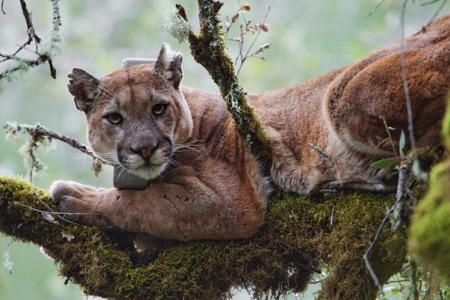
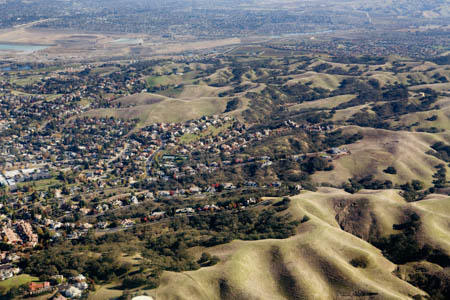
Mountain lion habitat in the Santa Cruz mountains is bordered by coastal cities to the west and Silicon Valley to the east, which makes humans a major source of mortality and fear for these cats. Photo by Sebastian Kennerknecht.
In the Santa Cruz mountains, pumas are top predators, patrolling a diverse landscape of forests, meadows, peaks, and valleys. But “mountain lion country” is also bordered by coastal cities to the west and Silicon Valley to the east, with major roadways and fringes of development reaching into wildlands. As a result, humans have become a major source of mortality and fear for these cats. UC Santa Cruz researchers have shown that pumas will go to great lengths to avoid human “super predators,” even bolting away from food at the sound of human voices.
And now, the research team’s latest work shows that these types of avoidance behaviors take a serious toll on pumas. A new paper, published in Proceedings of the National Academy of Sciences, shows that fear of humans causes mountain lions to increase their energy expenditures as they move through the landscape, and this can ultimately limit the size of the home ranges they’re able to maintain. Researchers are concerned about the long term impacts this might have on pumas and the ecosystems they help to regulate.
“Mountain lions fear us, and that fear has all kinds of impacts on their behavior and ecology, and ultimately, potentially even their populations and conservation,” said professor Chris Wilmers, the senior author on the paper.
Wilmers is principal investigator for the Santa Cruz Puma Project, through which he and colleagues have been studying local mountain lion populations for over a decade. Barry Nickel, director of UC Santa Cruz’s Center for Integrated Spatial Research, led the most recent study, which relied on data from five adult female pumas and eight adult males that were outfitted with tracking collars as they roamed their natural habitats.
Calculating energy costs
Tracking collars helped the research team calculate how many calories mountain lions burned, which offered new insight into how physical terrain and fear of humans affect habitat use. Photo by Sebastian Kennerknecht.
Throughout the two-month study period, the collars that researchers placed on wild pumas recorded high-resolution GPS and accelerometer data, which Wilmers said worked “essentially like a Fitbit” to help the team estimate how many calories a mountain lion burned based on where, how far, and how fast the cat was moving. The ultimate goal was to integrate the energy cost of navigating physical terrain with the cost of avoiding humans to see how both factors affect use of habitats.
To assess the impacts of physical terrain, researchers compared topography with trends in the cats’ movement data. This showed that less rugged terrain requires less energy for pumas to navigate, which may help to explain why mountain lions prefer habitats with easy-to-traverse valleys or ridges. And to get a sense for how fear of humans affected the cats, researchers also compared housing densities with collar tracking data.
This analysis showed that, in areas with higher housing densities, pumas were engaging in more energetically demanding movements, like stopping less and moving more quickly. Their movements were also much less efficient: instead of taking the shortest path to their destination, they took longer, meandering paths to navigate around perceived risks.
“Humans, as a risk factor, are actually increasing the energy an animal needs to traverse this landscape,” Nickel explained. “And this is primarily through changes in their behavior as a means to avoid humans.”
Fear takes a serious toll
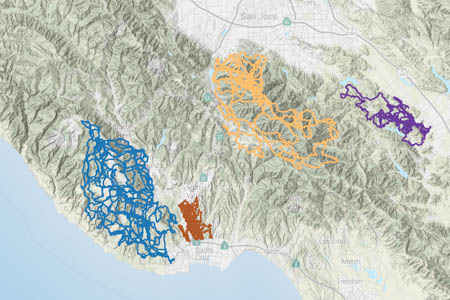
Tracking data for four male pumas shows a stark difference in the total home range area covered by pumas in habitats with the highest housing density (purple and brown tracks) compared with those in wildlands (yellow and blue tracks).
The constant vigilance that cats used as they moved through human-dominated landscapes is incredibly energy intensive. Nickel and the research team estimate that, in otherwise identical terrain, pumas expend 13 percent more calories per five-minute period in habitats close to people than they would in remote wildland habitats.
As a result, researchers found that fear of humans had a greater impact than variations in terrain on the amount of energy it takes for mountain lions to move about their habitats. In fact, the effect of increasing housing density on energetic costs of movement was four to 10 times greater than the effect of increasing slope and ruggedness of the terrain.
That’s a problem because researchers haven’t observed a corresponding increase in calorie consumption from the cats, and the other most likely way pumas might compensate for increased energy costs in navigating their habitats would be to reduce the total size of their territories. This trend showed up very clearly in the tracking data.
Both males and females showed reduced size in their home ranges associated with overall increased energy costs of navigating the landscape, but males, in particular, were especially affected by housing density. Male pumas in habitats most dominated by humans had 78.8 percent smaller home ranges compared to those with the most remote habitats.
Human-induced risk has actually become the primary driver of male patterns of space use among pumas, according to the paper. Females didn’t show this same trend, but the research team suspects males may be more vulnerable to human impacts because they typically have to establish larger home ranges to improve their odds of finding a mate.
Conservation implications
Protecting pumas will require limiting the amount of development that reaches into natural areas around the Santa Cruz mountains. Photo by Sebastian Kennerknecht.
Overall, researchers are concerned that pressure to avoid humans may harm the health of local mountain lion populations.
“It constrains their space use, which could then affect other aspects of their ecology, like finding mates, finding food, competing with other males, or other natural interactions,” Nickel said.
Because these cats are apex predators that help to control populations of prey—like deer and racoons—any impacts to puma populations have the potential to cascade out and affect other species. That makes mountain lions a key factor in the long term health of ecosystems across the Santa Cruz mountains.
The research team hopes this will motivate consideration of ways to reduce human impacts. Wilmers says one of the best strategies for helping pumas is to limit the amount of development that reaches into natural areas, so that these cats can have safe places to roam without fear.
“If we continue to develop California in the way we historically have, we’re going to lose this species,” Wilmers said. “But if we focus our development on making housing more dense in the areas where it already exists, like cities, then we stand a chance of keeping mountain lions with us well into the future.”
Sign up for our email newsletter for the latest science newsSign up for the NewsletterSIGN UP
The frozen kingdom of Antarctica may appear featureless from above, but beneath all that ice lies a mysterious and complex world that researchers say could be pivotal to understanding the effects of climate change.
It’s well established that the Antarctic ice sheet has been rapidly losing mass. As ocean temperatures have risen, the glaciers that make up the ice sheet are melting at a rate six times faster than that of 40 years ago. NASA reports that Antarctica is now losing 252 gigatons of ice per year — about three and a half Olympic swimming pools per second.
Nuclear weapons, globalpandemics, acceleratingclimate change: Is humanity running out of time? Despite 2020’s general awfulness, humanity paused on the path forward to armageddon — at least, according to the Doomsday Clock, a hypothetical timepiece that annually assesses our nearness to utter annihilation.
This year, the Doomsday Clock’s hands will not be moving forward, and it continues to show the same time that was set last year: 100 seconds to midnight, the Bulletin of the Atomic Scientists (BAS), a global organization…
STOCKHOLM, Jan 27 (Reuters) – Sweden will ban breeding of mink in 2021 to prevent the risk of mutations of the coronavirus spreading to humans, the government said on Wednesday.
Neighbour Denmark, one of the world’s biggest producers of fur for the fashion industry, slaughtered its entire herd of around 17 million mink in November after hundreds of farms suffered outbreaks of coronavirus and authorities found mutated strains of the virus among people.
Sweden recorded coronavirus cases at several mink farms, although authorities said in December the animals had not been found to carry the mutated strain as evident in Denmark.
“In Sweden, the mutated virus has, luckily, not got into our mink farms,” Financial Markets Minister Per Bolund told reporters at a news conference. “But our mink industry remains a further risk factor that we need to consider when it comes…
by: Sarah Fearing, Jason O. BoydPosted: Jan 25, 2021 / 08:23 PM EST / Updated: Jan 26, 2021 / 05:59 PM EST
ENGELHARD, N.C. (WAVY) — The North Carolina Wildlife Resources Commission said Tuesday a duck hunting accident Monday in Hyde County was an “unforeseeable accident.”
The victim was identified Monday as Brandon Marshall of Engelhard.
Sgt. Daniel Kennedy with the NC Wildlife Resources Commission Law Enforcement Division said that the incident happened around 2:30 p.m. Monday. Marshall was shot by a member of his party while duck hunting. Authorities said Tuesday that Marshall was hunting with his family.
He was in a duck blind with his son when he was accidentally shot in the leg. His brother, who was in a duck blind next to Marshall and his son, tried to help Marshall until NC Wildlife officers arrived on the scene.
The officers proceeded with lifesaving efforts until EMS…


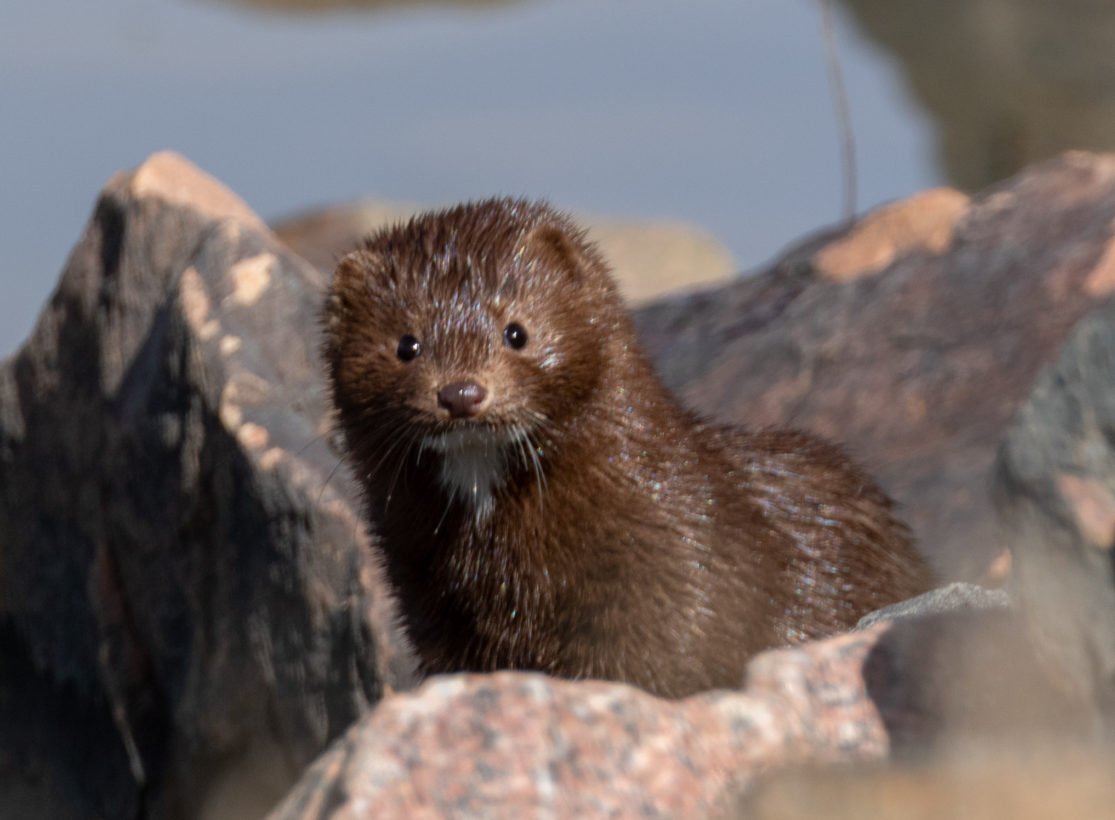

 Photo credit: Lysander Christo


 During Operation Upshot-Knothole, the U.S. Army exploded 11 nuclear bombs at a test site in Nevada between March and June in 1953. In the last of those tests — code name “Climax” — a 61-kiloton device was detonated on June 4, 1953.(Image: © Stocktrek Images/Getty)
 Algal blooms darken the ice sheet and cause increased melting.(Image: © Jim McQuaid)
 Exposing the Big Game