PETA has pressured the Irving-based oil giant since 2007 to drop its support of the race.
Mitch Seavey’s team reaches the finish line in the Iditarod Trail Sled Dog Race, Wednesday, March 18, 2020, in Nome, Alaska. (Marc Lester/Anchorage Daily News via AP)(Marc Lester / AP)
The Iditarod, the world’s most famous sled dog race, has lost another major sponsor as it prepares for a scaled back version of this year’s race because of the pandemic, officials said Thursday.
Historical cemetery affected by new section of the border wall in Texas
The historical Jackson Ranch Cemetery in Pharr, Texas, is one of many properties that have been…
“After careful review of sponsorships in light of current economic conditions, we’ve decided to conclude our sponsorship of the Iditarod following the 2021 race,” Exxon Mobil spokesperson Ashley Alemayehu said in an email to the AP.
“The health and safety of the dogs, and everyone involved in the event, has always been an important consideration for us,” Alemayehu said.
The Iditarod called Exxon Mobil a “great partner” in the race as well as the Iditarod Education program, saying in a statement that, “After careful review of sponsorships in light of current economic conditions, they have decided to conclude their sponsorship of the Iditarod following the 2021 race.”
Messages seeking comment from Iditarod officials were not immediately returned.SPONSORED CONTENT
The loss amounts to $250,000, PETA said, but Exxon Mobil could not immediately confirm the sponsorship amount. In 2009, Exxon Mobil committed to giving the Iditarod $1.25 million over the ensuing five years.
“We’re glad that they have recognized that it’s absolutely bad for business when corporations support abusive industries and events like the Iditarod,” said Colleen O’Brien, a vice president for the animal rights group.
PETA has lobbied Exxon Mobil to drop its sponsorship of the race since 2007. In December, the organization submitted a shareholders resolution to “end all sponsorship of activities in which animals are used and abused and killed,” O’Brien said. PETA owns 102 shares of the company’s stock.
Exxon Mobil executives met with PETA on a teleconference on Tuesday, in which they confirmed they would end sponsorship. O’Brien said PETA then withdrew the resolution and canceled Exxon Mobil-targeted ads it had planned to run on buses in Anchorage, in the Anchorage Daily News and the Texas edition of The Wall Street Journal leading up to the March 7 start of this year’s race.
PETA also called off planned protests for at least a dozen ExxonMobil locations around the country.
The animal rights group has been targeting national sponsors of the race to end what it sees as the abuse of dogs it says are forced to run the thousand-mile race.
The group claims more than 150 dogs have died since the race began in 1973. The Iditarod disputes the number but has not provided the AP with its count despite numerous requests over the years.
PETA last year took credit when Alaska Airlines and Chrysler, through an Anchorage dealership, dropped their sponsorships after PETA conducted protests at the airline’s corporate headquarters in Seattle and the carmaker’s in Detroit. At the time, neither company confirmed PETA’s protests played a role in their decisions.
Other national sponsors that have dropped out include Wells Fargo and Jack Daniel’s Tennessee Whiskey.
The loss of Exxon Mobil leaves only one national sponsor of the race, Millennium Hotels and Resorts through its Anchorage location, the Lakefront hotel. It also serves as the Iditarod’s headquarters during the race.
O’Brien said they will contact Millennium Hotels and Resorts and “urge them to sever their ties with the race before they’re targeted next. We’re not going to stop until dogs are no longer forced to race until they’re dead.”
A message sent through the Millennium website seeking comment was not immediately returned.
The race’s other sponsors are Alaska-based businesses or those with close ties to the state.
The Iditarod normally starts in Willow, Alaska, about 50 miles north of Anchorage, and takes mushers and their dogs nearly a thousand miles over rugged Alaska terrain to the finish line in Nome. However, this year’s race has been scaled back to about 860 miles and will start and end near Willow.
Twelve mushers, including defending champion Thomas Waerner of Norway, have dropped out of this year’s race, leaving 53 teams.
That’s among the three smallest fields in the last two decades, and all in the last three years. Last year, 57 teams started the race and 33 finished. In 2019, 52 teams began the race.
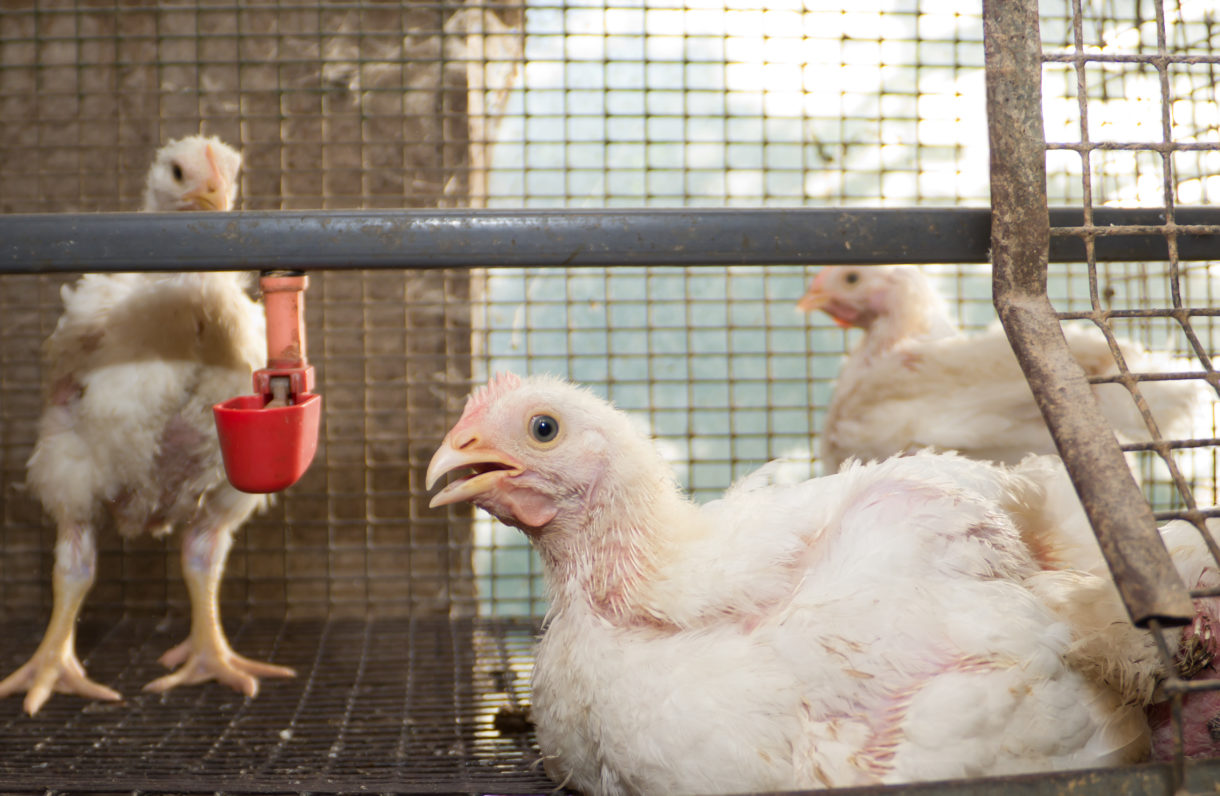
Increased line speeds benefit no one but chicken producers looking to fatten their profits. Even at existing speeds, conditions inside a slaughterhouse are already immensely dangerous and inhumane. Photo by Kharkhan_Oleg/iStock.com
The Biden administration has withdrawn a deplorable pending rule that would have allowed qualifying chicken slaughter plants in the United States to permanently dial up line speeds from an already inhumane and lightning-fast 140 birds per minute to 175 birds per minute.
The U.S. Department of Agriculture’s Food Safety and Inspection Service, under the Trump administration, approved waivers for slaughterhouses to operate at faster speeds. Dozens of chicken slaughterhouses received such waivers, including 16 that received waivers in the spring of 2020. It was a terrible decision given that slaughterhouses had been declared coronavirus hotspots. To add insult to injury, the Trump administration soon after began working on a new rule that would allow qualifying chicken plants to operate at the higher speed, without even applying for a waiver. In essence, chicken producers looking to make more profit could simply ratchet up the line speed to kill more chickens with no consideration for animal welfare or worker safety.
The Humane Society Legislative Fund had been working with key leaders in the House and Senate to advance a shift on this issue, directing the USDA to review its policy in the recently enacted omnibus appropriations package and critical lobbying to urge candidate Biden to speak out about line speeds on the campaign trail. Withdrawing this rule was one of our top priorities for the Biden administration. Next, we will continue to focus on ending the waiver for the dozens of slaughterhouses that are already operating at the higher speeds. We and our allies are already suing the USDA to stop this waiver program and revoke the waivers, and we are urging the USDA, under new leadership, to promptly do so.
Increased line speeds benefit no one but chicken producers looking to fatten their profits. Even at existing speeds, conditions inside a slaughterhouse are already immensely dangerous and inhumane. Workers, struggling to keep up with rapidly moving slaughter lines, grab the chickens and slam them into shackles, injuring the animals’ fragile legs while they’re still conscious. Some birds miss the throat-cutting blade and enter the scalder—a tank of extremely hot water—alive and fully conscious. Human injury rates are also high as workers struggle to keep up with fast-moving lines. Imagine the additional risks to animal welfare and worker safety from increasing line speeds even more.
Faster speeds also further increase the risk of pandemic spread in slaughterhouses, where more than 48,000 workers have already been infected with the coronavirus and at least 245 have died. In fact, other federal agencies, including the Centers for Disease Control and Prevention and the Occupational Safety and Health Administration, had asked that line speeds be slowed down during the pandemic.
We are excited about today’s outcome—it is the right decision for worker safety, animal welfare, food safety and the mitigation of pandemic risk. But there is a great deal more we hope to accomplish in coming weeks and months. President Biden has a strong record on animal protection, and we will be working with his administration to withdraw harmful regulatory actions against animals taken under Trump, including the removal of slaughter speed limits at pig slaughterhouses. We will also work to undo a number of harmful rules finalized by the last administration, including reinstating protections for gray wolves, reversing harmful changes to the Endangered Species Act, and stopping harmful hunting practices on Alaska’s federal lands. It’s a new day, and we are excited to make this one of the best years ever for animal protection policy gains at the federal level.
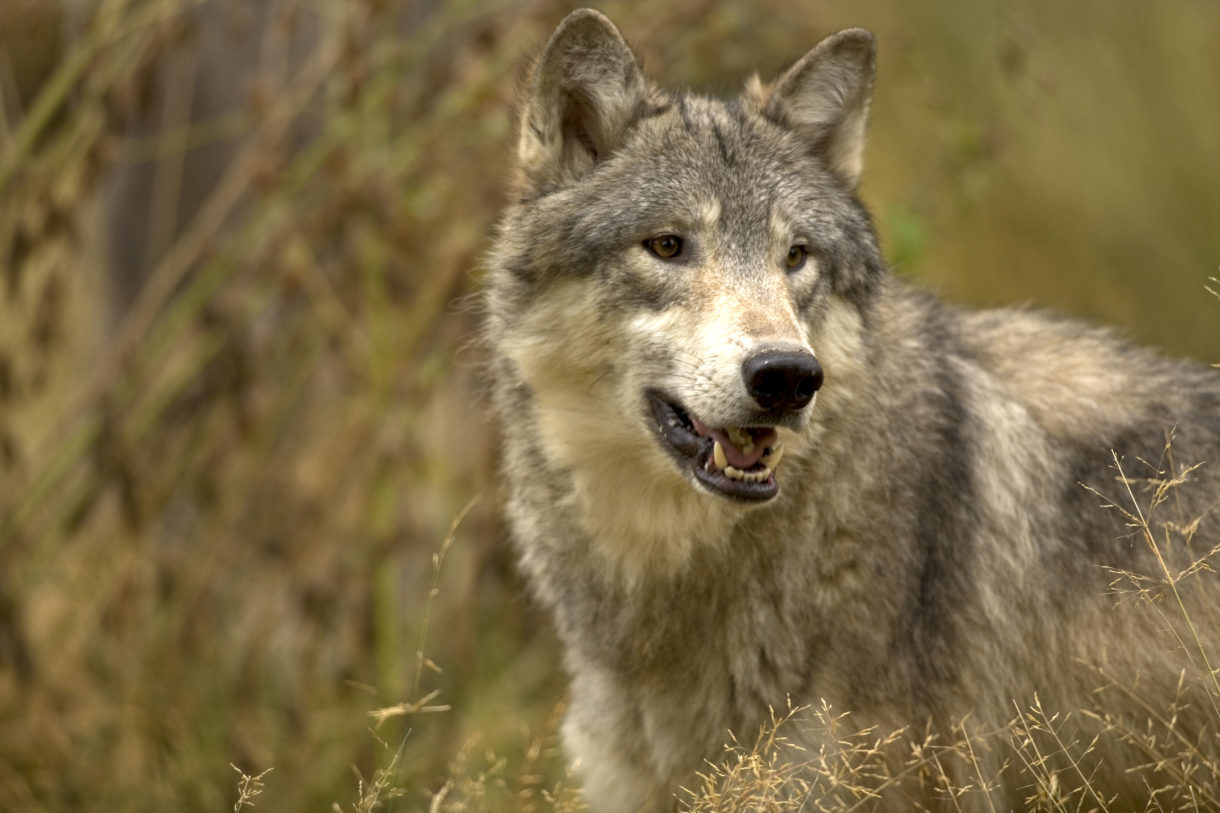
Wisconsin residents got less than 48 hours’ notice about the hearing today, but hundreds of individuals, scientists, and tribal representatives still submitted written comments and nearly 50 people signed up to testify, with the majority opposing such a reckless rush to slaughter.Photo by JAMcGraw/iStock.com16.0KSHARES
An attempt by some Wisconsin lawmakers to force a rushed and unlawful wolf hunting season in the state beginning next month has been narrowly defeated by the state’s Natural Resources Board.
In November, we reported how we had helped stop an effortby the Wisconsin Natural Resources Board to open a wolf hunting season soon after the Trump administration stripped federal protections for wolves. In aletter to state officials, including Gov. Tony Evers and the Department of Natural Resources, we warned that such an action would be unscientific and illegal, with disastrous consequences for the…
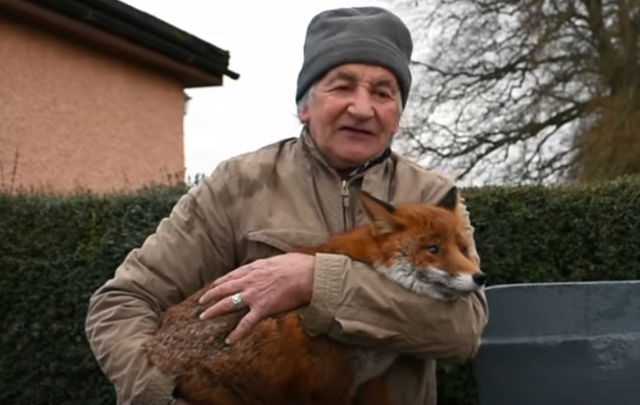
IrishCentral Staff@IrishCentralSep 11, 2019Patsy Gibbons and one of his foxes.FIONA ARYAN/YOUTUBE
Co Kilkenny man Patsy Gibbons rescued foxes and they quickly became some of his most unusual pets.
Three foxes, 28 hens, 12 ducks, two dogs, and two cats may sound like a recipe for disaster but for one Co Kilkenny man, it simply describes the wonderouscollection of petshe’s brought together in his home. Patsy Gibbons rescued foxes and through his love and care, they became his firm friends, turning Gibbons into something of a viral sensation when images of his fox friends made the internet back in 2014.
Gibbons first rescued the eldest fox Gráinne in 2007 when she was found in an old box looking for heat.
In 1987, a farmer near the town of Pouce Coupe, British Columbia, saw four gray wolves on his property and shot one of them. The wolf happened to be radio-collared, and the farmer reported the collar to authorities. The data revealed that the five-year-old female wolf had traveled all the way from Montana’s Glacier National Park—a distance of some 540 miles. This wolf, which was among the first litter of radio-collared wild-born wolves in the western United States, had loped through protected national parks and private ranches, crossed interstate highways, dodged traffic, and, along the way, avoided the rifle crosshairs of ranchers—until it met the last one.
That one wolf’s story is significant because it illustrates the opportunities and challenges that confront any wolf trying to recolonize the species’ former habitats. Before that event, biologists knew, via radio-collar tracking, that wolves traveled as much as 30 miles a day—but they didn’t know how far they would disperse. “This wolf was miles and decades away from the Yellowstone reintroduction,” says Diane Boyd, who is now the wolf and carnivore specialist of Montana Fish, Wildlife, and Parks Region 1. “Wolves were making a strong comeback in Montana on their own, [even though] Yellowstone was in the limelight for their reintroduction efforts.”“This is the most successful conservation story in North America.”
When many people think of wolf restoration, they naturally flash on the historic reintroduction of wolves to Yellowstone National Park in 1995 and 1996. Most people aren’t aware that wolves were simultaneously reintroduced in Idaho’s Frank Church Wilderness of No Return, and that, even before those notable events, wolves naturally recolonized Glacier National Park, in far northwestern Montana, in the early 1980s. National parks like Yellowstone and Glacier, it turns out, are only one part of the wolf recovery story.
“Parks and wilderness areas aren’t big enough [for full recovery],” says Michael Jamison of the National Parks Conservation Association.
Today, wolves have successfully recolonized many western states, including Montana, Idaho, and Wyoming, while dispersals from those packs have migrated even farther outward to Washington, Oregon, and California and, more recently, to Colorado, Utah, and even Arizona. “This is the most successful conservation story in North America,” Boyd says.
As wolves rebound across the western United States, conservation biologists are looking at ways to connect migration routes that are independent of traditional land conservation models in order to allow the species to disperse and diversify its gene pool. Parks are a good start, but such protected areas are biological islands in a sea of private property, too small to hold on to all of their wildlife. Once wolves leave the safety and security of protected areas, they have to find suitable habitat, navigate roads, and dodge hunters and ranchers intent on killing them. In order to achieve full recovery, biologists and wildlife conservationists say, we need to connect together the isolated refuges of the parks. “We have to connect the dots,” Jamison says.
“Public land holdings are puppy factories,” says Carter Niemeyer, a retired US Fish and Wildlife Service wolf trapper who has studied wolves for 50 years and helped bring wolves down from Canada’s Jasper National Park to Yellowstone and Idaho’s Frank Church Wilderness. “They are essential for pumping out animals.” But if wolves leave their family pack, they have “a one-way ticket” out if they leave the park because “outfitters, hunters, and trappers are on the edge knocking the hell out of them.” Idaho law, for example, allows individual hunters and trappers to kill up to 30 wolves a year. “All the different categories of public lands are central to dispersing animals and migrating species,” Niemeyer says.
Despite the threats from hunters and other obstacles such as roads, gray wolves are thriving in a way they haven’t in generations. There are an estimated 145 wolves in eastern Washington, and now 22 packs and 158 wolves in Oregon. There are at least a thousand wolves in both Idaho and Montana. Wyoming has 311 wolves. Experts estimate that California has 15 to 20 wolves. Voters in Colorado recently approved a ballot measure directing the state’s parks and wildlife agency to reintroduce wolves there—the first time that wolf reintroduction has been initiated via a popular referendum.
“One of the most important keys to wolf recovery is dispersal,” Boyd says. Wolves are dispersing from the epicenters like Glacier, the Frank Church Wilderness, and Yellowstone and moving westwards with ease because there are continuous forest corridors. But if they move south out of Yellowstone into Wyoming, there is an open expanse of land where they are considered varmints and can be shot on site or even aerially gunned down in fracking fields. Lone wolves have trouble making safe passage to distant lands because of the old rancher mentality of “shoot, shovel, and shut up.”
LIKE WHAT YOU READ? SIGN UP FOR DAILY UPDATES FROM SIERRA MAGAZINE.SIGN UP
For the wolves themselves, such dispersals are often arduous; for humans, they can be inspiring. In 2009, a Yellowstone female made it to Colorado. In 2008, a female wolf named B-300 swam the Snake River to cross into northeastern Oregon from Idaho. The following year, she mated and had pups. One of them was the famous OR-7—the first wolf to appear in California in more than a century. That wolf found a mate and is now back in southwestern Oregon.
In 2014, wolf scat was found on the North Rim of the Grand Canyon in Arizona and later confirmed to belong to a gray wolf from the northern populations. Experts believe dispersals this far south means that the northern gray wolf populations could reintegrate with the Mexican gray wolf populations in the Southwest and help diversify the wolf gene pool. Also, in 2014, a four-year-old male from the Boundary Pack in northern Idaho was identified in Utah’s Uinta Mountains.
A few years later, OR-54, a pup of OR-7, was the 54th wolf to be collared in Oregon. Since January 2018, this female has traveled more than 8,700 miles looking for a mate. She never found one, and in the course of her search, she has crossed back and forth from Oregon to California twice, passing through nine counties. Along the way, the she-wolf also killed some livestock. In December 2019, her radio collar went silent.
If wolves don’t get shot once they leave protected areas, there is a very high chance they will be hit by a car. The 4.18 million miles of roads that crisscross the United States carve up and fragment important habitat. In an early sign of wolf expansion, eight years after the Yellowstone reintroduction, a two-year-old female from Yellowstone’s Swan Lake pack was hit on Interstate 70 near Idaho Springs, Colorado. And once a road is constructed, it opens up former wildlands to the disturbance of human development and more habitat loss.
So, have wolves fully recovered?
Not exactly. The only truly healthy wolf populations that remain are in Alaska and Canada, where 90 percent of the wolves in North America live. This is mostly a function of viable habitat: Most of Alaska and Canada are undeveloped, and so there are simply fewer people, fewer hunters, fewer antagonistic ranchers, fewer vehicles, and fewer roads. In the Lower 48, wolf recovery—for all of its successes—remains precarious. According to the Center for Biological Diversity, there are no more than 6,000 wolves in the continental United States, and they occupy less than 10 percent of their historic range.
Boyd says she was midway through her career before she realized “people were going to make or break wolf recovery.” She smiles and reflects about how she loved wildlife but dreaded people. “Basically, the first 10 to 15 years of my career, I was kind of a misanthrope living in the North Fork Valley and running crews of dedicated volunteers. All we did was live and breathe wolves.” Now she spends most of her time creating “wolf tolerance zones” by mitigating problems with farmers and ranchers and correcting information. “Only through education can conservation be implemented.” “The old methods of conservation need to evolve into more complementary land-use models that include private lands held in conservancies and agricultural lands featuring a matrix of working acreage and wildlands.”
Boyd and Niemeyer agree that a lot of wildlife management is spent at the kitchen table in a ranch house, drinking coffee and getting acquainted. “Talking about the issues as well as forming relationships of trust,” Niemeyer says.
But even if conservationists succeed in cultivating human tolerance of wolves, the animals will remain isolated in protected areas unless we can construct migration corridors. Wolves and other animals don’t, of course, understand borders and boundaries as lines drawn on the maps. “The flipsides of boundaries are connections,” Jamison says. “Critters are going to go where critters have always gone, and sometimes that is inconvenient for us to figure out.”
That means that the old methods of conservation need to evolve into more complementary land-use models that include private lands held in conservancies and agricultural lands featuring a matrix of working acreage and wildlands. “Conservation has to wrangle with a pretty colonialist past of just putting lines on a map around pretty places that happened to be other people’s homes for thousands and thousands of years,” Jamison says.
One example of a new land-use designation is the proposed 130,000-acre Cultural Heritage Area in the Badger-Two Medicine portion of Montana’s Lewis and Clark National Forest. If established as envisioned, roughly half of the area will be set aside for conservation and the other half for cultural heritage preservation. “We have to work and heal our relations because all of the easy stuff has been done,” Jamison says. “New designations will deal with the fact that humans live here. But that is what connectivity is: linking up migrations and corridors by connecting the islands through existing land ownership and connecting people.”
In other places, wildlife migration corridors can be established through relatively simple methods such as building wildlife overpasses or underpasses to allow safe access across highways and interstates—a measure that also cuts down on vehicle collisions with wildlife and saves both animal and human lives. Another strategy is to create wildlife-friendly ranches that, among other measures, commit to removing the lowest strand from barbed-wire fences to allow pronghorn antelope to move through, or removing fences and opening fence gates at certain times of the year to allow elk or other game to move through. “Wolves can get around most obstacles, but the fewer the fences, the more receptive the land is to dispersal and migration of wildlife the better,” Niemeyer says.
“Nature’s a nomad, and she needs to move now more than ever because of a rapidly changing climate, compounded by the rapid development of landscapes, whether it is for industry or for highways or subdivisions,” Jamison says. “Critters are forced to move in ways they’ve never been forced to move before.”
BIDEN TAKES DAY ONE ACTION TO PROTECT ARCTIC LANDS AND WATERS
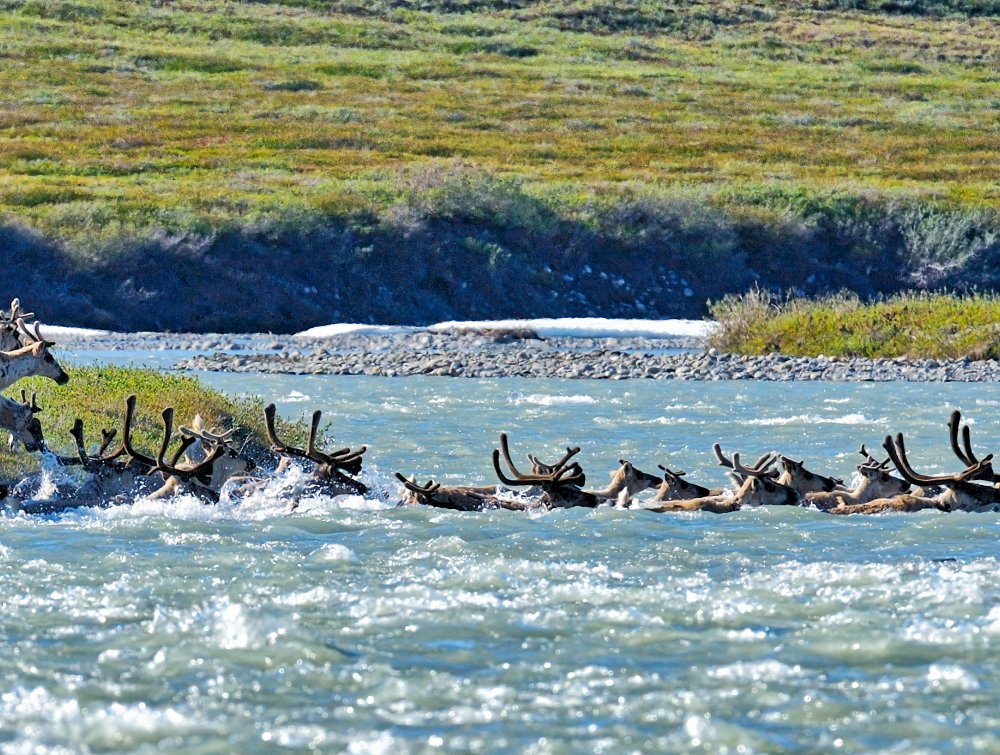
The Hulahula River runs from Alaska’s Brooks Range to the cArctic Refuge’s coastal plain, which is the calving ground of the Porcupine Caribou Herd.EDWARD BENNETT/BENNETT IMAGES LLC
After Trump’s sell off, the Arctic Refuge gets a reprieve
Just hours after being sworn into office, President Biden took a number of monumental actions to protect public lands, address the climate crisis and combat systemic racism, including an executive order that places a moratorium on all oil and gas activity in the Arctic National Wildlife Refuge.
This occurred only one day after the previous administration issued leases for drilling in the refuge’s coastal plain in a rushed, flawed and likely illegal process.
Biden’s action was met with great enthusiasm, particularly by many Gwich’in and Iñupiat peoples who have depended on and protected the refuge for thousands of years and rely on the caribou and other resources in the refuge to sustain their communities and cultures.
“Mashi’ choo, President Biden,” said Bernadette Demientieff, executive director of the Gwich’in Steering Committee. “The Gwich’in Nation is grateful to the president for his commitment to protecting sacred lands and the Gwich’in way of life.”
The executive order also reinstated President Obama’s withdrawal of most of the Arctic Ocean and parts of the Bering Sea from oil and gas drilling—an order that had been reversed by the Trump administration. Protecting offshore areas from the threat of a major oil spill benefits not only marine species such as fish, seals and bowhead whales, but the coastlines of sensitive lands like the Arctic Refuge, too.
We are grateful to President Biden for his commitment to protect the refuge, address the climate crisis and respect the human rights of Indigenous peoples. We are also grateful to the millions of people who made today’s announcement possible by putting the climate and social justice first. This action is a result of years of advocacy from people across the United States, including members and supporters of The Wilderness Society, who refused to stay silent as oil corporations and their friends sought to put drilling rigs in the Arctic Refuge.
This action is a result of years of advocacy from people across the United States, including members and supporters of The Wilderness Society.
This does not mean the fight to protect the Arctic Refuge and the calving grounds of the Porcupine Caribou Herd is over. The moratorium is temporary. But it’s a huge first step in Biden’s plan to review the legality of the Jan. 6 Arctic Refuge lease sale and the issuance of leases to the winning bidders.
We will continue to work with our Gwich’in and Iñupiat partners—as well as the Biden administration and our allies in the Congress and the conservation community—as we explore all options for ensuring that drilling never occurs on the coastal plain of the Arctic Refuge. We’ll also keep putting pressure on corporations like banks and insurers.
But today we rest, raise a glass and celebrate a new day for the Arctic.
HB224 Snaring Wolvesin Montana. An indiscriminate cruel death sentence, for wolves and any other innocent unfortunate creature, HB224 will have a public hearing soon in the Montana House Fish Wildlife & Parks committee.
Traps and snares are baited, secreted, and left unattended in the tens of thousands across our public lands. Snares for wolves will add a whole new level to these weapons of mass destruction for these empowered trappers’ lenient and inhumane recreation.
As we continue to hear from owners of trapped dogs in Montana, two bird dogs out hunting were recently snared in our state. Just after one dog was saved from the snare,they found the other dog was killed by anothersnare. They are not the first or the last of our beloved companion animalsto be trapped, injured, or killed. It is amongour worst nightmares, in our dreams and in realty.
This 2020 photo provided by the Wyoming Game and Fish Department shows the worn, mostly toothless jaw of Grizzly 168. The grizzly was the oldest documented in the Yellowstone region. Bear biologists euthanized the 34-year-old grizzly due to its poor health. (Zach Turnbull/Wyoming Game and Fish Department)
By ASSOCIATED PRESS |PUBLISHED: January 24, 2021 at 10:51 a.m. | UPDATED: January 25, 2021 at 3:29 a.m.
JACKSON, Wyo. (AP) — A 34-year-old grizzly bear captured in southwestern Wyoming has been confirmed as the oldest on record in the Yellowstone region, Wyoming wildlife officials said.
Grizzly bear 168 was captured last summer after it preyed on calves in the Upper Green River Basin area.
The male had just a few teeth left and weighed 170 pounds (77 kilograms), just a fraction of the 450 pounds (204 kilograms) the bear weighed as a 5-year-old when he was captured in…
It took evolution 3 or 4 billion years to produce Homo sapiens. If the climate had completely failed just once in that time then evolution would have come to a crashing halt and we would not be here now. So to understand how we came to exist on planet Earth, we’ll need to know how Earth managed to stay fit for life for billions of years.
This is not a trivial problem. Current global warming shows us that the climate can change considerably over the course of even a few centuries. Over geological timescales, it is even easier to change climate. Calculations show that there is the potential for Earth’s climate to deteriorate to temperatures below freezing or above boiling in just a few million years.
We also know that the Sun has become 30% more luminous since life first evolved. In theory, this should have caused the oceans to boil away by now, given that they were not generally frozen on the early Earth – this is known as the “faint young Sun paradox”. Yet, somehow, this habitability puzzle was solved.
Scientists have come up with two main theories. The first is that the Earth could possess something like a thermostat – a feedback mechanism (or mechanisms) that prevents the climate ever wandering to fatal temperatures.
Read news coverage based on evidence, not tweets
Get newsletter
The second is that, out of a large number of planets, perhaps some just make it through by luck, and Earth is one of those. This second scenario is made more plausible by the discoveries in recent decades of many planets outside our solar system – so-called exoplanets. Astronomical observations of distant stars tell us that many have planets orbiting them, and that some are of a size and density and orbital distance such that temperatures suitable for life are theoretically possible. It has been estimated that there are at least 2 billion such candidate planets in our galaxy alone.
There are many exoplanets…but how many have a stable climate? Jurik Peter / shutterstock
Scientists would love to travel to these exoplanets to investigate whether any of them have matched Earth’s billion years of climate stability. But even the nearest exoplanets, those orbiting the star Proxima Centauri, are more than four light-years away. Observational or experimental evidence is hard to come by.
Instead, I explored the same question through modelling. Using a computer program designed to simulate climate evolution on planets in general (not just Earth), I first generated 100,000 planets, each with a randomly different set of climate feedbacks. Climate feedbacks are processes that can amplify or diminish climate change – think for instance of sea-ice melting in the Arctic, which replaces sunlight-reflecting ice with sunlight-absorbing open sea, which in turn causes more warming and more melting.
In order to investigate how likely each of these diverse planets was to stay habitable over enormous (geological) timescales, I simulated each 100 times. Each time the planet started from a different initial temperature and was exposed to a randomly different set of climate events. These events represent climate-altering factors such as supervolcano eruptions (like Mount Pinatubo but much much larger) and asteroid impacts (like the one that killed the dinosaurs). On each of the 100 runs, the planet’s temperature was tracked until it became too hot or too cold or else had survived for 3 billion years, at which point it was deemed to have been a possible crucible for intelligent life.
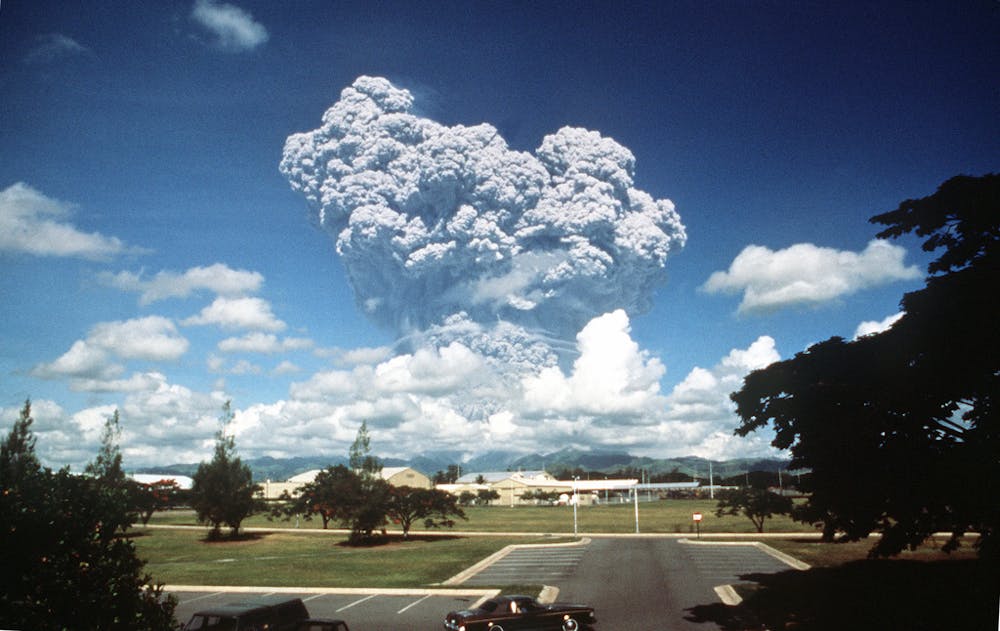
Climate-altering: the 1991 eruption of Mount Pinatubo in the Philippines blasted so much ash into the atmosphere that global temperatures temporarily dropped by 0.6˚C. SRA Blaze Lipowski / picryl
The simulation results give a definite answer to this habitability problem, at least in terms of the importance of feedbacks and luck. It was very rare (in fact, just one time out of 100,000) for a planet to have such strong stabilising feedbacks that it stayed habitable all 100 times, irrespective of the random climate events. In fact, most planets that stayed habitable at least once, did so fewer than ten times out of 100. On nearly every occasion in the simulation when a planet remained habitable for 3 billion years, it was partly down to luck. At the same time, luck by itself was shown to be insufficient. Planets that were specially designed to have no feedbacks at all, never stayed habitable; random walks, buffeted around by climate events, never lasted the course.
Repeat runs in the simulation were not identical: 1,000 different planets were generated randomly and each run twice. (a) results on first run, (b) results on second run. Green circles show success (stayed habitable for 3 billion years) and black failure. Toby Tyrrell, Author provided
This overall result, that outcomes depend partly on feedbacks and partly on luck, is robust. All sorts of changes to the modelling did not affect it. By implication, Earth must therefore possess some climate-stabilising feedbacks but at the same time good fortune must also have been involved in it staying habitable. If, for instance, an asteroid or solar flare had been slightly larger than it was, or had occurred at a slightly different (more critical) time, we would probably not be here on Earth today. It gives a different perspective on why we are able to look back on Earth’s remarkable, enormously extended, history of life evolving and diversifying and becoming ever more complex to the point that it gave rise to us.https://www.youtube.com/embed/K7hCh6v7HNs?wmode=transparent&start=0Professor Toby Tyrrell discusses his research.
TheModernaCovid-19vaccine created antibodies that neutralizedcoronavirusvariants first found in the United Kingdom and South Africa, the company said in a news release on Monday.
Two doses of the vaccine “is expected to be protective against emerging strains detected to date,” according to the release.
The company’s study showed that the variantfirstfound in the UK had “no significant impact” onthe vaccine’s effectiveness.
The results for the variant first spotted in South Africa, however, werenot asoptimistic —and some early studies havesuggestedvaccines may be somewhat less effective against this strain.
In the press release,Modernanotedthat“a six-fold reduction in neutralizing titers was observed with(the variantdiscovered in South Africa)relative to prior variants.”
The companysaid the vaccine was still expected to be effective.
“Despite this reduction, neutralizing titer levels with(the variant discovered in South Africa)remain above levels that are expected to be protective,” according to…

/cloudfront-us-east-1.images.arcpublishing.com/dmn/JAS5NHL3TJAQPGAES7NR73P56Q.JPG)


 Patsy Gibbons and one of his foxes.FIONA ARYAN/YOUTUBE







 Exposing the Big Game