New light shed on Charles Darwin’s ‘abominable mystery’

https://www.bbc.com/news/science-environment-55769269

By Helen Briggs
BBC Science correspondentPublished15 hours agoShare

Letters - Charles Darwin
image captionCharles Darwin transformed the way we see the natural world

A scientist has shed new light on the origins of Charles Darwin’s “abominable mystery”.

The famous naturalist was haunted by the question of how the first flowering plants evolved.

Darwin feared this inexplicable puzzle would undermine his theories of evolution, says Prof Richard Buggs.

Forgotten historical documents show a rival scientist was arguing for divine intervention in the rise of the flowering plants.

This greatly vexed Darwin in his final months, says the evolutionary biologist at Queen Mary, University of London.

“The mystery seems to have been made particularly abominable to him by its highly publicised use by the keeper of botany at the British Museum to argue for divine intervention in the history of life,” he says.

What is the abominable mystery?

Darwin coined the phrase, abominable mystery, in 1879. In a letter to his closest friend, botanist and explorer Dr Joseph Hooker, he wrote: “The rapid development as far as we can judge of all the higher plants within recent geological times is an abominable mystery.”

Blossom on cherry trees
image captionThere are more than 200,000 species of flowering plants

The mystery centres on the rise of the flowering plants, or angiosperms, the family of plants that produce flowers and bear their seeds in fruits.

They make up the vast majority of all known living plants, from oaks to wildflowers and water lilies.

Flowering plants appeared on Earth relatively recently on a geological timescale, then swiftly diversified in an explosion of colour, shape and form.

“In the fossil record they appear very suddenly in the Cretaceous, dated at about 100 million years ago, and there’s nothing that looks like an angiosperm before them and then they suddenly appear and in considerable diversity,” says Prof Buggs.

Questions raised by the sudden appearance of flowering plants are at the heart of Darwin’s abominable mystery, he explains.

“Why isn’t there a gradual evolution of the angiosperms? Why can’t we see intermediate forms between the gymnosperms – things like conifers – and the flowering plants? And why, when they appear, are they already so diverse?”

Why was Darwin puzzled?

Darwin was deeply bothered by how flowering plants conquered the world seemingly in the blink of an eye, while other large groups, such as the mammals, evolved gradually.

Tulips in bloom in Magdesburg, Germany
image captionTulips in bloom in Magdesburg, Germany

The advent of flowering plants suggested evolution could be both rapid and abrupt, in direct contradiction to an essential element of natural selection, natura non facit saltum – nature makes no leap.

Darwin toyed with the idea that flowering plants might have evolved on an as yet undiscovered island or continent.

In August 1881, only months before his death, he wrote to Hooker: “Nothing is more extraordinary in the history of the Vegetable Kingdom, as it seems to me, than the apparently very sudden or abrupt development of the higher plants. I have sometimes speculated whether there did not exist somewhere during long ages an extremely isolated continent perhaps near the South Pole.”

What’s the new thinking?

In the library at the Royal Botanic Gardens, Kew, Prof Buggs came across a re-print of a lecture from 1876 by the Scottish botanist William Carruthers that gives new context to Darwin’s thinking.

William Carruthers rose to become keeper of botany at the British Museum, and “a towering figure at the time in paleobotany”.

Botanical room of the British Museum in 1858
image captionBotanical room of the British Museum in 1858

In a lecture to the Geologists Association in the library of University College London, Carruthers highlighted the problems that Darwin had with the fossil record, focussing on the sudden appearance of flowering plants.

His comments were reported in The Times and the scientific press, sparking a public debate.

“Carruthers was using the abominable mystery to launch an attack on evolution itself,” says Prof Buggs. “He thought that God had created the angiosperms in the Cretaceous; they hadn’t evolved.

“To Darwin and his friends, this was anathema, basically, because [Carruthers] was trying to bring supernatural explanations into the fossil record.”

But Darwin had a problem. The points Carruthers was making about the fossil record were actually very difficult to explain in terms of evolution, says Prof Buggs.

He thinks this is what prompted Darwin to coin the phrase “an abominable mystery” and makes his case in a scientific paper, published in the American Journal of Botany.

The mystery was to Darwin what Fermat’s Last Theorem was to the 17th Century mathematician Pierre de Fermat, he adds.

“It gives an insight into what was going on in Darwin’s mind in the last few years of his life and it gives it an extra romance, almost, a bit like Fermat’s Last Theorem – Darwin’s last mystery, this problem preying on his mind in his final months.”

And is the mystery solved?

In short, no. “One hundred and forty years later, the mystery’s still unsolved,” says Prof Buggs. “Of course, we’ve made lots of progress in our understanding of evolution and in our knowledge of the fossil record, but this mystery is still there.”

After another violent night of protests, Seattle police speak out about their tactics

Exposing the Big Game's avatarThe Extinction Chronicles


https://komonews.com/news/local/after-another-violent-night-of-protests-seattle-police-speak-out-about-their-tactics

by Kara Kostanich, KOMO News reporter Thursday, January 21st 2021AASeveral protesters in Seattle on Wednesday night.https://imasdk.googleapis.com/js/core/bridge3.435.0_en.html#goog_378559604Volume 90% Several protesters in Seattle on Wednesday night.

Facebook Share Icon

Twitter Share Icon

Email Share Icon

SEATTLE —On a day when communities across the U.S. were celebrating the swearing in of anew commander-in-chief for the country, Seattle again garnered national attention because of adestructive protestthat wound through downtown streets.

The group of demonstrators, known as “Black Bloc” protesters because they are all dressed from head to toe in dark clothing, have been linked for months to chaotic protests.

City residents said they have grown weary from the destructive demonstrations.

“It was just disgusting,” said Brent Haverman, who lives near the Seattle Police Department West Precinct building and has watched violence play out for weeks since the summer. “Yesterday was a day of peace and unity.”

Haverman said police need to do more to quell the protests.

“This should be such a simple process for them…

View original post 316 more words

Americans Are Moving To Escape Climate Impacts. Towns Expect More To Come

Exposing the Big Game's avatarThe Extinction Chronicles

  • Facebook
  • Twitter
  • Flipboard
  • Email

https://www.npr.org/2021/01/22/956904171/americans-are-moving-to-escape-climate-impacts-towns-expect-more-to-come

January 22, 20215:00 AM ET

ANNIE ROPEIK

Doug and Judith Saum moved to New Hampshire from Reno, Nev., to escape the health effects of worsening wildfire smoke.Annie Ropeik/NHPR

The impacts of climate change could promptmillionsof Americans to relocate in coming decades, moving inland away from rising seas, or north to escape rising temperatures.

Judith and Doug Saum have moved already, recently leaving their home outside Reno, Nev.

“It was with a view of the Sierra [Nevada Mountains] that was just to die for,” Judith says. “We had a lot of friends, musician friends, we’d get together and play music with them often. It wasn’t easy to leave all that.”

The Saums had long thought about retiring to Colorado or Montana to be near family. But as they started making those plans several years ago, they were also noticing a new problem:…

View original post 689 more words

Hunter cited $10k, charged over illegally harvested 12-point buck in Illinois

Exposing the Big Game's avatarCommittee to Abolish Sport Hunting Blog

A man has been fined and charged following an investigation by the Illinois Department of...
A man has been fined and charged following an investigation by the Illinois Department of Natural Resources Conservation Police. Officials say on January 12 they finished an investigation on a hunter from Wonder Lake.(illinois dnr conservation police)

https://www.kwqc.com/2021/01/21/hunter-cited-10k-charged-over-illegally-harvested-12-point-buck-in-illinois/

By KWQC StaffPublished: Jan. 21, 2021 at 6:47 AM PST

McHenry Co., Ill. (KWQC) – A man has been fined and charged following an investigation by the Illinois Department of Natural Resources Conservation Police.

Officials say on January 12 they finished an investigation on a hunter from Wonder Lake.

The hunter, who isn’t being identified, illegally harvested a 12-point buck whitetail deer 42 minutes after legal shooting time according to officials.

The hunter was issued a $10,000 civil penalty per statue for the assessed value and charged with unlawful take of whitetail deer, deer hunting by the aid of bait, unlawfully hunting between 1/2 hour after sunset and 1/2 hour before sunrise…

View original post 127 more words

The Other Pandemic: Avian Flu Is Spreading Around the Globe

Exposing the Big Game's avatarThe Extinction Chronicles

ByClaire HamlettJanuary 19, 2021Wisconsin National Guard

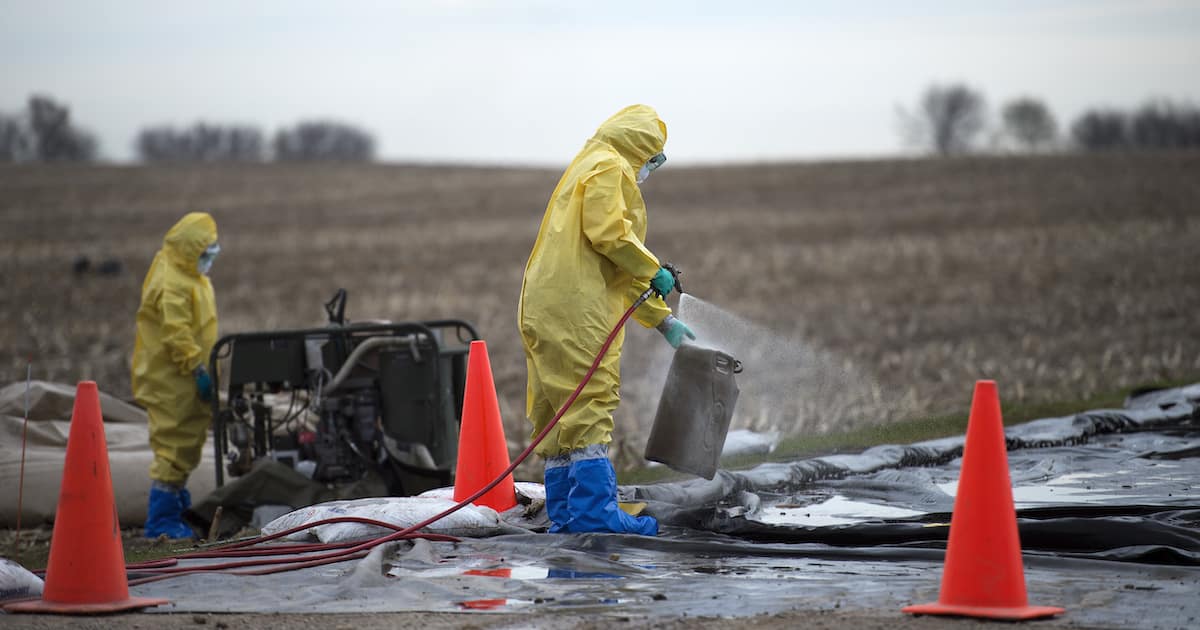
As the world continues to battle the coronavirus pandemic, a parallel scenario is unfolding in the avian world. Outbreaks ofavian fluhave been detected on poultry farms from the UK to Japan, resulting in millions of birds being culled globally. In the UK, all captive birds have been forced into their own lockdown since mid-December, with keepers of flocks big and small ordered to keep their birds indoors for the foreseeable future.

Since November, multiple strains of the avian flu including the highly pathogenic H5N1, one of the most common strains, have been found on farms in Japan, South Korea, India, Russia, Israel, and several European countries. Highly pathogenic strains can cause severe illness in birds with symptoms including swelling of the head and difficulty breathing, though some birds such asduckscan be asymptomatic. Death is almost guaranteed within…

View original post 1,050 more words

Carl Sagan, the animal rights visionary

He was talking about global warming and humane treatment of animals before they became fashionableNEXT BLOG ❯

https://www.downtoearth.org.in/blog/science-and-technology/carl-sagan-the-animal-rights-visionary-75171

By Shubhobroto Ghosh
Published: Friday 22 January 2021
Carl Sagan was an animal rights visionary in every sense of the word

Carl Sagan speaking at Cornell University in 1987. Photo: Wikimedia Commons Carl Sagan speaking at Cornell University in 1987. Photo: Wikimedia Commons

Carl Sagan is famous across the globe as the citizen scientist who brought forth the mysteries of the universe to millions of people across the world. But his contribution to protecting the planetary environment and enhancing respect for non-human species is not as widely known.

The creator of Cosmos: A Personal Voyage was talking about global warming and humane treatment of animals before they became fashionable.

The Pulitzer Prize-winning author and scientist was an animal rights visionary in every sense of the word. In a lecture at Cornell University in 1994, he spoke of the social structure of chimpanzees that he described as being one that he “would like to see more of in humans.”

Speaking of our relationship with other animals, Carl Sagan said:

“Humans — who enslave, castrate, experiment on, and fillet other animals — have had an understandable penchant for pretending animals do not feel pain. A sharp distinction between humans and ‘animals’ is essential if we are to bend them to our will, make them work for us, wear them, eat them — without any disquieting tinges of guilt or regret. It is unseemly of us, who often behave so unfeelingly toward other animals, to contend that only humans can suffer. The behavior of other animals renders such pretensions specious. They are just too much like us.”

Thus, we see animals exploited in the wildlife trade, elephant rides in Amer fort in Jaipur in India, crocodile shows in Thailand and tigers being chained perpetually so that tourists can click pictures with them in proximity in Thailand. World Animal Protection is actively attempting to bring all these atrocities to an end and will continue to do so in the future.

The importance of good writing to aid the humane treatment of animals cannot be emphasized enough, especially after the tragic year of 2020. World Animal Protection takes exceptional note of some publications in this regard in India, alongside Sagan’s Cosmos: Possible Worlds.

The Gopi Diaries: Coming Home, a book about the relationship between a dog and humans, was a unique endeavour in Indian literature by Infosys Foundation chairperson, Mr Sudha Murty. This book and the exemplary coverage given to the crisis horses find themselves facing in Kolkata’s Maidan by senior journalists Biplab Sarkar and Anindya Jana in the regional daily Aajkaal give us hope that all is not lost in a world driven apart by death and destruction.

The most outstanding legacy of Carl Sagan as an astronomer and a scientist is his famous speech titled Reflections on a Mote of Dust, which he delivered many times in his public presentations, is the most befitting tribute to him as an environmentalist. This speech is reproduced here in full:

“We succeeded in taking that picture [from deep space], and, if you look at it, you see a dot. That’s here. That’s home. That’s us. On it, everyone you ever heard of, every human being who ever lived, lived out their lives. The aggregate of all our joys and sufferings, thousands of confident religions, ideologies and economic doctrines, every hunter and forager, every hero and coward, every creator and destroyer of civilizations, every king and peasant, every young couple in love, every hopeful child, every mother and father, every inventor and explorer, every teacher of morals, every corrupt politician, every superstar, every supreme leader, every saint and sinner in the history of our species, lived there on a mote of dust, suspended in a sunbeam.

The earth is a very small stage in a vast cosmic arena. Think of the rivers of blood spilled by all those generals and emperors so that in glory and in triumph they could become the momentary masters of a fraction of a dot. Think of the endless cruelties visited by the inhabitants of one corner of the dot on scarcely distinguishable inhabitants of some other corner of the dot. How frequent their misunderstandings, how eager they are to kill one another, how fervent their hatreds. Our posturing, our imagined self-importance, the delusion that we have some privileged position in the universe are challenged by this point of pale light.

Our planet is a lonely speck in the great enveloping cosmic dark. In our obscurity — in all this vastness — there is no hint that help will come from elsewhere to save us from ourselves. It is up to us. It’s been said that astronomy is a humbling, and I might add, a character-building experience. To my mind, there is perhaps no better demonstration of the folly of human conceits than this distant image of our tiny world. To me, it underscores our responsibility to deal more kindly and compassionately with one another and to preserve and cherish that pale blue dot, the only home we’ve ever known.”

It is our duty, to imbibe the essence of this message and to be kind to each other, as well as to all forms of life on this planet.

The US Is Back in the Paris Agreement, But More Is Needed to Stave Off Disaster

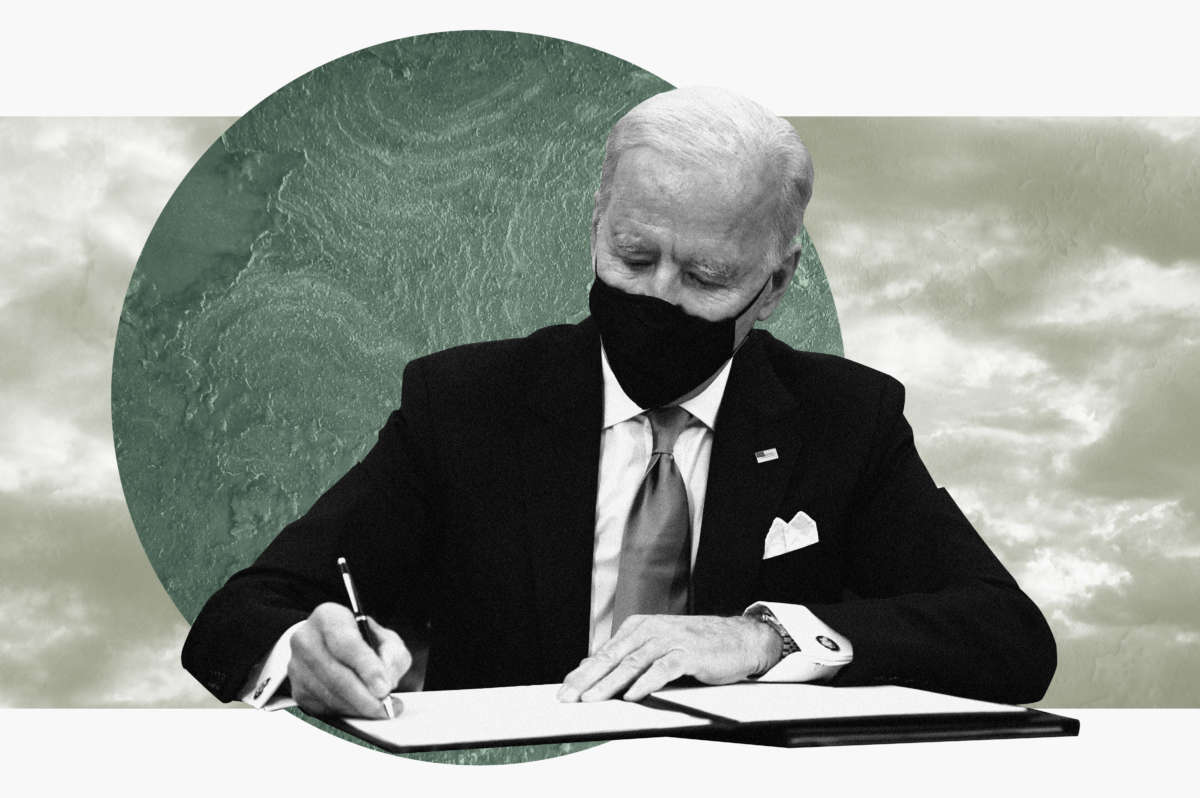
President Joe Biden signs an executive order with globe and sky behind
Activists are demanding the Biden-Harris administration pass a sweeping jobs bill to address the climate crisis head-on.

BYLeanna First-AraiTruthoutPUBLISHEDJanuary 21, 2021SHAREShare via FacebookShare via TwitterShare via Email

Shortly after getting settled in the Oval Office on his first day on the job, President Joe Biden delivered on his commitment to re-join the Paris Agreement, the 2015 pact adopted by almost every country in the world to curb climate change in an attempt to effectively stave off a sixth mass extinction. The signature was his third in a stack of 17 executive orders. Now the Biden-Harris administration will send a letter to the United Nations announcing the decision, and the U.S. will officially be a party to the agreement again in 30 days.

Climate scientists and scholars, who watched with horror as the U.S. officially pulled out of the agreement on November 4, 2020, say Biden’s move is more than merely symbolic, but it is only a starting point. “Every other diplomatic channel at our disposal is necessary to support climate action,” director of climate at Ocean Conservancy, Sarah Cooley, told Truthout. “We also need to see climate considerations re-emphasized in all parts of the government. We need to tackle this crisis from all sides and that means taking action through all of the federal agencies, legislation and executive powers,” she said.

The Paris Agreement established a 2 degrees Celsius upper limit of warming in an attempt to stave off the most calamitous impacts of climate change, like temperatures too high to sustain human life and sea level rise that envelops whole cities. Members of island nations made the case that a more ambitious limit, “1.5 to stay alive,” was the only benchmark that gave countries on the frontlines of the climate crisis a fighting chance. Climate activists who protested outside of the Paris summit called the agreement a “death sentence” for people in many parts of the world due to its inadequacy.

Get our free emails

  • Email

The global average temperature is already dangerously close to both limits, at almost 1 degree Celsius above pre-industrial temperatures. We are currently on track to burn 120 percent more fossil fuels by 2030 than what would enable warming to be limited to 1.5°C, according to a 2020 UN special report.

Since former President Trump filed notice that the U.S. would ditch the Paris Agreement in late 2019, we’ve lived through the second-hottest year ever recorded. In 2020, flames engulfed the globe. “Zombie fires” smoldered below ground in Siberia and the number of fires tripled in the world’s largest tropical wetlands, the Brazilian Pantanal. Heavy rains pushing at the banks of the Tittabawassee River breached two dams in central Michigan, prompting thousands of people to evacuate. Locusts descended on Kenya again, causing many farmers to lose a whole season’s harvest in 24 hours.

Nicaragua and Honduras were hit with back-to-back record-breaking hurricanes, which killed over 100 people and impacted an estimated 4.7 million, according to the Red Cross. Weeks later, a caravan of asylum seekers were met by Guatemalan police who attempted to prevent them from traveling through the country using riot shields and tear gas. “We have no work. We can’t go back,” a member of the caravan told The Guardian. “Back home we’re dying of hunger.”

With the U.S. remaining on the sidelines of the global climate agreement, other countries have continued to develop increasingly detailed plans mapping out how each government will adhere to domestic policies in line with each country’s emissions goals that theoretically stack up to a global net-zero emissions outcome by 2050. The individualized blueprints are known as “nationally determined contributions” (NDCs) under the Paris Agreement. All parties to Paris submitted initial plans shortly after the agreement was signed. Updated versions are due ahead of the next global climate convening, COP26, in Glasgow.

The Biden-Harris administration needs to not only meet but exceed its previous commitments, professor of global governance at UMass Boston, Maria Ivanova, told Truthout. “The global community is looking to the United States and assessing its trustworthiness,” she said. The U.S., which is responsible for the largest cumulative share of greenhouse gas emissions to date since 1750 — submitted its first and only NDC plan to the United Nations in February 2016. The document stated a goal of reducing greenhouse gas emissions, including carbon dioxide, methane and nitrous oxide 26 to 28 percent below 2005 levels by 2025. The five-page plan includes a short list of domestic laws, regulations and measures that suggest how it might achieve this goal, mentioning that the Environmental Protection Agency “is developing standards to address methane emissions from landfills and the oil and gas sector.”

In reality, the Trump administration weakened rules requiring oil and gas companies to find and plug methane leaks, which Scientific American reported could result in an additional 4.5 million metric tons of methane annually, or the equivalent of bringing 100 coal-fired power plants online each year.

By comparison, Bangladesh, which is responsible for .22 percent of carbon dioxide emissions, committed to reducing its greenhouse gasses 15 percent by 2030 from “business as usual.” Its 2016 NDC plan is accompanied by a detailed list of domestic policy prescriptions, like laws that require a shift toward the use of organic rather than synthetic fertilizers and move waste from landfills to composting systems.

Along with 44 other parties , Bangladeshi officials submitted an updated plan in December 2020, which details its plan to “ratchet up” policies to deliver on its reductions goals, and includes a national solar energy roadmap spanning 2021-2041 and a program to roll out clean cooking stoves to reduce emissions from burning biomass. The U.S. never updated the UN’s registry with any such roadmap of domestic policies that would reasonably result in a 25 percent emissions reduction by 2025.

“Ultimately, the ability of the U.S. to step up on the international front will depend on what the Biden  Administration is able to deliver on an ambitious domestic climate agenda,” policy director with the Climate and Energy program at the Union of Concerned Scientists, Rachel Cleetus, recently wrote on the organization’s blog. “If Congress and the Biden Administration step up, the U.S. can deliver economy wide emission reductions on the order of at least 50 percent below 2005 levels by 2030, and it can at least double its initial $3 billion commitment to the Green Climate Fund over the next four years,” she wrote.

The Green Climate Fund is the largest existing fund to aid developing countries in addressing climate change, which was established by the United Nations Framework Convention on Climate Change in 2010. The U.S. failed to meet its initial commitment to the fund, only one third of which was disbursed under the Obama administration.

According to Ivanova, establishing resilience offices in every city will be a critical first step to delivering on domestic policy, as well as the rollout of innovative transportation systems that do not assume individuals investing in a Tesla or a Prius. “[Everyone] should have the option to take zero emissions, high efficiency flying trains to work,” she said.

To prevent the creation of new environmental and human rights catastrophes in the shift to building full-city fleets of electric vehicles, burgeoning solar fields, offshore wind farms and distributed battery sites, the Biden-Harris administration must also commit to fair-trade agreements with countries home to deposits of raw materials like cobalt, nickel and lithium that are key to building these new technologies, Thea Riofrancos told the HuffPost. “When you go to the extractive frontier, you see the hyper exploitation of labor, contamination of ecosystems and violations of Indigenous rights,” Riofrancos said. Scholars have also pointed to the importance of improving recycling capacities for those materials to limit the need for extraction — in other words, developing a robust circular economy.

Among climate activist circles, the decision to re-join the agreement has been praised, but with reserve. Cancelling the Keystone XL pipeline without also shutting down Dakota Access and Line 3 would prove signing the Paris Agreement an empty gesture, some say. Youth climate activists from outside the U.S. have called on President Biden to “be brave,” to hold polluters accountable and to ramp up support for COVID relief packages that decarbonize the economy faster than the Paris Agreement calls for.

Edgar McGregor, a 20-year-old climate activist who carries out weekly trash cleanups in Los Angeles, likened Biden’s rejoining the Paris Agreement to children promising to do their homework. “It is great, but what lies ahead of us is tons of work, and we need to get started on it,” he said. “We did not elect Joe Biden to make promises, we elected him to make the right things happen. I’ll be expecting much, much more climate action from his administration.” Activists with the Sunrise Movement are holding protests across the U.S. today, demanding the Biden-Harris administration pass a sweeping jobs bill that addresses the climate crisis head-on.

In the first tweet from his official new account, Special Presidential Envoy for Climate John Kerry indicated he sees the need for deeper change, calling the Paris Agreement “a floor, not a ceiling,” for U.S. climate leadership. “Working together, the world must and will raise ambition,” Kerry wrote. “It’s time to get to work — the road to Glasgow begins here.”

Condition of deputy injured in hunting accident improves

Exposing the Big Game's avatarCommittee to Abolish Sport Hunting Blog

https://www.tahlequahdailypress.com/news/condition-of-deputy-injured-in-hunting-accident-improves/article_fad45d45-df93-593f-b918-0547103a7bd3.html

Condition of deputy injured in hunting accident improves
Deputy Curtis Elkins

Medical staff are continuing to monitor a Cherokee County Sheriff’s deputy who was hurt in a hunting accident.

Curtis Elkins was hunting Monday, Jan. 18 when he tripped and fell. Elkins’ gun went off, and struck his head.

Family and friends of the deputy stated on Facebook that doctors have stitched up his wound. As of Wednesday, Jan. 20, doctors were continuing with CT scans to monitor the swelling and bleeding.

Amanda Deckard reported Elkins told the doctors “Hello,” and that he had apparently retained his memory.

“The swelling is still causing his speech to be affected, and he hasn’t been able to talk well,” said Sheriff Jason Chennault. “They’re trying to let the swelling go down before they operate.”

Newest

All Comments

Start The ConversationPowered byViafoura

Keri Thornton

Keri Thornton

Follow Keri ThorntonCOUPON DEALSNEWSPAPER ADS

TRENDING…

View original post 13 more words

In ‘Spoor,’ someone’s hunting the hunters

https://www.bostonglobe.com/2021/01/20/arts/spoor-someones-hunting-hunters/

By Ty Burr Globe Staff,Updated January 20, 2021, 12:00 p.m.

Andrzej Grabowski and Agnieszka Mandat in "Spoor."
Andrzej Grabowski and Agnieszka Mandat in “Spoor.”SAMUEL GOLDWYN COMPANY

“Spoor,” from the renowned Polish director Agnieszka Holland, seems aimed at viewers hankering for an Agatha Christie mystery where Miss Marple turns out to be an animal rights advocate and men are responsible for the majority of evil in the world. Made in 2017, it’s newly available for virtual screening via the Brattle (www.brattlefilm.org) and on demand, and it’s well worth a look.

The veteran Polish actress Agnieszka Mandat plays Janina Duszejko, an elderly woman living alone in the countryside of the Kłodzko Valley, near the Czech border. Contentedly independent and scornful of interlopers, she is drawn into a mystery when her two beloved dogs disappear and local officials start dying in violent fashion.

Advertisement


https://3fdb650881bb4eb3895ce0a23ac22a38.safeframe.googlesyndication.com/safeframe/1-0-37/html/container.html


She and we aren’t necessarily sorry to see the humans go. They include a corrupt small-town police chief (Andrzej Konopka) and the neighborhood poacher (Adam Runcinski), and you may find yourself hoping for any number of others to be next: the priest (Marcin Bosak) who assures Janina that animals don’t have souls; the fat, venal mayor (Andrzej Grabowski); a vicious village power broker (Borys Szyc) who skins foxes for their fur and abuses his girlfriend Dobra (Patricia Volny). The heroine and the film are both agreed that the world is a better place without any of them.Get HomeFront in your inboxThe Weekender is temporarily HomeFront, your guide to the best ways to stay entertained at home any day of the week.Enter EmailSign Up

Agnieszka Mandat and Miroslav Krobot in "Spoor."
Agnieszka Mandat and Miroslav Krobot in “Spoor.”SAMUEL GOLDWYN COMPANY

Holland has directed award-winning features (“Europa Europa” in 1990, “In Darkness” in 2011) and episodes of US TV shows (“The Wire,” “House of Cards”); here, working with co-director Kasia Adamik, she steers clear of and-then-there-were-none mystery cliches. Instead, “Spoor” is an eerie, wintry, sometimes bleakly comic study of a society whose devolved values are reflected in its treatment of animals, and of an implacable old matriarch pushing back with all her might. Janina’s defense of the herds slaughtered by local hunters — deer and boar, badgers and martens — can turn from fierce to strident to hysterical, which makes it easy for officials — and maybe even a viewer — to write her off as crazy. Still, when she insists that it’s the animals themselves who may be responsible for the murders, part of you may want to believe her.

Advertisement


https://3fdb650881bb4eb3895ce0a23ac22a38.safeframe.googlesyndication.com/safeframe/1-0-37/html/container.html


The script is by Holland and Olga Tokarczuk, based on the latter’s novel “Drive Your Plough Over the Bones of the Dead” (2009), and it is generous with affection toward its main character, who actress Mandat renders with heart, fury, mischief, and the sensuality that comes from living to the fullest. “Spoor” surrounds Janina with a small but growing support system: her friend Dobra; a crusty neighbor who knows from cruelty (Wiktor Zborowski); an awkward young IT specialist for the police (Jakub Gierszal); a swaggering Czech entomologist (Miroslav Krobot). The movie suggests these people may represent a kinder alternative to our fallen world and hints that such a world may be closer than we think — with a little justifiable housecleaning.

Animal lovers stand to flinch at the hunting scenes and other moments of violence, all of which appear to have been staged aside from documentary footage of creatures fleeing from gunshots. By contrast, the movie makes a dark but compelling case that the people on the other end of the barrel deserve whatever’s coming to them.

★★★