
The question is, why aren’t we hearing about it in the media?
I’ve been posting a lot of articles lately on the record-breaking cold we’re getting in the Lower 48 thanks to the Polar Vortex. Fatal 100 car pileups on icy highways in Texas aren’t the norm for states that far South. But while reporting the facts of newsworthy fatalities, our nations news sources have been remiss in making any mention of a climate change connection.
It’s almost like a conspiracy to make our new president look better than the last one, so we won’t risk adding a line about the climate connection while there’s an impeachment to cover. Besides, people would like to think that the climate crisis was solved the minute they voted Biden in and Trump out.
It really wouldn’t have taken much time or ink to inform folks about the climate change link to our current Polar Vortex temperatures. I simply googled Climate Change + Polar Vortex and came up with:
“How climate change is affecting the polar vortex?
How Is the Polar Vortex Affected by Climate Change? … The change is warming higher latitudes and reducing the temperature difference between the warmer mid-latitude and polar regions. This weakens and destabilizes the polar jet stream, causing it to dip into lower latitudes, bringing polar air farther south.”
Or for a wordier explanation of what’s going on:
31 January 2019 16:56
Q&A: How is Arctic warming linked to the ‘polar vortex’ and other extreme weather?

ROBERT MCSWEENEY
31.01.2019 | 4:56pmEXTREME WEATHERQ&A: How is Arctic warming linked to the ‘polar vortex’ and other extreme weather?
The past week has seen some brutal weather hitting the US and Canada. With cold Arctic air plunging south down to the US midwest, six states have seen temperatures lower than the south pole and at least eight people have died due to the extreme cold.
The UK, too, is braced for snow this week, but nothing close to the scale seen in the US.
The very cold weather prompted President Trump to tweet: “What the hell is going on with Global Waming? [sic].” This followed an earlier tweet that it “wouldn’t be bad to have a little of that good old fashioned Global Warming right now!”
Trump’s comments received widespread derision from scientists and the media, with many articles pointing out that Trump is confusing short-term weather events with long-term climate, and that extreme cold weather still occurs in a warming world.
The cold, snowy weather has also been accompanied by a flurry of stories about the “polar vortex” and how it can bring extreme weather to the northern hemisphere mid-latitude regions of North America, Europe and Asia. But that is not the only way that the Arctic can affect conditions further south.
Over the past decade or so, a growing body of research has proposed ways in which rapid Arctic warming can lead to harsh winters, summer heatwaves and even floods and droughts across the mid-latitudes.
Some scientists say that climate change and Arctic sea ice loss are the root cause of these events, but others are more circumspect.
In this detailed Q&A, Carbon Brief speaks to scientists about the potential connections between Arctic warming and extreme weather across the mid-latitudes, what those theories look like, and how the evidence measures up.
- What is the theory?
- Where did the theory originate?
- What are the mechanisms?
- Mechanisms – Wavier jet stream
- Mechanisms – Polar vortex
- Mechanisms – Wave resonance
- What are the criticisms of the theory?
- Why is there uncertainty around the theory?
- Could a definitive link emerge in the future?
What is the theory?
The Arctic is warming more than twice as quickly than the global surface average. This phenomenon is known as “Arctic amplification”. In part, this stems from the rapid loss of sea ice cover in the region. As Arctic sea ice diminishes, energy from the sun that would have been reflected away by the bright white ice is instead absorbed by the ocean, causing further warming. (Declining snow cover over Arctic land areas has the same effect.)
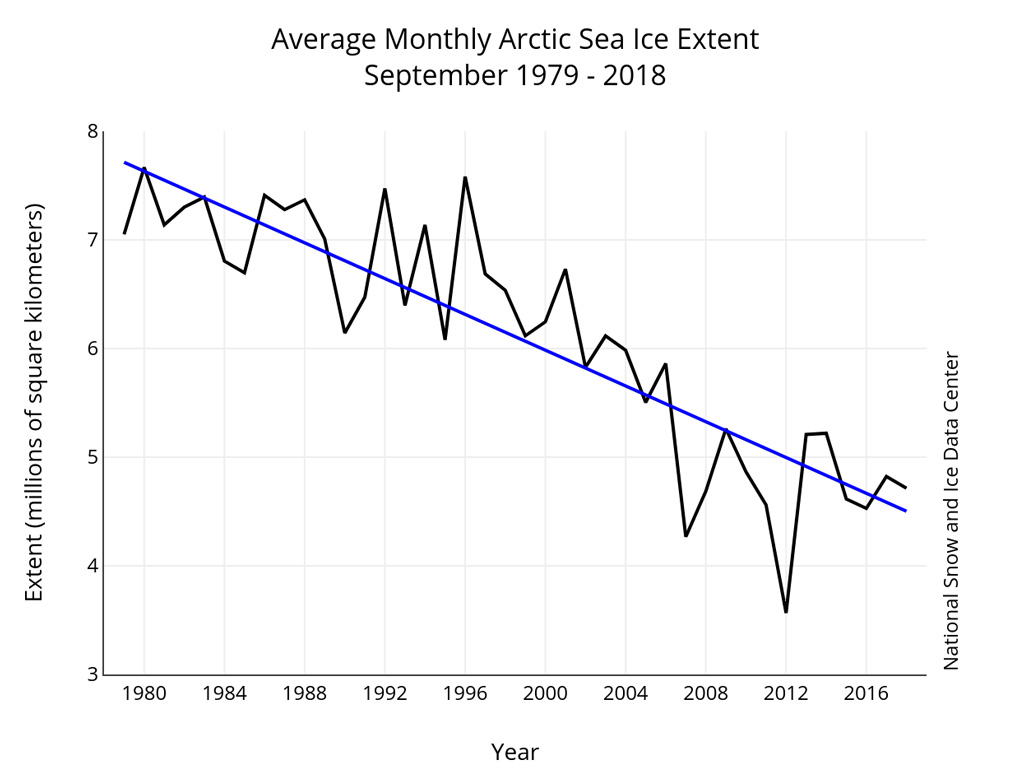
Late summer and early autumn have seen the largest declines in Arctic sea ice cover. Average September sea ice extent, for example, has decreased by around 13% per decade since 1979.
Average September Arctic sea ice extent from 1979 to 2018. Black line shows monthly average for each year; blue line shows the trend. Source: NSIDC
Arctic amplification is also caused by temperature feedbacks. As the Earth’s surface warms, it emits more energy back to space. But less energy is radiated back from the Arctic compared with lower latitudes, meaning the region warms more quickly.
Recent research has suggested that these rapid changes in the Arctic could be having knock-on impacts further south. While a warmer Arctic Ocean further inhibits sea ice growth, it also generates warmer and more moist air masses over the Arctic and nearby continents. A warming Arctic also reduces the temperature difference with the mid-latitudes, which has consequences for circulation patterns in the atmosphere (more on this later).
The theory goes that these changes contribute to an increase in unusual and extreme weather across the North America, Europe and Asia.
More: https://www.carbonbrief.org/qa-how-is-arctic-warming-linked-to-polar-vortext-other-extreme-weather
 Exposing the Big Game
Reblogged this on The Extinction Chronicles.