Default Mono Sans Mono Serif Sans Serif Comic Fancy Small CapsDefault X-Small Small Medium Large X-Large XX-LargeDefault Outline Dark Outline Light Outline Dark Bold Outline Light Bold Shadow Dark Shadow Light Shadow Dark Bold Shadow Light BoldDefault Black Silver Gray White Maroon Red Purple Fuchsia Green Lime Olive Yellow Navy Blue Teal Aqua OrangeDefault 100% 75% 50% 25% 0%Default Black Silver Gray White Maroon Red Purple Fuchsia Green Lime Olive Yellow Navy Blue Teal Aqua OrangeDefault 100% 75% 50% 25% 0%Bald eagle release video
Last week, the Washington Department of Fish and Wildlife Police referred 16 criminal charges against a man to the Clallam County prosecutor’s office. The suspect is accused of trapping a bald eagle with illegal steel jawed leghold traps, among other trapping violations.
In November of last year, WDFW Police received a report that a dog was trapped in a steel jawed leghold trap. The dog’s owner was able to free the dog but reported that a bald eagle was caught in another trap several feet away.
WDFW Police Sgt. Rosenberger responded and found the bald eagle struggling to free its talon from the trap. He was able to release the eagle and check it for injuries.Content Continues Below
“Thankfully, the bald eagle didn’t have any injuries or broken bones,” Rosenberger said. “This was a rare poaching incident where the poached animal was still alive and able to be released back into the wild immediately, on-site. It was a once-in-a-career event watching the eagle take flight on a crisp, sunny day, with the surrounding hills colored by fall leaves.”
WDFW officers removed additional illegal traps at the site.
Their investigation led them to a suspect who lives in Clallam County. He admitted to WDFW officers that he set several unpadded steel jawed leghold traps and wire snares, which captured and killed two coyotes.
If House Bills 224 and 225 pass, Montana will follow Idaho’s lead by extending the trapping season and allowing for the snaring of wolves.by Amanda Eggert02.03.2021
Two bills designed to reduce the wolf population in Montana by extending the trapping season and allowing licensed trappers to use snares were met with significant opposition during recent hearings before the House Fish, Wildlife and Parks Committee.
Retired wildlife biologistPaul Fielder, R-Thompson Falls, is sponsoring both measures.House Bill 225would direct the Fish and Wildlife Commission to add two weeks to each end of the current trapping season.House Bill 224would allow licensed trappers to set wolf snares.
On Thursday, Jan. 28, two proponents offered testimony in favor of the proposal to expand the trapping season, and 18 people spoke in opposition.
Rep. Fieldersaid he decided to introduce the bill after the…
PIERRE — South Dakota’s Nest Predator Bounty program will continue for 2021 and 2022, after additional authorization from the South Dakota Game, Fish and Parks Commission.
A resolution indicates that the 2021 program will include a payment of $10/predator and a cap of $500,000.
The entire program will be moved up earlier in the year, running from March 15 through July 1.
“The primary goal of the program is to enhance nest success for pheasants and ducks at localized levels by removing primary nest predators, like raccoons, striped skunks, opossums, red fox and badgers from the landscape,” said interim department secretary Kevin Robling in a statement. “Furthermore, this program is designed to increase youth and family participation in understanding and experiencing the tradition of trapping while enhancing our strong outdoor heritage.”
Why you should get vaccinated even if you’ve already had Covid-19CNNNow PlayingWhy you should get…
Source:CNNWhy you should get vaccinated even if you’ve already had Covid-1901:02
(CNN)You might be among the more than 26.6 million people in the United States who have had Covid-19 — and when it comes to coronavirus vaccines, emerging variants or the risk of re-infection, you might have a lot of questions.”We are continuing to learn a year into the pandemic,” Dr. Becky Smith, medical director of infection prevention and control and an infectious diseases specialist atDuke University Hospital, told CNN in an email.Yet there are still some answers to questions that doctors say Covid-19 survivors should know.
How much of a risk is reinfection?
The risk of reinfection “seems to be quite low” and the…
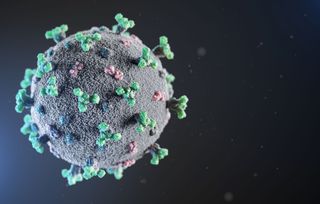
The novel coronavirus has developed a number of worrisome mutations, resulting in multiple new variants popping up around the world. Now, a new study sheds light on how the virus mutates so easily and why these mutations help it “escape” the body’s immune response.
The study researchers found that SARS-CoV-2, the virus that causes COVID-19, often mutates by simply deleting small pieces of its genetic code. Although the virus has its own “proofreading” mechanism that fixes errors as the virus replicates, a deletion won’t show up on the proofreader’s radar.
“It’s devilishly clever,” study senior author Paul Duprex, director of the Center for Vaccine Research at the University of Pittsburgh, told Live Science. “You can’t fix what’s not there.”
What’s more, for SARS-CoV-2, these deletions frequently show up in similar spots on the genome, according to the study, published Feb. 3 in the journal Science. These are sites where people’s antibodies would bind to and inactivate the virus. But because of these deletions, certain antibodies cannot recognize the virus.
Duprex likened the deletions to a string of beads where one bead is popped out. That might not seem like a big deal, but to an antibody, it’s “completely different,” he said. “These tiny little absences have a big, big effect.”
SARS-CoV-2 tends to develop mutations in certain spots, which “disguise” the virus from antibodies. The image on the left shows multiple antibodies (green and red) binding to SARS-CoV-2 within cells (blue). On the right, deletions in SARS-CoV-2 stop neutralizing antibodies from binding (absence of green) but other antibodies (red) still attach very well. (Image credit: Kevin McCarthy and Paul Duprex)
Sneaky deletions
Duprex and his colleagues first noticed these deletions in a patient who was infected with the coronavirus for an unusually long time — 74 days. The patient had a weakened immune system, which prevented them from clearing the virus properly. During the lengthy infection, the coronavirus started to evolve as it played “cat and mouse” with the patient’s immune system, ultimately developing deletions, the researchers said.
They wondered how common such deletions were. They used a database called GISAID to analyze some 150,000 genetic sequences of SARS-CoV-2 collected from samples around the world. And a pattern emerged. “These deletions started to line up to very distinct sites,” said study lead author Kevin McCarthy, assistant professor of molecular biology and molecular genetics at the University of Pittsburgh.
“We kept seeing them over and over and over again,” in SARS-CoV-2 samples collected from different parts of the world at different times, he said. It seemed that these viruses strains were independently developing these deletions due to a “common selective pressure,” the researchers wrote in their paper.
The researchers dubbed these sites “recurrent deletion regions.” They noticed that these regions tended to occur in spots on the virus’s spike protein where antibodies bind in order to disable the virus. “That gave us the first clue that possibly these deletions were leading to the ‘escape’ or the evolution [of the virus] away from the antibodies that are binding,” McCarthy said.
Predicting new variants
The researchers started their project in the summer of 2020, when the coronavirus wasn’t thought to be mutating in a significant way. But the deletions that popped up in their data said otherwise. In October 2020, they spotted a variant with these deletions that would later come to be known as the “U.K. variant,” or B.1.1.7. This variant gained global attention beginning in December 2020, when it took off rapidly in the United Kingdom.CLOSEhttps://imasdk.googleapis.com/js/core/bridge3.438.0_en.html#goog_1475731710Volume 0% PLAY SOUNDRELATED CONTENT
“Our survey for deletion variants captured the first representative of what would become the B.1.1.7 lineage,” the authors wrote. Their finding underscores the importance of closely monitoring the virus’s evolution by tracking these deletions and other mutations.
“We need to develop the tools, and we need to reinforce our vigilance for looking for these things and following them … so we can begin to predict what’s going on,” McCarthy said.
Although the virus may mutate to evade some antibodies, other antibodies can still effectively bind to and inactivate the virus.
“Going after the virus in multiple different ways is how we beat the shape-shifter,” Duprex said in a statement. “Combinations of different antibodies [i.e. different monoclonal antibody treatments] … different types of vaccines. If there’s a crisis, we’ll want to have those backups.”
The findings also show why it’s important to wear a mask and implement other measures to prevent the virus from spreading — the more people it infects, the more chances it has to replicate and potentially mutate.
“Anything that we can do to dampen the number of times it replicates … will buy us a little bit of time,” Duprex said.
The US has reported at least 618 cases of COVID-19 variants from the UK, Brazil and South Africa across 33 states, according to the Centers for Disease Control and Prevention.
Of that total, 611 are the more contagious UK variant known as B.1.1.7, of which there have been 187 cases in Florida and 145 in California,the CDC saidin a Thursday update.
There are five cases of the B.1.351 variant, which was first detected in South Africa. Three of them are in Maryland and two are in South Carolina.
Meanwhile, two cases of the P.1 strain from Brazil were…
Side-by-side comparisons of the images show how dramatically the outlet glaciers of the Vatnajökull ice cap have receded.
Then: vast reaches of ice and snow. Now: bare rock.
“On surface appearances, the extent of the climate crisis often remains largely invisible,” said Kieran Baxter from the University of Dundee, who documented the glaciers in 2020. “But here we can clearly see the gravity of the situation that is affecting the whole globe.”https://platform.twitter.com/embed/index.html?dnt=true&embedId=twitter-widget-0&frame=false&hideCard=false&hideThread=false&id=1356256106289508352&lang=en&origin=https%3A%2F%2Fwww.aljazeera.com%2Ffeatures%2F2021%2F2%2F5%2Fmelting-glaciers-rising-seas-climate-tipping-points&theme=light&widgetsVersion=ed20a2b%3A1601588405575&width=550px
Elemental power
I spent a week filming in Iceland for Planet SOS in 2019, perpetually awed by a landscape forged by the supercharged geology, shaped and reshaped by the effects of the elemental power of natural forces.
Basalt rock pinnacles hewn out by erosion stood sentinel on the shore with craggy mountains towering in the distance. Glaciers swept over active volcanoes, ash from previous eruptions carpeting the ice.
Through the millennia the glaciers have advanced and retreated but never has the withdrawal been as drastic as it is now. And it is happening to nearly all the world’s glaciers – from the Alps to the Andes, from Greenland to Antarctica.
I spoke to geologist Oddur Sigurðsson who has been charting glacier loss for decades and is well aware of the global implications.
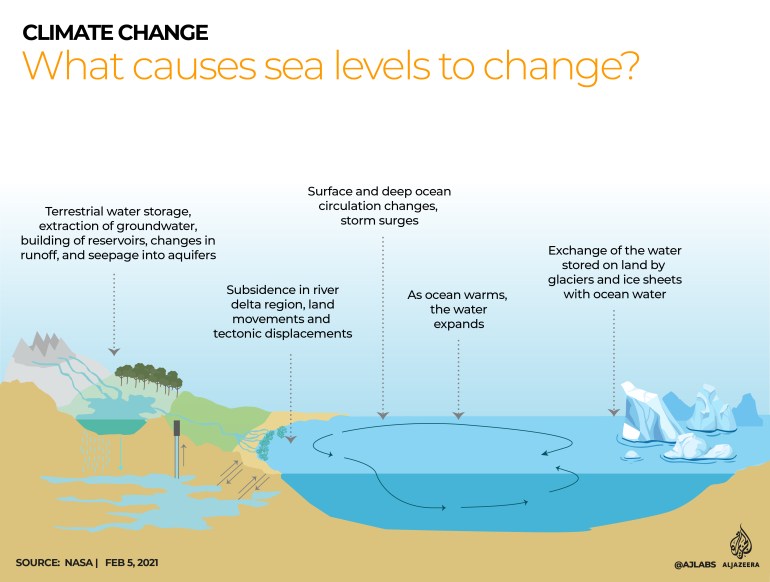
“Glaciers will melt,” he told me. “The meltwater runs into the ocean and the ocean surface rises. I told my friends in the United States, that the refugees would not only be coming from Mexico and Central America but also from Florida and the Atlantic coast.”
The first global ice-loss survey released recently found that melting of the ice sheets accelerated so much during the past 30 years that it is now in line with the worst-case scenarios outlined by scientists.
There was a stunning exchange on the recent Outrage and Optimism podcast which rendered host Christiana Figueres, one of the architects of the Paris Agreement, speechless.
She was told by leading climate scientist Johan Rockström, the director of the Potsdam Institute for Climate Impact Research, that we have already gone beyond some key tipping points. Losing the resilience of the planet was the nightmare that is keeping scientists awake at night, Rockström said.
“The number one is the canary in the coalmine – the Arctic summer sea ice. We have passed the point of no return, affecting weather systems in the Northern Hemisphere with heatwaves and drought and forest fires. It is impacting the Gulf Stream and causing warm surface temperatures that are accelerating the melting of the west Antarctic ice shelf.”
Rockström went on to say that a number of glaciers in west Antarctica are starting to irrevocably slide into the ocean, crossing another tipping point. “This would likely commit ourselves to one or two metres of sea-level rise.”
Land becomes sea
What does that physically mean? That by the century’s end, a huge proportion of our coastal populations would have had to move. Hundreds of millions of people would be going inland. And what is now perhaps an efficient subway transport system would become the domain of fish and sea squirts. Cities deluged, land becomes sea.
A recent report by Climate Risk Management says that 100 of the world’s airports could be below mean sea level by 2100. Of those, 20 airports handled more than 800 million passengers in 2018, approaching a fifth of the world’s passenger traffic that year.
Like we have said before, you think this pandemic bad? We ain’t seen nothing yet.
Careful caretakers
“It is a last warning system from science,” Rockström said. “Science is saying we have learned so much, here are the red flags. We can deviate away but that requires cutting emissions by half every decade and reaching a net-zero world economy in 30 years time.”
“We need to become very, very careful caretakers of oceans and all the natural ecosystems on land. Then we can still avoid the most catastrophic outcomes.”
These are warnings we hear time and time again, only they’re becoming louder and more urgent as science reveals reality, just as surely as the glaciers reveal bare rock.
Your environment round-up
1. UK PM risks ‘humiliation’ over coal mine: A leading climate scientist has urged Boris Johnson to halt production at a new coal mine in Cumbria. “You have a chance to change the course of our climate trajectory … Or you can stick with business-almost-as-usual and be vilified around the world,” James Hansen, the former top global warming researcher at NASA, wrote in a letter.
2. Meat and politics between Tibet and China: Tibetan Buddhist monks are urging former nomadic yak herders to embrace vegetarianism, while local authorities hope to bolster the industrial production of yak meat for a Chinese public that is consuming more meat than ever before.
3. Our unnatural disasters: Thanks to climate change, the world is seeing more wildfires, storms, and new viruses than it did in the recent past. Although we name them “natural” disasters, some say we should call them out for the man-made catastrophes they really are.
4. A freshwater Arctic Ocean?: During the Ice Ages, the Arctic basin was isolated from the world ocean, and may have swung between being filled with salt water and fresh water at different times, according to a recent geochemical study of marine sediments.
The final word
Tipping points are so dangerous because if you pass them, the climate is out of humanity’s control: if an ice sheet disintegrates and starts to slide into the ocean there’s nothing we can do about that.
The incident took place in Urho Kekkonen National Park in Lapland last October.Image: Maiju Saijets / Yle
Prosecutors have filed charges over ahunting accidentin which a mountain biker died from a gunshot wound in Urho Kekkonen National Park in October.
The suspect in the case, a man from the municipality of Savukoski in Lapland, is accused of aggravated involuntary manslaughter as well as a hunting crime.
According to the police’s preliminary investigation, the hunter was hunting for birds in the park and did not see the biker as the rifle was discharged, due to snow on the trees obscuring the hunter’s view.
A single bullet struck the cyclist in the upper body, fatally injuring him. The distance between the hunter and the cyclist was about 75 metres…
A 38-foot-long (11.5 meters) whale that washed ashore in the Florida Everglades in January 2019 turns out to be a completely new species. And it’s already considered endangered, scientists say.
When the corpse of the behemoth washed up along Sandy Key — underweight with a hard piece of plastic in its gut — scientists thought it was a subspecies of the Bryde’s (pronounced “broodus”) whale, a baleen whale species in the same group that includeshumpbackandblue whales. That subspecies was named Rice’s whale. Now, after genetic analysis of other Rice’s whales along with an examination of the skull from the Everglades whale, researchers think that…
ByBoris Ngounou- Published onFebruary 3 2021/ Modified onFebruary 3 2021
The Mauritanian government has just issued an alert on an outbreak of bird flu in the Diawling National Park. During a biodiversity monitoring of the park, the park curator discovered the carcasses of 245 pelican chicks and a dozen adults of the same species. And according to laboratory tests, these wild birds were victims of bird flu.
The Mauritanian Minister of the Environment and Sustainable Development has ordered the closure of Diawling National Park until further notice. The protected area located 195 km south of Nouakchott, the Mauritanian capital, has been infected by the bird flu virus. This is revealed by the results of laboratory tests carried out on a sample of the 267 pelicans found dead in the park and its surroundings.
In a press release issued on January 30th, 2021, the Mauritanian Minister of…












 (Image: © Shutterstock)


![[Osama Al Saadi/Al Jazeera]](https://www.aljazeera.com/wp-content/uploads/2021/02/Green-Read-Iceland.png?resize=770%2C513)


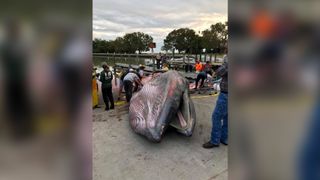 This 38-foot-long (11.5 meters) baleen whale stranded off Florida in 2019. The adult male is now considered part of a completely new, and endangered, species called Rice’s whale.(Image: © Florida Everglades National Park)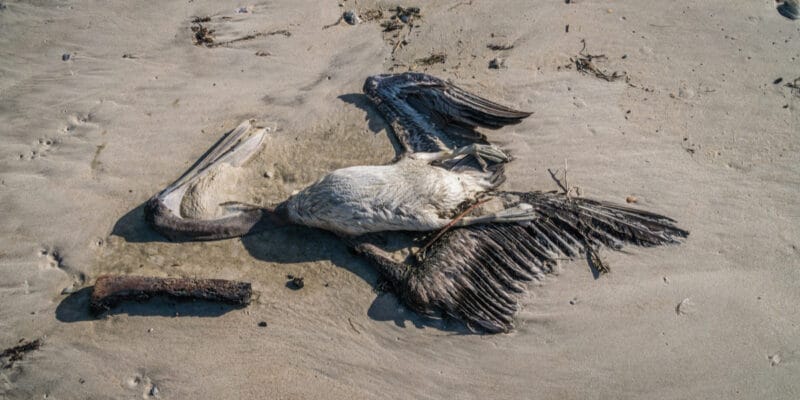
 Exposing the Big Game