By BRIAN NIEMIETZNEW YORK DAILY NEWS |FEB 23, 2021 AT 2:34 PM
A South African big game hunter who was savaged on social media after posting a Valentine’s Day photo of her holding the heart of a 17-year-old giraffe she’d killed is shooting back at critics.
“Oooo dear the world is triggered I totally forgot that everyone now has ‘feeling’ and gets triggered by everything!!!” the hunter said in a rant full of cliches and bad grammar.
“You can’t identify yourself as White because people will be triggered it’s racist,” she wrote.
Her diatribe also took on the issues of gender identity, pride in “heritage” and other matters regarding race. (Van der Merwe in another postingreferredto the Black Lives Matter as a terrorist movement and inexplicably implied that it has ties to…
MADISON, Wis. (AP)— Hunters and trappers blew past Wisconsin’s wolf kill target in less than 72 hours, forcinga premature end to a huntthat initially wasn’t supposed to happen for another nine months and raising the ire of animal rights activists.
The agency estimated that about 1,000 wolves roamed the state before the hunt began. The department’s population goal is 350.
The season began Monday and had been scheduled to run through Sunday, but DNR officials said the hunt would end at 3 p.m. Wednesday because so many animals had been killed…
A bill outlawing coyote-killing contests has made its way back to the Oregon Legislature.
Oregonians can hunt coyotes year-round, and current regulations do not limit the number of coyotes hunters can kill.
Rep. Mark Owens, R-Crane, said coyotes are predators that affect the livelihood of ranchers. He said the hunting contests are one way to keep the populations down. Owens said…
Photos of common wildlife traps shown in an Idaho Fish and Game brochure on protecting pets from hunting traps.IDAHO DEPARTMENT OF FISH & GAME
The potential expansion of wolf trapping into Blaine County — where it has never been allowed before — has drawn criticism from local officials and concerns about an increase in pet injuries in the highly-recreated area.ListenListening…1:54
Even now, Wood River Valley residents don’t need to travel far to reach legal wolf trapping ground, as State Senate Minority Leader Michelle Stennett, who represents the area, did in January.
“We were about four miles from my truck when my dog made a hideous screech,” she said. “I knew immediately he must have gotten into something. We were right on the side of the road. It was a white trap in white snow.”
I am against trapping.Traps pose a threat and danger to people, domestic pets and wildlife (targeted and nontargeted).It is not humane, requires little to no skill and does not respect the fact that public land belongs to the 1.9 million Idaho citizens (and growing), not just the 2,000 registered trappers.We are the No. 1 fastest-growing state in our country.Arizona is in second place. Arizona along with New Mexico, Colorado and California have disallowed trapping on public land.I have had the privilege of knowing many of the wolf experts, traveling in our wonderful wilderness and experiencing wolves first-hand. That is coupled with acquired knowledge based on fact and science.Wolves are a vital part of our ecosystem and often demonstrate characteristics that are more exemplary than some of human kind’s. Regrettably and wrongly, they have become “political tools.”
In Units 48 and 49, we have repeatedly proven that trapping wolves is…
Anna Popova, head of Russia’s Federal Service for Surveillance on Consumer Rights Protection and Human Wellbeing, stated that the early warning “gives us all, the entire world, time to prepare for possible mutations and react in an adequate and timely fashion.”
Disease outbreaks on modern farms are not uncommon, as genetically similar animals kept in close quarters are likely to spread illness fast. Unsanitary conditions can cause animals to fall into respiratory distress easily, and dead animals can serve as vectors for an array of illnesses. Drug-resistant bacteria known as “superbugs” have become an increasingly worrisome issue on farms across the world, as animals living in subpar conditions often require antibiotics to stay alive.
This in-depth 2016 Scientific American article explains why crowded modern farms are host to a plethora of contagious ailments, from MRSA to enterococci, a group of bacteria known to cause over 20,000 infections in humans annually. As the article states, in 2014 pharmaceutical companies sold nearly 21 million pounds of medically important antibiotics for use in animals raised for food, over three times the amount sold for use in humans.
“Resistant bacteria that food animals carry can get into a variety of foods,” states the Center for Disease Control on an informational webpage about antibiotic use in farmed animals. “Meat and poultry can become contaminated when the animals are slaughtered and processed. Fruits and vegetables can become contaminated when resistant bacteria from animal feces (poop) spreads to them through the environment, such as through irrigation water or fertilizers…illnesses that were once easily treatable with antibiotics are becoming more difficult to cure and more expensive to treat.” Advertisement
In 2017 the World Health Organization issued a statement advising that commercial farming operations stop routinely administering antibiotics to healthy animals, citing an increasing threat to human health. “Over-use and misuse of antibiotics in animals and humans is contributing to the rising threat of antibiotic resistance,” the statement reads. “Some types of bacteria that cause serious infections in humans have already developed resistance to most or all of the available treatments, and there are very few promising options in the research pipeline.”
The ongoing COVID-19 pandemic has been a sobering reality check to the risk of disease outbreaks and serves as a call to action for humanity. As long as animals exist on crowded and unsanitary factory farms, antibiotic resistance and disease spread will remain a dire public health risk. The evidence is clear; raising animals for food by the masses is deeply detrimental to both animal welfare and human health, and only a drastic food system reform can bring about change.Advertisement
Sign this petition to encourage Congress and the Senate to pass the Preventing Future Pandemics Act!Urge Congress and the Senate to Pass the Preventing Future Pandemics Act
The attorney for a Todd County man charged with manslaughter in connection to a hunting accident that claimed the life of a Hopkinsville man last year appeared for a pretrial conference Wednesday afternoon.
Mark Gilbert, who represents Julian Newton of Sharon Grove, appeared virtually before Christian Circuit Court Judge Andrew Self. Gilbert said they are close to resolving the case and asked Judge Self to set another hearing in the near future.Audio Player00:0000:00Use Up/Down Arrow keys to increase or decrease volume.
Judge Self set the time for 1:00 on that day. He added they would anticipate a plea and a resolution at that time.
The Kentucky Department of Fish and Wildlife investigated the hunting accident that occurred on McKinney Road in Christian County on October 18, 2020. Officials said Newton had thought 58-year old Charles Newton and his wife…
Outlawing ecocide would hold governments and corporations accountable for environmental negligence. We can’t wait
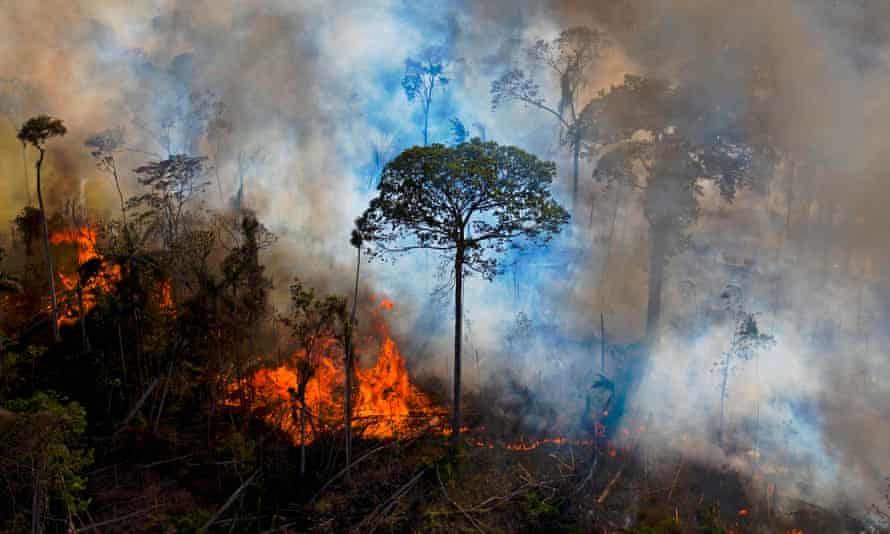
Smoke rises from an illegally lit fire in an Amazon rainforest reserve in Pará State, Brazil. Photograph: Carl de Souza/AFP/Getty Images
Wed 24 Feb 2021 02.16 EST
1,074
The Paris agreement is failing. Yet there is new hope for preserving a livable planet: the growing global campaign to criminalize ecocide can address the root causes of the climate crisis and safeguard our planet – the common home of all humanity and, indeed, all life on Earth.
The science is clear: without drastic action to limit temperature rise below 1.5C, the Earth, and all life on it, including all human beings, will suffer devastating consequences.Advertisement
Yet only two countries – Morocco and the Gambia – are on track to meet the 1.5C target. The largest emitters, including the United States, China, Russia and Saudi Arabia, are putting the world on course for 4C. At that rate, the polar ice caps will melt, causing dramatic sea level rise that will – in combination with other devastating effects like strengthening storms and droughts – cause mass famine, displacement and extinction.
Currently, much of humanity feels hopeless, but the establishment of ecocide as a crime offers something for people to get behind. Enacting laws against ecocide, as is under consideration in a growing number of jurisdictions, offers a way to correct the shortcomings of the Paris agreement. Whereas Paris lacks sufficient ambition, transparency and accountability, the criminalization of ecocide would be an enforceable deterrent. Outlawing ecocide would also address a key root cause of global climate change: the widespread destruction of nature, which, in addition to increasing greenhouse gas emissions, has devastating impacts on global health, food and water security, and sustainable development – to name a few.
Ecocide shares its roots with other landmark concepts in international law, including genocide. Indeed, ecocide and genocide often go hand in hand. Around the globe, ecological destruction is also decimating indigenous communities.To give just a few cases: Brazil’s Yanomami are facing mercury poisoning generated by the 20,000 illegal miners in their territories. 87% of Native Alaskan villages are experiencing climate-related erosion, even as they face growing calls to drill on their lands.
Conviction for ecocide would require demonstrating willful disregard for the consequences of actions such as deforestation, reckless drilling and mining. This threshold implicates a number of global and corporate leaders through their complicity in deforesting the Amazon and Congo basins, drilling recklessly in the Arctic and the Niger delta, or permitting unsustainable palm oil plantations in south-east Asia, among other destructive practices.
As a term, “ecocide” dates to 1970, when Arthur Galston, an American botanist, used it to describe the appalling effects of Agent Orange on the vast forests of Vietnam and Cambodia. On the 50th anniversary of the concept, we can take heart in the growing civic will to officially make ecocide an international crime.
Already, citizens, scientists and youth activists including Greta Thunberg are calling on global leaders to introduce ecocide at the international criminal court (ICC). Following the lead of climate-vulnerable ocean states Vanuatu and the Maldives in December 2019, President Emmanuel Macron of France vowed to champion it on the international stage last June and has proposed a version of it in French law. Finland and Belgium both expressed interest during the ICC’s annual assembly, and Spain’s parliamentary foreign affairs committee has issued recommendations to consider it. The EU has also voted to encourage its recognition by member states. And Pope Francis was ahead of the game in November 2019 when he called for ecocide to become an international crime against peace. The Stop Ecocide Foundation has recently convened a panel of heavyweight international lawyers to draft a robust legal definition of ecocide which this growing list of states can seriously consider proposing as an amendment to the ICC’s Rome Statute.
Criminalizing ecocide gives us the unprecedented chance to create a protective measure with legal teeth that could deter reckless leaders from damaging, short-sighted policies creating accountability in a way that Paris does not.
Just as important, we could motivate corporations to make dramatic shifts away from an unacceptable status quo that too often favors the destruction of nature for short-term profits. As ecocide becomes an impending legal reality, corporate leaders would be forced to adapt, and quickly, re-examining the way they do business and make decisions with our planet in mind.
But ecocide would not just be a punitive measure for corporate leaders. It would also offer considerable opportunities for new sustainable ventures. The pristine areas that ecocide targets – virgin forests, wetlands and our oceans – are precisely the places that have value far beyond mere extractive industries, including in sustainably developing new pharmaceuticals that may help in the current Covid-19 pandemic and in future pandemics. True leaders in the public and private sector would much prefer ethical, sustainable and long-term value creation that does not exploit nature or humanity. By outlawing bad actors, we will empower many more good ones.
As a global community, we cannot wait for more warning signs or the “right moment”. Last year alone has seen devastating examples of ecocide: fires ravaging the Amazon, the Congo basin, Australia, Alaska and Siberia all at unprecedented rates; a large oil spill in Ecuador; and unending, accelerating plastic pollution, which could weigh up to 1.3bn tons by 2040. Unfortunately, under cover of Covid-19, ecocide has accelerated. Deforestation in the Amazon basin increased by 50% in the first quarter of 2020, with rampant fires reaching a 13-year high in June.
In the midst of a global pandemic that demonstrates humanity’s shared vulnerability – and our need to work together collectively in the face of crisis – we must begin to understand that what we do to our ecosystems, we do to ourselves.
Indeed, the meaning of ecocide is fully encapsulated by its etymology. It comes from the Greek oikos (home) and the Latin cadere (to kill). Ecocide is literally “killing our home”.
TARZAN SWINGING FROM TREE TO TREE might seem like a Hollywood attempt at imagining the life of primitive men, but new findings suggest our ancient ancestors really were swingers.
WHAT’S NEW — Research published Wednesday in the journal Science Advances suggests the last common ancestor of hominids — a category of great apes that includes chimpanzees, gorillas, orangutans, and humans — climbed and swung in trees.
“Our findings support the view that humans and chimpanzees evolved from an ancestor that had similarities to modern apes in their locomotor adaptation,” lead author Thomas C. Prang, an assistant professor at Texas A&M University, tells Inverse.
SOME BACKGROUND — Most scientists recognize that the highly dextrous human hand seems to differ in shape and form from the hands primates use to swing from trees.
However, this evidence has given rise to a disputed hypothesis: Humans evolved from a quadrupedal ancestor that used all four limbs for movement on the ground, rather than a bipedal ancestor that suspends from trees.
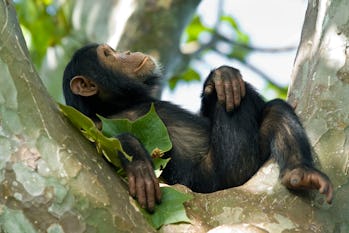
A chimpanzee in a tree. The researchers suggest the ancient ancestor of humans swung from trees like chimps. Getty
Proponents of this hypothesis believe the last common ancestor was more “monkey-like” and less similar to, say, chimpanzees or bonobos.
The researchers in this study were skeptical of this idea and wanted to test its merits.
HOW THEY DID IT — Researchers used a sample of 400-plus specimens, encompassing both living primates and ancient hominoid fossils.
First, researchers analyzed the ancient hand bones of Ardipithecus ramidus, which believers of the disputed hypothesis use to support their idea regarding a quadrupedal last common ancestor. Ardipithecus ramidus is a human ancestor that lived nearly 4.4 million years ago. Our understanding of it is predominantly linked to a partial skeleton found in 2009, nicknamed ‘Ardi.’
The initial interpretation of this hand suggested the last common ancestors of humans and chimpanzees used a form of locomotion called “above-branch clambering,” Prang explains.
The remains of Ardipithecus ramidus.Raphael GAILLARDE/Gamma-Rapho via Getty Image
He doubts this interpretation for one reason: monkeys and lemurs are the only primates that use above-branch climbing, and their much smaller bodies use external tails to help them with tree climbing — unlike the subject of their study.
“The inference of ‘above-branch’ adaptations in Ardipithecus is somewhat problematic since it’s chimpanzee-sized and lacks an external tail [like all apes and humans],” Prang says.
To test it, Prang and his colleagues reconstructed the evolution of the hominin hand and how it may have adapted in ancient environments.
A figure from the study showing the evolution of hands in various hominoids, including humans and Neanderthals.
WHAT THEY FOUND — The results showed that Ar. ramidus was most similar to chimpanzees, bonobos, and orangutans compared to “non-suspensory” monkeys. Overall, they compared the specimen across a sample of 53 anthropoid primate species.
Ar. ramidus had these suspensory traits — which enabled them to swing from tree branches — before a significant evolutionary shift occurred with the lineages of Homo (humans) and Australopithecus, an ancient ancestor of hominins, which includes humans and chimpanzees.
“The hand of Ardipithecus suggests that the last common ancestor of humans and chimpanzees was adapted to climbing tree trunks and suspending the body beneath branches,” Prang says.
The study, in turn, is framed as a debunking of the earlier hypothesis suggesting hominins evolved from an ancestor “with a generalized hand that lacked suspensory adaptations.”
According to Prang, the study also indicates an important evolutionary step related to the development of tool use.
“We show a major evolutionary jump between the hand of Ardipithecus and all later hominins that happens to coincide with the loss of tree climbing adaptations in the foot and the earliest known stone tools and stone tool-cut-marked animal fossils,” Prang says.
This finding provides support for the idea that Ar. ramidus displayed an early form of bipedalism — or the ability to walk upright on two legs — which helps us understand how human hands and feet evolved.
“Our study provides some support for the hypothesis that human hands and feet ‘co-evolved,’ which previous studies have suggested on the basis of comparisons of patterns of hand/foot trait relationships, and evolutionary simulations, among humans and chimpanzees,” Prang says.
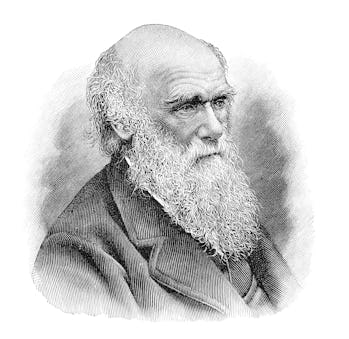
The researchers refer to Charles Darwin, the father of evolutionary theory, in discussing the implications of their findings.Getty
DIGGING INTO THE DETAILS — The researchers’ new findings harken back to the works of more historical evolutionary scholars.
“Our analysis is much more consistent with what people like Thomas Henry Huxley and Sir Arthur Keith proposed in the late 19th and early 20th century based on anatomical comparisons between humans and apes,” Prang says.
The most notable of these historical scholars is Charles Darwin, the father of evolution. Prang connects Darwin’s work to their findings on bipedalism in the ancient specimen, which can help explain human evolution.
“The classic idea attributed to Darwin is that bipedalism ‘freed the hands’ from their primary role in quadrupedal locomotion, which enabled natural selection to push hand anatomy in a new direction [directly or indirectly] related to manual dexterity, possibly useful for the manufacture and use of stone tools,” Pran says.
WHY IT MATTERS — According to the study, these findings “resolve a long-standing debate about the role of suspension in the ancestry of humans.”
Alexandros Karakostis, a hand biomechanics expert not affiliated with the study, describes the findings to Inverse as “very intriguing.” It provides a robust answer to “a heated debate,” Karakostis says — although it’s a debate that’s likely to continue.
“In this context, this new study identifies suspensory adaptations in the 4.4 million-year-old hand remains of Ardipithecus ramidus, suggesting that human hand morphology may have emerged from an evolutionary shift between Ardipithecus and Australopithecus,” he says.
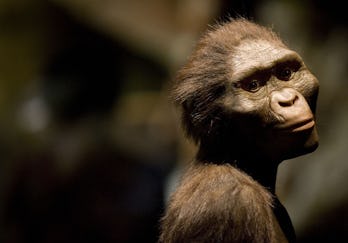
A sculptor’s rendering of the hominid Australopithecus afarensis. The researchers in this study discuss the evolution of Australopithecus. Getty
WHAT’S NEXT — In the future, the study team wants to examine the Ardipithecus hand in more detail.
Ameline Bardo, a postdoctoral research associate at the University of Kent not affiliated with the study, agrees a more detailed analysis of the hand bones would be necessary to “better understand the links between form and function of his hand.” This analysis, Bardo tells Inverse, may contribute to an understanding of the ancient creature’s movements.
Overall, Bardo views the study as “very well done” and contributes to the idea “early hominins evolved from an ancestor with a varied positional repertoire including suspension and vertical climbing.”
The study team is most excited to explore the paper’s implications for the evolution of great apes and humans
“If it is true that humans and chimpanzees evolved from an African ape-like ancestor, it implies that each African ape lineage evolved at different rates,” Prang says.
“It will be important to think about the evolutionary histories of African ape populations and how the evolutionary process might have shaped their anatomy and behavior over the last several million years.”
Abstract: The morphology and positional behavior of the last common ancestor of humans and chimpanzees are critical for understanding the evolution of bipedalism. Early 20th century anatomical research supported the view that humans evolved from a suspensory ancestor bearing some resemblance to apes. However, the hand of the 4.4-million-year-old hominin Ardipithecus ramidus purportedly provides evidence that the hominin hand was derived from a more generalized form. Here, we use morphometric and phylogenetic comparative methods to show that Ardipithecus retains suspensory adapted hand morphologies shared with chimpanzees and bonobos. We identify an evolutionary shift in hand morphology between Ardipithecus and Australopithecus that renews questions about the coevolution of hominin manipulative capabilities and obligate bipedalism initially proposed by Darwin. Overall, our results suggest that early hominins evolved from an ancestor with a varied positional repertoire including suspension and vertical climbing, directly affecting the viable range of hypotheses for the origin of our lineage.
*This month, the Germantown Sportsmen’s Association in New York has planned a squirrel killing contest – the “Squirrel Scramble.” Whoever kills the most squirrels or biggest squirrel in a day, gets a prize. Wildlife killing contests serve no ecological or conservation purpose.
They are not ‘hunting’ and they teach children that killing as many animals as you can for fun is perfectly okay. It is not okay. Please call immediately the number below to protest, as the contest is this Saturday , February 27th. If enough of us call perhaps they will feel pressured enough to suspend this unconscionable event. Germantown Council Office and Town Supervisor Robert Beaury at 518-537-6687 (press 2 for voicemail)*







 Exposing the Big Game