If you’re barreling down the road safely behind the wheel of your carbon-spewing steel-cage-contraption and “clip,” “wing” or “sideswipe” a soft-bodied deer trying to cross one of the ubiquitous roadways, even if it hobbles away looking “okay” you killed the poor creature. Maybe not outright and maybe not today, but you can bet that he or she won’t make it through too many cold nights without succumbing to his or her injuries.
The fact is, there are just far too many cars, driving far too fast for conditions (which include marked or unmarked deer crossings) for any semblance of sanity.
Just this morning, I had the displeasure of having to “put down” a wounded deer who had been staying in our hay shed for the past two nights. I knew he (one of his antlers was lost when the car or truck hit him) was wounded, but it wasn’t until he limped off yesterday morning dragging his broken and mangled hind leg that I knew for certain he had no hope of any natural recovery. The bone was protruding from the compound fracture which would never heal right on its own—and no vet around here would treat an injured deer since this county fancies itself a “trophy” mule deer area and deer are just a “resource.”
As much as I hate to take the life of any animal, I was forced to do what the deer ultimately wanted of me and end his suffering as quickly and humanely as possible. After the deed (I shot using a high-powered rifle with a scope through the open bathroom window), my wife and I rolled his lifeless body onto a tarp and slid it across the snow to a safe spot for scavengers to feed.
“Roadkill” is so prevalent in this valley that signs have been placed at either end of the highways leading into what should just be a deer wintering range warning motorists that the annual tally of deer deaths are 150+ (that figure updated yearly). But more ominous to most drivers is the estimated cost repairing their precious vehicles. Still, no dollar-value or loss of non-human life would convince most drivers they should change the speed limit to 25 or 35 miles-per-hour (as it’s marked and enforced through the towns).
I’m sure it would be considered heresy these days to demand an enforced 45 mph daytime speed limit on any highway bisecting any deer winter range, but that’s the kind of “extreme” step we’ll have to take if we want to go on using the name homo sapiens, meaning “intelligent ape,” and not be demoted to something reflecting recklessness or self-centered-ness—something like homo erraticus, homo psychopathicus, homo drive-too-fasticus or whatever type of homo scientists deem appropriate.
The recent guest opinion by Rusty Kramer, president of the Idaho Trapper’s Association (“Trapping is a safe and effective wildlife management tool,” Feb. 10), is an offense to wildlife management professionals everywhere. I am a wildlife biologist with peer-reviewed studies published in the scientific literature, and to hear trapping being promoted as “a safe and effective wildlife management tool” struck me as completely dishonest.
Kramer’s secondary organization, cynically named the Foundation for Wildlife Management, has nothing at all to do with wildlife management. This organization’s chief claim to fame is as a front group for the Rocky Mountain Elk Foundation to fund thousand-dollar bounties on wolves.
Trapping has never played a meaningful or ecologically useful role in wildlife management. Do we need to “manage” pine marten populations with trapping to prevent the decimation of pine squirrels? Is trapping of lynx a legitimate…
The sub-zero temperatures causing blackouts across the southern U.S. are connected to climate change.ByBrian K SullivanFebruary 16, 2021, 11:10 AM PSThttps://imasdk.googleapis.com/js/core/bridge3.443.0_en.html#goog_761743954Texas Bans Shipping of Natural Gas Out of StateUnmuteClimate Change, Bitter Cold Create Chaos for Energy Systems
The Earth’s poles are warming faster than anywhere on the planet. While the consequences of that aren’t completely understood, it’s becoming apparent that many of the world’s extreme weatherevents owe theArcticat least some of the credit.
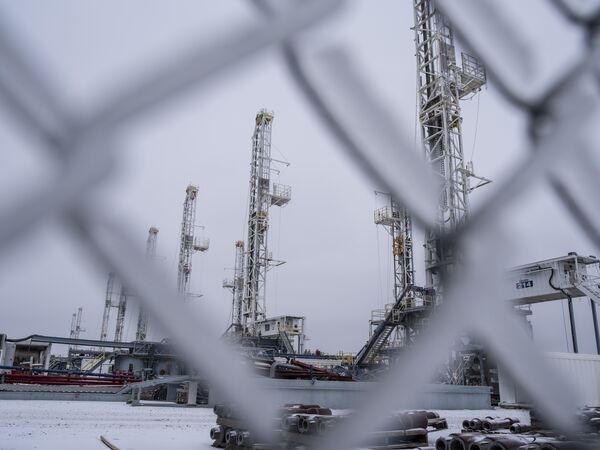
A blast of cold air that swept out of Canada in mid-February, moving across the Great Plains and deep into the South, has overburdened the electrical grid and triggeredwidespreadpower outagesin Texas, which like many southern statesrelies predominantly on electric…
BEAVER TWP., Ohio (WKBN) – A Sebring man is facing charges after a hunting-related accident in Beaver Township.
Police said Kasen Smith was deer hunting without a license or permission to hunt on land near Market Street and W. Calla Road, where it happened.
He shot at a deer, and the bullet flew across Calla Road, hitting a house and striking a man’s foot as he was sitting on a couch inside, police said. A baby was nearby.
According to a police report, Smith told investigators that he was up on the hill and did fire the gun in the direction of the houses…
The frigid air mass that is blanketing much of the lower 48 states and Mexico in subzero temperatures is set to linger across much of the continent until Saturday, according to the National Oceanic and Atmospheric Associhas already produced record snowfall, tornadoes and thundersnow.
So far, the death toll from Winter Storm Uri includessix peoplekilled in a 133-car pileup near Fort Worth, Texas; at leastthree peoplecrushed by debris in160 mph windin North Carolina; and amother and daughterpoisoned by carbon monoxide inside their car, where they huddled to stay warm overnight as the majority of Houston remained without power. Given thethree-year continued national risein people experiencing homelessness in cities across the…
The sub-zero temperatures causing blackouts across the southern U.S. are connected to climate change.By Brian K SullivanFebruary 16, 2021, 11:10 AM PSThttps://imasdk.googleapis.com/js/core/bridge3.443.0_en.html#goog_200084205Climate Change, Bitter Cold Create Chaos for Energy SystemsUnmuteClimate Change, Bitter Cold Create Chaos for Energy Systems
The Earth’s poles are warming faster than anywhere on the planet. While the consequences of that aren’t completely understood, it’s becoming apparent that many of the world’s extreme weather events owe the Arctic at least some of the credit.
A blast of cold air that swept out of Canada in mid-February, moving across the Great Plains and deep into the South, has overburdened the electrical grid and triggered widespread power outages in Texas, which like many southern states relies predominantly on electric heating, according to the Energy Information Administration. It was the second time in six months that extreme temperatures have brought grids to their knees—a heatwave across California in August caused a spike in energy demand for cooling equipment, forcing rolling blackouts for the first time since 2001.
Is the Texas cold blast connected to climate change? “I have argued a definitive yes,” said Judah Cohen, director of seasonal forecasting at Atmospheric and Environmental Research, part of risk analytics firm Verisk, who’s spent more than a decade studying what warming across the Arctic means to weather for the rest of the world.
In the Northern Hemisphere’s summer, this has led to a decrease in the contrast between the heat of the equator and the cold of North Pole. The strength of the summer jet stream, a river of wind that propels weather systems around the globe, depends on extreme temperature differences between these two regions. As the planet warms and this contrast diminishes, the jet stream weakens and can no longer push large weather patterns out of the way. This is what caused wildfires above the Arctic Circle, droughts throughout the world, and record-setting heat waves from Moscow to the U.S.
In the case of the Texas cold snap, the phenomenon began in the first week of January, when air in the stratosphere above the Arctic warmed suddenly. This set up a slow-moving atmospheric chain reaction that weakened the polar vortex, the girdle of winds that keeps frigid air corralled at the North Pole, allowing it to spill out into the temperate regions of Asia, Europe, and North America. Once the cold starts rolling south, very little can stop it.
“As the old saying goes, there is nothing between the Arctic and Dallas but a barbed wire fence,” said Dan Pydynowski, a meteorologist with AccuWeather Inc. “So when you get a direct discharge like this it will go all the way.”
While these events happen about six times per decade, according to the National Oceanic and Atmospheric Administration, Cohen maintains that climate change has increased the frequency with which the polar vortex weakens and allow the cold to air to run amok.
Texas has certainly seen snow before, said Bob Henson, a meteorologist with Yale Climate Connections. But he urged observers not to be distracted by individual anomalies. “We know the climate of the central U.S. can produce events like this,” he said. “The point is, when you sum up all the events that are happening 365 days a year, that is when you see climate change most vividly.”
Pedestrians walk on along a snow-covered street in Austin on Feb. 15.Photographer: Montinique Monroe/Getty Images
Across the U.S., severe thunderstorms and hail damage have been rising for decades. Some of that is due to increasing population, but that doesn’t explain the full extent of the increase. While scientists aren’t sure about the precise cause, there’s broad agreement that the weather is changing.
In the past year, many parts of the world’s oceans reached record warm temperatures. The Atlantic produced an all-time high of 30 hurricanes and tropical storms in 2020. Vast areas the west were consumed by wildfires, including parts of Oregon and Washington that were once too wet to produce the required dry brush as fuel. Studies by reinsurers Munich Re and Aon both show weather-related natural disasters around the world increasing over the years, while damage from other events such as earthquakes and volcanoes has remained the same.
The disparity between warming and cooling becomes most apparent in the all-time records. In the last year 292 all-time hot records have been set, according to the National Centers for Environmental Information, compared to three low temperature extremes. Scientists repeatedly point to this to show the world is getting warmer. What on Earth?The Bloomberg Green newsletter is your guide to the latest in climate news, zero-emission tech and green finance.EmailSign UpBy submitting my information, I agree to the Privacy Policy and Terms of Service and to receive offers and promotions from Bloomberg.
“It’s no secret that extreme weather events are happening more frequently,” said Jennifer Francis, senior scientist at the Woodwell Climate Research Center in Woods Hole, Massachusetts. “Climate scientists have been predicting this behavior for years, maybe decades, so it comes as no surprise whatsoever that we’re seeing back-to-back extremes of various types around the globe.”
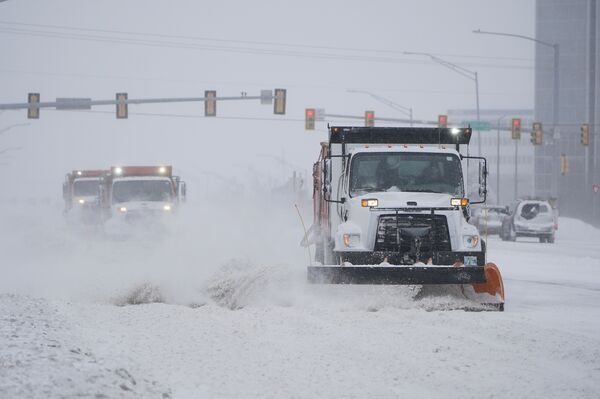
Snowplows clear the road in Oklahoma City on Feb. 14. Photographer: Sue Ogrocki/AP Photo
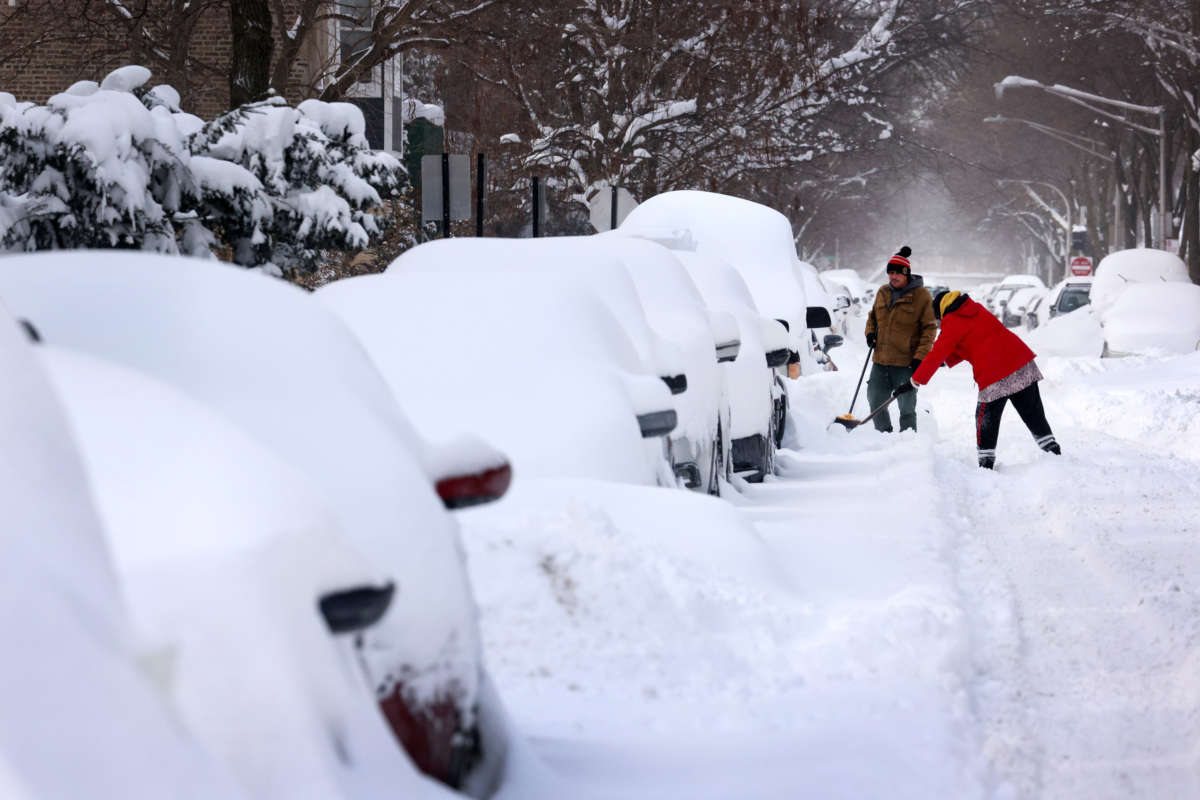
During the worst of the cold on Monday, 157 million people across the U.S. were living under winter storm warnings or weather advisories, said Brian Hurley, a senior branch forecaster with the U.S. Weather Prediction Center. Dallas was colder than Anchorage, Alaska. The cold itself damaged or forced power suppliers offline in a part of the country ill-prepared for frigid temperatures.
“The sorry state of the U.S. electric grid is a shining a bright light on the glaring need for grid modernization,” Francis said, as well as “mounting vulnerabilities in infrastructure of all sorts.”
Up until about two weeks ago, winter was relatively mild across the U.S. January was the ninth warmest across the 48 contiguous states, with temperatures among the 10 warmest for the month in Washington, Montana, North Dakota, South Dakota, Minnesota, Michigan, and Maine, the Centers for Environmental Information said. December was also mild in most places.
It’s not yet possible to connect the extreme cold of the last few days directly to climate change, but Henson says that doesn’t matter in the bigger picture.
“Climate change is real regardless of an extreme cold outbreak,” he said. “You don’t need to explain every cold and snow outbreak to explain climate change.”
Shy giant’s journey back from the brink of extinction has received less attention than its charismatic cetacean cousin https://www.youtube.com/embed/swRans1O4Ds?embed_config={%22adsConfig%22:{%22adTagParameters%22:{%22iu%22:%22/59666047/theguardian.com/environment/article/ng%22,%22cust_params%22:%22sens%3Df%26si%3Df%26vl%3D0%26cc%3DUS%26s%3Denvironment%26inskin%3Df%26se%3Dseascape-the-state-of-our-oceans%26ct%3Darticle%26co%3Dashifa-kassam%26url%3D%252Fenvironment%252F2021%252Ffeb%252F18%252Fthe-new-humpback-calf-sighting-sparks-hope-for-imperilled-right-whale%26br%3Df%26su%3D0%26edition%3Dus%26tn%3Dfeatures%26p%3Dng%26k%3Dwildlife%2Cworld%2Ccetaceans%2Cfishing%2Ceurope-news%2Cwhales%2Canimals%2Cspain%2Cenvironment%2Cmarine-life%2Cfishing-industry%2Cconservation%26sh%3Dhttps%253A%252F%252Fgu.com%252Fp%252Fgb88t%26pa%3Df%22}}}&enablejsapi=1&origin=https://www.theguardian.com&widgetid=1&modestbranding=100:39World’s most endangered right whale spotted off Spanish island – videoSeascape: the state of our oceans is supported by
It was a memorable finale to a day out on the Atlantic: a four-metre whale calf gliding past the boat as the divers returned to the Spanish island of El Hierro in the Canaries. Their incredible luck, however, would be made clear hours later, as researchers around the world clamoured for more details after seeing the 47-second video of the encounter online.
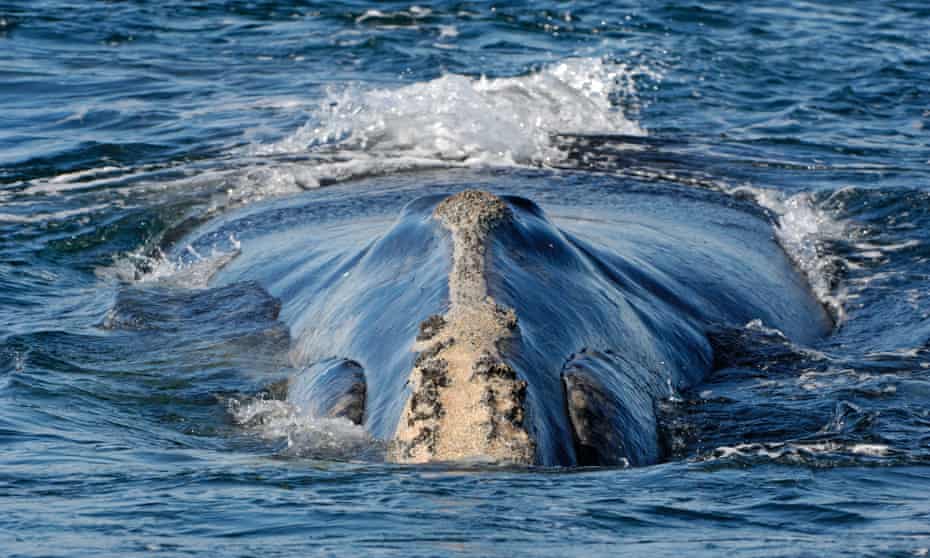
The divers had unwittingly stumbled across a North Atlantic right whale – one of the world’s most endangered whales. What made the December encounter extraordinary was that the recently born calf, which appeared to be alone, was spotted thousands of miles away from the species’ usual haunts along the eastern seaboard of Canada and the US.
“When I realised what it was, my hair stood up on end,” says Natacha Aguilar, a marine biologist at the University of La Laguna in Tenerife. “This is a species that has been considered extinct on this side of the Atlantic for about 100 years. And all of a sudden this newborn calf appears in El Hierro.”
This is a species that has been considered extinct on this side of the Atlantic for about 100 years
Natacha Aguilar, marine biologist
More than a dozen volunteers sprang into action, combing the area for any sign of the calf or clues as to how it had ended up in the archipelago long after centuries of whaling wiped out all traces of the species from European waters.
A handful of sightings in European waters over the years had been linked to whales with a penchant for transatlantic journeys. But Aguilar was tantalised by another – albeit more unlikely – possibility. “It could suggest that the species could be starting to recolonise the north Atlantic on the European and African side.”
The sighting was a bright moment for scientists tracking a species that has long been in the spotlight for all the wrong reasons. Since 2017, records show that 47 North Atlantic right whales have been found dead or seriously injured – a devastating blow to a species that has dwindled to fewer than 400 members.
Most of these incidents have been linked to interactions with humans. As North Atlantic right whales turned up snarled in fishing lines, nursing deep wounds from ship strikes or reeling from ocean noise, fear began to set in that the species would be the first great whale to become extinct in modern times.
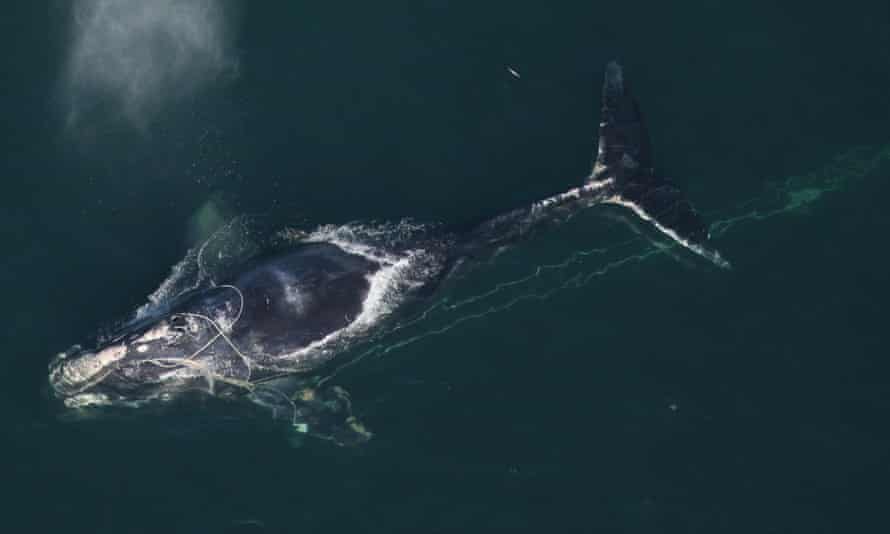
A North Atlantic right whale swims with a fishing net tangled around her head off Daytona Beach, Florida. Photograph: NOAA/Alamy
It was an unnerving turn for a species that just over a decade ago had been a symbol of resilience. Having been nearly hunted to extinction by whalers – right whales were easy targets as they move slowly, linger in coastal areas and float when killed – the species was the first whale to be protected by law, in 1935.Advertisementhttps://041e63b42a80c08ee9d3e2dca6ecb6b2.safeframe.googlesyndication.com/safeframe/1-0-37/html/container.html
Safeguarded from commercial whaling, their numbers began to slowly increase, galvanising hope that the risk of extinction had been staved off.
Further optimism came from another species that had forged a remarkable comeback after as much as 90% of their population was wiped out by whaling: humpback whales, whose numbers have now climbed into the tens of thousands.
“Humpback whales are one of the greatest conservation success stories of the 20th century,” says Chris Johnson of the WWF’s Protecting Whales and Dolphins initiative. “It’s not perfect but they’ve bounced back.”
“Are North Atlantic right whales the new humpback? I would say yes,” says Johnson. “In that we can succeed at this, too. But it’s going to take all of us. There are important decisions that we need to make in the next few years if we’re going to have species like the North Atlantic right whale around.”
A North Atlantic right whale in the Bay of Fundy, Canada. The whale can be easily identified by the white calluses on its head. Photograph: Brian J Skerry/NG/Getty
Central to saving these whales are the ships that ply the routes off the east coast of North America, as well as the fishers who harvest its waters, rich in lobster and snow crab. Data from US officials suggests that more than 85% of right whales, which can reach the length of a city bus and weigh as much as 70 tonnes, have been entangled in fishing gear at least once.Advertisement
As a result, debate over how best to protect the whales has often been drawn out, wasting precious time for a species on the brink of extinction. “We can’t lose a single whale a year right now,” says Heather Pettis, a scientist at the New England Aquarium, Boston, US. “They really need some immediate action.”
The push for protections has been further complicated by a warming ocean. “This is climate change in action,” says Moira Brown of the Canadian Whale Institute. “You have the most endangered large whale in the north Atlantic having to go further afield to find food because the Gulf of Maine is warming up.”
This search for food has been blamed for the whale’s increased presence in Canada’s Gulf of St Lawrence, an area teeming with ship traffic. It’s a bitter twist on an earlier conservation victory: in 2003, shipping lanes were rerouted in the nearby Bay of Fundy to avoid an important area for the whales.
“When we think of climate change, we think of things happening like the glaciers melting over 100 years,” says Brown. “This has happened in a decade. The pace is phenomenal.”
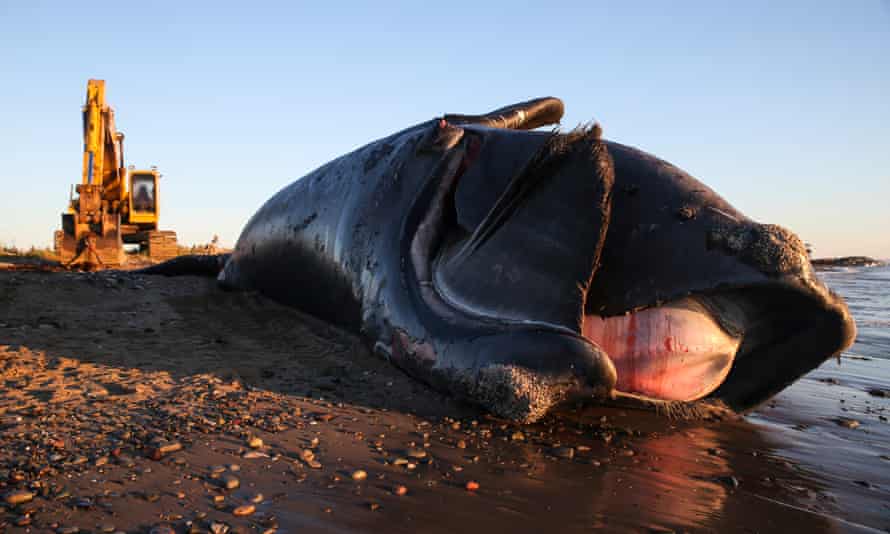
A 9-year-old North Atlantic right whale lies dead on a beach in New Brunswick, Canada after being towed onto the shore. The whale was known to researchers who said it had endured at least one vessel strike and three entanglements in fishing gear. Photograph: Nathan Klima/Boston Globe/Getty
The overlapping threats facing the whales hint at the complexity of the conservation issues involved, four decades after a groundswell of support pushed the International Whaling Commission to impose a moratorium on commercial whaling, says Greenpeace’s Willie Mackenzie.Advertisement
“Directly shooting them in the head with a harpoon is obviously a bad thing,” says Mackenzie. “But if we’re talking about ship strikes or fishing interactions, what’s the answer? You don’t get as many fish? You shouldn’t buy as much stuff? It’s not a direct cause and effect thing that people can understand very simply.”
He ascribes some of the success of the earlier campaign to imagery, whether it was the blood-soaked horror of commercial whaling captured by Greenpeace, or the awe-inspiring acrobatics of whales. The same strategy is now complicated by the fact that many of the species most at risk today are shyer and less well-known.
There’s a PR job here – humpbacks are really good at it and right whales not so much
Willie Mackenzie, Greenpeace
“There’s a PR job here and humpbacks are really good at it and right whales not so much,” he says, citing images of humpbacks spectacularly leaping out of the water or slapping their tails on the surface. “If you want to show people the majesty of a whale, that’s the picture you have to show them because they’re not going to be very excited about a black lump in the ocean or a really distant picture of something deep diving.”
Around the Canary Islands, more than six weeks after the North Atlantic right whale was spotted, researchers continue to search for clues. “Right now, there’s not much hope that it will appear again,” says Aguilar. “A newborn of that age is dependent on the mother. Maybe they’ve reunited and are still in the area. But if it is still not with its mother and has not been adopted by another whale, then it has died.”
Still, she is quick to characterise the sighting as a “historical moment” for the region. “It was a moment that gave me shivers and made me want to cry,” she says. “To have a whale considered extinct appear in the Canary Islands, it’s proof that nature, if we take care of it, has an enormous capacity to recover.”
An Elon Musk tweet can do everything from moving the stock market to convincing people to invest in a joke cryptocurrency. So when the richest man on Earth tweeted in late January about kicking $100 million to whoever could come up with the best technology to capture carbon from the air, the world took notice.
The cryptic tweet was followed by details that the billionaire donated $100 million toXPRIZEfor a carbon capture competition that will last four years. It’s a neoliberal meets techno-optimist wet dream. Here is the world’s richest man teaming up with a group founded by a futurist and with board members including Larry Page and James Cameron, all in the service of creating technology that doesn’t exist anywhere near scale to address a problem our broken political system hasn’t been able to solve.
Now PlayingSee massive rescue of…See massive rescue of freezing sea turtles 01:55
(CNN)As Texas’ deep freeze wreaks havoc on land, sea animals also suffer in its icy waters.This week, more than 2,600 turtles have been rescued around South Padre Island at the southern tip of the state.Volunteers and wildlife officials scouring bays and beaches for stranded turtles suffering from “cold-stun,” a condition which inhibits turtles’ mobility and often results in stranding.Sea Turtle Inc., a nonprofit in South Padre Island, rescued more than 2,500at-riskturtlesfrom nearby waters. It’s collecting hundreds by the day.The facility, which already housed turtles in its hospital, rehabilitation and education centers, hasbeen overwhelmed by the amount of rescues performed since temperatures dropped.”We have been so pleased with the community acceptance,” Wendy Knight, the executive director at Sea Turtle Inc. said in a Facebook video. “But all of these efforts will be in vain if we do not soon get power restored to our facility.”CNN has reached out to the organization, which is still suffering from power outages, and is awaiting a reply.Texas Game Wardens rescued 141 sea turtles from the frigid waters of the Brownsville Ship Channel and surrounding bays in the last week.On Wednesday, Texas Game Wardens rescued at least 141 turtles from the Brownsville Ship Channel, near South Padre Island. Turtles of all sizes rested on the deck of its large rescue vessel and were taken to nearby facilities, Texas Parks and Wildlife Department spokeswoman Megan Radke told CNN.
Turtles can’t survive in extremely cold water
The rescue effort began immediately for the Texas Game Wardens and the team at Sea Turtle Inc., who knew that turtles — unlike other sea animals — are unable to survive in extreme cold temperatures.While animals like dolphins or manatees are able to regulate their body temperatures internally, sea turtles’ body temperatures vary with surrounding water.At very low temperatures, turtles can become cold-stunned.According to the National Park Service, cold-stunned turtles are not able to move well. They become lethargic and often float to the surface or wash up onshore.This can lead to death from shock or predation, or from boat strikes.According to Sea Turtle Inc’s Facebook page, the storm is the biggest sea turtle cold-stunning event to happen in south Texas.
With a new generator, turtles have hope, for now
On Wednesday, SpaceX provided Sea Turtle Inc. with a generator large enough to cover the organization’s rehabilitation, education and conservation facilities, Knightsaid in a Facebook video.Because of the generator, turtles already housed at the facilities, along with newcomers, have been able to warm up.
Cuddling penguins and snorkeling alligators: What animals do to stay warm during extreme coldBut the prolonged power outage has blown out all 10 of the facility’s heaters and coolers, and each costs thousands of dollars to replace.Despite this, the team at Sea Turtle, Inc. remains hopeful.”For today, the sun is bright. SpaceX has provided us with a generator,” Knight said. “And we are moving forward.”
When the weather tested Texans’ mettle, they responded with hospitalityThe sanctuary, strapped for warming devices, evacuated animals to other facilities while trying to keep the rest as warm as possible with donated supplies.As Sea Turtle Inc. is pushed to capacity, the organization has begun using the South Padre Island Convention and Visitors Bureau for more space.They are asking for donations on their Facebook page, where they continues to issue updates.Those who have found sea turtles are encouraged to call Sea Turtle Inc’s emergency sea turtle line at 956-243-4361 or the Turtle Island Restoration Network at 1-866-TURTLE5.
(CNN)Themassive craterappeared violently and explosively in the Siberian tundra last year — a powerful blowout of methane gas throwing ice and rock hundreds of feet away and leaving a gaping circular scar in the empty and eerie landscape.It was the 17th hole to appear in the remote Yamal and Gyda peninsulas in the Russian Arctic since the first was spotted in 2013, mystifying scientists. The craters arethought to be linked to climate change. Drone photography, 3D modeling and artificial intelligence are helping to reveal their secrets.”The new crater is uniquely well preserved, as surface water hadn’t yet accumulated in the crater when we surveyed it, which allowed us to study a ‘fresh’ crater, untouched by degradation,” said Evgeny Chuvilin, lead research scientist at the Skolkovo Institute of Science and Technology’s Center for Hydrocarbon Recovery…






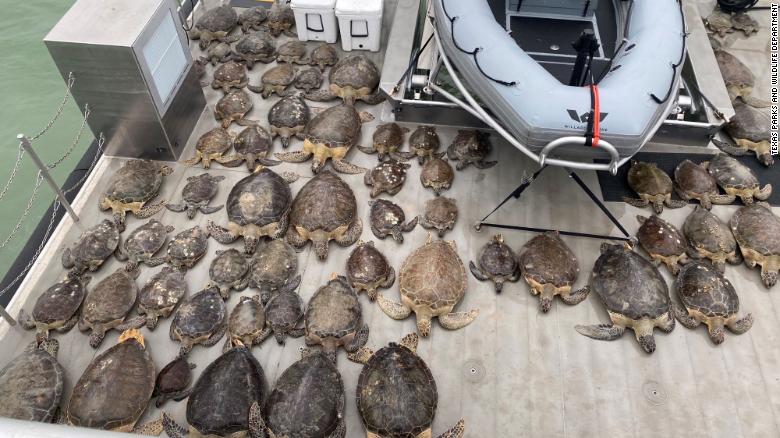 Texas Game Wardens rescued 141 sea turtles from the frigid waters of the Brownsville Ship Channel and surrounding bays in the last week.On Wednesday, Texas Game Wardens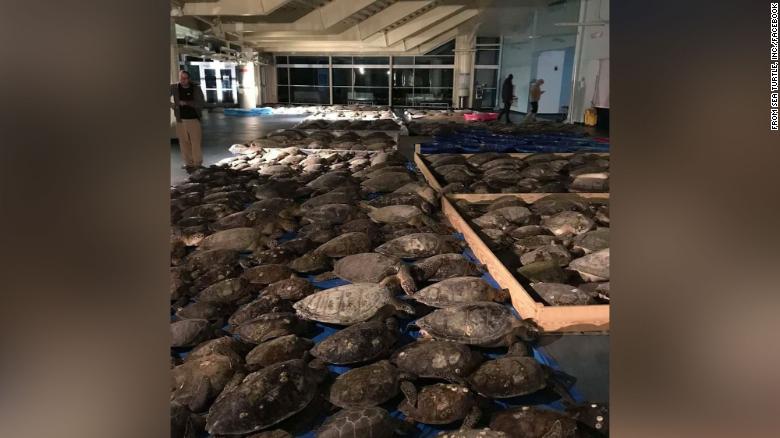
 Exposing the Big Game