Illustration showing the beginning of the Permian-Triassic mass extinction. 2020.Credit: PaleoFactory, Sapienza University of Rome forJurikova et al., Nature Geoscience 2020.
A new paper claims to identify the cause of the Great Dying that occured nearly 252 million years ago.
During the worst mass extinction event ever, most of Earth’s life perished.
The study suggests a volcanic eruption in Siberia spread aerosolized nickel particles that harmed organisms on the planet.
Dinosaurs are the most infamous victims of a mass extinction event 66 million years ago. But an even worse extinction happened 251.9 million years ago.
Called the end-Permian mass extinction or the Great Dying, this most severe of extinction events wiped out about 90 percent of the planet’s marine…
A lawsuit pitting habitat needs for grizzly bears and bull trout against road access for loggers and motorized tourists has resolved in favor of the animals in the Flathead National Forest.
However, U.S. District Judge Don Molloy ruled on Thursday that most of a new forest management plan governing the 2.4-million-acre national forest west and south of Glacier National Park may stand while the U.S. Forest Service and Fish and Wildlife Service fix some violations of the Endangered Species Act.
“It’s a pretty thorough and nuanced opinion,” said Lawson Fite, an American Forest Resource Council attorney representing the Montana Logging Association. “The judge said we can have a robust timber program on the Flathead that supports rural communities, keeps a healthy forest, and provides for grizzly bears continuing their impressive recovery. We’re gratified that grizzlies are recovering, and I think we should be celebrating that, rather than just keeping restrictions for their own sake.”https://f4d3d4a1462421edf6e8184efb847da3.safeframe.googlesyndication.com/safeframe/1-0-38/html/container.html
The challenge came from WildEarth Guardians, Swan View Coalition and several other environmental groups that accused the Flathead Forest of violating National Environmental Policy Act and Travel Management Rule provisions in drafting its new forest plan without adequate research or public review.
Molloy rejected those arguments, writing “this does not appear to be a case in which the agencies cut corners. Rather, with limited exception, the record reflects that federal defendants met their statutory obligations in planning for and implementing the revised plan.”
Instead, Molloy found the agencies failed to follow the Endangered Species Act by getting rid of previous policies that helped grizzlies and bull trout. He quoted the late Supreme Court Justice Ruth Bader Ginsburg in noting that getting rid of those policies “is like throwing away your umbrella in a rainstorm because you are not getting wet.”
Earthjustice attorney Tim Preso, who represented the Swan View Coalition, said the ruling confirmed studies showing the federal agencies were not actually enforcing the policies, such as complete removal of unneeded roads in wildlife habitat.
“The government was changing the rules that led to progress on grizzly bear and bull trout conservation,” Preso said. “They have to go back and rethink that.”
The Flathead National Forest includes a large part of the Northern Continental Divide Ecosystem, which has the largest single population of grizzly bears in the Lower 48 states. An estimated 1,000 grizzlies live in the mountains of Glacier National Park, the Bob Marshall Wilderness Complex, Flathead and Blackfeet Indian reservations and other wildlands extending south to Missoula.https://f4d3d4a1462421edf6e8184efb847da3.safeframe.googlesyndication.com/safeframe/1-0-38/html/container.htmlWatch now: One-star Glacier Park reviews IIPlay Video
shift + ←→slower / faster
↑↓volume
mmute
←→seek
. seek to previous
12… 6 seek to 10%, 20% … 60%
Sometimes the most amazing places on earth don’t impress everyone. Here are negative online reviews for Glacier National Park posted on TripAdvisor, Yelp and Google.
The environmental groups argued that Flathead Forest officials improperly abandoned old rules limiting forest road construction and requiring removal of unnecessary roads in places critical to grizzlies and bull trout. Road access frequently leads to bears getting killed in vehicle accidents or hunting incidents, and erosion from road surfaces can ruin streambeds bull trout need to spawn.
The groups also raised a number of other objections to the new forest plan, including the way it reviewed snowmobile and off-road vehicle routes, how it calculated harm to bears and fish for management purposes and how the overall plan was approved.
However, Molloy left the Flathead Forest’s forest plan in place, noting that both sides agreed the new plan was, on the whole, better for people and animals than the 1986 plan it replaces.
That means six forest projects currently in the works should stay active. They include the Taylor-Hellroaring, Hellroaring Basin Improvements, Crystal Cedar and March Madness blowdown salvage projects.
“If the revised plan were vacated, the economic impact on defendant-intervenors and on the local communities that depend on approved projects for employment could be severe,” Molloy wrote.
That included 575 wood industry jobs with an annual payroll of more than $40 million, along with at least eight other forest projects developing under the new forest plan. Instead, Molloy relied on the Forest Service’s testimony that “any project under the revised plan would have to be examined individually; if the project impacted roads, grizzly bears or bull trout, the project would require a site-specific consultation and a biological assessment with the Fish and Wildlife Service.”
Molloy rejected the environmental groups’ argument that the Flathead Plan unlawfully expanded snowmobile access in critical wildlife habitat. Instead, he ruled those snowmobile travel plans were already in place before the new forest plan got finalized, so it didn’t produce any changes. He also dismissed challenges to the Forest Service’s interpretation of travel-management rules for off-road vehicle use.
But he agreed the Fish and Wildlife Service failed to properly analyze how new forest management might hurt bears and trout, and that the Forest Service improperly relied on the FWS’ flawed analysis. For example, the groups showed that more than two-thirds of officially closed roads in the Swan Lake Ranger District showed signs of trespassing motor vehicles.
Hundreds of birds across the eastern United States have been dying from a mysterious illness, and wildlife experts aren’t sure what is causing it.
In late May, The Washington Post reported birds in the Washington, D.C., area were starting to die. Since then, six states – Ohio, Kentucky, Indiana, Maryland, Virginia and West Virginia – have reported similar instances.
Laura Kearns, a wildlife biologist with the Ohio Division of Wildlife, spoke with USA TODAY about what symptoms these birds are experiencing, what may be causing this illness and what people could do to help the birds.
Kearns said not all birds have the same exact symptoms, but one thing is common: physical changes around the eyes.
“Some report crustiness around the eyes, some report like bulging or swollen eyes. And then we’ve also had reports of the eyes being kind of sunken in,” Kearns said.
The Ohio Division of Wildlife reported blue jays, common grackles, American Robins, European starlings and sparrows have been affected. The Indiana Department of Natural Resources also said Northern cardinals have been affected.
Why is this happening?
The Indiana Department of Natural Resources took samples from the sick birds and they tested negative for the avian flu and the West Nile virus. Samples were then sent to the National Wildlife Health Center. The agency said in early June it was also working alongside the University of Georgia Southeastern Cooperative Wildlife Disease Study and the University of Pennsylvania Wildlife Futures Program.Get the Coronavirus Watch newsletter in your inbox.
Stay safe and informed with updates on the spread of the coronavirusDelivery: Varies
“We are eagerly awaiting the results from them,” Kearns said.
Could cicadas be a factor?
Brian Evans, an ornithologist with the Smithsonian Migratory Bird Center in Washington, D.C., brought up the idea to the NPR that the illness began to appear around the same time the Brood X cicadas began to emerge. Experts have said eating too many cicadas can hurt a dog’s digestive system because their exoskeletons and shells are hard to digest.
Kearns acknowledged a theory birds may be eating cicadas infected with fungus that rots their bodies as ill birds have been found in areas where there are cicadas present. However, she says sick birds have also been found where there are no cicadas, so it may be something else.
What should people do?
There are multiple things people that have homes birds frequently visit can do to help. Kearns recommends people take down their bird feeders for 7-10 days, or until the mortalities stop occurring.
The Indiana DNR says people should also clean bird feeders and baths with water and 10% bleach solution. People shouldn’t handle birds unless they are wearing disposable gloves and keep pets away from them. If someone encounters a dead bird, they should wear disposable gloves and place birds and gloves in a sealable plastic bag and throw away.
Fox News Flash top headlines are here. Check out what’s clicking on Foxnews.com.
More than 90% of theAmerican Westis in the grip of a historic and life-threateningdrought– and summer 2021 is just beginning.
A map of the severe conditions released Thursday by the U.S. Drought Monitor – which was started in 2000 and is produced through a partnership of the University of Nebraska-Lincoln’s National Drought Mitigation Center, the U.S. Department of Agriculture and National Oceanic and Atmospheric Administration – showed the vast region in dire straits.
I’ve seen several pine martens up close and they all seemed to be different sizes. Those that I’ve seen in trees (in WA and in Jasper) looked about the size of the a small house cat. But, once in the Washington cascades, at a place called Kennedy Hot Springs in the Glacier Peak Wilderness Area, I was in the hot pool and one came up and peered a me as though he was checking to see where the humans were–then he ran back towards my campsite. His behavior seemed suspicious, so I went back to camp to check on my belongings. Sure enough, what looked like a large pine marten was standing up and rummaging through my pack, which I’d left leaning against a log. It seemed to me the animal was more than the average 3 lbs., since he could reach into the top of my pack while standing with his hind feet flat on the ground. Since then, all the other martens I’ve seen seemed smaller than that individual. Reading now that the old-world pine martens were sometimes larger makes me wonder if there is sometime more variance in pine marten on this continent too.
Here’s one I saw in Jasper National Park in Alberta, Canada:
Edward SegarraUSA TODAY0:361:04https://imasdk.googleapis.com/js/core/bridge3.469.0_en.html#goog_306276742
Some stores in the Pacific Northwest are selling out ofportable air conditioners and fans as residentsaccustomed to mild summers brace for a heatwave that could bring triple-digit temperatures to major cities.
Seattle and Portland are poised for temperatures nearing or surpassing 100 degrees, and cities across the region are also expected to feel the burn of this sizzling heat,AccuWeather senior meteorologist Alex Sosnowskiwrote.
The Dalles, Oregon, which hasa population of approximately 16,000, could approach its all-time record of 112 degrees on Sundayand Spokane, Washington, could also make history with its slated slew of 100-degree temperatures.
“A dangerous heatwave is impacting the Pacific Northwest and into southern California,”the National Weather Service tweeted. “More than one hundredrecord high temperatures are forecast this weekend through Thursday.”
MILTON— A 32-year-old man was accidentally shot in the head Friday by his 8-year-old nephew while they were shooting chipmunks, according to police.
The man sustained non-life-threatening injuries and was sent toPortsmouth Regional Hospital and is expected to recover, police said.
Milton police andMilton Ambulance responded to120 Bolan Road about 11:31 a.m.
Police said they determined the 8-year-old fired a gun and the bullet ricocheted after killing the chipmunk, striking his uncle inthe head.
Milton Police Chief Richard Krauss said there will be no charges from his department in connection with the incident.
“It’s not against the law for anyone to teach a child how to shoot and take them hunting, even at 8 years old,” Krauss aid. “There are kids who learn how to hunt and shoot a lot younger than that. This was truly just a freak accident.”
Birds in Monroe and other Indiana counties are dying from a mysterious disease and state officials are asking residents to quit using bird feeders and bird baths, which may help spread the disease.
State bird biologist Allisyn-Marie Gillet saidBloomington’sWildCarewildlife rehabilitation center was thefirst to notify state officials about birdsthat were being brought in with eye problems and were dying. The affected birds show neurological problems and have swollen eyes with a crusty discharge.
The mysterious disease was first reported in the Washington, D.C., area in late May and since then has been discovered in Ohio, Kentucky, Virginia, Maryland, West Virginia, Delaware and Pennsylvania. Birds affected have included blue jays, American robins, common grackles, northern cardinals andEuropean starlings.
A well-known mama grizzly bear and one of her yearling cubs has been struck and killed by a train in Banff National Park.about 18 hours ago By: Cathy Ellis
Parks Canada suspects this is bear 130 and her two yearling cubs pictured on the third hole of the Stanley Thompson at the Banff Springs Golf Course earlier this spring. Photo courtesy of Jennifer Reimer/Parks Canada
BANFF – A well-known mama grizzly bear and one of her yearling cubs has been struck and killed by a train in Banff National Park.
The adult female, known as 130, was with her two yearlings on the Canadian Pacific Railway tracks at Mile 84.3 just west of the Banff townsite about 10 a.m.. on Thursday (June 24) when struck. One of the two cubs is alive and appears to be uninjured.
Parks Canada officials say wildlife experts, who raced to the scene when the report of the train strike came in to Banff dispatch, identified the bear as 130 based on a broken ear tag.
“The yearling that survived the incident appears to be uninjured and is moving through the area,” said David Dunbar, a spokesperson for Banff National Park.
“It is being monitored by Parks Canada staff. Precedent has shown that given its age and size, the orphaned yearling has a good chance of survival moving forward.”
There are no further details at this time on Parks Canada’s plans for this surviving young bear, whether it will be relocated to a quieter area of the park within its home range, or left alone.
On June, 3, Bear No. 130 and her cubs took down a newborn calf on the Banff Springs Golf Course, much to the surprise of a group of golfers on hole 2 of the Stanley Thompson.
“Some golfers had seen a calf run out onto the course and right behind it was one of the yearling cubs, and it nailed the calf and took it down right in front of them,” said Blair Fyten, a human-wildlife co-existence specialist with Banff National Park.
“A few seconds later, out of the bush comes mom and the other yearling, and mom grabs the calf, picks it up and heads back into the woods. Within minutes, they had pretty much eaten the calf and moved on.”
Bear No. 130, thought to be about 10 to 12 years old, emerged from the den in 2020 with three cubs in tow, but only two have been seen with her so far this spring.
In 2014, Bear 136, also known as Split Lip for his disfigured mouth, was the prime suspect in killing her previous litter of cubs.
Bear No. 130 did not hang around high-human use areas as a general rule, but it appears she was moving along on a narrow corridor on the train tracks foraging for food with her cubs.
Her home range does include the Bow Valley Parkway and the Fairhome bench, but she has been hanging around the Banff townsite this spring, including on Tunnel Mountain and the grassy greens of the Banff Springs Golf Course.
“She is a bear that hangs out a little bit around here, but more so the 1A and the Fairholme area,” Fyten said.
The premature death of bear 130 and one of her yearling cubs follows the death of bear No. 156 at the end of May in neighbouring Yoho National Park, who was struck by a vehicle on the Trans-Canada Highway near Field.
No. 156’s orphaned cubs, a male and a female, were relocated to a remote area of the backcountry within 156’s home range, which includes parts of Banff and Yoho national parks.
In Banff National Park, the death of No. 130 and one of her yearlings are the first confirmed grizzly bear mortality incidents on the railway in 2021.
Female bear 143, who had two cubs last year, was struck and killed on the train tracks between Caste Mountain and Lake Louise in September 2020. She spent most of her time in the backcountry of Banff and the adjacent Yoho and Kootenay national parks.
Grizzly bears are listed as threatened species in Alberta. Since 2000, at least 17 grizzly bears have been killed on the train tracks in Banff and Yoho national parks, which is considered a significant blow to Banff’s population of about 60 grizzlies.
Survival of female bears is considered critical to the population, given ongoing research has found that Banff’s bears reproducing more slowly than in other areas of North America because their food supply is limited in the harsh, mountain habitat.
The non-profit, Help Asheville Bears, said poaching can happen anywhere and with a copious amount of bears in Tennessee, they want people to stay aware.
Non-profits fighting poachers, saving them from illegal bear trapshttps://imasdk.googleapis.com/js/core/bridge3.469.0_en.html#goog_1603061767Volume 90%Author:Amelia Young (WBIR)Published:11:08 PM EDT June 24, 2021Updated:11:08 PM EDT June 24, 2021
KNOXVILLE, Tenn — It’s illegal, but people are still laying out bear traps. The latest known case comes out of western North Carolina. A non-profit was alerted Wednesday about a bear that was found with a missing paw.


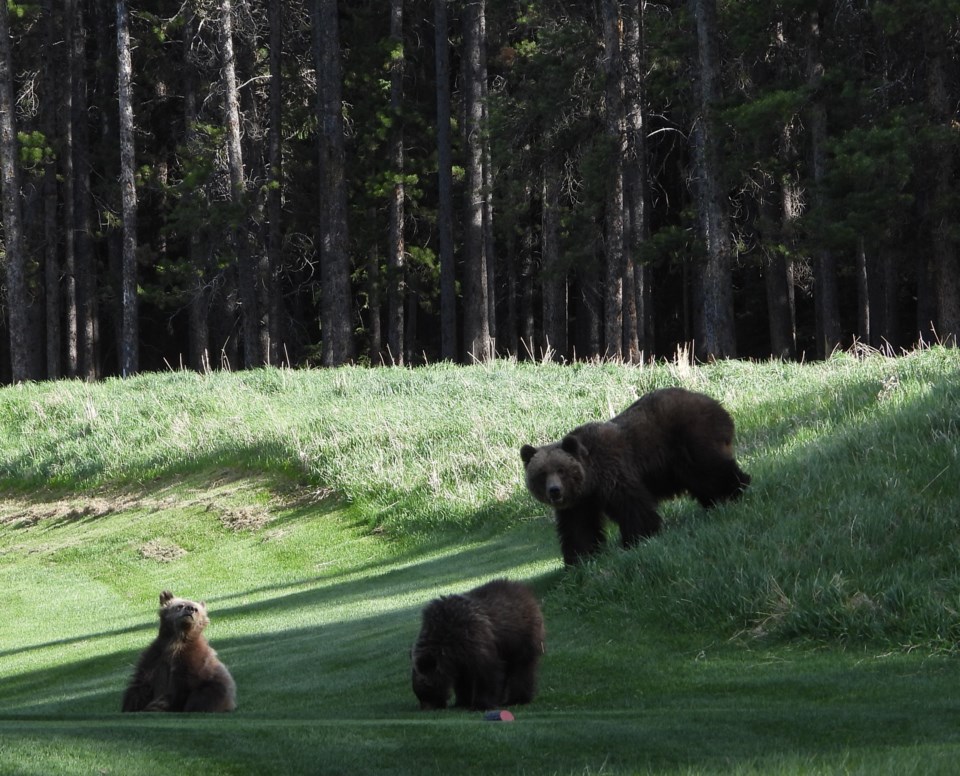 Parks Canada suspects this is bear 130 and her two yearling cubs pictured on the third hole of the Stanley Thompson at the Banff Springs Golf Course earlier this spring. Photo courtesy of Jennifer Reimer/Parks Canada


 Exposing the Big Game